Piezoelectric resonators in thin-film barium titanate from room temperature to millikelvin
Pith reviewed 2026-06-26 21:26 UTC · model grok-4.3
The pith
Thin-film barium titanate retains piezoelectric response with d33eff of 19 pC/N at millikelvin temperatures.
A machine-rendered reading of the paper's core claim, the machinery that carries it, and where it could break.
Core claim
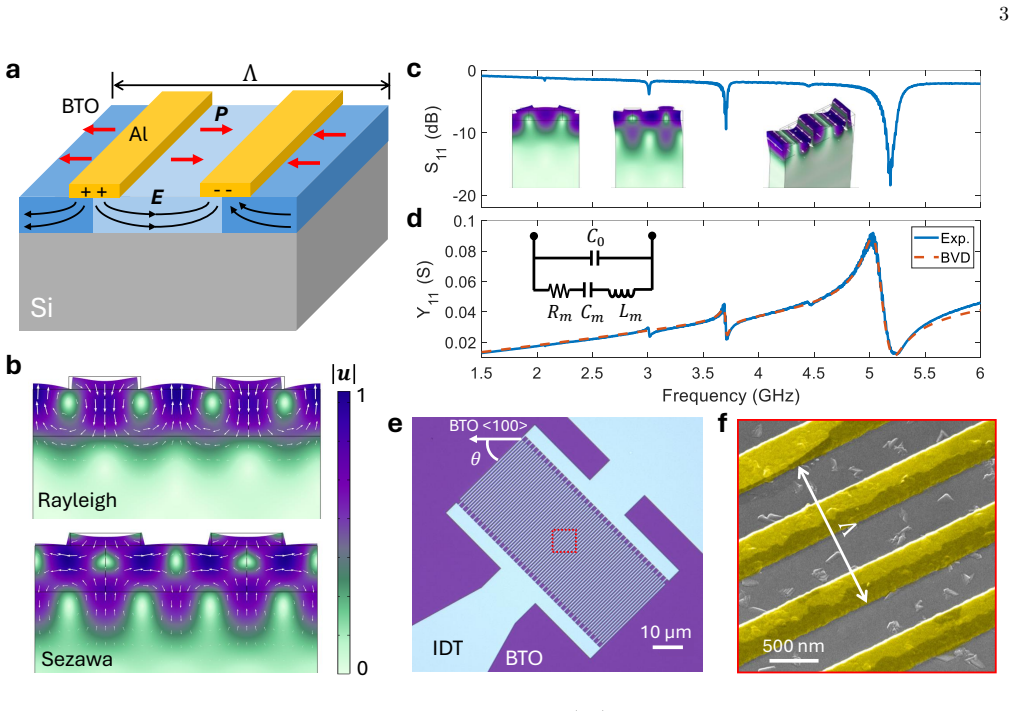
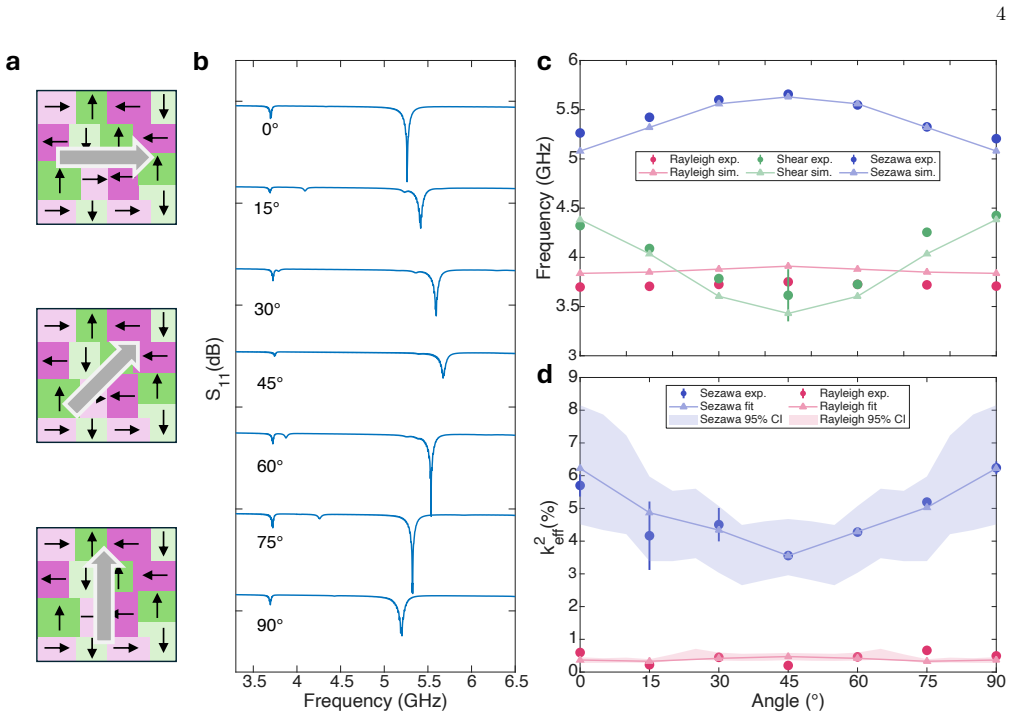
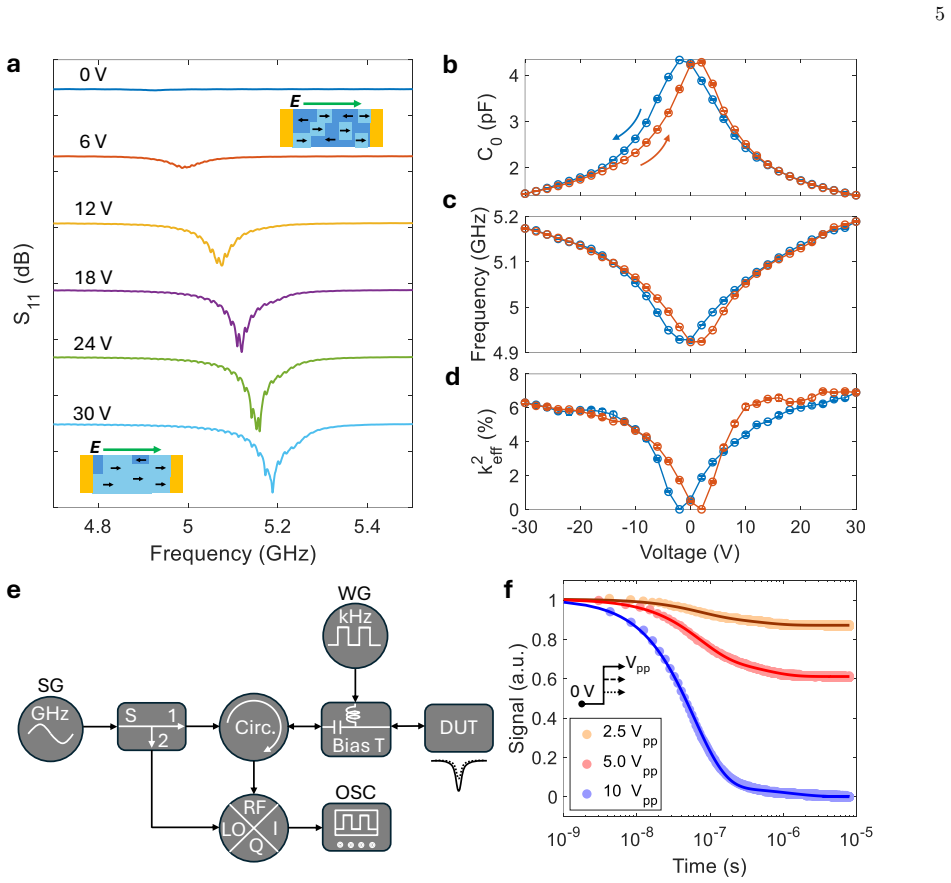
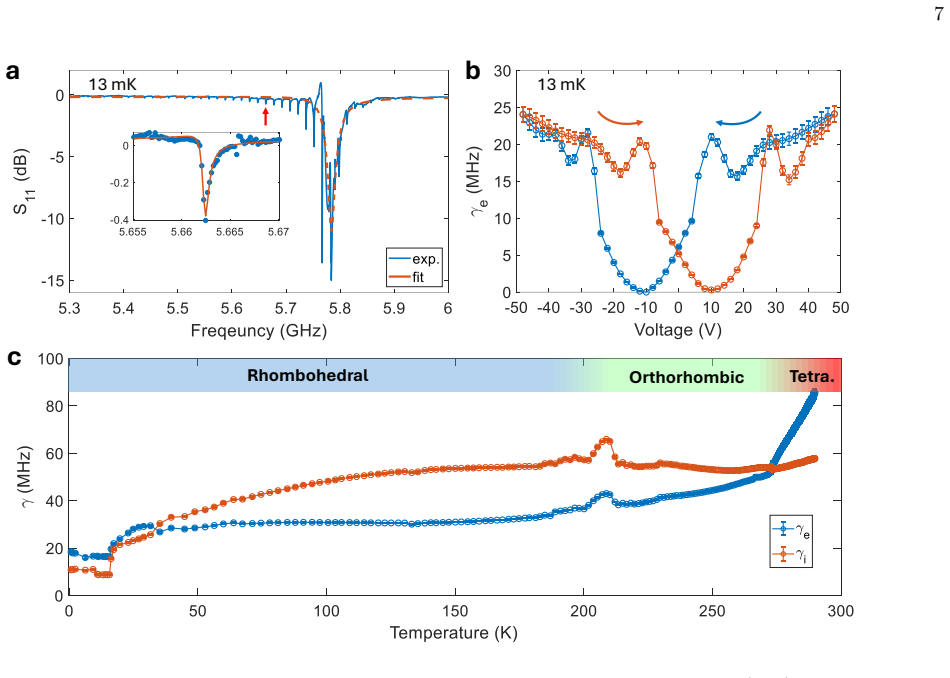
By fabricating and testing surface acoustic wave resonators on thin-film BTO, the work extracts an effective piezoelectric coefficient d33eff of 53 pC/N at room temperature from measured resonator data and finite-element modeling of the multi-domain film; the same devices exhibit an effective electromechanical coupling k2eff of 0.14 at 5.2 GHz and remain functional up to 7.8 GHz. The piezoelectric response persists upon cooling, yielding d33eff of 19 pC/N at millikelvin temperatures, while the intrinsic ferroelectricity also permits low-voltage, 100 ns switching of the resonator properties.
What carries the argument
Surface acoustic wave resonators fabricated directly on the thin-film BTO, whose frequency response is converted to an effective piezoelectric coefficient via finite-element modeling that accounts for the film's multi-domain microstructure.
If this is right
- Thin-film BTO can supply electromechanical coupling inside superconducting quantum circuits at their operating temperatures.
- The demonstrated 100 ns, low-voltage switching enables reconfigurable RF components or parametric amplifiers based on the same material stack.
- The high room-temperature k2eff of 0.14 supports use in classical RF signal-processing devices operating near 5 GHz.
- The persistence of piezoelectricity from 300 K to millikelvin shows that the ferroelectric phase remains stable across the full temperature range needed for hybrid classical-quantum systems.
Where Pith is reading between the lines
- Integration of these resonators with superconducting qubits could enable new hybrid devices that use mechanical modes for quantum information storage or transduction.
- The temperature dependence between 300 K and millikelvin invites further study of domain-wall motion or loss mechanisms that reduce d33eff at the lowest temperatures.
- Because the films are already compatible with standard microfabrication, the platform could be extended to other quantum-circuit elements such as tunable couplers or mechanical resonators.
Load-bearing premise
Finite-element modeling of the multi-domain microstructure converts the measured resonator frequencies and coupling into the reported effective piezoelectric coefficients without large systematic errors from domain assumptions or material variations.
What would settle it
A direct, model-independent measurement of strain under applied voltage on the same thin-film BTO at millikelvin temperature that yields a d33eff significantly below 19 pC/N.
Figures
read the original abstract
Ferroelectric materials, with their strong nonlinearities, underpin key technologies across radio-frequency (RF) signal processing, optical communications, and emerging quantum systems. Barium titanate (BTO) is a notable example, combining strong piezoelectric and electro-optic responses. While bulk BTO has been studied for decades, the piezoelectric properties of its recently available thin films, and their behavior at the millikelvin temperatures relevant to quantum hardware, remain largely unexplored. Here, we fabricate and characterize surface acoustic wave (SAW) resonators on thin-film BTO. The measured devices exhibit high electromechanical coupling (k2eff 0.14 at 5.2 GHz) and operate up to 7.8 GHz. From these measurements, combined with finite-element modeling of the multi-domain microstructure, we extract an effective piezoelectric coefficient d33eff of 53 pC/N, comparable to bulk BTO. Exploiting the intrinsic ferroelectricity, we further demonstrate low-voltage switching with a fast (100 ns) response, attractive for reconfigurable RF front-ends and parametric amplifiers. Extending these measurements to millikelvin temperatures, we find that the piezoelectric response persists, with d33eff 19 pC/N, pointing to the potential of BTO for piezoelectric coupling in superconducting quantum circuits. These results position thin-film BTO as a promising piezoelectric platform for both classical and quantum information technologies.
Editorial analysis
A structured set of objections, weighed in public.
Referee Report
Summary. The manuscript reports fabrication of surface acoustic wave resonators on thin-film barium titanate, with measured electromechanical coupling k²_eff up to 0.14 at 5.2 GHz and operation to 7.8 GHz. Using finite-element modeling of the multi-domain microstructure, the authors extract d33_eff = 53 pC/N at room temperature and 19 pC/N at millikelvin temperatures. They also demonstrate low-voltage ferroelectric switching with 100 ns response time and discuss applications to RF and superconducting quantum circuits.
Significance. If the finite-element conversion from measured k²_eff to d33_eff is free of large systematic bias, the work would establish persistence of piezoelectric response in thin-film BTO down to millikelvin temperatures, enabling potential integration with superconducting circuits. The experimental demonstration of fast switching is a secondary strength.
major comments (1)
- [Abstract and finite-element modeling section] Abstract and finite-element modeling section: the headline d33_eff values (53 pC/N at room temperature, 19 pC/N at millikelvin) are obtained by feeding measured resonator k²_eff into a finite-element model that assumes a specific multi-domain microstructure. No validation against independent local probes (PFM, vibrometry), no sensitivity analysis to domain-size or wall-density assumptions, and no reported uncertainty on the extracted coefficients are described, so any mismatch between modeled and actual microstructure directly scales the central millikelvin persistence claim.
minor comments (2)
- No error bars or raw frequency-shift data are mentioned for the extracted k²_eff or d33_eff values.
- The abstract states operation 'up to 7.8 GHz' but does not specify whether this is the highest measured resonance or a design target.
Simulated Author's Rebuttal
We thank the referee for their careful reading of the manuscript and for identifying this key point about the robustness of the d33_eff extraction. We address the comment below.
read point-by-point responses
-
Referee: [Abstract and finite-element modeling section] Abstract and finite-element modeling section: the headline d33_eff values (53 pC/N at room temperature, 19 pC/N at millikelvin) are obtained by feeding measured resonator k²_eff into a finite-element model that assumes a specific multi-domain microstructure. No validation against independent local probes (PFM, vibrometry), no sensitivity analysis to domain-size or wall-density assumptions, and no reported uncertainty on the extracted coefficients are described, so any mismatch between modeled and actual microstructure directly scales the central millikelvin persistence claim.
Authors: We agree that the manuscript would be strengthened by explicit sensitivity analysis and uncertainty quantification on the extracted d33_eff. In revision we will add an appendix or subsection that varies domain size and wall density over literature-reported ranges for BTO thin films, recomputes k²_eff, and reports the resulting spread in d33_eff together with the propagated uncertainty from the measured k²_eff values. This will quantify how microstructure assumptions affect the headline numbers. The central experimental observation of finite k²_eff at millikelvin temperatures remains direct evidence that electromechanical coupling persists; the d33_eff values are derived quantities used for comparison to bulk. We note, however, that independent local-probe validation (PFM or vibrometry) was not performed in this study, which focused on integrated SAW resonator metrics. Such data cannot be added retrospectively. revision: partial
- Validation against independent local probes (PFM, vibrometry) cannot be provided, as these measurements were not conducted.
Circularity Check
No significant circularity; experimental extraction via standard FEM modeling
full rationale
The derivation chain consists of fabricating SAW resonators, measuring k2eff directly from frequency response, and converting to d33eff via finite-element modeling of an assumed multi-domain microstructure. This is a conventional forward-model inversion step grounded in independent physical assumptions rather than any self-referential definition, fitted parameter renamed as prediction, or load-bearing self-citation. No equations reduce claimed outputs back to inputs by construction, and the central claims remain externally falsifiable through alternative characterization methods.
Axiom & Free-Parameter Ledger
free parameters (1)
- d33eff =
53 pC/N (room temp), 19 pC/N (millikelvin)
Reference graph
Works this paper leans on
-
[1]
Here, the frequency scaling of the BTO SAW is studied by characterizing IDTs with various periods
IDT period and frequency scaling High frequency operation while still maintaining high electromechanical coupling is essential for large bandwidth acoustic filters in next-generation wireless communication systems [3]. Here, the frequency scaling of the BTO SAW is studied by characterizing IDTs with various periods. Figure S3a shows theS 11 spectra for ID...
-
[2]
Figure S4a shows the dependence ofk 2 eff on IDT pair
IDT pair and aperture length The performances of IDTs with different number of pairs and aperture lengths are studied to examine the influence on electromechanical coupling. Figure S4a shows the dependence ofk 2 eff on IDT pair. It can be seenk 2 eff increases and saturates around 10% at large number of pairs. Thek 2 eff increases with IDT aperture as exp...
2000
-
[3]
3e in the main text
Measurement setup Our measurement setup is illustrated in Fig. 3e in the main text. A microwave signal at the Sezawa mode resonance frequency of 5.618 GHz and a power level of 10 dBm is generated by a signal generator (Windfreak SynthUSB3, SG). This signal is sent through a splitter (Mini-Circuits ZX10R-14-S+). The first output of the splitter is connecte...
-
[4]
Different models have been proposed to describe the switching dynamics based on different pictures of the nucleation and domain growth process
Modeling of the dynamics Ferroelectric domain switching has been widely studied in the past few decades, and it is commonly adopted that the switching involves domain nucleation and growth [21, 64]. Different models have been proposed to describe the switching dynamics based on different pictures of the nucleation and domain growth process. A conventional...
-
[5]
As we apply a square wave in the experiment, the transient when the bias switches back to 0 V is also obtained
Depolarization dynamics In the main text, the dynamics when switching from 0 V to a positive bias is presented, which corresponds to the poling of domains under an external electric field. As we apply a square wave in the experiment, the transient when the bias switches back to 0 V is also obtained. The changing of the measured signal is related with the ...
-
[6]
Here, the activation field, a material-dependent parameter, represents the energy barrier for domain switching
Dependence of switching time on voltage Previous studies have shown that the switching time increases as the electric field decreases [21, 65], which obeys the well-established Merz’s law [69], an empirical relation stating that the switching time is exponentially dependent on the ratio of an activation field to the applied electric field. Here, the activ...
-
[7]
Compliance and piezoelectric matrices rotations Considering an original coordinate systemx 1,x 2,x 3 and a rotated coordinate systemx ′ 1,x ′ 2,x ′ 3 . The orientation of the new axes relative to the original frame can be described by the directional cosines [70, 71] x′ 1 x′ 2 x′ 3 x1 α1 β1 γ1 x2 α2 β2 γ2 x3 α3 β3 γ3 α1 β1 γ1 α2 β2 γ2 α3 β3 γ3 =...
-
[8]
In our multi-domain construction, we fix the crystallographic 1-axis to be out-of-plane for all domains
Projecting material coefficients onto laboratory and device frame For tetragonal BTO, the crystallographic 1 and 2 axes are symmetry-degenerate, while the 3-axis (c-axis) coincides with the spontaneous polarization direction. In our multi-domain construction, we fix the crystallographic 1-axis to be out-of-plane for all domains. The remaining 2 and 3 axes...
-
[9]
Material homogenization methods a. Domain PopulationDepending on the IDT orientation, the effective electric field projected along each do- main’s c-axis is varied , which leads to an angle-dependent domain population. We assume that 0 ◦/90◦/180◦/ 270 ◦ domains have populations ofP 0◦ /P90◦ /P180◦ /P270◦ respectively, andP 0◦ +P 90◦ +P 180◦ +P 270◦ = 1. P...
-
[10]
Each colored element represents each of the domain
Finally, the coordinate is transformed from the lab frame to the the rotated device frame (gray)x ′′ 1 x′′ 2 x′′ 3 in the numerical modeling of our BTO SAW resonators.b,FEM model used in evaluating effective piezoelectric values. Each colored element represents each of the domain. The position of each domain is generated randomly during each simulation.c,...
-
[11]
In the first stage, the elastic property of the BTO is fitted to match the simulated mechanical resonant frequency with the experiments
Material coefficient and confidence interval extraction The extraction of material properties is performed using a 2-stage analysis. In the first stage, the elastic property of the BTO is fitted to match the simulated mechanical resonant frequency with the experiments. As will be discussed in the next section, the shear compliance coefficients 44 serves a...
-
[12]
It can be seen from the angular trend of each compliance component shown in Fig
Justification fors 44 tuning As shown in the main text, unlike the Rayleigh and Sezawa modes, the frequency of the shear mode decreases as the IDT orientation approaches 45 ◦, which is primarily caused by the angular dependence ofs 44,eff. It can be seen from the angular trend of each compliance component shown in Fig. S11 that only thes 44,eff maximizes ...
-
[13]
Here, the orientation dependence of thed eff 33, alongside its 95% confidence interval is shown in Fig
Orientation dependence ofd 33,eff In the main text, we gave the fittedd 33,eff at 0 ◦. Here, the orientation dependence of thed eff 33, alongside its 95% confidence interval is shown in Fig. S13. Similar to the effective compliance, the piezoelectric coefficient exhibits a 90◦ periodicity, and minimizes at 45 ◦. 0° 15° 30° 45° 60° 75°90°105° 120° 135° 150...
-
[14]
Measurement setup Cryogenic measurements are performed with the setup shown in Fig. S14. Our device under test (DUT) is wire- bonded to a printed circuit board (PCB) and enclosed within a copper box, which is mounted on the mixing chamber stage of a He-3/He-4 dilution refrigerator. The input microwave is routed through the input line and attenuated by 70 ...
-
[15]
Calibration method The cryogenic characterization is necessarily more limited in scope than the room-temperature study. At room temperature, a probe station allows many devices co-fabricated on the same chip to be measured rapidly, whereas each cryogenic measurement requires the device to be wire-bonded and packaged, limiting the number that can be charac...
-
[16]
Piezoelectric constant scaling at cryogenic temperature Since we use the zero-delay-through method which is self-calibrated, we cannot obtain the admittance of the IDT and thus fit fork 2 eff. Therefore, we estimate the piezoelectric response through the scaling of the external coupling coefficientγ e in the main text, which is proportional to the effecti...
-
[17]
Setter, D
N. Setter, D. Damjanovic, L. Eng, G. Fox, S. Gevorgian, S. Hong, A. Kingon, H. Kohlstedt, N. Park, G. Stephen- son,et al., Ferroelectric thin films: Review of materials, properties, and applications, Journal of applied physics 26 1.0 μm 1.2 μm 1.4 μm 1.8 μm 2.0 μm 2.2 μm 2.4 μm b ca 𝑢������� FIG. S15.Intrinsic Q of the fundamental Rayleigh mode. a,S 11 sp...
2006
-
[18]
X. Du, N. Sharma, Z. Tang, C. Leblanc, D. Jariwala, and R. H. Olsson, Near 6-ghz sezawa mode surface acoustic wave resonators using alscn on sic, Journal of Microelec- tromechanical Systems (2024)
2024
-
[19]
M. Z. Koohi and A. Mortazawi, Reconfigurable radios employing ferroelectrics: Recent progress on reconfig- urable rf acoustic devices based on thin-film ferroelectric barium strontium titanate, IEEE Microwave Magazine 21, 120 (2020)
2020
-
[20]
I. Anderson, A. Posadas, A. A. Demkov, and R. Lu, High coupling tunable acoustic resonators in monolithic bar- ium titanate, arXiv preprint arXiv:2604.26924 (2026)
Pith/arXiv arXiv 2026
-
[21]
X. Han, W. Fu, C.-L. Zou, L. Jiang, and H. X. Tang, Microwave-optical quantum frequency conversion, Op- tica8, 1050 (2021)
2021
-
[22]
von L¨ upke, I
U. von L¨ upke, I. C. Rodrigues, Y. Yang, M. Fadel, and Y. Chu, Engineering multimode interactions in cir- cuit quantum acoustodynamics, Nature Physics20, 564 (2024)
2024
-
[23]
C. T. Hann, C.-L. Zou, Y. Zhang, Y. Chu, R. J. Schoelkopf, S. M. Girvin, and L. Jiang, Hardware- efficient quantum random access memory with hybrid quantum acoustic systems, Physical review letters123, 250501 (2019)
2019
-
[24]
Forsch, R
M. Forsch, R. Stockill, A. Wallucks, I. Marinkovi´ c, C. G¨ artner, R. A. Norte, F. van Otten, A. Fiore, K. Srini- vasan, and S. Gr¨ oblacher, Microwave-to-optics conver- sion using a mechanical oscillator in its quantum ground state, Nature Physics16, 69 (2020)
2020
-
[25]
E. A. Wollack, A. Y. Cleland, R. G. Gruenke, Z. Wang, P. Arrangoiz-Arriola, and A. H. Safavi-Naeini, Quantum state preparation and tomography of entangled mechan- ical resonators, Nature604, 463 (2022)
2022
-
[26]
Von Hippel, R
A. Von Hippel, R. Breckenridge, F. Chesley, and L. Tisza, High dielectric constant ceramics, Industrial & Engineer- ing Chemistry38, 1097 (1946)
1946
-
[27]
C. P. Anderson, G. Scuri, A. Chan, S. Eun, A. D. White, G. H. Ahn, C. Jilly, A. Safavi-Naeini, K. Van Gasse, L. Li, et al., Quantum critical electro-optic and piezo-electric nonlinearities, Science390, 394 (2025)
2025
-
[28]
Zgonik, P
M. Zgonik, P. Bernasconi, M. Duelli, R. Schlesser, P. G¨ unter, M. Garrett, D. Rytz, Y. Zhu, and X. Wu, Dielectric, elastic, piezoelectric, electro-optic, and elasto- optic tensors of batio 3 crystals, Physical review B50, 5941 (1994)
1994
-
[29]
S. Abel, F. Eltes, J. E. Ortmann, A. Messner, P. Cast- era, T. Wagner, D. Urbonas, A. Rosa, A. M. Gutierrez, D. Tulli,et al., Large pockels effect in micro-and nanos- tructured barium titanate integrated on silicon, Nature materials18, 42 (2019)
2019
-
[30]
Eltes, W
F. Eltes, W. Li, E. Berikaa, M. S. Alam, S. Bernal, C. Minkenberg, D. V. Plant, and S. Abel, Thin-film bto- based modulators enabling 200 gb/s data rates with sub 1 vpp drive signal, inOptical Fiber Communication Con- ference(Optica Publishing Group, 2023) pp. Th4A–2
2023
-
[31]
Eltes, G
F. Eltes, G. E. Villarreal-Garcia, D. Caimi, H. Siegwart, A. A. Gentile, A. Hart, P. Stark, G. D. Marshall, M. G. Thompson, J. Barreto,et al., An integrated optical mod- ulator operating at cryogenic temperatures, Nature Ma- terials19, 1164 (2020)
2020
-
[32]
M. Lee, J. R. Renshof, K. J. van Zeggeren, M. J. Houmes, E. Lesne, M. ˇSiˇ skins, T. C. van Thiel, R. H. Guis, M. R. van Blankenstein, G. J. Verbiest,et al., Ultrathin piezo- electric resonators based on graphene and free-standing single-crystal batio3, Advanced Materials34, 2204630 (2022)
2022
-
[33]
V. Lee, S. A. Sis, J. D. Phillips, and A. Mortazawi, Intrin- sically switchable ferroelectric contour mode resonators, IEEE transactions on microwave theory and techniques 61, 2806 (2013). 27
2013
-
[34]
A. B. Posadas, H. Park, M. Reynaud, W. Cao, J. D. Reynolds, W. Guo, V. Jeyaselvan, I. Beskin, G. Z. Mashanovich, J. H. Warner,et al., Thick batio3 epitax- ial films integrated on si by rf sputtering for electro-optic modulators in si photonics, ACS Applied Materials & In- terfaces13, 51230 (2021)
2021
-
[35]
Acosta, N
M. Acosta, N. Novak, V. Rojas, S. Patel, R. Vaish, J. Koruza, G. Rossetti, and J. R¨ odel, Batio3-based piezo- electrics: Fundamentals, current status, and perspec- tives, Applied Physics Reviews4(2017)
2017
-
[36]
Li and L
Y. Li and L. Chen, Temperature-strain phase diagram for batio3 thin films, Applied physics letters88(2006)
2006
-
[37]
Geler-Kremer, F
J. Geler-Kremer, F. Eltes, P. Stark, D. Stark, D. Caimi, H. Siegwart, B. Jan Offrein, J. Fompeyrine, and S. Abel, A ferroelectric multilevel non-volatile photonic phase shifter, Nature Photonics16, 491 (2022)
2022
-
[38]
Nordlander, F
J. Nordlander, F. Eltes, M. Reynaud, J. N¨ urnberg, G. De Luca, D. Caimi, A. A. Demkov, S. Abel, M. Fiebig, J. Fompeyrine,et al., Ferroelectric domain architecture and poling of batio3 on si, Physical Review Materials4, 034406 (2020)
2020
-
[39]
Bl´ esin, H
T. Bl´ esin, H. Tian, S. A. Bhave, and T. J. Kippenberg, Quantum coherent microwave-optical transduction using high-overtone bulk acoustic resonances, Physical Review A104, 052601 (2021)
2021
-
[40]
Hadj-Larbi and R
F. Hadj-Larbi and R. Serhane, Sezawa saw devices: Re- view of numerical-experimental studies and recent ap- plications, Sensors and Actuators A: Physical292, 169 (2019)
2019
-
[41]
Ahmed, U
I. Ahmed, U. Rawat, J.-T. Chen, and D. Weinstein, Super-high-frequency low-loss sezawa mode saw devices in a gan/sic platform, IEEE Transactions on Ultrasonics, Ferroelectrics, and Frequency Control70, 291 (2023)
2023
-
[42]
Reynaud, M
M. Reynaud, M. Waqar, C. Du, A. B. Posadas, X. Pan, and A. A. Demkov, Enhancement of electro-optic re- sponse in batio3 films integrated on si via heating and cooling rate control, Communications Materials6, 176 (2025)
2025
-
[43]
Hill, The elastic behaviour of a crystalline aggregate, Proceedings of the Physical Society
R. Hill, The elastic behaviour of a crystalline aggregate, Proceedings of the Physical Society. Section A65, 349 (1952)
1952
-
[44]
J. Y. Li, The effective electroelastic moduli of textured piezoelectric polycrystalline aggregates, Journal of the Mechanics and Physics of Solids48, 529 (2000)
2000
-
[45]
Uetsuji, H
Y. Uetsuji, H. Kuramae, K. Tsuchiya, and M. Kamlah, A multiscale finite element simulation of piezoelectric ma- terials using realistic crystal morphology, WIT Transac- tions on Modelling and Simulation51, 601 (2011)
2011
-
[46]
H. Tian, J. Liu, A. Attanasio, A. Siddharth, T. Bl´ esin, R. Ning Wang, A. Voloshin, G. Lihachev, J. Riemens- berger, S. E. Kenning,et al., Piezoelectric actuation for integrated photonics, Advances in Optics and Photonics 16, 749 (2024)
2024
-
[47]
D. Zhao, T. Lenz, G. H. Gelinck, P. Groen, D. Dam- janovic, D. M. de Leeuw, and I. Katsouras, Depolariza- tion of multidomain ferroelectric materials, Nature com- munications10, 2547 (2019)
2019
-
[48]
D. Mo, S. Dabas, S. Rassay, and R. Tabrizian, Complementary-switchable dual-mode shf scandium alu- minum nitride baw resonator, IEEE Transactions on Electron Devices69, 4624 (2022)
2022
-
[49]
N. A. Estep, D. L. Sounas, and A. Al` u, Magnetless mi- crowave circulators based on spatiotemporally modulated rings of coupled resonators, IEEE Transactions on Mi- crowave Theory and Techniques64, 502 (2016)
2016
-
[50]
E. I. Rosenthal, C. S. Wang, J. Sloan, G. Scuri, Y. Shi, K. Pezeshki, P. M. Noertoft, J. Vuˇ ckovi´ c, and C. P. An- derson, Three-wave-mixing element with quantum para- electric materials, Phys. Rev. Applied25, 024091 (2026)
2026
-
[51]
G. S. MacCabe, H. Ren, J. Luo, J. D. Cohen, H. Zhou, A. Sipahigil, M. Mirhosseini, and O. Painter, Nano- acoustic resonator with ultralong phonon lifetime, Sci- ence370, 840 (2020)
2020
-
[52]
Lifshitz and M
R. Lifshitz and M. L. Roukes, Thermoelastic damping in micro-and nanomechanical systems, Physical review B61, 5600 (2000)
2000
-
[53]
Warner, M
A. Warner, M. Onoe, and G. Coquin, Determination of elastic and piezoelectric constants for crystals in class (3 m), The journal of the acoustical society of America42, 1223 (1967)
1967
- [54]
-
[55]
A comparison through other channels, such as the shear coupling governed byd 15, would require compliance and permittivity components we do not measure here. Be- cause BTO, LiNbO 3, and STO all haved 15 substan- tially larger thand 33, while the permittivities entering the shear coupling differ from material to material, the outcome of such a comparison i...
-
[56]
J. Lee, K. Eom, T. Paudel, B. Wang, H. Lu, H. Huyan, S. Lindemann, S. Ryu, H. Lee, T. Kim,et al., In-plane quasi-single-domain batio3 via interfacial symmetry en- gineering, Nature communications12, 6784 (2021)
2021
-
[57]
Thureja, A
P. Thureja, A. W. Nyholm, M. Thomaschewski, P. R. Jahelka, J. Belleville, and H. A. Atwater, Spalled barium titanate single crystal thin films for functional device ap- plications, Nano Letters (2025)
2025
-
[58]
Zhang, R
S. Zhang, R. Lu, H. Zhou, S. Link, Y. Yang, Z. Li, K. Huang, X. Ou, and S. Gong, Surface acoustic wave devices using lithium niobate on silicon carbide, IEEE Transactions on Microwave Theory and Techniques68, 3653 (2020)
2020
-
[59]
A. L. Emser, C. Metzger, B. C. Rose, and K. W. Lehn- ert, Thin-film quartz for high-coherence piezoelectric phononic crystal resonators, Physical Review Applied22, 064032 (2024)
2024
-
[60]
J. Xie, W. Wu, M. Shen, P. Fay, and H. X. Tang, To- wards terahertz nanomechanics, Nature Communications 16, 8549 (2025)
2025
-
[61]
H. G. Craighead, Nanoelectromechanical systems, Sci- ence290, 1532 (2000)
2000
-
[62]
Mirhosseini, A
M. Mirhosseini, A. Sipahigil, M. Kalaee, and O. Painter, Superconducting qubit to optical photon transduction, Nature588, 599 (2020)
2020
-
[63]
A. Raju, D. Hungund, D. Krueger, Z. Dong, Z. Sakotic, A. B. Posadas, A. A. Demkov, and D. Wasserman, High- q monolithic ring resonators in low-loss barium titanate on silicon, Laser & Photonics Reviews , 2402086 (2025)
2025
-
[64]
Y. D. Dahmani, C. J. Sarabalis, W. Jiang, F. M. Mayor, and A. H. Safavi-Naeini, Piezoelectric transduction of a wavelength-scale mechanical waveguide, Physical Review Applied13, 024069 (2020)
2020
-
[65]
Y. Luo, H. H. Diamandi, H. Li, R. Bi, D. Mason, T. Yoon, X. Guo, H. Tang, R. O. Behunin, F. J. Walker,et al., Lifetime-limited gigahertz-frequency mechanical oscilla- 28 tors with millisecond coherence times, arXiv preprint arXiv:2504.07523 (2025)
arXiv 2025
-
[66]
J. Wang, M. Park, S. Mertin, T. Pensala, F. Ayazi, and A. Ansari, A film bulk acoustic resonator based on fer- roelectric aluminum scandium nitride films, Journal of Microelectromechanical Systems29, 741 (2020)
2020
-
[67]
Y. Zou, C. Gao, J. Zhou, Y. Liu, Q. Xu, Y. Qu, W. Liu, J. B. W. Soon, Y. Cai, and C. Sun, Aluminum scandium nitride thin-film bulk acoustic resonators for 5g wide- band applications, Microsystems & Nanoengineering8, 124 (2022)
2022
-
[68]
Moreira, J
M. Moreira, J. Bjurstr¨ om, I. Katardjev, and V. Yantchev, Aluminum scandium nitride thin-film bulk acoustic res- onators for wide band applications, Vacuum86, 23 (2011)
2011
-
[69]
Rodriguez-Madrid, G
J. Rodriguez-Madrid, G. Iriarte, J. Pedros, O. A. Williams, D. Brink, and F. Calle, Super-high-frequency saw resonators on aln/diamond, IEEE Electron device letters33, 495 (2012)
2012
-
[70]
M. Park, Z. Hao, D. G. Kim, A. Clark, R. Dargis, and A. Ansari, A 10 ghz single-crystalline scandium-doped aluminum nitride lamb-wave resonator, in2019 20th In- ternational Conference on Solid-State Sensors, Actuators and Microsystems & Eurosensors XXXIII (TRANSDUC- ERS & EUROSENSORS XXXIII)(IEEE, 2019) pp. 450– 453
2019
-
[71]
M. Park, Z. Hao, R. Dargis, A. Clark, and A. Ansari, Epi- taxial aluminum scandium nitride super high frequency acoustic resonators, Journal of Microelectromechanical Systems29, 490 (2020)
2020
-
[72]
W. Dou, C. Zhou, R. Qin, Y. Yang, H. Guo, Z. Mu, and W. Yu, Super-high-frequency bulk acoustic resonators based on aluminum scandium nitride for wideband ap- plications, nanomaterials13, 2737 (2023)
2023
-
[73]
J. Lu, C. Huo, X. Huang, W. Li, Z. Mu, and W. Yu, Switchable bulk acoustic resonator based on aln/al0. 7sc0. 3n films, Electronics Letters61, e70241 (2025)
2025
-
[74]
S. Nam, W. Peng, P. Wang, D. Wang, Z. Mi, and A. Mor- tazawi, A mm-wave trilayer aln/scaln/aln higher order mode fbar, IEEE Microwave and Wireless Technology Letters33, 803 (2023)
2023
-
[75]
Z. Dai, H. Cheng, S. Xiao, H. Sun, and C. Zuo, Cou- pled shear saw resonator with high electromechanical coupling coefficient of 34% using x-cut linbo 3-on-sic sub- strate, IEEE Electron Device Letters45, 720 (2024)
2024
-
[76]
Kim and R
C. Kim and R. Ramprasad, Dielectric breakdown field of strained silicon under hydrostatic pressure, Applied Physics Letters111(2017)
2017
-
[77]
Tyunina, J
M. Tyunina, J. Per¨ antie, T. Kocourek, S. Saukko, H. Jan- tunen, M. Jelinek, and A. Dejneka, Oxygen vacancy dipoles in strained epitaxial bati o 3 films, Physical Re- view Research2, 023056 (2020)
2020
-
[78]
W. Guo, P. Tan, X. Ouyang, B. Li, H. Guo, X. Zhong, J. Wang, and F. Wang, Influence of charge accumulation at the grain boundary on the electrical behavior of a fer- roelectric field-effect transistor, AIP Advances8(2018)
2018
-
[79]
Chelladurai, M
D. Chelladurai, M. Kohli, J. Winiger, D. Moor, A. Mess- ner, Y. Fedoryshyn, M. Eleraky, Y. Liu, H. Wang, and J. Leuthold, Barium titanate and lithium niobate per- mittivity and pockels coefficients from megahertz to sub- terahertz frequencies, Nature Materials , 1 (2025)
2025
-
[80]
Y.-H. Shin, I. Grinberg, I.-W. Chen, and A. M. Rappe, Nucleation and growth mechanism of ferroelec- tric domain-wall motion, Nature449, 881 (2007)
2007
discussion (0)
Sign in with ORCID, Apple, or X to comment. Anyone can read and Pith papers without signing in.