Creating squeezed and non-classical collective motional many-body states through stroboscopic Rydberg dressing
Pith reviewed 2026-06-26 22:08 UTC · model grok-4.3
The pith
Stroboscopic Rydberg dressing couples atomic motion to Rydberg states to squeeze interatomic displacements below vacuum levels.
A machine-rendered reading of the paper's core claim, the machinery that carries it, and where it could break.
Core claim
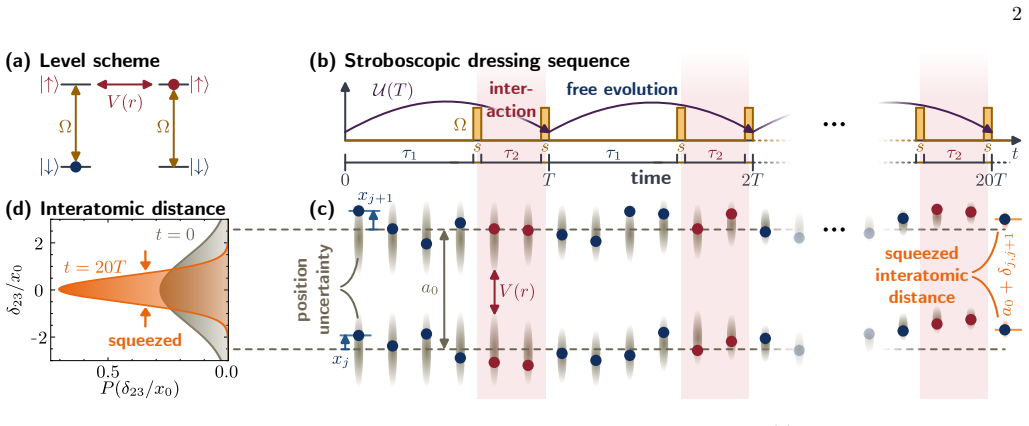
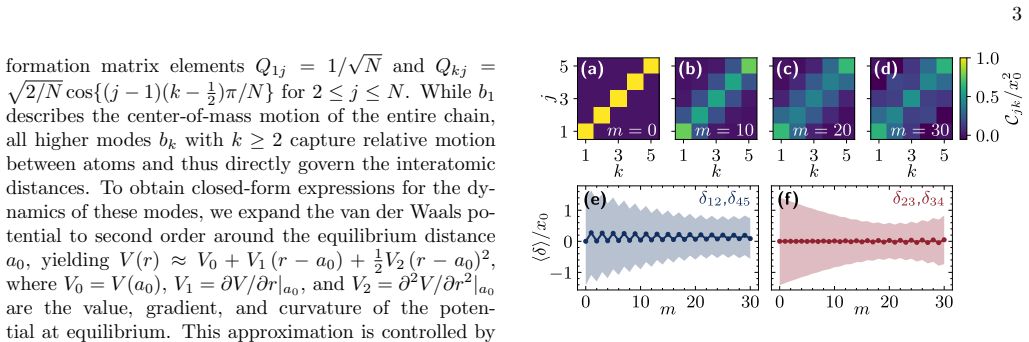
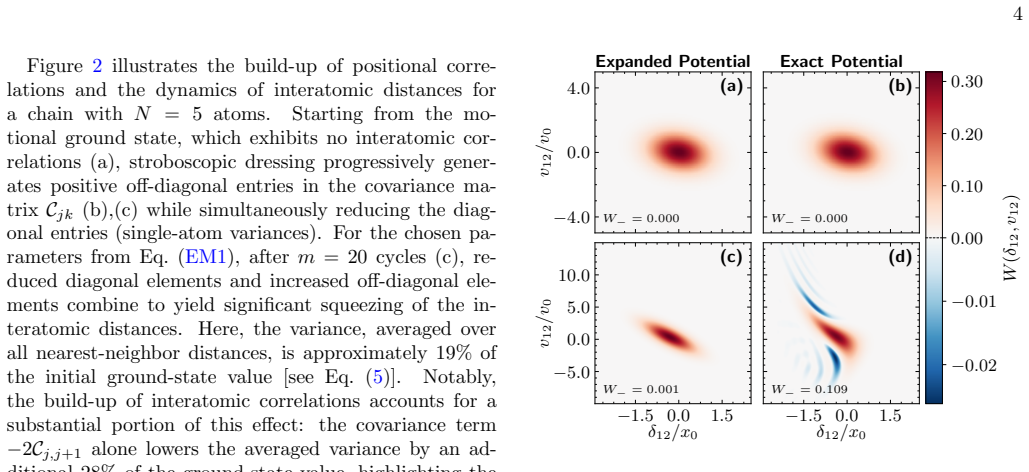
The authors show that stroboscopic Rydberg dressing produces a time-periodic effective Hamiltonian that couples atomic motion to Rydberg population. This interaction squeezes the quadratures associated with interatomic displacements, reducing their variance below the motional vacuum, and generates many-body states exhibiting substantial Wigner negativity.
What carries the argument
Stroboscopic Rydberg dressing, which generates a controllable, periodic motional-Rydberg coupling that collectively squeezes displacement modes.
If this is right
- Interatomic distance fluctuations drop to a fraction of the motional vacuum state.
- Many-body motional states with Wigner negativity become reachable.
- Motional contributions to gate infidelity can be suppressed.
- The prepared states may serve as a starting point for quantum metrology.
Where Pith is reading between the lines
- The squeezing protocol could be interleaved with existing cooling methods to reach still lower effective temperatures.
- Similar stroboscopic dressing might be adapted to other long-range interactions beyond Rydberg states.
- The generated non-classical motional states could be used to test bounds on motional decoherence in larger arrays.
Load-bearing premise
The Rydberg pulses must preserve coherence long enough for the designed motional coupling to dominate over decoherence and loss.
What would settle it
A measurement of interatomic distance variance after the protocol that finds it at or above the vacuum level, or a reconstructed Wigner function lacking negativity, would falsify the central claim.
Figures
read the original abstract
Realizing conditional quantum operations, e.g., quantum gates, for quantum computing and simulation requires controlled interactions between particles. Often, these interactions depend on the interparticle distance, and accordingly, an uncertainty of the relative particle position may translate into gate infidelities. We consider here a quantum computing platform based on an array of neutral atoms and present a method that allows to reduce the uncertainty of all interatomic distances. Our approach exploits the coupling between atomic motion and stroboscopically excited atomic Rydberg states. It allows to collectively squeeze the modes corresponding to interatomic displacements, thereby reducing distance fluctuations down to a fraction of the motional vacuum state. Furthermore, the method permits the creation of non-classical states with substantial Wigner negativity. These correlated states may allow reducing motional decoherence, increasing gate fidelity, and potentially yield a resource for quantum-enhanced metrology.
Editorial analysis
A structured set of objections, weighed in public.
Referee Report
Summary. The manuscript proposes a scheme for neutral-atom quantum computing platforms in which stroboscopic Rydberg dressing is used to engineer an effective coupling between atomic motion and Rydberg states. This coupling is claimed to collectively squeeze the modes associated with interatomic displacements, reducing distance fluctuations below the level of the motional vacuum state, and to generate non-classical collective motional states exhibiting substantial Wigner negativity. The resulting states are argued to suppress motional decoherence and improve gate fidelity while potentially serving as a resource for quantum metrology.
Significance. If the central claims hold, the work would supply a concrete, experimentally accessible route to engineering squeezed and non-classical motional states in Rydberg arrays without requiring additional trapping potentials or feedback. Such states directly address a dominant error source (position fluctuations) in distance-dependent Rydberg gates and could therefore improve gate fidelities and enable metrological gains. The stroboscopic approach is technically novel within the Rydberg-dressing literature.
major comments (2)
- [§3] §3 (effective Hamiltonian derivation): the mapping from the time-dependent stroboscopic drive to the claimed squeezing Hamiltonian is presented without a quantitative benchmark against the full time-dependent master equation that includes spontaneous emission, laser phase noise, and motional decoherence. Because the squeezing fraction and Wigner negativity are predicted from this effective model, the absence of such a validation leaves the central claim load-bearing on an unverified approximation.
- [§4] §4 (parameter regime and squeezing results): the reported reduction of distance fluctuations to a fraction of the vacuum level is shown only for idealized parameters; no scan is provided that demonstrates survival of squeezing when realistic values of the Rydberg lifetime and laser linewidth are inserted into the master equation. This directly affects whether the claimed sub-vacuum squeezing is experimentally attainable.
minor comments (2)
- Notation for the collective displacement modes is introduced without an explicit definition of the mode operators in terms of individual atomic positions; adding this would improve readability.
- Figure 2 caption does not state the integration time or the precise pulse sequence parameters used to generate the plotted Wigner functions.
Simulated Author's Rebuttal
We thank the referee for their careful reading and constructive feedback, which highlights important aspects of validating our effective model. We address the major comments below and will revise the manuscript to incorporate additional benchmarks and parameter scans as described.
read point-by-point responses
-
Referee: [§3] §3 (effective Hamiltonian derivation): the mapping from the time-dependent stroboscopic drive to the claimed squeezing Hamiltonian is presented without a quantitative benchmark against the full time-dependent master equation that includes spontaneous emission, laser phase noise, and motional decoherence. Because the squeezing fraction and Wigner negativity are predicted from this effective model, the absence of such a validation leaves the central claim load-bearing on an unverified approximation.
Authors: We acknowledge the value of a direct numerical validation. The effective Hamiltonian in §3 is obtained via standard time-averaging and adiabatic elimination under the weak-dressing and stroboscopic conditions detailed in the manuscript. In the revised version we will add an appendix containing quantitative comparisons between the effective-model predictions and numerical integration of the full time-dependent master equation (including spontaneous emission) for representative parameter sets, confirming that the reported squeezing fractions and Wigner negativity remain accurate within the regime of interest. revision: yes
-
Referee: [§4] §4 (parameter regime and squeezing results): the reported reduction of distance fluctuations to a fraction of the vacuum level is shown only for idealized parameters; no scan is provided that demonstrates survival of squeezing when realistic values of the Rydberg lifetime and laser linewidth are inserted into the master equation. This directly affects whether the claimed sub-vacuum squeezing is experimentally attainable.
Authors: The results of §4 illustrate the ideal-case performance to establish the underlying mechanism. We agree that robustness to realistic decoherence must be demonstrated. The revised manuscript will include additional master-equation simulations and parameter scans that incorporate finite Rydberg lifetimes and laser linewidths, delineating the range of experimental parameters for which sub-vacuum squeezing and Wigner negativity persist. revision: yes
Circularity Check
No circularity: derivation rests on independent physical modeling
full rationale
The paper's central claims derive from a proposed effective Hamiltonian coupling atomic motion to stroboscopically excited Rydberg states, yielding collective squeezing and Wigner-negative states. No equations or predictions reduce by construction to fitted inputs, self-citations, or ansatzes imported from prior author work. The mechanism is presented as a standard many-body atomic-physics construction without self-referential definitions or renaming of known results. The reader's assessment of score 2.0 is consistent with this self-contained structure.
Axiom & Free-Parameter Ledger
Reference graph
Works this paper leans on
-
[1]
Browaeys and T
A. Browaeys and T. Lahaye, Many-body physics with individually controlled Rydberg atoms, Nature Physics 16, 132 (2020)
2020
-
[2]
Saffman, T
M. Saffman, T. G. Walker, and K. Mølmer, Quantum information with Rydberg atoms, Reviews of Modern Physics82, 2313 (2010)
2010
-
[3]
C. S. Adams, J. D. Pritchard, and J. P. Shaffer, Ry- dberg atom quantum technologies, Journal of Physics B: Atomic, Molecular and Optical Physics53, 012002 (2019)
2019
-
[4]
Bluvstein, S
D. Bluvstein, S. J. Evered, A. A. Geim, S. H. Li, H. Zhou, T. Manovitz, S. Ebadi, M. Cain, M. Kali- nowski, D. Hangleiter, J. P. Bonilla Ataides, N. Maskara, I. Cong, X. Gao, P. Sales Rodriguez, T. Karolyshyn, G. Semeghini, M. J. Gullans, M. Greiner, V. Vuleti´ c, and M. D. Lukin, Logical quantum processor based on reconfigurable atom arrays, Nature626, 58 (2023)
2023
-
[5]
Endres, H
M. Endres, H. Bernien, A. Keesling, H. Levine, E. R. Anschuetz, A. Krajenbrink, C. Senko, V. Vuletic, M. Greiner, and M. D. Lukin, Atom-by-atom assembly of defect-free one-dimensional cold atom arrays, Science 354, 1024 (2016)
2016
- [6]
-
[7]
L. D. Carr, D. DeMille, R. V. Krems, and J. Ye, Cold and ultracold molecules: science, technology and appli- cations, New Journal of Physics11, 055049 (2009)
2009
-
[8]
D. K. Ruttley, T. R. Hepworth, A. Guttridge, and S. L. Cornish, Long-lived entanglement of molecules in magic- wavelength optical tweezers, Nature637, 827 (2025)
2025
-
[9]
Xiang and W
B. Xiang and W. Xiong, Molecular Polaritons for Chem- istry, Photonics and Quantum Technologies, Chemical Reviews124, 2512 (2024)
2024
-
[10]
Eschner, G
J. Eschner, G. Morigi, F. Schmidt-Kaler, and R. Blatt, Laser cooling of trapped ions, Journal of the Optical So- ciety of America B20, 1003 (2003)
2003
-
[11]
C. D. Bruzewicz, J. Chiaverini, R. McConnell, and J. M. Sage, Trapped-ion quantum computing: Progress and challenges, Applied Physics Reviews6, 021314 (2019)
2019
-
[12]
I. A. Chernyshev, R. C. Farrell, M. Illa, M. J. Savage, A. Maksymov, F. Tripier, M. A. Lopez-Ruiz, A. Ar- rasmith, Y. de Sereville, A. Brodutch, C. Girotto, A. Kaushik, and M. Roetteler, Pathfinding quantum sim- ulations of neutrinoless double-βdecay, Nature Commu- nications17, 1826 (2026)
2026
-
[13]
Monroe, W
C. Monroe, W. Campbell, L.-M. Duan, Z.-X. Gong, A. Gorshkov, P. Hess, R. Islam, K. Kim, N. Linke, G. Pagano, P. Richerme, C. Senko, and N. Yao, Pro- grammable quantum simulations of spin systems with trapped ions, Reviews of Modern Physics93, 025001 (2021)
2021
-
[14]
Shao, S.-L
X.-Q. Shao, S.-L. Su, L. Li, R. Nath, J.-H. Wu, and W. Li, Rydberg superatoms: An artificial quantum sys- 6 tem for quantum information processing and quantum optics, Applied Physics Reviews11, 031320 (2024)
2024
-
[15]
Weber, C
S. Weber, C. Tresp, H. Menke, A. Urvoy, O. Firstenberg, H. P. B¨ uchler, and S. Hofferberth, Calculation of Ryd- berg interaction potentials, Journal of Physics B: Atomic, Molecular and Optical Physics50, 133001 (2017)
2017
-
[16]
Anderlini, P
M. Anderlini, P. J. Lee, B. L. Brown, J. Sebby-Strabley, W. D. Phillips, and J. V. Porto, Controlled exchange in- teraction between pairs of neutral atoms in an optical lattice, Nature448, 452 (2007)
2007
-
[17]
M. M. M¨ uller, M. Murphy, S. Montangero, T. Calarco, P. Grangier, and A. Browaeys, Implementation of an ex- perimentally feasible controlled-phase gate on two block- aded Rydberg atoms, Physical Review A89, 032334 (2014)
2014
-
[18]
M. H. Goerz, T. Calarco, and C. P. Koch, The quantum speed limit of optimal controlled phasegates for trapped neutral atoms, Journal of Physics B: Atomic, Molecular and Optical Physics44, 154011 (2011)
2011
-
[19]
Ahlheit, C
L. Ahlheit, C. Nill, D. Svirskiy, J. de Haan, S. Schroers, W. Alt, N. Stiesdal, I. Lesanovsky, and S. Hofferberth, Magic running- and standing-wave optical traps for Ry- dberg atoms, Physical Review A111, 013115 (2025)
2025
-
[20]
Grimm, M
R. Grimm, M. Weidem¨ uller, and Y. B. Ovchinnikov, Op- tical dipole traps for neutral atoms (Academic Press,
-
[21]
Topcu and A
T. Topcu and A. Derevianko, Possibility of triple magic trapping of clock and Rydberg states of divalent atoms in optical lattices, Journal of Physics B: Atomic, Molecular and Optical Physics49, 144004 (2016)
2016
-
[22]
A. M. Kaufman, B. J. Lester, and C. A. Regal, Cooling a Single Atom in an Optical Tweezer to Its Quantum Ground State, Physical Review X2, 041014 (2012)
2012
-
[23]
Clements, F
E. Clements, F. W. Knollmann, S. Corsetti, Z. Li, A. Hattori, M. Notaros, R. Swint, T. Sneh, M. E. Kim, A. D. Leu, P. Callahan, T. Mahony, G. N. West, C. Sorace-Agaskar, D. Kharas, R. McConnell, C. D. Bruzewicz, I. L. Chuang, J. Notaros, and J. Chiaverini, Sub-Doppler Cooling of a Trapped Ion in a Phase- Stable Polarization Gradient, Physical Review Lette...
2026
-
[24]
Schine, A
N. Schine, A. W. Young, W. J. Eckner, M. J. Martin, and A. M. Kaufman, Long-lived Bell states in an array of optical clock qubits, Nature Physics18, 1067 (2022)
2022
-
[25]
A. L. Shaw, P. Scholl, R. Finkelstein, R. B.-S. Tsai, J. Choi, and M. Endres, Erasure cooling, control, and hyperentanglement of motion in optical tweezers, Science 388, 845 (2025)
2025
-
[26]
M. A. Taylor, J. Knittel, and W. P. Bowen, Fundamen- tal constraints on particle tracking with optical tweezers, New Journal of Physics15, 023018 (2013)
2013
-
[27]
Robicheaux, T
F. Robicheaux, T. M. Graham, and M. Saffman, Photon- recoil and laser-focusing limits to Rydberg gate fidelity, Physical Review A103, 022424 (2021)
2021
-
[28]
X.-F. Shi, Suppressing Motional Dephasing of Ground- Rydberg Transition for High-Fidelity Quantum Con- trol with Neutral Atoms, Physical Review Applied13, 10.1103/PhysRevApplied.13.024008 (2020)
-
[29]
S. D. Jenkins, T. Zhang, and T. A. B. Kennedy, Motional dephasing of atomic clock spin waves in an optical lat- tice, Journal of Physics B: Atomic, Molecular and Optical Physics45, 124005 (2012)
2012
-
[30]
Y. Liu, Y. Sun, Z. Fu, P. Xu, X. Wang, X. He, J. Wang, and M. Zhan, Infidelity Induced by Ground-Rydberg De- coherence of the Control Qubit in a Two-Qubit Rydberg- Blockade Gate, Physical Review Applied15, 054020 (2021)
2021
-
[31]
Soto-Garcia and N
J. Soto-Garcia and N. Chepiga, Infinite Randomness Criticality and Localization of the Floating Phase in Ar- rays of Rydberg Atoms Trapped with Nonperfect Tweez- ers, Phys. Rev. Lett.136, 056502 (2026)
2026
-
[32]
S. C. Burd, H. M. Knaack, R. Srinivas, C. Arenz, A. L. Collopy, L. J. Stephenson, A. C. Wilson, D. J. Wineland, D. Leibfried, J. J. Bollinger, D. T. C. Allcock, and D. H. Slichter, Experimental Speedup of Quantum Dynamics through Squeezing, PRX Quantum5, 020314 (2024)
2024
-
[33]
H.-Y. Lo, D. Kienzler, L. de Clercq, M. Marinelli, V. Neg- nevitsky, B. C. Keitch, and J. P. Home, Spin–motion en- tanglement and state diagnosis with squeezed oscillator wavepackets, Nature521, 336 (2015)
2015
-
[34]
Salvi, N
L. Salvi, N. Poli, V. Vuleti´ c, and G. M. Tino, Squeezing on Momentum States for Atom Interferometry, Physical Review Letters120, 033601 (2018)
2018
-
[35]
C. A. Rosiek, M. Rossi, A. Schliesser, and A. S. Sørensen, Quadrature Squeezing Enhances Wigner Negativity in a Mechanical Duffing Oscillator, PRX Quantum5, 030312 (2024)
2024
-
[36]
V. Lienhard, R. Martin, Y. T. Chew, T. Tomita, K. Ohmori, and S. de L´ es´ eleuc, Generation of Motional Squeezed States for Neutral Atoms in Optical Tweezers (2025), arXiv:2505.10092 [physics.atom-ph]
arXiv 2025
-
[37]
N. U. K¨ oyl¨ uo˘ glu, N. Maskara, J. Feldmeier, and M. D. Lukin, Floquet engineering of interactions and entan- glement in periodically driven Rydberg chains (2024), arXiv:2408.02741 [quant-ph]
arXiv 2024
-
[38]
J. Feldmeier, N. Maskara, N. U. K¨ oyl¨ uo˘ glu, and M. D. Lukin, Quantum simulation of dynamical gauge theo- ries in periodically driven Rydberg atom arrays (2024), arXiv:2408.02733 [quant-ph]
arXiv 2024
-
[39]
C. Nill, S. de L´ es´ eleuc, C. Groß, and I. Lesanovsky, Res- onant stroboscopic Rydberg dressing: Electron-motion coupling and multibody interactions, Physical Review A 111, L041104 (2025)
2025
-
[40]
Bharti, S
V. Bharti, S. Sugawa, M. Kunimi, V. S. Chauhan, T. P. Mahesh, M. Mizoguchi, T. Matsubara, T. Tomita, S. de L´ es´ eleuc, and K. Ohmori, Strong Spin-Motion Coupling in the Ultrafast Dynamics of Rydberg Atoms, Physical Review Letters133, 093405 (2024)
2024
-
[41]
Cariolaro and G
G. Cariolaro and G. Pierobon, Reexamination of Bloch- Messiah reduction, Physical Review A93, 062115 (2016)
2016
-
[42]
M. O. Brown, S. R. Muleady, W. J. Dworschack, R. J. Lewis-Swan, A. M. Rey, O. Romero-Isart, and C. A. Re- gal, Time-of-flight quantum tomography of an atom in an optical tweezer, Nature Physics19, 569 (2023)
2023
-
[43]
Romero-Isart, A
O. Romero-Isart, A. C. Pflanzer, M. L. Juan, R. Quidant, N. Kiesel, M. Aspelmeyer, and J. I. Cirac, Optically lev- itating dielectrics in the quantum regime: Theory and protocols, Physical Review A83, 013803 (2011)
2011
-
[44]
Leibfried, D
D. Leibfried, D. M. Meekhof, B. E. King, C. Monroe, W. M. Itano, and D. J. Wineland, Experimental Deter- mination of the Motional Quantum State of a Trapped Atom, Physical Review Letters77, 4281 (1996)
1996
-
[45]
Jansohn, A
C. Jansohn, A. Londo˜ no, Y. Li, H. Nguyen, P. R. Berman, and A. Kuzmich, Magic-wavelength trapping of alkali-metal Rydberg atoms: The role of landscape po- larization modulation, Physical Review A112, L041101 (2025)
2025
-
[46]
Barredo, V
D. Barredo, V. Lienhard, P. Scholl, S. de L´ es´ eleuc, 7 T. Boulier, A. Browaeys, and T. Lahaye, Three- Dimensional Trapping of Individual Rydberg Atoms in Ponderomotive Bottle Beam Traps, Physical Review Let- ters124, 023201 (2020)
2020
-
[47]
A. Parvej and L. Mathey, Lamb-Dicke Dynamics of In- teracting Rydberg Atoms Coupled to the Motion of an Optical Tweezer Array (2025), arXiv:2506.22669 [quant- ph]
arXiv 2025
-
[48]
Apol´ ın and D
J. Apol´ ın and D. P. Nadlinger, Recoil-Induced Errors and Their Correction in Photon-Mediated Entanglement be- tween Atomic Qubits, PRX Quantum7, 010326 (2026)
2026
-
[49]
S. R. Cohen and J. D. Thompson, Quantum Computing with Circular Rydberg Atoms, PRX Quantum2, 030322 (2021)
2021
-
[50]
C. J. Picken, R. Legaie, K. McDonnell, and J. D. Pritchard, Entanglement of neutral-atom qubits with long ground-Rydberg coherence times, Quantum Science and Technology4, 015011 (2018)
2018
-
[51]
Supplemental Material, which further contains a detailed derivation of the stroboscopic time-evolution operator U(mT), closed form expressions of the variances, covari- ances, and expectation values of the interatomic separa- tions, as well as an analysis of the protocol’s stability, and the impact of anharmonic tweezer potentials
-
[52]
Kenfack and K
A. Kenfack and K. Zyczkowski, Negativity of the Wigner function as an indicator of non-classicality, Journal of Op- tics B: Quantum and Semiclassical Optics6, 396 (2004)
2004
-
[53]
P. T. Grochowski, H. Pichler, C. A. Regal, and O. Romero-Isart, Quantum control of continuous systems via nonharmonic potential modulation, Quantum9, 1824 (2025)
2025
-
[54]
R. B.-S. Tsai, X. Sun, A. L. Shaw, R. Finkelstein, and M. Endres, Benchmarking and Fidelity Response Theory of High-Fidelity Rydberg Entangling Gates, PRX Quan- tum6, 010331 (2025)
2025
-
[55]
J. Rui, D. Wei, A. Rubio-Abadal, S. Hollerith, J. Zeiher, D. M. Stamper-Kurn, C. Gross, and I. Bloch, A subradi- ant optical mirror formed by a single structured atomic layer, Nature583, 369 (2020)
2020
-
[56]
Olmos and I
B. Olmos and I. Lesanovsky, Hybrid Sub- and Superra- diant States in Emitter Arrays with Quantized Motion, Physical Review Letters134, 243602 (2025)
2025
-
[57]
Srakaew, P
K. Srakaew, P. Weckesser, S. Hollerith, D. Wei, D. Adler, I. Bloch, and J. Zeiher, A subwavelength atomic array switched by a single Rydberg atom, Nature Physics19, 714 (2023)
2023
-
[58]
Chalopin, C
T. Chalopin, C. Bouazza, A. Evrard, V. Makhalov, D. Dreon, J. Dalibard, L. A. Sidorenkov, and S. Nascim- bene, Quantum-enhanced sensing using non-classical spin states of a highly magnetic atom, Nature Communica- tions9, 4955 (2018)
2018
-
[59]
Y. Li, X. Cheng, L. Wang, X. Zhao, W. Hou, Y. Li, K. Rehan, M. Zhu, L. Yan, X. Qin, X. Peng, H. Yuan, Y. Lin, and J. Du, Multi-parameter quantum metrol- ogy with stabilized multi-mode squeezed state (2023), arXiv:2312.10379 [quant-ph]
arXiv 2023
-
[60]
Magoni, C
M. Magoni, C. Nill, and I. Lesanovsky, Coherent Spin- Phonon Scattering in Facilitated Rydberg Lattices, Phys- ical Review Letters132, 133401 (2024)
2024
-
[61]
D. Brady and M. Fleischhauer, Non-Classical Spin- Phonon Correlations Induced by Rydberg Facilitation in a Lattice (2025), arXiv:2504.19679 [cond-mat]
arXiv 2025
-
[62]
Repository containing all corresponding data and source code of this manuscript, 10.5281/zenodo.20528768 (2026)
-
[63]
J. M¨ ogerle, F. Hummel, A. Keil, T. Legrand, E. J. Braun, H. Menke, J. King, B. Olmos, S. Hofferberth, H. P. B¨ uchler, and S. Weber, Accurate Modeling of Ry- dberg Atoms and Their Interactions: Theory and Im- plementation in PairInteraction (2026), arXiv:2605.14993 [physics.atom-ph]. End Matter Experimental considerations For the investigation in the ma...
Pith/arXiv arXiv 2026
discussion (0)
Sign in with ORCID, Apple, or X to comment. Anyone can read and Pith papers without signing in.