Exploiting More Than Symmetry in Variational Quantum Machine Learning
Pith reviewed 2026-06-26 17:26 UTC · model grok-4.3
The pith
Suitable subgroups preserve most generalization benefit in quantum circuits while task-motif gates drive dominant gains.
A machine-rendered reading of the paper's core claim, the machinery that carries it, and where it could break.
Core claim
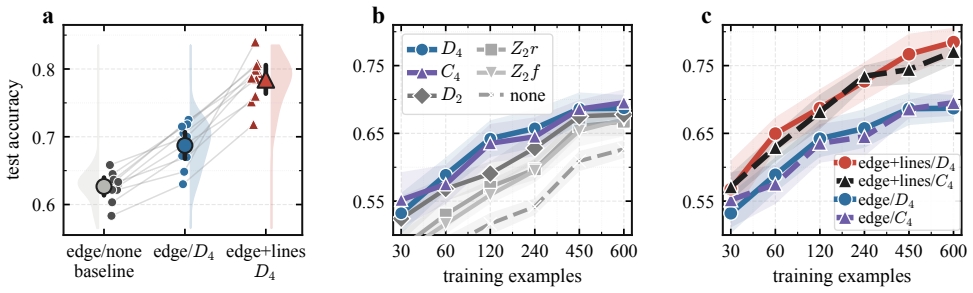
By building on symmetry-based parameter sharing, the work disentangles symmetry enforcement from trainable interaction choice, finding that suitable subgroups preserve most generalization benefit while dominant gains come from gates acting on decisive task motifs in the Tic-Tac-Toe test case.
What carries the argument
Disentanglement of symmetry level and trainable gate placement using symmetry-based parameter sharing.
If this is right
- Symmetry defines the admissible design space.
- Task-informed choice of trainable interactions is required for effective ansatze.
- Subgroups of the symmetry group retain most generalization benefits.
- Gates on decisive motifs yield primary gains.
Where Pith is reading between the lines
- Automatic detection of task motifs could automate ansatz design in other problems.
- The strategy may generalize to quantum tasks with hidden structures.
- Hybrid symmetry and motif approaches could improve other variational models.
Load-bearing premise
Results obtained on the Tic-Tac-Toe game apply to other variational quantum machine learning tasks.
What would settle it
A test on another task where full symmetry enforcement leads to better generalization than subgroup plus motif selection would falsify the claim.
Figures

read the original abstract
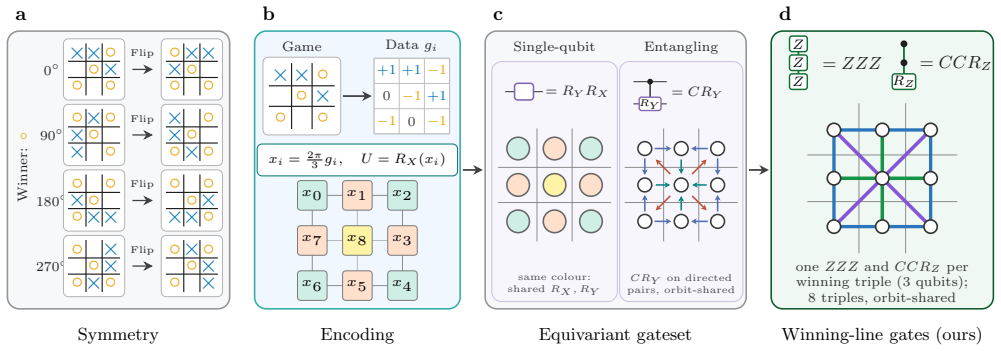
The success of variational quantum learning models crucially depends on choosing parametrizations that reflect the structure of the problem at hand. Symmetries provide one of the clearest such structures: whenever transformations of the input leave the desired outcome unchanged, this invariance should be built into the model rather than discovered during training. However, imposing a symmetry does not by itself determine a useful ansatz. Even within the symmetry-preserving space, one must decide where the trainable degrees of freedom should be placed. In this work, we study this remaining design freedom in equivariant variational quantum circuits. Building on symmetry-based parameter sharing, we disentangle two architectural choices: how much symmetry should be enforced, and which symmetry-respecting interactions should be trainable. Using Tic-Tac-Toe as a fully enumerable and structurally transparent test case, we find that suitable subgroups preserve most of the generalization benefit. By contrast, the dominant gains arise from gates acting directly on decisive task motifs. Thus, symmetry defines the admissible design space, while effective ansatze require an additional task-informed choice of trainable interactions.
Editorial analysis
A structured set of objections, weighed in public.
Referee Report
Summary. The manuscript claims that symmetry defines the admissible design space for equivariant variational quantum circuits in machine learning, but effective ansatze require an additional task-informed choice of which symmetry-respecting interactions should be made trainable. Using Tic-Tac-Toe as a fully enumerable test case, suitable subgroups preserve most of the generalization benefit while the dominant gains arise from gates acting directly on decisive task motifs identified from game rules.
Significance. If the result holds, the distinction between symmetry subgroup selection and trainable interaction choice offers a useful architectural principle for VQML ansatz design. The fully enumerable Tic-Tac-Toe testbed is a strength, enabling exact generalization computation and direct motif labeling from explicit rules rather than fitted parameters.
major comments (2)
- [Abstract and Experiments] The central claim that dominant gains arise from gates on decisive task motifs (Abstract) rests on Tic-Tac-Toe experiments where motifs are identified via exhaustive enumeration and explicit win/blocking rules; this makes the subgroup-vs-motif separation unusually clean but leaves the dominance ordering untested in tasks where state spaces cannot be enumerated and motifs cannot be read off from simple rule sets.
- [Discussion] The manuscript does not supply a concrete test or protocol for identifying decisive motifs in general VQML tasks (e.g., quantum chemistry Hamiltonians or image data), which is load-bearing for the recommendation that motif choice is an 'additional architectural degree of freedom' rather than the primary modeling decision.
minor comments (2)
- [Abstract] The abstract supplies no numerical values, error bars, or circuit diagrams for the reported generalization benefit, complicating assessment of robustness to hyperparameter choices.
- Notation for symmetry subgroups and motif gates would benefit from an early explicit table or diagram linking them to the Tic-Tac-Toe board positions.
Simulated Author's Rebuttal
We thank the referee for the constructive report and for recognizing the value of the fully enumerable Tic-Tac-Toe testbed. We address the two major comments below by clarifying the deliberate scope of our claims and by committing to revisions that make this scope explicit without overstating generality.
read point-by-point responses
-
Referee: [Abstract and Experiments] The central claim that dominant gains arise from gates on decisive task motifs (Abstract) rests on Tic-Tac-Toe experiments where motifs are identified via exhaustive enumeration and explicit win/blocking rules; this makes the subgroup-vs-motif separation unusually clean but leaves the dominance ordering untested in tasks where state spaces cannot be enumerated and motifs cannot be read off from simple rule sets.
Authors: We agree that the clean separation we observe is enabled by the enumerability of Tic-Tac-Toe and the direct availability of win/blocking motifs from the game rules. This was an intentional methodological choice that permits exact generalization metrics and unambiguous motif labeling, which the referee summary itself identifies as a strength. Our central claim is therefore scoped to this setting: within the symmetry-preserving design space, placing trainable gates on task-decisive motifs yields larger gains than varying the symmetry subgroup. We do not assert that the same dominance ordering must hold in every non-enumerable domain. We will revise the abstract and the opening of the Discussion to state this scope explicitly and to flag validation on non-enumerable tasks as future work. revision: yes
-
Referee: [Discussion] The manuscript does not supply a concrete test or protocol for identifying decisive motifs in general VQML tasks (e.g., quantum chemistry Hamiltonians or image data), which is load-bearing for the recommendation that motif choice is an 'additional architectural degree of freedom' rather than the primary modeling decision.
Authors: We acknowledge that the present manuscript supplies no general protocol for motif identification outside the Tic-Tac-Toe ruleset. The paper's contribution is to demonstrate, in a transparent and fully enumerable case, that motif placement constitutes an architectural choice distinct from symmetry subgroup selection. For broader tasks, motif selection would necessarily draw on domain knowledge (e.g., known relevant operators for a given Hamiltonian) or on auxiliary data-driven procedures; we do not claim to have developed or tested such procedures here. We will add a short paragraph in the Discussion that (i) states this limitation, (ii) reiterates that motif choice remains an additional degree of freedom once symmetry has defined the admissible space, and (iii) explicitly calls for the development of motif-discovery methods in future work. revision: yes
Circularity Check
No circularity: empirical enumeration study with no load-bearing derivations
full rationale
The paper is framed as an empirical investigation of variational quantum circuit design choices on the fully enumerable Tic-Tac-Toe game. No first-principles derivation, uniqueness theorem, or prediction is claimed that reduces by construction to fitted parameters, self-citations, or ansatze imported from prior work. Generalization benefits and motif dominance are reported from exhaustive enumeration and explicit game-rule labeling rather than from any closed-form equation that loops back to its inputs. The central claims therefore remain independent of the paper's own fitted values or self-referential steps.
Axiom & Free-Parameter Ledger
axioms (1)
- domain assumption Symmetries of the input that leave the target unchanged should be built into the model architecture.
Reference graph
Works this paper leans on
-
[1]
2023 , doi =
Meyer, Johannes Jakob and Mularski, Marian and Gil-Fuster, Elies and Mele, Antonio Anna and Arzani, Francesco and Wilms, Alissa and Eisert, Jens , journal =. 2023 , doi =
2023
-
[2]
PRX Quantum , volume =
Larocca, Martin and Sauvage, Fr. PRX Quantum , volume =. 2022 , doi =
2022
-
[3]
and Schatzki, Louis and Coles, Patrick J
Ragone, Michael and Braccia, Paolo and Nguyen, Quynh T. and Schatzki, Louis and Coles, Patrick J. and Sauvage, Fr. arXiv preprint arXiv:2210.07980 , year =
-
[4]
and Schatzki, Louis and Braccia, Paolo and Ragone, Michael and Coles, Patrick J
Nguyen, Quynh T. and Schatzki, Louis and Braccia, Paolo and Ragone, Michael and Coles, Patrick J. and Sauvage, Fr. PRX Quantum , volume =. 2024 , doi =
2024
-
[5]
and Braccia, Paolo and Ragone, Michael and Coles, Patrick J
Schatzki, Louis and Nguyen, Quynh T. and Braccia, Paolo and Ragone, Michael and Coles, Patrick J. and Sauvage, Fr. arXiv preprint arXiv:2210.09974 , year =
-
[6]
Glick, Jonathan R. and Gujarati, Tanvi P. and C. arXiv preprint arXiv:2105.03406 , year =
-
[7]
npj Quantum Information , volume =
Skolik, Andrea and Cattelan, Michele and Yarkoni, Sheir and B. npj Quantum Information , volume =. 2023 , doi =
2023
-
[8]
Quantum Science and Technology , volume =
Sauvage, Fr. Quantum Science and Technology , volume =. 2024 , doi =
2024
-
[9]
Quantum , volume =
P. Quantum , volume =. 2020 , doi =
2020
-
[10]
2019 , doi =
Benedetti, Marcello and Lloyd, Erika and Sack, Stefan and Fiorentini, Mattia , journal =. 2019 , doi =
2019
-
[11]
and Arrasmith, A
Cerezo, M. and Arrasmith, A. and Babbush, R. and Benjamin, S. C. and Endo, S. and Fujii, K. and McClean, J. R. and Mitarai, K. and Yuan, X. and Cincio, L. and Coles, P. J. , journal =. 2021 , doi =
2021
-
[12]
2021 , doi =
Schuld, Maria and Sweke, Ryan and Meyer, Johannes Jakob , journal =. 2021 , doi =
2021
-
[13]
and Welling, Max , booktitle =
Cohen, Taco S. and Welling, Max , booktitle =
-
[14]
Geometric Deep Learning: Grids, Groups, Graphs, Geodesics, and Gauges
Bronstein, Michael M. and Bruna, Joan and Cohen, Taco and Veli. arXiv preprint arXiv:2104.13478 , year =
work page internal anchor Pith review Pith/arXiv arXiv
-
[15]
2018 , doi =
Bergholm, Ville and others , journal =. 2018 , doi =
2018
-
[16]
Paszke, Adam and others , booktitle =
-
[17]
and Ba, Jimmy , booktitle =
Kingma, Diederik P. and Ba, Jimmy , booktitle =. 2015 , doi =
2015
discussion (0)
Sign in with ORCID, Apple, or X to comment. Anyone can read and Pith papers without signing in.