REVIEW 2 major objections 5 minor 133 references
Third- and fourth-order multipoles plus radial iso-density twists can explain B1422+231 flux ratios without dark-matter clumps.
Reviewed by Pith at T0; open to challenge. T0 means a machine referee read the full paper against a public rubric. the ladder, T0–T4 →
T0 review · grok-4.5
2026-07-14 04:45 UTC pith:66QBFR4L
load-bearing objection Clean existence proof that TNG multipoles + radial twists can fit B1422 flux ratios at 2% precision, but the successful macros sit in extreme tails and the sampling of radial variations is coarse. the 2 major comments →
Can third- and fourth-order multipoles plus radial variation of iso-density ellipses explain the observed flux ratios in B1422+231? YES, and a lesson learned from a TNG100 lensing galaxy sample
The pith
A machine-rendered reading of the paper's core claim, the machinery that carries it, and where it could break.
Core claim
Typical macroscopic, non-clumpy density perturbations—m3 and m4 multipoles plus radial variations of iso-density ellipses—extracted from TNG100 strong lenses can rescue an EPL+γ macro-model and fully reproduce the image positions and anomalous flux ratios of B1422+231 at 2 percent photometric precision, without any clumpy mass components.
What carries the argument
Simulation-based “coarse-grain” sampling of the high-dimensional perturbation space: multipole amplitudes and radial Δq, Δϕq profiles are extracted from 536 TNG100 projections and grafted onto SIE/EPL+γ macros via multi-slice and multipole lens models, then tested for successful 3-σ recovery of the observed configuration.
Load-bearing premise
The 536 simulated galaxy projections sample the high-dimensional space of radial ellipticity and twist variations densely enough that a non-detection can be trusted as a physical impossibility rather than incomplete coverage.
What would settle it
A larger simulation sample or a direct multi-slice reconstruction of B1422 that still cannot recover the 2 percent flux ratios within 3σ after all four perturbation types are freely varied would falsify the claim that these macroscopic features suffice.
If this is right
- At current 2 percent flux-ratio precision, B1422-like anomalies need not imply subhalos once realistic multipoles and iso-density twists are allowed.
- SIE+γ should be avoided as the default macro-model for flux-ratio studies; free radial slope already absorbs much of the anomaly.
- Global m3/m4 multipoles alone can artificially break degeneracies that real galaxies keep coupled to radial shape variation, biasing dark-matter inferences.
- Success-rate differences between multipole-only and twist-inclusive models largely reflect sampling density, not relative physical importance.
Where Pith is reading between the lines
- The same machinery applied to a statistical sample of quads could quantify how often macroscopic perturbations alone erase the need for substructure constraints.
- If future high-resolution imaging of B1422 reveals strong radial isophote twists, the paper’s successful multi-slice solutions become the preferred null hypothesis before subhalo searches.
- The demonstrated macro-model degeneracy implies that many existing subhalo mass-function limits may need re-derivation with free radial slopes and full multipole-plus-twist freedom.
Editorial analysis
A structured set of objections, weighed in public.
Referee Report
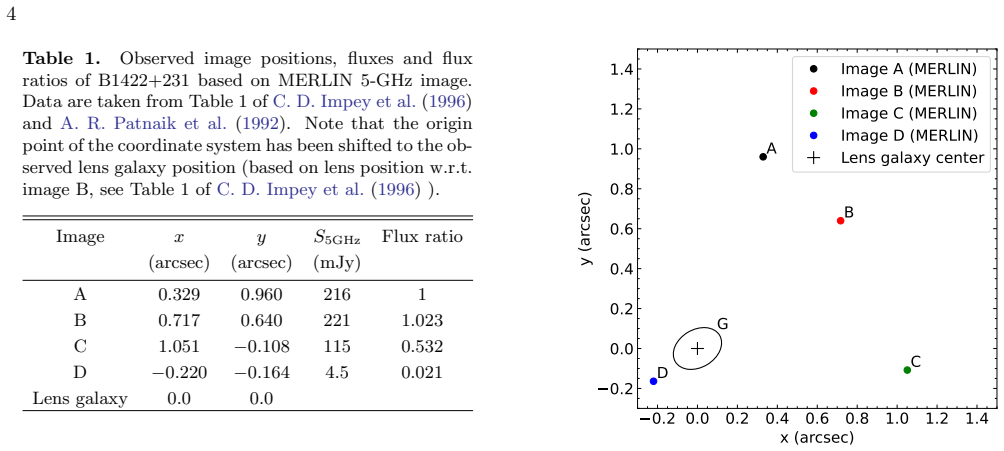
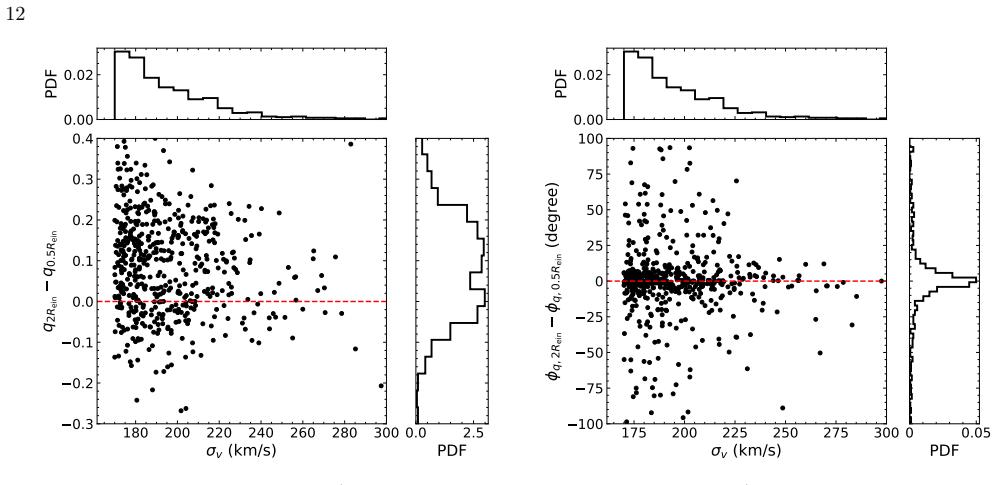
Summary. The paper asks whether non-clumpy macroscopic perturbations (global m3 and m4 multipoles plus radial variations of iso-density ellipticity and position angle) extracted from a TNG100 strong-lensing sample can reproduce the image positions and flux ratios of B1422+231 without clumpy substructure. Perturbations are measured via SPH surface-density maps and photutils isophote fits, then added to SIE+γ and EPL+γ macros (global multipoles via EPL_MULTIPOLE_M3M4; radial Δq/Δφq via a 1000-slice ElliSLICE construction). Macro parameters are re-optimized against MERLIN positions (and fluxes) under two astrometric and three photometric precision levels. At σp=10 mas both macros fit positions alone; at 2 mas astrometric anomalies appear and are partially rescued by the perturbations. With positions+fluxes, SIE+γ fails even at 10% photometry, while EPL+γ alone succeeds at 10% and 5% but fails at 2%; adding all four perturbation types yields a small number of successful EPL+γ analogues (Table 4, last row). The authors emphasize model flexibility, degeneracy, and the risk of artificially breaking degeneracies by adding only global multipoles.
Significance. If the existence result holds, it supplies a concrete, simulation-calibrated demonstration that typical non-clumpy azimuthal structure can produce the classic B1422 flux-ratio anomaly at the precision of current radio/mid-IR data, without dark-matter subhalos. The public code, transparent extraction pipeline, and systematic comparison of SIE versus EPL under controlled precision levels are genuine strengths. The caution against treating global m3/m4 as independent of radial ellipticity twists is timely for JWST and VLBI flux-ratio analyses that already include multipoles when constraining subhalo populations and dark-matter models. The work is an existence proof rather than a population inference, but that is still a useful contribution to the modeling literature.
major comments (2)
- Table 4 (2%-EPL row) and Fig. 12 / §5: the 10 successful EPL+γ+m3+m4+PAv+Qv cases (and the multipole-only successes) recover macros deep in the tails of both the adopted priors and the TNG/SL2S population (s~2.35, q~0.5, γ~0.27). The paper itself flags physical plausibility. Because the macro is freely re-optimized for every extracted perturbation, the “rescue” may be achieved only by driving the smooth component into a regime that a more realistic multi-component or non-power-law macro would not require. A quantitative comparison of these best-fit macros against the TNG sample’s own radial slopes, ellipticities and shear proxies (or an explicit statement that the YES claim is purely an existence result under the adopted EPL family) is needed to keep the central claim proportionate.
- §2.3–2.4 and §5 (discussion of Table 4 success rates): multipoles are implemented as globally averaged, radially constant m3/m4, while Δq/Δφq are fully radial. The paper notes that low success rates for PAv/Qv combinations may simply reflect incomplete sampling of a high-dimensional space (536 projections). This asymmetry is load-bearing for the claim that “all four types” can rescue the model: the few successes may be rare TNG projections whose large |am/a| and |Δq| happen to compensate an already extreme macro. Either a controlled test with radially varying multipoles, or a clearer quantification of how densely the radial-variation space is sampled, is required before the relative importance of multipoles versus ellipse twists can be interpreted.
minor comments (5)
- §2.5 / Table 2: the Gaussian prior on q and φq combines Impey et al. light measurements with the TNG mass–light offset; the absolute cut q∈[0.4,1] is stated but the impact of that hard boundary on the extreme-q solutions of Fig. 12 is not shown.
- Fig. 10 versus Fig. 12: the striking difference in recovered macros when fitting positions alone versus positions+fluxes is important; a short quantitative statement of how often the position-only solutions already lie near the flux-ratio solutions would help the reader.
- §3.1 and Fig. 5: the comparison of a4/a to Hao et al. (2006a) is useful; note explicitly that the annulus used here (0.8–1.2 Rein) differs from theirs, as already mentioned in the footnote.
- Typos / notation: “as as the center” (§2.5); occasional switches between φq and φa; ensure consistent use of “principal ellipse” versus “globally averaged” multipoles.
- The public repository is a clear plus; a short README note on which exact TNG snapshot and subhalo IDs produce the 10 successful full-perturbation models would aid reproducibility.
Circularity Check
No load-bearing circularity: TNG-extracted perturbations are independent of B1422 data; macros are re-optimized against external observations, yielding an existence result rather than a forced prediction.
specific steps
-
other
[Sec. 2.5 + Sec. 3.1 / Fig. 4]
"we consider the Gaussian priors on q and ϕq to be composed of two parts: one is from the light distribution of the lensing galaxy in C. D. Impey et al. (1996)... the other comes from the simulated misalignment between the mass and light elliptical shapes, which is given by qmass-qlight=0.08±0.06 and ϕq,mass-ϕq,light=0°±3.5° (see Section 3.1 and Fig. 4)."
The identical TNG100 sample that later supplies the m3/m4/Δq/Δϕq perturbations is also used to construct the mass–light prior. This is a minor self-reference, not a definitional loop: the prior only regularizes the macro search and is not required for the existence of successful fits (which in any case recover macros deep in the prior tails).
full rationale
The derivation chain is: (1) select TNG100 projections by independent photometric/kinematic cuts resembling SL2S; (2) extract m3/m4 amplitudes and radial Δq/Δϕq via isophote fitting (photutils/Ellipse) on the particle density maps; (3) for each fixed extracted perturbation, re-optimize the free macro parameters (θE, q, ϕq, s, γ, ϕγ, source position) of SIE+γ or EPL+γ against the external MERLIN positions and flux ratios of B1422, accepting only those that land inside 3σ. Success is therefore an existence statement over a coarse-grained sample of realistic non-clumpy features, not a prediction that reduces to the fit by construction. The sole mild self-reference is that the same TNG sample also supplies the mass–light misalignment used to set the Gaussian prior on q and ϕq (Sec. 2.5 + Fig. 4); that prior is not load-bearing for the YES claim (the successful high-precision models sit far in the tails of the prior anyway). No equation equates the target flux ratios to a quantity defined by the fit itself, no uniqueness theorem is imported from overlapping authors, and no ansatz is smuggled via self-citation. Extreme recovered macros (s~2.35, q~0.5, γ~0.27) raise a physical-plausibility question, not a circularity one.
Axiom & Free-Parameter Ledger
free parameters (4)
- EPL/SIE macro parameters (θE, q, ϕq, s, γ, ϕγ, source position)
- Gaussian prior means/widths on q and ϕq
- Number of elliptical slices (1000) and radial range (0.001–5.5 arcsec)
- Averaging annulus 0.8–1.2 Rein for global multipoles and principal ellipse
axioms (4)
- standard math Standard thin-lens equation and magnification under the point-source approximation
- domain assumption TNG100 projected mass maps (after SPH smoothing) supply statistically realistic macroscopic multipoles and radial ellipticity twists for real strong lenses
- ad hoc to paper Global (radially constant) m3 and m4 multipoles plus multi-slice Δq/Δϕq adequately capture the relevant non-elliptical complexity
- domain assumption Lens center coincides with the simulated galaxy center and is fixed at (0,0)
read the original abstract
Flux ratio anomalies in multiply-imaged quasar lenses are a long-standing issue. Using a classical system B1422+231 as a case study, we investigate how typical non-clumpy perturbations beyond elliptical shapes -- multipoles $m_3, m_4$ and radial variations in $q, \phi_q$ -- can account for the observed image positions and flux ratios under different observational precisions. We extract these perturbations from a pre-selected strong-lensing galaxy sample from the TNG100 simulation. Smooth macroscopic models (SIE+$\gamma$, EPL+$\gamma$) are then fitted to the observed image positions alone and to both positions and flux ratios, with and without including the extracted perturbations. With astrometric uncertainty of $\sigma_{p}=10$ mas, both macro-models alone can already successfully fit image positions within $3\sigma_{p}$. At $\sigma_{p}=2$ mas, however, 'astrometric anomalies' appear if smooth macro-models alone are adopted. In this case, adding the extracted perturbations can explain the anomalous image positions. When both positions and flux ratios are adopted, the SIE+$\gamma$ model family already shows 'flux ratio anomalies' at photometric uncertainty $\sigma_{f} \le 10\%$ (keeping $\sigma_{p}=10$ mas). When EPL+$\gamma$ is used, the smooth model alone can simultaneously fit both positions and flux ratios with $\sigma_{f}=10\%, 5\%$, but not with $\sigma_{f}=2\%$, where 'flux ratio anomalies' appear. Adding all four types of extracted perturbations can rescue the macro-models and explain the observed anomalous flux ratios. We present important lessons learned regarding model flexibility and degeneracy.
Figures




Reference graph
Works this paper leans on
-
[1]
C., Nightingale, J., He, Q., et al
Amorisco, N. C., Nightingale, J., He, Q., et al. 2022, MNRAS, 510, 2464, doi: 10.1093/mnras/stab3527
-
[2]
2023, Nature Astronomy, 7, 736, doi: 10.1038/s41550-023-01943-9 Astropy Collaboration, et al
Amruth, A., Broadhurst, T., Lim, J., et al. 2023, Nature Astronomy, 7, 736, doi: 10.1038/s41550-023-01943-9 Astropy Collaboration, et al. 2013, A&A, 558, A33, doi: 10.1051/0004-6361/201322068 Astropy Collaboration, et al. 2018, AJ, 156, 123, doi: 10.3847/1538-3881/aabc4f Astropy Collaboration, et al. 2022, ApJ, 935, 167, doi: 10.3847/1538-4357/ac7c74
-
[3]
Auger, M. W., Treu, T., Bolton, A. S., et al. 2010, ApJ, 724, 511, doi: 10.1088/0004-637X/724/1/511
-
[4]
1988, A&AS, 74, 385
Bender, R., Doebereiner, S., & Moellenhoff, C. 1988, A&AS, 74, 385
1988
-
[5]
1989, A&A, 217, 35
Madejsky, R. 1989, A&A, 217, 35
1989
-
[6]
1999, AJ, 118, 14, doi: 10.1086/300949
Bernstein, G., & Fischer, P. 1999, AJ, 118, 14, doi: 10.1086/300949
-
[7]
Bernstein, G., Fischer, P., Tyson, J. A., & Rhee, G. 1997, ApJL, 483, L79, doi: 10.1086/310747
-
[8]
2021, ApJ, 919, 38, doi: 10.3847/1538-4357/ac1108
Birrer, S. 2021, ApJ, 919, 38, doi: 10.3847/1538-4357/ac1108
-
[9]
2018, Physics of the Dark Universe, 22, 189, doi: 10.1016/j.dark.2018.11.002
Birrer, S., & Amara, A. 2018, Physics of the Dark Universe, 22, 189, doi: 10.1016/j.dark.2018.11.002
-
[10]
Birrer, S., Shajib, A. J., Gilman, D., et al. 2021, Journal of Open Source Software, 6, 3283, doi: 10.21105/joss.03283
-
[11]
1986, ApJ, 310, 568, doi: 10.1086/164709 Bradaˇ c, M., Schneider, P., Lombardi, M., et al
Blandford, R., & Narayan, R. 1986, ApJ, 310, 568, doi: 10.1086/164709 Bradaˇ c, M., Schneider, P., Lombardi, M., et al. 2004, A&A, 423, 797, doi: 10.1051/0004-6361:20040168 Bradaˇ c, M., Schneider, P., Steinmetz, M., et al. 2002, A&A, 388, 373, doi: 10.1051/0004-6361:20020559
doi:10.1086/164709 1986
-
[12]
2025, astropy/photutils: 2.3.0, 2.3.0 Zenodo, doi: 10.5281/zenodo.17129028
Bradley, L., Sip˝ ocz, B., Robitaille, T., et al. 2025, astropy/photutils: 2.3.0, 2.3.0 Zenodo, doi: 10.5281/zenodo.17129028
-
[13]
Brownstein, J. R., Bolton, A. S., Schlegel, D. J., et al. 2012, ApJ, 744, 41, doi: 10.1088/0004-637X/744/1/41
-
[14]
2003, MNRAS, 344, 1000, doi: 10.1046/j.1365-8711.2003.06897.x
Bruzual, G., & Charlot, S. 2003, MNRAS, 344, 1000, doi: 10.1046/j.1365-8711.2003.06897.x
-
[15]
Cao, X., Li, R., Nightingale, J. W., et al. 2022, Research in Astronomy and Astrophysics, 22, 025014, doi: 10.1088/1674-4527/ac3f2b
-
[16]
2006, MNRAS, 366, 1126, doi: 10.1111/j.1365-2966.2005.09981.x 19
Cappellari, M., Bacon, R., Bureau, M., et al. 2006, MNRAS, 366, 1126, doi: 10.1111/j.1365-2966.2005.09981.x 19
-
[17]
2020, PhRvL, 125, 111102, doi: 10.1103/PhysRevLett.125.111102
Broadhurst, T. 2020, PhRvL, 125, 111102, doi: 10.1103/PhysRevLett.125.111102
-
[18]
Chen, J., Kravtsov, A. V., & Keeton, C. R. 2003, ApJ, 592, 24, doi: 10.1086/375639
-
[19]
2002, ApJ, 565, 17, doi: 10.1086/324493
Chiba, M. 2002, ApJ, 565, 17, doi: 10.1086/324493
-
[20]
Inoue, K. T. 2005, ApJ, 627, 53, doi: 10.1086/430403
doi:10.1086/430403 2005
-
[21]
2024, MNRAS, 531, 3431, doi: 10.1093/mnras/stae1228
Vegetti, S. 2024, MNRAS, 531, 3431, doi: 10.1093/mnras/stae1228
-
[22]
Congdon, A. B., & Keeton, C. R. 2005, MNRAS, 364, 1459, doi: 10.1111/j.1365-2966.2005.09699.x
-
[23]
Dalal, N., & Kochanek, C. S. 2002, ApJ, 572, 25, doi: 10.1086/340303
doi:10.1086/340303 2002
-
[24]
Despali, G., Vegetti, S., White, S. D. M., Giocoli, C., & van den Bosch, F. C. 2018, MNRAS, 475, 5424, doi: 10.1093/mnras/sty159
-
[25]
2023, MNRAS, 522, 5434, doi: 10.1093/mnras/stad1313
Dike, V., Gilman, D., & Treu, T. 2023, MNRAS, 522, 5434, doi: 10.1093/mnras/stad1313
-
[26]
Dobler, G., & Keeton, C. R. 2006, MNRAS, 365, 1243, doi: 10.1111/j.1365-2966.2005.09809.x
-
[27]
Etherington, A., Nightingale, J. W., Massey, R., et al. 2024, MNRAS, 531, 3684, doi: 10.1093/mnras/stae1375
-
[29]
Evans, N. W., & Witt, H. J. 2003b, MNRAS, 345, 1351, doi: 10.1046/j.1365-2966.2003.07057.x
-
[30]
Fadely, R., & Keeton, C. R. 2012, MNRAS, 419, 936, doi: 10.1111/j.1365-2966.2011.19729.x
-
[31]
R., Nakajima, R., & Bernstein, G
Fadely, R., Keeton, C. R., Nakajima, R., & Bernstein, G. M. 2010, ApJ, 711, 246, doi: 10.1088/0004-637X/711/1/246
-
[32]
1989, A&AS, 79, 291
Fasano, G., & Bonoli, C. 1989, A&AS, 79, 291
1989
-
[33]
Gallazzi, A., Charlot, S., Brinchmann, J., White, S. D. M., & Tremonti, C. A. 2005, MNRAS, 362, 41, doi: 10.1111/j.1365-2966.2005.09321.x
-
[34]
Nierenberg, A. M. 2017, MNRAS, 467, 3970, doi: 10.1093/mnras/stx158
-
[35]
Gilman, D., Birrer, S., Nierenberg, A., & Oh, M. S. H. 2024, MNRAS, 533, 1687, doi: 10.1093/mnras/stae1810
-
[36]
2020a, MNRAS, 491, 6077, doi: 10.1093/mnras/stz3480
Gilman, D., Birrer, S., Nierenberg, A., et al. 2020a, MNRAS, 491, 6077, doi: 10.1093/mnras/stz3480
-
[37]
2018, MNRAS, 481, 819, doi: 10.1093/mnras/sty2261
Nierenberg, A. 2018, MNRAS, 481, 819, doi: 10.1093/mnras/sty2261
-
[38]
2019, MNRAS, 487, 5721, doi: 10.1093/mnras/stz1593
Gilman, D., Birrer, S., Treu, T., Nierenberg, A., & Benson, A. 2019, MNRAS, 487, 5721, doi: 10.1093/mnras/stz1593
-
[39]
2021, MNRAS, 507, 2432, doi: 10.1093/mnras/stab2335
Gilman, D., Bovy, J., Treu, T., et al. 2021, MNRAS, 507, 2432, doi: 10.1093/mnras/stab2335
-
[40]
2020b, MNRAS, 492, L12, doi: 10.1093/mnrasl/slz173
Gilman, D., Du, X., Benson, A., et al. 2020b, MNRAS, 492, L12, doi: 10.1093/mnrasl/slz173
-
[41]
2023, PhRvD, 107, 103008, doi: 10.1103/PhysRevD.107.103008
Gilman, D., Zhong, Y.-M., & Bovy, J. 2023, PhRvD, 107, 103008, doi: 10.1103/PhysRevD.107.103008
-
[42]
Gilman, D., Nierenberg, A. M., Treu, T., et al. 2025, arXiv e-prints, arXiv:2511.07513, doi: 10.48550/arXiv.2511.07513
-
[43]
Hao, C. N., Mao, S., Deng, Z. G., Xia, X. Y., & Wu, H. 2006a, MNRAS, 370, 1339, doi: 10.1111/j.1365-2966.2006.10545.x
-
[44]
Hao, C. N., Mao, S., Deng, Z. G., Xia, X. Y., & Wu, H. 2006b, MNRAS, 373, 1264, doi: 10.1111/j.1365-2966.2006.11137.x
-
[45]
Harris, C. R., Millman, K. J., van der Walt, S. J., et al. 2020, Nature, 585, 357, doi: 10.1038/s41586-020-2649-2
-
[46]
2019, MNRAS, 491, 4247–4253, doi: 10.1093/mnras/stz3305
Harvey, D., Valkenburg, W., Tamone, A., et al. 2019, MNRAS, 491, 4247–4253, doi: 10.1093/mnras/stz3305
-
[47]
2023, MNRAS, 518, 220, doi: 10.1093/mnras/stac2779
He, Q., Nightingale, J., Robertson, A., et al. 2023, MNRAS, 518, 220, doi: 10.1093/mnras/stac2779
-
[48]
Hogg, D. W., & Blandford, R. D. 1994, MNRAS, 268, 889, doi: 10.1093/mnras/268.4.889
-
[49]
Hou, S., Xiang, S., Sming Tsai, Y.-L., et al. 2026, Flux-ratio anomalies in cusp quasars reveal dark matter beyond CDM, doi: 10.48550/arXiv.2601.16818
-
[50]
2018, MNRAS, 475, 2438, doi: 10.1093/mnras/stx3320
Hsueh, J.-W., Despali, G., Vegetti, S., et al. 2018, MNRAS, 475, 2438, doi: 10.1093/mnras/stx3320
-
[51]
W., Enzi, W., Vegetti, S., et al
Hsueh, J. W., Enzi, W., Vegetti, S., et al. 2020, MNRAS, 492, 3047, doi: 10.1093/mnras/stz3177
-
[52]
D., Vegetti, S., et al
Hsueh, J.-W., Fassnacht, C. D., Vegetti, S., et al. 2016, MNRAS, 463, L51
2016
-
[53]
W., Oldham, L., Spingola, C., et al
Hsueh, J. W., Oldham, L., Spingola, C., et al. 2017, MNRAS, 469, 3713, doi: 10.1093/mnras/stx1082
-
[54]
Hunter, J. D. 2007, Computing in Science & Engineering, 9, 90, doi: 10.1109/MCSE.2007.55
-
[55]
Impey, C. D., Foltz, C. B., Petry, C. E., Browne, I. W. A., & Patnaik, A. R. 1996, ApJL, 462, L53, doi: 10.1086/310035
-
[56]
Inoue, K. T. 2016, MNRAS, 461, 164, doi: 10.1093/mnras/stw1270
-
[57]
Inoue, K. T., & Takahashi, R. 2012, MNRAS, 426, 2978, doi: 10.1111/j.1365-2966.2012.21915.x
-
[58]
T., Takahashi, R., Takahashi, T., & Ishiyama, T
Inoue, K. T., Takahashi, R., Takahashi, T., & Ishiyama, T. 2015, MNRAS, 448, 2704, doi: 10.1093/mnras/stv194
-
[59]
Jackson, N., Xanthopoulos, E., & Browne, I. W. A. 2000, MNRAS, 311, 389, doi: 10.1046/j.1365-8711.2000.03115.x
-
[60]
Jedrzejewski, R. I. 1987, MNRAS, 226, 747, doi: 10.1093/mnras/226.4.747 20
-
[61]
Kamada, A., Inoue, K. T., & Takahashi, T. 2016, PhRvD, 94, 023522, doi: 10.1103/PhysRevD.94.023522
-
[62]
Keeley, R. E., Nierenberg, A. M., Gilman, D., et al. 2023, MNRAS, 524, 6159, doi: 10.1093/mnras/stad2251
-
[63]
Keeley, R. E., Nierenberg, A. M., Gilman, D., et al. 2024, MNRAS, 535, 1652, doi: 10.1093/mnras/stae2458
-
[64]
Keeley, R. E., Nierenberg, A. M., Gilman, D., et al. 2025, arXiv e-prints, arXiv:2511.07765, doi: 10.48550/arXiv.2511.07765
-
[65]
Keeton, C. R. 2001, arXiv e-prints, astro, doi: 10.48550/arXiv.astro-ph/0102340
-
[66]
Keeton, C. R., Gaudi, B. S., & Petters, A. O. 2003, ApJ, 598, 138, doi: 10.1086/378934
doi:10.1086/378934 2003
-
[67]
Keeton, C. R., Gaudi, B. S., & Petters, A. O. 2005, ApJ, 635, 35, doi: 10.1086/497324
-
[68]
Keeton, C. R., Kochanek, C. S., & Seljak, U. 1997, ApJ, 482, 604, doi: 10.1086/304172
doi:10.1086/304172 1997
-
[69]
Keeton, C. R., Falco, E. E., Impey, C. D., et al. 2000, ApJ, 542, 74, doi: 10.1086/309517
-
[70]
Kochanek, C. S. 2021, MNRAS, 501, 5021, doi: 10.1093/mnras/staa4033
-
[71]
Kochanek, C. S., & Dalal, N. 2004, ApJ, 610, 69, doi: 10.1086/421436
doi:10.1086/421436 2004
-
[72]
Koopmans, L. V. E., Biggs, A., Blandford, R. D., et al. 2003, ApJ, 595, 712, doi: 10.1086/377434
-
[73]
1994, A&A, 286, 357, doi: 10.48550/arXiv.astro-ph/9311011
Kormann, R., Schneider, P., & Bartelmann, M. 1994, A&A, 286, 357, doi: 10.48550/arXiv.astro-ph/9311011
-
[74]
Kormendy, J., Fisher, D. B., Cornell, M. E., & Bender, R. 2009, ApJS, 182, 216, doi: 10.1088/0067-0049/182/1/216 Krajnovi´ c, D., Alatalo, K., Blitz, L., et al. 2013, MNRAS, 432, 1768, doi: 10.1093/mnras/sts315
-
[75]
Lam, S. K., Pitrou, A., & Seibert, S. 2015, in Proceedings of the Second Workshop on the LLVM Compiler Infrastructure in HPC, LLVM ’15 (New York, NY, USA: Association for Computing Machinery), doi: 10.1145/2833157.2833162
-
[76]
Lauer, T. R. 1985, MNRAS, 216, 429, doi: 10.1093/mnras/216.2.429
-
[77]
R., Neugebauer, G., Weir, N., Matthews, K., & Patnaik, A
Lawrence, C. R., Neugebauer, G., Weir, N., Matthews, K., & Patnaik, A. R. 1992, MNRAS, 259, 5P, doi: 10.1093/mnras/259.1.5P
-
[78]
T., Futamase, T., & Akhlaghi, M
Lefor, A. T., Futamase, T., & Akhlaghi, M. 2013, NewAR, 57, 1, doi: 10.1016/j.newar.2013.05.001
-
[79]
2009, MNRAS, 397, 341, doi: 10.1111/j.1365-2966.2009.14912.x
Liesenborgs, J., de Rijcke, S., Dejonghe, H., & Bekaert, P. 2009, MNRAS, 397, 341, doi: 10.1111/j.1365-2966.2009.14912.x
-
[80]
2014, MNRAS, 437, 2461, doi: 10.1093/mnras/stt2057
Lubini, M., Sereno, M., Coles, J., Jetzer, P., & Saha, P. 2014, MNRAS, 437, 2461, doi: 10.1093/mnras/stt2057
-
[81]
1998, MNRAS, 295, 587
Mao, S., & Schneider, P. 1998, MNRAS, 295, 587
1998
discussion (0)
Sign in with ORCID, Apple, or X to comment. Anyone can read and Pith papers without signing in.