REVIEW 4 major objections 6 minor 1 cited by
Quantum Optimization for Software Engineering: A Survey
T0 review · 4 major / 6 minor · reviewed 2026-08-15 · deepseek-v4-flash
Pith's one-line read This paper presents the first systematic literature review of quantum and quantum-inspired optimization applied to classical software engineering problems, finding 77 primary studies and showing where the field is concentrated and where…
desk verdict A useful first map of quantum(-inspired) optimization for classical SE, but the inconsistent search queries and a few sloppy errors should be fixed before the numbers are relied on. read the letter →
The pith
A machine-rendered reading of the paper's core claim, the machinery that carries it, and where it could break.
The reading
What carries the argument
The carrying object is the systematic literature review protocol itself: searches across six digital databases using a combined five-set Boolean query, explicit inclusion and exclusion criteria, and two rounds of backward and forward snowballing. This protocol turns 2083 raw hits into 77 primary studies and produces the tables that support every gap claim. A second distinctive device is the classification scheme that distinguishes the original SE problem's objectives from the objectives in the reformulated optimization problem, which lets the paper quantify a simplification tendency: multi-objective and many-objective SE problems are frequently collapsed into single-objective quantum formulations. The same protocol uses a standardized software engineering body of knowledge to label activities, which is what makes the claim about uncovered areas a clean result.
What would settle it
An independent reviewer could rerun the exact queries from the paper's appendix against the same six databases and apply the inclusion criteria; if the deduplicated total does not reproduce near 2083, or if the added studies shift the share of software engineering operations well below 55.84% and fill one of the reportedly empty activity areas, the review's quantitative map would be weakened.
Extended reading notes
Core claim
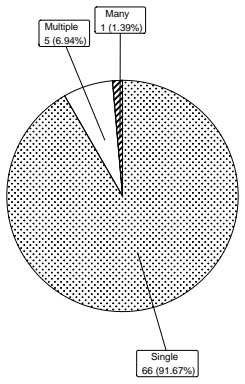
The paper's central discovery is the distributional shape of a young interdisciplinary field. It reports that, among 77 primary studies published between 2014 and 2025, 55.84% target software engineering operations, 20.78% target software testing, 12.99% target software quality, and 10.39% target software security; scheduling and test suite minimization are the two most frequently studied problems. It also reports that 65.75% of the SE problems are single-objective as originally posed, but after reformulation 91.67% of the optimization problems are single-objective, and that 48 of 80 solution instances are quantum-inspired approaches executed on classical hardware, with 17 hybrid and 15 purely quantum. Among the 32 approaches that use quantum algorithms, quantum annealing paired with a QUBO formulation dominates, and six of the fifteen activity chapters in the adopted software engineering body of knowledge have no primary study at all. The paper presents this as evidence that the field is real, growing, and still highly uneven.
Load-bearing premise
The review's conclusions stand on the assumption that its literature retrieval was complete and unbiased; if the database queries or the human inclusion and exclusion decisions missed a substantial share of relevant work, the reported percentages and the claimed gaps would no longer represent the field.
Editorial extensions
If this is right
- The field now has a reproducible baseline map; later reviewers can rerun the published queries and update the counts without starting from zero.
- Six SE activity areas — architecture, construction, process, models and methods, professional practice, and economics — are essentially open terrain for quantum and quantum-inspired optimization research.
- Because 91.67% of reformulated problems are single-objective, the trade-off structure of real multi-objective SE problems is largely unexplored; working on multi-objective quantum formulations is a direct research opening.
- The dominance of quantum annealing with QUBO means that advances in gate-based algorithms or in hybrid classical-quantum decomposition could substantially change the field's center of gravity.
- Most current solutions are quantum-inspired and run on classical hardware, so near-term practical use does not depend on waiting for fault-tolerant quantum computers.
Reading between the lines
- If the reported distribution is representative, the gap list doubles as a research prioritization menu: testing and operations are crowded, while requirements selection, design, construction, and process improvement are nearly empty.
- The observation that most primary studies appear outside SE venues implies an indexing problem that the review itself only partly solves; keeping the map current would require a cross-disciplinary watch rather than a single-community search.
- A testable extension would repeat the protocol at a later date and track whether the share of hybrid and purely quantum solutions grows as hardware becomes more accessible, and whether the six uncovered activities gain studies.
- The original-versus-reformulated objective count could become a standard reporting metric for future papers in this area, making the community's simplifying choices visible and comparable.
Signed reviews
Editorial analysis
A structured set of objections, weighed in public.
Referee Report
Summary. This paper presents a systematic literature review (SLR) of research applying quantum and quantum-inspired optimization to classical software engineering (SE) problems. The authors searched six digital databases on 13 January 2025, retrieved 2083 records (2186 raw hits), and after screening and snowballing selected 77 primary studies. They answer 11 research questions covering bibliometric trends, targeted SE activities and problems, optimization reformulations, solution types (quantum, hybrid, quantum-inspired), quantum algorithms used, and open challenges. The key reported findings are that 55.84% of primary studies target 'software engineering operations', that testing/quality/security make up most of the rest, that 91.67% of reformulated problems are single-objective, and that six SWEBOK activities remain uncovered. The authors claim this is the first SLR specifically on quantum and quantum-inspired optimization for classical SE.
Significance. The review addresses a genuinely useful gap: the SBSE community currently lacks a systematic map of how quantum and quantum-inspired optimization have been applied to classical SE problems. If the corpus is representative, the paper's maps (venues, activities, problems, solution types, algorithms) provide a baseline for future research and for the QSE roadmap. Strengths include the public artifact (GitHub) with extracted data, the detailed search and snowballing protocol, the use of SWEBOK v4.0 as an organizing framework, and the explicit RQ-by-RQ findings with reproducible figures and tables. The main value is the empirical mapping rather than a new technique. My reservations concern internal inconsistencies in the reported findings and the reproducibility of the corpus construction; these are correctable but must be addressed before the paper's claims can be relied upon.
major comments (4)
- [§7.2.1 (Findings of RQ11)] The finding states that 'six out of 15 SE activities have been covered by the primary studies, i.e., Software Architecture, Software Construction, SE Process, SE Models and Methods, SE Professional Practice, and SE Economics.' Table 11 marks exactly these six activities as ✗ (not covered), and the body text (e.g., 'there is no primary study that targets software architecture optimization') confirms they are absent. The RQ11 finding is thus the opposite of the evidence it summarizes. Please correct the finding to 'not covered' and ensure the count (6 of 15 uncovered, 9 covered) is stated consistently.
- [§5.2 (paragraph after Table 5)] The text says: 'For software failure prediction (see ▶ in Table 5), all seven studies are categorized under software security.' In Table 5, software failure prediction appears under 'software quality' (7 papers), not under 'software security'; the overlap marker ▶ indicates it is shared between software quality and software engineering operations (paper [91]). The sentence should say 'software quality'. As written, the paragraph misreports the paper's own classification and confuses the subsequent discussion of the overlap.
- [§3.2 / Appendix Table 14] The six database queries are not semantically equivalent instantiations of Listing 1. For the technique set (Set 3), Springer uses 'artificial intelligence OR ai', whereas Wiley and Web of Science use 'artificial AND intelligence OR ai', which parse differently under standard precedence. The field scope for 'software' also varies: full text (IEEE, ACM), ALL fields (Scopus, WoS), Abstract (Wiley), and no field restriction (Springer). These differences mean the 2083-retrieved pool is not the output of a single reproducible Boolean query, and the subsequent screening and snowballing cannot fully repair a systematic gap in the seed set. Since the paper's central empirical claims (e.g., the 55.84% share for SE operations, the six uncovered activities) are computed from this corpus, the authors should either show that the query variants are equivalent after operator and field semantics are accounted for, or re-run the search with normalized queries (and report the new corpus) to demonstrate the stability of the reported distributions.
- [§6.3 vs Table 7] The text states 'among the 17 hybrid quantum optimization solutions and 15 purely quantum optimization solutions', but Table 7 reports Hybrid 16 and Quantum 15. The discrepancy affects the interpretation of RQ9 counts (e.g., Figure 12 shows 32 quantum-approach instances). Please reconcile the count and state clearly how papers with multiple approaches (e.g., [20], [105], [130]) are counted.
minor comments (6)
- [References] References [1] and [2] are identical (Abbas et al., 2024), as are [102] and [103] (Murillo et al., 2025). Please remove duplicates or renumber.
- [§4.3 (Findings of RQ3)] The sentence 'surpassing 27.27% in conferences, 10.39% in workshops, and 3 in open-access archive entries' mixes a count with percentages; state '3 papers (3.90%)' for consistency.
- [§1 (Introduction)] The word 'reproducability' should be 'reproducibility'.
- [§7.2.2] The phrase 'were each quantum solution is associated' should be 'where each quantum solution is associated'.
- [§1 & Abstract] The claim 'we present the first SLR' should be qualified relative to Mandal et al. [96] and Murillo et al. [103], which are also 2025 SLRs with partial overlap; the paper already discusses the differences in scope in Section 9.1, but the abstract and intro should be worded to avoid an overclaim.
- [§3.3 / Table 14] Table 14 sums to 2186 raw hits, while the text reports 2083 unique papers after deduplication. Please clarify explicitly whether the 2083 number already excludes duplicates from the six-source union, as the current wording in Section 3.3 ('yielding 2083 papers') is ambiguous.
Circularity Check
RQ11's 'uncovered SWEBOK activities' gap is largely an artifact of the Set 4 search-term list, making a headline finding partly self-definitional.
-
self definitional
[Section 3.2 (Listing 1 / Table 14) and Section 7.2.1 (Table 11)]
"Section 3.2: 'The terms in Set 4 collectively covers core SE phases or activities referred to another recent SLR [89]'. Table 14: 'api OR develop* OR bug OR code OR coding OR debug OR defect OR deploy OR evolution OR fault OR fix OR maintenance OR program OR refactor* OR repair OR requirement OR test* OR verification OR validation OR vulnerab* OR configur*'."
Set 4 is a closed keyword list of SE activities. The SWEBOK chapters reported as uncovered—Software Architecture, Construction, Process, Models/Methods, Professional Practice, Economics—have no representative keyword in Set 4 (no 'architecture', 'design', 'construction', 'process', 'model*', 'method*', 'professional', or 'economics'). A paper addressing only those activities cannot pass the mandatory Set 4 filter, so its absence from the 77-study corpus is a property of the search string, not an empirically established gap. The paper presents this absence as RQ11's research gap and even rationalizes it as 'meta-level concerns', without noting that the query never searched those activities. The gap claim is thus partly equivalent to the inclusion filter by construction.
full rationale
The SLR's main corpus construction is externally grounded: 2083 records from six databases were screened and snowballed to 77 primary studies, and the bibliometric/solution-type distributions (RQs 1-3, 6-10) are empirical classifications of those studies, not fitted predictions. Self-citations such as [86], [87], [150], [151], [116], and [163] are published, externally available results and are not load-bearing for the search-and-classification method. The one material circularity is the RQ11 gap analysis: the search query's Set 4 term list omits several SWEBOK activity areas, and the paper's headline 'significant gaps across other SE activities' is at least partly a consequence of that omission rather than an independent discovery. This does not invalidate the rest of the survey, but the gap claims should be re-stated as 'not retrieved by our query' or the query should be re-run with a SWEBOK-derived term set. Accordingly, the circularity is partial rather than total.
Assumptions & free parameters
assumptions (3)
- domain assumption The six selected digital libraries (ACM, IEEE Xplore, Scopus, Springer, Web of Science, Wiley) plus manual snowballing are sufficient to retrieve the relevant literature corpus.
- domain assumption SWEBOK v4.0 provides a valid and complete classification of software engineering activities for mapping primary studies.
- domain assumption The inclusion/exclusion criteria in Table 2 can be applied consistently across 2083 papers by human reviewers.
Cite this review
Pith. "Pith review of Quantum Optimization for Software Engineering: A Survey." pith.science (2026). https://pith.science/paper/66SSS5J2
@misc{pith2026250616878,
  author       = {Pith},
  title        = {Pith review of: Quantum Optimization for Software Engineering: A Survey},
  year         = {2026},
  howpublished = {\url{https://pith.science/paper/66SSS5J2}},
  note         = {Machine review of arXiv:2506.16878}
}
read the original abstract
Quantum computing, particularly in the area of quantum optimization, is steadily progressing toward practical applications, supported by an expanding range of hardware platforms and simulators. While Software Engineering (SE) optimization has a strong foundation, which is exemplified by the active Search-Based Software Engineering (SBSE) community and numerous classical optimization methods, the growing complexity of modern software systems and their engineering processes demands innovative solutions. This Systematic Literature Review (SLR) focuses specifically on studying the literature that applies quantum or quantum-inspired algorithms to solve classical SE optimization problems. We examine 77 primary studies selected from an initial pool of 2083 publications obtained through systematic searches of six digital databases using carefully crafted search strings. Our findings reveal concentrated research efforts in areas such as SE operations and software testing, while exposing significant gaps across other SE activities. Additionally, the SLR uncovers relevant works published outside traditional SE venues, underscoring the necessity of this comprehensive review. Overall, our study provides a broad overview of the research landscape, empowering the SBSE community to leverage quantum advancements in addressing next-generation SE challenges.
Figures


Figures from the paper (10 more)




Forward citations
Cited by 1 Pith paper
-
Shadow-Based Noise Fingerprinting of Simulated Quantum Noise Models
Physics-informed classical-shadow features from fixed 3-qubit probes let a random forest identify ten simulated quantum noise channels at 0.84 test accuracy.
Reference graph
Works this paper leans on
-
[2]
Amira Abbas, Andris Ambainis, Brandon Augustino, Andreas B¨ artschi, Harry Buhrman, Carleton Coffrin, Giorgio Cortiana, Vedran Dunjko, Daniel J Egger, Bruce G Elmegreen, et al . 2024. Challenges and opportunities in quantum optimization.Nature Reviews Physics(2024), 1--18
2024
-
[103]
Juan Manuel Murillo, Jose Garcia-Alonso, Enrique Moguel, Johanna Barzen, Frank Leymann, Shaukat Ali, Tao Yue, Paolo Arcaini, Ricardo P´ erez-Castillo, Ignacio Garc´ ıa-Rodr´ ıguez de Guzm´ an, Mario Piattini, Antonio Ruiz-Cort´ es, Antonio Brogi, Jianjun Zhao, Andriy Miranskyy, and Manuel Wimmer. 2025. Quantum Software Engineering: Roadmap and Challenges ...
doi:10.1145/3712002 2025
-
[91]
Jungang Lou, Yunliang Jiang, Qing Shen, and Ruiqin Wang. 2018. Failure prediction by relevance vector regression with improved quantum-inspired gravitational search.Journal of Network and Computer Applications103 (2018), 171--177
2018
-
[20]
Gabriella Bettonte, Valentin Gilbert, Daniel Vert, St´ ephane Louise, and Renaud Sirdey. 2022. Quantum approaches for WCET-related optimization problems. InInternational Conference on Computational Science. Springer, 202--217
2022
-
[105]
Nitin Nayak, Jan Rehfeld, Tobias Winker, Benjamin Warnke, Umut C ¸alikyilmaz, and Sven Groppe. 2023. Constructing optimal bushy join trees by solving qubo problems on quantum hardware and simulators. In Proceedings of the international workshop on big data in emergent distributed environments. 1--7. 33
work page 2023
-
[130]
Manuel Sch¨ onberger, Stefanie Scherzinger, and Wolfgang Mauerer. 2023. Ready to leap (by co-design)? join order optimisation on quantum hardware.Proceedings of the ACM on Management of Data1, 1 (2023), 1--27
work page 2023
-
[3]
Tariq Ahamed Ahanger, Fadl Dahan, Usman Tariq, and Imdad Ullah. 2022. Quantum inspired task optimization for IoT edge fog computing environment.Mathematics11, 1 (2022), 156
2022
-
[4]
Tameem Albash and Daniel A Lidar. 2018. Adiabatic quantum computation.Reviews of Modern Physics 90, 1 (2018), 015002
2018
Show all 170 references
-
[5]
Aldeida Aleti, Barbora Buhnova, Lars Grunske, Anne Koziolek, and Indika Meedeniya. 2012. Software architecture optimization methods: A systematic literature review.IEEE Transactions on Software Engineering39, 5 (2012), 658--683
2012
-
[6]
Shaukat Ali, Lionel C Briand, Hadi Hemmati, and Rajwinder Kaur Panesar-Walawege. 2009. A system- atic review of the application and empirical investigation of search-based test case generation.IEEE Transactions on Software Engineering36, 6 (2009), 742--762
2009
-
[7]
Manuel S Alvarez-Alvarado, Francisco E Alban-Chac´ on, Erick A Lamilla-Rubio, Carlos D Rodr´ ıguez- Gallegos, and Washington Vel´ asquez. 2021. Three novel quantum-inspired swarm optimization algorithms using different bounded potential fields.Scientific Reports11, 1 (2021), 11655
2021
-
[8]
Joshua Ammermann, Fabian Jakob Brenneisen, Tim Bittner, and Ina Schaefer. 2024. Quantum Solution for Configuration Selection and Prioritization. InProceedings of the 5th ACM/IEEE International Workshop on Quantum Software Engineering. 21--28
2024
-
[9]
Bruno Apolloni, C Carvalho, and Diego De Falco. 1989. Quantum stochastic optimization.Stochastic Processes and their Applications33, 2 (1989), 233--244
1989
-
[10]
quantum annealing
Bruno Apolloni, Nicol` o Cesa-Bianchi, and Diego De Falco. 1990. A numerical implementation of “quantum annealing”. InStochastic Processes, Physics and Geometry: Proceedings of the Ascona-Locarno Conference. 97--111
1990
-
[11]
Andrea Arcuri. 2009. On search based software evolution. In2009 1st International Symposium on Search Based Software Engineering. IEEE, 39--42
2009
-
[12]
2011.The quantum story: A history in 40 moments
Jim Baggott. 2011.The quantum story: A history in 40 moments. OUP Oxford
2011
-
[13]
Anu Bajaj and Ajith Abraham. 2022. Test case prioritization and reduction using hybrid quantum-behaved particle swarm optimization. In2022 IEEE Congress on Evolutionary Computation (CEC). IEEE, 1--8. 28
2022
-
[14]
Anu Bajaj, Ajith Abraham, Saroj Ratnoo, and Lubna Abdelkareim Gabralla. 2022. Test case prioritization, selection, and reduction using improved quantum-behaved particle swarm optimization.Sensors22, 12 (2022), 4374
2022
-
[15]
Anu Bajaj, Om Prakash Sangwan, and Ajith Abraham. 2022. Improved novel bat algorithm for test case prioritization and minimization.Soft Computing26, 22 (2022), 12393--12419
2022
-
[16]
Jerzy Balicki. 2021. Many-objective quantum-inspired particle swarm optimization algorithm for placement of virtual machines in smart computing cloud.Entropy24, 1 (2021), 58
2021
-
[17]
Vita Santa Barletta, Danilo Caivano, Christian Catalano, and Mirko De Vincentiis. 2024. Quantum-based automotive threat intelligence and countermeasures. InProceedings of the 28th International Conference on Evaluation and Assessment in Software Engineering. 548--554
2024
-
[18]
Vita Santa Barletta, Danilo Caivano, Mirko De Vincentiis, Alessio Magr` ı, and Antonio Piccinno. 2022. Quantum optimization for IoT security detection. InInternational Symposium on Ambient Intelligence. Springer, 187--196
2022
-
[19]
Vita Santa Barletta, Danilo Caivano, Alfred Lako, and Anibrata Pal. 2023. Quantum as a service architecture for security in a smart city. InInternational Conference on the Quality of Information and Communications Technology. Springer, 76--89
2023
-
[21]
Munish Bhatia and Sandeep K Sood. 2020. Quantum computing-inspired network optimization for IoT applications.IEEE Internet of Things Journal7, 6 (2020), 5590--5598
2020
-
[22]
Munish Bhatia, Sandeep K Sood, and Simranpreet Kaur. 2019. Quantum-based predictive fog scheduler for IoT applications.Computers in Industry111 (2019), 51--67
2019
-
[23]
Carlos Blanco, Antonio Santos-Olmo, and Luis Enrique S´ anchez. 2024. QISS: Quantum-enhanced sustainable security incident handling in the IoT.Information15, 4 (2024), 181
2024
-
[24]
Kostas Blekos, Dean Brand, Andrea Ceschini, Chiao-Hui Chou, Rui-Hao Li, Komal Pandya, and Alessandro Summer. 2024. A review on quantum approximate optimization algorithm and its variants.Physics Reports1068 (2024), 1--66
2024
-
[25]
Leonardo Bottaci. 2001. A genetic algorithm fitness function for mutation testing. InProceedings of the SEMINALL-workshop at the 23rd international conference on software engineering, Toronto, Canada. Citeseer
2001
-
[26]
Giuseppe Buonaiuto, Francesco Gargiulo, Giuseppe De Pietro, Massimo Esposito, and Marco Pota. 2023. Best practices for portfolio optimization by quantum computing, experimented on real quantum devices. Scientific Reports13, 1 (2023), 19434
2023
-
[27]
Danilo Caivano, Mirko De Vincentiis, Federica Nitti, and Anibrata Pal. 2022. Quantum optimization for fast CAN bus intrusion detection. InProceedings of the 1st international workshop on quantum programming for software engineering. 15--18
2022
-
[28]
Marco Cerezo, Andrew Arrasmith, Ryan Babbush, Simon C Benjamin, Suguru Endo, Keisuke Fujii, Jarrod R McClean, Kosuke Mitarai, Xiao Yuan, Lukasz Cincio, et al . 2021. Variational quantum algorithms.Nature Reviews Physics3, 9 (2021), 625--644
2021
-
[29]
Junwen Chen, Xuemei Qi, Linfeng Chen, Fulong Chen, and Guihua Cheng. 2020. Quantum-inspired ant lion optimized hybrid k-means for cluster analysis and intrusion detection.Knowledge-Based Systems203 (2020), 106167
2020
-
[30]
Juan I Cirac and Peter Zoller. 1995. Quantum computations with cold trapped ions.Physical review letters74, 20 (1995), 4091
1995
-
[31]
Myra B Cohen, Charles J Colbourn, and Alan CH Ling. 2003. Augmenting simulated annealing to build interaction test suites. In14th International Symposium on Software Reliability Engineering, 2003. ISSRE 2003.IEEE, 394--405. 29
2003
-
[32]
Antonio Garc´ ıa de la Barrera, Ignacio Garc´ ıa-Rodr´ ıguez de Guzm´ an, Macario Polo, and Jos´ e A Cruz-Lemus
-
[33]
Manuel De Stefano, Fabiano Pecorelli, Dario Di Nucci, Fabio Palomba, and Andrea De Lucia. 2022. Software engineering for quantum programming: How far are we?Journal of Systems and Software190 (2022), 111326
2022
-
[34]
J Deepalakshmi and M Chandran. 2022. An optimized clustering model for heterogeneous cross-project de- fect prediction using Quantum Crow search. In2022 1st International Conference on Software Engineering and Information Technology (ICoSEIT). IEEE, 30--35
2022
-
[35]
Daniel Delahaye, Supatcha Chaimatanan, and Marcel Mongeau. 2018. Simulated annealing: From basics to applications. InHandbook of metaheuristics. Springer, 1--35
2018
-
[36]
Lijuan Deng, Long Wan, and Jian Guo. 2022. Research on security anomaly detection for big data platforms based on quantum optimization clustering.Mathematical Problems in Engineering2022, 1 (2022), 4805035
2022
-
[37]
Raghunadha Reddi Dornala, Sudhir Ponnapalli, Kalakoti Thriveni Sai, Siva Rama Krishna Reddi Koteru, Rami Reddy Koteru, and Bhavani Koteru. 2023. Quantum based Fault-Tolerant Load Balancing in Cloud Computing with Quantum Computing. In2023 3rd International Conference on Innova...
2023
-
[38]
Russell C Eberhart and Yuhui Shi. 1998. Comparison between genetic algorithms and particle swarm optimization. InInternational conference on evolutionary programming. Springer, 611--616
1998
-
[39]
Linus Ekstrom, Hao Wang, and Sebastian Schmitt. 2025. Variational quantum multiobjective optimization. Physical Review Research7, 2 (2025), 023141
2025
-
[40]
Sebastian Elbaum, Alexey G Malishevsky, and Gregg Rothermel. 2002. Test case prioritization: A family of empirical studies.IEEE transactions on software engineering28, 2 (2002), 159--182
2002
-
[41]
Mahzabeen Emu, Salimur Choudhury, and Kai Salomaa. 2022. Resource optimization of sfc embedding for iot networks using quantum computing. In2022 IEEE 27th International Workshop on Computer Aided Modeling and Design of Communication Links and Networks (CAMAD). IEEE, 83--88
2022
-
[42]
Mahzabeen Emu, Salimur Choudhury, and Kai Salomaa. 2024. Warm and cold start quantum annealing for metaverse resource optimization.IEEE Open Journal of the Communications Society5 (2024), 1057--1071
2024
-
[43]
Tobias Fankhauser, Marc E Sol` er, Rudolf Marcel F¨ uchslin, and Kurt Stockinger. 2023. Multiple query optimization using a gate-based quantum computer.IEEE Access11 (2023), 114031--114043
2023
-
[44]
Edward Farhi, Jeffrey Goldstone, Sam Gutmann, and Michael Sipser. 2000. Quantum computation by adiabatic evolution.arXiv preprint quant-ph/0001106(2000)
2000 arXiv
-
[45]
Richard P Feynman. 1982. Simulating Physics with Computers.International Journal of Theoretical Physics21, 6/7 (1982)
1982
-
[46]
Antonio Filieri, Henry Hoffmann, and Martina Maggio. 2015. Automated multi-objective control for self-adaptive software design. InProceedings of the 2015 10th Joint Meeting on Foundations of Software Engineering. 13--24
2015
-
[47]
Weimin Gan and Jianhui Li. 2024. Research on Genetic Quantum Particle Swarm Optimization Fu- sion Algorithm in Virtual Machine Scheduling. InProceedings of the 2nd International Conference on Educational Knowledge and Informatization. 136--142
2024
-
[48]
Antonio Garc´ ıa de la Barrera, Ignacio Garc´ ıa-Rodr´ ıguez de Guzm´ an, Macario Polo, and Mario Piattini
-
[49]
Felix Gemeinhardt, Antonio Garmendia, Manuel Wimmer, Benjamin Weder, and Frank Leymann. 2023. Quantum combinatorial optimization in the nisq era: A systematic mapping study.Comput. Surveys56, 3 (2023), 1--36
2023
-
[50]
Nicolas Gisin, Gr´ egoire Ribordy, Wolfgang Tittel, and Hugo Zbinden. 2002. Quantum cryptography. Reviews of modern physics74, 1 (2002), 145. 30
2002
-
[51]
Qianwen Gou, Yunwei Dong, Yujiao Wu, and Qiao Ke. 2024. RRGcode: Deep hierarchical search-based code generation.Journal of Systems and Software211 (2024), 111982
2024
-
[52]
Sven Groppe and Jinghua Groppe. 2021. Optimizing transaction schedules on universal quantum computers via code generation for grover’s search algorithm. InProceedings of the 25th International Database Engineering & Applications Symposium. 149--156
2021
-
[53]
Lov K Grover. 1996. A fast quantum mechanical algorithm for database search. InProceedings of the twenty-eighth annual ACM symposium on Theory of computing. 212--219
1996
-
[54]
Xu Guo, Xiaoyu Song, and Jian-tao Zhou. 2022. A synergic quantum particle swarm optimisation for constrained combinatorial test generation.IET software16, 3 (2022), 279--300
2022
-
[55]
Xu Guo, Xiaoyu Song, Jian-tao Zhou, and Feiyu Wang. 2023. A tolerance-based memetic algorithm for constrained covering array generation.Memetic Computing15, 3 (2023), 319--340
2023
-
[56]
Xu Guo, Xiaoyu Song, Jian-tao Zhou, Feiyu Wang, and Kecheng Tang. 2023. An Effective Approach to High Strength Covering Array Generation in Combinatorial Testing.IEEE Transactions on Software Engineering49, 10 (2023), 4566--4593
2023
-
[57]
Xu Guo, Xiaoyu Song, Jian-tao Zhou, Feiyu Wang, Kecheng Tang, and Zhuowei Wang. 2023. A memetic algorithm for high-strength covering array generation.IET Software17, 4 (2023), 538--553
2023
-
[58]
Mark Harman, S Afshin Mansouri, and Yuanyuan Zhang. 2012. Search-based software engineering: Trends, techniques and applications.ACM Computing Surveys (CSUR)45, 1 (2012), 1--61
2012
-
[59]
Dylan Herman, Cody Googin, Xiaoyuan Liu, Yue Sun, Alexey Galda, Ilya Safro, Marco Pistoia, and Yuri Alexeev. 2023. Quantum computing for finance.Nature Reviews Physics5, 8 (2023), 450--465
2023
-
[60]
Toshimori Honjo, Tomohiro Sonobe, Kensuke Inaba, Takahiro Inagaki, Takuya Ikuta, Yasuhiro Yamada, Takushi Kazama, Koji Enbutsu, Takeshi Umeki, Ryoichi Kasahara, et al . 2021. 100,000-spin coherent Ising machine.Science advances7, 40 (2021), eabh0952
2021
-
[61]
Yipeng Huang and Margaret Martonosi. 2019. Statistical assertions for validating patterns and finding bugs in quantum programs. InProceedings of the 46th International Symposium on Computer Architecture. 541--553
2019
-
[62]
Hager Hussein, Ahmed Younes, and Walid Abdelmoez. 2020. Quantum-inspired genetic algorithm for solving the test suite minimization problem.WSEAS Transactions on Computers19 (2020)
2020
-
[63]
Hager Hussein, Ahmed Younes, and Walid Abdelmoez. 2021. Quantum algorithm for solving the test suite minimization problem.Cogent Engineering8, 1 (2021), 1882116
2021
-
[64]
Hirotaka Irie, Goragot Wongpaisarnsin, Masayoshi Terabe, Akira Miki, and Shinichirou Taguchi. 2019. Quantum annealing of vehicle routing problem with time, state and capacity. InQuantum Technology and Optimization Problems: First International Workshop, QTOP 2019, Munich, Germ...
2019
-
[65]
Richa Jain and Neelam Sharma. 2023. A quantum inspired hybrid SSA--GWO algorithm for SLA based task scheduling to improve QoS parameter in cloud computing.Cluster Computing26, 6 (2023), 3587--3610
2023
-
[66]
Samyak Jhaveri, Alberto Krone-Martins, and Cristina V Lopes. 2023. Cloning and beyond: A quantum solution to duplicate code. InProceedings of the 2023 ACM SIGPLAN International Symposium on New Ideas, New Paradigms, and Reflections on Programming and Software. 32--49
2023
-
[67]
Yue Jia, Myra B Cohen, Mark Harman, and Justyna Petke. 2015. Learning combinatorial interaction test generation strategies using hyperheuristic search. In2015 IEEE/ACM 37th IEEE International Conference on Software Engineering, Vol. 1. IEEE, 540--550
2015
-
[68]
Luis Jim´ enez-Navajas, F Buhler, Frank Leymann, Ricardo P´ erez-Castillo, Mario Piattini, and Daniel Vietz
-
[69]
Cong Jin. 2021. Cross-project software defect prediction based on domain adaptation learning and optimization.Expert Systems with Applications171 (2021), 114637
2021
-
[70]
Cong Jin and Shu-Wei Jin. 2015. Prediction approach of software fault-proneness based on hybrid artificial neural network and quantum particle swarm optimization.Applied Soft Computing35 (2015), 717--725. 31
2015
-
[71]
Cong Jin and Shu-Wei Jin. 2016. Parameter optimization of software reliability growth model with S-shaped testing-effort function using improved swarm intelligent optimization.Applied Soft Computing 40 (2016), 283--291
2016
-
[72]
Sourabh Katoch, Sumit Singh Chauhan, and Vijay Kumar. 2021. A review on genetic algorithm: past, present, and future.Multimedia tools and applications80 (2021), 8091--8126
2021
-
[73]
G Kiruthiga and S Mary Vennila. 2019. An enriched chaotic quantum whale optimization algorithm based job scheduling in cloud computing environment.International Journal of Advanced Trends in Computer Science and Engineering6, 4 (2019), 1753--1760
2019
-
[74]
2002.Classical and quantum computation
Alexei Yu Kitaev, Alexander Shen, and Mikhail N Vyalyi. 2002.Classical and quantum computation. Number 47. American Mathematical Soc
2002
-
[75]
Gopal Krishna and Anish Kumar Saha. 2023. Optimal sensor spacing in IoT network based on quantum computing technology.International Journal of Parallel, Emergent and Distributed Systems38, 1 (2023), 58--84
2023
-
[76]
Adarsh Kumar, Diego Augusto de Jesus Pacheco, Keshav Kaushik, and Joel JPC Rodrigues. 2022. Futuristic view of the internet of quantum drones: review, challenges and research agenda.Vehicular Communications36 (2022), 100487
2022
-
[77]
Updesh Kumar Jaiswal and Amarjeet Prajapati. 2025. Optimizing the software test case through physics- informed particle-based method.International Journal of System Assurance Engineering and Management (2025), 1--18
2025
-
[78]
A Charan Kumari and K Srinivas. 2016. Comparing the performance of quantum-inspired evolutionary algorithms for the solution of software requirements selection problem.Information and Software Technology 76 (2016), 31--64
2016
-
[79]
Christoph Laaber, Tao Yue, and Shaukat Ali. 2024. Evaluating search-based software microbenchmark prioritization.IEEE Transactions on Software Engineering(2024)
2024
-
[80]
Annu Lambora, Kunal Gupta, and Kriti Chopra. 2019. Genetic algorithm-A literature review. In2019 international conference on machine learning, big data, cloud and parallel computing (COMITCon). IEEE, 380--384
2019
-
[81]
Claire Le Goues, ThanhVu Nguyen, Stephanie Forrest, and Westley Weimer. 2011. Genprog: A generic method for automatic software repair.Ieee transactions on software engineering38, 1 (2011), 54--72
2011
-
[82]
Neilson Carlos Leite Ramalho, Higor Amario de Souza, and Marcos Lordello Chaim. 2025. Testing and Debugging Quantum Programs: The Road to 2030.ACM Trans. Softw. Eng. Methodol.34, 5, Article 155 (May 2025), 46 pages.https://doi.org/10.1145/3715106
2025 doi
-
[83]
Bingdong Li, Jinlong Li, Ke Tang, and Xin Yao. 2015. Many-objective evolutionary algorithms: A survey. ACM Computing Surveys (CSUR)48, 1 (2015), 1--35
2015
-
[84]
Fei Li, Min Liu, and Gaowei Xu. 2019. A quantum ant colony multi-objective routing algorithm in WSN and its application in a manufacturing environment.Sensors19, 15 (2019), 3334
2019
-
[85]
Xuetao Li, Yuxia Zhang, Cailean Osborne, Minghui Zhou, Zhi Jin, and Hui Liu. 2025. Systematic literature review of commercial participation in open source software.ACM Transactions on Software Engineering and Methodology34, 2 (2025), 1--31
2025
-
[86]
Yuechen Li, Kai-Yuan Cai, and Beibei Yin. 2025. Preparation and Utilization of Mixed States for Testing Quantum Programs.ACM Transactions on Software Engineering and Methodology(2025)
2025
-
[87]
Yuechen Li, Hanyu Pei, Linzhi Huang, Beibei Yin, and Kai-Yuan Cai. 2024. Automatic repair of quantum programs via unitary operation.ACM Transactions on Software Engineering and Methodology33, 6 (2024), 1--43
2024
-
[88]
Bo Liu, Guo Zhou, Yongquan Zhou, Qifang Luo, and Yuanfei Wei. 2024. Quantum-inspired multi-objective African vultures optimization algorithm with hierarchical structure for software requirement.Cluster Computing27, 8 (2024), 11317--11345
2024
-
[89]
Junwei Liu, Kaixin Wang, Yixuan Chen, Xin Peng, Zhenpeng Chen, Lingming Zhang, and Yiling Lou. 2024. Large language model-based agents for software engineering: A survey.arXiv preprint arXiv:2409.02977 (2024). 32
2024 arXiv
-
[90]
Yang Liu, Chaoqun Li, Yao Zhang, Mengying Xu, Jing Xiao, and Jie Zhou. 2022. HPCP-QCWOA: High performance clustering protocol based on quantum clone whale optimization algorithm in integrated energy system.Future Generation Computer Systems135 (2022), 315--332
2022
-
[92]
Chengjie Lu, Huihui Zhang, Tao Yue, and Shaukat Ali. 2021. Search-based selection and prioritization of test scenarios for autonomous driving systems. InInternational Symposium on Search Based Software Engineering. Springer, 41--55
2021
-
[93]
Hong Lu, Shuai Wang, Tao Yue, Jan F Nyg˚ ard, et al. 2017. Automated refactoring of OCL constraints with search.IEEE Transactions on Software Engineering45, 2 (2017), 148--170
2017
-
[94]
Ashis Kumar Mandal and Basabi Chakraborty. 2025. Quantum computing and quantum-inspired techniques for feature subset selection: A review.Knowledge and Information Systems67, 3 (2025), 2019--2061
2025
-
[95]
Ashis Kumar Mandal, Md Nadim, Chanchal K Roy, Banani Roy, and Kevin A Schneider. 2024. Evaluating the Performance of a D-Wave Quantum Annealing System for Feature Subset Selection in Software Defect Prediction. In2024 IEEE International Conference on Quantum Computing and Engi...
2024
-
[96]
Ashis Kumar Mandal, Md Nadim, Chanchal K Roy, Banani Roy, and Kevin A Schneider. 2025. Quantum software engineering and potential of quantum computing in software engineering research: a review. Automated Software Engineering32, 1 (2025), 27
2025
-
[97]
Andriy Miranskyy. 2022. Using quantum computers to speed up dynamic testing of software. InProceedings of the 1st International Workshop on Quantum Programming for Software Engineering. 26--31
2022
-
[98]
Mohamed Wiem Mkaouer, Marouane Kessentini, Slim Bechikh, Kalyanmoy Deb, and Mel ´O Cinn´ eide. 2014. High dimensional search-based software engineering: finding tradeoffs among 15 objectives for automating software refactoring using NSGA-III. InProceedings of the 2014 Annual C...
2014
-
[99]
Nikolaj Moll, Panagiotis Barkoutsos, Lev S Bishop, Jerry M Chow, Andrew Cross, Daniel J Egger, Stefan Filipp, Andreas Fuhrer, Jay M Gambetta, Marc Ganzhorn, et al . 2018. Quantum optimization using variational algorithms on near-term quantum devices.Quantum Science and Technol...
2018
-
[100]
Oscar Montiel, Yoshio Rubio, Cynthia Olvera, and Ajelet Rivera. 2019. Quantum-inspired acromyrmex evolutionary algorithm.Scientific reports9, 1 (2019), 12181
2019
-
[101]
Saravanan Muniswamy and Radhakrishnan Vignesh. 2024. Joint optimization of load balancing and resource allocation in cloud environment using optimal container management strategy.Concurrency and Computation: Practice and Experience36, 12 (2024), e8035
2024
-
[104]
Banavath Balaji Naik, Bollu Priyanka, and Sarfaraj Alam Ansari. 2025. Energy-efficient task offloading and efficient resource allocation for edge computing: a quantum inspired particle swarm optimization approach.Cluster Computing28, 3 (2025), 155
2025
-
[106]
An Ngo-The and G¨ unther Ruhe. 2008. Optimized resource allocation for software release planning.IEEE Transactions on Software Engineering35, 1 (2008), 109--123
2008
-
[107]
2010.Quantum computation and quantum information
Michael A Nielsen and Isaac L Chuang. 2010.Quantum computation and quantum information. Cambridge university press
2010
-
[108]
Jiayang Niu, Jie Li, Ke Deng, Mark Sanderson, and Yongli Ren. 2024. Performance-Driven QUBO for Recommender Systems on Quantum Annealers.arXiv preprint arXiv:2410.15272(2024)
2024 arXiv
-
[109]
Mark O’Keeffe and Mel ´O Cinn´ eide. 2006. Search-based software maintenance. InConference on software maintenance and reengineering (CSMR’06). IEEE, 10--pp
2006
-
[110]
Chia-Ho Ou, Yu-Hong Li, Chih-Yu Chen, Chi-Hsuan Wu, Yu-Chen Tsai, Zhi-You Yan, and Ching-Ray Chang. 2023. Quantum-inspired optimization for task scheduling in software development projects. In2023 IEEE International Conference on Quantum Computing and Engineering (QCE), Vol. 2...
2023
-
[111]
Matteo Paltenghi and Michael Pradel. 2024. A Survey on Testing and Analysis of Quantum Software. arXiv preprint arXiv:2410.00650(2024)
2024 arXiv
-
[112]
Sanjai Pathak, Ashish Mani, and Amlan Chatterjee. 2023. An Opposition Learning-based Quantum Inspired Salp Swarm Optimization for The Multiobjective Controller Placement Problem. In2023 10th IEEE Uttar Pradesh Section International Conference on Electrical, Electronics and Com...
2023
-
[113]
Sanjai Pathak, Ashish Mani, and Amlan Chatterjee. 2024. A Cooperative Hybrid Quantum-inspired Salp Swarm and Differential Evolution for solving CEC 2022 Benchmark and Controller Placement Problems in Software Defined Networks.IEEE Access(2024)
2024
-
[114]
Alberto Peruzzo, Jarrod McClean, Peter Shadbolt, Man-Hong Yung, Xiao-Qi Zhou, Peter J Love, Al´ an Aspuru-Guzik, and Jeremy L O’brien. 2014. A variational eigenvalue solver on a photonic quantum processor.Nature communications5, 1 (2014), 4213
2014
-
[115]
Justyna Petke, Saemundur O Haraldsson, Mark Harman, William B Langdon, David R White, and John R Woodward. 2017. Genetic improvement of software: a comprehensive survey.IEEE Transactions on Evolutionary Computation22, 3 (2017), 415--432
2017
-
[116]
Mauro Pezz` e, Silvia Abrah˜ ao, Birgit Penzenstadler, Denys Poshyvanyk, Abhik Roychoudhury, and Tao Yue. 2025. A 2030 Roadmap for Software Engineering.ACM Trans. Softw. Eng. Methodol.34, 5, Article 118 (May 2025), 55 pages.https://doi.org/10.1145/3731559
2025 doi
-
[117]
Pooja and Sandeep Kumar Sood. 2024. Scientometric analysis of quantum-inspired metaheuristic algorithms. Artificial Intelligence Review57, 2 (2024), 22
2024
-
[118]
Dipesh Pradhan, Shuai Wang, Shaukat Ali, Tao Yue, and Marius Liaaen. 2019. Employing rule mining and multi-objective search for dynamic test case prioritization.Journal of Systems and Software153 (2019), 86--104
2019
-
[119]
John Preskill. 2018. Quantum computing in the NISQ era and beyond.Quantum2 (2018), 79
2018
-
[120]
Wenxin Qiao, Yicen Liu, Yu Lu, Xi Li, Jie Yan, and Zhigang Yao. 2020. A novel approach for service function chain embedding in cloud datacenter networks.IEEE Communications Letters25, 4 (2020), 1134--1138
2020
-
[121]
Wenxin Qiao, Hao Lu, Yu Lu, Lijie Meng, and Yicen Liu. 2021. A Dynamic Service Reconfiguration Method for Satellite–Terrestrial Integrated Networks.Future Internet13, 10 (2021). https://doi.org/ 10.3390/fi13100260
2021 doi
-
[122]
Finley Alexander Quinton, Per Arne Sevle Myhr, Mostafa Barani, Pedro Crespo del Granado, and Hongyu Zhang. 2025. Quantum annealing applications, challenges and limitations for optimisation problems compared to classical solvers.Scientific Reports15, 1 (2025), 12733
2025
-
[123]
Nor Ashila Abdul Rahman. 2022. A Review on Search-Based Mutation Testing.Academia of Information Computing Research3, 1 (2022)
2022
-
[124]
Aurora Ramirez, Jose Raul Romero, and Christopher L Simons. 2018. A systematic review of interaction in search-based software engineering.IEEE Transactions on Software Engineering45, 8 (2018), 760--781. 34
2018
-
[125]
Shalli Rani, Himanshi Babbar, Pardeep Kaur, and Asif Ali Khan. 2023. A novel approach of localization with single mobile anchor using quantum-based Salp swarm algorithm in wireless sensor networks.Soft Computing(2023), 1--15
2023
-
[126]
Jiawei Ren, Yulei Sui, Xiao Cheng, Yuan Feng, and Jianjun Zhao. 2024. Dynamic Transitive Closure-Based Static Analysis through the Lens of Quantum Search.ACM Transactions on Software Engineering and Methodology33, 5 (2024), 1--29
2024
-
[127]
Oscar H Montiel Ross. 2019. A review of quantum-inspired metaheuristics: Going from classical computers to real quantum computers.Ieee Access8 (2019), 814--838
2019
-
[128]
Arnab Roy, Joseph L Pachuau, Nongmeikapam Brajabidhu Singh, and Anish Kumar Saha. 2024. Quantum inspired genetic algorithm and optimization of queuing delay. InTENCON 2024-2024 IEEE Region 10 Conference (TENCON). IEEE, 1929--1933
2024
-
[129]
Pranshi Saxena, Ibrahim Sabek, and Federico Spedalieri. 2024. Constrained quadratic model for optimizing join orders. InProceedings of the 1st Workshop on Quantum Computing and Quantum-Inspired Technology for Data-Intensive Systems and Applications. 38--44
2024
-
[131]
Manuel Sch¨ onberger, Immanuel Trummer, and Wolfgang Mauerer. 2023. Quantum-inspired digital annealing for join ordering.Proceedings of the VLDB Endowment17, 3 (2023), 511--524
2023
-
[132]
Manuel Sch¨ onberger, Immanuel Trummer, and Wolfgang Mauerer. 2023. Quantum Optimisation of General Join Trees.. InVLDB Workshops
2023
-
[133]
Samuel Sep´ ulveda, Ania Cravero, Guillermo Fonseca, and Leandro Antonelli. 2024. Systematic review on requirements engineering in quantum computing: Insights and future directions.Electronics13, 15 (2024), 2989
2024
-
[134]
Manuel A Serrano, Luis E S´ anchez, Antonio Santos-Olmo, David Garc´ ıa-Rosado, Carlos Blanco, Vita Santa Barletta, Danilo Caivano, and Eduardo Fern´ andez-Medina. 2024. Minimizing incident response time in real-world scenarios using quantum computing.Software Quality Journal3...
2024
-
[135]
Qing Shen, Jungang Lou, Xiongtao Zhang, and Yunliang Jiang. 2021. Failure prediction by regularized fuzzy learning with intelligent parameters selection.Applied Soft Computing100 (2021), 106952
2021
-
[136]
Dalia Sobhy, Rami Bahsoon, Leandro Minku, and Rick Kazman. 2021. Evaluation of software architectures under uncertainty: A systematic literature review.ACM Transactions on Software Engineering and Methodology (TOSEM)30, 4 (2021), 1--50
2021
-
[137]
Sandeep Kumar Sood et al . 2025. Quantum-inspired metaheuristic algorithms for Industry 4.0: A scientometric analysis.Engineering Applications of Artificial Intelligence139 (2025), 109635
2025
-
[138]
Sriraman Tallam and Neelam Gupta. 2005. A concept analysis inspired greedy algorithm for test suite minimization.ACM SIGSOFT Software Engineering Notes31, 1 (2005), 35--42
2005
-
[139]
Kit-Sang Tang, Kim-Fung Man, Sam Kwong, and Qianhua He. 1996. Genetic algorithms and their applications.IEEE signal processing magazine13, 6 (1996), 22--37
1996
-
[140]
Lian Tong, Lan Yang, Xin Zhao, and Li Liu. 2023. How can a hybrid quantum-inspired gravitational search algorithm decrease energy consumption in IoT-based software-defined networks?Sustainable Computing: Informatics and Systems40 (2023), 100920
2023
-
[141]
Antonio Trovato, Manuel De Stefano, Fabiano Pecorelli, Dario Di Nucci, and Andrea De Lucia. 2025. Reformulating regression test suite optimization using quantum annealing-an empirical study.International Journal on Software Tools for Technology Transfer(2025), 1--14
2025
-
[142]
Immanuel Trummer and Christoph Koch. 2015. Multiple query optimization on the D-Wave 2X adiabatic quantum computer.arXiv preprint arXiv:1510.06437(2015)
2015 arXiv
-
[143]
Immanuel Trummer and Davide Venturelli. 2024. Leveraging quantum computing for database index selection. InProceedings of the 1st Workshop on Quantum Computing and Quantum-Inspired Technology for Data-Intensive Systems and Applications. 14--26. 35
2024
-
[144]
Md Habib Ullah, Rozhin Eskandarpour, Honghao Zheng, and Amin Khodaei. 2022. Quantum computing for smart grid applications.IET Generation, Transmission & Distribution16, 21 (2022), 4239--4257
2022
-
[145]
Valter Uotila. 2025. Left-Deep Join Order Selection with Higher-Order Unconstrained Binary Optimization on Quantum Computers.arXiv preprint arXiv:2502.00362(2025)
2025 arXiv
-
[146]
Helen Urgelles, Pablo Picazo-Martinez, David Garcia-Roger, and Jose F Monserrat. 2022. Multi-objective routing optimization for 6G communication networks using a quantum approximate optimization algorithm. Sensors22, 19 (2022), 7570
2022
-
[147]
Michael Wagner, Ludwig Kampel, and Dimitris E Simos. 2019. Quantum-inspired evolutionary algorithms for covering arrays of arbitrary strength. InAnalysis of Experimental Algorithms: Special Event, SEA 2 2019, Kalamata, Greece, June 24-29, 2019, Revised Selected Papers. Springe...
2019
-
[148]
Meng Wang, Poulami Das, and Prashant J Nair. 2024. Qoncord: A Multi-Device Job Scheduling Framework for Variational Quantum Algorithms. In2024 57th IEEE/ACM International Symposium on Microarchitecture (MICRO). IEEE, 735--749
2024
-
[149]
Shuai Wang, Shaukat Ali, and Arnaud Gotlieb. 2015. Cost-effective test suite minimization in product lines using search techniques.Journal of Systems and Software103 (2015), 370--391
2015
-
[150]
Xinyi Wang, Shaukat Ali, Tao Yue, and Paolo Arcaini. 2024. Quantum approximate optimization algorithm for test case optimization.IEEE Transactions on Software Engineering(2024)
2024
-
[151]
Xinyi Wang, Asmar Muqeet, Tao Yue, Shaukat Ali, and Paolo Arcaini. 2024. Test case minimization with quantum annealers.ACM Transactions on Software Engineering and Methodology34, 1 (2024), 1--24
2024
-
[152]
Zai Wang, Ke Tang, and Xin Yao. 2010. Multi-objective approaches to optimal testing resource allocation in modular software systems.IEEE Transactions on Reliability59, 3 (2010), 563--575
2010
-
[153]
2024.Guide to the Software Engineering Body of Knowledge (SWEBOK Guide), Version 4.0
Hironori Washizaki (Ed.). 2024.Guide to the Software Engineering Body of Knowledge (SWEBOK Guide), Version 4.0. IEEE Computer Society. https://www.computer.org/education/bodies-of-knowledge /software-engineering#about https://www.swebok.org
2024
-
[154]
Maochuan Wu, Junyu Lin, Shouchuang Shi, Long Ren, and Zhiwen Wang. 2020. Hybrid optimization-based GRU neural network for software reliability prediction. InInternational conference of pioneering computer scientists, engineers and educators. Springer, 369--383
2020
-
[155]
Gang Xiong, Yu-xiang Hu, Le Tian, Ju-long Lan, Jun-fei Li, and Qiao Zhou. 2016. A virtual service placement approach based on improved quantum genetic algorithm.Frontiers of Information Technology & Electronic Engineering17, 7 (2016), 661--671
2016
-
[156]
Gang Xiong, Penghao Sun, Yuxiang Hu, Julong Lan, and Kan Li. 2016. An optimized deployment mechanism for virtual middleboxes in NFV-and SDN-enabling network.KSII Transactions on Internet and Information Systems (TIIS)10, 8 (2016), 3474--3497
2016
-
[157]
Jifeng Xuan, He Jiang, Zhilei Ren, and Zhongxuan Luo. 2012. Solving the large scale next release problem with a backbone-based multilevel algorithm.IEEE Transactions on Software Engineering38, 5 (2012), 1195--1212
2012
-
[158]
Sheir Yarkoni, Elena Raponi, Thomas B¨ ack, and Sebastian Schmitt. 2022. Quantum annealing for industry applications: Introduction and review.Reports on Progress in Physics85, 10 (2022), 104001
2022
-
[159]
Yuan Yuan and Wolfgang Banzhaf. 2018. Arja: Automated repair of java programs via multi-objective genetic programming.IEEE Transactions on software engineering46, 10 (2018), 1040--1067
2018
-
[160]
Yusliza Yusoff, Mohd Salihin Ngadiman, and Azlan Mohd Zain. 2011. Overview of NSGA-II for optimizing machining process parameters.Procedia Engineering15 (2011), 3978--3983
2011
-
[161]
Feng Zhang. 2020. Intelligent task allocation method based on improved QPSO in multi-agent system. Journal of ambient intelligence and humanized computing11, 2 (2020), 655--662
2020
-
[162]
Gexiang Zhang. 2011. Quantum-inspired evolutionary algorithms: a survey and empirical study.Journal of Heuristics17, 3 (2011), 303--351
2011
-
[163]
Huihui Zhang, Man Zhang, Tao Yue, Shaukat Ali, and Yan Li. 2020. Uncertainty-wise requirements prioritization with search.ACM Transactions on Software Engineering and Methodology (TOSEM)30, 1 (2020), 1--54. 36
2020
-
[164]
Quanyuan Zhang, Haolun Li, Yanli Liu, Shangrong Ouyang, Caiting Fang, Wentao Mu, and Hao Gao. 2021. A new quantum particle swarm optimization algorithm for controller placement problem in software-defined networking.Computers and Electrical Engineering95 (2021), 107456
2021
-
[165]
Ya-nan Zhang, Hong Yang, Zheng-kui Lin, Qing Dai, and Yu-feng Li. 2017. A test suite reduction method based on novel quantum ant colony algorithm. In2017 4th International Conference on Information Science and Control Engineering (ICISCE). IEEE, 825--829
2017
-
[166]
Jianjun Zhao. 2020. Quantum software engineering: Landscapes and horrizons.arXiv preprint arXiv:.07047 (2020)
2020
-
[167]
Luyin Zhao and Sebastian Elbaum. 2003. Quality assurance under the open source development model. Journal of Systems and Software66, 1 (2003), 65--75
2003
-
[168]
Xin Zhou, Sicong Cao, Xiaobing Sun, and David Lo. 2024. Large language model for vulnerability detection and repair: Literature review and the road ahead.ACM Transactions on Software Engineering and Methodology(2024)
2024
-
[169]
Bing Zhu, Yuhang Sun, Jian Zhao, Jiayi Han, Peixing Zhang, and Tianxin Fan. 2023. A critical scenario search method for intelligent vehicle testing based on the social cognitive optimization algorithm.IEEE Transactions on Intelligent Transportation Systems24, 8 (2023), 7974--7...
2023
-
[2022]
InQuantum Software Engineering
Quantum software testing: current trends and emerging proposals. InQuantum Software Engineering. Springer, 167--191
-
[2023]
Quantum software testing: State of the art.Journal of Software: Evolution and Process35, 4 (2023), e2419
2023
-
[2024]
Quantum software development: a survey.Quantum Information and Computation24, 7 and 8 (2024), 0609--0642
2024
Reviewed August 15, 2026 · model on record in the stance chip above.
Discussion (0). Continue with ORCID to comment.