Tunable Electronic and Transport Properties of Biphenylene via Fluorination and Disorder
Pith reviewed 2026-06-26 23:35 UTC · model grok-4.3
The pith
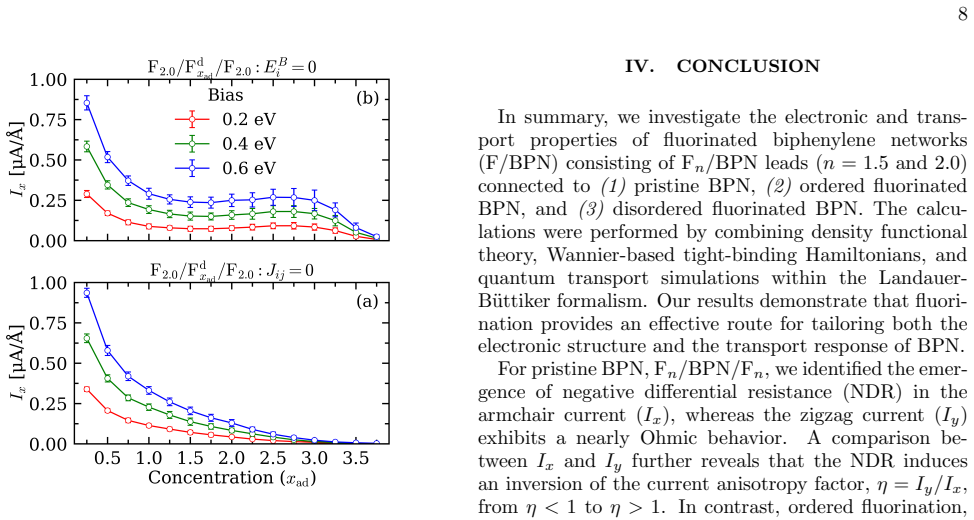
Fluorination and correlated disorder in biphenylene produce tunable anisotropic conduction with negative differential resistance that can be suppressed or direction-inverted by concentration and ordering.
A machine-rendered reading of the paper's core claim, the machinery that carries it, and where it could break.
Core claim
In ordered fluorinated biphenylene, negative differential resistance appears together with a bias-driven reversal of the favored transport direction between armchair and zigzag. Introducing chemical disorder eliminates the negative differential resistance and moves the response toward an approximately Ohmic regime. At high fluorine coverage, a nonmonotonic variation of armchair current with adatom concentration occurs because correlated quasi-linear fluorine conformations open armchair-directed carbon-pi channels while blocking zigzag transport.
What carries the argument
Correlated quasi-linear fluor conformations that open armchair-oriented C-pi transport channels while suppressing zigzag transport.
If this is right
- Ordered fluorination produces bias-induced inversion of the preferred transport direction.
- Disorder removes negative differential resistance and yields approximately Ohmic transport.
- High fluorine coverage yields nonmonotonic armchair current dependence on concentration due to quasi-linear conformations.
- Correlated fluorination functions as a mechanism to engineer electronic transport properties.
Where Pith is reading between the lines
- The same concentration and ordering control might apply to other anisotropic Dirac materials to achieve similar transport tuning.
- Optimal fluorine levels suggested by the nonmonotonic behavior could be tested to maximize current in one direction.
- Experimental synthesis routes that favor correlated linear fluorine patterns would be needed to realize the predicted armchair preference.
- The approach connects to broader efforts in defect and adatom engineering for two-dimensional carbon electronics.
Load-bearing premise
The density-functional-theory electronic structures and the Wannier-based transport simulations accurately reflect the real atomic arrangements, bonding, and scattering in fluorinated biphenylene at the studied concentrations.
What would settle it
Measure current-voltage curves on fabricated samples of biphenylene with controlled fluorine concentrations and ordering to check whether negative differential resistance and direction inversion appear only in ordered cases and disappear with disorder.
Figures
read the original abstract
Biphenylene (BPN) network is a newly synthesized 2D carbon allotrope hosting anisotropic Dirac electronic states. Here, we investigate how fluorination and correlated chemical disorder modify the electronic structure and charge transport of fluorinated biphenylene (F/BPN) using density functional theory, Wannier-based tight-biding Hamiltonian, and quantum transport simulations. We show that fluorination reshapes the transport response of BPN, producing concentration-dependent anisotropic conduction regimes. For pristine and ordered fluorinated systems, we identified the emergence of negative differential resistance (NDR) and a bias-induced inversion of the preferred transport direction, from armchair to zigzag and vice versa. In contrast, disorder suppresses the NDR, driving the system toward an approximately Ohmic transport regime. At high fluorine coverage, we further observed a nonmonotonic dependence of the armchair current on adatom concentration, which we attribute to the formation of correlated quasi-linear fluor conformation that promote armchair-oriented C-$\pi$ transport channels while simultaneously suppressing transport along the zigzag direction. Our results demonstrate that correlated fluorination can be used as an active mechanism to engineer electronic transport.
Editorial analysis
A structured set of objections, weighed in public.
Referee Report
Summary. The manuscript uses DFT, Wannier tight-binding Hamiltonians, and Landauer-Büttiker quantum transport simulations to examine how fluorination concentration and correlated disorder alter the electronic structure and charge transport of biphenylene. It reports concentration-dependent anisotropic conduction, negative differential resistance (NDR) and bias-driven transport-direction inversion in ordered systems, suppression of NDR toward Ohmic behavior under disorder, and a nonmonotonic armchair current at high coverage attributed to correlated quasi-linear fluorine conformations that open armchair C-π channels while blocking zigzag transport.
Significance. If the numerical trends are robust, the work shows that correlated fluorination offers a controllable route to engineer anisotropic conduction and NDR in a recently synthesized 2D carbon allotrope, extending the toolkit for 2D-material transport design beyond substitutional doping or strain.
major comments (2)
- [Methods / Results (computational details)] The abstract and methods description state that results derive from DFT + Wannier + quantum-transport calculations, yet supply no convergence data (k-point meshes, plane-wave cutoff, supercell sizes for disorder realizations) or error estimates on the reported currents and NDR features. This absence makes it impossible to judge whether the claimed concentration-dependent regimes and direction inversion are numerically stable.
- [Methods (disorder implementation)] The disorder model is described only qualitatively as 'correlated chemical disorder'; no explicit algorithm, correlation length, or ensemble averaging procedure is given. Because the suppression of NDR and the nonmonotonic armchair current are attributed directly to this model, the lack of a reproducible definition is load-bearing for the central claim.
minor comments (2)
- [Figures] Figure captions should explicitly state the bias range, temperature (if any), and number of disorder realizations used for each transport curve.
- [Abstract / Introduction] The abstract uses 'correlated fluorination' and 'correlated quasi-linear fluor conformation' without a prior definition; a short clarifying sentence in the introduction would improve readability.
Simulated Author's Rebuttal
We thank the referee for the careful reading of our manuscript and the constructive comments. We address each major comment below and will make the necessary revisions to improve the clarity and reproducibility of our work.
read point-by-point responses
-
Referee: [Methods / Results (computational details)] The abstract and methods description state that results derive from DFT + Wannier + quantum-transport calculations, yet supply no convergence data (k-point meshes, plane-wave cutoff, supercell sizes for disorder realizations) or error estimates on the reported currents and NDR features. This absence makes it impossible to judge whether the claimed concentration-dependent regimes and direction inversion are numerically stable.
Authors: We agree with the referee that providing convergence data and error estimates is essential for assessing the robustness of our results. In the revised version of the manuscript, we will add detailed information on the k-point meshes, plane-wave cutoffs, and supercell sizes used in our DFT calculations and disorder simulations. Additionally, we will include discussions or supplementary data on the convergence of the transport currents and NDR features with respect to these parameters. revision: yes
-
Referee: [Methods (disorder implementation)] The disorder model is described only qualitatively as 'correlated chemical disorder'; no explicit algorithm, correlation length, or ensemble averaging procedure is given. Because the suppression of NDR and the nonmonotonic armchair current are attributed directly to this model, the lack of a reproducible definition is load-bearing for the central claim.
Authors: The referee correctly points out that the disorder model requires a more explicit description to ensure reproducibility. We will revise the methods section to provide a detailed account of the algorithm used to implement the correlated chemical disorder, including the specific correlation length, the method for generating the fluorine configurations, and the ensemble averaging procedure over multiple realizations. This will directly support the claims regarding the effects of disorder on NDR and the nonmonotonic current behavior. revision: yes
Circularity Check
No significant circularity
full rationale
The paper reports a forward computational workflow: DFT electronic structures of fluorinated biphenylene structures are obtained, converted to Wannier tight-binding Hamiltonians, and used in Landauer-Büttiker transport calculations. No equation reduces a reported current, NDR feature, or anisotropy to a quantity fitted from the same transport data. No self-citation is invoked as a uniqueness theorem or to smuggle an ansatz. The central claim (correlated fluorination engineers transport) is an output of the simulations rather than an input by construction. This is the standard non-circular pattern for materials-simulation studies.
Axiom & Free-Parameter Ledger
axioms (1)
- domain assumption Density functional theory with standard functionals yields sufficiently accurate band structures and geometries for fluorinated carbon lattices
Reference graph
Works this paper leans on
-
[1]
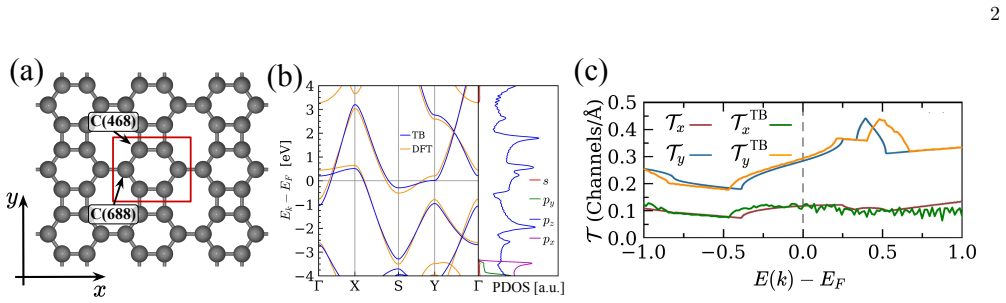
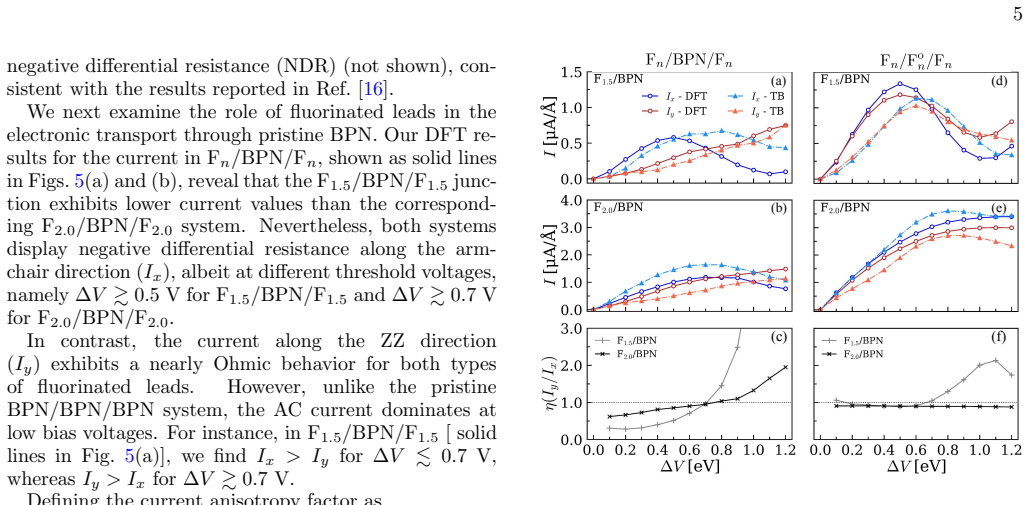
Pristine scatterer:F n/BPN/Fn The metallic character of pristine BPN is primarily governed by the carbon 2p z orbitals associated with the square lattice [C(468) in Fig. 1(a)]. Combined with the anisotropic arrangement of these square lattices, this electronic structure gives rise to a pronounced directional dependence of the transport properties in BPN. ...
-
[2]
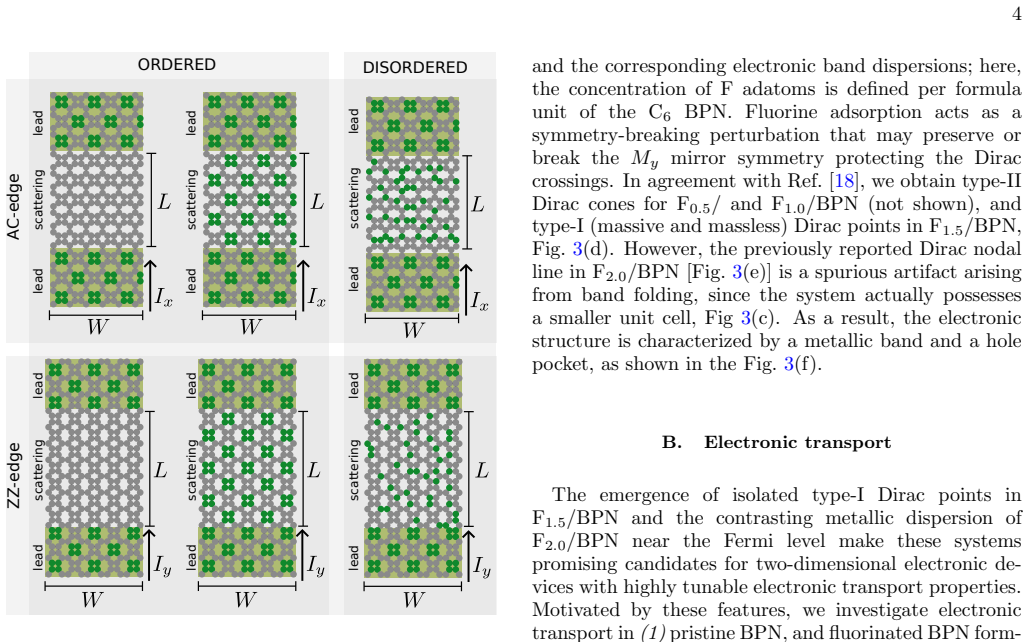
Ordered scatterer:F n/Fo n/Fn Here, we examine the electronic transport in ordered systems, F n/Fo n/Fn, in which the geometry of the leads and the scattering regions is the same, Fig. 4. Our results for the current [I(V)] in F 1.5/Fo 1.5/F1.5 and F2.0/Fo 2.0/F2.0, based on first-principles DFT calcu- lations [solid lines in Figs. 5(d) and (e), respective...
-
[3]
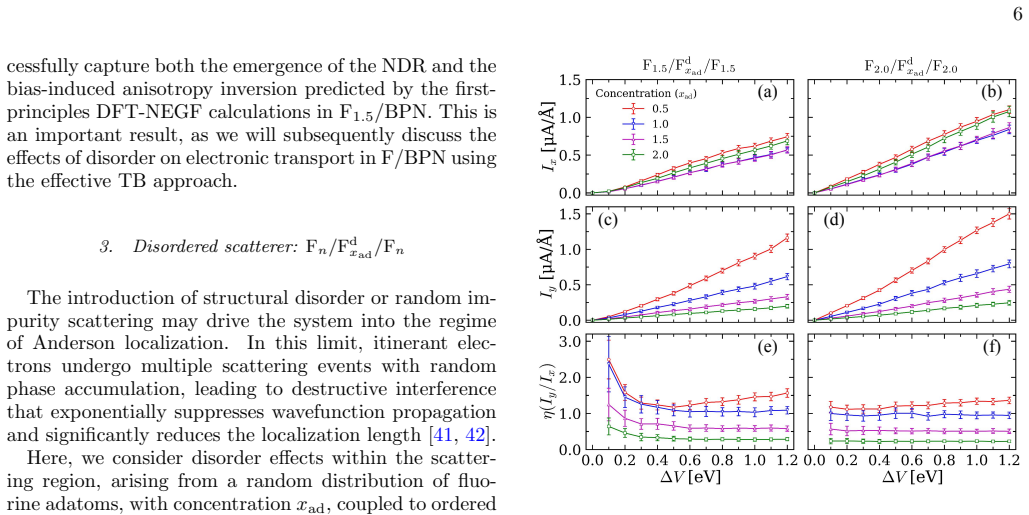
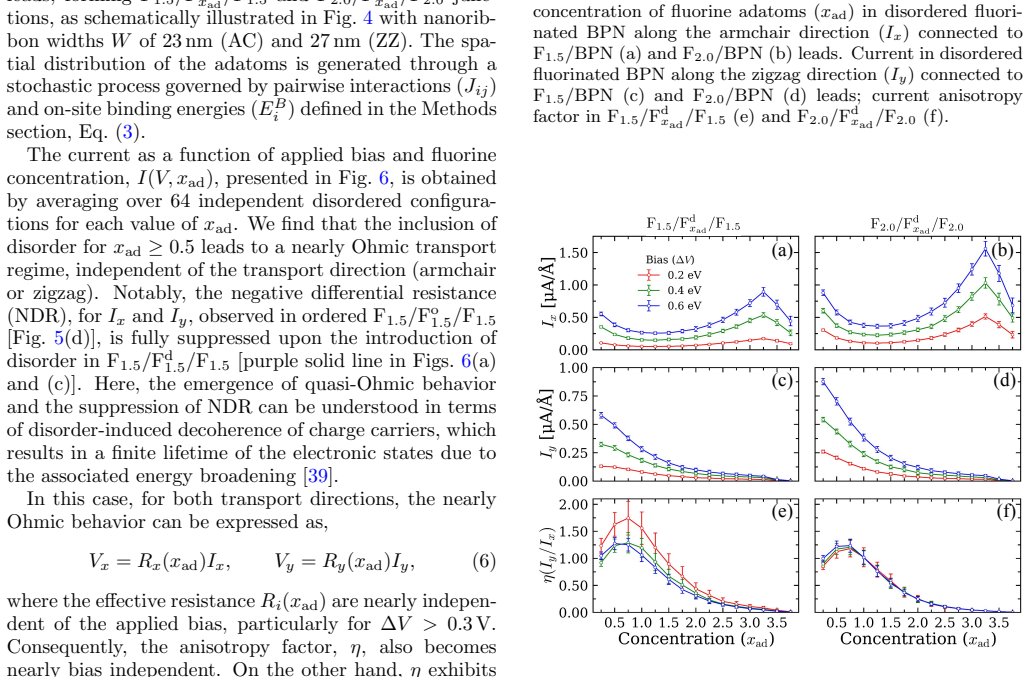
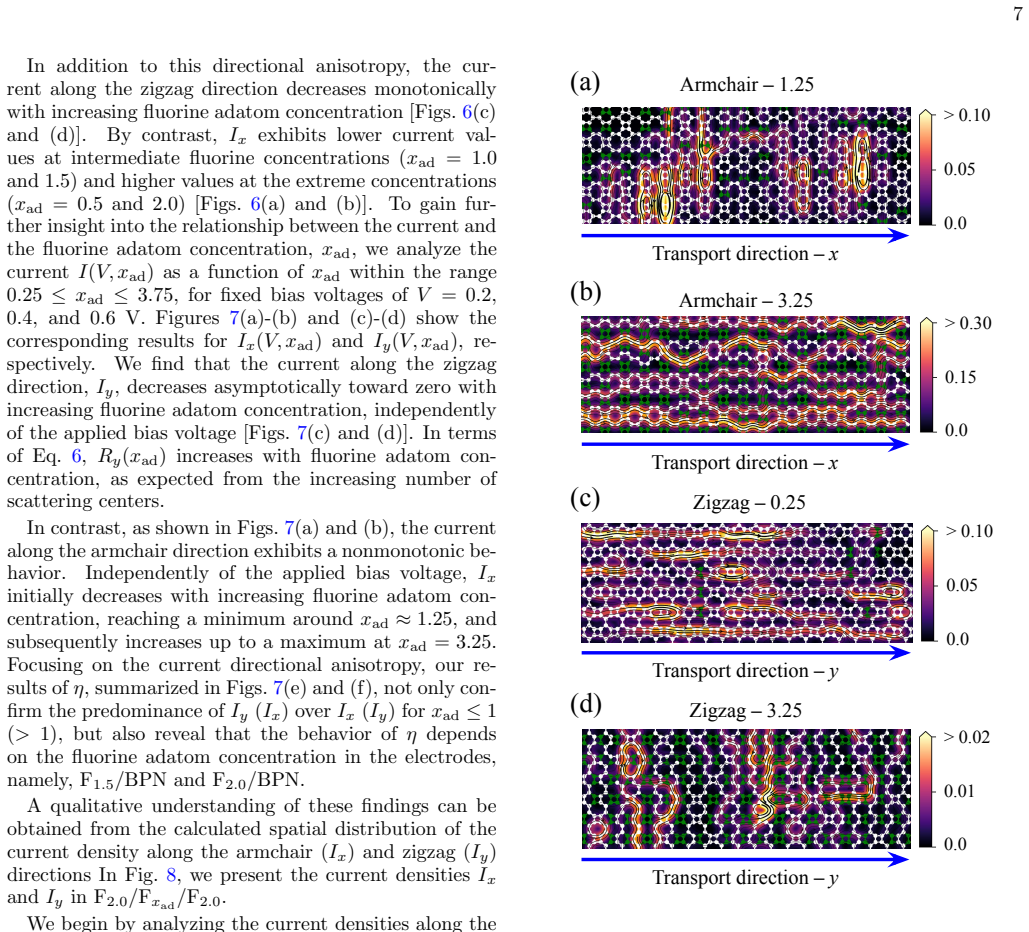
Disordered scatterer:F n/Fd xad/Fn The introduction of structural disorder or random im- purity scattering may drive the system into the regime of Anderson localization. In this limit, itinerant elec- trons undergo multiple scattering events with random phase accumulation, leading to destructive interference that exponentially suppresses wavefunction prop...
-
[4]
Paupitz, A
R. Paupitz, A. Fonseca, M. Bessa, G. Fabris, W. da Cunha, L. Machado, M. Pereira, L. Ribeiro, and D. Galv˜ ao, A concise review of recently synthesized 2D carbon allotropes: Amorphous carbon, graphynes, biphenylene and fullerene networks, Carbon252, 121320 (2026)
2026
-
[5]
Ahmad, A
F. Ahmad, A. Mahmood, and T. Muhmood, Car- bon allotropes: Basics, properties and applications, in Heteroatom-Doped Carbon Allotropes: Progress in Syn- thesis, Characterization, and Applications(American Chemical Society, 2024) p. 1–18
2024
-
[6]
Y. Liu, G. Wang, Q. Huang, L. Guo, and X. Chen, Struc- tural and Electronic Properties ofTGraphene: A Two- Dimensional Carbon Allotrope with Tetrarings, Phys. Rev. Lett.108, 225505 (2012)
2012
-
[7]
H. Li, J. H. Lim, Y. Lv, N. Li, B. Kang, and J. Y. Lee, Graphynes and Graphdiynes for Energy Storage and Cat- alytic Utilization: Theoretical Insights into Recent Ad- vances, Chemical Reviews123, 4795–4854 (2023)
2023
-
[8]
Q. Liu, X. Wang, J. Yu, and J. Wang, Graphyne and graphdiyne nanoribbons: from their structures and properties to potential applications, Physical Chemistry Chemical Physics26, 1541–1563 (2024)
2024
-
[9]
Koizumi, H
K. Koizumi, H. T. Phan, K. Nishigomi, and K. Wak- abayashi, Topological edge and corner states in the biphenylene network, Phys. Rev. B109, 035431 (2024)
2024
-
[10]
Y.-W. Son, H. Jin, and S. Kim, Magnetic Ordering, Anomalous Lifshitz Transition, and Topological Grain Boundaries in Two-Dimensional Biphenylene Network, Nano Letters22, 3112–3117 (2022)
2022
-
[11]
Crasto de Lima, G
F. Crasto de Lima, G. J. Ferreira, and R. H. Miwa, Topo- logical flat band, Dirac fermions and quantum spin Hall phase in 2D Archimedean lattices, Physical Chemistry Chemical Physics21, 22344–22350 (2019)
2019
-
[12]
Q. Fan, L. Yan, M. W. Tripp, O. Krejˇ c´ ı, S. Dimos- thenous, S. R. Kachel, M. Chen, A. S. Foster, U. Koert, P. Liljeroth, and J. M. Gottfried, Biphenylene network: A nonbenzenoid carbon allotrope, Science372, 852–856 (2021)
2021
-
[13]
Z. Tong, A. Pecchia, C. Yam, T. Dumitric˘ a, and T. Frauenheim, Ultrahigh Electron Thermal Conductiv- ity in T-Graphene, Biphenylene, and Net-Graphene, Ad- vanced Energy Materials12, 10.1002/aenm.202200657 (2022)
-
[14]
P.-F. Liu, J. Li, C. Zhang, X.-H. Tu, J. Zhang, P. Zhang, B.-T. Wang, and D. J. Singh, Type-II Dirac cones and electron-phonon interaction in monolayer bipheny- lene from first-principles calculations, Phys. Rev. B104, 235422 (2021)
2021
-
[15]
Y. Luo, C. Ren, Y. Xu, J. Yu, S. Wang, and M. Sun, A first principles investigation on the structural, me- chanical, electronic, and catalytic properties of bipheny- lene, Scientific Reports11, 10.1038/s41598-021-98261-9 (2021)
-
[16]
T. Liu, Y. Jing, and Y. Li, Two-Dimensional Bipheny- lene: A Graphene Allotrope with Superior Activity to- ward Electrochemical Oxygen Reduction Reaction, The Journal of Physical Chemistry Letters12, 12230–12234 (2021)
2021
-
[17]
M. P. Lebre, D. Pacine, E. N. Lima, A. A. C. Cotta, and I. S. S. de Oliveira, First-Principles Study of Metal–Biphenylene Nanoscale Interfaces: Structural, Electronic, and Catalytic Properties, ACS Applied Nano Materials 10.1021/acsanm.5c02590 (2025)
-
[18]
T. Han, Y. Liu, X. Lv, and F. Li, Biphenylene mono- layer: a novel nonbenzenoid carbon allotrope with potential application as an anode material for high- performance sodium-ion batteries, Physical Chemistry Chemical Physics24, 10712–10716 (2022)
2022
-
[19]
D. P. Kuritza, R. H. Miwa, and J. E. Padilha, Directional dependence of the electronic and transport properties of biphenylene under strain conditions, Physical Chemistry Chemical Physics26, 12142–12149 (2024)
2024
-
[20]
W. Feng, P. Long, Y. Feng, and Y. Li, Two- Dimensional Fluorinated Graphene: Synthesis, Struc- tures, Properties and Applications, Advanced Science3, 10.1002/advs.201500413 (2016)
-
[21]
S. Mo, J. Seo, S.-K. Son, S. Kim, J.-W. Rhim, and H. Lee, Engineering Two-Dimensional Nodal Semimet- als in Functionalized Biphenylene by Fluorine Adatoms, Nano Letters24, 4885 (2024)
2024
-
[22]
Simonov and A
A. Simonov and A. L. Goodwin, Designing disorder into crystalline materials, Nature Reviews Chemistry4, 657–673 (2020)
2020
-
[23]
Q. Li, E. H. Hwang, E. Rossi, and S. Das Sarma, Theory of 2D Transport in Graphene for Correlated Disorder, Phys. Rev. Lett.107, 156601 (2011)
2011
-
[24]
K. Cho, M. Ko´ nczykowski, S. Teknowijoyo, M. A. Tanatar, J. Guss, P. B. Gartin, J. M. Wilde, A. Kreyssig, R. J. McQueeney, A. I. Goldman, V. Mishra, P. J. Hirschfeld, and R. Prozorov, Using controlled disorder to probe the interplay between charge order and su- perconductivity in NbSe2, Nature Communications9, 10.1038/s41467-018-05153-0 (2018)
-
[25]
V. D. Neverov, A. E. Lukyanov, A. V. Krasavin, A. Vagov, and M. D. Croitoru, Correlated disorder as a way towards robust superconductivity, Communications Physics5, 10.1038/s42005-022-00933-z (2022)
-
[26]
M. F. F. das Neves, H. M. Barˆ ea, T. Perfecto, J. Bettini, F. C. de Lima, R. F. Oliveira, A. Fazzio, E. R. Leite, and M. Santhiago, Room-Temperature Tuning of Elec- trical Conductivity in Single MoS 2 Flakes via Nanoscale Amorphization by Focused Ion Beam, Advanced Materi- als Technologies10, 10.1002/admt.202501505 (2025)
-
[27]
P. W. Anderson, Absence of Diffusion in Certain Random Lattices, Phys. Rev.109, 1492 (1958)
1958
-
[28]
F. M. Izrailev and A. A. Krokhin, Localization and the Mobility Edge in One-Dimensional Potentials with Cor- related Disorder, Phys. Rev. Lett.82, 4062 (1999)
1999
-
[29]
J. D. Bodyfelt, D. Leykam, C. Danieli, X. Yu, and S. Flach, Flatbands under Correlated Perturbations, Phys. Rev. Lett.113, 236403 (2014)
2014
-
[30]
Toloza Sandoval, A
M. Toloza Sandoval, A. Ara´ ujo, F. Crasto de Lima, and A. Fazzio, Transport fingerprints of helical edge states in Sierpi´ nski tapestries, Physica E: Low-dimensional Sys- tems and Nanostructures165, 116097 (2025)
2025
-
[31]
Kresse and J
G. Kresse and J. Furthm¨ uller, Efficient iterative schemes for ab initio total-energy calculations using a plane-wave basis set, Phys. Rev. B54, 11169 (1996)
1996
-
[32]
J. P. Perdew, K. Burke, and M. Ernzerhof, Generalized Gradient Approximation Made Simple, Phys. Rev. Lett. 77, 3865 (1996). 10
1996
-
[33]
S. Grimme, J. Antony, S. Ehrlich, and H. Krieg, A con- sistent and accurateab initioparametrization of den- sity functional dispersion correction (DFT-D) for the 94 elements H-Pu, The Journal of Chemical Physics132, 10.1063/1.3382344 (2010)
-
[34]
P. E. Bl¨ ochl, Projector augmented-wave method, Phys. Rev. B50, 17953 (1994)
1994
-
[35]
Kresse and D
G. Kresse and D. Joubert, From ultrasoft pseudopoten- tials to the projector augmented-wave method, Phys. Rev. B59, 1758 (1999)
1999
-
[36]
Pizzi, V
G. Pizzi, V. Vitale, R. Arita, S. Bl¨ ugel, F. Freimuth, G. G´ eranton, M. Gibertini, D. Gresch, C. Johnson, T. Koretsune, J. Iba˜ nez-Azpiroz, H. Lee, J.-M. Lihm, D. Marchand, A. Marrazzo, Y. Mokrousov, J. I. Mustafa, Y. Nohara, Y. Nomura, L. Paulatto, S. Ponc´ e, T. Pon- weiser, J. Qiao, F. Th¨ ole, S. S. Tsirkin, M. Wierzbowska, N. Marzari, D. Vanderbi...
2020
-
[37]
L. V. Keldysh, Diagram technique for nonequilibrium processes, inSelected Papers of Leonid V Keldysh (WORLD SCIENTIFIC, 2023) p. 47–55
2023
-
[38]
Haug and A.-P
H. Haug and A.-P. Jauho,Quantum kinetics in trans- port and optics of semiconductors(Springer Berlin Hei- delberg, 2008)
2008
-
[39]
Brandbyge, J.-L
M. Brandbyge, J.-L. Mozos, P. Ordej´ on, J. Taylor, and K. Stokbro, Density-functional method for nonequilib- rium electron transport, Phys. Rev. B65, 165401 (2002)
2002
-
[40]
In order to get some insight about this configuration, we employ a linear potential drop in the scattering region matching the bias values at the electrodes
Our TB approach does not solve the Keldysh nor the Poisson equations self-consistently, consequently, neglect- ing non-equilibrium charge redistribution. In order to get some insight about this configuration, we employ a linear potential drop in the scattering region matching the bias values at the electrodes
-
[41]
C. W. Groth, M. Wimmer, A. R. Akhmerov, and X. Waintal, Kwant: a software package for quantum transport, New Journal of Physics16, 063065 (2014)
2014
-
[42]
Datta,Electronic Transport in Mesoscopic Systems (Cambridge University Press, 1995)
S. Datta,Electronic Transport in Mesoscopic Systems (Cambridge University Press, 1995)
1995
-
[43]
Y. Xie, L. Chen, J. Xu, and W. Liu, Effective regula- tion of the electronic properties of a biphenylene network by hydrogenation and halogenation, RSC Advances12, 20088–20095 (2022)
2022
-
[44]
Cresti, N
A. Cresti, N. Nemec, B. Biel, G. Niebler, F. Triozon, G. Cuniberti, and S. Roche, Charge transport in disor- dered graphene-based low dimensional materials, Nano Research1, 361–394 (2008)
2008
-
[45]
E. R. Mucciolo, A. H. Castro Neto, and C. H. Lewenkopf, Conductance quantization and transport gaps in disor- dered graphene nanoribbons, Phys. Rev. B79, 075407 (2009)
2009
discussion (0)
Sign in with ORCID, Apple, or X to comment. Anyone can read and Pith papers without signing in.