REVIEW 5 minor 2 cited by
The Optimal Smoothings of Sublinear Functions and Convex Cones
T0 review · 0 major / 5 minor · reviewed 2026-08-05 · deepseek-v4-flash
Pith's one-line read The paper characterizes all optimal smoothings of sublinear functions and convex cones as exactly the beta-smooth convex objects between two explicit extremal smoothings, with the tradeoff governed by a single width invariant.
desk verdict Complete characterization of optimal smoothings for sublinear functions and convex cones; proofs hold up, and the only real soft spot is the numerical exponential-cone example. read the letter →
The pith
A machine-rendered reading of the paper's core claim, the machinery that carries it, and where it could break.
The reading
What carries the argument
The carrying mechanism is the pair of 'cores': $C_\sigma := \{(x,r) \mid (x,r)+\operatorname{epi}(\tfrac12\|\cdot\|^2) \subseteq \operatorname{epi}\sigma\}$ for sublinear functions and $C_K := \{x \mid x+B(0,1) \subseteq K\}$ for cones. From each core the paper defines a center and a width, $w_\sigma = r_\sigma + \tfrac12\|x_\sigma\|^2$ and $w_K = \|x_K\|-1$. The extremal smoothings are then infimal convolutions with $\tfrac12\|\cdot\|^2$ for functions, and Minkowski sums with balls followed by rescaling for sets; the rescaling $[f]_\eta(x)=\eta f(x/\eta)$, $[C]_\eta=\eta C$ transfers every $\beta=1$ result to all $\beta>0$. The interval theorems hold because Lemma 4.9 forces every finite-di
What would settle it
Take $\sigma=\max\{x_1,x_2\}$ on $\mathbb{R}^2$. The theorem says every $1$-smooth convex $f$ has $\sup_x |f(x)-\sigma(x)| \ge w_\sigma/2 = 1/8$. A numerical search over $1$-smooth convex functions that obtains a strictly smaller sup-distance would refute Theorem 4.1. For the conic version, compute the minimal Hausdorff distance from a $1$-smooth convex body to the second-order cone $K$ and compare it with $w_K/(2+w_K)=(\sqrt{2}-1)/(\sqrt{2}+1)$; finding a smaller distance falsifies Theorem 4.2.
Extended reading notes
Core claim
The paper's central claim is that for any sublinear function $\sigma$ and any closed convex cone $K$ with nonempty interior, the set of all optimal smoothings has a complete, explicit description. Theorem 4.1 states that $\sigma$ is $\lambda$-smoothable exactly when $\lambda \ge w_\sigma/2$, and that for any $\beta>0$, a $\beta$-smooth convex $f$ is an optimal $\beta$-smoothing of $\sigma$ exactly when $[F^{\mathrm{gen}}_\sigma]_{1/\beta} \le f \le [f^{\mathrm{gen}}_\sigma]_{1/\beta}$, where $w_\sigma$ is the functional width and $F^{\mathrm{gen}}_\sigma, f^{\mathrm{gen}}_\sigma$ are the lower and upper extremal smoothings built from the core. Theorem 4.2 gives the conic analogue: $K$ is $\l
Load-bearing premise
The proof assumes every candidate smoothing is closed and at finite distance from the original, because Lemma 4.9 then forces the candidate to have the same directions at infinity (its horizon cone) as the original; if a smoothing were non-closed or infinitely far, the bracketing interval would not be forced.
Editorial extensions
If this is right
- For any sublinear function, an optimal smoothing can be certified just by checking that it sits between two known functions; no minimax distance calculation is needed.
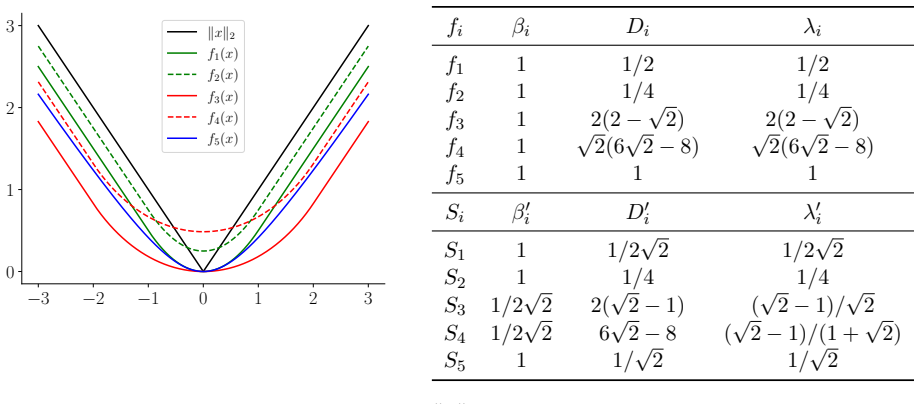
- For any norm, the Moreau envelope is optimal among outer smoothings; the $\ell_1$ norm has a unique optimal smoothing, while some weighted-$\ell_\infty$ norms have a whole interval of equally good ones.
- The max function and the maximum eigenvalue function each have a unique optimal smoothing with an explicit piecewise-quadratic (respectively spectral) formula and approximation error $(1-1/d)/(4\beta)$.
- Composing that optimal max smoothing through a Lipschitz map with Lipschitz Jacobian yields an accelerated-gradient guarantee for finite maxima whose constant improves log-sum-exp smoothing by a factor $1/\sqrt{\log n}$ (Theorem 5.1).
- Every closed convex set containing a ball is a section of a smoothable cone, so the conic smoothing theory applies to general convex constraint sets (Theorem 5.2).
Reading between the lines
- We infer that the if-and-only-if interval statement makes optimal-smoothing search a convex feasibility problem: any $1$-smooth convex $f$ in $[F^{\mathrm{gen}}_\sigma, f^{\mathrm{gen}}_\sigma]$ is automatically Pareto-optimal, so solvers can select smoothings with extra structural properties for free.
- The authors explicitly leave open optimal smoothings under general norms; we infer that rebuilding the core around a non-Euclidean unit ball would change $w_\sigma$ and $w_K$, and could decide whether the $\sqrt{\log n}$ gain over log-sum-exp survives in the $\ell_\infty$-Lipschitz regime.
- We infer that the uniqueness criterion (core equals a translated copy of the original) is a practical diagnostic: cones like the nonnegative, second-order, and semidefinite cones have forced smoothings, whereas the exponential cone does not, so the exponential cone's interval freedom could be exploited to preserve sparsity or decomposability in conic algorithms.
- We infer that the numerical core computation for the exponential cone is a template for applying the theory to arbitrary convex bodies via the conic section in Theorem 5.2, though the paper stops short of testing that pipeline.
Editorial analysis
A structured set of objections, weighed in public.
Referee Report
Summary. This paper studies the problem of optimally smoothing sublinear functions and closed convex cones. It defines the functional/conic core, center, and width, and proves that for every target smoothness level the set of all optimal smoothings is an explicit interval between two extremal smoothings: Theorems 4.1 and 4.2 give the general characterizations, and Theorems 4.3--4.6 give the analogous characterizations for inner and outer smoothings. The theory is applied to norms, the ReLU and max functions, maximum eigenvalue functions, nonnegative/SOC/SDP/exponential cones, amenable composite functions, and general convex sets via conic lifting. Proofs are given in Section 4.3.
Significance. The main results, if correct, provide a complete, essentially parameter-free description of the Pareto frontier between smoothness and approximation error for two natural classes of nonsmooth objects. The paper contains explicit formulas for several important examples, validates them against known cases such as the Moreau envelope and the second-order cone, and derives a concrete improvement over log-sum-exp smoothing for finite maxima. The development is self-contained and nicely exhibits the function/set symmetry. I found the central argument sound; the issues that remain are local proof details and presentation points.
minor comments (5)
- [Section 4.3.2, Lemma 4.13, Eq. (4.19)] In the proof of Lemma 4.13, the unit normal ζ is introduced without specifying which element of N_S(P_S(0)) is chosen. The equality ||P_S(0)-ζ|| = ||P_S(0)||+1 requires ζ = -P_S(0)/||P_S(0)|| (with the P_S(0)=0 case handled separately). As written, the equality is not justified. This is a local repair: choose ζ accordingly or add a sentence justifying the existence of such a unit normal.
- [Section 4.3.2, Lemma 4.12] There is a sign error in the projection computation. Equation (2.1) gives P_{Sin_K}(0) = P_{CK}(0) + P_{B1}(-P_{CK}(0)), not P_{CK}(0) - P_{B1}(-P_{CK}(0)). The final displayed bound ||P_{Sin_K}(0)|| = ||x_K|| - 1 is correct once the sign is fixed, since P_{B1}(-x_K) = -x_K/||x_K||.
- [Section 3.1] The claim that a (λ,Δ)-smoothable sublinear function or cone must be (λ,0)-smoothable 'from Lemma 3.3' is not immediate and, under the stated definition, the scaling argument does not by itself prove it. Since the rest of the paper is developed for Δ=0 and the main theorems are proved there, please reword this reduction, prove it, or explicitly restrict the definition to Δ=0.
- [Section 4.2.5, Table 1] The exponential cone entries are computed numerically by dense sampling of the normal cone and numerical projection. The text should state more explicitly that the core, center, width, and the 'No' in the uniqueness column are numerical observations rather than rigorous analytic conclusions, so that the example is not over-interpreted.
- [Section 5.1, Theorem 5.1 proof] The proof uses the assertion that ∇fσ(z) ∈ ∂σ(0) for all z, saying this follows from finite distance and Lemma 4.9. This is true, but it deserves a short justification: finite distance implies epiσ is the horizon cone of epifσ, and the subgradient inequality combined with σ(y) = max_{ζ∈∂σ(0)}<ζ,y> gives the inclusion. Please add this one-line argument.
Circularity Check
No significant circularity: optimal-smoothing characterization is derived from explicit core/center/width definitions and independent convex-analytic lemmas.
full rationale
The central theorems (4.1/4.2) characterize all optimal smoothings as the interval between explicit extremal smoothings built from the functional/conic core, center, and width of the input sigma or K. These objects are defined directly from sigma/K, not from the family of optimal smoothings; Lemma 4.3 derives the core independently as an epigraph via Fenchel conjugation, and Lemma 4.9 — the horizon-cone identity for finite-distance smoothings — is proved from Rockafellar's recession-cone calculus without presupposing the interval characterization. The lower/upper bounds in Lemmas 4.10–4.13 follow by direct convex-analytic arguments (Moreau envelope formulas, smooth-set decompositions, and projection identities). The set-side proof relies on [20, Prop. 3] (representation of 1-smooth sets as C+B(0,1)); although this is a same-group citation, it is a parameter-free structural lemma with stated assumptions that do not include the target result, so under the review rules it counts as independent support and does not create circularity. No fitted parameter is renamed as a prediction, and no uniqueness conclusion is imported from prior work. The only issue found is a small, repairable exposition gap in Lemma 4.13: an arbitrary unit normal zeta in N_S(P_S(0)) need not be parallel to -P_S(0), so the equality ||P_S(0)-zeta|| = ||P_S(0)||+1 requires choosing zeta = -P_S(0)/||P_S(0)|| (with the P_S(0)=0 case handled separately). This is a correctness nuance, not a circularity, and does not affect the conclusions. Overall, the derivation is self-contained relative to standard convex analysis.
Assumptions & free parameters
assumptions (5)
- standard math Finite sublinear functions on a Euclidean space are support functions of their subdifferential at 0: sigma(y)=sup_{zeta in partial sigma(0)} <zeta,y>.
- standard math The Moreau envelope of a closed convex function with 1/2||.||^2 is 1-smooth, and any 1-smooth convex function can be represented as a Moreau envelope of a convex function (Rockafellar-Wets Proposition 12.60).
- domain assumption For closed convex sets at finite Hausdorff distance from a cone K, their horizon cones coincide (Lemma 4.9).
- domain assumption Any 1-smooth closed convex set S decomposes as C+B(0,1), and Minkowski sums with balls preserve smoothness (Liu-Grimmer [20, Proposition 3, Lemma 9]).
- domain assumption K is a closed convex cone with nonempty interior and K is not equal to E.
Cite this review
Pith. "Pith review of The Optimal Smoothings of Sublinear Functions and Convex Cones." pith.science (2026). https://pith.science/paper/6ACLG6ON
@misc{pith2026250806681,
  author       = {Pith},
  title        = {Pith review of: The Optimal Smoothings of Sublinear Functions and Convex Cones},
  year         = {2026},
  howpublished = {\url{https://pith.science/paper/6ACLG6ON}},
  note         = {Machine review of arXiv:2508.06681}
}
read the original abstract
This paper considers the problem of smoothing convex functions and sets, seeking the nearest smooth convex function or set to a given one. For convex cones and sublinear functions, a full characterization of the set of all optimal smoothings is given. These provide if and only if characterizations of the set of optimal smoothings for any target level of smoothness. Optimal smoothings restricting to either inner or outer approximations also follow from our theory. Finally, we apply our theory to provide insights into smoothing amenable functions given by compositions with sublinear functions and generic convex sets by expressing them as conic sections.
Figures

Forward citations
Cited by 2 Pith papers
-
An Elementary Proof of the Near Optimality of LogSumExp Smoothing
A new elementary lower bound shows any smoothing of the max function has error at least 0.40726 ln(d), making LogSumExp's ln(d) error near-optimal, with exact optimal smoothings for d=2,3.
-
A smoothing extended sequential quadratic method for difference-of-convex optimization over a convex composite inequality constraint
Develops a smoothing extension of ESQM for DC optimization over convex composite inequality constraints, proving O(ε^{-3}) iteration complexity to (ε,ε)-KKT points plus convergence in the convex case.
Reference graph
Works this paper leans on
-
[1]
Jean-Jacques Moreau. Proximité et dualité dans un espace hilbertien.Bulletin de la Société Mathématique de France, 93:273–299, 1965
work page 1965
-
[2]
A fast iterative shrinkage-thresholding algorithm for linear inverse problems
Amir Beck and Marc Teboulle. A fast iterative shrinkage-thresholding algorithm for linear inverse problems. SIAM Journal on Imaging Sciences, 2(1):183–202, 2009
work page 2009
-
[3]
Stochastic model-based minimization of weakly convex functions
Damek Davis and Dmitriy Drusvyatskiy. Stochastic model-based minimization of weakly convex functions. SIAM Journal on Optimization, 29(1):207–239, 2019
2019
-
[4]
J-P Penot and Mireille L Bougeard. Approximation and decomposition properties of some classes of locally dc functions.Mathematical Programming, 41(1):195–227, 1988
work page 1988
-
[5]
A remark on regularization in hilbert spaces.Israel Journal of Mathematics, 55(3):257–266, 1986
Jean-Michel Lasry and Pierre-Louis Lions. A remark on regularization in hilbert spaces.Israel Journal of Mathematics, 55(3):257–266, 1986
work page 1986
-
[6]
Approximation and regularization of arbitrary functions in hilbert spaces by the lasry-lions method
Hédy Attouch and Dominique Aze. Approximation and regularization of arbitrary functions in hilbert spaces by the lasry-lions method. InAnnales de l’Institut Henri Poincaré C, Analyse non linéaire, volume 10, pages 289–312. Elsevier, 1993
work page 1993
-
[7]
A. Ben-Tal and M. Teboulle. A smoothing technique for nondifferentiable optimization problems. In Szymon Dolecki, editor,Optimization, pages 1–11, Berlin, Heidelberg, 1989. Springer Berlin Heidelberg. 25
work page 1989
-
[8]
Amir Beck and Marc Teboulle. Smoothing and first order methods: A unified framework.SIAM Journal on Optimization, 22:557–580, 2012
work page 2012
Show all 35 references
-
[9]
Nearly maximum flows in nearly linear time
Jonah Sherman. Nearly maximum flows in nearly linear time. InProceedings of the 2013 IEEE 54th Annual Symposium on Foundations of Computer Science, FOCS ’13, page 263–269, USA, 2013. IEEE Computer Society
2013
-
[10]
Random gradient-free minimization of convex functions.Founda- tions of Computational Mathematics, 17(2):527–566, 2017
Yurii Nesterov and Vladimir Spokoiny. Random gradient-free minimization of convex functions.Founda- tions of Computational Mathematics, 17(2):527–566, 2017
2017
-
[11]
Subdifferentially polynomially bounded functions and gaussian smoothing-based zeroth-order optimization.arXiv preprint arXiv:2405.04150v3, 2024
Ming Lei, Ting Kei Pong, Shuqin Sun, and Man-Chung Yue. Subdifferentially polynomially bounded functions and gaussian smoothing-based zeroth-order optimization.arXiv preprint arXiv:2405.04150v3, 2024
2024 arXiv
-
[13]
Extremum problems with inequalities as subsidiary conditions
Fritz John. Extremum problems with inequalities as subsidiary conditions. InStudies and Essays, Presented to R. Courant on his 60th Birthday January 8, 1948, pages 187–204. Wiley Interscience, New York, 1948
1948
-
[14]
Rounding of polytopes in the real number model of computation.Mathematics of Operations Research, 21(2):307–320, 1996
Leonid G Khachiyan. Rounding of polytopes in the real number model of computation.Mathematics of Operations Research, 21(2):307–320, 1996
1996
-
[15]
Rounding of convex sets and efficient gradient methods for linear programming problems
Yurii Nesterov. Rounding of convex sets and efficient gradient methods for linear programming problems. Optimization Methods and Software, 23(1):109–142, 2008
2008
-
[16]
Performance estimation for smooth and strongly convex sets.arXiv preprint arXiv:2410.14811v2, 2024
Alan Luner and Benjamin Grimmer. Performance estimation for smooth and strongly convex sets.arXiv preprint arXiv:2410.14811v2, 2024
2024 arXiv
-
[17]
Analytic and polyhedral approximation of convex bodies in separable polyhedral banach spaces.Israel Journal of Mathematics, 105(1):139–154, 1998
Robert Deville, Vladimir Fonf, and Petr Hájek. Analytic and polyhedral approximation of convex bodies in separable polyhedral banach spaces.Israel Journal of Mathematics, 105(1):139–154, 1998
1998
-
[18]
A smoothing moving balls approximation method for a class of conic-constrained difference-of-convex optimization problems.arXiv preprint arXiv:2505.12314v1, 2025
Jiefeng Xu, Ting Kei Pong, and Nung sing Sze. A smoothing moving balls approximation method for a class of conic-constrained difference-of-convex optimization problems.arXiv preprint arXiv:2505.12314v1, 2025
2025 arXiv
-
[19]
Roger J. B. Wets R. Tyrrell Rockafellar.Variational Analysis. Springer Berlin, Heidelberg, 2009
2009
-
[20]
Gauges and accelerated optimization over smooth and/or strongly convex sets.arXiv preprint arXiv:2303.05037v3, 2024
Ning Liu and Benjamin Grimmer. Gauges and accelerated optimization over smooth and/or strongly convex sets.arXiv preprint arXiv:2303.05037v3, 2024
2024
-
[21]
Scalable projection-free optimization methods via multira- dial duality theory.arXiv preprint arXiv:2403.13688v2, 2024
Thabo Samakhoana and Benjamin Grimmer. Scalable projection-free optimization methods via multira- dial duality theory.arXiv preprint arXiv:2403.13688v2, 2024
2024 arXiv
-
[22]
Zikai Xiong and Robert M. Freund. The role of level-set geometry on the performance of pdhg for conic linear optimization. arXiv preprint arXiv:2406.01942v3, 2024
2024 arXiv
-
[23]
Freund and Jorge R
Robert M. Freund and Jorge R. Vera. Condition-based complexity of convex optimization in conic linear form via the ellipsoid algorithm.SIAM Journal on Optimization, 10(1):155–176, 1999
1999
-
[24]
Jonathan T. Barron. Squareplus: A softplus-like algebraic rectifier.arXiv preprint arXiv:2112.11687v1, 2021
2021 arXiv
-
[25]
Prajit Ramachandran, Barret Zoph, and Quoc V. Le. Searching for activation functions.arXiv preprint arXiv:1710.05941v2, 2017
2017 arXiv
-
[26]
Deep sparse rectifier neural networks
Xavier Glorot, Antoine Bordes, and Yoshua Bengio. Deep sparse rectifier neural networks. In Geoffrey Gordon, David Dunson, and Miroslav Dudík, editors, Proceedings of the Fourteenth International Conference on Artificial Intelligence and Statistics, volume 15 ofProceedings of ...
2011
-
[27]
Fast and accurate deep network learning by exponential linear units (elus).arXiv preprint arXiv:1511.07289v5, 2016
Djork-Arné Clevert, Thomas Unterthiner, and Sepp Hochreiter. Fast and accurate deep network learning by exponential linear units (elus).arXiv preprint arXiv:1511.07289v5, 2016. 26
2016 arXiv
-
[28]
Efficient projections onto the l 1-ball for learning in high dimensions
John Duchi, Shai Shalev-Shwartz, Yoram Singer, and Tushar Chandra. Efficient projections onto the l 1-ball for learning in high dimensions. InProceedings of the 25th international conference on Machine learning, pages 272–279, 2008
2008
-
[29]
Fast projection onto the simplex and the l1 ball.Math
Laurent Condat. Fast projection onto the simplex and the l1 ball.Math. Program., 158(1–2):575–585, July 2016
2016
-
[30]
A tutorial on geometric programming
Stephen Boyd, Seung-Jean Kim, Lieven Vandenberghe, and Arash Hassibi. A tutorial on geometric programming. Optimization and Engineering, 8(1):67–127, 2007
2007
-
[31]
Tyrrell Rockafellar.Convex analysis
R. Tyrrell Rockafellar.Convex analysis. Princeton landmarks in mathematics and physics. Princeton University Press, Princeton, N.J, 1997 - 1970
1997
-
[32]
James V. Burke. Descent methods for composite nondifferentiable optimization problems.Mathematical Programming, 33(3):260–279, 1985
1985
-
[33]
Gradient methods for minimizing composite functions.Mathematical Programming, 140(1):125–161, 2013
Yurii Nesterov. Gradient methods for minimizing composite functions.Mathematical Programming, 140(1):125–161, 2013
2013
-
[34]
A. S. Lewis and S. J. Wright. A proximal method for composite minimization.Mathematical Programming, 158(1):501–546, 2016
2016
-
[35]
On a class of nonsmooth composite functions.Mathematics of Operations Research, 28(4):677–692, 2003
Alexander Shapiro. On a class of nonsmooth composite functions.Mathematics of Operations Research, 28(4):677–692, 2003
2003
-
[36]
A method of solving a convex programming problem with convergence rateo(1/k2)
Yurii Nesterov. A method of solving a convex programming problem with convergence rateo(1/k2). Soviet Mathematics Doklady, 27(2):372–376, 1983. A Optimal Smoothing of the Maximum Eigenvalue Function ConsiderE = Sd×d, the space of symmetricd×d matrices with the trace inner prod...
1983
Reviewed August 5, 2026 · model on record in the stance chip above.
Discussion (0). Sign in to comment.