REVIEW 2 major objections 4 minor 2 cited by
Unifying Feature-Based Explanations with Functional ANOVA and Cooperative Game Theory
T0 review · 2 major / 4 minor · reviewed 2026-08-11 · deepseek-v4-flash
Pith's one-line read Feature-based explanations reduce to two choices: the feature distribution used for imputation and the aggregation of higher-order interactions.
desk verdict A genuinely useful two-axis framework for perturbation-based explanations, but the exact placement of Integrated Gradients and other gradient methods under 'partial b-fANOVA' is wrong and needs a caveat. read the letter →
The pith
A machine-rendered reading of the paper's core claim, the machinery that carries it, and where it could break.
The reading
What carries the argument
The load-bearing object is the fANOVA decomposition generated by a value function F_S(x)=\int F(x)\,dP(x_{-S}), together with the Möbius transform of the resulting explanation game. The fANOVA component recursively defines effects f_S(x)=\int F(x)\,dP(x_{-S})-\sum_{T\subset S}f_T(x), so the choice of P completely determines one dimension of the framework; the Möbius transform m(S)=\sum_{T\subseteq S}(-1)^{s-t}\nu(T) is the pure additive contribution of a set in cooperative game theory, and Theorem 4 shows that pure, partial, and full influence measures are precisely different summaries of this transform. Theorem 1 supplies the bridge to gradient methods by proving that b-fANOVA effects coincide with Taylor interactions when F is represented by its Taylor series around the baseline.
What would settle it
Take a one-dimensional ReLU network F(x)=\max(0,x-c) with a baseline b<c and an instance x_0>c. The exact b-fANOVA effect is $f^{{(b)}}$_1(x_0)=F(x_0)-F(b)=x_0-c, but the Taylor series of F around b is identically zero in a neighborhood of b, so Theorem 1's equality fails. This is a concrete model where the framework's gradient-method categorization is not exact.
Extended reading notes
Core claim
The central claim is that every feature-based explanation in the framework's catalog is determined by two components. First, the choice of distribution P in the fANOVA value function F_S(x) = \int F(x)\,dP(x_{-S}) specifies how the feature distribution enters the explanation: baseline (b-fANOVA) sets P to Dirac masses at a point b, marginal (m-fANOVA) integrates over the joint marginal distribution, and conditional (c-fANOVA) integrates over p(x_{-S} \mid x_S). Second, the game-theoretic aggregation of the Möbius transform m(S)=\sum_{T\subseteq S}(-1)^{s-t}\nu(T) yields three regimes: pure effects keep only the isolated effect m(S), partial effects (Shapley value, generalized values, Shapley interactions) spread higher-order terms with index-specific weights, and full effects include all higher-order terms involving the set. Theorem 1 identifies b-fANOVA effects with Taylor interactions, which is what places gradient-based methods in the framework; Theorem 2 states when the three decompositions coincide; Theorem 3 identifies the Möbius transform of the sensitivity game with the variance of c-fANOVA effects for independent features; and Theorem 4 gives the summary rules that make pure, partial, and full effects increasingly sensitive to higher-order interactions.
Load-bearing premise
The identification of b-fANOVA effects with Taylor interactions in Theorem 1 assumes that the model F is represented by its infinite Taylor series around the baseline b; for ReLU networks and tree ensembles this analyticity fails, so the framework's placement of gradient-based methods is only approximate for those model classes.
Editorial extensions
If this is right
- Baseline, interventional, and observational SHAP are all partial individual effects that differ only in whether the imputation is b-, m-, or c-fANOVA.
- PDP and M-plots compute pure joint effects of m- and c-fANOVA, so their centering choices align directly with fANOVA components.
- SAGE and PFI/CFI are the partial and full individual effects of the risk game, meaning they answer different questions about performance loss rather than competing versions of the same question.
- For independent features, the Möbius transform of the sensitivity game is the variance of the corresponding c-fANOVA effect, linking global sensitivity indices for dependent data to the same grid.
- Gradient-based methods such as Integrated Gradients, DeepSHAP, and Integrated Hessians summarize b-fANOVA effects, subject to the Taylor-representability condition in Theorem 1.
Reading between the lines
- The paper does not make this explicit, but the framework suggests that comparing explanation methods is a matter of comparing two dials; a practitioner could use it to pre-register exactly which distributional and interaction assumptions a method encodes.
- An implication beyond the paper is that benchmark disagreements between attribution methods can be diagnosed by holding one dial fixed and varying the other, rather than by treating methods as incommensurable.
- One testable extension is to quantify how far gradient-based attributions deviate from exact b-fANOVA effects on non-analytic models such as ReLU networks; Theorem 1 guarantees equality only when the Taylor representation exists.
- The appendix already points toward a broader grid: replacing the three imputations with retraining-based value functions would add model fitting as a third dimension, a direction the paper identifies as future work.
Signed reviews
Editorial analysis
A structured set of objections, weighed in public.
Referee Report
Summary. This paper proposes a unified framework for feature-based explanations by combining functional ANOVA (fANOVA) with cooperative game theory. Three fANOVA decompositions (baseline, marginal, conditional) capture the influence of the feature distribution, while three game-theoretic summary types (pure, partial, full) capture increasing influence of higher-order interactions. The framework is instantiated on local, sensitivity, and risk explanation games, and a catalog of existing XAI methods (SHAP variants, IG, DeepSHAP, SAGE, PFI, Sobol indices, etc.) is mapped to pairs (fANOVA type, interaction summary). The paper includes proofs of the main theorems in the appendix, a practitioner guide, and experiments on synthetic and real-world data.
Significance. If the categorization is accurate, the paper provides a valuable two-dimensional taxonomy that clarifies why explanation methods disagree: the choice of imputation distribution and the choice of higher-order interaction summary. The core mathematical machinery (Möbius inversion relating local games to fANOVA effects, Theorem 4's summary of the Möbius transform) is correct and well-presented. Concrete strengths are the machine-checkable-style appendix proofs, the explicit treatment of pure/partial/full effects in Tables 2 and 3, the reproducible code link, and the clear, falsifiable claim that each method is characterized by an imputation family and an interaction family. The empirical sections usefully illustrate the framework, especially the synthetic experiments varying feature correlation. The main weakness is that the catalog places Integrated Gradients and Integrated Hessians as exact instances of the partial b-fANOVA effect, but their weights depend on Taylor monomial degree rather than subset size, so that placement is not exact.
major comments (2)
- [Section 3.1, Theorem 1 and Appendix A.1] Integrated Gradients is catalogued as the partial individual b-fANOVA effect, but Eq. (5) shows that its weight on a b-fANOVA interaction I(κ) is kappa_i / sum(kappa), which depends on the degree vector, not the uniform Shapley weight 1/s. A concrete counterexample makes the gap concrete: for F(x1,x2)=x1^2*x2 with baseline b=(0,0) and instance x0=(1,1), the local b-fANOVA game has ν(empty)=0, ν({1})=0, ν({2})=0, ν({1,2})=1, so the Shapley partial effect is (0.5, 0.5). Integrated Gradients, however, assigns weights 2/3 and 1/3 because the only Taylor interaction has κ=(2,1). Thus IG is not the partial b-fANOVA effect, and Table 4's placement is inaccurate unless it is explicitly qualified as a degree-weighted generalization. The same issue affects Integrated Hessians, whose weights are product-weighted by degrees. The Limitations section (§7) states that some gradient methods summarize derivatives on a more fine-grained level, but the main text and Figure 1 present the placements without this caveat. I request that the authors either correct the classification (e.g., mark IG/IH as 'degree-weighted partial b-fANOVA') or add a prominent qualification in Section 4.1 and Figure 1.
- [Section 3.1, Theorem 1 and Appendix A.1] Theorem 1 identifies b-fANOVA effects with Taylor interactions only when F is represented by its Taylor series expanded around the baseline b. This analyticity assumption is load-bearing: deep networks with ReLU activations and tree ensembles are not globally Taylor-representable, so for such models the mappings of DeepSHAP, Integrated Gradients, and Integrated Hessians to b-fANOVA effects are at best approximate. The paper should state this assumption explicitly wherever the gradient-method taxonomy is used (Section 4.1 and Appendix E.1.2), rather than only in the Limitations section. The authors should also indicate whether the degree-weight issue in the previous comment is independent of this analyticity concern; the counterexample above uses a polynomial, so it is not an artifact of non-analyticity.
minor comments (4)
- [Section 1, Contributions] In the bullet 'Interpretations for three types of explanations ...', the word 'undermined' appears where 'underlined' or 'supported' is presumably intended; please correct the typo.
- [Title and abstract] The title and abstract contain 'ANOV A' with an extra space; this appears to be a formatting artifact and should be fixed to 'ANOVA'.
- [Section 3.2, Corollary 1 and Remark 1] Corollary 1 is essentially the Möbius inversion theorem applied to the inclusion ordering, as the authors themselves note in Remark 1. This is fine, but the framing as a 'corollary' of the framework should be softened if the reader might otherwise over-interpret it as a new prediction; the current text already handles this, so this is only a presentation suggestion.
- [Figure 1 and Table 4] Since Integrated Gradients and Integrated Hessians are not exact Shapley partial effects, Figure 1 and Table 4 would benefit from a footnote or asterisk indicating the degree-weighted nature of these methods, to avoid misleading practitioners who read the table as an exact correspondence.
Circularity Check
One acknowledged definitional identity (Möbius inversion) is non-load-bearing; the framework's categorizations and experiments are not circular.
-
self definitional
[Section 3.2, Corollary 1 and Remark 1]
"Corollary 1. The MT m(loc) x0 of the local explanation game ν(loc) x0 is the fANOVA effect fS evaluated at x0, m(loc) x0(S) = Σ T ⊆S (−1)s−tFT (x0) = fS(x0), i.e., the pure additive contribution of the features in S in the fANOVA decomposition. Remark 1. Corollary 1 follows directly from the definitions of the MT and the fANOVA components. In fact, both are special cases of the Möbius inversion theorem (Rota, 1964, Proposition 2) with the inclusion ordering."
The local explanation game is defined as ν(loc)(S) = F_S(x0), and the fANOVA effect f_S(x0) is defined from the same value functions F_S by inclusion-exclusion (Eq. 1). The Möbius transform of ν(loc) is exactly that same inclusion-exclusion, so the equality m(loc)(S) = f_S(x0) holds by construction rather than as an independently discovered prediction. The paper transparently labels it as 'follows directly from the definitions', and the central contribution—categorizing existing explanation methods along imputation and interaction dimensions—does not depend on this identity being an empirical output. Hence the circularity is real but minor and non-load-bearing.
full rationale
Apart from the acknowledged definitional identity in Corollary 1, the paper's derivation chain is self-contained. Theorem 1 is proved from the Taylor expansion and the inclusion-exclusion form of b-fANOVA, Theorems 2 and 3 are proved from the definitions of the value functions and variance, and Theorem 4 follows from standard game-theoretic summary formulas. The categorization of methods such as SHAP, SAGE, PFI, Sobol' indices, PDP, and M-plots is checked against their known definitions rather than against quantities fitted in this paper. The experiments use correctly specified synthetic models and real-world benchmarks; no fitted parameter is relabeled as a prediction. The self-citations (Muschalik et al. 2024a,b; Fumagalli et al. 2023, 2024) concern implementation details and approximation algorithms, not load-bearing theoretical premises. The placement of Integrated Gradients and Integrated Hessians under 'partial b-fANOVA' is approximate because their Taylor-interaction weights differ from Shapley weights; that is a correctness/accuracy issue, not circularity. Overall, the central claim has independent content and the only definitional reduction is openly acknowledged, so a low score is appropriate.
Assumptions & free parameters
assumptions (4)
- domain assumption F is representable by its Taylor series around baseline b for the explained instance x0 (Theorem 1).
- standard math The Möbius inversion theorem and inclusion-exclusion principle hold for the set function lattice (Lemma 1, Corollary 1).
- standard math For independent features, fANOVA effects on disjoint feature sets are independent and the variance decomposition holds (Section 2.1, Theorem 3).
- domain assumption Feature influence is meaningfully represented by the value function F_S(x) = E[F(x_S, X_-S)] under baseline, marginal, or conditional distributions (Definitions 1 to 3).
Cite this review
Pith. "Pith review of Unifying Feature-Based Explanations with Functional ANOVA and Cooperative Game Theory." pith.science (2026). https://pith.science/paper/6AOXCV5V
@misc{pith2026241217152,
  author       = {Pith},
  title        = {Pith review of: Unifying Feature-Based Explanations with Functional ANOVA and Cooperative Game Theory},
  year         = {2026},
  howpublished = {\url{https://pith.science/paper/6AOXCV5V}},
  note         = {Machine review of arXiv:2412.17152}
}
read the original abstract
Feature-based explanations, using perturbations or gradients, are a prevalent tool to understand decisions of black box machine learning models. Yet, differences between these methods still remain mostly unknown, which limits their applicability for practitioners. In this work, we introduce a unified framework for local and global feature-based explanations using two well-established concepts: functional ANOVA (fANOVA) from statistics, and the notion of value and interaction from cooperative game theory. We introduce three fANOVA decompositions that determine the influence of feature distributions, and use game-theoretic measures, such as the Shapley value and interactions, to specify the influence of higher-order interactions. Our framework combines these two dimensions to uncover similarities and differences between a wide range of explanation techniques for features and groups of features. We then empirically showcase the usefulness of our framework on synthetic and real-world datasets.
Figures


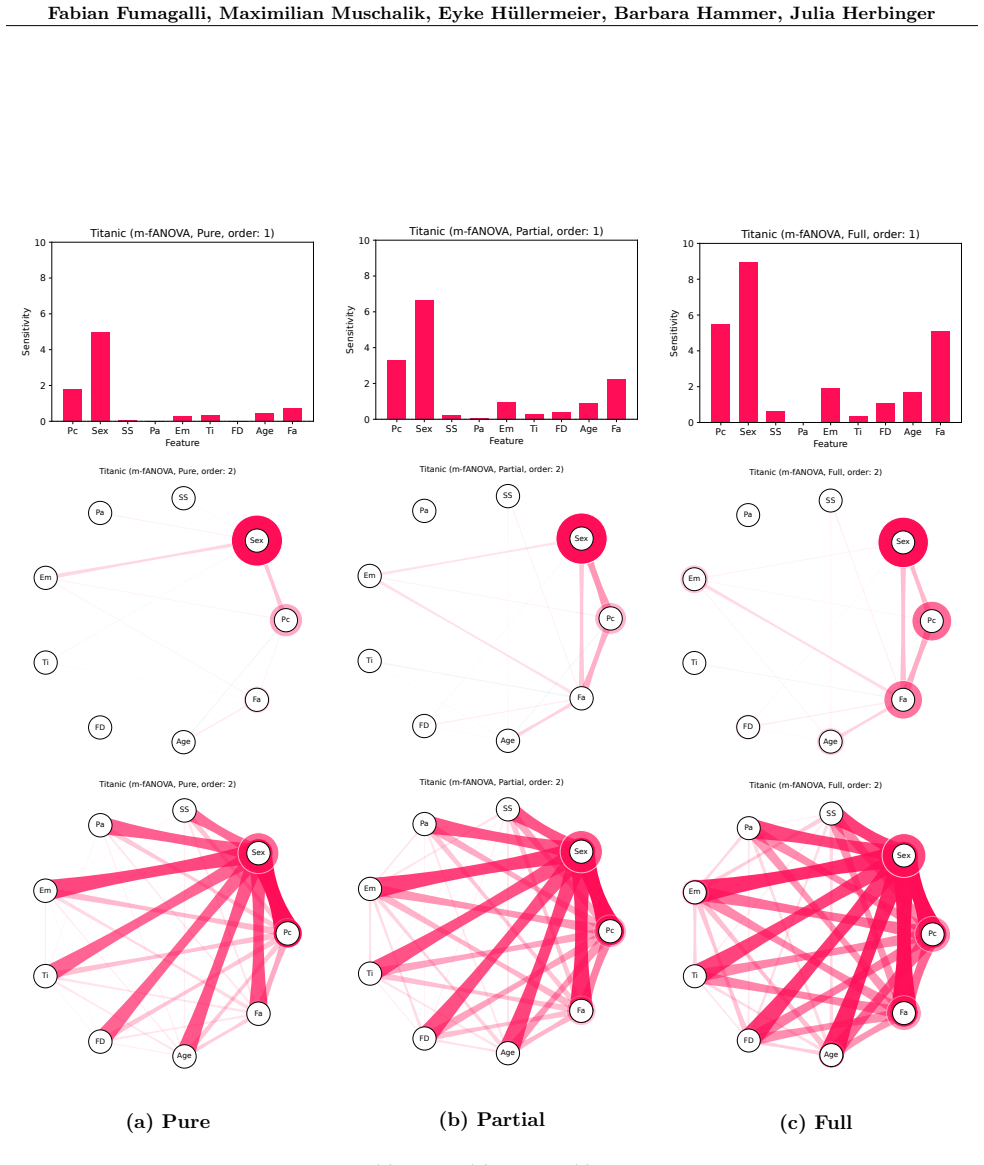
Figures from the paper (8 more)




Forward citations
Cited by 2 Pith papers
-
Permutation-Free High-Order Interaction Tests
Kernel tests xdHSIC, xLI, xSI detect high-order joint independence and factorisation without permutations, with a claimed standard normal null.
-
Adaptive Prompting: Ad-hoc Prompt Composition for Social Bias Detection
On StereoSet and SBIC, a trained DeBERTa encoder that selects per-input prompt compositions from 64 options raises macro F1 above every fixed composition, but on CobraFrames it falls below the best fixed composition.
Reference graph
Works this paper leans on
-
[1]
Aas, K., Jullum, M., and Løland, A. (2021). Explaining individual predictions when features are dependent: More accurate approximations to Shapley values . Artificial Intelligence , 298:103502
2021
-
[2]
Ancona, M., Ceolini, E., \" O ztireli, C., and Gross, M. (2018). Towards better understanding of gradient-based attribution methods for Deep Neural Networks . In 6th International Conference on Learning Representations, ICLR 2018, Vancouver, BC, Canada, April 30 - May 3, 2018, Conference Track Proceedings . OpenReview.net
2018
-
[3]
Apley, D. W. and Zhu, J. (2020). Visualizing the effects of predictor variables in black box supervised learning models . Journal of the Royal Statistical Society: Series B (Statistical Methodology) , 82(4):1059--1086
work page 2020
-
[4]
Au, Q., Herbinger, J., Stachl, C., Bischl, B., and Casalicchio, G. (2022). Grouped feature importance and combined features effect plot . Data Mining and Knowledge Discovery , 36(4):1401--1450
work page 2022
-
[5]
Aumann, R. J. and Shapley, L. S. (1974). Values of Non-Atomic Games . Princeton University Press
work page 1974
-
[6]
Bach, S., Binder, A., Montavon, G., Klauschen, F., M \"u ller, K.-R., and Samek, W. (2015). On pixel-wise explanations for non-linear classifier decisions by layer-wise relevance propagation . PloS one , 10(7):e0130140
work page 2015
-
[7]
Baniecki, H., Casalicchio, G., Bischl, B., and Biecek, P. (2024). Efficient and accurate explanation estimation with distribution compression. CoRR , abs/2406.18334
arXiv 2024
-
[8]
Bordt, S. and von Luxburg, U. (2023). From Shapley values to generalized additive models and back . In International Conference on Artificial Intelligence and Statistics , pages 709--745. PMLR
work page 2023
Show all 82 references
-
[9]
Breiman, L. (2001). Random Forests . Machine Learning , 45(1):5--32
2001
-
[10]
Chastaing, G., Gamboa, F., and Prieur, C. (2012). Generalized Hoeffding-Sobol decomposition for dependent variables - application to sensitivity analysis . Electronic Journal of Statistics , 6(none):2420–2448
2012
-
[11]
C., Lundberg, S
Chen, H., Covert, I. C., Lundberg, S. M., and Lee, S.-I. (2023). Algorithms to estimate Shapley value feature attributions . Nature Machine Intelligence , 5(6):590--601
2023
-
[12]
and Guestrin, C
Chen, T. and Guestrin, C. (2016). Xgboost: A scalable tree boosting system. Proceedings of the 22nd ACM SIGKDD International Conference on Knowledge Discovery and Data Mining , pages 785--794
2016
-
[13]
Covert, I., Lundberg, S., and Lee, S.-I. (2021). Explaining by removing: A unified framework for model explanation . Journal of Machine Learning Research , 22(209):1--90
2021
-
[14]
M., and Lee, S.-I
Covert, I., Lundberg, S. M., and Lee, S.-I. (2020). Understanding Global Feature Contributions With Additive Importance Measures . In Advances in Neural Information Processing Systems , volume 33, pages 17212--17223. Curran Associates, Inc
2020
-
[15]
Deng, H., Zou, N., Du, M., Chen, W., Feng, G., Yang, Z., Li, Z., and Zhang, Q. (2024). Unifying Fourteen Post-Hoc Attribution Methods With Taylor Interactions . IEEE Transactions on Pattern Analysis and Machine Intelligence , 46(7):4625--4640
2024
-
[16]
G., Janizek, J
Erion, G. G., Janizek, J. D., Sturmfels, P., Lundberg, S. M., and Lee, S. (2021). Improving performance of deep learning models with axiomatic attribution priors and expected gradients . Nat. Mach. Intell. , 3(7):620--631
2021
-
[17]
K., Bothmann, L., Wright, M
Ewald, F. K., Bothmann, L., Wright, M. N., Bischl, B., Casalicchio, G., and K \"o nig, G. (2024). A Guide to Feature Importance Methods for Scientific Inference . In Explainable Artificial Intelligence , pages 440--464, Cham. Springer Nature Switzerland
2024
-
[18]
Fisher, A., Rudin, C., and Dominici, F. (2019). All Models are Wrong, but Many are Useful: Learning a Variable's Importance by Studying an Entire Class of Prediction Models Simultaneously. Journal of Machine Learning Research , 20(177):1--81
2019
-
[19]
Friedman, E. J. (2004). Paths and consistency in additive cost sharing . Int. J. Game Theory , 32(4):501–518
2004
-
[20]
Friedman, J. H. (2001). Greedy Function Approximation: A Gradient Boosting Machine . The Annals of Statistics , 29(5):1189--1232
2001
-
[21]
Friedman, J. H. and Popescu, B. E. (2008). Predictive Learning via Rule Ensembles . The Annals of Applied Statistics , 2(3):916--954
2008
-
[22]
Fujimoto, K., Kojadinovic, I., and Marichal, J. (2006). Axiomatic characterizations of probabilistic and cardinal-probabilistic interaction indices . Games and Economic Behavior , 55(1):72--99
2006
-
[23]
Fumagalli, F., Muschalik, M., Kolpaczki, P., H \" u llermeier, E., and Hammer, B. (2024). KernelSHAP-IQ: Weighted Least Square Optimization for Shapley Interactions . In Forty-first International Conference on Machine Learning ( ICML 2024)
2024
-
[24]
Fumagalli, F., Muschalik, M., Kolpaczki, P., H \"u llermeier, E., and Hammer, B. E. (2023). SHAP - IQ : Unified Approximation of any-order Shapley Interactions . In Thirty-seventh Conference on Neural Information Processing Systems (NeurIPS 2023)
2023
-
[25]
Goldstein, A., Kapelner, A., Bleich, J., and Pitkin, E. (2015). Peeking Inside the Black Box: Visualizing Statistical Learning With Plots of Individual Conditional Expectation . Journal of Computational and Graphical Statistics , 24(1):44--65
2015
-
[26]
Grabisch, M. (1997). k-order additive discrete fuzzy measures and their representation . Fuzzy Sets Syst. , 92(2):167--189
1997
-
[27]
Grabisch, M., Marichal, J.-L., and Roubens, M. (2000). Equivalent representations of set functions . Mathematics of Operations Research , 25(2):157--178
2000
-
[28]
and Roubens, M
Grabisch, M. and Roubens, M. (1999). An axiomatic approach to the concept of interaction among players in cooperative games . International Journal of Game Theory , 28(4):547--565
1999
-
[29]
Han, T., Srinivas, S., and Lakkaraju, H. (2022). Which explanation should I choose? A function approximation perspective to characterizing post hoc explanations. In Koyejo, S., Mohamed, S., Agarwal, A., Belgrave, D., Cho, K., and Oh, A., editors, Advances in Neural Information...
2022
-
[30]
Harris, C., Pymar, R., and Rowat, C. (2022). Joint Shapley values: a measure of joint feature importance . In Proceedings of the International Conference on Learning Representations ( ICLR )
2022
-
[31]
Harsanyi, J. C. (1963). A simplified bargaining model for the n-person cooperative game . International Economic Review , 4(2):194--220
1963
-
[32]
Herbinger, J., Bischl, B., and Casalicchio, G. (2022). Repid: Regional effect plots with implicit interaction detection . In International Conference on Artificial Intelligence and Statistics , pages 10209--10233. PMLR
2022
-
[33]
T., and Wright, M
Hiabu, M., Meyer, J. T., and Wright, M. N. (2023). Unifying local and global model explanations by functional decomposition of low dimensional structures . In International Conference on Artificial Intelligence and Statistics , pages 7040--7060. PMLR
2023
-
[34]
Hoeffding, W. (1948). A Class of Statistics with Asymptotically Normal Distribution . The Annals of Mathematical Statistics , 19(3):293–325
1948
-
[35]
Hooker, G. (2004). Discovering additive structure in black box functions . In Proceedings of the tenth ACM SIGKDD International Conference on Knowledge Discovery and Data mining , pages 575--580
2004
-
[36]
Hooker, G. (2007). Generalized Functional ANOVA Diagnostics for High-Dimensional Functions of Dependent Variables . Journal of Computational and Graphical Statistics , 16(3):709--732
2007
-
[37]
and Matsumori, Y
Iwasawa, H. and Matsumori, Y. (2024). Interaction Decomposition of prediction function
2024
-
[38]
D., Sturmfels, P., and Lee, S
Janizek, J. D., Sturmfels, P., and Lee, S. (2021). Explaining Explanations: Axiomatic Feature Interactions for Deep Networks . J. Mach. Learn. Res. , 22:104:1--104:54
2021
-
[39]
Janzing, D., Minorics, L., and Bl \" o baum, P. (2020). Feature relevance quantification in explainable AI: A causal problem . In The 23rd International Conference on Artificial Intelligence and Statistics, AISTATS 2020, 26-28 August 2020, Online [Palermo, Sicily, Italy] , vol...
2020
-
[40]
and Barry, R
Kelley Pace , R. and Barry, R. (1997). Sparse spatial autoregressions . Statistics & Probability Letters , 33(3):291--297
1997
-
[41]
and Wright, M
Koenen, N. and Wright, M. N. (2024). Toward Understanding the Disagreement Problem in Neural Network Feature Attribution . In Explainable Artificial Intelligence , page 247–269, Cham. Springer Nature Switzerland
2024
-
[42]
Kolpaczki, P., Muschalik, M., Fumagalli, F., Hammer, B., and H\" u llermeier, E. (2024). SVARM-IQ : Efficient Approximation of Any-order S hapley Interactions through Stratification . In Proceedings of The 27th International Conference on Artificial Intelligence and Statistics...
2024
-
[43]
Lhoest, Q., Villanova del Moral, A., von Platen, P., Wolf, T., Šaško, M., Jernite, Y., Thakur, A., Tunstall, L., Patil, S., Drame, M., Chaumond, J., Plu, J., Davison, J., Brandeis, S., Sanh, V., Le Scao, T., Canwen Xu, K., Patry, N., Liu, S., McMillan-Major, A., Schmid, P., Gu...
2021
-
[44]
M., Erion, G
Lundberg, S. M., Erion, G. G., and Lee, S.-I. (2019). Consistent Individualized Feature Attribution for Tree Ensembles . arXiv preprint arXiv:1802.03888
2019 arXiv
-
[45]
Lundberg, S. M. and Lee, S.-I. (2017). A Unified Approach to Interpreting Model Predictions . In Advances in Neural Information Processing Systems , volume 30
2017
-
[46]
and Razaviyayn, M
Lundstrom, D. and Razaviyayn, M. (2023). A unifying framework to the analysis of interaction methods using synergy functions . In International Conference on Machine Learning , pages 23005--23032. PMLR
2023
-
[47]
L., Daly, R
Maas, A. L., Daly, R. E., Pham, P. T., Huang, D., Ng, A. Y., and Potts, C. (2011). Learning word vectors for sentiment analysis. In Proceedings of the 49th Annual Meeting of the Association for Computational Linguistics: Human Language Technologies, (HLT 2011) , pages 142--150...
2011
-
[48]
Marichal, J., Kojadinovic, I., and Fujimoto, K. (2007). Axiomatic characterizations of generalized values . Discret. Appl. Math. , 155(1):26--43
2007
-
[49]
Mitchell, R., Cooper, J., Frank, E., and Holmes, G. (2022). Sampling Permutations for Shapley Value Estimation . J. Mach. Learn. Res. , 23:43:1--43:46
2022
-
[50]
Molnar, C., K \"o nig, G., Bischl, B., and Casalicchio, G. (2023). Model-agnostic feature importance and effects with dependent features: a conditional subgroup approach . Data Mining and Knowledge Discovery , pages 1--39
2023
-
[51]
A., Casalicchio, G., Grosse-Wentrup, M., and Bischl, B
Molnar, C., K \"o nig, G., Herbinger, J., Freiesleben, T., Dandl, S., Scholbeck, C. A., Casalicchio, G., Grosse-Wentrup, M., and Bischl, B. (2022). General pitfalls of model-agnostic interpretation methods for machine learning models . In xxAI-Beyond Explainable AI: Internatio...
2022
-
[52]
Muschalik, M., Baniecki, H., Fumagalli, F., Kolpaczki, P., Hammer, B., and Hüllermeier, E. (2024a). shapiq: Shapley Interactions for Machine Learning . In The Thirty-eight Conference on Neural Information Processing Systems Datasets and Benchmarks Track
2024
-
[53]
Muschalik, M., Fumagalli, F., Hammer, B., and H \" u llermeier, E. (2024b). Beyond TreeSHAP: Efficient Computation of Any-Order Shapley Interactions for Tree Ensembles . In Thirty-Eighth AAAI Conference on Artificial Intelligence, ( AAAI 2024) , pages 14388--14396. AAAI Press
2024
-
[54]
Olsen, L. H. B., Glad, I. K., Jullum, M., and Aas, K. (2024). A comparative study of methods for estimating model-agnostic Shapley value explanations . Data Mining and Knowledge Discovery , pages 1--48
2024
-
[55]
Owen, A. B. (2013). Variance Components and Generalized Sobol’ Indices . SIAM/ASA Journal on Uncertainty Quantification , 1(1):19–41
2013
-
[56]
Owen, A. B. (2014). Sobol’ Indices and Shapley Value . SIAM/ASA Journal on Uncertainty Quantification , 2(1):245–251
2014
-
[57]
Owen, A. B. and Prieur, C. (2017). On Shapley Value for Measuring Importance of Dependent Inputs . SIAM/ASA Journal for Uncertainty Quantification , 5(1):986--1002
2017
-
[58]
Paszke, A., Gross, S., Massa, F., Lerer, A., Bradbury, J., Chanan, G., Killeen, T., Lin, Z., Gimelshein, N., Antiga, L., Desmaison, A., Kopf, A., Yang, E., DeVito, Z., Raison, M., Tejani, A., Chilamkurthy, S., Steiner, B., Fang, L., Bai, J., and Chintala, S. (2019). Pytorch: A...
2019
-
[59]
Pedregosa, F., Varoquaux, G., Gramfort, A., Michel, V., Thirion, B., Grisel, O., Blondel, M., Prettenhofer, P., Weiss, R., Dubourg, V., Vanderplas, J., Passos, A., Cournapeau, D., Brucher, M., Perrot, M., and Duchesnay, E. (2011). Scikit-learn: Machine Learning in Python . Jou...
2011
-
[60]
Why Should I Trust You?
Ribeiro, M. T., Singh, S., and Guestrin, C. (2016). "Why Should I Trust You?": Explaining the Predictions of Any Classifier . In Proceedings of the 22nd ACM SIGKDD International Conference on Knowledge Discovery and Data Mining, San Francisco, CA, USA, August 13-17, 2016 , pag...
2016
-
[61]
Rota, G.-C. (1964). On the foundations of combinatorial theory: I. Theory of M \"o bius functions . In Classic Papers in Combinatorics , pages 332--360. Springer
1964
-
[62]
Sanh, V., Debut, L., Chaumond, J., and Wolf, T. (2019). Distilbert, a distilled version of bert: smaller, faster, cheaper and lighter. CoRR , abs/1910.01108
2019 arXiv
-
[63]
Shapley, L. S. (1953). A Value for N-person Games . Contributions to the Theory of Games , 2(28):307--317
1953
-
[64]
Shrikumar, A., Greenside, P., and Kundaje, A. (2017). Learning Important Features Through Propagating Activation Differences . In Proceedings of the 34th International Conference on Machine Learning, ICML 2017, Sydney, NSW, Australia, 6-11 August 2017 , volume 70 of Proceeding...
2017
-
[65]
B., and Wattenberg, M
Smilkov, D., Thorat, N., Kim, B., Vi \' e gas, F. B., and Wattenberg, M. (2017). SmoothGrad: removing noise by adding noise . CoRR , abs/1706.03825
2017 arXiv
-
[66]
Sobol', I. M. (2001). Global sensitivity indices for nonlinear mathematical models and their Monte Carlo estimates . Mathematics and Computers in Simulation , 55(1):271–280
2001
-
[67]
Stone, C. J. (1994). The Use of Polynomial Splines and Their Tensor Products in Multivariate Function Estimation . The Annals of Statistics , 22(1):118 -- 171
1994
-
[68]
Strobl, C., Boulesteix, A.-L., Kneib, T., Augustin, T., and Zeileis, A. (2008). Conditional variable importance for random forests . BMC bioinformatics , 9:1--11
2008
-
[69]
and Kononenko, I
Strumbelj, E. and Kononenko, I. (2010). An Efficient Explanation of Individual Classifications using Game Theory . J. Mach. Learn. Res. , 11:1--18
2010
-
[70]
and Kononenko, I
S trumbelj, E. and Kononenko, I. (2014). Explaining prediction models and individual predictions with feature contributions . Knowledge and Information Systems , 41:647--665
2014
-
[71]
Strumbelj, E., Kononenko, I., and Robnik - Sikonja, M. (2009). Explaining instance classifications with interactions of subsets of feature values . Data Knowl. Eng. , 68(10):886--904
2009
-
[72]
Sturmfels, P., Lundberg, S., and Lee, S.-I. (2020). Visualizing the Impact of Feature Attribution Baselines . Distill . https://distill.pub/2020/attribution-baselines
2020
-
[73]
Sundararajan, M., Dhamdhere, K., and Agarwal, A. (2020). The S hapley T aylor interaction index . In International conference on machine learning , pages 9259--9268. PMLR
2020
-
[74]
and Najmi, A
Sundararajan, M. and Najmi, A. (2020). The Many Shapley Values for Model Explanation . In Proceedings of the 37th International Conference on Machine Learning, ICML 2020, 13-18 July 2020, Virtual Event , volume 119 of Proceedings of Machine Learning Research , pages 9269--9278. PMLR
2020
-
[75]
Sundararajan, M., Taly, A., and Yan, Q. (2017). Axiomatic Attribution for Deep Networks . In Proceedings of the 34th International Conference on Machine Learning, ICML 2017, Sydney, NSW, Australia, 6-11 August 2017 , volume 70 of Proceedings of Machine Learning Research , page...
2017
-
[76]
Tan, S., Hooker, G., Koch, P., Gordo, A., and Caruana, R. (2023). Considerations when learning additive explanations for black-box models . Machine Learning , 112(9):3333--3359
2023
-
[77]
Tsai, C.-P., Yeh, C.-K., and Ravikumar, P. (2023). Faith-shap: The faithful Shapley interaction index . Journal of Machine Learning Research , 24(94):1--42
2023
-
[78]
Tsang, M., Rambhatla, S., and Liu, Y. (2020). How does this interaction affect me? interpretable attribution for feature interactions . Advances in neural information processing systems , 33:6147--6159
2020
-
[79]
D., and Russell, C
Wachter, S., Mittelstadt, B. D., and Russell, C. (2017). Counterfactual Explanations without Opening the Black Box: Automated Decisions and the GDPR . CoRR , abs/1711.00399
2017 arXiv
-
[80]
L., Gugger, S., Drame, M., Lhoest, Q., and Rush, A
Wolf, T., Debut, L., Sanh, V., Chaumond, J., Delangue, C., Moi, A., Cistac, P., Rault, T., Louf, R., Funtowicz, M., Davison, J., Shleifer, S., von Platen, P., Ma, C., Jernite, Y., Plu, J., Xu, C., Scao, T. L., Gugger, S., Drame, M., Lhoest, Q., and Rush, A. M. (2020). Transfor...
2020
-
[81]
Zeiler, M. D. and Fergus, R. (2014). Visualizing and Understanding Convolutional Networks . In Computer Vision - ECCV 2014 - 13th European Conference, Zurich, Switzerland, September 6-12, 2014, Proceedings, Part I , volume 8689 of Lecture Notes in Computer Science , page 818–8...
2014
-
[82]
M., Cohen, T
Zintgraf, L. M., Cohen, T. S., Adel, T., and Welling, M. (2017). Visualizing Deep Neural Network Decisions: Prediction Difference Analysis . In 5th International Conference on Learning Representations, ICLR 2017, Toulon, France, April 24-26, 2017, Conference Track Proceedings ...
2017
Reviewed August 11, 2026 · model on record in the stance chip above.
Discussion (0). Continue with ORCID to comment.