REVIEW 3 major objections 6 minor 21 references
Crowdsourcing real-time viral disease and pest information. A case of nation-wide cassava disease surveillance in a developing country
T0 review · 3 major / 6 minor · reviewed 2026-08-14 · deepseek-v4-flash
Pith's one-line read This paper claims that a mobile phone-based crowdsourcing system with 29 trained volunteers sustained 76 weeks of near real-time, geo-tagged surveillance of cassava viral diseases and pests in Uganda, yielding more than 7,000 reports.
desk verdict Honest deployment paper with a real 76-week dataset; the incentive claims are suggestive, not causal, and the surveillance-grade framing outruns the unvalidated labels. read the letter →
The pith
A machine-rendered reading of the paper's core claim, the machinery that carries it, and where it could break.
The reading
What carries the argument
The load-bearing mechanism is the AdSurv crowdsourcing chain: a smartphone application that captures an image, a label, a comment, and GPS coordinates for each report; a back-end server that runs summary statistics; and a web dashboard that maps submissions in real time and can render disease-density heat maps. Weekly surveillance tasks broadcast a specific target, such as Cassava Mosaic Disease symptoms, and the responses update a national situation map. This mechanism carries the argument because it converts distributed human visual judgment into structured, spatially referenced surveillance data without requiring experts to travel.
What would settle it
Take a random sample of about 200 geo-tagged reports from the collected 7,000 and have cassava experts independently re-classify each submitted image; if expert and participant labels agree on fewer than roughly 70% of cases, the national situation map would be misleading rather than informative. A coarser check is to compare the crowdsourced disease heat map with the next annual national expert survey: district-level conflicts would point to the crowd's label accuracy as the weak link.
Extended reading notes
Core claim
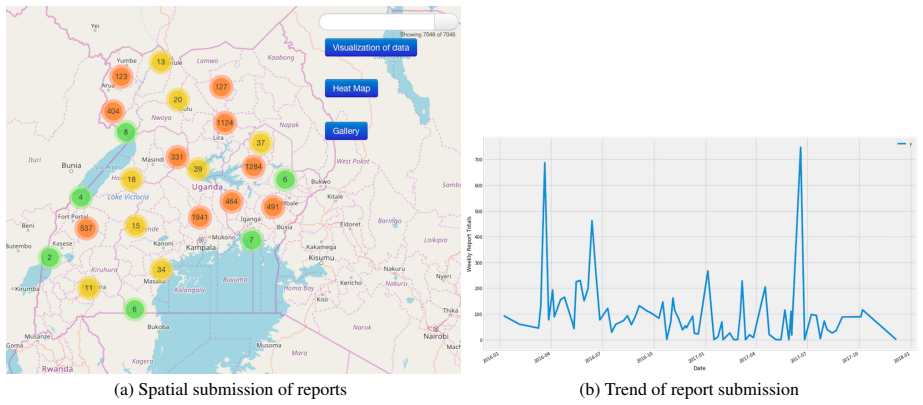
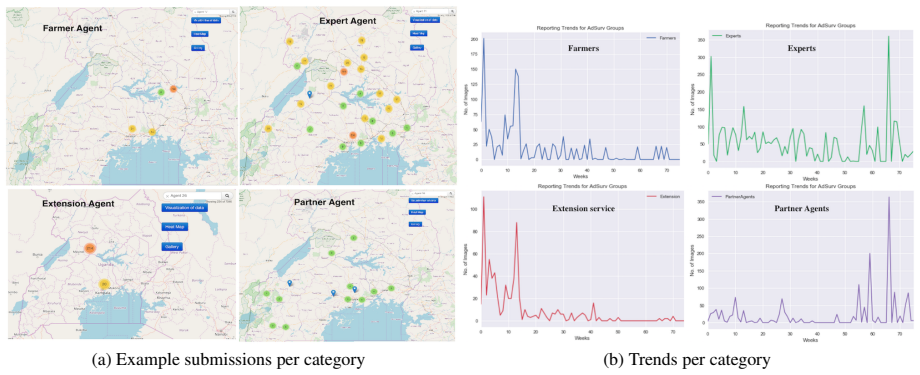
The central claim is that an ad hoc, phone-based crowdsourcing network can provide near real-time, geo-tagged surveillance of cassava viral disease and pests on a national scale. Over 76 weeks, a crowd of 29 trained volunteers submitted more than 7,000 reports, each containing an image, a text label, a comment, and a GPS reading, and these reports populated a live map and dashboard of crop health across Uganda. Participation reached about a third of what a fully compliant, trouble-free group would have produced, with dropouts caused by stolen or broken devices and by GPS resolution failures on some handsets. On incentives, the authors find that pay-per-report micropayments most raised participation among experts and partner agents, while farmers responded more to follow-up calls, SMS prompts, and reputation broadcasts, and each incentive bundle sustained elevated reporting for roughly ten weeks.
Load-bearing premise
The surveillance value of the system depends on the untested assumption that the disease labels and judgments supplied by participants are accurate enough to trust on a national disease map, and the paper explicitly does not evaluate this accuracy.
Editorial extensions
If this is right
- If the central claim is correct, national crop surveillance can run all year round at roughly the cost of mobile data rather than the cost of annual expert travel.
- Incentive design can be tuned by participant category, with direct micropayments for experts and partner agents and communication and reputation rewards for farmers.
- Rotating incentive bundles can sustain reporting for about ten weeks per bundle, so a schedule of alternating incentives keeps the crowd active.
- The accumulated image-and-label dataset is a resource for training automated disease classification tools.
- The architecture transfers to other crops, pests, and countries with similar smallholder farming systems and mobile phone penetration.
Reading between the lines
- Beyond the paper, once label accuracy is measured, reports could be weighted by participant reliability, converting the raw crowd signal into a calibrated surveillance statistic.
- The observed drop in participation when airtime was replaced by post-submission micropayments suggests a design rule: keep the marginal cost of reporting at zero for rural participants.
- The paper's 35-report-per-village cap is a primitive spatial duplicate control; an automated duplicate-detection step would be the scalable version.
- A staggered within-crowd comparison of incentive bundles would turn the reported ten-week decay curves into testable predictions about what keeps each participant type engaged.
Signed reviews
Editorial analysis
A structured set of objections, weighed in public.
Referee Report
Summary. The paper presents AdSurv, a mobile crowdsourcing system for cassava disease and pest surveillance, deployed in Uganda over 76 weeks with 29 volunteer participants (farmers, extension workers, crop experts, and partner agents). The authors report collecting more than 7,000 geo-tagged image reports, describe the participation patterns of the different user categories, and discuss the effects of six incentive types (equipment provision, data credit, prompts, subject surveillance, feedback, and micropayments). The paper argues that this ad hoc crowdsourcing approach can supplement annual expert surveys by providing more frequent, spatially distributed, near-real-time surveillance data. The authors acknowledge that the pilot was not designed as a controlled experiment and that the accuracy of the participant-supplied image labels was not evaluated.
Significance. If the feasibility claim holds, the paper provides a valuable case study of mobile crowdsourcing for agricultural disease surveillance in a low-resource setting. Strengths of the work include the long deployment period (76 weeks), the real-world participant pool, and the honest reporting of operational challenges (GPS failures, data credit diversion, and incentive gaming). The paper is also explicit about its own limitations, which aids interpretation. However, the scientific significance is moderated by two factors: the lack of any validation of the participants' image labels and diagnoses against expert ground truth, and the absence of experimental control in the incentive analysis. As a feasibility and deployment report, the paper is informative; as evidence for incentive effects or as a source of surveillance-grade disease data, it remains suggestive rather than conclusive.
major comments (3)
- [Related Work] The Related Work section states: 'Because we presently do not evaluate how accurate these particular analyses are, the work we present here mainly focuses on the crowdsourcing aspect.' This admission directly undercuts the central claim in the abstract and title that the system provides 'real-time surveillance data on viral disease and pest incidence and severity.' Without validation of participant-supplied labels and images against expert ground truth, the 7,000 reports are strong evidence of participation and data-collection feasibility, but not yet evidence that the resulting maps are surveillance-grade. The authors should either provide a small validation study (e.g., expert review of a random subsample) or revise the title, abstract, and conclusion to explicitly limit claims to 'submitted reports' and discuss data-quality validation as future work that is required before use in disease surveillance.
- [Incentives structure / Effect of incentives] The causal statements about incentives are not supported by the study design. For example, the Effect of incentives section claims 'The direct monetary rewards of pay-per-report most incentivised the crop experts and the partner agents' and 'Farmers seem to be most motivated by the non-monetary incentives,' yet the pilot was not a controlled experiment (Limitations section), incentives were applied in a 'semi-consecutive, semi-mixed fashion' and 'combined randomly from time to time,' and the participant pool was only 29 people. Multiple incentives changed simultaneously, and there was no control group. The authors themselves note in The pilot section that 'our assertions in this paper are mainly on the conjecture side of the line.' I recommend reframing all incentive-related conclusions as observational hypotheses with clearly identified confounds, rather than as demonstrated findings. In particular, the observed reporting rise from week 55 to week 60 coincided with the micropayment increase, renewal of SMS/call prompts, and the broadcast of two subject surveillance tasks; the isolated effect of the monetary incentive cannot be identified from these data.
- [Discussion on challenges] Item 7 of the challenges documents that after the micropayment was increased to 500 UGX per report, 'an agent would report many reports from within a very small restricted locality,' with counts jumping from 12 to over 70 per week, and that a cap of 35 rewardable reports per village had to be imposed. This is not a peripheral operational detail; it demonstrates that the monetary incentive motivated submissions that are unlikely to reflect genuine disease observations, undermining the surveillance value of the data. The paper should discuss the implications of this gaming behavior for data quality, describe any filtering or validation mechanisms applied (before or after the cap was introduced), and outline how future deployments will prevent or detect such behavior. Without such a discussion, the feasibility claim for disease surveillance remains incomplete.
minor comments (6)
- [Abstract and Results] The phrase 'more than 7,000 reports was collected' should be 'more than 7,000 reports were collected' for subject-verb agreement.
- [Figures] Figures 2 and 3 are referenced in the text but not included in the manuscript text; ensure that all figures are present with captions and readable axis labels, and that the timeseries plots have explicit week numbers.
- [Related Work] The typo 'voluteered geographical information' should be corrected to 'volunteered geographical information.'
- [Throughout] The system name is inconsistently written as both 'AdSurv' and 'Adsurv'; please unify the capitalization.
- [Reporting trends by category] In the bullet list, 'For the reminder of the pilot' should read 'For the remainder of the pilot.'
- [Results / Reporting by agent category] The statement that expert agents 'generally posted higher quality reports especially on the subject surveillance matters probably because of the specialised knowledge they possess' uses 'quality' without any defined quality metric and includes the speculative word 'probably.' This claim should either be removed or supported by a concrete measure (e.g., agreement with expert re-labeling).
Circularity Check
No circularity: the paper reports an empirical deployment and descriptive observations; no claimed derivation reduces to its own inputs.
full rationale
The paper's central claims are empirical rather than derivational: the AdSurv system was deployed for 76 weeks and collected over 7,000 geo-tagged reports, and the authors describe observed participation patterns under various incentives. There is no fitted model, no mathematical derivation, and no prediction that is defined in terms of its own outcome. The authors explicitly disclaim evaluation of label accuracy, stating 'Because we presently do not evaluate how accurate these particular analyses are, the work we present here mainly focuses on the crowdsourcing aspect,' which limits the claim to the feasibility of crowdsourced data collection rather than asserting a derived disease map. The incentive observations are reported as descriptive findings from the pilot, not as predictions validated against the same data. Citations to prior crowdsourcing frameworks such as KCVC are contextual and not load-bearing in a circular way; no central result is justified solely by a self-citation. The documented limitations, such as the pilot not being a controlled experiment and the observed gaming of micropayments, affect evidential strength and correctness risk, but they do not constitute circular reasoning. Therefore the circularity score is 0.
Assumptions & free parameters
assumptions (3)
- domain assumption Participants can operate smartphones and submit geo-tagged reports after limited training.
- domain assumption The image labels supplied by participants are accurate enough for disease surveillance.
- ad hoc to paper The 76-week reporting trends are attributable to the incentives applied.
Cite this review
Pith. "Pith review of Crowdsourcing real-time viral disease and pest information. A case of nation-wide cassava disease surveillance in a developing country." pith.science (2026). https://pith.science/paper/6B4D3CM5
@misc{pith2026190804237,
  author       = {Pith},
  title        = {Pith review of: Crowdsourcing real-time viral disease and pest information. A case of nation-wide cassava disease surveillance in a developing country},
  year         = {2026},
  howpublished = {\url{https://pith.science/paper/6B4D3CM5}},
  note         = {Machine review of arXiv:1908.04237}
}
read the original abstract
In most developing countries, a huge proportion of the national food basket is supported by small subsistence agricultural systems. A major challenge to these systems is disease and pest attacks which have a devastating effect on the smallholder farmers that depend on these systems for their livelihoods. A key component of any proposed solution is a good disease surveillance network. However, current surveillance efforts are unable to provide sufficient data for monitoring such phenomena over a vast geographic area efficiently and effectively due to limited resources, both human and financial. Crowdsourcing with farmer crowds that have access to mobile phones offers a viable option to provide all year round real-time surveillance data on viral disease and pest incidence and severity. This work presents a mobile ad hoc surveillance system for monitoring viral diseases and pests in cassava. We present results from a pilot in Uganda where this system was deployed for 76 weeks. We discuss the participation behaviours of the crowds with mobile smartphones as well as the effects of several incentives applied.
Figures

Reference graph
Works this paper leans on
-
[1]
write newline
" write newline "" before.all 'output.state := FUNCTION fin.entry add.period write newline FUNCTION new.block output.state before.all = 'skip after.block 'output.state := if FUNCTION new.sentence output.state after.block = 'skip output.state before.all = 'skip after.sentence 'output.state := if if FUNCTION not #0 #1 if FUNCTION and 'skip pop #0 if FUNCTIO...
-
[2]
Agapie, E.; Teevan, J.; and Monroy-Hern \'a ndez, A. 2015. Crowdsourcing in the field: A case study using local crowds for event reporting. In Third AAAI Conference on Human Computation and Crowdsourcing
work page 2015
-
[3]
Chatzimilioudis, G.; Konstantinidis, A.; Laoudias, C.; and Zeinalipour-Yazti, D. 2012. Crowdsourcing with smartphones. IEEE Internet Computing 16(5):36--44
work page 2012
-
[4]
Chklovski, T., and Gil, Y. 2005. Towards managing knowledge collection from volunteer contributors. In AAAI Spring Symposium: Knowledge Collection from Volunteer Contributors , 21--27
work page 2005
-
[5]
Chklovski, T. 2003. Learner: a system for acquiring commonsense knowledge by analogy. In Proceedings of the 2nd international conference on Knowledge capture , 4--12. ACM
work page 2003
-
[6]
Haklay, M. 2013. Citizen science and volunteered geographic information: Overview and typology of participation. In Crowdsourcing geographic knowledge . Springer. 105--122
work page 2013
-
[7]
Kanefsky, B.; Barlow, N. G.; and Gulick, V. C. 2001. Can distributed volunteers accomplish massive data analysis tasks. Lunar and Planetary Science 1
work page 2001
-
[8]
V.; Bernstein, M.; Gerber, E.; Shaw, A.; Zimmerman, J.; Lease, M.; and Horton, J
Kittur, A.; Nickerson, J. V.; Bernstein, M.; Gerber, E.; Shaw, A.; Zimmerman, J.; Lease, M.; and Horton, J. 2013. The future of crowd work. In Proceedings of the 2013 conference on Computer supported cooperative work , 1301--1318. ACM
work page 2013
Show all 21 references
-
[9]
N.; and Ramjee, R
Mohan, P.; Padmanabhan, V. N.; and Ramjee, R. 2008. Nericell: rich monitoring of road and traffic conditions using mobile smartphones. In Proceedings of the 6th ACM conference on Embedded network sensor systems , 323--336. ACM
2008
-
[10]
Nuwamanya, E.; Baguma, Y.; Atwijukire, E.; Acheng, S.; and Alicai, T. 2015. Competitive commercial agriculture in sub saharan africa. International Journal of Plant Physiology and Biochemistry 7(2):12--22
2015
-
[11]
Otim-Nape, G.; Bua, A.; Thresh, J.; Baguma, Y.; Ogwal, S.; Ssemakula, G.; Acola, G.; Byabakama, B.; et al. 2000. The current pandemic of cassava mosaic virus disease in east africa and its control. The current pandemic of cassava mosaic virus disease in East Africa and its control
2000
-
[12]
Paolacci, G.; Chandler, J.; and Ipeirotis, P. G. 2010. Running experiments on amazon mechanical turk
2010
-
[13]
J., and Bederson, B
Quinn, A. J., and Bederson, B. B. 2011. Human computation: a survey and taxonomy of a growing field. In Proceedings of the SIGCHI conference on human factors in computing systems , 1403--1412. ACM
2011
-
[14]
K.; Chou, C
Rana, R. K.; Chou, C. T.; Kanhere, S. S.; Bulusu, N.; and Hu, W. 2010. Ear-phone: an end-to-end participatory urban noise mapping system. In Proceedings of the 9th ACM/IEEE International Conference on Information Processing in Sensor Networks , 105--116. ACM
2010
-
[15]
Silvertown, J. 2009. A new dawn for citizen science. Trends in ecology & evolution 24(9):467--471
2009
-
[16]
On the Move to Meaningful Internet Systems
Singh, P.; Lin, T.; Mueller, E. T.; Lim, G.; Perkins, T.; and Zhu, W. L. 2002. Open mind common sense: Knowledge acquisition from the general public. In OTM Confederated International Conferences" On the Move to Meaningful Internet Systems" , 1223--1237. Springer
2002
-
[17]
A.; and Leyton-Brown, K
Ssekibuule, R.; Quinn, J. A.; and Leyton-Brown, K. 2013. A mobile market for agricultural trade in uganda. In Proceedings of the 4th Annual Symposium on Computing for Development , 9. ACM
2013
-
[18]
Stevens, M., and D’Hondt, E. 2010. Crowdsourcing of pollution data using smartphones. In Workshop on Ubiquitous Crowdsourcing
2010
-
[19]
Thiagarajan, A.; Ravindranath, L.; LaCurts, K.; Madden, S.; Balakrishnan, H.; Toledo, S.; and Eriksson, J. 2009. Vtrack: accurate, energy-aware road traffic delay estimation using mobile phones. In Proceedings of the 7th ACM conference on embedded networked sensor systems , 85...
2009
-
[20]
Van Pelt, C., and Sorokin, A. 2012. Designing a scalable crowdsourcing platform. In Proceedings of the 2012 ACM SIGMOD International Conference on Management of Data , 765--766. ACM
2012
-
[21]
Zhu, H.; Kraut, R.; and Kittur, A. 2012. Organizing without formal organization: group identification, goal setting and social modeling in directing online production. In Proceedings of the ACM 2012 conference on Computer Supported Cooperative Work , 935--944. ACM
2012
Reviewed August 14, 2026 · model on record in the stance chip above.
Discussion (0). Continue with ORCID to comment.