REVIEW 2 major objections 6 minor 45 references
Identification of second-gradient elastic materials from planar hexagonal lattices. Part I: Analytical derivation of equivalent constitutive tensors
T0 review · 2 major / 6 minor · reviewed 2026-08-14 · deepseek-v4-flash
Pith's one-line read A hexagonal lattice of hinged, axially loaded bars is equivalent to a form I second-gradient elastic material, with closed-form condensed constitutive tensors.
desk verdict Closed-form condensed second-gradient tensors for the three-stiffness hexagonal lattice, honestly scoped; the main limitation—condensed projection—is disclosed, not hidden. read the letter →
The pith
A machine-rendered reading of the paper's core claim, the machinery that carries it, and where it could break.
The reading
What carries the argument
The central object is a 'form I' second-gradient elastic material, that is, a continuum whose energy is quadratic in both the strain and the strain gradient. The machinery is energy equivalence under constrained quadratic displacement boundary conditions: a lattice cell is loaded by $u = \alpha x + (x\otimes x):\beta$ plus an additional linear displacement $\Delta u$ chosen so that all nodal resultants vanish, and the same equilibrium constraint reduces the six quadratic amplitudes $\beta$ to four independent ones. The key fact is that this constraint produces the same reduced kinematics for the lattice and for the second-gradient continuum, so the transformation matrix between constrained and free amplitudes coincides ($T_{\rm lat}=T_{\rm SGE}$). Matching the cell energies for every cell position and every pair of amplitudes then determines the condensed tensors $C$, $M^*$, and $A^*$; matching the purely linear part first reproduces the known isotropic Cauchy moduli of the lattice. The 'condensed' qualification means that only those combinations of the full fifth- and sixth-order tensors that enter the quadratic self-equilibrated tests are fixed by the procedure.
What would settle it
Deform a large hexagonal lattice under a set of independent cubic displacement fields, measure the cell energy, and test whether these data can be matched by a positive-definite completion of the condensed tensors $M^*$ and $A^*$; a mismatch, or a completion that violates positive definiteness for positive $k,\hat{k},\tilde{k}$, would show that the lattice is not the full 'form I' material claimed.
Extended reading notes
Core claim
The central claim is that a hexagonal lattice with axially deformable bars can be identified with a 'form I' second-gradient elastic material: a continuum whose stored energy depends on strain and on the gradient of strain. The identification is made by imposing equality between the energy of a lattice unit cell and that of a hexagonal continuum cell for displacement fields with a dominant quadratic part, plus an extra linear displacement that makes the nodal forces vanish. This yields closed-form condensed constitutive tensors: the fourth-order Cauchy tensor $C$, the fifth-order strain-curvature coupling tensor $M^*$, and the sixth-order curvature tensor $A^*$ (Eqs. (87)--(90)). The equivalent material is generally nonlocal, anisotropic, and non-centrosymmetric, while its first-order Cauchy reduction is isotropic, local, and centrosymmetric; it reduces to a Cauchy material only as the hexagon side length $\ell$ tends to zero, when $M^*$ and $A^*$ vanish. Because the energy matching is restricted to self-equilibrated quadratic displacement fields, only a 'condensed' form of the material is identified, and the completion to the full set of second-gradient tensors is left to Part II.
Load-bearing premise
The load-bearing premise is that matching the energy only for displacement fields that already satisfy equilibrium is enough to pin down a real equivalent material: the missing higher-order stiffness constants must be fillable into a physically valid, positive-definite elastic solid, not just a description of the particular tests used.
Editorial extensions
If this is right
- The equivalent continuum has an internal length $\ell$: the higher-order moduli $M^*$ scale linearly and $A^*$ quadratically with the hexagon side length, so size effects disappear as the lattice is refined.
- The first-order (Cauchy) equivalent material is local, isotropic, and centrosymmetric, while the higher-order equivalent material is generally anisotropic and non-centrosymmetric; $M^*_{13}$ and $M^*_{14}$ vanish only on special curves in the stiffness-ratio plane.
- The first-order identification recovers the known isotropic Cauchy moduli of the hexagonal lattice, so the second-gradient formulas extend the established effective elasticity rather than replacing it.
- Because the identification is condensed, further independent tests or constraints are needed to determine the full second-gradient material; Part II is presented as supplying the missing completion, positive definiteness, and validation.
- The closed-form dependence of the tensors on $k,\hat{k},\tilde{k}$ and $\ell$ gives a direct design rule for microstructured solids with tunable nonlocal response.
Reading between the lines
- A natural extension, not made in the paper: if Part II produces a positive-definite completion, the condensed formulas become a ready homogenization rule, so that dispersion relations and gradient-dominated deformations of the lattice could be computed directly from the continuum tensors without solving the discrete network.
- A testable consequence the authors do not draw: subjecting the lattice to remote displacement fields with cubic components would excite the higher-order moduli that the condensed identification leaves undetermined; measuring that energy would show whether a valid completion exists.
- The same energy-matching-with-equilibrium-restoring-field scheme could be applied to other periodic truss topologies; the hexagonal case is special because the equilibrium constraint on the quadratic amplitudes coincides for the lattice and the continuum, which may not hold for other geometries.
- The stiffness-ratio-dependent non-centrosymmetry at the condensed level implies that lattices with unequal bars could serve as planar mechanical analogues of non-centrosymmetric or odd-elastic solids, a directional-response consequence the paper mentions only as design relevance.
Signed reviews
Editorial analysis
A structured set of objections, weighed in public.
Referee Report
Summary. This paper (Part I of two) derives, by energy equivalence, a homogeneous second-gradient elastic ('form I' Mindlin) solid equivalent to an infinite periodic hexagonal lattice of hinged bars deforming in pure axial extension, with three distinct bar stiffnesses k, k-hat, and k-tilde arranged so as to preserve hexagonal symmetry. The method prescribes remote displacements with a dominant quadratic component, augmented by an 'additional field' chosen to make the lattice nodal resultants vanish, and matches the lattice cell energy to the energy of a form I Mindlin solid under the corresponding equilibrium-constrained quadratic fields. This yields closed-form expressions for the first-order Cauchy tensor C (Eq. 87), the condensed coupling tensor M* and condensed curvature tensor A* (Eqs. 89-90), together with the coincidence of the lattice and continuum equilibrium-constraint sets, T_lat = T_SGE (Eq. 88). The identification is explicitly 'condensed': it fixes only the projections of the full higher-order tensors onto the four-dimensional self-equilibrated quadratic subspace, a limitation that the abstract and Section 5 acknowledge. The equivalent response reduces to a Cauchy material only as the hexagon side length tends to zero. Positive definiteness and symmetry of the tensors, completion to a full second-gradient material, and numerical validation are deferred to Part II.
Significance. If correct, the result provides the first fully explicit, closed-form nonlocal constitutive law for the three-stiffness hexagonal axial-bar lattice, demonstrating a physically interesting effect: a lattice that is isotropic, local, and centrosymmetric at the Cauchy order becomes anisotropic, nonlocal, and non-centrosymmetric at the second-gradient order (Eq. 91, Fig. 5). Strong points are the systematic energy-matching framework, the explicit reporting of all coefficient matrices in Appendix A (which makes the closed-form results independently checkable), the clean l- and l^2-scaling of the higher-order terms, and a nontrivial internal consistency check: the self-equilibrium constraint sets of the lattice and of the second-gradient solid coincide once C is identified (Eq. 88). The derivation is parameter-free in the sense that the constitutive coefficients are explicit functions of (k, k-hat, k-tilde, l) with no fitted constants, and the first-order benchmark against the Day et al. moduli holds once Eq. (1)'s prefactor is read as sqrt(27/16). The condensed character of the identification is honestly disclosed.
major comments (2)
- [Sec. 3, Eqs. (41)-(45); Sec. 4.3, Eqs. (85)-(90)] The two central algebraic steps of the derivation are asserted rather than derived. The passage from the resultant equilibrium equations (41)-(43) to the solution (44)-(45) of the 'system of 30 linear equations in the 18 unknown components' is presented without any solution procedure, even though this solution defines the additional field used in every subsequent energy computation. Likewise, the energy matching (84) is a heavily overdetermined system (more than one hundred scalar identities G[r] = H[r] for r = 1,...,10 against roughly twenty-eight constitutive unknowns), and the paper asserts without demonstration that Eqs. (87)-(90) satisfy all of these identities simultaneously. Because the manuscript is explicitly an analytical derivation, please outline the solution procedure for the 30-equation system, or state clearly that Eqs. (44)-(45) and the identities (85) were verified by symbolic computation, and indicate which of the scalar identities are independent.
- [Secs. 1, 4.3, and 5] The headline claim that the lattice 'can be identified with a form I Mindlin elastic material' (Section 1) is stated unconditionally, whereas the derivation fixes only the condensed tensors M* = M T_SGE and A* = T_SGE^T A T_SGE, i.e., the projections of the full fifth- and sixth-order constitutive tensors onto the four-dimensional equilibrium-constrained quadratic subspace (Eqs. 81-90). Section 5 discloses this limitation, but the abstract and introduction do not carry the qualification, and no argument is given that an admissible (positive-definite, symmetry-respecting) completion M, A exists. Since a positive-definite algebraic extension of A always exists once A* is positive definite, the decisive open check is the positive definiteness of A* over the admissible stiffness range, which is deferred to Part II. I recommend restating the central claim as the identification of the condensed equilibrium-subspace response, with the full material identification explicitly conditional on the Part II completion, or, alternatively, verifying positive definiteness of A* within this paper.
minor comments (6)
- [Eq. (1)] The shear-modulus prefactor should be typeset as sqrt(27/16) (that is, 3 sqrt(3)/4) rather than (sqrt 27)/16, since only the former value is consistent with C33 in Eq. (87).
- [Sec. 3 and Sec. 5] There are typos in 'purely linear (beta = 0) didplacement' (near Fig. 3) and 'positivedefinitess' (Section 5).
- [Eqs. (36)-(44) and (58)] The (m,n|i) node notation, with its heavy sub- and superscripts, is difficult to parse; a nomenclature table or a consolidated statement of the Voigt index map (54)-(66) would substantially improve readability.
- [After Eq. (88)] Add a sentence showing that substituting C from Eq. (87) into the coefficients D1,...,D8 of Eq. (75) reproduces the entries of Tlat in Eq. (58); currently the claimed equality T_lat = T_SGE has to be re-derived by the reader.
- [Eqs. (49)-(50)] State explicitly that the condensed tensors are defined relative to the normalization that the additional field does not alter the mean displacement gradient (Eq. 40); a different normalization would in general change the lattice energy (59) and hence the identified M* and A*.
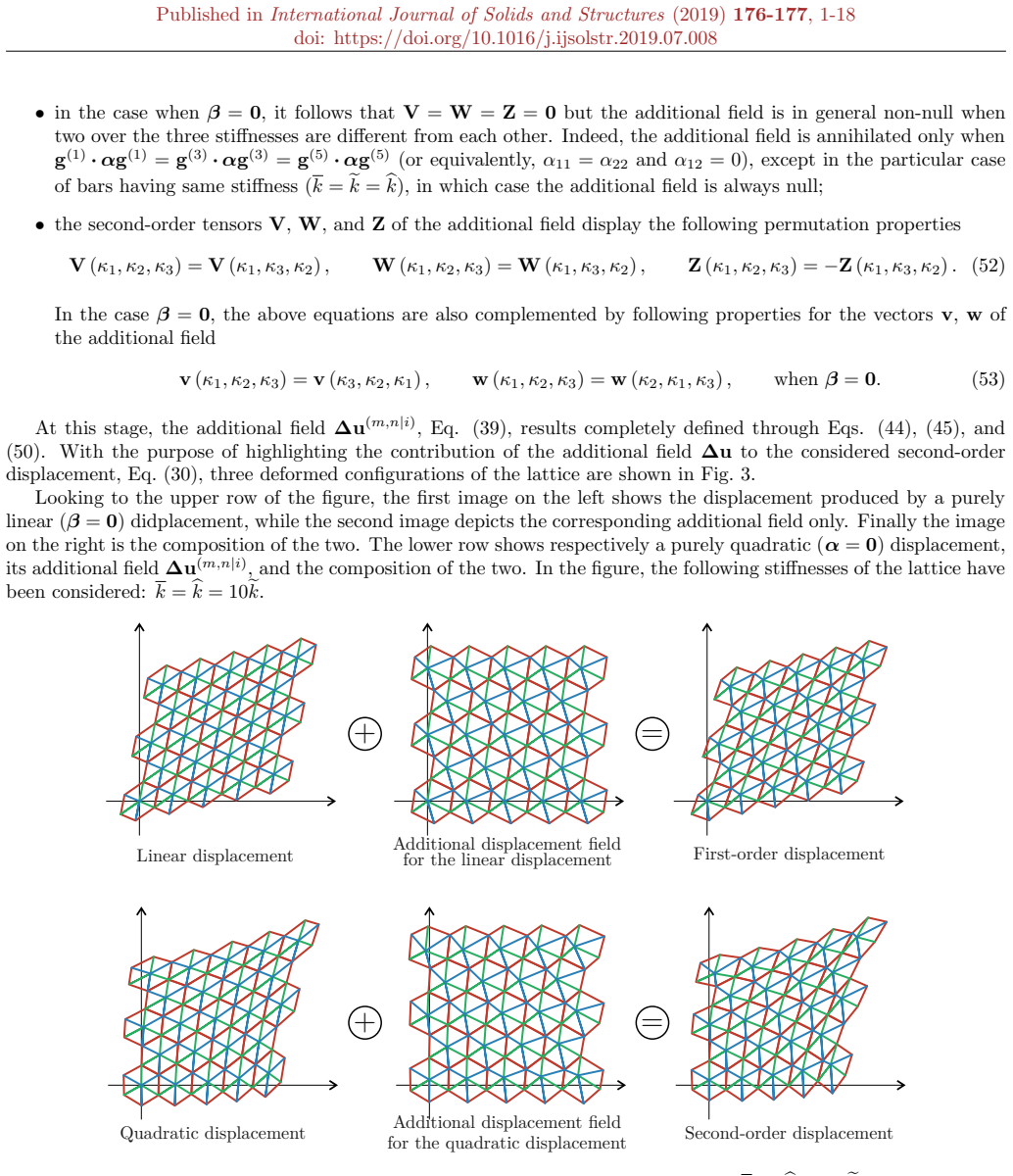
- [Sec. 4.4] The claim that the additional field plays a marginal kinematic role is illustrated with one stiffness ratio (k-hat/k = 2, k-tilde/k = 3) and no quantitative error measure; this is acceptable as an illustration but should be labeled as such.
Circularity Check
No circularity: the constitutive tensors are obtained from an explicit energy-equivalence derivation, not fitted to the target, and the condensed-form limitation is acknowledged rather than concealed.
full rationale
The derivation chain is self-contained. The lattice elastic energy (Eq. 59) is computed directly from bar elongations under equilibrium-constrained quadratic displacement fields, while the SGE energy (Eq. 83) is the integrated Mindlin form-I energy. Identification is imposed by the matching condition U_lat = U_SGE for every cell and every admissible pair (a, b*), Eq. (84), which gives the coefficient identities G[r] = H[r], Eq. (85). The first-order coefficients (Eq. 87) reproduce the external Cauchy moduli of Day et al., and the higher-order condensed tensors M* and A* (Eqs. 89-90) are solved from the same coefficient matching rather than fitted to any preselected outcome. The equality Tlat = TSGE, Eq. (88), is a consistency result following from the determined C, not an input assumption. The paper explicitly states that only a 'condensed' form is identified and that completion, positive definiteness, and validation are deferred to Part II; this is a transparent scope limitation rather than a circular dependency. Self-references to prior quadratic-field identification methods and to Part II are methodological or deferred-validation citations, not load-bearing premises that reduce the claimed result to its own inputs.
Assumptions & free parameters
assumptions (6)
- domain assumption Bars are linearly elastic, hinge-connected, and deform only axially (no bending).
- domain assumption The lattice is infinite and periodic, with a hexagonal unit cell as representative volume.
- domain assumption The equivalent continuum belongs to the class of Mindlin 'form I' second-gradient elastic materials with energy quadratic in strain and curvature.
- ad hoc to paper The equilibrium-restoring additional field is linear in nodal coordinates (Eq. 39).
- ad hoc to paper Energy matching over self-equilibrated quadratic fields is sufficient to identify the condensed tensors.
- standard math Cell displacement fields are linearly interpolated along bars when computing averaged gradients.
Cite this review
Pith. "Pith review of Identification of second-gradient elastic materials from planar hexagonal lattices. Part I: Analytical derivation of equivalent constitutive tensors." pith.science (2026). https://pith.science/paper/6CZZY42I
@misc{pith2026190801568,
  author       = {Pith},
  title        = {Pith review of: Identification of second-gradient elastic materials from planar hexagonal lattices. Part I: Analytical derivation of equivalent constitutive tensors},
  year         = {2026},
  howpublished = {\url{https://pith.science/paper/6CZZY42I}},
  note         = {Machine review of arXiv:1908.01568}
}
read the original abstract
A second-gradient elastic (SGE) material is identified as the homogeneous solid equivalent to a periodic planar lattice characterized by a hexagonal unit cell, which is made up of three different linear elastic bars ordered in a way that the hexagonal symmetry is preserved and hinged at each node, so that the lattice bars are subject to pure axial strain while bending is excluded. Closed form-expressions for the identified non-local constitutive parameters are obtained by imposing the elastic energy equivalence between the lattice and the continuum solid, under remote displacement conditions having a dominant quadratic component. In order to generate equilibrated stresses, in the absence of body forces, the applied remote displacement has to be constrained, thus leading to the identification in a \lq condensed' form of a higher-order solid, so that imposition of further constraints becomes necessary to fully quantify the equivalent continuum. The identified SGE material reduces to an equivalent Cauchy material only in the limit of vanishing side length of hexagonal unit cell. The analysis of positive definiteness and symmetry of the equivalent constitutive tensors, the derivation of the second-gradient elastic properties from those of the higher-order solid in the \lq condensed' definition, and a numerical validation of the identification scheme are deferred to Part II of this study.
Figures


Figures from the paper (2 more)


Reference graph
Works this paper leans on
-
[1]
H. Abdoul-Anziz and P. Seppecher. Strain gradient and generalized continua obtained by homogenizing frame lattices. Mathematics and Mechanics of Complex Systems , 6(3):213–250, 2018
work page 2018
-
[2]
A. Askar and A.S. Cakmak. A structural model of a micropolar continuum. International Journal of Engineering Science, 6(10):583–589, 1968
work page 1968
-
[3]
Bacca, D
M. Bacca, D. Bigoni, F. Dal Corso, and D. Veber. Mindlin second-gradient elastic properties from dilute two- phase cauchy-elastic composites. part I: Closed form expression for the effective higher-order constitutive tensor. International Journal of Solids and Structures , 50(24):4010–4019, 2013
2013
-
[4]
Bacca, D
M. Bacca, D. Bigoni, F. Dal Corso, and D. Veber. Mindlin second-gradient elastic properties from dilute two- phase cauchy-elastic composites part II: Higher-order constitutive properties and application cases. International Journal of Solids and Structures , 2013
2013
-
[5]
A. Bacigalupo and L. Gambarotta. Computational two-scale homogenization of periodic masonry: characteristic lengths and dispersive waves. Computer Methods in Applied Mechanics and Engineering , 213:16–28, 2012
work page 2012
-
[6]
A. Bacigalupo and L. Gambarotta. Second-gradient homogenized model for wave propagation in heterogeneous periodic media. International Journal of Solids and Structures , 51(5):1052–1065, 2014
work page 2014
-
[8]
M.R. Begley and J.W. Hutchinson. The mechanics of size-dependent indentation. Journal of the Mechanics and Physics of Solids , 46(10):2049–2068, 1998
work page 1998
-
[9]
A.J. Beveridge, M.A. Wheel, and D.H. Nash. The micropolar elastic behaviour of model macroscopically hetero- geneous materials. International Journal of Solids and Structures , 50(1):246 – 255, 2013
work page 2013
Show all 45 references
-
[10]
Bigoni and W.J
D. Bigoni and W.J. Drugan. Analytical derivation of cosserat moduli via homogenization of heterogeneous elastic materials. Journal of Applied Mechanics , 74(4):741–753, 2007
2007
-
[11]
Born and K
M. Born and K. Huang. Dynamical theory of crystal lattices . Clarendon press, 1954
1954
-
[12]
Buechner and R.S
P.M. Buechner and R.S. Lakes. Size effects in the elasticity and viscoelasticity of bone.Biomechanics and modeling in mechanobiology, 1(4):295–301, 2003
2003
-
[13]
A.L. Cauchy. Sur l’equilibre et le mouvement d’un syst´ eme de points materiels sollicit´ es par forces d’attraction ou de r´ epulsion mutuelle.Ex. de Math. , pages 187–213, 1828
-
[14]
Dal Corso and J.R
F. Dal Corso and J.R. Willis. Stability of strain-gradient plastic materials. Journal of the Mechanics and Physics of Solids, 59(6):1251–1267, 2011
2011
-
[15]
Danas, V.S
K. Danas, V.S. Deshpande, and N.A. Fleck. Size effects in the conical indentation of an elasto-plastic solid. Journal of the Mechanics and Physics of Solids , 60(9):1605–1625, 2012
2012
-
[16]
Day, K.A
A.R. Day, K.A. Snyder, E.J. Garboczi, and M.F. Thorpe. The elastic moduli of a sheet containing circular holes. Journal of the Mechanics and Physics of Solids , 40(5):1031–1051, 1992
1992
-
[17]
Genoese, A
A. Genoese, A. Genoese, N. L. Rizzi, and Ginevra Salerno. Force constants of bn, sic, aln and gan sheets through discrete homogenization. Meccanica, 53(3):593–611, 2018
2018
-
[18]
Gourgiotis and A
P.A. Gourgiotis and A. Piccolroaz. Steady-state propagation of a mode II crack in couple stress elasticity. International Journal of Fracture , 188(2):119–145, 2014
2014
-
[19]
Gourgiotis, Th
P.A. Gourgiotis, Th. Zisis, and K.P. Baxevanakis. Analysis of the tilted flat punch in couple-stress elasticity. International Journal of Solids and Structures , 85:34–43, 2016
2016
-
[20]
P.N. Keating. Effect of invariance requirements on the elastic strain energy of crystals with application to the diamond structure. Physical Review, 145(2):637, 1966
1966
-
[21]
Kirkwood
J.G. Kirkwood. The skeletal modes of vibration of long chain molecules. The Journal of Chemical Physics , 7(7):506–509, 1939
1939
-
[22]
R.S. Lakes. Experimental microelasticity of two porous solids. International Journal of Solids and Structures , 22(1):55–63, 1986
1986
-
[23]
Latture, M.R
R.M. Latture, M.R. Begley, and F.W. Zok. Design and mechanical properties of elastically isotropic trusses. Journal of Materials Research , 33(3):249–263, 2018
2018
-
[24]
Le Dret and A
H. Le Dret and A. Raoult. Homogenization of hexagonal lattices. Networks and Heterogeneous Media, 8(2):541– 572, 2013
2013
-
[25]
R.D. Mindlin. Micro-structure in linear elasticity. Archive for Rational Mechanics and Analysis , 16(1):51–78, 1964
1964
-
[26]
H.P. Neumann. Equations of state and phase transitions for some plane-lattice models. Physical Review A , 11(3):1043, 1975
1975
-
[27]
Ostoja-Starzewski
M. Ostoja-Starzewski. Lattice models in micromechanics. Applied Mechanics Reviews, 55(1):35–60, 2002
2002
-
[28]
Piccolroaz, G
A. Piccolroaz, G. Mishuris, and E. Radi. Mode III interfacial crack in the presence of couple-stress elastic materials. Engineering Fracture Mechanics, 80:60–71, 2012
2012
-
[29]
Rizzi, D
G. Rizzi, D. Veber, F. Dal Corso, and D. Bigoni. Identification of second-gradient elastic materials from planar hexagonal lattices. part II: Mechanical characteristics and model validation. International Journal of Solids and Structures, 176–177:19–35, 2019
2019
-
[30]
Seppecher, J.-J
P. Seppecher, J.-J. Alibert, and F. Dell’Isola. Linear elastic trusses leading to continua with exotic mechanical interactions. Journal of Physics: Conference Series , 319:109–124, 09 2011. 17 Published in International Journal of Solids and Structures (2019) 176-177, 1-18 doi...
2019 doi
-
[31]
Shi, G.and Tong
P. Shi, G.and Tong. The derivation of equivalent constitutive equations of honeycomb structures by a two scale method. Computational Mechanics, 15(5):395–407, 1995
1995
-
[32]
Sluys, R
L.J. Sluys, R. De Borst, and H.-B. M¨ uhlhaus. Wave propagation, localization and dispersion in a gradient- dependent medium. International Journal of Solids and Structures , 30(9):1153–1171, 1993
1993
-
[33]
Snyder, E.J
K.A. Snyder, E.J. Garboczi, and A. R. Day. The elastic moduli of simple two-dimensional isotropic composites: Computer simulation and effective medium theory. Journal of applied physics , 72(12):5948–5955, 1992
1992
-
[34]
Spadoni and M
A. Spadoni and M. Ruzzene. Elasto-static micropolar behavior of a chiral auxetic lattice. Journal of the Mechanics and Physics of Solids , 60(1):156 – 171, 2012
2012
-
[35]
Suiker, A.V
A.S.J. Suiker, A.V. Metrikine, and R. De Borst. Comparison of wave propagation characteristics of the cosserat continuum model and corresponding discrete lattice models. International Journal of Solids and Structures , 38(9):1563–1583, 2001
2001
-
[36]
W. E. Warren and E. Byskov. Three-fold symmetry restrictions on two-dimensional micropolar materials. Euro- pean Journal of Mechanics-A/Solids , 21(5):779–792, 2002
2002
-
[37]
Waseem, A.J
A. Waseem, A.J. Beveridge, M.A. Wheel, and D.H. Nash. The influence of void size on the micropolar constitutive properties of model heterogeneous materials. European Journal of Mechanics - A/Solids , 40:148 – 157, 2013
2013
-
[38]
Zisis, P.A
Th. Zisis, P.A. Gourgiotis, and F. Dal Corso. A contact problem in couple stress thermoelasticity: The indentation by a hot flat punch. International Journal of Solids and Structures , 63:226–239, 2015. Appendix A - Components of the matrices H[r] and G[r] The coefficients of the...
2019
-
[39]
+ 9I[1]I[2]I[3] + 54I2 [3] ) 32I2 [1]I3 [2] , H[6] 13 =−81 √ 3I[3] ( 2I[1]I[2] + 9I[3] ) 32I[1]I2 [2] , H[6] 14 =−243 √ 3I[3] ( 2I[1]I[2] + 3I[3] ) 32I[1]I2 [2] , H[6] 22 = 243I[3] ( 2I2 [1]I2 [2]− 15I[1]I[2]I[3] + 54I2 [3] ) 32I2 [1]I3 [2] , H[6] 23 = 81 √ 3I[3] ( 2I[1]I[2]− ...
-
[40]
+ 9I[1]I[2]I[3] + 162I2 [3] ) 32I2 [1]I3 [2] , H[6] 34 = 81I[3] ( −2I2 [1]I2
-
[41]
+ 81I[1]I[2]I[3] + 162I2 [3] ) 32I2 [1]I3 [2] , H[6] 44 = 81I[3] ( 2I[1]I[2] + 9I[3] )( 13I[1]I[2] + 18I[3] ) 32I2 [1]I3 [2] (A.6) H[7] 11 = 81I[3] ( 2I[1]I[2] + 9I[3] )( 8I[1]I[2] + 9I[3] ) 16I2 [1]I3 [2] , H[7] 12 = 2187I2 [3] ( 2I[1]I[2] + 3I[3] ) 16I2 [1]I3 [2] , H[7] 13 =...
2019
-
[42]
+ 27I[1]I[2]I[3] + 81I2 [3] )] / ( 64I2 [1]I3 [2] ) , H[10] 22 = 9I[3] 64I2 [1]I4 [2] [( −10 ( ˆk +~k )3 k 5 − ( ˆk +~k )2( 20ˆk2− 137~kˆk + 20~k2 ) k 4 + − ( ˆk +~k )( 10ˆk4− 53~kˆk3 + 219~k2ˆk2− 53~k3ˆk + 10~k4 ) k 3 + +2ˆk~k ( 12ˆk4− 45~kˆk3 + 349~k2ˆk2− 45~k3ˆk + 12~k4 ) k...
2019
-
[43]
+ 27I[1]I[2]I[3] + 81I2 [3] )] / ( 64I2 [1]I3 [2] ) , H[10] 44 = 9 64I2 [1]I4 [2] [( 2 ( ˆk +~k )3( 12ˆk2−~kˆk + 12~k2 ) k 6 + + ( ˆk +~k )2( 48ˆk4 + 260~kˆk3 + 103~k2ˆk2 + 260~k3ˆk + 48~k4 ) k 5 + + ( ˆk +~k )( 24ˆk6 + 286~kˆk5 + 583~k2ˆk4− 255~k3ˆk3 + 583~k4ˆk2 + 286~k5ˆk + ...
2019
-
[44]
+ D2 ( M∗ 21 + √ 3M∗ 31 ) + √ 3D5M∗ 12 + D5M∗ 32 + D6 (√ 3M∗ 11 + M∗ 31 ) + M∗ 12 ) , G[9] 13 = 9 2𝓁 ( D1M∗ 23 + √ 3D1M∗ 33 + D3M∗ 21 + √ 3D3M∗ 31 + √ 3D5M∗ 13 + D5M∗ 33 + D7 (√ 3M∗ 11 + M∗ 31 ) + M∗ 13 + M∗ 31 ) , G[9] 14 = 9 2𝓁 (√ 3 (D1M∗ 34 + D4M∗
-
[45]
+ D1M∗ 24 + ( D4 + √ 3 ) M∗ 21 + √ 3D5M∗ 14 + D5M∗ 34 + D8 (√ 3M∗ 11 + M∗ 31 ) + M∗ 14 ) , G[9] 22 = 9 𝓁 ( D2M∗ 22 + √ 3 (D2 + 1) M∗ 32 + D6 (√ 3M∗ 12 + M∗ 32 )) , G[9] 23 = 9 2𝓁 ( D2M∗ 23 + √ 3D2M∗ 33 + D3M∗ 22 + √ 3D3M∗ 32 + D6 (√ 3M∗ 13 + M∗ 33 ) + D7 (√ 3M∗ 12 + M∗ 32 ) + ...
-
[46]
(A.20) 27
+ D2M∗ 24 + ( D4 + √ 3 ) M∗ 22 + D6 (√ 3M∗ 14 + M∗ 34 ) + D8 (√ 3M∗ 12 + M∗ 32 )) , G[9] 33 = 9 𝓁 ( D3 ( M∗ 23 + √ 3M∗ 33 ) + D7 (√ 3M∗ 13 + M∗ 33 ) + M∗ 33 ) , G[9] 34 = 9 2𝓁 ( D3M∗ 24 + √ 3D3M∗ 34 + ( D4 + √ 3 ) M∗ 23 + √ 3D4M∗ 33 + D7 (√ 3M∗ 14 + M∗ 34 ) + D8 (√ 3M∗ 13 + M∗...
2019 doi
Reviewed August 14, 2026 · model on record in the stance chip above.
Discussion (0). Continue with ORCID to comment.