REVIEW 2 major objections 4 minor 28 references
A L2-norm regularized incremental-stencil WENO scheme for compressible flows
T0 review · 2 major / 4 minor · reviewed 2026-08-14 · deepseek-v4-flash
Pith's one-line read Penalizing low-order stencil reconstructions by their L2 error cuts WENO dissipation without losing shock capture.
desk verdict A real but incremental WENO variant: the L2-regularization idea is sound and the benchmarks are encouraging, but the 5th-order claim is never verified for the hybrid scheme actually used. read the letter →
The pith
A machine-rendered reading of the paper's core claim, the machinery that carries it, and where it could break.
The reading
What carries the argument
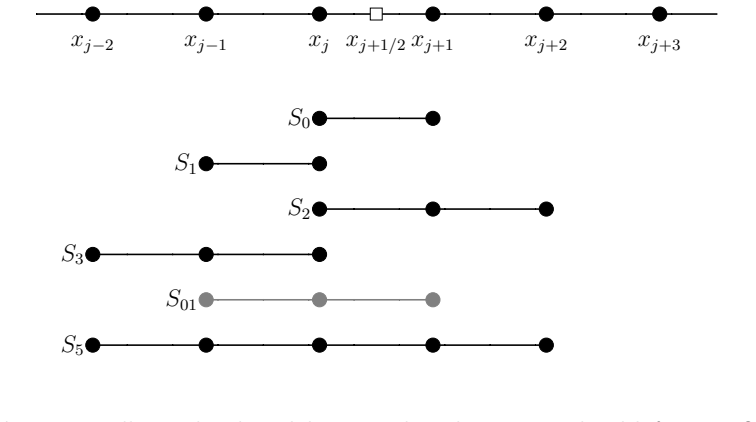
The central object is the regularized weighting rule $\alpha_k^r = d_k(1+\lambda\tau_5/(\lambda\beta_k+E_k+\varepsilon))$ applied over the four incremental candidate stencils of WENO-IS: two two-point and two three-point stencils inside a five-point full stencil. The novelty is the L2-norm error term $E_k$, the integrated squared difference between a candidate reconstruction and a three-point reference, which is nonzero only for the two-point stencils; together with the adaptive parameter $\lambda$ it transfers weight from low-order to high-order stencils in smooth regions. A non-dimensional discontinuity detector built from a sixth-order derivative of the characteristic variables controls $\lambda$, and a hybrid scheme switches to the optimal linear upwind flux when the detector falls below a threshold. This machinery is what carries the paper's claimed $\omega_k - d_k = O(\Delta x^4)$ closeness of the nonlinear weights to the optimal weights and hence the fifth-order accuracy.
What would settle it
Recompute the integrals defining $E_0$ and $E_1$ in Eq. (25) directly from the stated reconstruction polynomials. If the coefficient multiplying $(f_{j-1}-2f_j+f_{j+1})^2$ is not $1/45$ (one direct quadrature yields $23/960$), then the Taylor expansion in Eq. (29) does not describe the implemented penalty and the claimed $\omega_k-d_k=O(\Delta x^4)$ needs to be rechecked; a grid-convergence test on a smooth non-critical wave with this exact implementation would then settle whether fifth-order convergence actually occurs.
Extended reading notes
Core claim
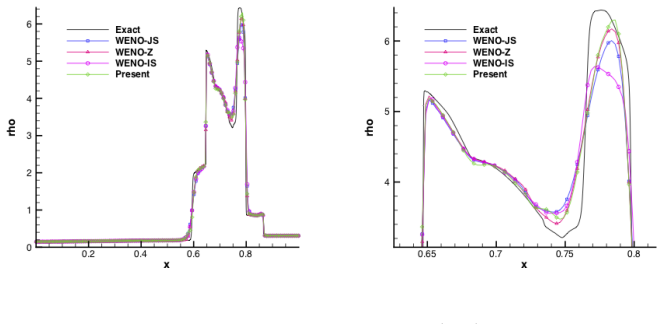
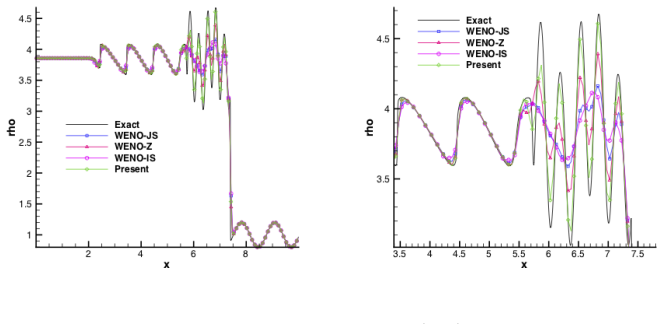
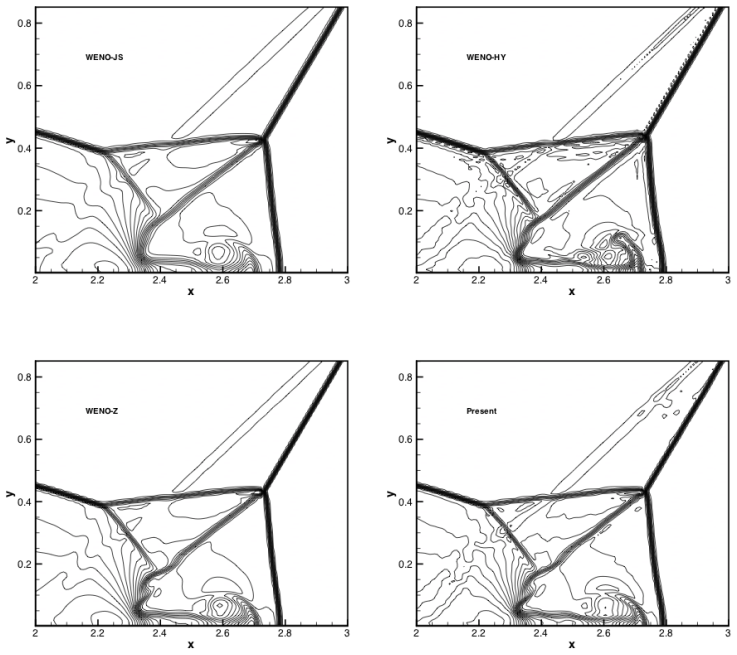
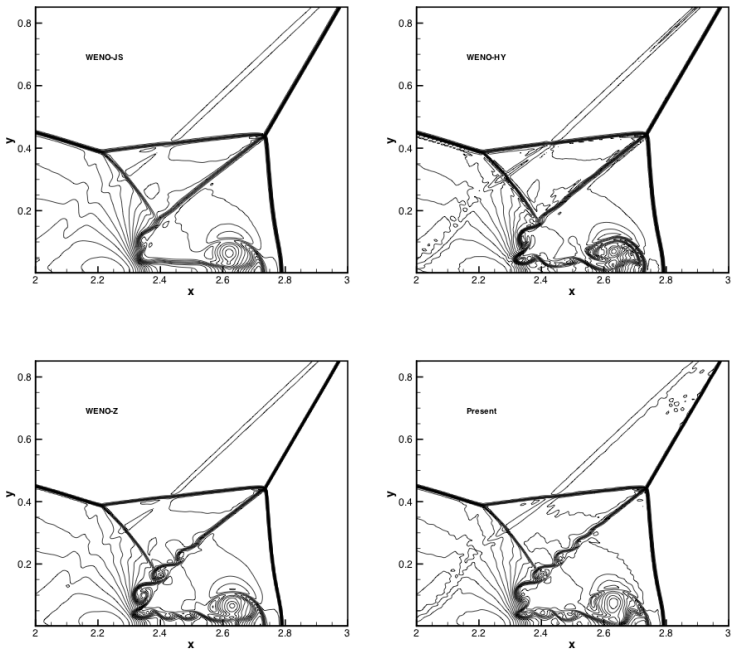
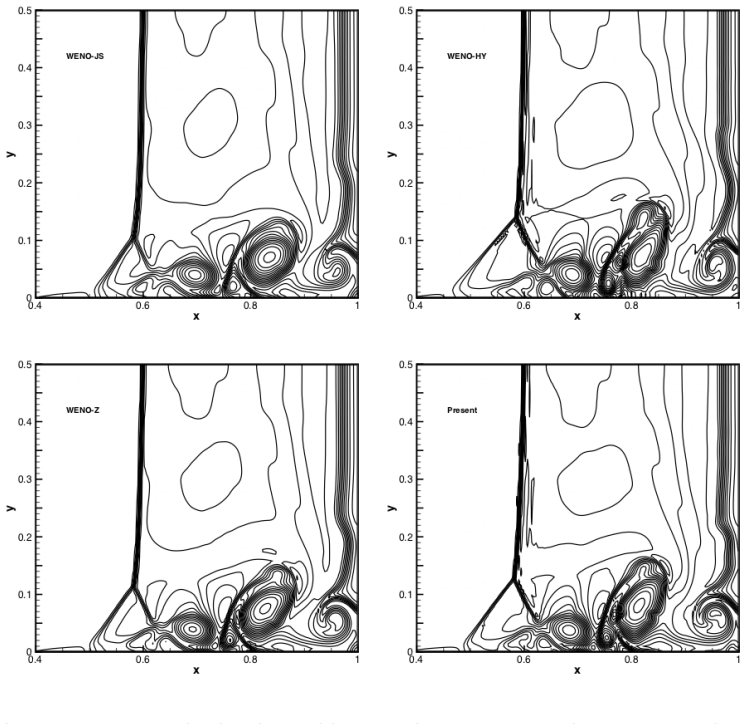
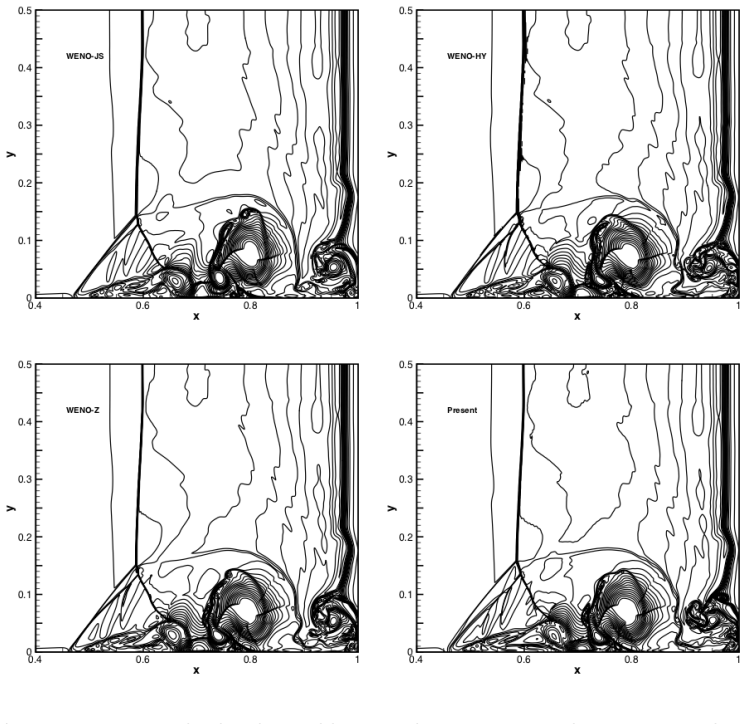
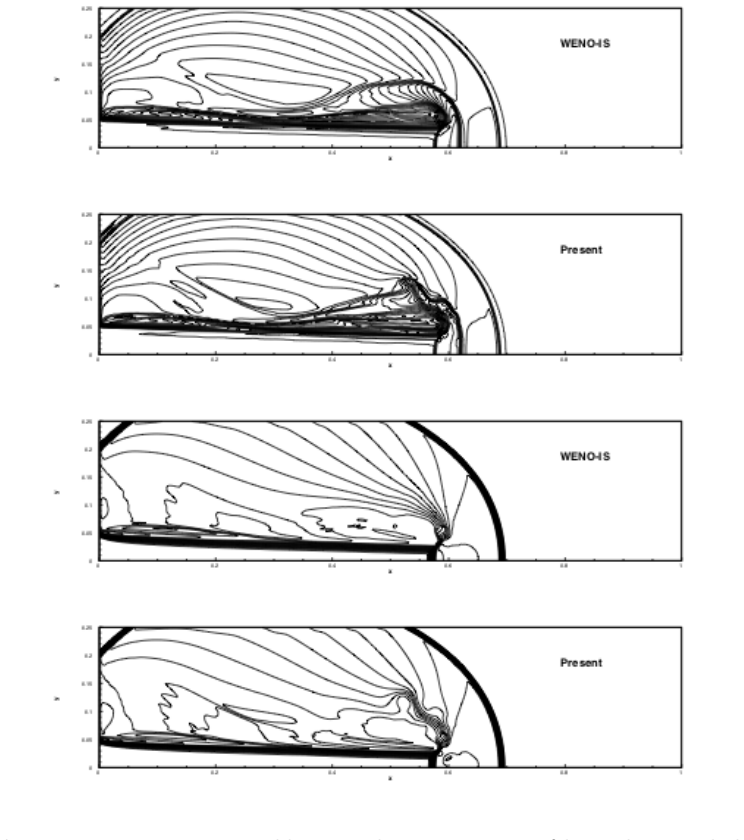
The central claim is that the excessive dissipation of incremental-stencil WENO comes from ignoring the accuracy gap between the two-point and three-point candidate stencils. The paper turns the WENO weighting into a regularized optimization: weights are computed by $\alpha_k^r = d_k(1+\lambda\tau_5/(\lambda\beta_k + E_k + \varepsilon))$ with $E_0=E_1=(1/45)(f_{j-1}-2f_j+f_{j+1})^2$, $E_2=E_3=0$, and $\lambda=c\sigma_s$ where $\sigma_s$ is a non-dimensional discontinuity detector. In smooth flow $\lambda$ is small, so the error terms suppress the two-point stencils and the three-point stencils dominate, restoring low dissipation and formal accuracy; at shocks $\lambda$ is large, the original smoothness indicators take over, and the two-point stencils remain available for robustness. Benchmark results are offered as evidence that this weighting recovers fifth-order convergence away from critical points and resolves broadband sound waves, shock-entropy interactions, double Mach reflection and viscous shock-tube structures with less damping than WENO-JS, WENO-Z and WENO-IS, while passing the Mach 2000 jet without positivity-preserving limiters.
Load-bearing premise
The scheme's accuracy and dissipation gains rest on the stated formula for the L2-norm penalty, $E_0=E_1=(1/45)(f_{j-1}-2f_j+f_{j+1})^2$, being exact; the paper states this formula without derivation, so if its coefficient or form is wrong, the weight transfer and the claimed $O(\Delta x^4)$ recovery are not guaranteed.
Editorial extensions
If this is right
- For smooth flows away from critical points, the scheme satisfies $\omega_k - d_k = O(\Delta x^4)$, so it can reach the formal fifth order of the full stencil rather than stagnating at the two-point stencil order.
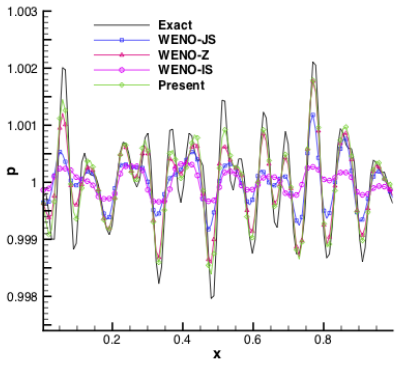
- For broadband sound waves, shock-entropy interaction and vortical structures, the scheme damps high-wavenumber content less than WENO-JS, WENO-Z and WENO-IS, which is what compressible DNS and LES need.
- Near strong discontinuities the two-point stencils are still preferred, giving shock robustness; the paper reports stability on a Mach 2000 jet without any positivity-preserving limiter.
- The hybrid detector switching makes the scheme faster than WENO-JS and WENO-Z, costing roughly three-quarters of the WENO-Z time in the reported two-dimensional cases.
Reading between the lines
- The same L2-regularization construction could extend to higher-order incremental stencil sets, such as seventh-order reconstructions with two-, three- and four-point candidates, by choosing a reference flux that penalizes every stencil below the target order.
- If the stated coefficient $1/45$ in $E_0$ differs from a direct quadrature of the reconstruction polynomials, the qualitative weight-shift mechanism may still survive, but the exact order condition and the reported dissipation balance would need recalibration.
- The hybrid threshold is fixed once in the paper as $C=1$, $\alpha=3$; treating that threshold as a tunable parameter could let users trade a little more dissipation for extra robustness in specific applications.
Signed reviews
Editorial analysis
A structured set of objections, weighed in public.
Referee Report
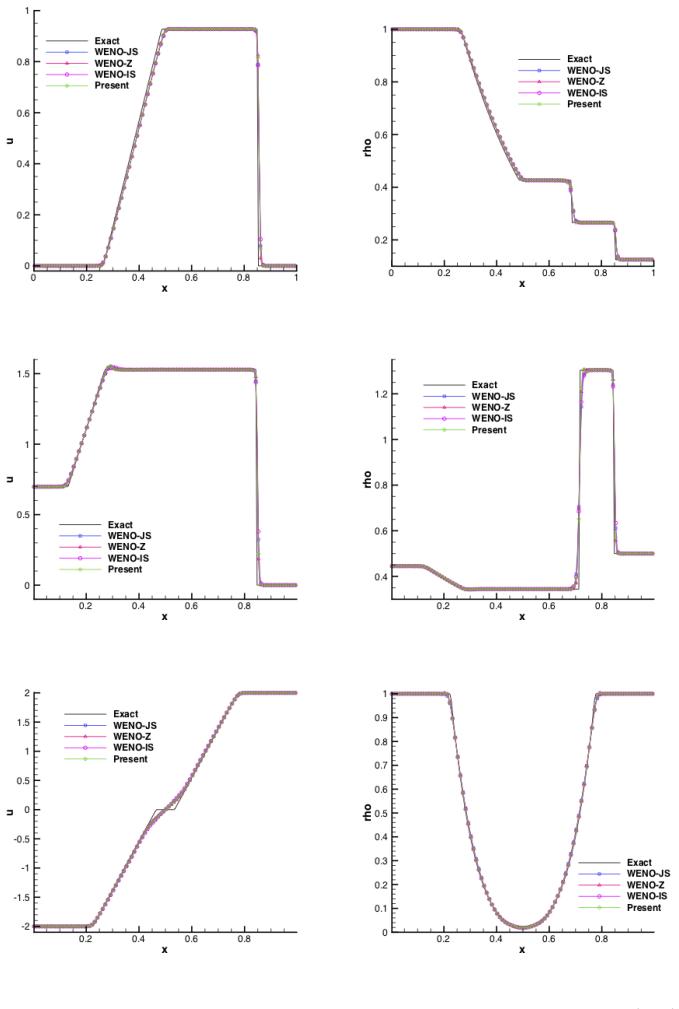
Summary. This manuscript proposes a modification of the WENO-IS scheme in which the nonlinear weights for the two 2-point candidate stencils are penalized by an L2-norm error relative to the central 3-point stencil, with the penalty strength controlled adaptively by a non-dimensional discontinuity detector. A further hybrid switch replaces the nonlinear reconstruction by an optimal linear upwind flux in regions identified as smooth. The resulting scheme is tested on one- and two-dimensional benchmark problems including shock tubes, interacting blast waves, the Shu-Osher problem, double Mach reflection, a viscous shock tube, and a Mach 2000 jet, and is reported to resolve fine flow structures with less numerical dissipation than WENO-JS, WENO-Z, WENO-IS, and WENO-HY while retaining robustness.
Significance. The proposed modification is conceptually simple and different from existing WENO weight adjustments: it treats the mismatch between 2-point and 3-point stencil accuracies as an L2-error term and regularizes the weights accordingly. If the claimed 5th-order accuracy and robustness are verified, the method would be a useful low-dissipation, robust shock-capturing option. Strengths of the manuscript include the use of parameters c=1, C=1, and alpha=3 taken from prior work rather than fitted to the benchmarks, comparisons against external reference solutions, a demanding benchmark suite, and an explicit enough description to reproduce the scheme. The principal weakness is that no convergence study is reported for the scheme as actually implemented, so the formal accuracy claim is not yet established.
major comments (2)
- [Sections 3.1, 3.3, and 4] The formal-order analysis in Section 3.1 establishes omega_k - d_k = O(Delta x^4) only for the pure regularized WENO weights (28) at non-critical points, but the scheme used in all Section 4 benchmarks is the hybrid flux (33) with the cell-wise switch (35). No convergence test is reported for this hybrid scheme; therefore the paper's stated 5th-order property is not verified for the proposed scheme as actually implemented. On smooth data the detector (30) scales as sigma_s = O(Delta x^10), while the threshold in (35) is epsilon = O(Delta x^3), so asymptotically the linear upwind flux (34) is selected throughout a smooth wave and the effective scheme differs from the WENO branch that is analyzed. The authors should add a scalar linear-advection convergence table for the hybrid flux (33)-(35) and a smooth two-dimensional Euler vortex convergence test, reporting errors and observed orders on a sequence of grids, including at least one case with a critical point.
- [Section 4 and Section 3.3] All reported 'Present' results use the hybrid scheme (33)-(35), so the improvement over WENO-IS cannot be attributed specifically to the L2-norm regularization; the linear-upwind branch alone may account for much of the reduced dissipation observed in smooth regions. To support the central claim, the authors should present at least one benchmark, for example the broadband sound-wave case or the Shu-Osher case, computed with the regularized WENO weights (28) alone, without the hybrid switch. This would isolate the contribution of the L2-norm regularization from the contribution of the linear-upwind hybridization.
minor comments (4)
- [Eq. (29)] The Taylor expansion in Eq. (29) is misprinted: the leading term should be (1/45) f''_j^2 Delta x^4, not (1/45) f''_j Delta x^4, and the remainder should be O(Delta x^8), not O(Delta x^6). The missing square makes the expression dimensionally inconsistent; the asymptotic conclusion omega_k - d_k = O(Delta x^4) is unaffected once the square is restored.
- [Eq. (12)] The Taylor expansion for tau_5 in Eq. (12) also appears to lack squares: the leading term should be (f'''_j)^2 Delta x^6 and the second term should contain squared derivatives. This is likely a typesetting omission, but it should be corrected for consistency with the smoothness-indicator definition (10).
- [Section 3.3 and Eq. (33)] The switch function sigma_{j+1/2} in Eq. (33) and the detector sigma_s in Eq. (30) are not explicitly related. The text states that sigma_{j+1/2} equals one in smooth regions and later states the condition sigma_s < epsilon for using the linear scheme; the authors should state explicitly that sigma_{j+1/2} = 1 if and only if sigma_s < epsilon.
- [Eq. (27)] The derivation of the L2-norm error coefficient 1/45 in Eq. (27) is asserted without showing the underlying reconstruction convention. Adding a sentence stating that the cell-average reconstruction framework of Eqs. (2)-(3) is used, together with a short derivation or an appendix entry, would remove ambiguity for readers who work with point-value interpolation.
Circularity Check
No significant circularity: the 5th-order estimate follows algebraically from the displayed Taylor expansions, and the benchmark predictions are compared against external reference solutions.
full rationale
The paper's central derivation chain is self-contained rather than circular. The 5th-order claim in Section 3.1 is obtained by substituting the displayed Taylor expansions of the smoothness indicators (Eq. (12)) and the L2-norm error terms (Eq. (29)) into the regularized weights (Eq. (28)); the conclusion that ω_r_k − d_k = O(Δx^4) at non-critical points is a direct algebraic consequence of those equations, not an input fitted to the benchmark results. The constants c = 1, C = 1, and α = 3 are chosen heuristically, but no parameter is calibrated to the test cases used to claim improved resolution or robustness. The numerical comparisons in Section 4 are made against exact solutions, grid-converged references, or established high-resolution results, so the predictions are externally checkable. The WENO-IS and WENO-HY components are cited prior works by overlapping authors, but they are published schemes that are also recomputed as baselines in this paper; the central claim does not reduce to an unverified self-citation. The main weakness noted by the skeptical reading—that the hybrid switch in Eqs. (33)–(35) is not included in the Section 3.1 Taylor analysis—is a completeness or rigor gap in the formal order-of-accuracy argument, not a circular reduction of the claimed result to its own inputs. No step renames a fitted quantity as a prediction or defines an output in terms of the claimed output.
Assumptions & free parameters
free parameters (5)
- c (regularization parameter scaling) =
1
- C (threshold constant) =
1
- alpha (threshold exponent) =
3
- epsilon (smoothness indicator offset) =
1e-20
- L (characteristic length scale) =
domain-dependent
assumptions (4)
- domain assumption Jiang-Shu smoothness indicators of Eq. (9) correctly measure local solution smoothness for the candidate stencils
- domain assumption The high-order reference smoothness indicator tau5 of Eq. (10) scales as O(Delta x^6) and is small in smooth regions
- domain assumption The non-dimensional discontinuity detector sigma_s of Eq. (30) is O(1) at discontinuities and tends to 0 in smooth regions at the threshold used
- domain assumption The linear upwind scheme in Eq. (34) is sufficiently accurate and stable in smooth regions
Cite this review
Pith. "Pith review of A L2-norm regularized incremental-stencil WENO scheme for compressible flows." pith.science (2026). https://pith.science/paper/6DFI6FEO
@misc{pith2026190802464,
  author       = {Pith},
  title        = {Pith review of: A L2-norm regularized incremental-stencil WENO scheme for compressible flows},
  year         = {2026},
  howpublished = {\url{https://pith.science/paper/6DFI6FEO}},
  note         = {Machine review of arXiv:1908.02464}
}
read the original abstract
For the simulation of compressible flow with a broadband of length scales and discontinuities, the WENO schemes using incremental stencil sizes other than uniform ones are promising for more robustness and less numerical dissipation. However, in smooth region, large weights may be assigned to smaller stencils due to the lack of high-order derivatives in the smoothness indicator compared with that of larger stencils, and may degrade the order accuracy and lead too much numerical dissipation to resolve fine flow structures. In order to cope with this drawback, based on the stencil selection of WENO-IS [Wang et al., IJMF 104 (2018): 20-31], we propose a L2-norm regularized incremental-stencil WENO scheme. In this method, a new L2-norm regularization is introduced into the WENO weighting strategy to modulate the weights of incremental-width stencils by taking account the L2-norm error term. A high-order non-dimensional discontinuity detector is then utilized as the regularization parameter for adaptive control. In addition, a hybrid method is adopted to further improve the performance and the computational efficiency. A number of benchmark cases suggest that the present scheme achieves very good robustness and fine-structure resolving capabilities.
Figures
Figures from the paper (7 more)
Reference graph
Works this paper leans on
-
[1]
A. Harten, High resolution schemes for hyperbolic conservation laws, Journal of computational physics 49 (3) (1983) 357–393
work page 1983
- [2]
-
[3]
X.-D. Liu, S. Osher, T. Chan, Weighted essentially non-oscillatory schemes, Journal of computational physics 115 (1) (1994) 200–212
work page 1994
-
[4]
G.-S. Jiang, C.-W. Shu, Efficient implementation of weighted eno schemes, Journal of computational physics 126 (1) (1996) 202–228
work page 1996
-
[5]
A. K. Henrick, T. D. Aslam, J. M. Powers, Mapped weighted essentially non-oscillatory schemes: achieving optimal order near critical points, Journal of Computational Physics 207 (2) (2005) 542–567
2005
-
[6]
M. P. Mart´ ın, E. M. Taylor, M. Wu, V. G. Weirs, A bandwidth- optimized weno scheme for the effective direct numerical simulation 34 of compressible turbulence, Journal of Computational Physics 220 (1) (2006) 270–289
work page 2006
-
[7]
G. Gerolymos, D. S´ en´ echal, I. Vallet, Very-high-order weno schemes, Journal of Computational Physics 228 (23) (2009) 8481–8524
work page 2009
- [8]
Show all 28 references
-
[9]
Castro, B
M. Castro, B. Costa, W. S. Don, High order weighted essentially non- oscillatory weno-z schemes for hyperbolic conservation laws, Journal of Computational Physics 230 (5) (2011) 1766–1792
2011
-
[10]
E. M. Taylor, M. Wu, M. P. Mart´ ın, Optimization of nonlinear error for weighted essentially non-oscillatory methods in direct numerical simu- lations of compressible turbulence, Journal of Computational Physics 223 (1) (2007) 384–397
2007
-
[11]
Sun, Y.-X
Z.-S. Sun, Y.-X. Ren, C. Larricq, S.-y. Zhang, Y.-c. Yang, A class of finite difference schemes with low dispersion and controllable dissipation for dns of compressible turbulence, Journal of computational physics 230 (12) (2011) 4616–4635
2011
-
[12]
X. Hu, Q. Wang, N. A. Adams, An adaptive central-upwind weighted essentially non-oscillatory scheme, Journal of Computational Physics 229 (23) (2010) 8952–8965
2010
-
[13]
X. Hu, N. A. Adams, Scale separation for implicit large eddy simulation, Journal of Computational Physics 230 (19) (2011) 7240–7249. 35
2011
-
[14]
L. Fu, X. Y. Hu, N. A. Adams, A family of high-order targeted eno schemes for compressible-fluid simulations, Journal of Computational Physics 305 (2016) 333–359
2016
-
[15]
X. Y. Hu, N. A. Adams, C.-W. Shu, Positivity-preserving method for high-order conservative schemes solving compressible euler equations, Journal of Computational Physics 242 (2013) 169–180
2013
-
[16]
Zhang, C.-W
X. Zhang, C.-W. Shu, On positivity-preserving high order discontinuous galerkin schemes for compressible euler equations on rectangular meshes, Journal of Computational Physics 229 (23) (2010) 8918–8934
2010
-
[17]
B. Wang, G. Xiang, X. Y. Hu, An incremental-stencil weno reconstruc- tion for simulation of compressible two-phase flows, International Jour- nal of Multiphase Flow 104 (2018) 20–31
2018
-
[18]
M. A. Nielsen, Neural networks and deep learning, Vol. 25, Determina- tion press USA, 2015
2015
-
[19]
X. Hu, B. Wang, N. A. Adams, An efficient low-dissipation hybrid weighted essentially non-oscillatory scheme, Journal of Computational Physics 301 (2015) 415–424
2015
-
[20]
G. A. Sod, A survey of several finite difference methods for systems of nonlinear hyperbolic conservation laws, Journal of computational physics 27 (1) (1978) 1–31
1978
-
[21]
P. D. Lax, Weak solutions of nonlinear hyperbolic equations and their numerical computation, Communications on pure and applied mathe- matics 7 (1) (1954) 159–193. 36
1954
-
[22]
Einfeldt, C.-D
B. Einfeldt, C.-D. Munz, P. L. Roe, B. Sj¨ ogreen, On godunov-type meth- ods near low densities, Journal of computational physics 92 (2) (1991) 273–295
1991
-
[23]
Woodward, P
P. Woodward, P. Colella, The numerical simulation of two-dimensional fluid flow with strong shocks, Journal of computational physics 54 (1) (1984) 115–173
1984
-
[24]
L. Han, T. Indinger, X. Hu, N. A. Adams, Wavelet-based adaptive multi-resolution solver on heterogeneous parallel architecture for compu- tational fluid dynamics, Computer Science-Research and Development 26 (3-4) (2011) 197
2011
-
[25]
Shi, Y.-T
J. Shi, Y.-T. Zhang, C.-W. Shu, Resolution of high order weno schemes for complicated flow structures, Journal of Computational Physics 186 (2) (2003) 690–696
2003
-
[26]
V. Daru, C. Tenaud, Evaluation of tvd high resolution schemes for un- steady viscous shocked flows, Computers & fluids 30 (1) (2000) 89–113
2000
-
[27]
Sj¨ ogreen, H
B. Sj¨ ogreen, H. C. Yee, Grid convergence of high order methods for mul- tiscale complex unsteady viscous compressible flows, Journal of compu- tational physics 185 (1) (2003) 1–26
2003
-
[28]
G. Zhou, K. Xu, F. Liu, Grid-converged solution and analysis of the unsteady viscous flow in a two-dimensional shock tube, Physics of Fluids 30 (1) (2018) 016102. 37
2018
Reviewed August 14, 2026 · model on record in the stance chip above.
Discussion (0). Continue with ORCID to comment.