REVIEW 3 major objections 5 minor 28 references
Modeling subgrid combustion processes in simulations of thermonuclear supernovae
T0 review · 3 major / 5 minor · reviewed 2026-08-14 · deepseek-v4-flash
Pith's one-line read Unresolved supernova burning can be reconstructed from fluid-element histories, making yield predictions testable.
desk verdict A competent, clearly written review of SNe Ia combustion modeling; the two-step post-processing framework is useful but the paper overstates how much verification actually closes the loop. read the letter →
The pith
A machine-rendered reading of the paper's core claim, the machinery that carries it, and where it could break.
The reading
What carries the argument
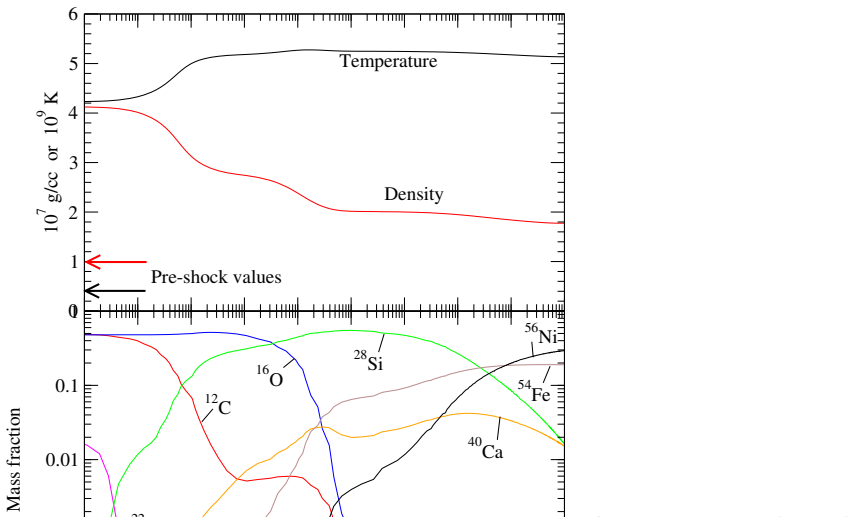
The machinery is the fluid-element 'track': the density and temperature history $\rho(t)$ and $T(t)$ recorded for each parcel of fuel as the explosion simulation runs. Around this track, two subgrid handles operate: a coarsened combustion model inside the hydrodynamics (turbulent flame speed $s_t = \Xi s_\ell$ with a wrinkling factor for deflagrations; reaction limiting or flame thickening for detonations) and a post-processing reconstruction that rebuilds the unresolved reaction structure from the local physics—steady-state self-heating for deflagrations, curvature- and density-gradient-based steady-state models for detonations—before a full 200+ species network computes the ashes.
What would settle it
Run a high-resolution simulation of a small turbulent flame or curved detonation at supernova conditions (density near $10^7$ g cm$^{-3}$, carbon–oxygen fuel) that resolves the $\sim 10^{-2}$ cm carbon-burning width, and compare the final isotopic yields and front structure with the yields obtained by applying the paper's steady-state reconstruction to a coarse simulation of the same setup; a mismatch larger than the quantified steady-state error would falsify the central claim.
Extended reading notes
Core claim
The central discovery is a prescription for making unresolved burning verifiable. For deflagrations, the pressure near the reaction front feeds a self-heating calculation that mimics how a laminar flame behaves, recovering the multi-stage structure that the grid cannot carry. For detonations, information about front curvature and density gradients is used with steady-state models to reconstruct the post-shock burning stages. Verification becomes achievable because the detailed model of the unresolved stages can be closely compared with the simulation outcome, and because the errors are controlled by how well the steady-state and constant-pressure approximations hold, which the paper argues can be mostly quantified.
Load-bearing premise
The reconstruction collapses if a flame or detonation front inside the exploding star behaves unlike its steady, constant-pressure reference structure, because then the interpolated burning history used to compute yields is wrong.
Editorial extensions
If this is right
- Nuclear yields predicted by any full-star supernova scenario can be checked against observed spectra and solar abundances without resolving the flame width.
- The deflagration-detonation transition and the helium-shell double-detonation scenarios become distinguishable by comparing their reconstructed yields, rather than by tuning subgrid parameters.
- Uncertainties in predicted abundances become quantifiable, since they are tied to measurable departures from steady-state and constant-pressure burning.
- Curved detonations initiated off-center can be handled in whole-star simulations because only the macroscopic curvature needs to be resolved, with the microscopic burn reconstructed from it.
Reading between the lines
- Beyond the paper: the track-and-reconstruct strategy is transferable to any explosion where the burning front is unresolved—for example, neutron-star mergers or helium flashes on white dwarfs—provided the local front structure can be modeled in steady state.
- Beyond the paper: one could test the steady-state assumption directly by comparing reconstructed yields from a coarse simulation against a fully resolved simulation of a turbulent flame or curved detonation at the same density and composition; disagreement would show where the reconstruction needs a dynamical correction.
- Beyond the paper: because the reconstruction depends on pressure and density-gradient histories, it implies that simulation accuracy at the largest scales (stellar structure and turbulence cascade) sets a floor on nucleosynthesis accuracy, even with a perfect nuclear network.
Signed reviews
Editorial analysis
A structured set of objections, weighed in public.
Referee Report
Summary. This paper is a short review/perspective on modeling subgrid combustion in simulations of thermonuclear (Type Ia) supernovae. It first outlines two proposed explosion scenarios, the deflagration-detonation transition and the helium-shell double detonation, highlighting the current challenges in making each viable. It then describes the wide separation of scales between the full-star simulation and the smallest reaction-front scales, and summarizes the standard subgrid modeling strategies for deflagrations (flame thickening, front tracking, turbulent flame-speed models) and detonations (reaction limiting, steady-state detonation structures with curvature and density-gradient corrections). The central methodological proposal is to post-process fluid-element temperature and density histories with full nuclear networks while using ancillary simulation information to reconstruct unresolved combustion stages, arguing that this makes yield predictions and their verification more achievable. The paper contains no new derivations or simulations; it presents a review of the field and a research program.
Significance. If the proposed reconstruction framework leads to verified yield predictions, it would strengthen the use of Type Ia supernova simulations as discriminators between explosion scenarios. The paper provides a useful, largely accurate summary of the scale-separation problem and the standard modeling toolkit, and it correctly emphasizes the need to connect simulation outcomes to observables. The descriptive sections are supported by a standard set of references, including the authors' own prior work. The main weakness is that the paper's central verifiability claim is overstated as written: the proposed comparison is between a reconstruction and a simulation that uses the same subgrid approximations, so it does not by itself establish physical fidelity. The paper would be more convincing if it identified concrete independent tests (such as resolved direct numerical simulations of flame/eddy interactions or laboratory detonation experiments) or explicitly reframed the claim as internal consistency rather than verification.
major comments (3)
- [Section 3.3] The statement that 'Verification now becomes more achievable, as the detailed model of the unresolved combustion stages can be closely compared to the outcome of the simulation' describes a consistency check rather than an independent verification. Because the simulation's combustion model (flame thickening or reaction limiting, summarized in Sections 3.1 and 3.2) is built from the same subgrid approximations used in the post-processing reconstruction, agreement between the two outcomes does not test whether those approximations represent the true unresolved physics. Please either specify an external standard (for example, direct numerical simulations that resolve the flame or detonation structure, or appropriate experimental data) against which the reconstruction would be verified, or rephrase this claim to state that the comparison establishes internal consistency only.
- [Section 3.3] The sentence that 'the uncertainties are controlled by the degree to which approximations like the steady state and constant pressure assumptions are satisfied, which can be mostly quantified' is unsupported by the manuscript. The paper gives no concrete way to quantify the errors introduced by turbulent strain, pressure fluctuations, and unsteadiness in the deflagration case, nor the effects of turbulence-shock interactions and pulsations in the detonation case. Please either provide a concrete quantification strategy, such as comparing the steady-state reconstruction against resolved simulations of a single eddy interacting with a flame or of an unsteady detonation, or temper the claim about how well the uncertainties can be quantified.
- [Section 3.3] For deflagrations, the reconstruction uses a self-heating calculation that mimics a laminar flame, whereas Section 3.1 emphasizes that the unresolved combustion at grid scales is a turbulent flame whose rate is set by the wrinkling factor Ξ. The paper does not explain how the laminar self-heating model accounts for the turbulent flame structure, or under what conditions (e.g., Gibson-scale arguments, Karlovitz number ranges) the laminar approximation is expected to hold. This is a load-bearing point for the yield predictions and should be addressed explicitly.
minor comments (5)
- [Abstract] In the sentence listing the two scenarios, the phrase 'double detonation, With' uses an incorrectly capitalized 'With' after a comma, and the sentence is a fragment; please correct the capitalization and punctuation.
- [Section 2.2] The text contains the misspelling 'Chandreskhar'; it should be 'Chandrasekhar'.
- [Figure 2] The vertical axis label 'Shear (cm s -1)' would be cleaner and more conventional if written as 'Shear (cm s^{-1})' to match the style used elsewhere in the text.
- [Section 3.1] The phrase 'In quiet, i.e. laminar, flow' is awkwardly punctuated; consider 'In quiet (laminar) flow' for readability.
- [References] Reference [24] is cited as an arXiv e-print; if a journal version has appeared since submission, please update it at the revision stage.
Circularity Check
No significant circularity: this is a review/position paper describing subgrid modeling strategies, with no fitted parameters, derived predictions, or derivation loop.
full rationale
The paper does not present a derivation or a prediction that reduces to its inputs. It is a review-style discussion of two proposed Type Ia supernova scenarios and the challenges of modeling unresolved combustion stages. The central methodological claims are that fluid-element histories ('tracks') can be post-processed with a full nuclear network, and that unresolved combustion stages can be reconstructed using laminar-flame self-heating calculations for deflagrations and steady-state models for detonations (Section 3.3). These statements describe prior and proposed work; they do not fit parameters to data and then rename the fit as a prediction. The self-citations to the authors' own papers [22, 24] are descriptive references to methods rather than load-bearing unverified premises that force a conclusion. The skeptical concern about verification comparing the reconstruction to the simulation outcome is a legitimate correctness risk about the adequacy of steady-state and constant-pressure approximations, but the paper does not claim that agreement with its own coarse simulation constitutes independent physical validation; it only says verification 'becomes more achievable' because the models can be compared. That is a research-program statement, not a circular derivation. No equation is shown to equal its own input, and no fitted quantity is renamed as an output. Under the hard rule requiring a quoted reduction, no circular step is identifiable, so the appropriate finding is no significant circularity.
Assumptions & free parameters
assumptions (4)
- domain assumption Kolmogorov turbulence model describes the subgrid shear field.
- domain assumption Steady-state detonation structure applies to carbon-oxygen detonations.
- domain assumption Constant pressure and self-heating approximations hold for laminar flames.
- domain assumption The two considered scenarios are representative of normal SNe Ia.
Cite this review
Pith. "Pith review of Modeling subgrid combustion processes in simulations of thermonuclear supernovae." pith.science (2026). https://pith.science/paper/6DM7YUJS
@misc{pith2026190806176,
  author       = {Pith},
  title        = {Pith review of: Modeling subgrid combustion processes in simulations of thermonuclear supernovae},
  year         = {2026},
  howpublished = {\url{https://pith.science/paper/6DM7YUJS}},
  note         = {Machine review of arXiv:1908.06176}
}
read the original abstract
Supernovae of type Ia are thought to arise from the thermonuclear incineration of a carbon-oxygen white dwarf stellar remnant. However, the detailed explosion scenario and stellar evolutionary origin scenario -- or scenarios -- which lead to observed supernovae are still quite uncertain. One of the principal tests of proposed scenarios is comparison with the explosion products inferred, for example, from the spectrum of the supernovae. Making this comparison requires computation of the combustion dynamics and products through simulation of proposed scenarios. Here we discuss two specific proposed explosion scenarios, the deflagration-detonation transition and the helium shell double detonation, With these two examples in mind, we proceed to discuss challenges to computational modeling of the combustion taking place in these explosions. Both subsonically and supersonically propagating reaction fronts are discussed, called deflagrations and detonations respectively. Several major stages of the combustion occur on length and time scales that are many orders of magnitude smaller than those accessible in simulations of the explosion. Models which attempt to capture this sub-grid behavior and the verification of those models is briefly discussed.
Figures

Reference graph
Works this paper leans on
-
[1]
Seitenzahl I R and Townsley D M 2017 Nucleosynthesis in Thermonuclear Supernovae (Springer International Publishing AG) p 1955 in Handbook of Supernovae eds. Alsabti, A. W. and Murdin, P
work page 2017
-
[2]
R¨ opke F K and Sim S A 2018 Space Science Reviews 214 72 (Preprint 1805.07268)
work page Pith review arXiv 2018
-
[3]
Noebauer U M, Taubenberger S, Blinnikov S, Sorokina E and Hillebrandt W 2016 MNRAS 463 2972–2985 (Preprint 1609.00241)
work page Pith review arXiv 2016
-
[4]
R¨ opke F K, Hillebrandt W, Schmidt W, Niemeyer J C, Blinnikov S I and Mazzali P A 2007Astrophys J 668 1132–1139 (Preprint 0707.1024)
-
[5]
Nomoto K, Thielemann F K and Yokoi K 1984 Astrophys J 286 644–658
work page 1984
-
[6]
Khokhlov A M 1991 Astron Astrophys 245 114–128
work page 1991
-
[7]
Hoeflich P and Khokhlov A 1996 Astrophys J 457 500 (Preprint astro-ph/9602025)
arXiv 1996
-
[8]
Zingale M, Nonaka A, Almgren A S, Bell J B, Malone C M and Woosley S E 2011 Astrophys J 740 8
work page 2011
Show all 28 references
-
[9]
Nonaka A, Aspden A J, Zingale M, Almgren A S, Bell J B and Woosley S E 2012 Astrophys J 745 73 (Preprint 1111.3086)
2012 arXiv
-
[10]
Seitenzahl I R, Ciaraldi-Schoolmann F, R¨ opke F K, Fink M, Hillebrandt W, Kromer M, Pakmor R, Ruiter A J, Sim S A and Taubenberger S 2013 MNRAS 429 1156–1172 (Preprint 1211.3015)
2013 arXiv
-
[11]
Miles B J, van Rossum D R, Townsley D M, Timmes F X, Jackson A P, Calder A C and Brown E F 2016 Astrophys J 824 59 (Preprint 1508.05961)
2016 arXiv
-
[12]
Shen K J, Kasen D, Miles B J and Townsley D M 2018 Astrophys J 854 52 (Preprint 1706.01898)
2018 arXiv
-
[13]
Livne E and Arnett D 1995 Astrophys J 452 62
1995
-
[14]
Kromer M, Sim S A, Fink M, R¨ opke F K, Seitenzahl I R and Hillebrandt W 2010Astrophys J 719 1067–1082 (Preprint 1006.4489)
-
[15]
Shen K J and Moore K 2014 Astrophys J 797 46 (Preprint 1409.3568)
2014 arXiv
-
[16]
Guillochon J, Dan M, Ramirez-Ruiz E and Rosswog S 2010 Astrophys J Let 709 L64–L69 ( Preprint 0911.0416)
2010 arXiv
-
[17]
Timmes F X and Woosley S E 1992 Astrophys J 396 649–667
1992
-
[18]
Chamulak D A, Brown E F and Timmes F X 2007 Astrophys J Let 655 L93–L96 ( Preprint astro-ph/ 0612507)
2007
-
[19]
Glazyrin S I, Blinnikov S I and Dolgov A 2013 MNRAS 433 2840–2849 (Preprint 1208.4038)
2013 arXiv
-
[20]
Jackson A P, Townsley D M and Calder A C 2014 Astrophys J 784 174 (Preprint 1402.4527)
2014 arXiv
-
[21]
Schmidt W, Niemeyer J C, Hillebrandt W and R¨ opke F K 2006 Astron Astrophys 450 283–294 ( Preprint astro-ph/0601500)
2006 arXiv
-
[22]
Townsley D M, Miles B J, Timmes F X, Calder A C and Brown E F 2016 Astrophys J Suppl 225 3 (Preprint 1605.04878)
2016 arXiv
-
[23]
Dunkley S D, Sharpe G J and Falle S A E G 2013 MNRAS 431 3429–3443
2013
-
[24]
Miles B J, Townsley D M, Shen K J, Timmes F X and Moore K 2018 ArXiv e-prints (Preprint 1806.07820)
2018 arXiv
-
[25]
Calder A C, Townsley D M, Seitenzahl I R, Peng F, Messer O E B, Vladimirova N, Brown E F, Truran J W and Lamb D Q 2007 Astrophys J 656 313–332 (Preprint astro-ph/0611009)
2007 arXiv
-
[26]
Townsley D M, Jackson A P, Calder A C, Chamulak D A, Brown E F and Timmes F X 2009 Astrophys J 701 1582–1604 (Preprint 0906.4384)
2009 arXiv
-
[27]
R¨ opke F K, Niemeyer J C and Hillebrandt W 2003 Astrophys J 588 952–961 (Preprint astro-ph/0211202)
2003 arXiv
-
[28]
Kushnir D, Katz B, Dong S, Livne E and Fern´ andez R 2013 Astrophys J Let 778 L37 (Preprint 1303.1180)
2013 arXiv
Reviewed August 14, 2026 · model on record in the stance chip above.
Discussion (0). Continue with ORCID to comment.