REVIEW 3 major objections 6 minor 57 references
Pro-Pose: Unpaired Full-Body Portrait Synthesis via Canonical UV Maps
T0 review · 3 major / 6 minor · reviewed 2026-08-03 · deepseek-v4-flash
Pith's one-line read This paper claims that a single in-the-wild photo, reposed in canonical UV space with donor masks, yields a controllable high-fidelity avatar trained on largely unpaired data.
desk verdict Donor-masking is a genuinely useful trick and the overfitting diagnosis is solid, but the Gemini-generated evaluation targets make the SOTA numbers hard to trust as fidelity to the real person. read the letter →
The pith
A machine-rendered reading of the paper's core claim, the machinery that carries it, and where it could break.
The reading
What carries the argument
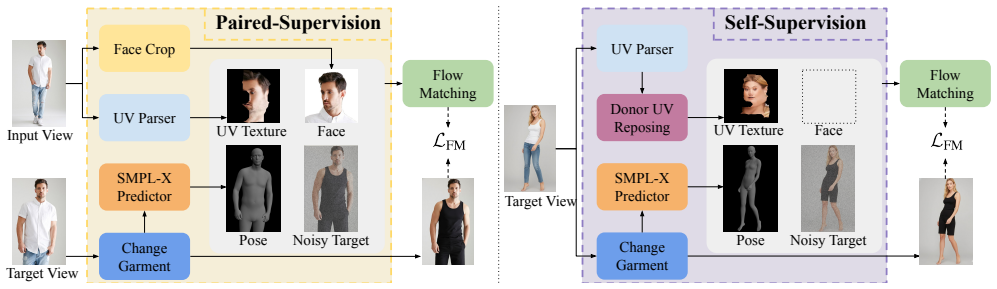
The central object is the canonical UV texture map, a fixed parametrization of the parametric body model. From one image, only a partial texture Tp = T ⊙ Mp is extractable, where Mp is the binary visibility mask of the pose; occlusions make the partial texture leak pose. The load-bearing mechanism is donor-based UV reposing: masking Tp with the visibility mask of an unrelated donor pose Mp̃ yields Tp→p̃ = T ⊙ (Mp ⊙ Mp̃), whose commutative intersection destroys the boundary signature. The generator is a latent rectified flow model trained with the flow-matching objective, conditioned on the masked texture, target pose, and an optional face crop; test-time personalization is done by finetuning
What would settle it
Compare the standardized-edited images against their original inputs using ArcFace face similarity and a human identity-recognition study. If a substantial fraction of edited images drops below a face-similarity threshold, or if humans cannot reliably match edited to original identities, the ground truth used in the quantitative tables is unreliable and the reported numbers partly measure alignment to the edit model. A second check: train the same model with pairs taken from original unedited images (allowing garment-agnostic losses only on the face) and see whether out-of-domain gains persist
Extended reading notes
Core claim
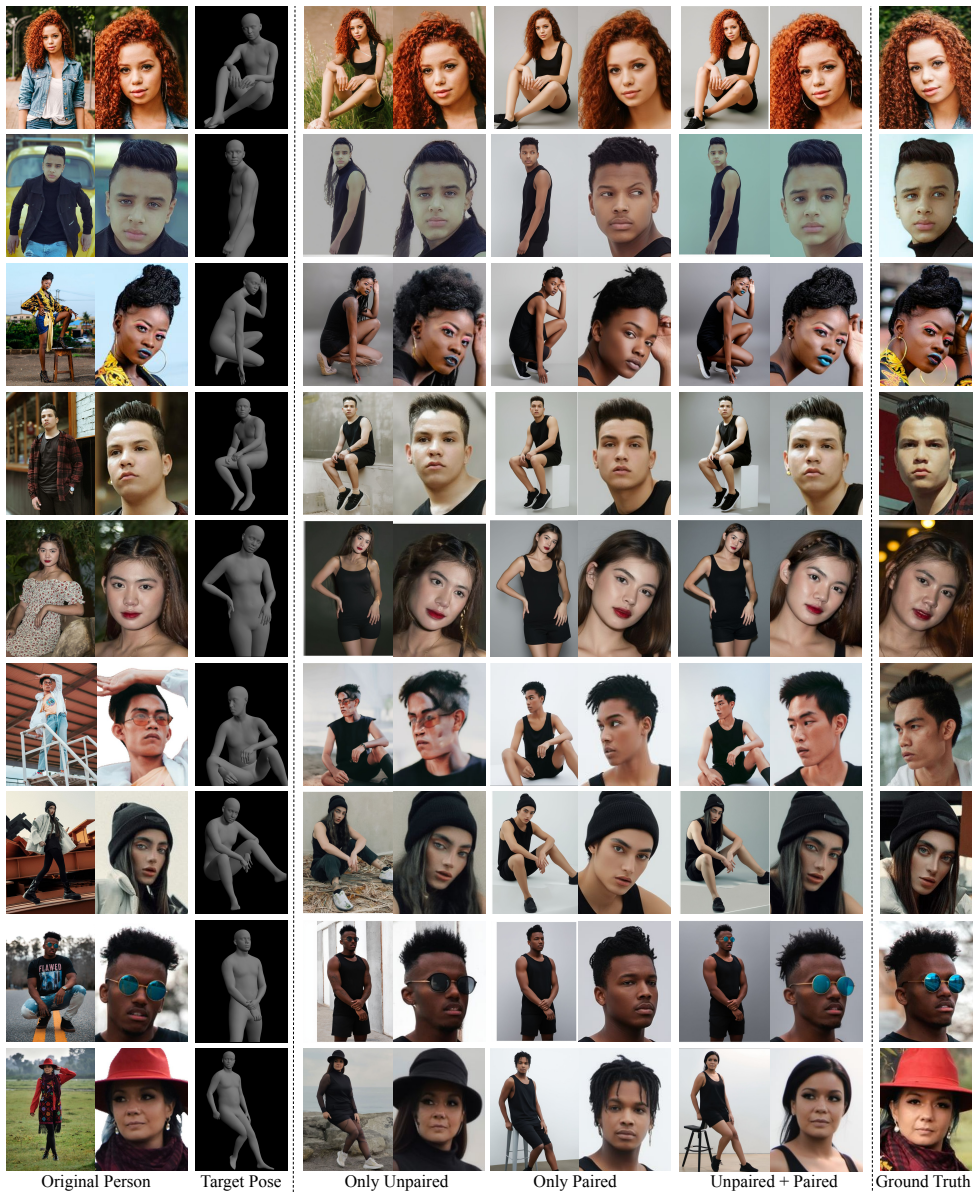
On its own terms, the paper establishes that a partial UV texture from a single view, masked by a random donor visibility mask, is a sufficient conditioning signal for learning geometric reposing without paired supervision: the generator approximates Ap ≈ gθ(T ⊙ (Mp ⊙ Mp̃), p). Because the intersection mask is commutative, texture boundaries no longer reveal the source pose, so the model must learn true warping rather than boundary-leaking copy-paste. Combined with dropping the face crop in the unpaired branch, this permits effective self-supervision from massive single-image data, and the resulting model outperforms paired-only and unpaired-only variants on both in-domain and out-of-domain
Load-bearing premise
The entire training and evaluation pipeline rests on the unverified premise that the proprietary edit which standardizes clothing preserves the person's identity, body shape, pose, and pixel alignment well enough to serve as ground truth for 30K paired samples and for every reported metric.
Editorial extensions
If this is right
- A single in-the-wild photo suffices to produce a pose-controllable, garment-standardized avatar, enabling downstream uses like virtual try-on.
- Joint training on unpaired data measurably reduces identity overfitting: the paper's diagnostic shows paired-only models pull novel faces toward a small set of training identities, while the hybrid model keeps maximum face similarity to the training set low.
- Donor-based masking outperforms random patch masking on all reported metrics, indicating that realistically structured occlusions are essential for teaching geometric warping.
- Few-shot finetuning improves face similarity by 18.3% over the base model, showing test-time personalization compensates for the base model's struggles under extreme poses.
- Because UV conditioning is currently restricted to the face, distinct body features such as tattoos are not preserved; the paper itself flags full-body skin-texture conditioning as the next step.
Reading between the lines
- If the proprietary edit that standardizes clothing subtly alters face geometry or body proportions, the paired supervision target is synthetic; the reported pixel and face-similarity gains may partly measure agreement with that edit model, not fidelity to the original person. A human-perceptual test against unedited ground truth would separate these.
- The donor-masking idea transfers beyond humans: any generative task where an observation is a partial sample of a canonical surface (depth maps, semantic maps, 3D object textures) could use donor masks to break boundary leakage and learn from unpaired data.
- A testable extension is to vary the donor mask pool's IoU range (currently [0.4, 0.8]) and measure how mask difficulty trades off against training stability; the paper does not run this study.
- The identity-overfitting diagnostic (face similarity of generated images to the training set) is a useful general evaluation; applying it to other reposing baselines would clarify whether their failures stem from memorization or representation limits.
Editorial analysis
A structured set of objections, weighed in public.
Referee Report
Summary. Pro-Pose addresses single-image full-body reposing by operating in canonical SMPL-X UV space. To learn from unpaired images, it introduces Donor-based UV Reposing (Sec. 3.2.1): the input partial texture T_p is masked by a visibility mask from an unrelated donor pose p̃, yielding T⊙(M_p⊙M_p̃), which breaks boundary-based pose leakage. A latent rectified Flow Matching generator (Flux backbone) is trained jointly on ~30K paired DeepFashion images and ~470K unpaired images, with targets standardized to black tank-top/shorts via Gemini 2.5 Flash Image (the BaseClothing / BC dataset). At test time, few-shot LoRA finetuning personalizes the model. Experiments compare against CFLD, MCLD, LEFFA, OnePoseTrans, and UniHuman on DeepFashion and WPose, and report ablations of donor masking, data source, and finetuning, plus an identity-overfitting analysis.
Significance. If the quantitative claims were fully supported, this would be a useful contribution to controllable avatar synthesis: the donor-masking idea is simple and potentially transferable, the paired/unpaired joint training recipe is sensible, and the identity-overfitting diagnostic (Sec. 11) is a valuable methodological addition. The ablations are internally coherent, and the qualitative results are often impressive. However, the evaluation is substantially weakened by the use of Gemini-generated BC ground truth for both training and evaluation, which makes the current SOTA claims hard to verify. The paper's strengths are real, but the empirical case needs considerable strengthening before the central claim of identity-preserving high-fidelity reposing is established.
major comments (3)
- [Sec. 3.6, Sec. 4.1, Tables 1-4] The image-fidelity claims rest on a target generated by the same proprietary model used to create training targets. Prompt V1/V2 (Appendix Sec. 7) generates the BC-GT for every DeepFashion/WPose evaluation pair, and PSNR/SSIM/FID/LPIPS in Table 1 are computed against BC-GT. Pro-Pose is trained to reproduce Gemini's BC edits, so high pixel-level scores partly measure agreement with one edit model, not fidelity to the original person. The comparison is also unfair to the baselines (CFLD, MCLD, LEFFA, OnePoseTrans, UniHuman), which are trained to generate original garments and are evaluated against BC-GT. The paper should (i) provide a matched comparison with baselines trained/adapted to BC targets, (ii) report identity and geometry metrics computed directly against the original input face/body, and (iii) include a human evaluation of identity preservation relative to the original subject.
- [Sec. 11.2, Fig. 16] The identity-overfitting analysis shows that the paired-only model pulls WPose outputs toward DeepFashion training identities more than the full model does. This establishes lower memorization of training identities, but it does not establish that the full model preserves the input subject's identity. A model could have low similarity to training identities yet still fail to match the target person. Direct FaceSim/DINO between generated outputs and the original input face, or face-verification/retrieval against the source subject, is required to support the paper's central identity-preservation claim.
- [Sec. 3.4.2, Sec. 5] The claimed robustness to extreme pose changes is in tension with the donor-mask design. Donor masks are selected with IoU in [0.4, 0.8] relative to the source mask, so the training distribution rarely includes very low-overlap occlusions, which are precisely the regimes where Sec. 5 admits the base model fails. The paper should quantify performance as a function of source-target overlap on WPose and report how often the IoU constraint is violated by test poses. Without this, the base model's 'extreme pose' capability is unsupported; the finetuning mitigation is only partially evaluated.
minor comments (6)
- [Sec. 7, Fig. 5] Prompt V1 asks for pixel-aligned editing, but no quantitative verification of alignment between input and BC-GT is reported. A small visual audit of BC-GT pairs would clarify how much identity/pose drift the editing introduces.
- [Table 3] The caption does not state which evaluation dataset and target metric regime are used. Since the reported PSNR (19.87) matches the WPose M-PSNR in Table 1, this should be labeled explicitly to avoid ambiguity.
- [Sec. 4.1] The FID reference set is unspecified: is FID computed against BC-GT, original test images, or a separate held-out set? Clarify for both DeepFashion and WPose.
- [Fig. 14] The figure contains stray Python print statements and numeric outputs in the lower-left panel, which look like a leftover artifact. Please remove them.
- [References] Reference [28] has a typo ('Patterm') and reference [40] has an author-name typo ('V orobiov'). Please proofread the bibliography.
- [Eq. (9)] The face-masked latent loss uses M_j, a 'target's latent-space face mask', but the paper does not specify how this mask is constructed in latent space. Provide details in Sec. 3.5 or the appendix.
Circularity Check
Partial evaluation circularity: BC-GT is created by the same Gemini 2.5 Flash Image model that generates training targets, so pixel/perceptual fidelity partly measures agreement with one synthetic edit distribution.
-
fitted input called prediction
[§3.6 (Basic Clothing dataset) and §4.1 (Datasets and Metrics)]
"We construct a standardized training dataset by processing paired DeepFashion [25] data, unpaired FFHQ [16] faces, and commercial images [55, 56] using Gemini 2.5 Flash Image [7]. ... For image similarity (PSNR, SSIM [45]) and perceptual metrics (FID [10], LPIPS [51]), we therefore compare our outputs against a Basic Clothing version."
The Flow Matching objective (Eq. 5) trains vθ to denoise x0 = E(I_p) where I_p is Gemini's BC edit of the target; the evaluation in Tables 1 and 4 uses the same Gemini BC edit as ground truth. Thus PSNR/SSIM/LPIPS/FID against BC-GT measure agreement with Gemini 2.5 Flash Image's garment-standardizing edits, not independent fidelity to the real person. The model is not forced to match BC-GT by a single fitted constant, but the train and test targets share the same synthetic conditional distribution, so the headline fidelity numbers are partially self-referential. No independent validation of Gemini's identity/body-shape preservation is reported.
full rationale
Pro-Pose's core derivation is not circular by construction: gθ is a Flow Matching model conditioned on partial UV texture, target SMPL-X pose, and an optional face crop; the donor-masking mechanism is tested against a random-masking baseline; the identity-overfitting diagnostic compares generated faces to external DeepFashion training identities. Moreover, face-region PSNR/SSIM/LPIPS/DINO (Table 4) and FaceSim are reported against the original image, providing independent evidence for identity preservation. The circularity is limited to the synthetic BC evaluation: both the 30K paired training targets and the WPose/DeepFashion BC-GT evaluation targets are produced by the same Gemini 2.5 Flash Image edit pipeline, so the pixel/perceptual and SOTA metrics partly measure how well the model imitates Gemini's edit distribution, not how faithfully the output matches the original subject. Because the central identity claim has independent support and the derivation itself is not equivalent to its inputs, score 4 rather than 6+.
Assumptions & free parameters
free parameters (6)
- Donor mask IoU constraint range =
[0.4, 0.8]
- Conditioning dropout probabilities =
0.05 all-drop, 0.3 T_in, 0.3 face, 0.1 pose
- LoRA rank and learning rate =
rank 128, lr 1e-4
- UV seam filtering threshold =
τ_dist (value not reported)
- Test-time finetuning budget =
5000 iterations, batch size 4, with regularization images
- Identity-clustering thresholds =
cosine 0.6 visual / 0.4 structural
assumptions (6)
- domain assumption SMPL-X estimated pose and z-buffer visibility masks accurately reflect the true body pose and self-occlusion.
- domain assumption Gemini 2.5 Flash Image edits preserve identity, pose, framing, and pixel-alignment in the BaseClothing dataset.
- domain assumption Donor visibility-mask intersection T ⊙ (Mp ⊙ Mp̃) simulates a plausible novel-pose partial texture whose boundaries carry no pose-leakage signal.
- domain assumption Pretrained Flux.1 dev VAE/transformer priors transfer to 16-channel latent flow matching over human avatars.
- domain assumption The DeepFashion identity-count analysis (ArcFace thresholds 0.6/0.4) is a faithful measure of identity diversity.
- ad hoc to paper Evaluation against a BaseClothing-edited ground truth is a fair comparison for all methods.
Cite this review
Pith. "Pith review of Pro-Pose: Unpaired Full-Body Portrait Synthesis via Canonical UV Maps." pith.science (2026). https://pith.science/paper/6DOMBFBC
@misc{pith2026251217143,
  author       = {Pith},
  title        = {Pith review of: Pro-Pose: Unpaired Full-Body Portrait Synthesis via Canonical UV Maps},
  year         = {2026},
  howpublished = {\url{https://pith.science/paper/6DOMBFBC}},
  note         = {Machine review of arXiv:2512.17143}
}
read the original abstract
Photographs of people taken by professional photographers typically present the person in beautiful lighting, with an interesting pose, and flattering quality. This is unlike common photos people take of themselves in uncontrolled conditions. In this paper, we explore how to canonicalize a person's 'in-the-wild' photograph into a controllable, high-fidelity avatar -- reposed in a simple environment with standardized minimal clothing. A key challenge is preserving the person's unique whole-body identity, facial features, and body shape while stripping away the complex occlusions of their original garments. While a large paired dataset of the same person in varied clothing and poses would simplify this, such data does not exist. To that end, we propose two key insights: 1) Our method transforms the input photo into a canonical full-body UV space, which we couple with a novel reposing methodology to model occlusions and synthesize novel views. Operating in UV space allows us to decouple pose from appearance and leverage massive unpaired datasets. 2) We personalize the output photo via multi-image finetuning to ensure robust identity preservation under extreme pose changes. Our approach yields high-quality, reposed portraits that achieve strong quantitative performance on real-world imagery, providing an ideal, clean biometric canvas that significantly improves the fidelity of downstream applications like Virtual Try-On (VTO).
Figures


Figures from the paper (11 more)




Reference graph
Works this paper leans on
-
[1]
Tim Brooks, Aleksander Holynski, and Alexei A. Efros. In- structpix2pix: Learning to follow image editing instructions. InCVPR, 2023. 3
2023
-
[2]
Chan, Connor Z
Eric R. Chan, Connor Z. Lin, Matthew A. Chan, Koki Nagano, Boxiao Pan, Shalini De Mello, Orazio Gallo, Leonidas Guibas, Jonathan Tremblay, Sameh Khamis, Tero Karras, and Gordon Wetzstein. Efficient geometry-aware 3D generative adversarial networks. InCVPR, 2022. 2
2022
-
[3]
Ricky T. Q. Chen, Yulia Rubanova, Jesse Bettencourt, and David K Duvenaud. Neural ordinary differential equations. InAdvances in Neural Information Processing Systems. Cur- ran Associates, Inc., 2018. 4
2018
-
[4]
Arcface: Additive angular mar- gin loss for deep face recognition.IEEE Transactions on Pat- tern Analysis and Machine Intelligence, 44(10):5962–5979,
Jiankang Deng, Jia Guo, Jing Yang, Niannan Xue, Irene Kot- sia, and Stefanos Zafeiriou. Arcface: Additive angular mar- gin loss for deep face recognition.IEEE Transactions on Pat- tern Analysis and Machine Intelligence, 44(10):5962–5979,
-
[5]
A varia- tional u-net for conditional appearance and shape generation
Patrick Esser, Ekaterina Sutter, and Bj ¨orn Ommer. A varia- tional u-net for conditional appearance and shape generation. InCVPR, 2018. 2
2018
-
[6]
One-shot learning for pose-guided person image synthesis in the wild
Dongqi Fan, Tao Chen, Mingjie Wang, Rui Ma, Qiang Tang, Zili Yi, Qian Wang, and Liang Chang. One-shot learning for pose-guided person image synthesis in the wild. InICASSP 2025 - 2025 IEEE International Conference on Acoustics, Speech and Signal Processing (ICASSP), pages 1–5, 2025. 6, 8, 3, 4
2025
-
[7]
Introducing gemini 2.5 flash image, our state-of-the-art image model
Alisa Fortin, Guillaume Vernade, Kat Kampf, and Am- maar Reshi. Introducing gemini 2.5 flash image, our state-of-the-art image model. Google for Developers Blog, 2025.https://developers.googleblog.com/ en/introducing- gemini- 2- 5- flash- image/, accessed: 2025-11-04. 2, 5, 1
2025
-
[8]
Contex-human: Free- view rendering of human from a single image with texture- consistent synthesis
Xiangjun Gao, Xiaoyu Li, Chaopeng Zhang, Qi Zhang, Yan- pei Cao, Ying Shan, and Long Quan. Contex-human: Free- view rendering of human from a single image with texture- consistent synthesis. InCVPR, 2024. 2
2024
Show all 57 references
-
[9]
Viton: An image-based virtual try-on network
Xintong Han, Zuxuan Wu, Zhe Wu, Ruichi Yu, and Larry S Davis. Viton: An image-based virtual try-on network. In CVPR, 2018. 2, 3
2018
-
[10]
Gans trained by a two time-scale update rule converge to a local nash equilib- rium.Advances in neural information processing systems, 30, 2017
Martin Heusel, Hubert Ramsauer, Thomas Unterthiner, Bernhard Nessler, and Sepp Hochreiter. Gans trained by a two time-scale update rule converge to a local nash equilib- rium.Advances in neural information processing systems, 30, 2017. 6
2017
-
[11]
Animate anyone: Consistent and controllable image-to-video synthesis for character animation
Li Hu, Xin Gao, Peng Zhang, Ke Sun, Bang Zhang, and Liefeng Bo. Animate anyone: Consistent and controllable image-to-video synthesis for character animation. InCVPR,
-
[12]
ARCH: Animatable Reconstruction of Clothed Humans
Zeng Huang, Yuanlu Xu, Christoph Lassner, Hao Li, and Tony Tung. ARCH: Animatable Reconstruction of Clothed Humans . InCVPR, 2020. 2
2020
-
[13]
Jafarian and H
Y . Jafarian and H. Park. Self-supervised 3d representation learning of dressed humans from social media videos.IEEE Transactions on Pattern Analysis & Machine Intelli- gence, 2022. 2
2022
-
[14]
Learning high fi- delity depths of dressed humans by watching social media dance videos
Yasamin Jafarian and Hyun Soo Park. Learning high fi- delity depths of dressed humans by watching social media dance videos. InProceedings of the IEEE/CVF Conference on Computer Vision and Pattern Recognition (CVPR), pages 12753–12762, 2021. 2
2021
-
[15]
Progressive growing of gans for improved quality, stability, and variation.arXiv preprint arXiv:1710.10196, 2017
Tero Karras, Timo Aila, Samuli Laine, and Jaakko Lehtinen. Progressive growing of gans for improved quality, stability, and variation.arXiv preprint arXiv:1710.10196, 2017. 3
2017 arXiv
-
[16]
A style-based generator architecture for generative adversarial networks
Tero Karras, Samuli Laine, and Timo Aila. A style-based generator architecture for generative adversarial networks. In CVPR, 2019. 2, 5, 1
2019
-
[17]
3d gaussian splatting for real-time radiance field rendering.ACM Transactions on Graphics,
Bernhard Kerbl, Georgios Kopanas, Thomas Leimk ¨uhler, and George Drettakis. 3d gaussian splatting for real-time radiance field rendering.ACM Transactions on Graphics,
-
[18]
Flux.https://github.com/ black-forest-labs/flux, 2024
Black Forest Labs. Flux.https://github.com/ black-forest-labs/flux, 2024. 4, 5
2024
-
[19]
High-resolution virtual try-on with misalignment and occlusion-handled conditions.arXiv preprint arXiv:2206.14180, 2022
Sangyun Lee, Gyojung Gu, Sunghyun Park, Seunghwan Choi, and Jaegul Choo. High-resolution virtual try-on with misalignment and occlusion-handled conditions.arXiv preprint arXiv:2206.14180, 2022. 3
2022 arXiv
-
[20]
Plummer, and Zhe Lin
Nannan Li, Qing Liu, Krishna Kumar Singh, Yilin Wang, Jianming Zhang, Bryan A. Plummer, and Zhe Lin. Unihu- man: A unified model for editing human images in the wild. InCVPR, 2024. 6, 7, 8, 3, 4
2024
-
[21]
Dense in- trinsic appearance flow for human pose transfer
Yining Li, Chen Huang, and Chen Change Loy. Dense in- trinsic appearance flow for human pose transfer. InCVPR,
-
[22]
Microsoft coco: Common objects in context
Tsung-Yi Lin, Michael Maire, Serge Belongie, James Hays, Pietro Perona, Deva Ramanan, Piotr Doll´ar, and C Lawrence Zitnick. Microsoft coco: Common objects in context. In European conference on computer vision, pages 740–755. Springer, 2014. 6
2014
-
[23]
Yaron Lipman, Ricky T. Q. Chen, Heli Ben-Hamu, Maxi- milian Nickel, and Matt Le. Flow matching for generative modeling, 2023. 4
2023
-
[24]
Multi- focal conditioned latent diffusion for person image synthesis
Jiaqi Liu, Jichao Zhang, Paolo Rota, and Nicu Sebe. Multi- focal conditioned latent diffusion for person image synthesis. InCVPR, 2025. 2, 3, 5, 6, 8, 4
2025
-
[25]
Deepfashion: Powering robust clothes recognition and retrieval with rich annotations
Ziwei Liu, Ping Luo, Shi Qiu, Xiaogang Wang, and Xiaoou Tang. Deepfashion: Powering robust clothes recognition and retrieval with rich annotations. InCVPR, 2016. 2, 5, 6, 8, 1, 3, 4
2016
-
[26]
Coarse-to-fine latent diffusion for pose- guided person image synthesis
Yanzuo Lu, Manlin Zhang, Andy J Ma, Xiaohua Xie, and Jian-Huang Lai. Coarse-to-fine latent diffusion for pose- guided person image synthesis. InCVPR, 2024. 3, 5, 6
2024
-
[27]
Mediapipe: A framework for perceiving and processing reality
Camillo Lugaresi, Jiuqiang Tang, Hadon Nash, Chris Mc- Clanahan, Esha Uboweja, Michael Hays, Fan Zhang, Chuo- Ling Chang, Ming Yong, Juhyun Lee, Wan-Teh Chang, Wei Hua, Manfred Georg, and Matthias Grundmann. Mediapipe: A framework for perceiving and processing reality. InThird...
2019
-
[28]
Repaint: Inpainting using denoising diffusion probabilistic models
Andreas Lugmayr, Martin Danelljan, Andres Romero, Fisher Yu, Radu Timofte, and Luc Van Gool. Repaint: Inpainting using denoising diffusion probabilistic models. InProceed- ings of the IEEE/CVF Conference on Computer Vision and Patterm Recognition (CVPR), 2022. 3
2022
-
[29]
Pose guided person image genera- tion
Liqian Ma, Xu Jia, Qianru Sun, Bernt Schiele, Tinne Tuyte- laars, and Luc Van Gool. Pose guided person image genera- tion. InAdvances in Neural Information Processing Systems (NeurIPS), 2017. 2
2017
-
[30]
Hpsv3: Towards wide-spectrum human preference score
Yuhang Ma, Xiaoshi Wu, Keqiang Sun, and Hongsheng Li. Hpsv3: Towards wide-spectrum human preference score. In Proceedings of the IEEE/CVF International Conference on Computer Vision (ICCV), pages 15086–15095, 2025. 6
2025
-
[31]
Controllable person image synthesis with attribute-decomposed gan
Yifang Men, Yiming Mao, Yuning Jiang, Wei-Ying Ma, and Zhouhui Lian. Controllable person image synthesis with attribute-decomposed gan. InCVPR, 2020. 2
2020
-
[32]
Human gaus- sian splatting: Real-time rendering of animatable avatars
Arthur Moreau, Jifei Song, Helisa Dhamo, Richard Shaw, Yiren Zhou, and Eduardo P ´erez-Pellitero. Human gaus- sian splatting: Real-time rendering of animatable avatars. arXiv:2311.17113 [cs.CV], 2023. 2
2023 arXiv
-
[33]
Human gaussian splatting: Real-time rendering of animatable avatars
Arthur Moreau, Jifei Song, Helisa Dhamo, Richard Shaw, Yiren Zhou, and Eduardo P ´erez-Pellitero. Human gaussian splatting: Real-time rendering of animatable avatars. In CVPR, 2024. 2
2024
-
[34]
Dress Code: High- Resolution Multi-Category Virtual Try-On
Davide Morelli, Matteo Fincato, Marcella Cornia, Federico Landi, Fabio Cesari, and Rita Cucchiara. Dress Code: High- Resolution Multi-Category Virtual Try-On. InProceedings of the European Conference on Computer Vision, 2022. 3
2022
-
[35]
Dinov2: Learning robust visual features without supervision
Maxime Oquab, Timoth ´ee Darcet, Th ´eo Moutakanni, Huy V o, Marc Szafraniec, Vasil Khalidov, Pierre Fernandez, Daniel Haziza, Francisco Massa, Alaaeldin El-Nouby, et al. Dinov2: Learning robust visual features without supervision. arXiv preprint arXiv:2304.07193, 2023. 6
2023 arXiv
-
[36]
Georgios Pavlakos, Vasileios Choutas, Nima Ghorbani, Timo Bolkart, Ahmed A. A. Osman, Dimitrios Tzionas, and Michael J. Black. Expressive body capture: 3d hands, face, and body from a single image. InCVPR, 2019. 1, 2, 3, 4
2019
-
[37]
Li, and Ge Li
Yurui Ren, Xiaoming Yu, Junming Chen, Thomas H. Li, and Ge Li. Deep image spatial transformation for person image generation. InCVPR, 2020. 2
2020
-
[38]
Pifu: Pixel-aligned implicit function for high-resolution clothed human digitiza- tion
Shunsuke Saito, Zeng Huang, Ryota Natsume, Shigeo Mor- ishima, Angjoo Kanazawa, and Hao Li. Pifu: Pixel-aligned implicit function for high-resolution clothed human digitiza- tion. InICCV, 2019. 2
2019
-
[39]
Pifuhd: Multi-level pixel-aligned implicit function for high-resolution 3d human digitization
Shunsuke Saito, Tomas Simon, Jason Saragih, and Hanbyul Joo. Pifuhd: Multi-level pixel-aligned implicit function for high-resolution 3d human digitization. InCVPR, 2020. 2
2020
-
[40]
Mohler, Larry S
Soubhik Sanyal, Alexander Egorovich V orobiov, Timo Bolkart, Matthew Loper, Betty J. Mohler, Larry S. Davis, Javier Romero, and Michael J. Black. Learning realistic hu- man reposing using cyclic self-supervision with 3d shape, pose, and appearance consistency. InICCV, 2021. 2
2021
-
[41]
Deformable gans for pose-based human im- age generation
Aliaksandr Siarohin, Enver Sangineto, St ´ephane Lathuili`ere, and Nicu Sebe. Deformable gans for pose-based human im- age generation. InProceedings of the IEEE/CVF Conference on Computer Vision and Pattern Recognition (CVPR), 2018. 2
2018
-
[42]
First order motion model for image animation.IEEE Transactions on Pattern Analysis and Machine Intelligence (TPAMI), 2019
Aliaksandr Siarohin, St ´ephane Lathuili`ere, Sergey Tulyakov, Elisa Ricci, and Nicu Sebe. First order motion model for image animation.IEEE Transactions on Pattern Analysis and Machine Intelligence (TPAMI), 2019. 2
2019
-
[43]
Toward characteristic- preserving image-based virtual try-on network
Bochao Wang, Huabin Zheng, Xiaodan Liang, Yimin Chen, Liang Lin, and Meng Yang. Toward characteristic- preserving image-based virtual try-on network. InECCV,
-
[44]
Disco: Disentangled control for referring human dance generation in real world
Tan Wang, Linjie Li, Kevin Lin, Chung-Ching Lin, Zhengyuan Yang, Hanwang Zhang, Zicheng Liu, and Li- juan Wang. Disco: Disentangled control for referring human dance generation in real world. InCVPR, 2024. 3
2024
-
[45]
Bovik, H.R
Zhou Wang, A.C. Bovik, H.R. Sheikh, and E.P. Simoncelli. Image quality assessment: from error visibility to structural similarity.IEEE Transactions on Image Processing, 13(4): 600–612, 2004. 6
2004
-
[46]
Yuliang Xiu, Jinlong Yang, Dimitrios Tzionas, and Michael J. Black. ICON: Implicit Clothed humans Obtained from Normals. InCVPR, 2022. 2
2022
-
[47]
Oot- diffusion: Outfitting fusion based latent diffusion for control- lable virtual try-on.AAAI, 2025
Yuhao Xu, Tao Gu, Weifeng Chen, and Chengcai Chen. Oot- diffusion: Outfitting fusion based latent diffusion for control- lable virtual try-on.AAAI, 2025. 3
2025
-
[48]
Towards photo-realistic virtual try-on by adaptively generating-preserving image content
Han Yang, Ruimao Zhang, Xiaobao Guo, Wei Liu, Wang- meng Zuo, and Ping Luo. Towards photo-realistic virtual try-on by adaptively generating-preserving image content. In CVPR, 2020. 3
2020
-
[49]
3dhu- mangan: 3d-aware human image generation with 3d pose mapping
Zhuoqian Yang, Shikai Li, Wayne Wu, and Bo Dai. 3dhu- mangan: 3d-aware human image generation with 3d pose mapping. InICCV, 2023. 2
2023
-
[50]
PISE: Person image synthesis and editing with decoupled gan
Jinsong Zhang, Kun Li, Yu-Kun Lai, and Jingyu Yang. PISE: Person image synthesis and editing with decoupled gan. In CVPR, 2021. 2
2021
-
[51]
The unreasonable effectiveness of deep features as a perceptual metric
Richard Zhang, Phillip Isola, Alexei A Efros, Eli Shecht- man, and Oliver Wang. The unreasonable effectiveness of deep features as a perceptual metric. InProceedings of the IEEE conference on computer vision and pattern recogni- tion, pages 586–595, 2018. 6
2018
-
[52]
Humannerf: Ef- ficiently generated human radiance field from sparse inputs
Fuqiang Zhao, Wei Yang, Jiakai Zhang, Pei-Ying Lin, Yingliang Zhang, Jingyi Yu, and Lan Xu. Humannerf: Ef- ficiently generated human radiance field from sparse inputs. InCVPR, 2022. 2
2022
-
[53]
Learning flow fields in attention for controllable person image generation
Zijian Zhou, Shikun Liu, Xiao Han, Haozhe Liu, Kam Woh Ng, Tian Xie, Yuren Cong, Hang Li, Mengmeng Xu, Juan- Manuel P´erez-R´ua, Aditya Patel, Tao Xiang, Miaojing Shi, and Sen He. Learning flow fields in attention for controllable person image generation. InCVPR, 2025. 2, 3, 5...
2025
-
[54]
CelebV- HQ: A large-scale video facial attributes dataset
Hao Zhu, Wayne Wu, Wentao Zhu, Liming Jiang, Siwei Tang, Li Zhang, Ziwei Liu, and Chen Change Loy. CelebV- HQ: A large-scale video facial attributes dataset. InECCV,
-
[55]
Tryondiffusion: A tale of two un- ets
Luyang Zhu, Dawei Yang, Tyler Zhu, Fitsum Reda, William Chan, Chitwan Saharia, Mohammad Norouzi, and Ira Kemelmacher-Shlizerman. Tryondiffusion: A tale of two un- ets. InCVPR, 2023. 2, 3, 5, 1
2023
-
[56]
M&m vto: Multi- garment virtual try-on and editing
Luyang Zhu, Yingwei Li, Nan Liu, Hao Peng, Dawei Yang, and Ira Kemelmacher-Shlizerman. M&m vto: Multi- garment virtual try-on and editing. InCVPR, 2024. 2, 3, 5, 1
2024
-
[57]
Progressive pose attention transfer for person image generation
Zhen Zhu, Tengteng Huang, Baoguang Shi, Miao Yu, Bofei Wang, and Xiang Bai. Progressive pose attention transfer for person image generation. InCVPR, 2019. 2
2019
Reviewed August 3, 2026 · model on record in the stance chip above.
Discussion (0). Continue with ORCID to comment.