REVIEW 4 major objections 7 minor 61 references
An open-source framework embeds real floating-gate and ReRAM device physics into SNN training so designers can optimize physical synaptic parameters and jointly score accuracy, area and power.
Reviewed by Pith at T0; open to challenge. T0 means a machine referee read the full paper against a public rubric. the ladder, T0–T4 →
T0 review · grok-4.5
2026-07-14 16:00 UTC pith:6DVK6ISY
load-bearing objection Useful open mixed-signal SNN co-design tool with real device-parameter training; the hardware-predictive claim is only weakly anchored beyond single-neuron ISI and a tiny XOR net. the 4 major comments →
A Hardware-Aware Open-Source Framework for Design Space Exploration of Mixed-Signal Spiking Neural Networks
The pith
A machine-rendered reading of the paper's core claim, the machinery that carries it, and where it could break.
Core claim
By embedding nonlinear, measurement-calibrated floating-gate and ReRAM synapse models and multiple mixed-signal neuron implementations directly into a PyTorch training and inference loop, the framework enables end-to-end optimization of physical synaptic parameters and quantitative cross-layer design-space exploration of accuracy, area, power and quantization effects on standard neuromorphic benchmarks.
What carries the argument
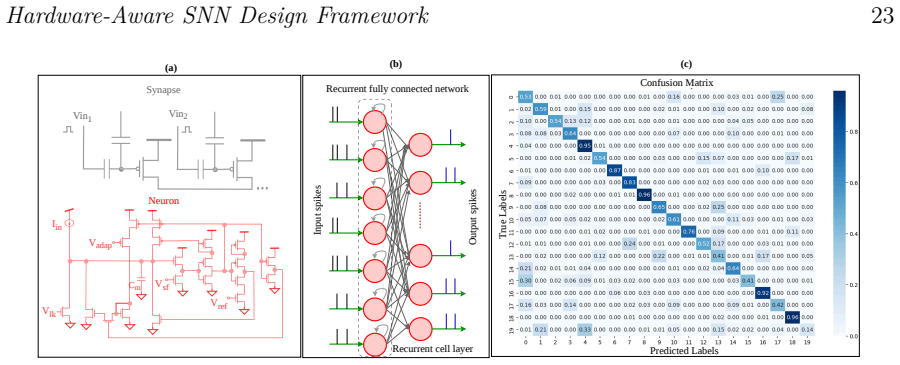
Custom PyTorch modules that implement the modified EKV floating-gate current law and the exponential-sinh ReRAM I-V characteristic so the trainable weights are the device parameters V_FG0 and filament gap g; surrogate-gradient BPTT then updates those physical parameters while Euler-discretized neuron models (Axon-Hillock, LIF variants, Hodgkin-Huxley) produce spikes.
Load-bearing premise
That average-behavior device models and simple point-neuron circuits fitted to measured I-V and spike-rate curves are faithful enough to predict real silicon accuracy, area and power without modeling noise, mismatch, parasitics, routing delays or on-chip calibration.
What would settle it
Build a small mixed-signal SNN with the same FG or ReRAM synapses and neuron circuits, load the tool-optimized physical parameters with no extra tuning, and check whether measured classification accuracy, power and area on one benchmark match the framework's reported numbers within the claimed margins.
If this is right
- Designers can rank floating-gate versus ReRAM and LIF versus Axon-Hillock or Hodgkin-Huxley configurations by joint accuracy-area-power metrics before tape-out.
- Post-training 8-bit floating-gate and 3-bit ReRAM quantization can be scored for accuracy drop without a separate abstract-to-device mapping step.
- Recurrent and fully connected architectures can be compared under identical hardware models on temporal tasks such as SHD.
- Neuron parameters extracted from both 65 nm and 28 nm processes can be swapped inside the same training pipeline, supporting multi-node exploration.
Where Pith is reading between the lines
- If mean-device models prove sufficient, co-training on physical parameters could cut the lengthy bias and weight calibration that currently limits mixed-signal neuromorphic chips.
- Adding device-noise and mismatch distributions to the same embedding would turn the explorer into a variability-aware optimizer rather than a mean-behavior tool.
- An open common harness of this form could become a shared benchmark for comparing future analog synapse technologies on identical SNN tasks and metrics.
Editorial analysis
A structured set of objections, weighed in public.
Referee Report
Summary. The manuscript presents an open-source PyTorch framework for mixed-signal SNN design-space exploration that embeds experimentally calibrated floating-gate (65 nm) and ReRAM (Skywater 130 nm) nonlinear synapse models, together with multiple mixed-signal neuron models (Axon-Hillock, adaptive/standard/Schmitt LIF, Hodgkin–Huxley), into end-to-end training. Synaptic parameters optimized during learning are physical device quantities (V_FG0, filament gap g) rather than abstract weights. The tool supports fully connected and recurrent architectures, is evaluated on N-MNIST, DVS Gesture and SHD, and reports classification accuracy jointly with estimated silicon area, power and post-training quantization sensitivity. A small 2×8×2 XOR network is cross-checked against Cadence (function, area, power), and single-neuron ISI curves are matched to transistor-level simulations.
Significance. If the framework’s accuracy–area–power rankings are accepted as indicative of mixed-signal hardware trade-offs, this is a practically useful contribution: it lowers the barrier between algorithmic SNN work and analog neuromorphic circuit constraints, ships open code, and unifies several calibrated device and neuron models under one training loop. Strengths include measurement-anchored FG and ReRAM I–V models, Cadence-validated neuron ISI behavior, an explicit XOR circuit co-simulation, and joint reporting of accuracy with hardware metrics on standard neuromorphic datasets. The main value is as a co-design exploration platform rather than as a new learning algorithm or a fully predictive silicon model.
major comments (4)
- The central claim that the framework supports quantitative, hardware-predictive design-space exploration (Abstract; §1; §7) rests on mean-behavior models whose network-level fidelity is only weakly validated. Single-neuron ISI matches Cadence (Fig. 9–10; Supp. S3) and a 2×8×2 XOR net matches area/power to ~0.1% with 100% function (§6.1). Full-network results in Tables 2–4 are pure Python: no multi-neuron Cadence co-simulation, no injected mismatch/noise/parasitics/drift, and no AER/routing. §8 correctly flags these gaps, but the abstract and conclusion still present accuracy drops and ReRAM vs FG area/power rankings as hardware-oriented design guidance. Either temper the claim to “simulation-internal, mean-model exploration” or add at least one multi-neuron fidelity check (e.g., mismatch Monte Carlo or a larger Cadence/Python co-sim) that shows rankings are stable.
- Table 3 and §6: area and power are obtained by analytically scaling Cadence core-block layouts and accumulating branch/event currents × V_DD (Eq. 16). This omits interconnect, AER arbitration, memory access, and array parasitics that often dominate mixed-signal neuromorphic chips. The reported >100× area advantage of ReRAM vs FG and the absolute mW-scale numbers are therefore not yet comparable to deployable systems. Please state explicitly what is included/excluded in the area/power model, and either (i) add a sensitivity analysis under plausible routing/peripheral overheads or (ii) reframe Table 3 as core-compute estimates only, not full-chip metrics.
- §6.2 / Discussion: accuracy degradations of ~8–11% (N-MNIST) and ~7–8% (DVS) when replacing nn.Linear with ReRAM/FG are attributed to “hardware-induced non-idealities,” yet the authors note that disentangling nonlinearity, limited precision, and architecture is left for future work. Without an ablation (ideal linear weights vs nonlinear continuous device model vs post-training quantization alone; Tables 2 vs 4), the design-space conclusions about which neuron–synapse pair “best satisfies” accuracy–energy–area constraints are under-supported. A minimal ablation on one dataset would substantially strengthen the comparative claims.
- §3.1 and Table 4: quantization is applied post-training (8-bit FG, 3-bit ReRAM) by nearest-level projection after continuous optimization of V_FG0 or g. The framework’s stated advantage is optimizing physical parameters inside the training loop; discrete programmable levels are not part of that loop. For ReRAM especially (only 8 levels), PTQ can dominate the accuracy gap. Either integrate differentiable or STE-based quantization during training, or clearly separate “device-nonlinear continuous training” from “hardware-level discrete programming” when interpreting Table 4.
minor comments (7)
- Table 1 comparison is thin on modern hardware-aware or mixed-signal SNN tools (e.g., Brian2/Lava with device plugins, NeuroSim-class CIM estimators, SANA-FE cited only in limitations). A short positioning paragraph would help readers place the contribution.
- Fig. 1 caption and body: “eThe implementation” appears to be a typo; also “SnnTorch” / “snnTorch” capitalization is inconsistent.
- Eq. (2) text refers to Q_FG but the displayed equation uses capacitive coupling terms only; align notation with the prose.
- Table 2: architecture strings and neuron process nodes (65 nm vs 28 nm) are useful; please also report number of trainable device parameters and whether recurrent weights use the same FG/ReRAM model as feedforward weights.
- §5.1.2: Mutual SNN Pooling is important for DVS results; a one-sentence statement of whether pooling is fixed or learned, and whether it is counted in area/power, would avoid ambiguity.
- Code link (§9) is welcome; please pin a commit/tag and list which tables/figures are fully reproducible from the public repo.
- Supplementary temporal-deviation analysis (Fig. S3) is valuable; consider promoting a short quantitative summary (median |ΔV|, ISI error) into the main text near Fig. 9–10.
Circularity Check
No load-bearing circularity: device models are fitted to independent I–V/ISI measurements and Cadence baselines; network accuracy and area/power rankings are evaluated on external public datasets rather than reducing to those fits by construction.
full rationale
The paper’s central claim is an engineering framework that embeds calibrated FG (eqs. 1–2, Fig. 4) and ReRAM (eq. 3, Fig. 6) nonlinearities plus mixed-signal neuron models into PyTorch modules so that physical parameters (V_FG0, filament gap g) can be optimized end-to-end and accuracy/area/power/quantization reported jointly on N-MNIST, DVS Gesture and SHD. The device equations are ordinary empirical fits to measured I–V curves and Cadence ISI data; those fits are then used as fixed forward models inside training. Classification losses are computed on public external benchmarks, not on the same I–V or ISI data used for calibration, so the reported accuracies and the 8–11 % hardware-induced drops are not forced by construction. Area and power numbers are obtained by scaling separate Cadence layout baselines (Sec. 6.1 XOR match, Table 3). Self-citations ([37], [43], [59]) supply the measurement anchors and Verilog-A models; they are ordinary prior characterization work, not uniqueness theorems or load-bearing premises that close a definitional loop. No step equates a claimed prediction to its own fitted input, renames a known result, or smuggles an ansatz that forces the design-space rankings. The acknowledged fidelity gaps (noise, mismatch, AER, §8) are correctness risks, not circularity. Hence only a minimal residual score for ordinary self-citation of the authors’ own device characterizations.
Axiom & Free-Parameter Ledger
free parameters (5)
- FG EKV/device fit parameters (κ, σ, I_thpmos, C ratios, V_TP, etc.)
- ReRAM model constants I0, g0, V0 and filament bounds
- Neuron circuit parameters (C_mem, thresholds, leak/adapt/ref currents, time constants)
- Quantization bit-widths and clip ranges (FG 8-bit, ReRAM 3-bit)
- Network hyperparameters (layer sizes, epochs, T time bins, learning setup)
axioms (5)
- domain assumption Surrogate-gradient BPTT through non-differentiable spikes yields useful credit assignment for these nonlinear analog synapses.
- domain assumption Mean device I–V behavior (ignoring device-to-device and cycle-to-cycle variation during training) is sufficient for design-space ranking.
- domain assumption First-order Euler discretization of membrane ODEs at chosen Δt preserves spike rates well enough for classification metrics.
- ad hoc to paper Area and average power can be estimated by scaling Cadence block layouts and accumulating branch/event currents × V_DD.
- standard math Standard math of chain rule and matrix multiplies for custom nn.Module forward maps.
read the original abstract
Energy-efficient neuromorphic computing at the edge requires simulation tools that can capture the non-ideal behavior of mixed-signal spiking neural network (SNN) hardware while supporting system-level design exploration. This work presents an open-source hardware-aware simulation framework for mixed-signal SNNs that enables comparative analysis across neuron, synapse and architecture choices. The framework supports multiple neuron models, including Leaky Integrate-and-Fire (LIF), Hodgkin-Huxley (HH) and Axon-Hillock (AH), together with non-volatile analog synapses based on floating-gate transistors and ReRAM devices. By incorporating device-level nonlinearities directly into PyTorch-based training and inference, the tool enables optimization of physical synaptic parameters rather than idealized abstract weights. The framework is evaluated on standard neuromorphic benchmarks, including N-MNIST, DVS Gesture and Spiking Heidelberg Digits (SHD). For each model dataset configuration, it reports classification accuracy together with hardware-oriented metrics such as silicon area, power consumption and quantization sensitivity. These capabilities enable cross-layer design space exploration and help identify neuron-synapse configurations that best satisfy application-specific constraints on accuracy, energy efficiency, area and hardware fidelity.
Figures


Reference graph
Works this paper leans on
-
[1]
Edge intelligence through in-sensor and near-sensor computing for the artificial intelligence of things,
Y. Baek, B. Bae, H. Shin, C. Sonnadara, H. Cho, C.-Y. Lin, Y. Mu, C. Shen, S. Shah, G. Wang, and K. Lee, “Edge intelligence through in-sensor and near-sensor computing for the artificial intelligence of things,” npj Unconventional Computing , vol. 2, no. 1, p. 25, Oct. 2025. [Online]. A vailable:https://www.nature.com/articles/s44335-025-00040-6
2025
-
[2]
Networks of spiking neurons: the third generation of neural network models,
W. Maass, “Networks of spiking neurons: the third generation of neural network models,” Neural Networks, vol. 10, no. 9, pp. 1659–1671, 1997
1997
-
[3]
A Survey of Neuromorphic Computing and Neural Networks in Hardware,
C. D. Schuman, T. E. Potok, R. M. Patton, J. D. Birdwell, M. E. Dean, G. S. Rose, and J. S. Plank, “A Survey of Neuromorphic Computing and Neural Networks in Hardware,” May 2017, arXiv:1705.06963 [cs.NE]. [Online]. A vailable: http://arxiv.org/abs/1705.06963
Pith/arXiv arXiv 2017
-
[4]
Loihi: A Neuromorphic Manycore Processor with On-Chip Learning,
M. Davies, N. Srinivasa, T.-H. Lin, G. Chinya, Y. Cao, S. H. Choday, G. Dimou, P. Joshi, N. Imam, S. Jain, Y. Liao, C.-K. Lin, A. Lines, R. Liu, D. Mathaikutty, S. McCoy, A. Paul, J. Tse, G. Venkataramanan, Y.-H. Weng, A. Wild, Y. Yang, and H. Wang, “Loihi: A Neuromorphic Manycore Processor with On-Chip Learning,” IEEE Micro, vol. 38, no. 1, pp. 82–99, Ja...
2018
-
[5]
TrueNorth: Design and Tool Flow of a 65 mW 1 Million Neuron Programmable Neurosynaptic Chip,
F. Akopyan, J. Sawada, A. Cassidy, R. Alvarez-Icaza, J. Arthur, P. Merolla, N. Imam, Y. Nakamura, P. Datta, G.-J. Nam, B. Taba, M. Beakes, B. Brezzo, J. B. Kuang, R. Manohar, W. P. Risk, B. Jackson, and D. S. Modha, “TrueNorth: Design and Tool Flow of a 65 mW 1 Million Neuron Programmable Neurosynaptic Chip,” IEEE Transactions on Computer-Aided Design of ...
2015
-
[6]
SpiNNaker: A 1-W 18-Core System-on-Chip for Massively-Parallel Neural Network Simulation,
E. Painkras, L. A. Plana, J. Garside, S. Temple, F. Galluppi, C. Patterson, D. R. Lester, A. D. Brown, and S. B. Furber, “SpiNNaker: A 1-W 18-Core System-on-Chip for Massively-Parallel Neural Network Simulation,” IEEE Journal of Solid-State Circuits , vol. 48, no. 8, pp. 1943–1953, Aug. 2013, conference Name: IEEE Journal of Solid-State Circuits
1943
-
[7]
A 65k-neuron 73-Mevents/s 22-pJ/event asynchronous micro-pipelined integrate-and-fire array transceiver,
J. Park, S. Ha, T. Yu, E. Neftci, and G. Cauwenberghs, “A 65k-neuron 73-Mevents/s 22-pJ/event asynchronous micro-pipelined integrate-and-fire array transceiver,” in 2014 IEEE Biomedical Circuits and Systems Conference (BioCAS) Proceedings , Oct. 2014, pp. 675–678
2014
-
[8]
Spike timing–dependent plasticity: a hebbian learning rule,
N. Caporale and Y. Dan, “Spike timing–dependent plasticity: a hebbian learning rule,” Annu. Rev. Neurosci., vol. 31, no. 1, pp. 25–46, 2008
2008
-
[9]
Neuromorphic electronic systems,
C. Mead, “Neuromorphic electronic systems,” Proceedings of the IEEE , vol. 78, no. 10, pp. 1629– 1636, Oct. 1990, conference Name: Proceedings of the IEEE
1990
-
[10]
Memory and Information Processing in Neuromorphic Systems,
G. Indiveri and S.-C. Liu, “Memory and Information Processing in Neuromorphic Systems,” Proceedings of the IEEE , vol. 103, no. 8, pp. 1379–1397, Aug. 2015, conference Name: Proceedings of the IEEE
2015
-
[11]
A reconfigurable on-line learning spiking neuromorphic processor comprising 256 neurons and 128k synapses,
N. Qiao, H. Mostafa, F. Corradi, M. Osswald, F. Stefanini, D. Sumislawska, and G. Indiveri, “A reconfigurable on-line learning spiking neuromorphic processor comprising 256 neurons and 128k synapses,” Frontiers in neuroscience, vol. 9, p. 141, 2015. Hardware-Aware SNN Design Framework 28
2015
-
[12]
Exploiting inherent error resiliency of deep neural networks to achieve extreme energy efficiency through mixed-signal neurons,
B. Chatterjee, P. Panda, S. Maity, A. Biswas, K. Roy, and S. Sen, “Exploiting inherent error resiliency of deep neural networks to achieve extreme energy efficiency through mixed-signal neurons,” IEEE Transactions on Very Large Scale Integration (VLSI) Systems , vol. 27, no. 6, pp. 1365–1377, 2019
2019
-
[13]
Neuromorphic analog circuits for robust on-chip always-on learning in spiking neural networks,
A. Rubino, M. Cartiglia, M. Payvand, and G. Indiveri, “Neuromorphic analog circuits for robust on-chip always-on learning in spiking neural networks,” arXiv preprint arXiv:2307.06084 , 2023
Pith/arXiv arXiv 2023
-
[14]
Variation-tolerant hardware synthesis of spiking neural networks,
V. V Nair, S. N. Chowdhury, and S. Shah, “Variation-tolerant hardware synthesis of spiking neural networks,” in 2025 First International Conference on Intelligent Computing and Systems at the Edge (ICEdge) , vol. 1, 2025, pp. 1–6
2025
-
[15]
Training Spiking Neural Networks Using Lessons From Deep Learning,
J. K. Eshraghian, M. Ward, E. Neftci, X. Wang, G. Lenz, G. Dwivedi, M. Bennamoun, D. S. Jeong, and W. D. Lu, “Training Spiking Neural Networks Using Lessons From Deep Learning,” Aug. 2023, arXiv:2109.12894 [cs]. [Online]. A vailable: http://arxiv.org/abs/2109.12894
Pith/arXiv arXiv 2023
-
[16]
Shaping the learning landscape in neural networks around wide flat minima,
C. Baldassi, F. Pittorino, and R. Zecchina, “Shaping the learning landscape in neural networks around wide flat minima,” Proceedings of the National Academy of Sciences , vol. 117, no. 1, pp. 161–170, 2020
2020
-
[17]
Gerstner, W
W. Gerstner, W. M. Kistler, R. Naud, and L. Paninski, Neuronal Dynamics: From Single Neurons to Networks and Models of Cognition . Cambridge University Press, 2014
2014
-
[18]
Genesis: A system for simulating neural networks,
M. Wilson, U. Bhalla, J. Uhley, and J. Bower, “Genesis: A system for simulating neural networks,” Advances in neural information processing systems , vol. 1, 1988
1988
-
[19]
The neuron simulation environment,
M. L. Hines and N. T. Carnevale, “The neuron simulation environment,” Neural Computation, vol. 9, no. 6, pp. 1179–1209, 08 1997. [Online]. A vailable: https://doi.org/10.1162/neco.1997.9.6.1179
-
[20]
Ermentrout, Simulating, Analyzing, and Animating Dynamical Systems: A Guide to XPPAUT for Researchers and Students
B. Ermentrout, Simulating, Analyzing, and Animating Dynamical Systems: A Guide to XPPAUT for Researchers and Students . SIAM Press, 2002
2002
-
[21]
Csim: A neural simulation environment for modeling the dynamics of spiking neuron networks,
T. Natschläger, T. Bertschinger, R. Legenstein, and N. Maass, “Csim: A neural simulation environment for modeling the dynamics of spiking neuron networks,” Technical Report, 2003
2003
-
[22]
Exact simulation of integrate-and-fire models with synaptic conductances,
R. Brette, “Exact simulation of integrate-and-fire models with synaptic conductances,” Neural Computation, vol. 18, no. 8, pp. 2004–2027, 2006
2004
-
[23]
Nest (neural simulation tool),
M.-O. Gewaltig and M. Diesmann, “Nest (neural simulation tool),” Scholarpedia, vol. 2, no. 4, p. 1430, 2007
2007
-
[24]
On the performance of voltage stepping for the simulation of adaptive, nonlinear integrate-and-fire neuronal networks,
M. G. Kaabi, A. Tonnelier, and D. Martinez, “On the performance of voltage stepping for the simulation of adaptive, nonlinear integrate-and-fire neuronal networks,” Neural computation , vol. 23, no. 5, pp. 1187–1204, 2011
2011
-
[25]
A large-scale model of the functioning brain,
C. Eliasmith, T. C. Stewart, X. Choo, T. Bekolay, T. DeWolf, Y. Tang, and D. Rasmussen, “A large-scale model of the functioning brain,” Science, vol. 338, no. 6111, pp. 1202–1205, 2012
2012
-
[26]
Ncs: A framework for simulating large- scale, biologically realistic neural networks,
R. V. Hoang, F. C. H. Jr., P. H. Goodman, and M. Zirpe, “Ncs: A framework for simulating large- scale, biologically realistic neural networks,” in Proceedings of the International Joint Conference on Neural Networks (IJCNN) , 2003, pp. 411–416
2003
-
[27]
Mosaic: in-memory computing and routing for small-world spike-based neuromorphic systems,
T. Dalgaty, F. Moro, Y. Demirağ, A. De Pra, G. Indiveri, E. Vianello, and M. Payvand, “Mosaic: in-memory computing and routing for small-world spike-based neuromorphic systems,” Nature Communications, vol. 15, no. 1, p. 142, 2024
2024
-
[28]
The neuron book,
N. T. Carnevale and M. L. Hines, “The neuron book,” Cambridge University Press , 2006
2006
-
[29]
Simulation of networks of spiking neurons: A review of tools and strategies,
R. Brette, M. Rudolph, T. Carnevale, M. Hines, D. Beeman, J. M. Bower, M. Diesmann, A. Morrison, P. H. Goodman, F. C. H. Jr., M. Zirpe, T. Natschläger, D. Pecevski, B. Ermentrout, A. Djurfeldt, A. Lansner, O. Rochel, T. Vieville, E. Muller, A. P. Davison, S. H. B. Rotter, and A. Destexhe, “Simulation of networks of spiking neurons: A review of tools and s...
2007
-
[30]
A floating gate and its application to memory devices,
D. Kahng and S. M. Sze, “A floating gate and its application to memory devices,” The Bell System Technical Journal, vol. 46, no. 6, pp. 1288–1295, 1967
1967
-
[31]
A floating-gate MOS learning array with locally computed weight updates,
C. Diorio, P. Hasler, B. A. Minch, and C. A. Mead, “A floating-gate MOS learning array with locally computed weight updates,” IEEE Transactions on Electron Devices , vol. 44, no. 12, pp. Hardware-Aware SNN Design Framework 29 2281–2289, Dec. 1997, conference Name: IEEE Transactions on Electron Devices
1997
-
[32]
Floating Gate Synapses With Spike-Time- Dependent Plasticity,
S. Ramakrishnan, P. E. Hasler, and C. Gordon, “Floating Gate Synapses With Spike-Time- Dependent Plasticity,” IEEE Transactions on Biomedical Circuits and Systems , vol. 5, no. 3, pp. 244–252, Jun. 2011, conference Name: IEEE Transactions on Biomedical Circuits and Systems
2011
-
[33]
Temporally learning floating-gate VLSI synapses,
S.-C. Liu and R. Mockel, “Temporally learning floating-gate VLSI synapses,” in 2008 IEEE International Symposium on Circuits and Systems , May 2008, pp. 2154–2157
2008
-
[34]
Implementation of multilayer perceptron network with highly uniform passive memristive crossbar circuits,
F. M. Bayat, M. Prezioso, B. Chakrabarti, H. Nili, I. Kataeva, and D. Strukov, “Implementation of multilayer perceptron network with highly uniform passive memristive crossbar circuits,” Nature Communications , vol. 9, no. 1, p. 2331, Jun. 2018, number: 1. [Online]. A vailable: https://www.nature.com/articles/s41467-018-04482-4
2018
-
[35]
C. C. Enz, F. Krummenacher, and E. A. Vittoz, “An analytical MOS transistor model valid in all regions of operation and dedicated to low-voltage and low-current applications,” Analog Integrated Circuits and Signal Processing , vol. 8, no. 1, pp. 83–114, Jul. 1995. [Online]. A vailable:https://doi.org/10.1007/BF01239381
-
[36]
Modeling, simulation and implementation of circuit elements in an open-source tool set on the FPAA,
A. Natarajan and J. Hasler, “Modeling, simulation and implementation of circuit elements in an open-source tool set on the FPAA,” Analog Integrated Circuits and Signal Processing , vol. 91, no. 1, pp. 119–130, Apr. 2017. [Online]. A vailable: http://link.springer.com/10.1007/s10470-016-0914-y
-
[37]
Analysis and verilog-a modeling of floating-gate transistors,
S. N. Chowdhury, M. Chen, and S. Shah, “Analysis and verilog-a modeling of floating-gate transistors,” IEEE Open Journal of Circuits and Systems , 2024
2024
-
[38]
Integrated Floating-Gate Programming Environment for System-Level ICs,
S. Kim, J. Hasler, and S. George, “Integrated Floating-Gate Programming Environment for System-Level ICs,” IEEE Transactions on Very Large Scale Integration (VLSI) Systems , vol. 24, no. 6, pp. 2244–2252, Jun. 2016, conference Name: IEEE Transactions on Very Large Scale Integration (VLSI) Systems
2016
-
[39]
Modeling and analysis of analog non-volatile devices for compute-in-memory applications,
C. Brando, M. Park, S. N. Chowdhury, M. Chen, K. Lee, and S. Shah, “Modeling and analysis of analog non-volatile devices for compute-in-memory applications,” in 2023 IEEE 66th International Midwest Symposium on Circuits and Systems (MWSCAS) . IEEE, 2023, pp. 103–107
2023
-
[40]
10 × 10nm 2 hf/hfo x crossbar resistive ram with excellent performance, reliability and low-energy operation,
B. Govoreanu, G. S. Kar, Y. Chen, V. Paraschiv, S. Kubicek, A. Fantini, I. Radu, L. Goux, S. Clima, R. Degraeve et al. , “10 × 10nm 2 hf/hfo x crossbar resistive ram with excellent performance, reliability and low-energy operation,” in 2011 International Electron Devices Meeting. IEEE, 2011, pp. 31–6
2011
-
[41]
Influence of oxygen vacancies in ald hfo2-x thin films on non-volatile resistive switching phenomena with a ti/hfo2-x/pt structure,
A. S. Sokolov, Y.-R. Jeon, S. Kim, B. Ku, D. Lim, H. Han, M. G. Chae, J. Lee, B. G. Ha, and C. Choi, “Influence of oxygen vacancies in ald hfo2-x thin films on non-volatile resistive switching phenomena with a ti/hfo2-x/pt structure,” Applied Surface Science, vol. 434, pp. 822–830, 2018
2018
-
[42]
A low-temperature-grown tio2-based device for the flexible stacked rram application,
H. Y. Jeong, Y. I. Kim, J. Y. Lee, and S.-Y. Choi, “A low-temperature-grown tio2-based device for the flexible stacked rram application,” Nanotechnology, vol. 21, no. 11, p. 115203, 2010
2010
-
[43]
Characterization and modeling of multilevel analog reram synapses in the sky130 process,
I. Didin, C. Brando, C.-Y. Lin, and S. Shah, “Characterization and modeling of multilevel analog reram synapses in the sky130 process,” IEEE Journal on Exploratory Solid-State Computational Devices and Circuits , 2026
2026
-
[44]
Neuromorphic Silicon Neuron Circuits,
G. Indiveri, B. Linares-Barranco, T. J. Hamilton, A. v. Schaik, R. Etienne-Cummings, T. Delbruck, S.-C. Liu, P. Dudek, P. Häfliger, S. Renaud, J. Schemmel, G. Cauwenberghs, J. Arthur, K. Hynna, F. Folowosele, S. Saighi, T. Serrano-Gotarredona, J. Wijekoon, Y. Wang, and K. Boahen, “Neuromorphic Silicon Neuron Circuits,” Frontiers in Neuroscience, vol. 5, 2011
2011
-
[45]
Mead, Analog VLSI and neural systems
C. Mead, Analog VLSI and neural systems . USA: Addison-Wesley Longman Publishing Co., Inc., 1989
1989
-
[46]
A low-power adaptive integrate-and-fire neuron circuit,
G. Indiveri, “A low-power adaptive integrate-and-fire neuron circuit,” in Proceedings of the 2003 International Symposium on Circuits and Systems, 2003. ISCAS ’03. , vol. 4, 2003, pp. IV–IV
2003
-
[47]
Hardware aware modeling of mixed-signal spiking neural network,
S. Chowdhury and S. Shah, “Hardware aware modeling of mixed-signal spiking neural network,” IEEE NEWCAS , 2022
2022
-
[48]
A. L. Hodgkin and A. F. Huxley, “A quantitative description of membrane current and its application to conduction and excitation in nerve,” The Journal of Physiology , vol. 117, no. 4, pp. 500–544, 1952. [Online]. A vailable: https://physoc.onlinelibrary.wiley.com/doi/abs/10.1113/jphysiol.1952.sp004764
-
[49]
Hodgkin–Huxley Neuron and FPAA Dynamics,
A. Natarajan and J. Hasler, “Hodgkin–Huxley Neuron and FPAA Dynamics,” IEEE Transactions on Biomedical Circuits and Systems , vol. 12, no. 4, pp. 918–926, Aug. 2018, conference Name: IEEE Transactions on Biomedical Circuits and Systems
2018
-
[50]
Backpropagation through time and the brain,
T. P. Lillicrap and A. Santoro, “Backpropagation through time and the brain,” Current opinion in neurobiology, vol. 55, pp. 82–89, 2019
2019
-
[51]
Surrogate Gradient Learning in Spiking Neural Networks,
E. O. Neftci, H. Mostafa, and F. Zenke, “Surrogate Gradient Learning in Spiking Neural Networks,” arXiv:1901.09948 [cs, q-bio] , May 2019, arXiv: 1901.09948. [Online]. A vailable: http://arxiv.org/abs/1901.09948
Pith/arXiv arXiv 1901
-
[52]
Converting Static Image Datasets to Spiking Neuromorphic Datasets Using Saccades,
G. Orchard, A. Jayawant, G. K. Cohen, and N. Thakor, “Converting Static Image Datasets to Spiking Neuromorphic Datasets Using Saccades,” Frontiers in Neuroscience , vol. 9, 2015. [Online]. A vailable: https://www.frontiersin.org/articles/10.3389/fnins.2015.00437/full
-
[53]
A low power, fully event-based gesture recognition system,
A. Amir, B. Taba, D. Berg, T. Melano, J. McKinstry, C. Di Nolfo, T. Nayak, A. Andreopoulos, G. Garreau, M. Mendoza et al. , “A low power, fully event-based gesture recognition system,” in Proceedings of the IEEE conference on computer vision and pattern recognition , 2017, pp. 7243–7252
2017
-
[54]
The heidelberg spiking data sets for the systematic evaluation of spiking neural networks,
B. Cramer, Y. Stradmann, J. Schemmel, and F. Zenke, “The heidelberg spiking data sets for the systematic evaluation of spiking neural networks,” IEEE Transactions on Neural Networks and Learning Systems, vol. 33, no. 7, pp. 2744–2757, 2022
2022
-
[55]
Deep learning for event-based vision: A comprehensive survey and benchmarks,
X. Zheng, Y. Liu, Y. Lu, T. Hua, T. Pan, W. Zhang, D. Tao, and L. Wang, “Deep learning for event-based vision: A comprehensive survey and benchmarks,” arXiv preprint arXiv:2302.08890, 2023
Pith/arXiv arXiv 2023
-
[56]
Tonic: event-based datasets and transformations
G. Lenz, K. Chaney, S. Bam Shrestha, O. Oubari, S. Picaud, and G. Zarrella, “Tonic: event-based datasets and transformations. ” Zenodo, 2021
2021
-
[57]
Performance comparison of dvs data spatial downscaling methods using spiking neural networks,
A. Gruel, J. Martinet, B. Linares-Barranco, and T. Serrano-Gotarredona, “Performance comparison of dvs data spatial downscaling methods using spiking neural networks,” in Proceedings of the IEEE/CVF Winter Conference on Applications of Computer Vision , 2023, pp. 6494–6502
2023
-
[58]
Sana-fe: Simulating advanced neuromorphic architectures for fast exploration,
J. A. Boyle, M. Plagge, S. G. Cardwell, F. S. Chance, and A. Gerstlauer, “Sana-fe: Simulating advanced neuromorphic architectures for fast exploration,” IEEE Transactions on Computer- Aided Design of Integrated Circuits and Systems , vol. 44, no. 8, pp. 3165–3178, 2025
2025
-
[59]
Open-source floating-gate cell for analogue synapses,
M. Chen, C. Sonnadara, and S. Shah, “Open-source floating-gate cell for analogue synapses,” Electronics Letters , vol. 60, no. 17, p. e70036, 2024, _eprint: https://onlinelibrary.wiley.com/doi/pdf/10.1049/ell2.70036. [Online]. A vailable: https://onlinelibrary.wiley.com/doi/abs/10.1049/ell2.70036 Supplementary Material Supplementary Material 31
-
[60]
Standard LIF neuron M84M1 M M3M2 C1 M5 M6 M9 M7 VspikeIleak Iin Figure S1: Standard LIF neuron circuit used in the manuscript The LIF neuron circuit, shown in Fig
Neuron dynamics 11.1. Standard LIF neuron M84M1 M M3M2 C1 M5 M6 M9 M7 VspikeIleak Iin Figure S1: Standard LIF neuron circuit used in the manuscript The LIF neuron circuit, shown in Fig. S1, uses a membrane capacitor ( C1) to integrate input current ( Iin). Its temporal dynamics are governed by: C1 dVmem dt = −gl ( Vmem − Vreset ) + Iin(t) (S17) where gl r...
-
[61]
Quantization 12.1. Floating gate synapse This work implements a hardware-grounded 8-bit post-training quantization (PTQ) scheme rooted in the floating-gate synapse characterization frameworks established by [ 37, 59]. As characterized, the physical device exhibits threshold voltage ( Vtp) levels distributed across a 0–5 V dynamic range with device-level v...
discussion (0)
Sign in with ORCID, Apple, or X to comment. Anyone can read and Pith papers without signing in.