Lone-Pair-Induced Lattice Softness Enables Ultralow Thermal Conductivity in Hybrid Organic-Inorganic Perovskite GuaPbI₃
Pith reviewed 2026-06-27 06:00 UTC · model grok-4.3
The pith
Lone-pair chemistry softens the GuaPbI3 lattice to produce ultralow thermal conductivity of 0.088 W m^{-1} K^{-1} while keeping electronic pathways active.
A machine-rendered reading of the paper's core claim, the machinery that carries it, and where it could break.
Core claim
Lone-pair-rich hybrid frameworks generate soft and electronically heterogeneous lattice environments that suppress phonon transport while preserving electronically accessible states, demonstrated by the ultralow lattice thermal conductivity measured in crystalline GuaPbI3 together with the supporting transport and DFT results.
What carries the argument
lone-pair-induced lattice softness, the chemically driven softening of the hybrid framework that produces soft phonon modes and localized electrostatic microenvironments from charge redistribution.
If this is right
- Crystalline hybrid perovskites can reach thermal conductivities below 0.1 W m^{-1} K^{-1} without nanostructural engineering.
- Carrier transport remains strongly sensitive to chemical potential near the band edges.
- The Lorenz number deviates from conventional Wiedemann-Franz behavior near the band edges.
- Bulk-dominated electronic transport can coexist with extreme phonon suppression.
Where Pith is reading between the lines
- The same lone-pair strategy could be tested in other hybrid families for thermal-barrier or thermoelectric applications.
- The valence-conduction asymmetry may be exploited by doping to raise the thermoelectric figure of merit.
- Thin-film or device measurements would check whether the bulk phonon suppression and electronic pathways translate to practical geometries.
Load-bearing premise
The ultralow thermal conductivity arises specifically from lone-pair effects on lattice dynamics rather than from defects or other artifacts of the mechanochemical synthesis.
What would settle it
Synthesis and thermal-conductivity measurement of an analogous hybrid perovskite that lacks lone-pair-active cations on the A-site and yields a value substantially above 0.088 W m^{-1} K^{-1}.
Figures

read the original abstract
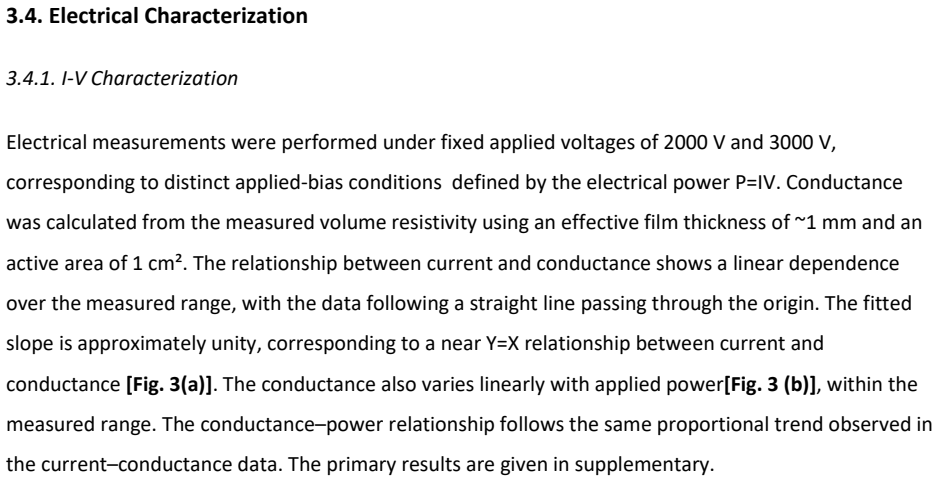
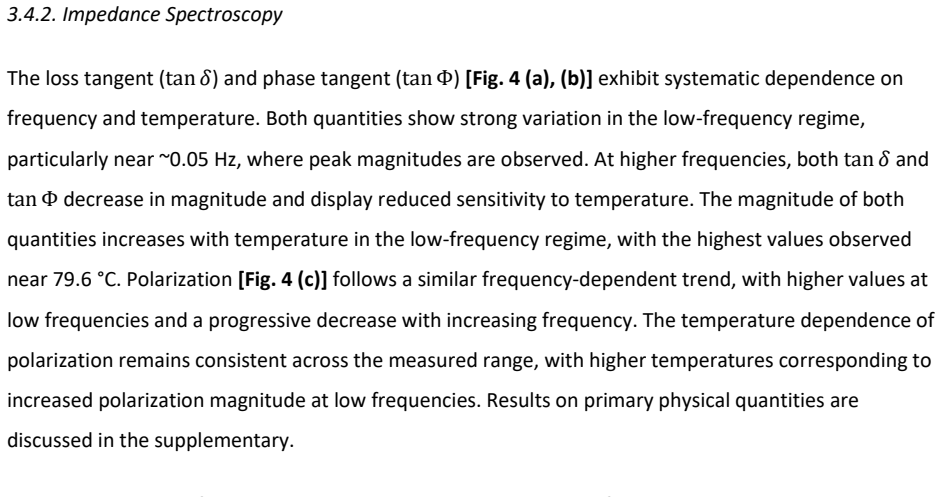
Thermoelectric cooling efficiency is fundamentally constrained by lattice thermal conductivity, yet conventional inorganic thermoelectrics have approached a performance plateau despite extensive nanostructural engineering. Organic thermoelectrics possess intrinsically low thermal conductivity but often suffer from limited and morphology-sensitive charge transport. Here, we introduce a lone-pair-driven materials design strategy based on chemically induced lattice softness in hybrid organic-inorganic perovskites. A physics-guided symbolic-regression-based machine-learning framework identifies a lone-pair-dominated compositional regime associated with suppressed lattice thermal conductivity and selects GuaPbI3 as a candidate material. Mechanochemical synthesis yields crystalline GuaPbI3 with an ultralow room-temperature thermal conductivity of kappa = 0.088 W m^-1 K^-1. Electrical measurements reveal electronically active, bias-dependent bulk conduction pathways despite strong phonon suppression, while impedance spectroscopy confirms bulk-dominated transport. Density functional theory calculations indicate weakly dispersive valence bands, valence-conduction asymmetry, and localized electrostatic microenvironments from charge redistribution within the lattice. Calculated transport coefficients suggest strong sensitivity of carrier transport to chemical potential, while Lorenz-number analysis indicates deviations from conventional Wiedemann-Franz behavior near the band edges. These results support a picture in which lone-pair-rich hybrid frameworks generate soft and electronically heterogeneous lattice environments that suppress phonon transport while preserving electronically accessible states. This work establishes chemically induced lattice softness as a design principle for ultralow-thermal-conductivity hybrid materials.
Editorial analysis
A structured set of objections, weighed in public.
Referee Report
Summary. The manuscript claims that a physics-guided symbolic-regression ML framework identifies a lone-pair-dominated compositional regime in hybrid perovskites, selecting GuaPbI3 as a candidate that exhibits chemically induced lattice softness. Mechanochemical synthesis produces the material with measured room-temperature lattice thermal conductivity of 0.088 W m^{-1} K^{-1}. Electrical and impedance measurements indicate bulk-dominated, bias-dependent conduction, while DFT reveals weakly dispersive valence bands, valence-conduction asymmetry, and localized electrostatic microenvironments. These elements together support the design principle that lone-pair-rich frameworks suppress phonon transport while preserving electronically accessible states for potential thermoelectric applications.
Significance. If substantiated, the work would establish lone-pair-induced lattice softness as a chemically tunable route to ultralow thermal conductivity in hybrid organic-inorganic perovskites, offering a design strategy that complements nanostructuring approaches. The integration of ML-guided candidate selection, experimental synthesis and transport measurements, and DFT analysis of band structure and electrostatics provides a multi-pronged assessment of the mechanism, with the reported κ value and noted deviations from Wiedemann-Franz behavior near band edges representing concrete, testable outcomes.
major comments (1)
- [Abstract (ML framework paragraph)] Abstract (ML framework paragraph): The symbolic-regression framework is presented as identifying the lone-pair-dominated regime responsible for suppressed lattice thermal conductivity and selecting GuaPbI3. No cross-validation scores, held-out test performance, feature-ablation results, or explicit comparisons to non-lone-pair control compounds are referenced. This is load-bearing for the central claim because all subsequent synthesis, κ measurement, and DFT analysis rest on the framework having isolated a genuine causal mechanism rather than rediscovering known low-κ hybrids via correlations in the training distribution.
minor comments (1)
- [Abstract] Abstract: The thermal conductivity is reported as kappa = 0.088 W m^{-1} K^{-1}; ensure that the symbol, units, and any temperature dependence are defined consistently in the main text and figures.
Simulated Author's Rebuttal
We thank the referee for their thorough review and constructive feedback on our manuscript. We address the major comment regarding the presentation of the machine learning framework in the abstract below.
read point-by-point responses
-
Referee: [Abstract (ML framework paragraph)] Abstract (ML framework paragraph): The symbolic-regression framework is presented as identifying the lone-pair-dominated regime responsible for suppressed lattice thermal conductivity and selecting GuaPbI3. No cross-validation scores, held-out test performance, feature-ablation results, or explicit comparisons to non-lone-pair control compounds are referenced. This is load-bearing for the central claim because all subsequent synthesis, κ measurement, and DFT analysis rest on the framework having isolated a genuine causal mechanism rather than rediscovering known low-κ hybrids via correlations in the training distribution.
Authors: We agree that the abstract, as currently written, does not explicitly reference the quantitative validation metrics of the symbolic regression model. The full manuscript provides these details in the Methods and Results sections, including the model's performance metrics and comparisons. To address this concern directly, we will revise the abstract to include a concise statement on the cross-validation and test performance, as well as a note directing readers to the supplementary information for feature ablation and control compound comparisons. This revision will better substantiate the framework's role in identifying the causal mechanism. revision: yes
Circularity Check
No circularity; derivation chain self-contained against external benchmarks
full rationale
The visible abstract and context describe an ML framework selecting a candidate, followed by independent synthesis, kappa measurement, electrical/impedance data, and DFT calculations. No equations, self-citations, or fitted-parameter renamings are quoted that reduce any load-bearing claim to its own inputs by construction. The ML step is presented as input to experiment rather than a fitted output renamed as prediction. This matches the default expectation of no significant circularity when no explicit reduction can be exhibited.
Axiom & Free-Parameter Ledger
axioms (1)
- domain assumption The symbolic-regression ML framework accurately maps composition to suppressed lattice thermal conductivity via lone-pair effects
Reference graph
Works this paper leans on
-
[1]
Introduction Here we introduce a materials-discovery strategy based on chemically induced lattice softness and implement it using a physics-guided symbolic-regression machine-learning framework to identify candidate hybrid perovskites. Rather than functioning as a quantitatively predictive model, the machine- learning approach acts as a compositional scre...
-
[2]
Machine Learning Model The symbolic-regression framework converged to a stable analytical expression across multiple independent runs
Results 3.1. Machine Learning Model The symbolic-regression framework converged to a stable analytical expression across multiple independent runs. The resulting ranking function is: 𝐹 𝑄𝑀,𝐺𝑀,𝐿𝑍 = 23.882 + 𝐺𝑀 + 𝑒𝐿𝑍 − 𝐿𝑍 ∗ 𝑄𝑀 1 3 (9) Higher values of 𝐹 correspond to compositions statistically associated with lower lattice thermal conductivity. Rather than p...
2000
-
[3]
The underlying premise is that chemical composition itself can reveal intrinsic lattice softness capable of strongly suppressing phonon transport
Discussion Rather than investigating whether thermoelectric performance can be enhanced through engineering approaches such as nanostructuring or interface scattering to reduce lattice thermal conductivity, the present study addresses a different question: whether materials possessing intrinsically low lattice thermal conductivity (𝜅𝑙) can be identified p...
-
[4]
Acknowledgement The authors would like to acknowledge CRF IIT Delhi for providing the required experimental facilities
-
[5]
D. Zhao, G. Tan, Appl. Therm. Eng. 2014, 66, 15
2014
-
[6]
Thermoelectric cooling materials | Nature Materials,
“Thermoelectric cooling materials | Nature Materials,” can be found under https://www.nature.com/articles/s41563-020-00852-w, n.d
-
[7]
Typical thermoelectric materials: Progress and prospects - ScienceDirect,
“Typical thermoelectric materials: Progress and prospects - ScienceDirect,” can be found under https://www.sciencedirect.com/science/article/abs/pii/S037596012500060X, n.d
-
[8]
Zheng, T
Y. Zheng, T. J. Slade, L. Hu, X. Y. Tan, Y. Luo, Z.-Z. Luo, J. Xu, Q. Yan, M. G. Kanatzidis, Chem. Soc. Rev. 2021, 50, 9022
2021
-
[9]
Mehdizadeh Dehkordi, M
A. Mehdizadeh Dehkordi, M. Zebarjadi, J. He, T. M. Tritt, Mater. Sci. Eng. R Rep. 2015, 97, 1
2015
-
[10]
X. Qian, J. Zhou, G. Chen, Nat. Mater. 2021, 20, 1188
2021
-
[11]
Advanced Thermoelectric Design: From Materials and Structures to Devices | Chemical Reviews,
“Advanced Thermoelectric Design: From Materials and Structures to Devices | Chemical Reviews,” can be found under https://pubs.acs.org/doi/full/10.1021/acs.chemrev.0c00026, n.d
-
[12]
H. Alam, S. Ramakrishna, Nano Energy 2013, 2, 190
2013
-
[13]
Organic thermoelectric materials for energy harvesting and temperature control | Nature Reviews Materials,
“Organic thermoelectric materials for energy harvesting and temperature control | Nature Reviews Materials,” can be found under https://www.nature.com/articles/natrevmats201650, n.d
-
[14]
“Anisotropic and Ultralow Phonon Thermal Transport in Organic– Inorganic Hybrid Perovskites: Atomistic Insights into Solar Cell Thermal Management and Thermoelectric Energy Conversion Efficiency - Wang - 2016 - Advanced Functional Materials - Wiley Online Library,” can be found under https://advanced.onlinelibrary.wiley.com/doi/abs/10.1002/adfm.201600284, n.d
-
[15]
Carrier recombination in CH3NH3PbI3: why is it a slow process? - IOPscience,
“Carrier recombination in CH3NH3PbI3: why is it a slow process? - IOPscience,” can be found under https://iopscience.iop.org/article/10.1088/1361-6633/ac4be9/meta, n.d
-
[16]
M. A. Haque, S. Kee, D. R. Villalva, W.-L. Ong, D. Baran, Adv. Sci. 2020, 7, 1903389
2020
-
[17]
“Hybrid Organic–Inorganic Perovskites (HOIPs): Opportunities and Challenges - Berry - 2015 - Advanced Materials - Wiley Online Library,” can be found under https://advanced.onlinelibrary.wiley.com/doi/abs/10.1002/adma.201502294, n.d
-
[18]
Y. Jung, W. Lee, S. Han, B.-S. Kim, S.-J. Yoo, H. Jang, Adv. Mater. 2023, 35, 2204872
2023
-
[19]
W. Li, Z. Wang, F. Deschler, S. Gao, R. H. Friend, A. K. Cheetham, Nat. Rev. Mater. 2017, 2, 1
2017
-
[20]
W. Tian, H. Zhou, L. Li, Small 2017, 13, 1702107
2017
-
[21]
D. A. Egger, A. M. Rappe, L. Kronik, Acc. Chem. Res. 2016, 49, 573
2016
-
[22]
T. M. Brenner, D. A. Egger, L. Kronik, G. Hodes, D. Cahen, Nat. Rev. Mater. 2016, 1, 1
2016
-
[23]
Papadimitriou, I
I. Papadimitriou, I. Gialampoukidis, S. Vrochidis, I. Kompatsiaris, Comput. Mater. Sci. 2024, 235, 112793
2024
-
[24]
J. Cai, X. Chu, K. Xu, H. Li, J. Wei, Nanoscale Adv. 2020, 2, 3115
2020
-
[25]
Machine learning in materials science - Wei - 2019 - InfoMat - Wiley Online Library,
“Machine learning in materials science - Wei - 2019 - InfoMat - Wiley Online Library,” can be found under https://onlinelibrary.wiley.com/doi/10.1002/inf2.12028, n.d
-
[26]
Y. Liu, T. Zhao, W. Ju, S. Shi, J. Materiomics 2017, 3, 159
2017
-
[27]
Angelis, F
D. Angelis, F. Sofos, T. E. Karakasidis, Arch. Comput. Methods Eng. 2023, 30, 3845
2023
-
[28]
Quade, M
M. Quade, M. Abel, K. Shafi, R. K. Niven, B. R. Noack, Phys. Rev. E 2016, 94, 012214
2016
-
[29]
Y. Wang, N. Wagner, J. M. Rondinelli, MRS Commun. 2019, 9, 793
2019
-
[30]
Orzechowski, W
P. Orzechowski, W. La Cava, J. H. Moore, in Proc. Genet. Evol. Comput. Conf., Association For Computing Machinery, New York, NY, USA, 2018, pp. 1183–1190
2018
-
[31]
Joblib: running Python functions as pipeline jobs — joblib 1.4.2 documentation,
“Joblib: running Python functions as pipeline jobs — joblib 1.4.2 documentation,” can be found under https://joblib.readthedocs.io/en/stable/, n.d
-
[32]
Welcome to gplearn’s documentation! — gplearn 0.4.2 documentation,
“Welcome to gplearn’s documentation! — gplearn 0.4.2 documentation,” can be found under https://gplearn.readthedocs.io/en/stable/, n.d
-
[33]
H. Xie, S. Hao, J. Bao, T. J. Slade, G. J. Snyder, C. Wolverton, M. G. Kanatzidis, J. Am. Chem. Soc. 2020, 142, 9553
2020
-
[34]
Behera, M
D. Behera, M. Manzoor, R. Sharma, M. M. Salah, I. Stich, S. K. Mukherjee, Crystals 2023, 13, 408
2023
-
[35]
T. Kaur, M. M. Sinha, Mater. Today Commun. 2021, 26, 101741
2021
-
[36]
S. A. Mir, D. C. Gupta, J. Alloys Compd. 2021, 854, 156000
2021
-
[37]
X. Song, X. Shai, S. Deng, J. Wang, J. Li, X. Ma, X. Li, T. Wei, W. Ren, L. Gao, Y. Fu, H. Wang, C. Zeng, J. Phys. Chem. C 2022, 126, 11751
2022
-
[38]
M. A. Ali, S. A. Dar, A. A. AlObaid, T. I. Al-Muhimeed, H. H. Hegazy, G. Nazir, G. Murtaza, J. Phys. Chem. Solids 2021, 159, 110258
2021
-
[39]
X. Wang, Y. Zhao, S. Zeng, Z. Wang, Y. Chen, J. Ni, Phys. Rev. B 2022, 105, 014310
2022
-
[40]
M. A. Ali, T. Alshahrani, G. Murtaza, Mater. Sci. Semicond. Process. 2021, 127, 105728
2021
-
[41]
K. Chen, C. Li, M. Hu, X. Hou, C. Li, Z. Chen, Materials 2017, 10, 362
2017
-
[42]
Maiti, M
T. Maiti, M. Saxena, P. Roy, J. Mater. Res. 2019, 34, 107
2019
-
[43]
Wu, X.-L
H. Wu, X.-L. Shi, W.-D. Liu, M. Li, H. Gao, W. Zhou, Z. Shao, Y. Wang, Q. Liu, Z.-G. Chen, Chem. Eng. J. 2021, 425, 130668
2021
-
[44]
Saxena, T
M. Saxena, T. Maiti, J. Alloys Compd. 2017, 710, 472
2017
-
[45]
“Effect of Halogen Ions on the Low Thermal Conductivity of Cesium Halide Perovskite | The Journal of Physical Chemistry C,” can be found under https://pubs.acs.org/doi/abs/10.1021/acs.jpcc.0c08324, n.d
-
[46]
R. Wang, A. Yang, L. Bao, M. Peng, Y. Duan, Vacuum 2022, 202, 111146
2022
-
[47]
Mukherjee, Bull
R. Mukherjee, Bull. Mater. Sci. 2020, 43, 197
2020
-
[48]
S. A. Khandy, D. C. Gupta, J. Magn. Magn. Mater. 2018, 458, 176
2018
-
[49]
E. I. Marchenko, S. A. Fateev, A. A. Petrov, V. V. Korolev, A. Mitrofanov, A. V. Petrov, E. A. Goodilin, A. B. Tarasov, Chem. Mater. 2020, 32, 7383
2020
-
[50]
K. A. Parrey, S. A. Khandy, I. Islam, A. Laref, D. C. Gupta, A. Niazi, A. Aziz, S. G. Ansari, R. Khenata, S. Rubab, J. Electron. Mater. 2018, 47, 3615
2018
-
[51]
X. Song, J. Wang, Y. Zhao, J. Ni, S. Meng, Z. Dai, Phys. Lett. A 2022, 456, 128550
2022
-
[52]
A. Ali, A. Karim, M. Rashid, A. I. Aljameel, H. Albalawi, M. Morsi, S. Bouzgarrou, Q. Mahmood, J. Phys. Chem. Solids 2021, 159, 110295
2021
-
[53]
A. Mera, T. Zelai, S. A. Rouf, N. A. Kattan, Q. Mahmood, J. Mater. Res. Technol. 2023, 24, 5588
2023
-
[54]
Chik, Mater
A. Chik, Mater. Today Proc. 2022, 66, 3985
2022
-
[55]
Al-Qaisi, M
S. Al-Qaisi, M. Mushtaq, S. Alomairy, T. V. Vu, H. Rached, B. U. Haq, Q. Mahmood, M. S. Al-Buriahi, Mater. Sci. Semicond. Process. 2022, 150, 106947
2022
-
[56]
Sun, C.-L
H.-L. Sun, C.-L. Yang, M.-S. Wang, X.-G. Ma, Y.-G. Yi, Mater. Today Energy 2021, 19, 100611
2021
-
[57]
Singh, H
J. Singh, H. Kaur, G. Singh, S. K. Tripathi, Mater. Today Energy 2021, 21, 100820
2021
-
[58]
van Roekeghem, J
A. van Roekeghem, J. Carrete, C. Oses, S. Curtarolo, N. Mingo, Phys. Rev. X 2016, 6, 041061
2016
-
[59]
Ullah, M
R. Ullah, M. A. Ali, A. Khan, G. Murtaza, A. Mahmood, S. M. Ramay, Mater. Res. Bull. 2021, 134, 111112
2021
-
[60]
Y. Zhao, S. Zeng, G. Li, C. Lian, Z. Dai, S. Meng, J. Ni, Phys. Rev. B 2021, 104, 224304
2021
-
[61]
Y. Xiao, P. Sui, Y. Zhao, J. Ni, S. Meng, Z. Dai, Int. J. Energy Res. 2022, 46, 13687
2022
-
[62]
Tahiri, S
N. Tahiri, S. Dahbi, I. Dani, O. El Bounagui, H. Ez-Zahraouy, Comput. Theor. Chem. 2021, 1204, 113421
2021
-
[63]
Z. Nabi, B. Benichou, M. Ramzan, T. Bellakhdar, B. Bouabdallah, Mater. Today Commun. 2022, 31, 103393
2022
-
[64]
S. A. Khandy, D. C. Gupta, Mater. Chem. Phys. 2020, 239, 121983
2020
-
[65]
Jong, C.-J
U.-G. Jong, C.-J. Yu, Y.-H. Kye, S.-N. Hong, H.-G. Kim, Phys. Rev. Mater. 2020, 4, 075403
2020
-
[66]
S. A. Khandy, D. C. Gupta, J. Solid State Chem. 2021, 300, 122196
2021
-
[67]
T. I. Al-Muhimeed, A. Shafique, A. A. AlObaid, M. Morsi, G. Nazir, M. mana AL-Anazy, Q. Mahmood, Int. J. Energy Res. 2021, 45, 19645
2021
-
[68]
H. Saci, B. Bouabdallah, N. Benseddik, Z. Nabi, B. Bouhafs, B. Benichou, T. Bellakhdar, A. Zaoui, Comput. Condens. Matter 2023, 35, e00791
2023
-
[69]
Haque, M
E. Haque, M. A. Hossain, J. Alloys Compd. 2018, 748, 63
2018
-
[70]
Y. He, G. Galli, Chem. Mater. 2014, 26, 5394
2014
-
[71]
Ahmed, M
T. Ahmed, M. Roknuzzaman, A. Sultana, A. Biswas, Md. S. Alam, M. Saiduzzaman, K. M. Hossain, Mater. Today Commun. 2021, 29, 102973
2021
-
[72]
A. Doi, S. Shimano, M. Kriener, A. Kikkawa, Y. Taguchi, Y. Tokura, Sci. Technol. Adv. Mater. 2022, 23, 858
2022
-
[73]
Z. Tong, Y. Zhang, A. Pecchia, C. Yam, L. Zhou, T. Dumitrică, T. Frauenheim, Adv. Sci. 2023, 10, 2205934
2023
-
[74]
C. Lee, J. Hong, A. Stroppa, M.-H. Whangbo, J. Hoon Shim, RSC Adv. 2015, 5, 78701
2015
-
[75]
X. Song, Y. Zhao, X. Wang, J. Ni, S. Meng, Z. Dai, Phys. Chem. Chem. Phys. 2023, 25, 5776
2023
-
[76]
Abdullah, D
D. Abdullah, D. C. Gupta, J. Magn. Magn. Mater. 2023, 569, 170474
2023
-
[77]
S. A. Khandy, D. C. Gupta, J. Phys. Chem. Solids 2019, 135, 109079
2019
-
[78]
Mahmood, M
Q. Mahmood, M. Hassan, N. Yousaf, A. A. AlObaid, T. I. Al-Muhimeed, M. Morsi, H. Albalawi, O. A. Alamri, Mater. Sci. Semicond. Process. 2022, 137, 106180
2022
-
[79]
M. Nabi, D. C. Gupta, RSC Adv. 2019, 9, 15852
2019
-
[80]
Alhodaib, J
A. Alhodaib, J. Solid State Chem. 2022, 309, 123015
2022
discussion (0)
Sign in with ORCID, Apple, or X to comment. Anyone can read and Pith papers without signing in.