Prethermal cooling with many-body quantum quenches
Pith reviewed 2026-06-26 12:19 UTC · model grok-4.3
The pith
A hopping quench in the Hubbard model creates a prethermal state whose effective temperature drops by the square of the final-to-initial hopping ratio.
A machine-rendered reading of the paper's core claim, the machinery that carries it, and where it could break.
Core claim
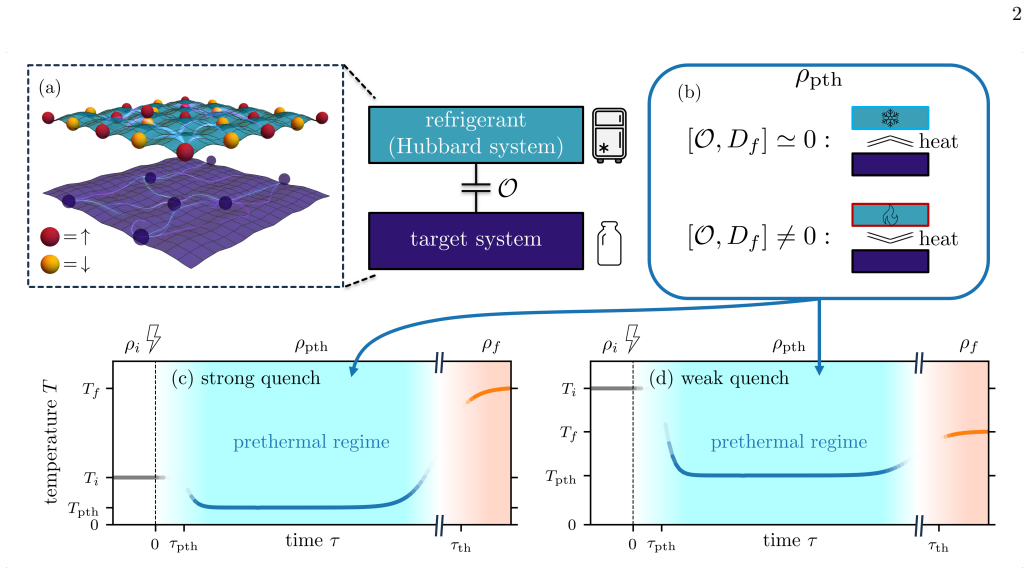
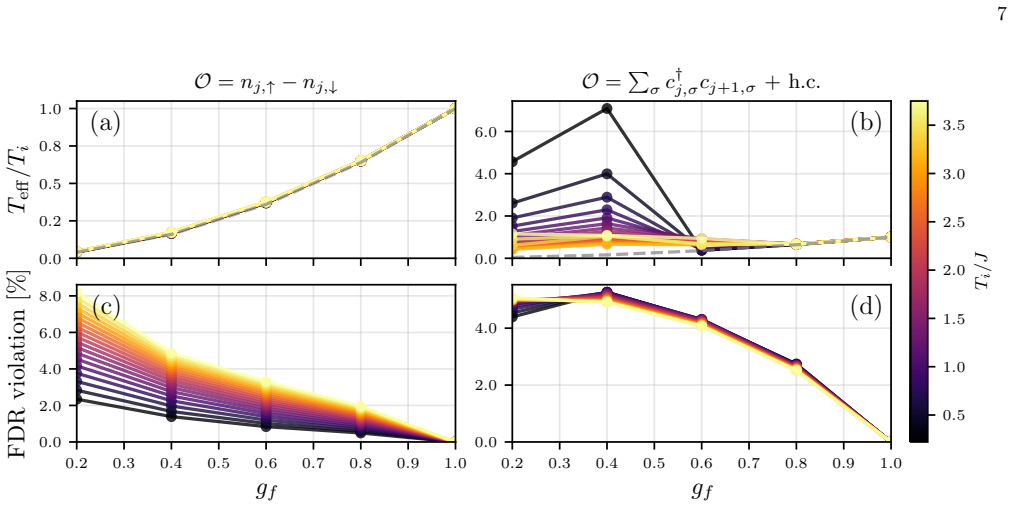
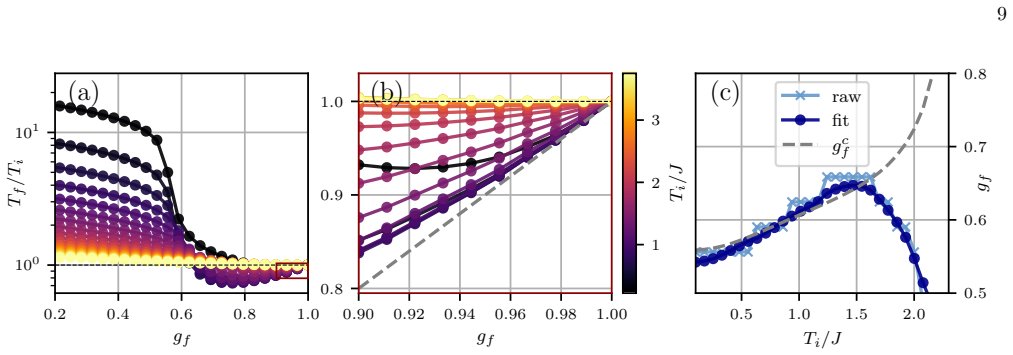
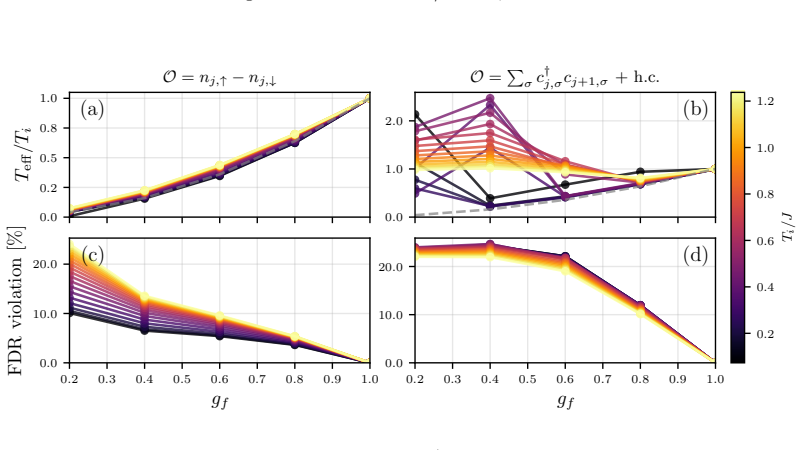
In the half-filled fermionic Hubbard model with U ≫ t, a sudden quench of the hopping term from t_i to t_f deposits work into a long-lived non-equilibrium doublon density. This density persists for a time exponentially large in (U/t)^2. During the resulting prethermal regime, doublon-number-conserving operators experience an effective temperature T_pre = T_init × (t_f / t_i)^2 and satisfy a corresponding fluctuation-dissipation relation. The Hubbard lattice can therefore cool another system when the inter-system coupling conserves doublon number.
What carries the argument
The quench-induced non-equilibrium doublon density, which stores the work performed by the hopping increase and thereby lowers the effective temperature of doublon-conserving operators.
If this is right
- The prethermal temperature is lowered by the square of the hopping ratio for all doublon-number-conserving operators.
- An effective fluctuation-dissipation theorem holds inside the prethermal window for those operators.
- The prethermal regime survives for a time exponentially large in (U/t)^2 before full thermalization.
- The Hubbard system functions as a refrigerant for any target coupled through doublon-conserving interactions.
- The cooling protocol extends the principle of adiabatic demagnetization to a many-body quantum quench setting.
Where Pith is reading between the lines
- The same mechanism could be tested in optical-lattice experiments by preparing an initial thermal state, performing the hopping quench, and tracking correlation functions of spin or charge operators.
- Analogous cooling may occur in other strongly interacting lattice models that possess a gapped, long-lived high-energy excitation whose number is approximately conserved.
- Cooling efficiency would degrade if the coupling to the target system allows doublon creation or annihilation at appreciable rates.
- The protocol suggests exploring whether periodic driving or other quench sequences can further extend the lifetime of the non-equilibrium doublon reservoir.
Load-bearing premise
The doublon density produced by the quench stays out of equilibrium for a time exponentially longer than the timescales on which the prethermal state would otherwise relax.
What would settle it
After the quench, measure the effective temperature of doublon-conserving operators through their fluctuation-dissipation ratio and check whether it equals the initial temperature multiplied by (t_f/t_i)^2; or directly measure whether the doublon lifetime is shorter than exponentially large in (U/t)^2.
Figures
read the original abstract
Many-body quantum quenches are typically associated with heating. In this work, we show that quantum quenches that perform positive work on the system can still lead to effective cooling of low-energy degrees of freedom if the quench energy is deposited in long-lived high-energy excitations. We discuss this explicitly for a quench of the hopping term t in the strong-coupling (U >> t) fermionic Hubbard model at half filling, where the quench induces a very long-lived non-equilibrium doublon density. The associated prethermal state persists for a time exponentially large in (U/t)^2. During this time window, we find an effective prethermal temperature that is reduced by the square of the ratio of final to initial hopping amplitude with respect to the initial temperature. This manifests as an effective fluctuation-dissipation relation that holds for doublon-number conserving operators. In a practical implementation the Hubbard system acts as a refrigerant to cool a target system provided the coupling conserves doublon number. Our protocol can be thought of as a quantum quench many-body generalization of adiabatic demagnetization.
Editorial analysis
A structured set of objections, weighed in public.
Referee Report
Summary. The manuscript claims that a positive-work quench of the hopping amplitude t in the strong-coupling half-filled Hubbard model deposits excess energy into a long-lived non-equilibrium doublon density. This density persists for a time exponentially large in (U/t)^2, enabling a prethermal regime in which low-energy degrees of freedom reach an effective temperature reduced by the factor (t_f/t_i)^2 relative to the initial temperature. The prethermal state obeys an effective fluctuation-dissipation relation restricted to doublon-number-conserving operators and can refrigerate a weakly coupled target system whose coupling conserves doublon number. The protocol is presented as a many-body generalization of adiabatic demagnetization.
Significance. If the central claims hold, the work supplies a concrete, quench-based route to effective cooling that exploits established prethermalization physics rather than external baths or slow ramps. The explicit scaling of the effective temperature with (t_f/t_i)^2 and the restriction to doublon-conserving operators furnish falsifiable predictions that could be tested in cold-atom or quantum-dot platforms. The manuscript correctly situates the result within the existing literature on Hubbard-model prethermalization and virtual-process lifetimes.
minor comments (2)
- The abstract states the temperature reduction factor without indicating the section or equation where the effective-temperature definition and the fluctuation-dissipation relation are derived; adding an explicit forward reference would improve readability.
- Figure captions should explicitly state the system size, the value of U/t, and the observable used to extract the effective temperature so that the numerical evidence for the (t_f/t_i)^2 scaling can be assessed at a glance.
Simulated Author's Rebuttal
We thank the referee for their positive assessment of the manuscript, accurate summary of the central claims, and recommendation for minor revision. The referee correctly situates the work within the prethermalization literature and identifies the falsifiable predictions. No specific major comments were listed in the report.
Circularity Check
No significant circularity; derivation self-contained in standard prethermalization physics
full rationale
The central claim follows from partitioning excess quench energy into the long-lived doublon sector of the strong-coupling Hubbard model, with the effective temperature scaling as (t_f/t_i)^2 arising directly from the known virtual-process effective Hamiltonian J ~ 4t^2/U. No parameter is fitted to data and then relabeled as a prediction, no self-citation supplies a uniqueness theorem or ansatz, and the doublon lifetime is justified by high-order virtual processes already established in the literature. The protocol is presented as an analogy to adiabatic demagnetization without redefining any input quantity in terms of the output. The derivation chain is therefore independent of its own results.
Axiom & Free-Parameter Ledger
axioms (1)
- domain assumption Strong coupling limit U >> t in the fermionic Hubbard model at half filling
Reference graph
Works this paper leans on
-
[1]
Bloch, J
I. Bloch, J. Dalibard, and W. Zwerger, Reviews of Mod- ern Physics80, 885 (2008)
2008
-
[2]
Gross and I
C. Gross and I. Bloch, Science357, 995 (2017)
2017
-
[3]
Tarruell and L
L. Tarruell and L. Sanchez-Palencia, Comptes Rendus Physique Quantum Simulation / Simulation Quantique, 19, 365 (2018)
2018
-
[4]
A. E. Leanhardt, T. A. Pasquini, M. Saba, A. Schi- rotzek, Y. Shin, D. Kielpinski, D. E. Pritchard, and W. Ketterle, Science301, 1513 (2003), https://www.science.org/doi/pdf/10.1126/science.1088827
-
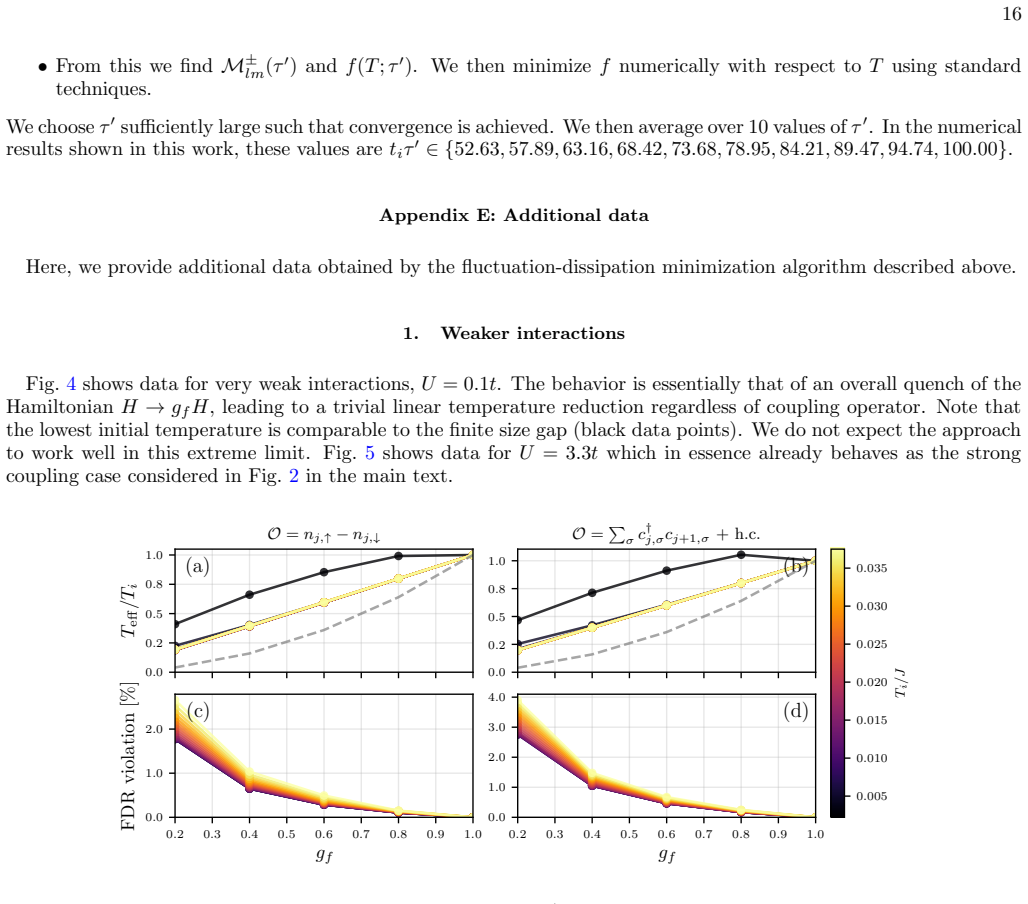
[5]
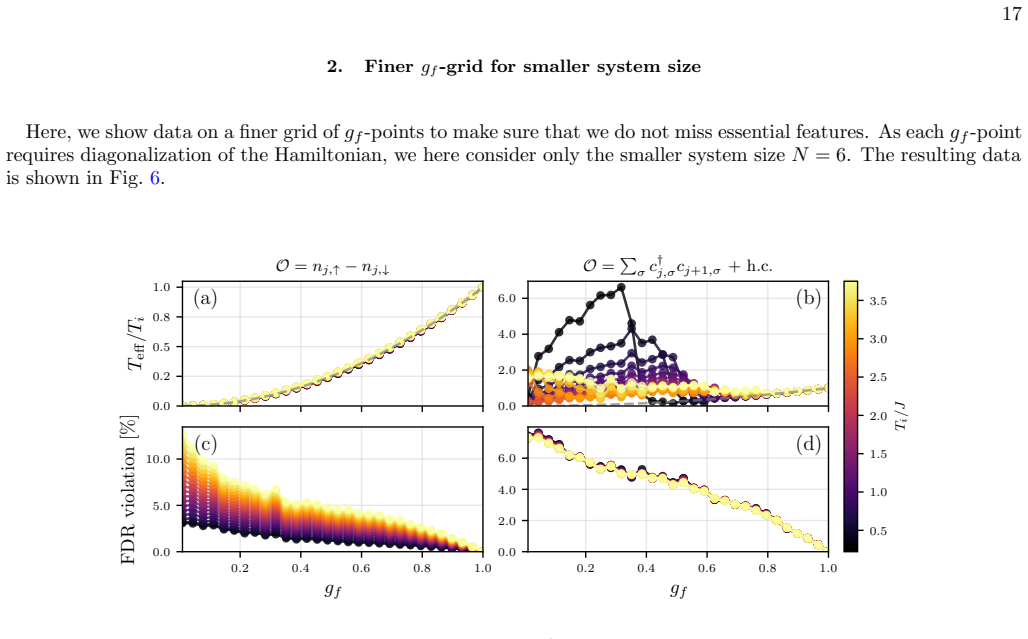
J¨ ordens, N
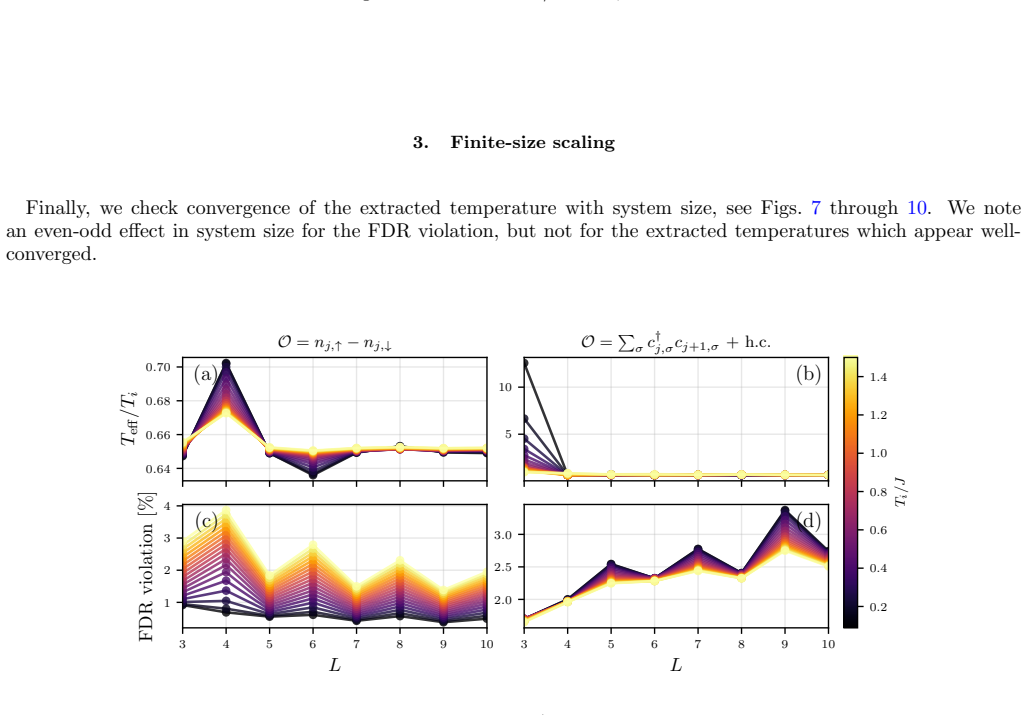
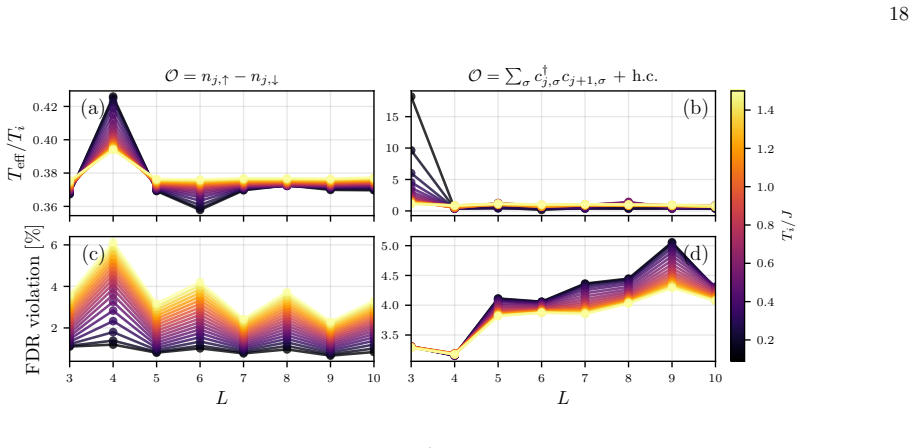
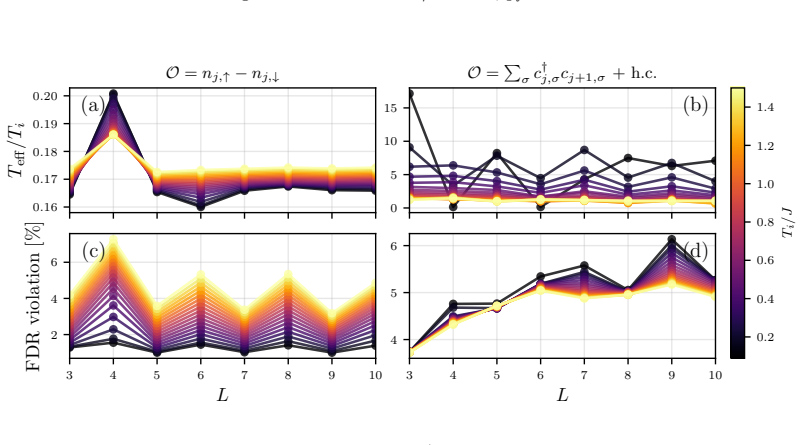
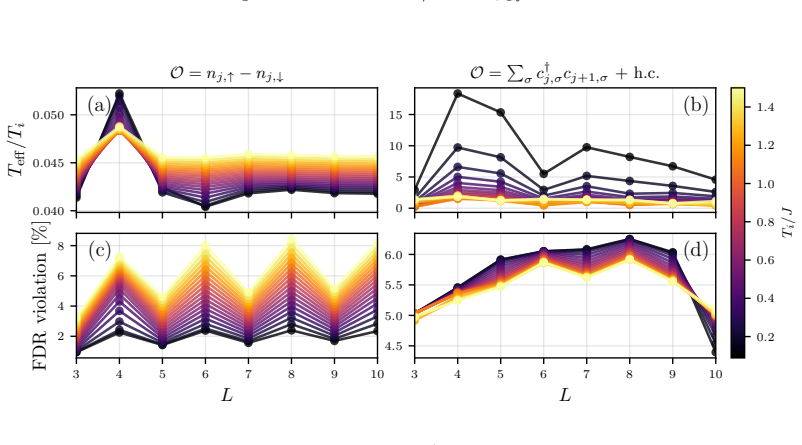
R. J¨ ordens, N. Strohmaier, K. G¨ unter, H. Moritz, and T. Esslinger, Nature455, 204 (2008)
2008
-
[6]
Schneider, L
U. Schneider, L. Hackerm¨ uller, S. Will, Th. Best, I. Bloch, T. A. Costi, R. W. Helmes, D. Rasch, and A. Rosch, Science322, 1520 (2008)
2008
-
[7]
R. A. Hart, P. M. Duarte, T.-L. Yang, X. Liu, T. Paiva, E. Khatami, R. T. Scalettar, N. Trivedi, D. A. Huse, and R. G. Hulet, Nature519, 211 (2015)
2015
-
[8]
Mazurenko, C
A. Mazurenko, C. S. Chiu, G. Ji, M. F. Parsons, M. Kan´ asz-Nagy, R. Schmidt, F. Grusdt, E. Demler, D. Greif, and M. Greiner, Nature545, 462 (2017)
2017
-
[9]
M. Xu, L. H. Kendrick, A. Kale, Y. Gang, C. Feng, S. Zhang, A. W. Young, M. Lebrat, and M. Greiner, Na- ture642, 909 (2025)
2025
-
[10]
Bourgund, T
D. Bourgund, T. Chalopin, P. Bojovi´ c, H. Schl¨ omer, S. Wang, T. Franz, S. Hirthe, A. Bohrdt, F. Grusdt, I. Bloch, and T. A. Hilker, Nature637, 57 (2025)
2025
-
[11]
P. A. Lee, Reviews of Modern Physics78, 17 (2006)
2006
-
[12]
D. P. Arovas, E. Berg, S. A. Kivelson, and S. Raghu, An- nual Review of Condensed Matter Physics13, 239 (2022)
2022
-
[13]
Popp, J.-J
M. Popp, J.-J. Garcia-Ripoll, K. G. Vollbrecht, and J. I. Cirac, Physical Review A74, 013622 (2006)
2006
-
[14]
Griessner, A
A. Griessner, A. J. Daley, S. R. Clark, D. Jaksch, and P. Zoller, Physical Review Letters97, 220403 (2006)
2006
-
[15]
Capogrosso-Sansone, S ¸
B. Capogrosso-Sansone, S ¸. G. S¨ oyler, N. Prokof’ev, and B. Svistunov, Physical Review A77, 015602 (2008)
2008
-
[16]
Ho and Q
T.-L. Ho and Q. Zhou, Proceedings of the National Academy of Sciences106, 6916 (2009)
2009
-
[17]
T.-L. Ho and Q. Zhou, Universal Cooling Scheme for Quantum Simulation (2009), arXiv:0911.5506 [cond- mat.quant-gas]
Pith/arXiv arXiv 2009
-
[18]
De Leo, J.-S
L. De Leo, J.-S. Bernier, C. Kollath, A. Georges, and V. W. Scarola, Physical Review A83, 023606 (2011)
2011
-
[19]
Paiva, Y
T. Paiva, Y. L. Loh, M. Randeria, R. T. Scalettar, and N. Trivedi, Physical Review Letters107, 086401 (2011)
2011
-
[20]
Goto and I
S. Goto and I. Danshita, Phys. Rev. A96, 063602 (2017)
2017
-
[21]
Kantian, S
A. Kantian, S. Langer, and A. J. Daley, Physical Review Letters120, 060401 (2018)
2018
-
[22]
C. S. Chiu, G. Ji, A. Mazurenko, D. Greif, and M. Greiner, Physical Review Letters120, 243201 (2018)
2018
-
[23]
A. E. Mirasola, M. L. Wall, and K. R. A. Hazzard, Phys- ical Review A98, 033607 (2018)
2018
-
[24]
Werner, M
P. Werner, M. Eckstein, M. M¨ uller, and G. Refael, Nature Communications10, 5556 (2019)
2019
-
[25]
Werner, J
P. Werner, J. Li, D. Goleˇ z, and M. Eckstein, Physical Review B100, 155130 (2019)
2019
-
[26]
M. P. Zaletel, A. Kaufman, D. M. Stamper-Kurn, and N. Y. Yao, Physical Review Letters126, 103401 (2021)
2021
-
[27]
Kuzmin, T
V. Kuzmin, T. V. Zache, C. Kokail, L. Pastori, A. Celi, M. Baranov, and P. Zoller, PRX Quantum3, 020304 (2022)
2022
-
[28]
X. Wen, R. Fan, and A. Vishwanath, Floquet’s Refrig- erator: Conformal Cooling in Driven Quantum Critical Systems (2022), arXiv:2211.00040 [cond-mat]
arXiv 2022
-
[29]
Langbehn, K
J. Langbehn, K. Snizhko, I. Gornyi, G. Morigi, Y. Gefen, and C. P. Koch, PRX Quantum5, 030301 (2024)
2024
-
[30]
Matthies, M
A. Matthies, M. Rudner, A. Rosch, and E. Berg, Quan- tum8, 1505 (2024)
2024
-
[31]
Kishony, M
G. Kishony, M. S. Rudner, and E. Berg, Communications Physics8, 73 (2025)
2025
-
[32]
Kishony, M
G. Kishony, M. S. Rudner, A. Rosch, and E. Berg, Phys- ical Review Letters134, 086503 (2025). 11
2025
-
[33]
J. Langbehn, G. Mouloudakis, E. King, R. Menu, I. Gornyi, G. Morigi, Y. Gefen, and C. P. Koch, Uni- versal cooling of quantum systems via randomized mea- surements (2025), arXiv:2506.11964 [quant-ph]
arXiv 2025
-
[34]
W. Zhao, L.-N. Wu, F. Petiziol, and A. Eckardt, SciPost Physics19, 073 (2025), arXiv:2501.07293 [cond-mat]
arXiv 2025
-
[35]
P. W. H. Pinkse, A. Mosk, M. Weidem¨ uller, M. W. Reynolds, T. W. Hijmans, and J. T. M. Walraven, Phys- ical Review Letters78, 990 (1997)
1997
-
[36]
D. M. Stamper-Kurn, H.-J. Miesner, A. P. Chikkatur, S. Inouye, J. Stenger, and W. Ketterle, Physical Review Letters81, 2194 (1998)
1998
-
[37]
Bernier, C
J.-S. Bernier, C. Kollath, A. Georges, L. De Leo, F. Ger- bier, C. Salomon, and M. K¨ ohl, Physical Review A79, 061601 (2009)
2009
-
[38]
Catani, G
J. Catani, G. Barontini, G. Lamporesi, F. Rabatti, G. Thalhammer, F. Minardi, S. Stringari, and M. In- guscio, Physical Review Letters103, 140401 (2009)
2009
-
[39]
Medley, D
P. Medley, D. M. Weld, H. Miyake, D. E. Pritchard, and W. Ketterle, Physical Review Letters106, 195301 (2011)
2011
-
[40]
B. Yang, H. Sun, C.-J. Huang, H.-Y. Wang, Y. Deng, H.-N. Dai, Z.-S. Yuan, and J.-W. Pan, Science369, 550 (2020)
2020
-
[41]
D. M. Stamper-Kurn, Physics2, 80 (2009)
2009
-
[42]
Abanin, W
D. Abanin, W. De Roeck, W. W. Ho, and F. Huve- neers, Communications in Mathematical Physics354, 809 (2017)
2017
-
[43]
Winkler, G
K. Winkler, G. Thalhammer, F. Lang, R. Grimm, J. Hecker Denschlag, A. J. Daley, A. Kantian, H. P. B¨ uchler, and P. Zoller, Nature441, 853 (2006)
2006
-
[44]
Strohmaier, D
N. Strohmaier, D. Greif, R. J¨ ordens, L. Tarruell, H. Moritz, T. Esslinger, R. Sensarma, D. Pekker, E. Alt- man, and E. Demler, Physical Review Letters104, 080401 (2010)
2010
-
[45]
Sensarma, D
R. Sensarma, D. Pekker, E. Altman, E. Demler, N. Strohmaier, D. Greif, R. J¨ ordens, L. Tarruell, H. Moritz, and T. Esslinger, Physical Review B82, 224302 (2010)
2010
-
[46]
Hassler, A
F. Hassler, A. R¨ uegg, M. Sigrist, and G. Blatter, Physical Review Letters104, 220402 (2010)
2010
-
[47]
M. Eckstein, Physical Review B84, 10.1103/Phys- RevB.84.035122 (2011)
-
[48]
Kollar, F
M. Kollar, F. A. Wolf, and M. Eckstein, Physical Review B84, 054304 (2011)
2011
-
[49]
A. L. Chudnovskiy, D. M. Gangardt, and A. Kamenev, Physical Review Letters108, 085302 (2012)
2012
-
[50]
Hofmann and M
F. Hofmann and M. Potthoff, Physical Review B85, 205127 (2012)
2012
-
[51]
Moeckel and S
M. Moeckel and S. Kehrein, Physical Review Letters100, 175702 (2008)
2008
-
[52]
Eckstein, M
M. Eckstein, M. Kollar, and P. Werner, Physical Review Letters103, 056403 (2009)
2009
-
[53]
M. Schir´ o and M. Fabrizio, Physical Review Letters105, 076401 (2010), arXiv:1005.0992 [cond-mat]
Pith/arXiv arXiv 2010
-
[54]
A. H. MacDonald, S. M. Girvin, and D. Yoshioka, Phys- ical Review B37, 9753 (1988)
1988
-
[55]
Bravyi, D
S. Bravyi, D. P. DiVincenzo, and D. Loss, Annals of Physics326, 2793 (2011)
2011
-
[56]
, where the ex- pectation value ofVand [S, V] in a low-temperature state is exponentially suppressed inU/T
This is easily seen by going to the Schrieffer-Wolff frame, ˜V=V+ [S, V] + [S,[S, V]] +. . ., where the ex- pectation value ofVand [S, V] in a low-temperature state is exponentially suppressed inU/T. Only the term P0[S,[S, V]]P 0 =−P 0 ˜H(g)P 0 survives
-
[57]
Nathan and M
F. Nathan and M. S. Rudner, Physical Review B102, 115109 (2020)
2020
-
[58]
This effectively removes energy non-conserving pieces which do not play a role at sufficiently late times
-
[59]
J¨ uttner, A
G. J¨ uttner, A. Kl¨ umper, and J. Suzuki, Nuclear Physics B522, 471 (1998)
1998
-
[60]
E. H. Lieb and F. Y. Wu, Physical Review Letters20, 1445 (1968)
1968
-
[61]
H. J. Mikeska, Physical Review B12, 2794 (1975)
1975
-
[62]
T. Deguchi, F. H. L. Essler, F. G¨ ohmann, A. Kl¨ umper, V. E. Korepin, and K. Kusakabe, Physics Reports331, 197 (2000), arXiv:cond-mat/9904398
Pith/arXiv arXiv 2000
-
[63]
F. H. L. Essler, H. Frahm, F. G¨ ohmann, A. Kl¨ umper, and V. E. Korepin,The One-Dimensional Hubbard Model (Cambridge University Press, Cambridge, 2005)
2005
-
[64]
C. Sch¨ onle, D. Jansen, F. Heidrich-Meisner, and L. Vidmar, Physical Review B103, 235137 (2021), arXiv:2011.13958 [cond-mat]. Appendix A: Postquench expectation values in the prequench state The pre- and postquench generators of the Schrieffer-Wolff transformation areS i ≡S(g= 1) andS f ≡S(g=g f). In order to evaluate the expectation values of postquench...
arXiv 2021
-
[65]
4 shows data for very weak interactions,U= 0.1t
Weaker interactions Fig. 4 shows data for very weak interactions,U= 0.1t. The behavior is essentially that of an overall quench of the HamiltonianH→g f H, leading to a trivial linear temperature reduction regardless of coupling operator. Note that the lowest initial temperature is comparable to the finite size gap (black data points). We do not expect the...
-
[66]
As eachg f-point requires diagonalization of the Hamiltonian, we here consider only the smaller system sizeN= 6
Finerg f-grid for smaller system size Here, we show data on a finer grid ofg f-points to make sure that we do not miss essential features. As eachg f-point requires diagonalization of the Hamiltonian, we here consider only the smaller system sizeN= 6. The resulting data is shown in Fig. 6. 0.0 0.2 0.5 0.8 1.0 Teff /Ti (a) O = nj,↑ − nj,↓ 0.0 2.0 4.0 6.0 (b...
-
[67]
7 through 10
Finite-size scaling Finally, we check convergence of the extracted temperature with system size, see Figs. 7 through 10. We note an even-odd effect in system size for the FDR violation, but not for the extracted temperatures which appear well- converged. 0.64 0.66 0.68 0.70 Teff /Ti (a) O = nj,↑ − nj,↓ 5 10 (b) O =∑ σ c† j,σcj+1,σ + h.c. 3 4 5 6 7 8 9 10 L...
discussion (0)
Sign in with ORCID, Apple, or X to comment. Anyone can read and Pith papers without signing in.