Lateral hydrodynamics in supported membranes: The Evans-Sackmann model and its extensions
Pith reviewed 2026-05-20 01:04 UTC · model grok-4.3
The pith
The supported-membrane mobility tensor unifies treatments of diffusion, polymer dynamics, and phase separation in quasi-two-dimensional environments.
A machine-rendered reading of the paper's core claim, the machinery that carries it, and where it could break.
Core claim
The Evans-Sackmann model introduces a linear momentum decay term to capture the hydrodynamic coupling between a fluid membrane and a nearby substrate. Solving the resulting equations yields a mobility tensor that consistently describes lateral transport phenomena, including the drag experienced by disk-shaped inclusions and liquid domains as well as the coarsening dynamics during membrane phase separation.
What carries the argument
The linear momentum decay term that models the viscous interaction with the substrate through a thin lubricating fluid layer.
If this is right
- Correlated diffusion of multiple inclusions follows directly from the off-diagonal elements of the mobility tensor.
- Polymer chain dynamics on the membrane can be treated using the hydrodynamic interactions encoded in the tensor.
- Phase separation kinetics are determined by the hydrodynamic drag on growing domains.
- Many-body effects in quasi-two-dimensional systems become systematically accessible through the same tensor.
Where Pith is reading between the lines
- The approach may extend naturally to other confined fluid systems, such as colloids between plates.
- Odd viscosity in chiral membranes could be detected by observing flow patterns perpendicular to applied forces in experiments.
- Active membrane models might reveal new instabilities not present in passive cases.
Load-bearing premise
Membrane-substrate coupling occurs through a thin lubricating fluid layer that produces a linear momentum decay term.
What would settle it
An experimental measurement of the diffusion constant for a protein-sized inclusion in a supported bilayer at a known distance from the substrate that disagrees with the value calculated from the Evans-Sackmann mobility tensor.
Figures




read the original abstract
We review the theoretical development and modern applications of the Evans-Sackmann hydrodynamic model for lateral transport in supported fluid membranes. We first cover the original formulation, emphasizing the linear momentum decay term that captures membrane-substrate coupling mediated by a thin lubricating fluid layer. This coupling term enables quantitative interpretation of tracer diffusion measurements in supported bilayers. Building on this foundation, we survey theoretical extensions that relax standard boundary conditions at the inclusion perimeter, where inclusions refer to embedded objects such as proteins, lipid domains, or tracer particles within the membrane. We discuss the drag of a disk and a liquid domain, as well as the dynamics of membrane phase separation. We further highlight how the supported-membrane mobility tensor serves as a unifying tool for systematic treatments of correlated diffusion, polymer dynamics, phase separation kinetics, and many-body interactions in quasi-two-dimensional environments. Finally, we discuss recent extensions to active and chiral membranes, where odd viscosity provides a transverse hydrodynamic response and offers a possible route for detecting chirality in two-dimensional fluids.
Editorial analysis
A structured set of objections, weighed in public.
Referee Report
Summary. The manuscript reviews the Evans-Sackmann hydrodynamic model for lateral transport in supported fluid membranes. It covers the original formulation with its linear momentum decay term arising from membrane-substrate coupling via a thin lubricating layer, extensions that relax boundary conditions at the perimeters of inclusions (disks and liquid domains), the drag on such objects, phase separation dynamics, and the use of the supported-membrane mobility tensor to treat correlated diffusion, polymer dynamics, phase separation kinetics, and many-body interactions. The review concludes with extensions to active and chiral membranes in which odd viscosity supplies a transverse response that may enable experimental detection of chirality in two-dimensional fluids.
Significance. As a review that synthesizes established results rather than advancing new derivations, the paper provides a coherent overview that positions the mobility tensor as a unifying construct for quasi-two-dimensional membrane phenomena. This framing can help researchers connect disparate applications in membrane biophysics and soft matter. The discussion of odd viscosity offers a concrete, falsifiable suggestion for chirality detection that could guide future experiments. The manuscript accurately restates prior literature without introducing internal inconsistencies or parameter-fitting artifacts.
minor comments (2)
- Abstract: the phrase 'systematic treatments of correlated diffusion, polymer dynamics, phase separation kinetics, and many-body interactions' is repeated almost verbatim in the final paragraph; a single consolidated statement would improve readability.
- The description of the original Evans-Sackmann formulation would benefit from an explicit statement of the hydrodynamic boundary conditions at the substrate (e.g., no-slip or partial-slip) to make the linear decay term fully transparent to readers unfamiliar with the 1980s literature.
Simulated Author's Rebuttal
We thank the referee for the positive and constructive report, which accurately summarizes the scope of our review and highlights its potential utility for connecting disparate applications in membrane biophysics. We appreciate the recommendation for minor revision and the recognition that the discussion of odd viscosity offers a falsifiable suggestion for chirality detection.
Circularity Check
Review paper restates prior literature with no new internal derivations
full rationale
This is a review article that surveys the established Evans-Sackmann hydrodynamic model and its extensions from the existing literature. The abstract and structure explicitly frame the content as a survey of prior formulations, extensions to inclusions, phase separation, and active/chiral membranes, without advancing new derivations, theorems, or predictions whose validity depends on parameters or assumptions defined inside this manuscript. All load-bearing technical steps trace to external citations rather than self-referential fits or redefinitions, so no circular reduction occurs within the paper's own chain.
Axiom & Free-Parameter Ledger
axioms (1)
- domain assumption Membrane-substrate coupling is mediated by a thin lubricating fluid layer that produces linear momentum decay
Lean theorems connected to this paper
-
IndisputableMonolith/Foundation/AbsoluteFloorClosure.leanreality_from_one_distinction unclear?
unclearRelation between the paper passage and the cited Recognition theorem.
the governing equations take the form of the in-plane force balance: η_m ∇²v − ∇p − (η/h) v = 0 ... κ⁻¹ = √(η_m h / η)
-
IndisputableMonolith/Cost/FunctionalEquation.leanwashburn_uniqueness_aczel unclear?
unclearRelation between the paper passage and the cited Recognition theorem.
the mobility tensor G(r) ... expressed with modified Bessel functions K_n(κr)
What do these tags mean?
- matches
- The paper's claim is directly supported by a theorem in the formal canon.
- supports
- The theorem supports part of the paper's argument, but the paper may add assumptions or extra steps.
- extends
- The paper goes beyond the formal theorem; the theorem is a base layer rather than the whole result.
- uses
- The paper appears to rely on the theorem as machinery.
- contradicts
- The paper's claim conflicts with a theorem or certificate in the canon.
- unclear
- Pith found a possible connection, but the passage is too broad, indirect, or ambiguous to say the theorem truly supports the claim.
Reference graph
Works this paper leans on
-
[1]
Advanced core-to-core network for the physics of self-organizing active matter
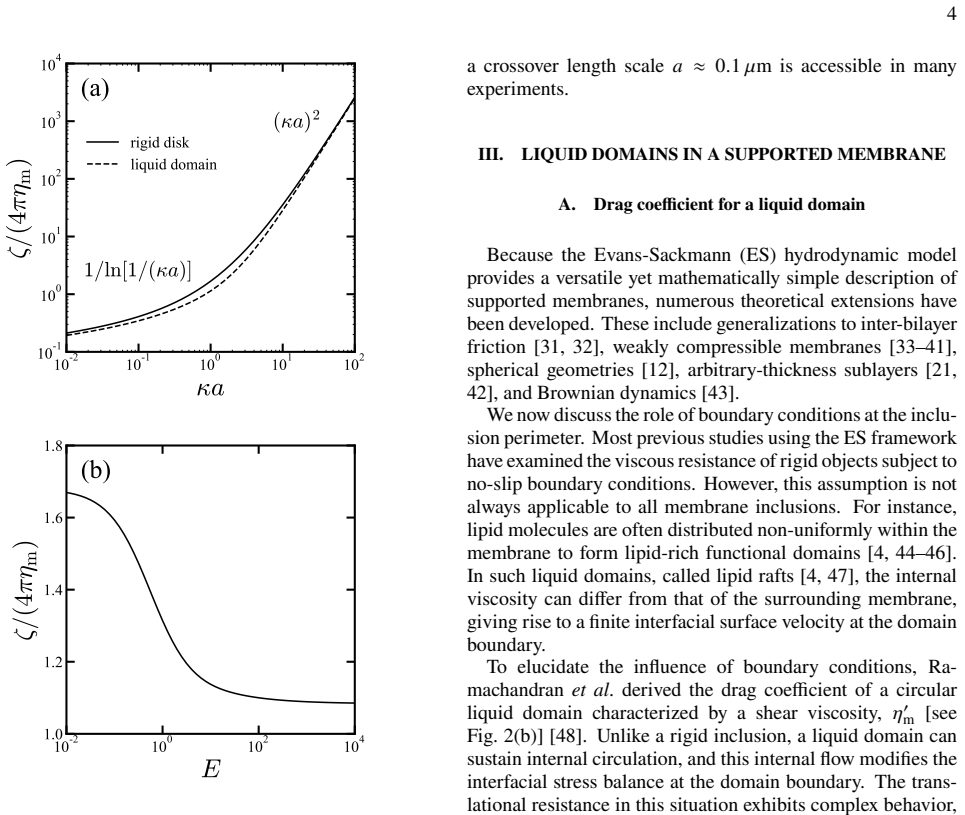
The drag coefficient𝜁shows a logarithmic dependence on size when𝜅𝑎≪1, whereas it increases quadratically when𝜅𝑎≫1. (b) Semi-log plot of the dimensionless drag coefficient𝜁/(4𝜋𝜂 m)for a liquid domain as a function of the viscosity ratio𝐸. The liquid domain size is chosen as𝜅𝑎=1. of the diffusion coefficient, therefore, provides a powerful ex- perimental to...
-
[2]
S. J. Singer and G. L. Nicolson, The fluid mosaic model of the structure of cell membranes: Cell membranes are viewed as two-dimensional solutions of oriented globular proteins and lipids, Science175, 720 (1972)
work page 1972
-
[3]
B. Alberts, A. Johnson, J. Lewis, M. Raff, K. Roberts, and P. Walter,Mol. Biol. Cell(Garland Science, New York, 2008)
work page 2008
- [4]
-
[5]
K. Simons and E. Ikonen, Functional rafts in cell membranes, Nature387, 569 (1997)
work page 1997
-
[6]
L. D. Landau and E. M. Lifshitz,Fluid Mechanics, Vol. 6 (Perg- amon Press, Oxford, 1987)
work page 1987
-
[7]
J. Happel and H. Brenner,Low Reynolds Number Hydrodynam- ics(Springer, Netherlands, 1983)
work page 1983
-
[8]
R. Lipowsky and E. Sackmann,Structure and dynamics of mem- branes: I. from cells to vesicles/II. generic and specific interac- tions(Elsevier, 1995)
work page 1995
-
[9]
P. G. Saffman and M. Delbr¨ uck, Brownian motion in biological membranes, Proc. Natl. Acad. Sci. U.S.A.72, 3111 (1975). 12
work page 1975
-
[10]
P. G. Saffman, Brownian motion in thin sheets of viscous fluid, J. Fluid Mech.73, 593 (1976)
work page 1976
- [11]
-
[12]
M. L. Henle and A. J. Levine, Hydrodynamics in curved mem- branes: The effect of geometry on particulate mobility, Phys. Rev. E81, 011905 (2010)
work page 2010
-
[13]
W. Shi, M. Moradi, and E. Nazockdast, The drag of a filament moving in a supported spherical bilayer, J. Fluid Mech.979, A6 (2024)
work page 2024
-
[14]
N. Oppenheimer and H. Diamant, Correlated diffusion of mem- brane proteins and their effect on membrane viscosity, Biophys. J.96, 3041 (2009)
work page 2009
-
[15]
Sackmann, Supported membranes: Scientific and practical applications, Science271, 43 (1996)
E. Sackmann, Supported membranes: Scientific and practical applications, Science271, 43 (1996)
work page 1996
-
[16]
M. Tanaka and E. Sackmann, Polymer-supported membranes as models of the cell surface, Nature437, 656 (2005)
work page 2005
-
[17]
E. T. Castellana and P. S. Cremer, Solid supported lipid bilayers: From biophysical studies to sensor design, Surf. Sci. Rep.61, 429 (2006)
work page 2006
- [18]
-
[19]
E. Evans and E. Sackmann, Translational and rotational drag coefficients for a disk moving in a liquid membrane associated with a rigid substrate, J. Fluid Mech.194, 553 (1988)
work page 1988
- [20]
-
[21]
E. Sackmann and M. Tanaka, Supported membranes on soft polymer cushions: fabrication, characterization and applica- tions, Trends Biotechnol.18, 58 (2000)
work page 2000
-
[22]
H. A. Stone and A. Ajdari, Hydrodynamics of particles embed- ded in a flat surfactant layer overlying a subphase of finite depth, J. Fluid Mech.369, 151 (1998)
work page 1998
-
[23]
B. A. Camley and F. L. Brown, Diffusion of complex objects embedded in free and supported lipid bilayer membranes: role of shape anisotropy and leaflet structure, Soft Matter9, 4767 (2013)
work page 2013
-
[24]
A. A. Anthony, O. Sahin, M. K. Yapici, D. Rogers, and A. R. Honerkamp-Smith, Systematic measurements of inter- leaflet friction in supported bilayers, Biophys. J.121, 2981 (2022)
work page 2022
- [25]
- [26]
-
[27]
C. Bar-Haim and H. Diamant, Correlations in suspensions con- fined between viscoelastic surfaces: Noncontact microrheology, Phys. Rev. E96, 022607 (2017)
work page 2017
-
[28]
H. C. Brinkman, A calculation of the viscous force exerted by a flowing fluid on a dense swarm of particles, Appl. Sci. Res. A 1, 27 (1949)
work page 1949
-
[29]
M. Abramowitz and I. A. Stegun,Handbook of Mathematical Functions with Formulas, Graphs, and Mathematical Tables, Vol. 55 (Dover Publications Inc, New York, 2000)
work page 2000
-
[30]
Diamant, Hydrodynamic interaction in confined geometries, J
H. Diamant, Hydrodynamic interaction in confined geometries, J. Phys. Soc. Jpn.78, 041002 (2009)
work page 2009
-
[31]
Doi,Soft Matter Physics(Oxford University Press, New York, 2013)
M. Doi,Soft Matter Physics(Oxford University Press, New York, 2013)
work page 2013
-
[32]
K. Seki, S. Mogre, and S. Komura, Diffusion coefficients in leaflets of bilayer membranes, Phys. Rev. E89, 022713 (2014)
work page 2014
-
[33]
R. J. Hill and C.-Y. Wang, Diffusion in phospholipid bilayer membranes: Dual-leaflet dynamics and the roles of tracer- leaflet and inter-leaflet coupling, Proc. R. Soc. A470, 20130843 (2014)
work page 2014
-
[34]
C. Barentin, C. Ybert, J.-M. Di Meglio, and J.-F. Joanny, Surface shear viscosity of Gibbs and Langmuir monolayers, J. Fluid Mech.397, 331 (1999)
work page 1999
-
[35]
G. J. Elfring, L. G. Leal, and T. M. Squires, Surface viscosity and Marangoni stresses at surfactant laden interfaces, J. Fluid Mech.792, 712 (2016)
work page 2016
-
[36]
H. Manikantan and T. M. Squires, Surfactant dynamics: hidden variables controlling fluid flows, J. Fluid Mech.892, P1 (2020)
work page 2020
- [37]
- [38]
- [39]
-
[40]
R. Lier, C. Duclut, S. Bo, J. Armas, F. J¨ ulicher, and P. Sur´owka, Lift force in odd compressible fluids, Phys. Rev. E108, L023101 (2023)
work page 2023
-
[41]
A. Daddi-Moussa-Ider, A. Vilfan, and Y. Hosaka, Analytical solution for the hydrodynamic resistance of a disk in a com- pressible fluid layer with odd viscosity on a rigid substrate, J. Chem. Phys.162, 064103 (2025)
work page 2025
-
[42]
A. Daddi-Moussa-Ider, Y. Hosaka, E. Tjhung, and A. Vilfan, Hydrodynamic flow field and frictional resistance coefficient of a disk rotating steadily in a compressible fluid layer with odd viscosity on a rigid substrate, J. Phys. Soc. Jpn.94, 044401 (2025)
work page 2025
-
[43]
K. Seki, S. Ramachandran, and S. Komura, Diffusion coefficient of an inclusion in a liquid membrane supported by a solvent of arbitrary thickness, Phys. Rev. E84, 021905 (2011)
work page 2011
-
[44]
K. Seki and S. Komura, Brownian dynamics in a thin sheet with momentum decay, Phys. Rev. E47, 2377 (1993)
work page 1993
-
[45]
S. L. Veatch and S. L. Keller, Seeing spots: Complex phase behavior in simple membranes, Biochim. Biophys. Acta Mol. Cell Res.1746, 172 (2005)
work page 2005
- [46]
-
[47]
S. Komura and D. Andelman, Physical aspects of heterogeneities in multi-component lipid membranes, Adv. Colloid Interface Sci.208, 34 (2014)
work page 2014
-
[48]
D. Lingwood and K. Simons, Lipid rafts as a membrane- organizing principle, Science327, 46 (2010)
work page 2010
-
[49]
S. Ramachandran, S. Komura, M. Imai, and K. Seki, Drag coef- ficient of a liquid domain in a two-dimensional membrane, Eur. Phys. J. E31, 303 (2010)
work page 2010
-
[50]
C. Dietrich, L. A. Bagatolli, Z. N. Volovyk, N. L. Thompson, M. Levi, K. Jacobson, and E. Gratton, Lipid rafts reconstituted in model membranes, Biophys. J.80, 1417 (2001)
work page 2001
-
[51]
S. L. Veatch and S. L. Keller, Separation of liquid phases in giant vesicles of ternary mixtures of phospholipids and cholesterol, Biophys. J.85, 3074 (2003)
work page 2003
- [52]
-
[53]
G. Or ¨add, P. W. Westerman, and G. Lindblom, Lateral diffusion 13 coefficients of separate lipid species in a ternary raft-forming bilayer: A Pfg-NMR multinuclear study, Biophys. J.89, 315 (2005)
work page 2005
-
[54]
T. Baumgart, S. T. Hess, and W. W. Webb, Imaging coexisting fluid domains in biomembrane models coupling curvature and line tension, Nature425, 821 (2003)
work page 2003
-
[55]
M. Yanagisawa, M. Imai, T. Masui, S. Komura, and T. Ohta, Growth dynamics of domains in ternary fluid vesicles, Biophys. J.92, 115 (2007)
work page 2007
-
[56]
C. A. Stanich, A. R. Honerkamp-Smith, G. G. Putzel, C. S. Warth, A. K. Lamprecht, P. Mandal, E. Mann, T.-A. D. Hua, and S. L. Keller, Coarsening dynamics of domains in lipid mem- branes, Biophys. J.105, 444 (2013)
work page 2013
-
[57]
A. J. Bray, Theory of phase-ordering kinetics, Adv. Phys.51, 481 (2002)
work page 2002
-
[58]
Onuki,Phase Transition Dynamics(Cambridge University Press, Cambridge, 2002)
A. Onuki,Phase Transition Dynamics(Cambridge University Press, Cambridge, 2002)
work page 2002
-
[59]
S. Ramachandran, S. Komura, and G. Gompper, Effects of an embedding bulk fluid on phase separation dynamics in a thin liquid film, EPL89, 56001 (2010)
work page 2010
-
[60]
S. L. Veatch, O. Soubias, S. L. Keller, and K. Gawrisch, Critical fluctuations in domain-forming lipid mixtures, Proc. Natl. Acad. Sci. U.S.A.104, 17650 (2007)
work page 2007
-
[61]
A. R. Honerkamp-Smith, P. Cicuta, M. D. Collins, S. L. Veatch, M. den Nijs, M. Schick, and S. L. Keller, Line tensions, corre- lation lengths, and critical exponents in lipid membranes near critical points, Biophys. J.95, 236 (2008)
work page 2008
-
[62]
S. L. Veatch, P. Cicuta, P. Sengupta, A. Honerkamp-Smith, D. Holowka, and B. Baird, Critical fluctuations in plasma mem- brane vesicles, ACS Chem. Biol.3, 287 (2008)
work page 2008
-
[63]
K. Seki, S. Komura, and M. Imai, Concentration fluctuations in binary fluid membranes, J. Phys.: Condens. Matter19, 072101 (2007)
work page 2007
-
[64]
S. Ramachandran, S. Komura, K. Seki, and M. Imai, Hydrody- namic effects on concentration fluctuations in multicomponent membranes, Soft Matter7, 1524 (2011)
work page 2011
-
[65]
Lauga,The Fluid Dynamics of Cell Motility, Vol
E. Lauga,The Fluid Dynamics of Cell Motility, Vol. 62 (Cam- bridge University Press, 2020)
work page 2020
-
[66]
C. Pozrikidis,Boundary Integral and Singularity Methods for Linearized Viscous Flow(Cambridge University Press, Cam- bridge, England, 1992)
work page 1992
-
[67]
S. Ramachandran, S. Komura, K. Seki, and G. Gompper, Dy- namics of a polymer chain confined in a membrane, Eur. Phys. J. E34, 46 (2011)
work page 2011
-
[68]
N. Oppenheimer and H. Diamant, Correlated dynamics of in- clusions in a supported membrane, Phys. Rev. E82, 041912 (2010)
work page 2010
-
[69]
S. Komura and K. Seki, Diffusion constant of a polymer chain in biomembranes, J. Phys. II France5, 5 (1995)
work page 1995
-
[70]
A. S. Mikhailov and R. Kapral, Hydrodynamic collective effects of active protein machines in solution and lipid bilayers, Proc. Natl. Acad. Sci. U.S.A.112, E3639 (2015)
work page 2015
- [71]
-
[72]
Manikantan, Tunable collective dynamics of active inclusions in viscous membranes, Phys
H. Manikantan, Tunable collective dynamics of active inclusions in viscous membranes, Phys. Rev. Lett.125, 268101 (2020)
work page 2020
-
[73]
E. M. Purcell, Life at low Reynolds number, inPhysics and our world: reissue of the proceedings of a symposium in honor of Victor F Weisskopf(World Scientific, 2014) pp. 47–67
work page 2014
-
[74]
Y. Ota, Y. Hosaka, K. Yasuda, and S. Komura, Three-disk mi- croswimmer in a supported fluid membrane, Phys. Rev. E97, 052612 (2018)
work page 2018
-
[75]
Y. Hosaka and S. Komura, Nonequilibrium transport induced by biological nanomachines, Biophys. Rev. Lett.17, 51 (2022)
work page 2022
-
[76]
D. Banerjee, A. Souslov, A. G. Abanov, and V. Vitelli, Odd viscosity in chiral active fluids, Nat. Commun.8, 1573 (2017)
work page 2017
-
[77]
J. E. Avron, Odd viscosity, J. Stat. Phys.92, 543 (1998)
work page 1998
-
[78]
S. Ganeshan and A. G. Abanov, Odd viscosity in two- dimensional incompressible fluids, Phys. Rev. Fluids2, 094101 (2017)
work page 2017
- [79]
-
[80]
H. Masoud and H. A. Stone, The reciprocal theorem in fluid dynamics and transport phenomena, J. Fluid Mech.879, P1 (2019)
work page 2019
discussion (0)
Sign in with ORCID, Apple, or X to comment. Anyone can read and Pith papers without signing in.