AC calorimetric study of magneto-quantum oscillations in anisotropic multiband V₂Ga₅ superconductor
Pith reviewed 2026-06-26 22:22 UTC · model grok-4.3
The pith
AC calorimetry detects a single 126.6 T frequency that confirms the bulk elliptical γ Fermi-surface pocket in V₂Ga₅ and shows its net Berry flux stays constant under any field orientation.
A machine-rendered reading of the paper's core claim, the machinery that carries it, and where it could break.
Core claim
A single dominant MQO frequency of 126.6 T resolved by FFT in AC-calorimetry data on V₂Ga₅ directly confirms the bulk origin of the elliptical γ Fermi-surface pocket near the Z point; its angular dependence reproduces the calculated anisotropy, while the net Berry flux stays invariant under field rotation owing to a conserved hybridization phase twist within the pocket.
What carries the argument
The γ Fermi-surface pocket together with its conserved hybridization phase twist that keeps net Berry flux orientation-independent.
If this is right
- The method isolates bulk DOS oscillations without magnetization artifacts.
- Precise values of cyclotron mass, Dingle temperature, quantum relaxation time, mobility, and mean free path follow directly from amplitude analysis.
- Net Berry flux invariance holds for arbitrary field orientations because the phase twist inside the γ pocket is conserved.
- AC calorimetry functions as a macroscopic probe of topological orbital hybridization in multiband intermetallics.
Where Pith is reading between the lines
- The same AC-calorimetry approach could map Berry-phase properties in other anisotropic superconductors where magnetization signals are weak.
- If the phase twist is conserved across related compounds, similar flux invariance might appear in any multiband system with hybridized pockets near high-symmetry points.
- Testing the frequency under pressure or doping would check whether the γ pocket remains the dominant contributor when the superconducting transition temperature changes.
Load-bearing premise
The AC-calorimetry signal comes only from the oscillatory bulk quasiparticle density of states of the γ pocket, with negligible input from other bands or surface effects.
What would settle it
A de Haas–van Alphen measurement on the same crystals that yields a different dominant frequency or an angular dependence that deviates from the first-principles calculation after identical background handling.
Figures




read the original abstract
Unlike de Haas--van Alphen measurements, heat-capacity magneto-quantum oscillations directly probe the oscillatory bulk quasiparticle density of states. Here, we report the observation of MQOs in V$_2$Ga$_5$ single crystals studied via highly sensitive ac calorimetry. The strongest MQO signal is observed for a magnetic field applied along the vanadium chains, in excellent agreement with de Haas--van Alphen magnetization data. A single dominant frequency of 126.6 T resolved by fast Fourier transform confirms the true bulk origin of the elliptical $\gamma$ Fermi-surface pocket located near the Z point of the Brillouin zone. The angular dependence of the FFT frequency closely tracks the anisotropy of the $\gamma$ pocket, as supported by first-principles calculations. Analysis of the temperature- and field-dependent MQO amplitudes allows the precise determination of the effective cyclotron mass, Dingle temperature, quantum relaxation time, carrier mobility, and electron mean free path. Furthermore, we demonstrate that the net Berry flux is invariant with respect to the magnetic-field orientation, as a consequence of a conserved hybridization phase twist within the $\gamma$ pocket. These findings establish ac calorimetry as a powerful macroscopic probe of topological orbital hybridization in complex intermetallics.
Editorial analysis
A structured set of objections, weighed in public.
Referee Report
Summary. The manuscript reports AC-calorimetric detection of magneto-quantum oscillations (MQOs) in V₂Ga₅ single crystals. A single dominant FFT frequency of 126.6 T is identified and assigned to the elliptical γ Fermi-surface pocket near Z; its angular dependence is said to track the pocket anisotropy from DFT. Amplitude analysis versus temperature and field yields the cyclotron mass, Dingle temperature, quantum relaxation time, mobility, and mean free path. The net Berry flux is claimed to be invariant under field reorientation because of a conserved hybridization phase twist inside the γ pocket. The work positions AC calorimetry as a bulk probe of topological orbital hybridization in multiband superconductors.
Significance. If the single-frequency exclusivity and Berry-flux invariance are rigorously established, the result would provide a macroscopic, bulk-sensitive route to orbital-hybridization topology that complements dHvA, with potential relevance to other anisotropic intermetallic superconductors. The parameter extraction (mass, Dingle temperature, mobility) would be a useful addition to the literature on V₂Ga₅.
major comments (2)
- [abstract] Abstract (FFT paragraph): the assertion that observation of a single dominant frequency of 126.6 T 'confirms the true bulk origin' of the γ pocket is load-bearing for the central claim yet rests on the unverified premise that other bands and surface/vortex contributions lie below noise after background removal. The manuscript must supply the raw C_ac(H) traces, explicit background-subtraction protocol, window functions, and quantitative multi-frequency fit residuals to demonstrate that no additional frequencies exceed the noise floor.
- [Berry flux discussion] Berry-flux section: the statement that net Berry flux is invariant 'as a consequence of a conserved hybridization phase twist within the γ pocket' is presented without an explicit derivation linking the observed frequency anisotropy to a field-independent flux value. If this invariance is a key result, the manuscript must show the flux calculation (e.g., via Lifshitz–Kosevich amplitude or Onsager relation) and demonstrate that the phase-twist constraint follows directly from the data rather than from an additional model assumption.
Simulated Author's Rebuttal
We thank the referee for their careful reading of our manuscript and for the constructive comments, which will help strengthen the presentation of our AC calorimetry results on V₂Ga₅. We address each major comment below.
read point-by-point responses
-
Referee: [abstract] Abstract (FFT paragraph): the assertion that observation of a single dominant frequency of 126.6 T 'confirms the true bulk origin' of the γ pocket is load-bearing for the central claim yet rests on the unverified premise that other bands and surface/vortex contributions lie below noise after background removal. The manuscript must supply the raw C_ac(H) traces, explicit background-subtraction protocol, window functions, and quantitative multi-frequency fit residuals to demonstrate that no additional frequencies exceed the noise floor.
Authors: We agree that additional documentation of the data processing is needed to rigorously support the single-frequency claim. In the revised manuscript we will add the raw C_ac(H) traces to the supplementary information, provide an explicit description of the background-subtraction protocol, specify the window functions used for the FFT, and include quantitative residuals from multi-frequency fits demonstrating that no secondary frequencies exceed the noise floor. revision: yes
-
Referee: [Berry flux discussion] Berry-flux section: the statement that net Berry flux is invariant 'as a consequence of a conserved hybridization phase twist within the γ pocket' is presented without an explicit derivation linking the observed frequency anisotropy to a field-independent flux value. If this invariance is a key result, the manuscript must show the flux calculation (e.g., via Lifshitz–Kosevich amplitude or Onsager relation) and demonstrate that the phase-twist constraint follows directly from the data rather than from an additional model assumption.
Authors: The invariance follows from the Onsager relation applied to the measured frequency anisotropy, which reproduces the DFT-predicted elliptical cross-section of the γ pocket; the hybridization phase twist remains orientation-independent because the topological orbital character is intrinsic to the pocket. We acknowledge that an explicit step-by-step derivation was not included in the main text. In revision we will add a supplementary section containing the flux calculation (via Onsager relation and Lifshitz–Kosevich amplitude analysis) and show that the phase-twist constraint is directly implied by the data together with the DFT band structure, without further model assumptions. revision: yes
Circularity Check
No significant circularity; claims rest on independent experimental FFT data and external first-principles comparisons
full rationale
The abstract and provided text contain no equations, self-citations, or derivations that reduce a claimed result to its own inputs by construction. The single dominant 126.6 T frequency is presented as direct experimental confirmation of the γ-pocket bulk origin via comparison to dHvA data; angular dependence is stated to track anisotropy 'as supported by first-principles calculations' (external benchmark). The Berry-flux invariance is asserted as a demonstrated consequence of a conserved hybridization phase twist, but no reduction to a fitted parameter, self-defined quantity, or load-bearing self-citation is quoted or exhibited. No ansatz smuggling, renaming of known results, or uniqueness theorems imported from the same authors appear. The derivation chain is therefore self-contained against external benchmarks (dHvA, band-structure calculations) with no circular steps meeting the strict quotation-and-reduction criteria.
Axiom & Free-Parameter Ledger
free parameters (1)
- FFT frequency =
126.6 T
axioms (2)
- domain assumption AC calorimetry signal is proportional to the oscillatory quasiparticle density of states without significant non-bulk contributions.
- domain assumption The angular dependence of the observed frequency directly reflects the intrinsic ellipticity of the γ pocket.
Reference graph
Works this paper leans on
-
[1]
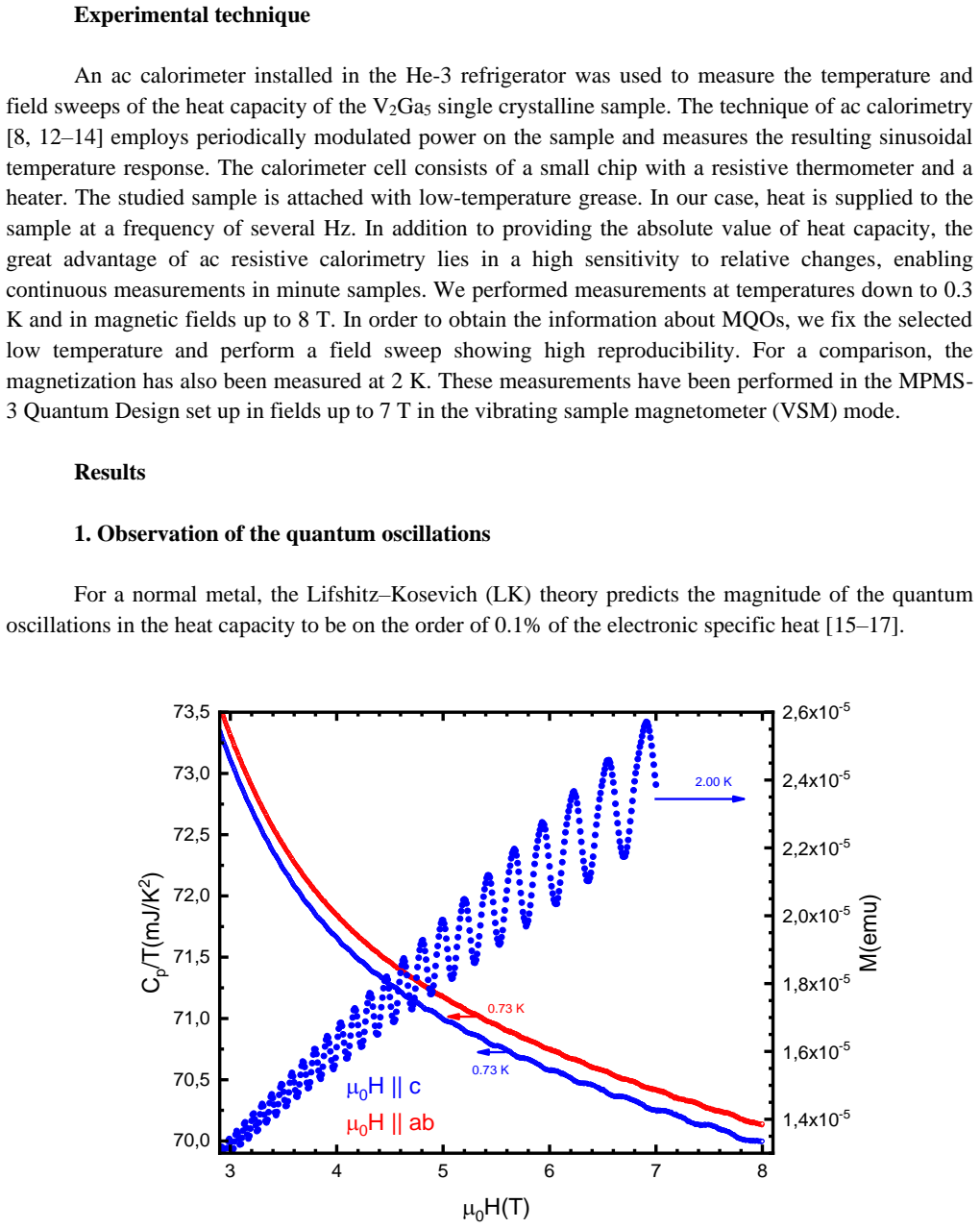
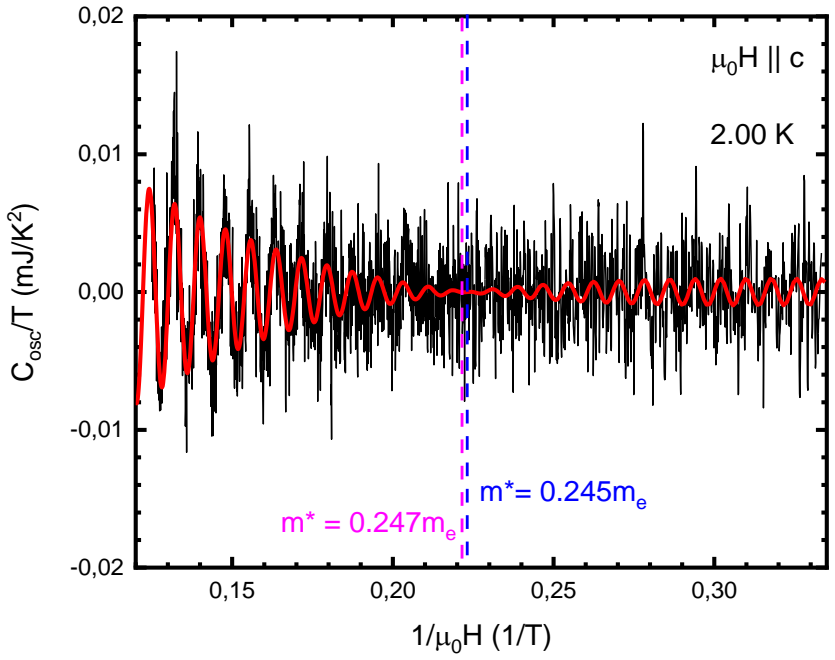
Observation of the quantum oscillations For a normal metal, the Lifshitz –Kosevich (LK) theory predicts the magnitude of the quantum oscillations in the heat capacity to be on the order of 0.1% of the electronic specific heat [15–17]. 3 4 5 6 7 8 70,0 70,5 71,0 71,5 72,0 72,5 73,0 73,5 0.73 K 0.73 K Cp/T(mJ/K2) m0H(T) m0H || c m0H || ab 2.00 K 1,4x10⁻⁵ 1,...
-
[2]
Further, by simple linear interpolation, we obtained data sets uniform in 1/B, which is necessary for the fast Fourier transform (FFT)
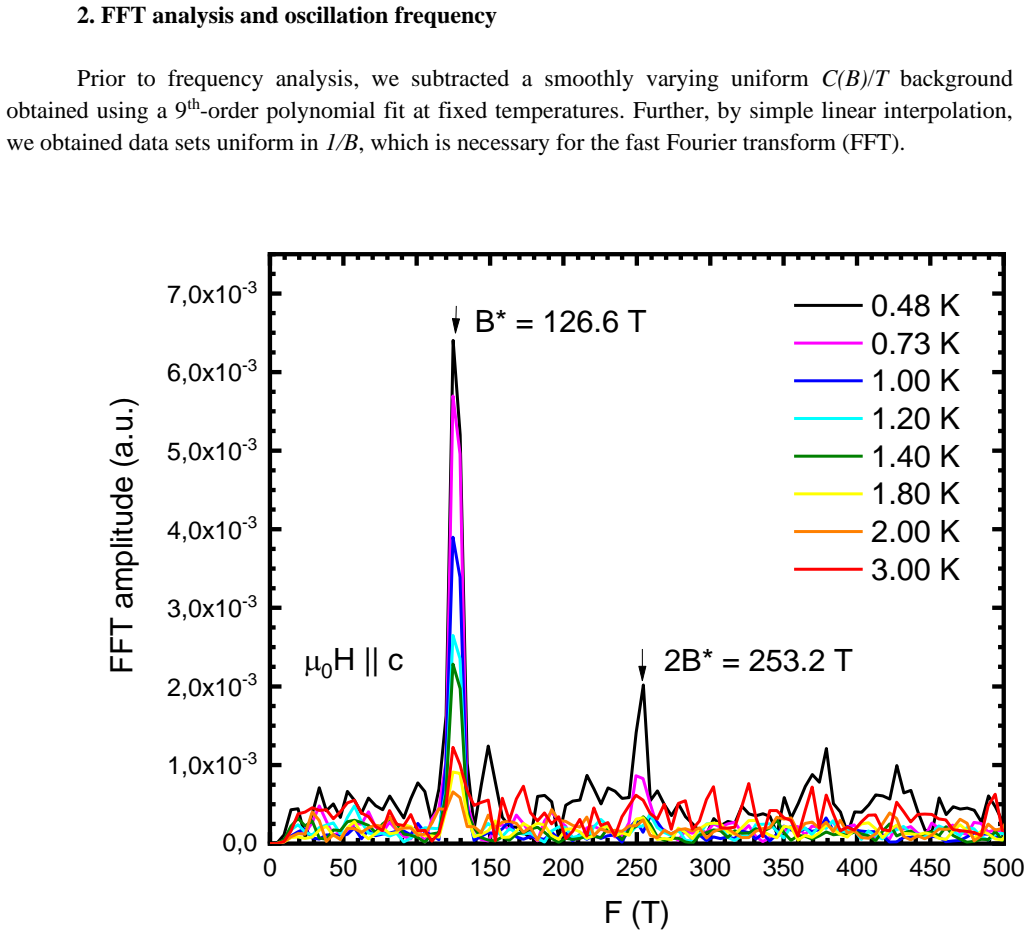
FFT analysis and oscillation frequency Prior to frequency analysis, we subtracted a smoothly varying uniform C(B)/T background obtained using a 9 th-order polynomial fit at fixed temperatures. Further, by simple linear interpolation, we obtained data sets uniform in 1/B, which is necessary for the fast Fourier transform (FFT). 0 50 100 150 200 250 300 350...
-
[3]
The first common approach involves fitting the thermal smearing factor fT(z) (Eq
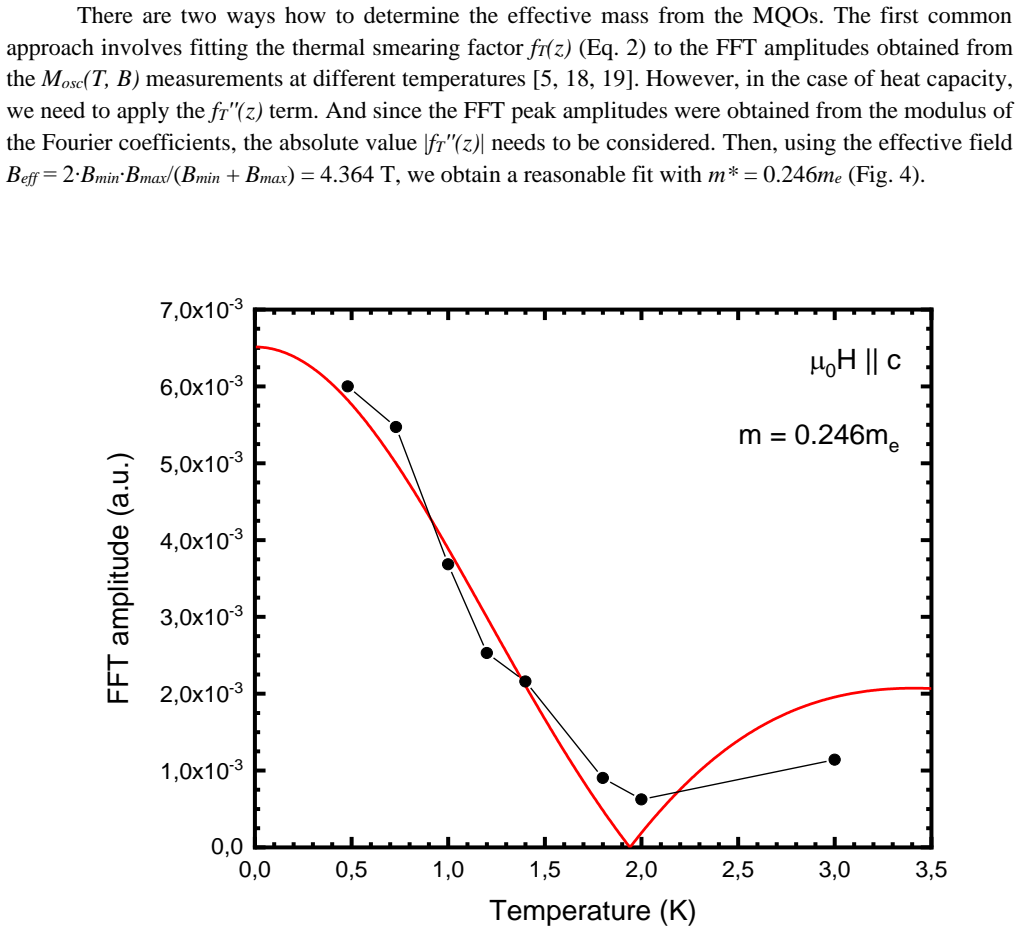
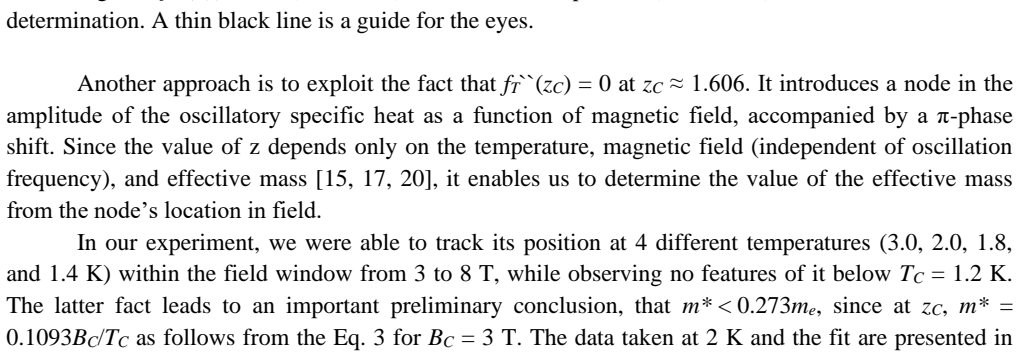
Effective mass There are two ways how to determine the effective mass from the MQOs. The first common approach involves fitting the thermal smearing factor fT(z) (Eq. 2) to the FFT amplitudes obtained from the Mosc(T, B) measurements at different temperatures [5, 18, 19]. However, in the case of heat capacity, we need to apply the fT''(z) term. And since ...
-
[4]
Dingle temperature Another important parameter in the LK model is the Dingle temperature TD. Electron scattering broadens the Landau levels, resulting in an extra amplitude reduction factor, which would have an effect approximately equivalent to that of a rise in temperature. A lower Dingle temperature indicates weaker scattering and sharper Landau levels...
-
[5]
The LK fit of Cosc(T, B) at 2 K shown in Fig
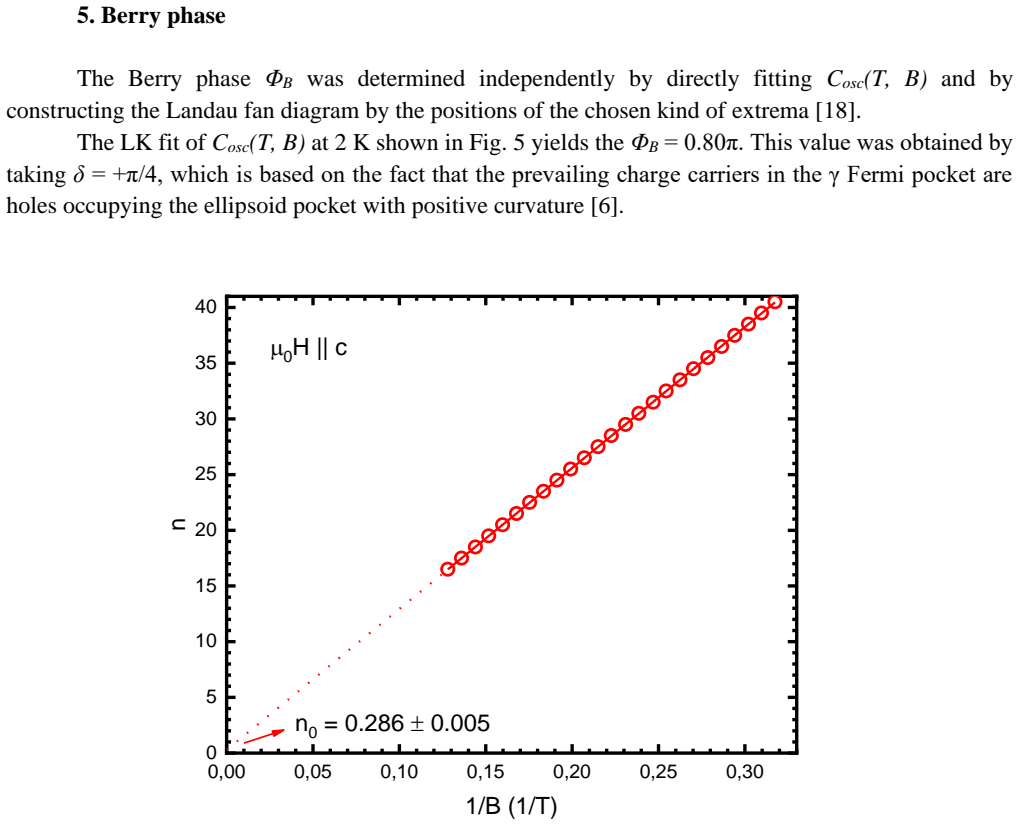
Berry phase The Berry phase ΦB was determined independently by directly fitting Cosc(T, B) and by constructing the Landau fan diagram by the positions of the chosen kind of extrema [18]. The LK fit of Cosc(T, B) at 2 K shown in Fig. 5 yields the ΦB = 0.80π. This value was obtained by taking δ = +π/4, which is based on the fact that the prevailing charge c...
-
[6]
Angular dependence of quantum oscillations 0 50 100 150 200 250 300 350 400 450 500 0,0 1,0x10⁻³ 2,0x10⁻³ 3,0x10⁻³ 4,0x10⁻³ 5,0x10⁻³ 6,0x10⁻³ FFT amplitude (a.u.) F (T) 0° H||c 15° 30° 45° 60° 75° 90° H||ab Fig. 8. The FFT spectra of the Cosc/T data when the external magnetic field is oriented towards the c axis at different angles (0.73 K). In Fig. 8, we...
2021
-
[7]
C. A. M. van Beijnen and J. D. Elen, Potential fabrication method of superconducting multilament wires of the A-15-type, IEEE Trans. Magn. 11, 243 (1975)
1975
-
[8]
Cruceanu, G
E. Cruceanu, G. Antesberger, C. Papastaikoudis, Low-temperature electrical properties of V2Ga5, Solid State Commun. 15, 1047 (1974)
1974
-
[9]
K. C. Lobring, C. E. Check, J. Zhang, S. Li, C. Zheng, and K. Rogacki, Single crystal growth, bonding analysis and superconductivity of V2Ga5, J. Alloys Compd. 347, 72 (2002)
2002
-
[10]
C. Q. Xu, C. C. Zhao, Y. Shen, D. Ratkovski, X. Ma, W. Zhou, X. Yin, B. Li, A. F. Bangura, C. Cao, B. Wang, Z. Zhu, X. Ke, D. Qian, S. Y. Li, and X. Xu, Multigap nodeless superconductivity in the Dirac intermetallic alloy V 2Ga5 with one-dimensional vanadium chains, Phys. Rev. B 109, L100506 (2024)
2024
-
[11]
Y. L. Huang et al., Transport and quantum oscillations in the quasi -one-dimensional superconductor V2Ga5, Physical Review B 111, 024503 (2025)
2025
-
[12]
Haniš, J
J. Haniš, J. Kačmarčík, F. Košuth, P. Szabó, P. Samuely, and M. Gmitra, Band -Selective Tunneling and Anisotropic Multiband Superconductivity in V2Ga5, to be published
-
[13]
Cheng, M
P.-Y. Cheng, M. Oudah, T. -L. Hung, C. -E. Hsu, C. -C. Chang, J.-Y. Haung, T. -C. Liu, C. -M. Cheng, M.-N. Ou, W. -T. Chen, L. Z. Deng, C. -C. Lee, Y. -Y. Chen, C. -N. Kuo, C. -S. Lue, J. Machts, K.M. Kojima, A. M. Hallas, and C. -L. Huang, Physical properties and electronic structure of the two - gap superconductor V2Ga5, Phys. Rev. Res. 6, 033253 (2024)
2024
-
[14]
Kačmarčík, I
J. Kačmarčík, I. Vinograd, B. Michon, A. Rydh, A. Demuer, R. Zhou, H. Mayaffre, R. Liang, W. N. Hardy, D. A. Bonn, N. Doiron -Leyraud, L. Taillefer, M. -H. Julien, C. Marcenat, and T. Klein, Klein, Unusual Interplay between Superconductivity and Field -Induced Charge Order in YBa 2Cu3Oy, Physical Review Letters 121, 167002 (2018)
2018
-
[15]
Wang and O
L. Wang and O. Vafek, Quantum oscillations of the specific heat in d-wave superconductors with loop current order, Phys. Rev. B 88, 024506 (2013)
2013
-
[16]
https://next-gen.materialsproject.org/materials/mp-20405/
-
[17]
https://legacy.materialsproject.org/materials/mp-20405/
-
[18]
Kacmarcík, Z
J. Kacmarcík, Z. Pribulová, V. Paluchová, P. Szabó, P. Husaníková, G. Karapetrov, and P. Samuely, Heat capacity of single-crystal CuxTiSe2 superconductors, Phys. Rev. B 88, 020507(R) (2013)
2013
-
[19]
Samuely, P
P. Samuely, P. Szabó, J. Kacmarcík, A. Meerschaut, L. Cario, A. G. M. Jansen, T. Cren, M. Kuzmiak, O. Šofranko, and T. Samuely, Extreme in -plane upper critical magnetic fields of heavily doped quasi-two-dimensional transition metal dichalcogenides, Phys. Rev. B 104, 224507 (2021)
2021
-
[20]
P. F. Sullivan and G. Seidel, Steady-state, ac-temperature calorimetry, Phys. Rev. 173, 679 (1968)
1968
-
[21]
P. G. LaBarre, A. Rydh, J. Palmer-Fortune, J. A. Frothingham, S. T. Hannahs, A. P. Ramirez and N. A. Fortune, Magnetoquantum oscillations in the specific heat of a topological Kondo insulator, J. Phys.: Condens. Matter 34, 36LT01(2022)
2022
-
[22]
Shoenberg, Magnetic Oscillations in Metals , Cambridge: Cambridge University Press, 1984
D. Shoenberg, Magnetic Oscillations in Metals , Cambridge: Cambridge University Press, 1984
1984
-
[23]
V. A. Bondarenko, S. Uji, T. Terashima, C. Terakura , S. Tanaka, S. Maki, J. Yamada, and S. Nakatsuji, First observations of the heat capacity quantum oscillations in the organic superconductor (BEDT-TTF)2Cu(NCS)2, Synth. Met. 120, 1039 (2001)
2001
-
[24]
Jin Hu et al., Evidence of Topological Nodal -Line Fermions in ZrSiSe and ZrSiTe , Physical Review Letters 117, 016602 (2016)
2016
-
[25]
Luo et al., Investigation of de Haas -van Alphen and Shubnikov -de Haas quantum oscillations in PrTe3, Physical Review B 109, 035121 (2024)
X. Luo et al., Investigation of de Haas -van Alphen and Shubnikov -de Haas quantum oscillations in PrTe3, Physical Review B 109, 035121 (2024)
2024
-
[26]
Chen et al., Quantum Oscillations in the Heat Capacity of Kondo Insulator YbB 12, Physical Review Letters 135, 156501 (2025)
K.-W. Chen et al., Quantum Oscillations in the Heat Capacity of Kondo Insulator YbB 12, Physical Review Letters 135, 156501 (2025)
2025
-
[27]
P. M. C. Rourke, and S. R. Julian, Numerical extraction of de Haas -van Alphen frequencies from calculated band energies, Computer Physics Communications 183, 324-332 (2012)
2012
-
[28]
Teruya, M
A. Teruya, M. Takeda, A. Nakamura, H. Harima, Y. Haga, K. Uchima, M. Hedo, T. Nakama, and Y. Onuki, Characteristic Fermi surface properties of V 2Ga5, CoGa3, TiGa3, ZrGa3, and ZrAl 3 with different tetragonal structures, J. Phys. Soc. Jpn. 84, 054703 (2015)
2015
discussion (0)
Sign in with ORCID, Apple, or X to comment. Anyone can read and Pith papers without signing in.