REVIEW 3 major objections 4 minor 143 references
Performance of Tkatchenko-Scheffler Dispersion Method with Updated van der Waals Radii: Importance for Alkali-Containing Systems
T0 review · 3 major / 4 minor · reviewed 2026-08-06 · deepseek-v4-flash
Pith's one-line read A polarizability-based update to van der Waals radii fixes the systematic alkali overbinding in the Tkatchenko-Scheffler dispersion method, matching many-body accuracy for alkali halides and lead halide perovskites.
desk verdict A solid, careful benchmark showing that updated TS radii fix the alkali overbinding; the qualitative conclusion holds, but the quantitative edge over MBD NL depends on reference-volume construction that still contains thermal expansion. read the letter →
The pith
A machine-rendered reading of the paper's core claim, the machinery that carries it, and where it could break.
The reading
What carries the argument
The load-bearing object is the polarizability-based van der Waals radius relation $R_0^A = C(\alpha_A^{\mathrm{eff}})^{1/7}$ ($C=2.54$ a.u.), introduced in the 2018 revision and paired with a revised heteronuclear distance $R_{AB}^0 = 2C((\alpha_A+\alpha_B)/2)^{1/7}$. It replaces the density-contour radii of the 2009 method. Because alkali atoms have large polarizabilities, the relation substantially increases their radii, which controls the onset of the damping function in the pairwise $E_{\mathrm{vdW}} = -\frac12\sum f_{\mathrm{damp}} C_6/R^6$ energy; the later onset removes the spurious extra binding. The Hirshfeld-volume scaling of $C_6$ and $\alpha$ is unchanged, so the whole correction
What would settle it
An anharmonic phonon calculation of the zero-point equilibrium volumes of CsPbCl3, CsPbBr3, and CsPbI3 would settle the ranking: if the true 0 K references differ from the Appendix B values by more than about 1.5%, the reported ordering among TS 2018, TS alkali, and MBD NL in the perovskite benchmarks changes.
Extended reading notes
Core claim
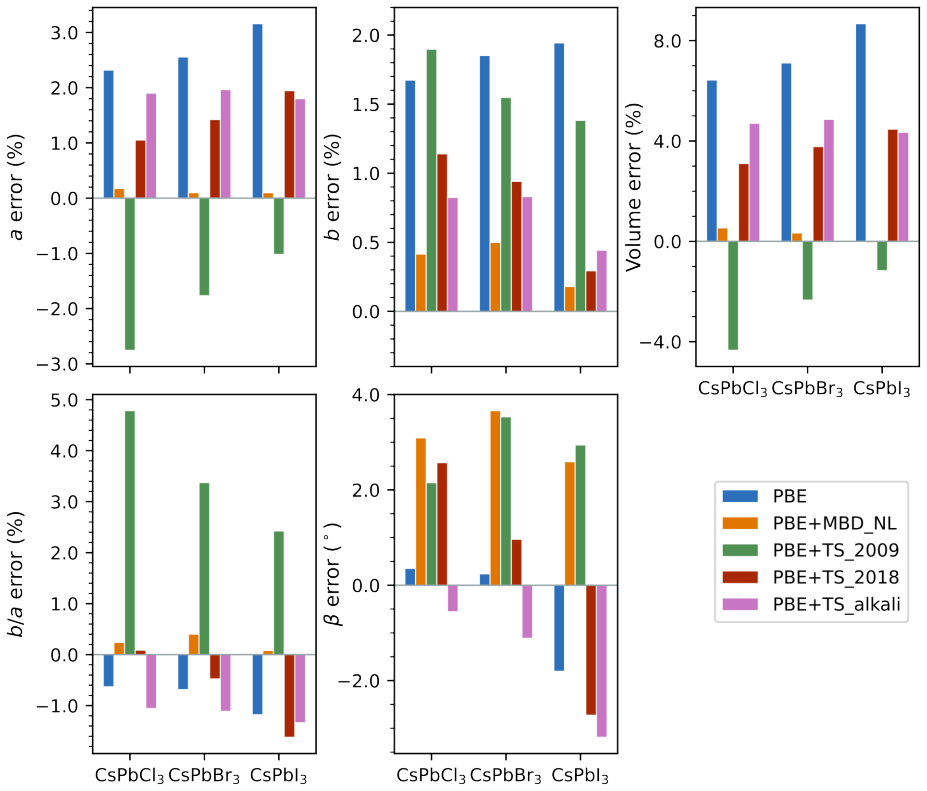
The central claim is that TS 2009's alkali overbinding stems from underestimated free-atom van der Waals radii, and that replacing them with polarizability-derived radii removes the error. The 2018 revision uses $R_0^A = C(\alpha_A^{\mathrm{eff}})^{1/7}$ with $C=2.54$ a.u., giving much larger radii for alkali atoms and a later damping onset for the $-C_6/R^6$ term. The paper shows that PBE+TS 2018 and PBE+TS alkali match RPA@PBE dimer curves within about 0.1 eV, cut alkali-halide volume error from 20% to about 3.4-4.0% (close to PBE+MBD NL's 2.6%), and preserve correct Pnma symmetry and better $b/a$ and $\beta$ anisotropies in CsPbCl3, CsPbBr3, and CsPbI3, where TS 2009 artificially breaks s
Load-bearing premise
The benchmark conclusions rest on the zero-point-corrected experimental reference volumes used in Appendix B; if that phonon-based correction is biased for any material class, the reported volume errors could shift by about 1.5%, enough to reorder the perovskite results.
Editorial extensions
If this is right
- For alkali halides, PBE+TS 2018 and PBE+TS alkali lower the mean absolute cell-volume error from about 20% with TS 2009 to about 3.4-4.0%, closely matching PBE+MBD NL's 2.6%.
- For non-alkali binary semiconductors, TS 2018 keeps errors around 3.0%, essentially unchanged from TS 2009's 2.3%, so the alkali fix does not hurt other materials.
- For CsPbCl3, CsPbBr3, and CsPbI3, the updated methods remove TS 2009's artificial symmetry lowering and exaggerated b/a and beta distortions; MBD NL still wins on low-temperature volume but overshoots the beta angle.
- TS alkali is exactly TS 2009 in alkali-free systems, so existing TS 2009-based workflows can be extended to alkali-containing systems without changing results elsewhere.
- The cheap pairwise TS method becomes a practical option for hybrid organic-inorganic perovskites and other alkali-containing insulators.
Reading between the lines
- Because the 2018 revision also changes radii substantially for lanthanides and actinides, the same fix may remove analogous overbinding in compounds of those elements; the paper sets those aside because of multireference complexity.
- Other pairwise dispersion corrections that use element-dependent radii could harbor the same alkali error; transferring the polarizability-based radius update to those schemes is a natural test.
- The better room-temperature lattice parameters reported for TS 2018 and TS alkali, despite being Born-Oppenheimer results, suggest error cancellation with missing thermal expansion; explicit finite-temperature phonon calculations could separate the two.
Editorial analysis
A structured set of objections, weighed in public.
Referee Report
Summary. The paper benchmarks the Tkatchenko-Scheffler dispersion method with updated van der Waals radii (TS_2018), a more targeted alkali-only variant (TS_alkali), the original TS_2009, and the nonlocal many-body dispersion method (MBD NL) for structural predictions. The benchmark set comprises five alkali dimers against RPA@PBE reference curves, 45 inorganic solids against experimental volumes, and three CsPbX3 halide perovskites against low-temperature experimental structures. The central claim is that TS_2018 and TS_alkali correct the large alkali-related overbinding of TS_2009, reach accuracy comparable to PBE+MBD NL for alkali halides and binary semiconductors, and give better lattice anisotropies than TS_2009 for CsPbCl3, CsPbBr3, and CsPbI3.
Significance. If the conclusions hold, the paper provides a practical result: a simple pairwise dispersion correction with updated radii can replace a more expensive many-body method for alkali-containing solids, and the TS_alkali variant offers backward compatibility for non-alkali systems. The work is careful in several respects: RPA@PBE dimer references use counterpoise corrections and carefully converged basis sets; solid-state volumes are obtained from equation-of-state fits; and the reference volumes are corrected for zero-point motion. The data and implementations are promised to be publicly available, which strengthens reproducibility. However, the quantitative ranking among methods is sensitive to how the experimental reference volumes are defined, and the paper does not currently provide uncertainty estimates for its headline error statistics.
major comments (3)
- [Appendix B, Tables 2 and 4] The reference volumes for alkali halides are not Born-Oppenheimer equilibrium volumes. Table 2 states that lattice constants and elastic moduli are room-temperature data, and Appendix B subtracts only the zero-point volume correction Δv. Thermal expansion from 0 K to 300 K is therefore left in the reference. For LiF the zero-point correction alone is ~4.4% of v0, and thermal expansion adds ~1–2% for typical alkali halides. Since Table 1 separates the methods by less than one percentage point (e.g., 2.63% for MBD NL vs 3.40% for TS_2018), the central claim that TS_2018/TS_alkali are 'comparable' to MBD NL is not robust until the thermal contribution is either subtracted using low-temperature lattice constants or explicitly estimated and propagated.
- [Cs-containing 3D Metal Halide Perovskites, Table 6] The perovskite volume errors are evaluated against 90–100 K experimental data without any zero-point correction, while the computational volumes are at the Born-Oppenheimer surface. The paper itself notes a ~1.5% zero-point contraction for a related perovskite. For TS_2018 the reported volume overestimates (+3.1%, +3.8%, +4.5% for Cl, Br, I) would increase by roughly that amount if the reference were corrected, making MBD NL's volume advantage larger than shown in Fig. 6c. The anisotropy claims are less affected, but the section should report corrected reference volumes or a sensitivity analysis for the volume comparison.
- [Table 1] The aggregate errors ⟨R.E.⟩ and ⟨|R.E.|⟩ are reported without uncertainty estimates. The difference between the best-performing method (PBE+MBD NL, 2.63%) and PBE+TS_2018 (3.40%) for alkali halides is comparable to plausible systematic shifts in the experimental references (thermal expansion, Debye-model approximation). Without standard errors, bootstrap intervals, or per-material scatter, the 'comparable accuracy' conclusion is not quantitatively supported. Please add uncertainty measures and, if possible, a table of per-material errors.
minor comments (4)
- [Section 2.2, Eq. (6)] Eq. (6) writes R0_A = C (α_eff_A)^{1/7} using the effective polarizability defined in Eq. (3), but Eq. (7) and the TS_2018 method as described use free-atom polarizabilities. This is confusing; clarify whether the updated radii are free-atom constants or environment-dependent.
- [Data availability] The GitHub URL 'https://github.com/aschankler/ts18benchmark data' contains a space and is not clickable. Fix the link.
- [Throughout] Several typographical errors: 'the the' in the abstract, 'compatability' near the TS_alkali definition, and 'calculated calculated' in the caption of Fig. 2. Please proofread.
- [Section 3.1, Fig. 3] The statement that 'four methods ... perform similarly' at intermediate distances is based on visual inspection of <0.1 eV differences. A quantitative table of errors at the equilibrium distance or a measure of mean absolute deviation would make the claim more precise.
Circularity Check
No significant circularity: method parameters are imported from prior work and tested against independent references.
full rationale
The paper benchmarks externally fixed parametrizations. The TS_2018 vdW radii come from Fedorov et al. (Ref. 23), with the constant C = 2.54 fitted to noble-gas vdW radii (Eq. 6) and the heteronuclear distance rule of Eq. 7 also taken from that prior work; TS_alkali is defined as TS_2009 with only alkali radii updated. None of these parameters are fitted to the alkali-dimer RPA curves, the 45 experimental solid-state volumes, or the CsPbX3 perovskite lattice parameters used as benchmarks. The paper's central claims are therefore testable consequences rather than re-statements of inputs. The only significant caveat is the construction of zero-point-corrected reference volumes in Appendix B using a Debye/Dugdale-MacDonald model with experimental B0, B1, and ΘD; this is an external reference-model uncertainty, not a circular reduction of the predicted volumes to a fitted target. Self-citations to Tkatchenko-Scheffler 2009, Fedorov et al. 2018, and MBD NL are normal method attribution and are not used to replace independent evidence; the benchmarks in this paper constitute the load-bearing verification.
Assumptions & free parameters
free parameters (3)
- Damping coefficient s_R for PBE =
0.94
- Proportionality constant C in the vdW radius relation =
2.54 a.u.
- Damping steepness d =
20 a0
assumptions (5)
- domain assumption Dispersion energy has the pairwise C6/R^6 form with a Fermi damping function (Eqs. 1 and 5).
- domain assumption Hirshfeld volume ratios scale free-atom polarizabilities and C6 coefficients (Eqs. 2-4).
- domain assumption RPA@PBE with counterpoise correction is an accurate reference for alkali dimer binding curves.
- domain assumption The Debye model with the Dugdale-MacDonald approximation gives unbiased zero-point volume corrections for all 45 reference solids.
- domain assumption Many-body screening is negligible in the highly symmetric solids studied, so pairwise and MBD results can be compared directly.
Cite this review
Pith. "Pith review of Performance of Tkatchenko-Scheffler Dispersion Method with Updated van der Waals Radii: Importance for Alkali-Containing Systems." pith.science (2026). https://pith.science/paper/6EBPFL6R
@misc{pith2026260801501,
  author       = {Pith},
  title        = {Pith review of: Performance of Tkatchenko-Scheffler Dispersion Method with Updated van der Waals Radii: Importance for Alkali-Containing Systems},
  year         = {2026},
  howpublished = {\url{https://pith.science/paper/6EBPFL6R}},
  note         = {Machine review of arXiv:2608.01501}
}
abstract
The Tkatchenko-Scheffler (TS) pairwise method to calculate dispersion interactions is a widely used approach to incorporate missing long-range van der Waals contributions in semilocal and hybrid density functional calculations. Despite numerous refinements of the approach to include many-body terms, the original formulation still remains highly relevant as an efficient and robust method, especially for organic and/or insulating materials. In 2018, Fedorov et al. reported updated van der Waals radii to the seminal work published in 2009. The present work examines the accuracy of the TS method with updated van der Waals radii (abbreviated as TS_2018), coupled with the semilocal Perdew-Burke-Ernzerhof density functional, for structural predictions of semiconducting and insulating materials in comparison to the non-local many-body dispersion method and the original TS method (TS_2009). Special attention is paid to materials containing alkali elements, for which the TS_2009 method exhibits a large overbinding, associated with potentially large errors in predicted atomic structures. We also consider a more narrow reformulation (TS_alkali) where only the the alkali atoms are corrected, so the method remains otherwise compatible with TS_2009. The binding energy curves of five alkali dimers are used to assess the TS_2009 and the TS_2018 methods in comparison to the random phase approximation. Using 45 inorganic solid compounds with available experimental reference data, as well as three widely studied, Cs-containing halide perovskites, CsPb$X_3$ ($X$ = Cl, Br, I), we then examine the performance of the TS_2018 and TS_alkali approaches compared to TS_2009 and the beyond-pairwise, nonlocal many-body dispersion method; the latter found to give good results as well.
Figures


Figures from the paper (6 more)




Reference graph
Works this paper leans on
-
[1]
Theory of van der Waals Attraction
Langbein, D. Theory of van der Waals Attraction. Springer tracts in modern physics 1974, 1--139
1974
-
[2]
Perspective: Advances and challenges in treating van der Waals dispersion forces in density functional theory
Klime s , J.; Michaelides, A. Perspective: Advances and challenges in treating van der Waals dispersion forces in density functional theory. The Journal of chemical physics 2012, 137, 120901
2012
-
[3]
P.; Taylor, S.; Baran, J
Jarvis, S. P.; Taylor, S.; Baran, J. D.; Champness, N. R.; Larsson, J.; Moriarty, P. Measuring the mechanical properties of molecular conformers. Nature communications 2015, 6, 8338
2015
-
[4]
Validation Challenge of Density-Functional Theory for Peptides—Example of Ac-Phe-Ala _5 -LysH ^+
Rossi, M.; Chutia, S.; Scheffler, M.; Blum, V. Validation Challenge of Density-Functional Theory for Peptides—Example of Ac-Phe-Ala _5 -LysH ^+ . The Journal of Physical Chemistry A 2014, 118, 7349–7359
2014
-
[5]
Exploring the conformational preferences of 20-residue peptides in isolation: Ac-Ala _19 -Lys + H ^+ vs
Schubert, F.; Rossi, M.; Baldauf, C.; Pagel, K.; Warnke, S.; von Helden, G.; Filsinger, F.; Kupser, P.; Meijer, G.; Salwiczek, M.; Koksch, B.; Scheffler, M.; Blum, V. Exploring the conformational preferences of 20-residue peptides in isolation: Ac-Ala _19 -Lys + H ^+ vs. Ac-Lys-Ala _19 + H ^+ and the current reach of DFT . Physical Chemistry Chemical Phys...
2015
-
[6]
M.; van de Streek, J.; Sasikumar, K.; Dietrich, H.; Helfferich, J.; Aerts, L.; Braun, D
Firaha, D.; Liu, Y. M.; van de Streek, J.; Sasikumar, K.; Dietrich, H.; Helfferich, J.; Aerts, L.; Braun, D. E.; Broo, A.; DiPasquale, A. G.; others Predicting crystal form stability under real-world conditions. Nature 2023, 623, 324--328
2023
-
[7]
Bucko, T.; Hafner, J.; Leb \`e gue, S.; Angy \'a n, J. G. Improved description of the structure of molecular and layered crystals: ab initio DFT calculations with van der Waals corrections. The Journal of Physical Chemistry A 2010, 114, 11814--11824
2010
-
[8]
B.; Snaider, J
Gao, Y.; Shi, E.; Deng, S.; Shiring, S. B.; Snaider, J. M.; Liang, C.; Yuan, B.; Song, R.; Janke, S. M.; Liebman-Pel \'a ez, A.; others Molecular engineering of organic--inorganic hybrid perovskites quantum wells. Nature chemistry 2019, 11, 1151--1157
2019
Show all 143 references
-
[9]
Y.; Song, R.; Liang, J.; Jin, L.; Wang, K.; Li, S.; Shi, E.; Gao, Y.; Zeller, M.; Teat, S
Park, J. Y.; Song, R.; Liang, J.; Jin, L.; Wang, K.; Li, S.; Shi, E.; Gao, Y.; Zeller, M.; Teat, S. J.; others Thickness control of organic semiconductor-incorporated perovskites. Nature Chemistry 2023, 1--9
2023
-
[10]
K.; Song, R.; Liu, H.; Khanal, D
Jana, M. K.; Song, R.; Liu, H.; Khanal, D. R.; Janke, S. M.; Zhao, R.; Liu, C.; Valy Vardeny, Z.; Blum, V.; Mitzi, D. B. Organic-to-inorganic structural chirality transfer in a 2D hybrid perovskite and impact on Rashba-Dresselhaus spin-orbit coupling. Nature communications 202...
2020
-
[11]
F.; Brunecky, R.; You, W.; Berry, J
Kim, Y.-H.; Song, R.; Hao, J.; Zhai, Y.; Yan, L.; Moot, T.; Palmstrom, A. F.; Brunecky, R.; You, W.; Berry, J. J.; others The Structural Origin of Chiroptical Properties in Perovskite Nanocrystals with Chiral Organic Ligands. Advanced Functional Materials 2022, 2200454
2022
-
[12]
B.; Blum, V
Song, R.; Liu, C.; Kanai, Y.; Mitzi, D. B.; Blum, V. Structure and electronic tunability of acene alkylamine based layered hybrid organic-inorganic perovskites from first principles. Physical Review Materials 2023, 7, 084601
2023
-
[13]
Density functional theory study of two-dimensional hybrid organic-inorganic perovskites: frontier level alignment and chirality-induced spin splitting
Song, R.; Zhao, R. Density functional theory study of two-dimensional hybrid organic-inorganic perovskites: frontier level alignment and chirality-induced spin splitting. AAPPS Bulletin 2024, 34
2024
-
[14]
H.; Parsegian, V
French, R. H.; Parsegian, V. A.; Podgornik, R.; Rajter, R. F.; Jagota, A.; Luo, J.; Asthagiri, D.; Chaudhury, M. K.; Chiang, Y.-m.; Granick, S.; others Long range interactions in nanoscale science. Reviews of Modern Physics 2010, 82, 1887
2010
-
[15]
Electronic structure and van der Waals interactions in the stability and mobility of point defects in semiconductors
Gao, W.; Tkatchenko, A. Electronic structure and van der Waals interactions in the stability and mobility of point defects in semiconductors. Physical review letters 2013, 111, 045501
2013
-
[16]
F.; Zhang, H.; Yang, H.; Yao, X.; Zhao, H
Wang, Y.; Gould, T.; Dobson, J. F.; Zhang, H.; Yang, H.; Yao, X.; Zhao, H. Density functional theory analysis of structural and electronic properties of orthorhombic perovskite CH 3 NH 3 PbI 3. Physical Chemistry Chemical Physics 2014, 16, 1424--1429
2014
-
[17]
B.; Al-Douri, Y
Ferjani, H.; Smida, Y. B.; Al-Douri, Y. First-Principles Calculations to Investigate the Effect of Van der Waals Interactions on the Crystal and Electronic Structures of Tin-Based 0D Hybrid Perovskites. Inorganics 2022, 10, 155
2022
-
[18]
Ab initio Calculation of van der Waals Bonded Molecular Crystals
Lu, D.; Li, Y.; Rocca, D.; Galli, G. Ab initio Calculation of van der Waals Bonded Molecular Crystals. Physical Review Letters 2009, 102, 206411
2009
-
[19]
J.; Gould, T.; Lee, E
Kim, M.; Kim, W. J.; Gould, T.; Lee, E. K.; Leb\` e gue, S.; Kim, H. uMBD : A Materials-Ready Dispersion Correction That Uniformly Treats Metallic, Ionic, and van der Waals Bonding. Journal of the American Chemical Society 2020, 142, 2346–2354
2020
-
[20]
B.; Blum, V
Liu, C.; Huhn, W.; Du, K.-Z.; Vazquez-Mayagoitia, A.; Dirkes, D.; You, W.; Kanai, Y.; Mitzi, D. B.; Blum, V. Tunable semiconductors: control over carrier states and excitations in layered hybrid organic-inorganic perovskites. Physical Review Letters 2018, 121, 146401
2018
-
[21]
Benchmark thermodynamic analysis of methylammonium lead iodide decomposition from first principles
Heine, D.; Yu, H.-C.; Blum, V. Benchmark thermodynamic analysis of methylammonium lead iodide decomposition from first principles. Journal of Physics: Energy 2023, 6, 015015
2023
-
[22]
Accurate molecular van der Waals interactions from ground-state electron density and free-atom reference data
Tkatchenko, A.; Scheffler, M. Accurate molecular van der Waals interactions from ground-state electron density and free-atom reference data. Physical review letters 2009, 102, 073005
2009
-
[23]
V.; Sadhukhan, M.; St \"o hr, M.; Tkatchenko, A
Fedorov, D. V.; Sadhukhan, M.; St \"o hr, M.; Tkatchenko, A. Quantum-mechanical relation between atomic dipole polarizability and the van der Waals radius. Physical Review Letters 2018, 121, 183401
2018
-
[24]
J.; Sohail, B.; Rochford, L
Blowey, P. J.; Sohail, B.; Rochford, L. A.; Lafosse, T.; Duncan, D. A.; Ryan, P. T. P.; Warr, D. A.; Lee, T.-L.; Costantini, G.; Maurer, R. J.; Woodruff, D. P. Alkali Doping Leads to Charge-Transfer Salt Formation in a Two-Dimensional Metal–Organic Framework. ACS Nano 2020, 14...
2020
-
[25]
Accurate description of van der Waals complexes by density functional theory including empirical corrections
Grimme, S. Accurate description of van der Waals complexes by density functional theory including empirical corrections. Journal of Computational Chemistry 2004, 25, 1463–1473
2004
-
[26]
A.; Car, R.; Scheffler, M
Tkatchenko, A.; DiStasio Jr, R. A.; Car, R.; Scheffler, M. Accurate and efficient method for many-body van der Waals interactions. Physical review letters 2012, 108, 236402
2012
-
[27]
M.; DiStasio Jr, R
Ambrosetti, A.; Reilly, A. M.; DiStasio Jr, R. A.; Tkatchenko, A. Long-range correlation energy calculated from coupled atomic response functions. The Journal of chemical physics 2014, 140, 18A508
2014
-
[28]
Density functional model for van der Waals interactions: Unifying many-body atomic approaches with nonlocal functionals
Hermann, J.; Tkatchenko, A. Density functional model for van der Waals interactions: Unifying many-body atomic approaches with nonlocal functionals. Physical review letters 2020, 124, 146401
2020
-
[29]
D.; Johnson, E
Becke, A. D.; Johnson, E. R. Exchange-hole dipole moment and the dispersion interaction revisited. The Journal of chemical physics 2007, 127
2007
-
[30]
F.; Johnson, E
Rumson, A. F.; Johnson, E. R. Low thermal expansion of layered electrides predicted by density-functional theory. The Journal of Chemical Physics 2023, 159
2023
-
[31]
Price, A. J. A.; Otero-de-la Roza, A.; Johnson, E. R. XDM -corrected hybrid DFT with numerical atomic orbitals predicts molecular crystal lattice energies with unprecedented accuracy. Chemical Science 2023, 14, 1252–1262
2023
-
[32]
Can (semi)local density functional theory account for the London dispersion forces? Chemical Physics Letters 1994, 229, 175–180
Kristy\' a n, S.; Pulay, P. Can (semi)local density functional theory account for the London dispersion forces? Chemical Physics Letters 1994, 229, 175–180
1994
-
[33]
Empirical correction to density functional theory for van der Waals interactions
Wu, Q.; Yang, W. Empirical correction to density functional theory for van der Waals interactions. The Journal of chemical physics 2002, 116, 515--524
2002
-
[34]
On the Importance of Electron Correlation Effects for the -- Interactions in Cyclophanes
Grimme, S. On the Importance of Electron Correlation Effects for the -- Interactions in Cyclophanes. Chemistry - A European Journal 2004, 10, 3423–3429
2004
-
[35]
Semiempirical hybrid density functional with perturbative second-order correlation
Grimme, S. Semiempirical hybrid density functional with perturbative second-order correlation. The Journal of Chemical Physics 2006, 124, 034108
2006
-
[36]
Szabo, A.; Ostlund, N. S. Modern quantum chemistry: introduction to advanced electronic structure theory; Courier Corporation, 2012
2012
-
[37]
A collective description of electron interactions
Bohm, D.; Pines, D. A collective description of electron interactions. I. Magnetic interactions. Physical Review 1951, 82, 625
1951
-
[38]
Accurate density functionals: Approaches using the adiabatic-connection fluctuation-dissipation theorem
Fuchs, M.; Gonze, X. Accurate density functionals: Approaches using the adiabatic-connection fluctuation-dissipation theorem. Physical Review B 2002, 65, 235109
2002
-
[39]
Theory and practice of modeling van der Waals interactions in electronic-structure calculations
St\" o hr, M.; Van Voorhis, T.; Tkatchenko, A. Theory and practice of modeling van der Waals interactions in electronic-structure calculations. Chemical Society Reviews 2019, 48, 4118–4154
2019
-
[40]
Resolution-of-identity approach to Hartree–Fock , hybrid density functionals, RPA , MP2 and GW with numeric atom-centered orbital basis functions
Ren, X.; Rinke, P.; Blum, V.; Wieferink, J.; Tkatchenko, A.; Sanfilippo, A.; Reuter, K.; Scheffler, M. Resolution-of-identity approach to Hartree–Fock , hybrid density functionals, RPA , MP2 and GW with numeric atom-centered orbital basis functions. New Journal of Physics 2012...
2012
-
[41]
Random-phase approximation and its applications in computational chemistry and materials science
Ren, X.; Rinke, P.; Joas, C.; Scheffler, M. Random-phase approximation and its applications in computational chemistry and materials science. Journal of Materials Science 2012, 47, 7447--7471
2012
-
[42]
C.; Lundqvist, B
Dion, M.; Rydberg, H.; Schr \"o der, E.; Langreth, D. C.; Lundqvist, B. I. Van der Waals density functional for general geometries. Physical review letters 2004, 92, 246401
2004
-
[43]
A.; Van Voorhis, T
Vydrov, O. A.; Van Voorhis, T. Nonlocal van der Waals density functional made simple. Physical review letters 2009, 103, 063004
2009
-
[44]
R.; Michaelides, A
Klime s , J.; Bowler, D. R.; Michaelides, A. Van der Waals density functionals applied to solids. Physical Review B 2011, 83, 195131
2011
-
[45]
D.; Kong, L.; Lundqvist, B
Lee, K.; Murray, \'E . D.; Kong, L.; Lundqvist, B. I.; Langreth, D. C. Higher-accuracy van der Waals density functional. Physical Review B 2010, 82, 081101
2010
-
[46]
A.; Van Voorhis, T
Vydrov, O. A.; Van Voorhis, T. Nonlocal van der Waals density functional: The simpler the better. The Journal of Chemical Physics 2010, 133, 244103
2010
-
[47]
Nonlocal van der Waals density functional made simple and efficient
Sabatini, R.; Gorni, T.; de Gironcoli, S. Nonlocal van der Waals density functional made simple and efficient. Physical Review B 2013, 87, 041108(R)
2013
-
[48]
P.; Sun, J
Peng, H.; Yang, Z.-H.; Perdew, J. P.; Sun, J. Versatile van der Waals Density Functional Based on a Meta-Generalized Gradient Approximation. Physical Review X 2016, 6, 041005
2016
-
[49]
Next-Generation Nonlocal van der Waals Density Functional
Chakraborty, D.; Berland, K.; Thonhauser, T. Next-Generation Nonlocal van der Waals Density Functional. Journal of Chemical Theory and Computation 2020, 16, 5893–5911
2020
-
[50]
R.; Lee, K.; Schr\" o der, E.; Thonhauser, T.; Hyldgaard, P.; Lundqvist, B
Berland, K.; Cooper, V. R.; Lee, K.; Schr\" o der, E.; Thonhauser, T.; Hyldgaard, P.; Lundqvist, B. I. van der Waals forces in density functional theory: a review of the vdW-DF method. Reports on Progress in Physics 2015, 78, 066501
2015
-
[51]
Nonlocal van der Waals functionals for solids: Choosing an appropriate one
Tran, F.; Kalantari, L.; Traor\' e , B.; Rocquefelte, X.; Blaha, P. Nonlocal van der Waals functionals for solids: Choosing an appropriate one. Physical Review Materials 2019, 3, 063602
2019
-
[52]
Rom\' a n-P\' e rez, G.; Soler, J. M. Efficient Implementation of a van der Waals Density Functional: Application to Double-Wall Carbon Nanotubes. Physical Review Letters 2009, 103
2009
-
[53]
Electronic Exchange and Correlation in van der Waals Systems: Balancing Semilocal and Nonlocal Energy Contributions
Hermann, J.; Tkatchenko, A. Electronic Exchange and Correlation in van der Waals Systems: Balancing Semilocal and Nonlocal Energy Contributions. Journal of Chemical Theory and Computation 2018, 14, 1361–1369
2018
-
[54]
J.; Lee, E
Kim, M.; Kim, W. J.; Lee, E. K.; Lebegue, S.; Kim, H. Recent development of atom-pairwise van der waals corrections for density functional theory: From molecules to solids. International Journal of Quantum Chemistry 2016, 116, 598--607
2016
-
[55]
Die gegenseitige einwirkung zweier wasserstoffatome
Wang, S. Die gegenseitige einwirkung zweier wasserstoffatome. Phys. Z 1927, 28, 663--666
1927
-
[56]
The general theory of molecular forces
London, F. The general theory of molecular forces. Transactions of the Faraday Society 1937, 33, 8b--26
1937
-
[57]
F.; White, A.; Rubio, A
Dobson, J. F.; White, A.; Rubio, A. Asymptotics of the Dispersion Interaction: Analytic Benchmarks for van der Waals Energy Functionals. Physical Review Letters 2006, 96, 073201
2006
-
[58]
G.; Kresse, G.; Dobson, J
Leb\` e gue, S.; Harl, J.; Gould, T.; \' A ngy\' a n, J. G.; Kresse, G.; Dobson, J. F. Cohesive Properties and Asymptotics of the Dispersion Interaction in Graphite by the Random Phase Approximation. Physical Review Letters 2010, 105, 196401
2010
-
[59]
A consistent and accurate ab initio parametrization of density functional dispersion correction (DFT-D) for the 94 elements H-Pu
Grimme, S.; Antony, J.; Ehrlich, S.; Krieg, H. A consistent and accurate ab initio parametrization of density functional dispersion correction (DFT-D) for the 94 elements H-Pu. The Journal of chemical physics 2010, 132
2010
-
[60]
Extension of the D3 dispersion coefficient model
Caldeweyher, E.; Bannwarth, C.; Grimme, S. Extension of the D3 dispersion coefficient model. The Journal of Chemical Physics 2017, 147, 034112
2017
-
[61]
Effect of the damping function in dispersion corrected density functional theory
Grimme, S.; Ehrlich, S.; Goerigk, L. Effect of the damping function in dispersion corrected density functional theory. Journal of computational chemistry 2011, 32, 1456--1465
2011
-
[62]
B.; Head-Gordon, M
Witte, J.; Mardirossian, N.; Neaton, J. B.; Head-Gordon, M. Assessing DFT-D3 damping functions across widely used density functionals: Can we do better? Journal of chemical theory and computation 2017, 13, 2043--2052
2017
-
[63]
Dobson, J. F. Beyond pairwise additivity in London dispersion interactions. International Journal of Quantum Chemistry 2014, 114, 1157–1161
2014
-
[64]
P.; Rappe, A
Tao, J.; Zheng, F.; Gebhardt, J.; Perdew, J. P.; Rappe, A. M. Screened van der Waals correction to density functional theory for solids. Physical Review Materials 2017, 1, 020802
2017
-
[65]
Tkatchenko, A.; Ambrosetti, A.; DiStasio, R. A. Interatomic methods for the dispersion energy derived from the adiabatic connection fluctuation-dissipation theorem. The Journal of Chemical Physics 2013, 138, 074106
2013
-
[66]
A.; Van Voorhis, T
Vydrov, O. A.; Van Voorhis, T. Dispersion interactions from a local polarizability model. Physical Review A 2010, 81, 062708
2010
-
[67]
P.; Burke, K.; Ernzerhof, M
Perdew, J. P.; Burke, K.; Ernzerhof, M. Generalized gradient approximation made simple. Physical review letters 1996, 77, 3865
1996
-
[68]
K.; Janke, S
Jana, M. K.; Janke, S. M.; Dirkes, D. J.; Dovletgeldi, S.; Liu, C.; Qin, X.; Gundogdu, K.; You, W.; Blum, V.; Mitzi, D. B. Direct-bandgap 2D silver--bismuth iodide double perovskite: the structure-directing influence of an oligothiophene spacer cation. Journal of the American ...
2019
-
[69]
E.; Levin, A.; Brunecky, R.; Berry, J
Lu, H.; Xiao, C.; Song, R.; Li, T.; Maughan, A. E.; Levin, A.; Brunecky, R.; Berry, J. J.; Mitzi, D. B.; Blum, V.; others Highly distorted chiral two-dimensional tin iodide perovskites for spin polarized charge transport. Journal of the American Chemical Society 2020, 142, 130...
2020
-
[70]
S.; Politzer, P
Brinck, T.; Murray, J. S.; Politzer, P. Polarizability and volume. The Journal of chemical physics 1993, 98, 4305--4306
1993
-
[71]
The use of atomic intrinsic polarizabilities in the evaluation of the dispersion energy
Olasz, A.; Vanommeslaeghe, K.; Krishtal, A.; Veszpr \'e mi, T.; Van Alsenoy, C.; Geerlings, P. The use of atomic intrinsic polarizabilities in the evaluation of the dispersion energy. The Journal of chemical physics 2007, 127, 224105
2007
-
[72]
Linear response time-dependent density functional theory for van der Waals coefficients
Chu, X.; Dalgarno, A. Linear response time-dependent density functional theory for van der Waals coefficients. The Journal of Chemical Physics 2004, 121, 4083–4088
2004
-
[73]
Toward reliable density functional methods without adjustable parameters: The PBE0 model
Adamo, C.; Barone, V. Toward reliable density functional methods without adjustable parameters: The PBE0 model. The Journal of Chemical Physics 1999, 110, 6158–6170
1999
-
[74]
Gobre, V. V. Efficient modelling of linear electronic polarization in materials using atomic response functions. Ph.D.\ thesis, Fritz-Haber-institut der Max-Planck-Gesellschaft Berlin-Germany, 2016
2016
-
[75]
V.; Hod, O.; Scheffler, M.; Kronik, L
Marom, N.; Tkatchenko, A.; Rossi, M.; Gobre, V. V.; Hod, O.; Scheffler, M.; Kronik, L. Dispersion interactions with density-functional theory: benchmarking semiempirical and interatomic pairwise corrected density functionals. Journal of Chemical Theory and Computation 2011, 7,...
2011
-
[76]
Bondi, A. v. van der Waals volumes and radii. The Journal of physical chemistry 1964, 68, 441--451
1964
-
[77]
Relativistic pseudopotential calculations on Xe2, RnXe, and Rn2: The van der Waals properties of radon
Runeberg, N.; Pyykk \"o , P. Relativistic pseudopotential calculations on Xe2, RnXe, and Rn2: The van der Waals properties of radon. International journal of quantum chemistry 1998, 66, 131--140
1998
-
[78]
V.; Gori, M
Tkatchenko, A.; Fedorov, D. V.; Gori, M. Fine-Structure Constant Connects Electronic Polarizability and Geometric van-der-Waals Radius of Atoms. The Journal of Physical Chemistry Letters 2021, 12, 9488–9492
2021
-
[79]
The van der Waals potentials between all the rare gas atoms from He to Rn
Tang, K.; Toennies, J. The van der Waals potentials between all the rare gas atoms from He to Rn. The Journal of chemical physics 2003, 118, 4976--4983
2003
-
[80]
Ab initio molecular simulations with numeric atom-centered orbitals
Blum, V.; Gehrke, R.; Hanke, F.; Havu, P.; Havu, V.; Ren, X.; Reuter, K.; Scheffler, M. Ab initio molecular simulations with numeric atom-centered orbitals. Computer Physics Communications 2009, 180, 2175--2196
2009
-
[81]
Abbott, J. W. et al. Roadmap on Advancements of the FHI -aims Software Package. Electronic Structure 2026,
2026
-
[82]
A.; Caldas, M
Lima, N. A.; Caldas, M. J. Long range van der Waals density functional: Dimers involving alkali-metal, alkaline-earth-metal, and noble-gas atoms. Physical Review B—Condensed Matter and Materials Physics 2005, 72, 033109
2005
-
[83]
Long-range dispersion interactions
Mitroy, J.; Zhang, J.-Y. Long-range dispersion interactions. II. Alkali-metal and rare-gas atoms. Physical Review A—Atomic, Molecular, and Optical Physics 2007, 76, 032706
2007
-
[84]
P.; Ruzsinszky, A
Tao, J.; Perdew, J. P.; Ruzsinszky, A. Long-range van der Waals attraction and alkali-metal lattice constants. Physical Review B—Condensed Matter and Materials Physics 2010, 81, 233102
2010
-
[85]
Van der Waals density functional from multipole dispersion interactions
Alves de Lima, N. Van der Waals density functional from multipole dispersion interactions. The Journal of chemical physics 2010, 132
2010
-
[86]
Molecular tests of the random phase approximation to the exchange-correlation energy functional
Furche, F. Molecular tests of the random phase approximation to the exchange-correlation energy functional. Physical Review B 2001, 64, 195120
2001
-
[87]
Galano, A.; Alvarez-Idaboy, J. R. A new approach to counterpoise correction to BSSE. Journal of computational chemistry 2006, 27, 1203--1210
2006
-
[88]
J.; Zhu, K
Li, Z.; Yang, M.; Park, J.-S.; Wei, S.-H.; Berry, J. J.; Zhu, K. Stabilizing perovskite structures by tuning tolerance factor: formation of formamidinium and cesium lead iodide solid-state alloys. Chemistry of Materials 2016, 28, 284--292
2016
-
[89]
R.; McClure, E
Linaburg, M. R.; McClure, E. T.; Majher, J. D.; Woodward, P. M. Cs _ 1-x Rb _x PbCl _3 and Cs _ 1-x Rb _x PbBr _3 solid solutions: understanding octahedral tilting in lead halide perovskites. Chemistry of Materials 2017, 29, 3507--3514
2017
-
[90]
C.; Malliakas, C
Stoumpos, C. C.; Malliakas, C. D.; Peters, J. A.; Liu, Z.; Sebastian, M.; Im, J.; Chasapis, T. C.; Wibowo, A. C.; Chung, D. Y.; Freeman, A. J.; Wessels, B. W.; Kanatzidis, M. G. Crystal Growth of the Perovskite Semiconductor CsPbBr _3 : A New Material for High-Energy Radiation...
2013
-
[91]
B.; Guo, S.; Abeykoon, A
Straus, D. B.; Guo, S.; Abeykoon, A. M.; Cava, R. J. Understanding the Instability of the Halide Perovskite CsPbI3 through Temperature-Dependent Structural Analysis. Advanced Materials 2020, 32, 2001069
2020
-
[92]
A.; J\" o bsis, H
Muscarella, L. A.; J\" o bsis, H. J.; Baumgartner, B.; Prins, P. T.; Maaskant, D. N.; Petukhov, A. V.; Chernyshov, D.; McMonagle, C. J.; Hutter, E. M. Which Ion Dominates the Temperature and Pressure Response of Halide Perovskites and Elpasolites? The Journal of Physical Chemi...
2023
-
[93]
C.; Wang, Z.; Wong, P
Cao, Q.; Song, R.; Chan, C. C.; Wang, Z.; Wong, P. Y.; Wong, K. S.; Blum, V.; Lu, H. Chiral Perovskite Nanoplatelets with Tunable Circularly Polarized Luminescence in the Strong Confinement Regime. Advanced Optical Materials 2023, 11, 2203125
2023
-
[94]
Benchmark data is available publicly at https://github.com/aschankler/ts18\_benchmark\_data
-
[95]
High order integration schemes on the unit sphere
Delley, B. High order integration schemes on the unit sphere. Journal of Computational Chemistry 1996, 17, 1152–1155
1996
-
[96]
The basis set superposition error in correlated electronic structure calculations
Gutowski, M.; Van Lenthe, J.; Verbeek, J.; Van Duijneveldt, F.; Cha asinski, G. The basis set superposition error in correlated electronic structure calculations. Chemical Physics Letters 1986, 124, 370--375
1986
-
[97]
Error Estimates for Solid-State Density-Functional Theory Predictions: An Overview by Means of the Ground-State Elemental Crystals
Lejaeghere, K.; Van Speybroeck, V.; Van Oost, G.; Cottenier, S. Error Estimates for Solid-State Density-Functional Theory Predictions: An Overview by Means of the Ground-State Elemental Crystals. Critical Reviews in Solid State and Materials Sciences 2013, 39, 1–24
2013
-
[98]
Strain and Stress: Derivation, Implementation, and Application to Organic Crystals
Knuth, F. Strain and Stress: Derivation, Implementation, and Application to Organic Crystals. Ph.D.\ thesis, Freie Universität, Berlin, 2015
2015
-
[99]
B.; Perdew, J
Alchagirov, A. B.; Perdew, J. P.; Boettger, J. C.; Albers, R. C.; Fiolhais, C. Energy and pressure versus volume: Equations of state motivated by the stabilized jellium model. Physical Review B 2001, 63, 224115
2001
-
[100]
I.; Philipsen, P
Hao, P.; Fang, Y.; Sun, J.; Csonka, G. I.; Philipsen, P. H. T.; Perdew, J. P. Lattice constants from semilocal density functionals with zero-point phonon correction. Physical Review B 2012, 85, 014111
2012
-
[101]
S.; MacDonald, D
Dugdale, J. S.; MacDonald, D. K. C. The Thermal Expansion of Solids. Physical Review 1953, 89, 832–834
1953
-
[102]
B.; Sirdeshmukh, L.; Subhadra, K
Sirdeshmukh, D. B.; Sirdeshmukh, L.; Subhadra, K. G. Alkali Halides: A Handbook of Physical Properties; Springer Series in Materials Science 49; Springer: Berlin Heidelberg, 2001
2001
-
[103]
R\" o ssler, U., Ed. Semiconductors: New Data and Updates for IIa-VI Compounds with Mg and Sr (Structural Properties, Thermal and Thermodynamic Properties, and Lattice Properties) ; Landolt-B\" o rnstein - Group III Condensed Matter; Springer Berlin Heidelberg, 2017; Vol. 44H
2017
-
[104]
II-VI and I-VII Compounds; Semimagnetic Compounds ; Landolt-B\" o rnstein - Group III Condensed Matter; Springer-Verlag, 1999; Vol
Madelung, O., Rössler, U., Schulz, M., Eds. II-VI and I-VII Compounds; Semimagnetic Compounds ; Landolt-B\" o rnstein - Group III Condensed Matter; Springer-Verlag, 1999; Vol. 41B
1999
-
[105]
Verma, J. K. D.; Aggarwal, M. D. An averaging method for the shear modulus and Debye temperatures of cubic solids. Journal of Applied Physics 1975, 46, 2841–2844
1975
-
[106]
M.; Campbell, A
Peiris, S. M.; Campbell, A. J.; Heinz, D. L. Compression of MgS to 54 GPa . Journal of Physics and Chemistry of Solids 1994, 55, 413–419
1994
-
[107]
O.; Tompson, C
Baldwin, T. O.; Tompson, C. W. X -Ray Characteristic Temperatures of Some II—VI Ionic Compounds. The Journal of Chemical Physics 1964, 41, 1420–1426
1964
-
[108]
Properties of diamond under hydrostatic pressures up to 140 GPa
Occelli, F.; Loubeyre, P.; LeToullec, R. Properties of diamond under hydrostatic pressures up to 140 GPa . Nature Materials 2003, 2, 151–154
2003
-
[109]
E.; Morrison, J
Desnoyehs, J. E.; Morrison, J. A. The heat capacity of diamond between 12.8° and 277°K. Philosophical Magazine 1958, 3, 42–48
1958
-
[110]
Group IV Elements, IV-IV and III-V Compounds
Madelung, O., Rössler, U., Schulz, M., Eds. Group IV Elements, IV-IV and III-V Compounds. Part a - Lattice Properties ; Landolt-B\" o rnstein - Group III Condensed Matter; Springer-Verlag, 2001; Vol. 41A1
2001
-
[111]
Nonmetallic crystals with high thermal conductivity
Slack, G. Nonmetallic crystals with high thermal conductivity. Journal of Physics and Chemistry of Solids 1973, 34, 321–335
1973
-
[112]
The Dependence of the Debye Temperature on the Elastic Constants
Siethoff, H.; Ahlborn, K. The Dependence of the Debye Temperature on the Elastic Constants. physica status solidi (b) 1995, 190, 179–191
1995
-
[113]
Non-Tetrahedrally Bonded Elements and Binary Compounds I ; Landolt-B\" o rnstein - Group III Condensed Matter; Springer-Verlag, 1998; Vol
Madelung, O., Rössler, U., Schulz, M., Eds. Non-Tetrahedrally Bonded Elements and Binary Compounds I ; Landolt-B\" o rnstein - Group III Condensed Matter; Springer-Verlag, 1998; Vol. 41C
1998
-
[114]
BHAGAVANTAM, S.; RAO, T. S. Elastic Constants of Galena. Nature 1951, 168, 42–42
1951
-
[115]
I.; Ponyatovskii, E
Peresada, G. I.; Ponyatovskii, E. G.; Sokolovskaya, Z. D. Pressure dependence of the elastic constants of PbS . Physica Status Solidi (a) 1976, 35, K177–K180
1976
-
[116]
S.; Gibbs, A
Knight, K. S.; Gibbs, A. S.; Bull, C. L.; Powell, A. V.; Funnell, N. P.; Ridley, C. J. Low-intermediate-temperature, high-pressure thermoelastic and crystallographic properties of thermoelectric clausthalite ( PbSe-I ). Materials Advances 2022, 3, 2077–2088
2022
-
[117]
Structure determination of the intermediate phase of PbSe using experiments and calculations
Li, Y.; Li, G.; Lin, C.; Li, X.; Liu, J. Structure determination of the intermediate phase of PbSe using experiments and calculations. Journal of Applied Physics 2014, 116
2014
-
[118]
Revisit of Pressure-Induced Phase Transition in PbSe : Crystal Structure, and Thermoelastic and Electrical Properties
Wang, S.; Zang, C.; Wang, Y.; Wang, L.; Zhang, J.; Childs, C.; Ge, H.; Xu, H.; Chen, H.; He, D.; Zhao, Y. Revisit of Pressure-Induced Phase Transition in PbSe : Crystal Structure, and Thermoelastic and Electrical Properties. Inorganic Chemistry 2015, 54, 4981–4989
2015
-
[119]
Elastic constants of PbSe
Lippmann, G.; K\" a stner, P.; Wanninger, W. Elastic constants of PbSe . Physica Status Solidi (a) 1971, 6, K159–K161
1971
-
[120]
E.; Belson, H
Houston, B.; Strakna, R. E.; Belson, H. S. Elastic Constants, Thermal Expansion, and Debye Temperature of Lead Telluride. Journal of Applied Physics 1968, 39, 3913–3916
1968
-
[121]
J.; Saunders, G
Miller, A. J.; Saunders, G. A.; Yogurtcu, Y. K. Pressure dependences of the elastic constants of PbTe , SnTe and Ge _ 0.08 Sn _0.92 Te . Journal of Physics C: Solid State Physics 1981, 14, 1569–1584
1981
-
[122]
H.; Quarrington, J
Parkinson, D. H.; Quarrington, J. E. The Molar Heats of Lead Sulphide, Selenide and Telluride in the Temperature Range 20 K to 260 K . Proceedings of the Physical Society. Section A 1954, 67, 569–579
1954
-
[123]
C.; Loong, C.-K
Nipko, J. C.; Loong, C.-K. Phonon excitations and related thermal properties of aluminum nitride. Physical Review B 1998, 57, 10550–10554
1998
-
[124]
Group IV Elements, IV-IV and III-V Compounds
Madelung, O., Rössler, U., Schulz, M., Eds. Group IV Elements, IV-IV and III-V Compounds. Part b - Electronic, Transport, Optical and Other Properties ; Landolt-B\" o rnstein - Group III Condensed Matter; Springer-Verlag, 2002; Vol. 41A1
2002
-
[125]
Elastic constants of gallium nitride
Polian, A.; Grimsditch, M.; Grzegory, I. Elastic constants of gallium nitride. Journal of Applied Physics 1996, 79, 3343–3344
1996
-
[126]
C.; Loong, C.-K.; Balkas, C
Nipko, J. C.; Loong, C.-K.; Balkas, C. M.; Davis, R. F. Phonon density of states of bulk gallium nitride. Applied Physics Letters 1998, 73, 34–36
1998
-
[127]
A.; Paszkiewicz, T.; Wolski, S.; Jeżowski, A.; Plackowski, T
Danilchenko, B. A.; Paszkiewicz, T.; Wolski, S.; Jeżowski, A.; Plackowski, T. Heat capacity and phonon mean free path of wurtzite GaN . Applied Physics Letters 2006, 89
2006
-
[128]
P\" a ssler, R. Limiting Debye temperature behavior following from cryogenic heat capacity data for group- IV , III-V , and II-VI materials: Limiting Debye temperature behavior detected from cryogenic heat capacity data. physica status solidi (b) 2009, 247, 77–92
2009
-
[129]
Steigmeier, E. F. THE DEBYE TEMPERATURES OF III-V COMPOUNDS. Applied Physics Letters 1963, 3, 6–8
1963
-
[130]
F.; Sladek, R
Boyle, W. F.; Sladek, R. J. Elastic constants and lattice anharmonicity of GaSb and GaP from ultrasonic-velocity measurements between 4.2 and 300 K . Physical Review B 1975, 11, 2933–2940
1975
-
[131]
Holste, J. C. Specific Heats of GaSb , GaAs , InSb , InAs , Bi , Cd , Sn , and Zn below 30 K. Physical Review B 1972, 6, 2495
1972
-
[132]
Yao, L. et al. Structural stability and Raman scattering of InN nanowires under high pressure. Journal of Materials Research 2010, 25, 2330–2335
2010
-
[133]
Y.; Emtsev, V
Davydov, V. Y.; Emtsev, V. V.; Goncharuk, I. N.; Smirnov, A. N.; Petrikov, V. D.; Mamutin, V. V.; Vekshin, V. A.; Ivanov, S. V.; Smirnov, M. B.; Inushima, T. Experimental and theoretical studies of phonons in hexagonal InN . Applied Physics Letters 1999, 75, 3297–3299
1999
-
[134]
Rössler, U., Ed. New Data and Updates for several Semiconductors with Chalcopyrite Structure, for several II-VI Compounds and diluted magnetic IV-VI Compounds ; Landolt-B\" o rnstein - Group III Condensed Matter; Springer Berlin Heidelberg, 2013; Vol. 44F
2013
-
[135]
High-density phases of ZnO : Structural and compressive parameters
Desgreniers, S. High-density phases of ZnO : Structural and compressive parameters. Physical Review B 1998, 58, 14102–14105
1998
-
[136]
G.; White, G
Collins, J. G.; White, G. K.; Birch, J. A.; Smith, T. F. Thermal expansion of ZnTe and HgTe and heat capacity of HgTe at low temperatures. Journal of Physics C: Solid State Physics 1980, 13, 1649–1656
1980
-
[137]
Birch, J. A. Heat capacities of ZnS, ZnSe and CdTe below 25K. Journal of Physics C: Solid State Physics 1975, 8, 2043–2047
1975
-
[138]
Pressure dependence of single crystal elastic constants and anharmonic properties of wurtzite
Chang, E.; Barsch, G. Pressure dependence of single crystal elastic constants and anharmonic properties of wurtzite. Journal of Physics and Chemistry of Solids 1973, 34, 1543–1563
1973
-
[139]
F.; Dunegan, H
Cline, C. F.; Dunegan, H. L.; Henderson, G. W. Elastic Constants of Hexagonal BeO , ZnS , and CdSe . Journal of Applied Physics 1967, 38, 1944–1948
1967
-
[140]
Lee, B. H. Elastic Constants of ZnTe and ZnSe between 77°–300°K. Journal of Applied Physics 1970, 41, 2984–2987
1970
-
[141]
New Data and Updates for II-VI Compounds ; Landolt-B\" o rnstein - Group III Condensed Matter; Springer Berlin Heidelberg, 2009; Vol
Rössler, U., Ed. New Data and Updates for II-VI Compounds ; Landolt-B\" o rnstein - Group III Condensed Matter; Springer Berlin Heidelberg, 2009; Vol. 44B
2009
-
[142]
A.; WHITSETT, C
LEHOCZKY, A.; NELSON, D. A.; WHITSETT, C. R. Elastic Constants of Mercury Selenide. Physical Review 1969, 188, 1069–1073
1969
-
[143]
D.; Pearson, W
Villars, P.; Calvert, L. D.; Pearson, W. B. Pearson's Handbook of Crystallographic Data for Intermetallic Phases. Volumes 1, 2, 3. American Society for Metals, 1985, 1985, 3258 mcitethebibliography
1985
Reviewed August 6, 2026 · model on record in the stance chip above.
Discussion (0). Continue with ORCID to comment.