LLM-Driven Personalities for Decision Making in Emergency Simulations
Pith reviewed 2026-07-01 03:15 UTC · model grok-4.3
The pith
Encoding OCEAN personality traits in LLM prompts produces distinct decision patterns among virtual agents in evacuation simulations.
A machine-rendered reading of the paper's core claim, the machinery that carries it, and where it could break.
Core claim
LLM-driven personality profiles significantly impact agents' decisions, leading to distinct behavioral patterns across different traits. These findings suggest that heterogeneous crowds composed of LLM-guided agents can enhance the realism and variability of simulated environments, offering a flexible alternative to traditional rule-based approaches.
What carries the argument
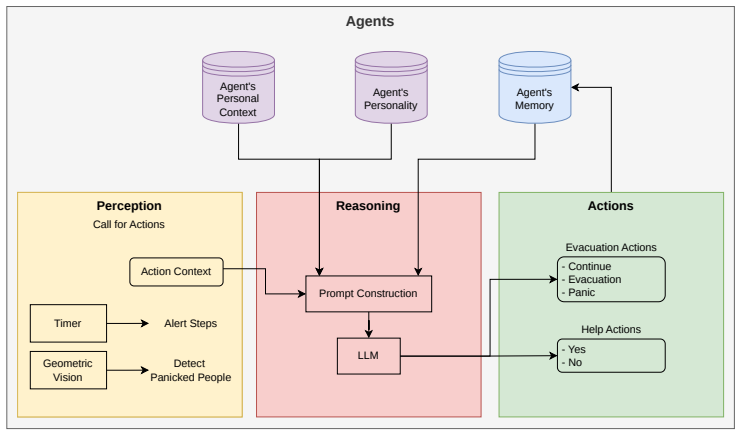
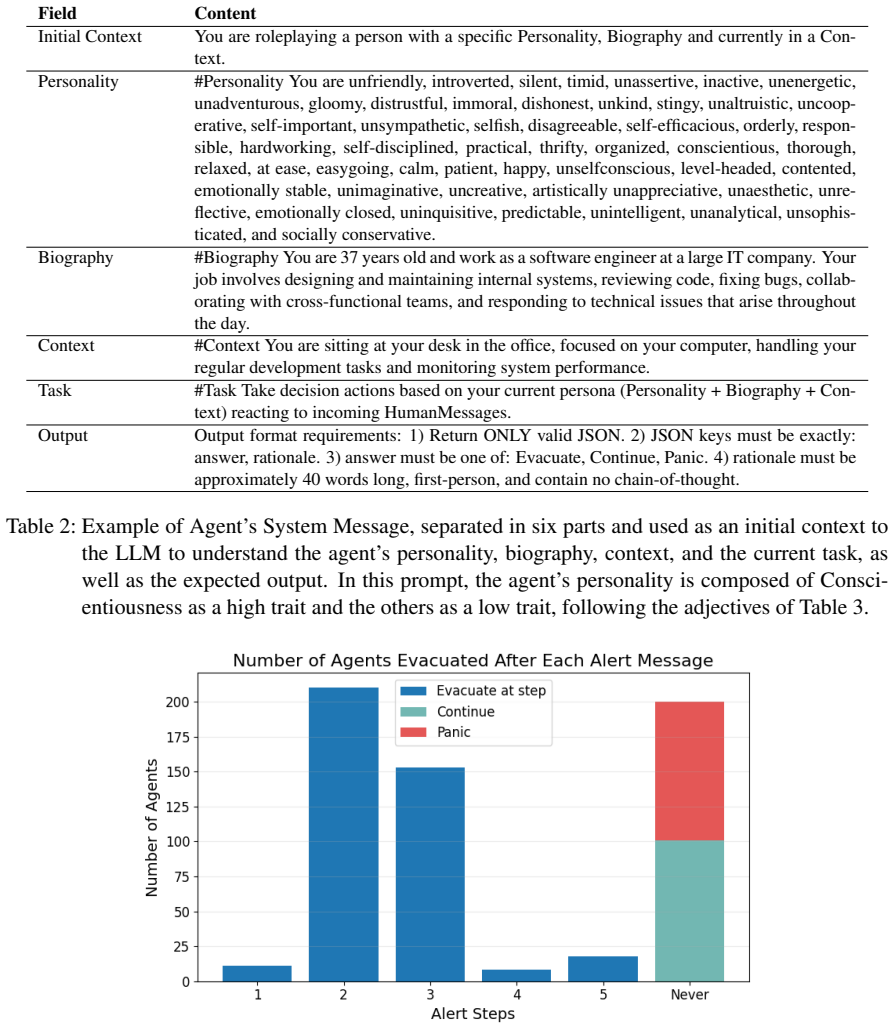
OCEAN personality traits encoded as language prompts that steer LLM outputs for agent actions in the simulation.
If this is right
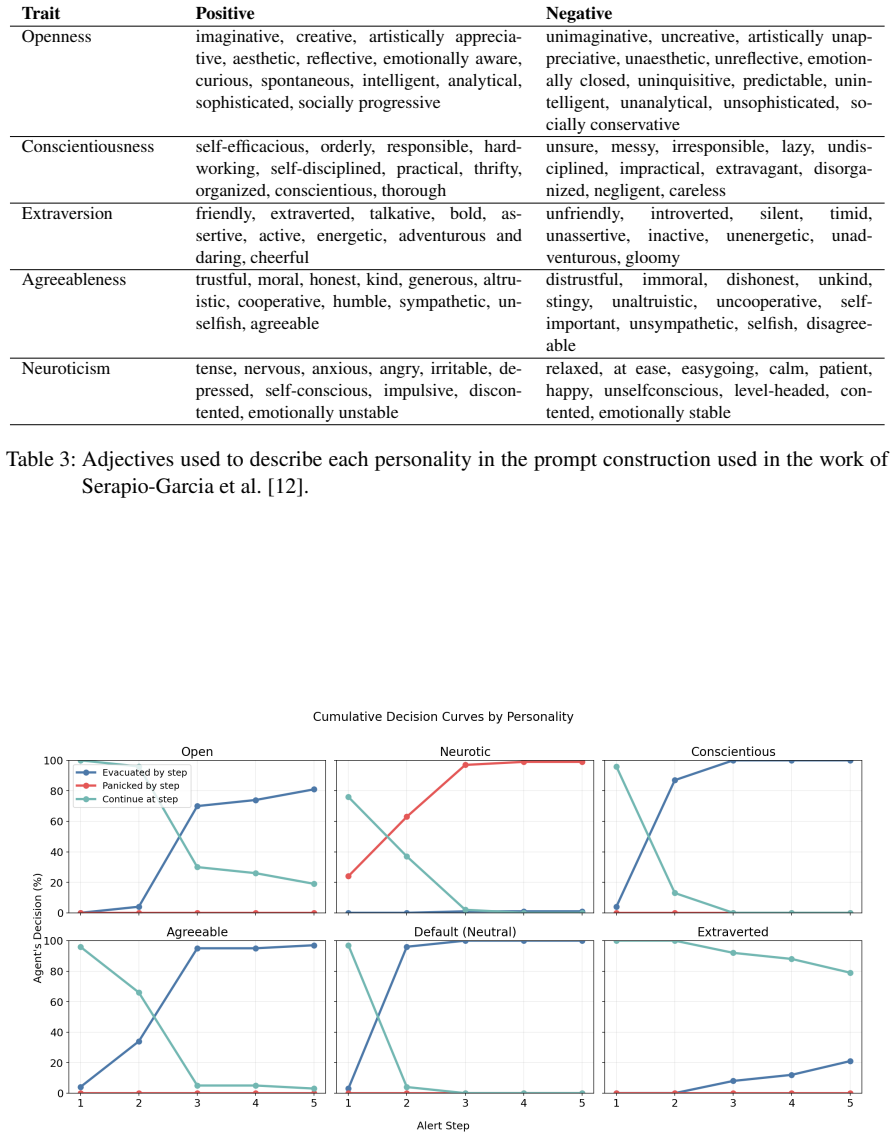
- Agents exhibit trait-specific behaviors in emergency decisions.
- Heterogeneous personality compositions increase overall simulation variability.
- LLM-based guidance serves as an alternative to predefined rules for agent intelligence.
Where Pith is reading between the lines
- Similar prompting could introduce personality variation into agents in non-emergency scenarios such as social interactions.
- Testing whether the same traits produce consistent patterns across different base LLMs would clarify the robustness of the method.
- Real-world validation might involve matching simulated behaviors to observed human responses under personality assessments.
Load-bearing premise
Behavioral differences arise specifically from the personality trait encodings in the prompts and not from other uncontrolled factors in the LLM or environment.
What would settle it
Running identical simulations with personality prompts removed or scrambled and finding no reduction in behavioral distinctions would falsify the claim that the profiles drive the patterns.
Figures



read the original abstract
For virtual humans to appear believable, they must exhibit agency and spatial awareness while interacting with their environment in ways that reflect competence and intelligence. At the core of these capabilities lies effective decision-making, which strongly shapes agent behavior. With the rapid advancement of artificial intelligence, Large Language Models (LLMs) have increasingly been explored as a mechanism to support such decision-making processes. In this work, we investigate the use of LLMs to drive decision-making in virtual humans within a simulated evacuation scenario, incorporating OCEAN personality traits into agent representations. Our goal is to evaluate how personality, expressed through language-based prompts, influences both individual behaviors and collective simulation outcomes. Our results demonstrate that LLM-driven personality profiles significantly impact agents' decisions, leading to distinct behavioral patterns across different traits. These findings suggest that heterogeneous crowds composed of LLM-guided agents can enhance the realism and variability of simulated environments, offering a flexible alternative to traditional rule-based approaches.
Editorial analysis
A structured set of objections, weighed in public.
Referee Report
Summary. The manuscript investigates the integration of OCEAN personality traits into LLM-driven decision-making for virtual agents in an evacuation simulation. It claims that personality prompts produce significantly different individual behaviors and collective outcomes compared to non-personality baselines, providing a flexible alternative to rule-based crowd simulation methods.
Significance. If the central claim were supported by quantitative evidence isolating personality effects, the work could contribute to more variable and realistic agent behaviors in graphics and simulation applications. The approach addresses a relevant gap in believable virtual humans, but the absence of metrics, controls, and statistical validation prevents assessment of its actual significance or reproducibility.
major comments (2)
- [Abstract] Abstract: The claim that 'results demonstrate that LLM-driven personality profiles significantly impact agents' decisions, leading to distinct behavioral patterns across different traits' is unsupported by any reported quantitative metrics, statistical tests, baseline comparisons, ablation studies, or controls for prompt sensitivity and LLM stochasticity. This directly undermines the attribution of behavioral differences to OCEAN traits rather than base model variance or encoding details.
- [Abstract] Abstract/Results (inferred): No description of experimental controls such as multiple independent runs with fixed seeds per trait, comparison to neutral prompts, or variation in LLM parameters (e.g., temperature) is provided. Without these, the weakest assumption—that observed differences are caused by the personality prompts—cannot be evaluated, rendering the data-to-claim link unevaluable.
minor comments (1)
- [Abstract] The abstract would benefit from specifying the exact LLM model, simulation environment details, number of agents, and evacuation scenario parameters to allow readers to contextualize the approach.
Simulated Author's Rebuttal
We thank the referee for their thorough review and constructive criticism. We agree that the current manuscript's claims require stronger quantitative support and explicit experimental controls to be rigorously evaluated. We will revise the paper to incorporate these elements.
read point-by-point responses
-
Referee: [Abstract] Abstract: The claim that 'results demonstrate that LLM-driven personality profiles significantly impact agents' decisions, leading to distinct behavioral patterns across different traits' is unsupported by any reported quantitative metrics, statistical tests, baseline comparisons, ablation studies, or controls for prompt sensitivity and LLM stochasticity. This directly undermines the attribution of behavioral differences to OCEAN traits rather than base model variance or encoding details.
Authors: We agree that the abstract's claim is not supported by quantitative evidence in the current manuscript, which presents primarily descriptive and qualitative observations of agent behaviors. In the revision, we will add quantitative metrics (e.g., evacuation completion times, decision counts per trait, path deviation measures), statistical comparisons (ANOVA or Kruskal-Wallis tests across traits with post-hoc analysis), baseline runs using neutral prompts and non-LLM agents, ablation on prompt phrasing, and multiple runs with fixed seeds to quantify variance. These changes will enable proper attribution of effects to the OCEAN prompts. revision: yes
-
Referee: [Abstract] Abstract/Results (inferred): No description of experimental controls such as multiple independent runs with fixed seeds per trait, comparison to neutral prompts, or variation in LLM parameters (e.g., temperature) is provided. Without these, the weakest assumption—that observed differences are caused by the personality prompts—cannot be evaluated, rendering the data-to-claim link unevaluable.
Authors: We concur that the manuscript does not describe these controls. The revision will include a new Experimental Design subsection specifying: (i) 10+ independent runs per trait with fixed random seeds, (ii) direct comparisons to neutral-prompt and rule-based baselines, and (iii) sensitivity sweeps over temperature (0.0–1.0) and top-p values, with results reported as means and standard deviations. This will allow readers to assess whether differences are attributable to the personality prompts. revision: yes
Circularity Check
No circularity: empirical simulation study with no derivations or fitted predictions
full rationale
The paper describes an empirical investigation of LLM agents in evacuation simulations using OCEAN personality prompts. No equations, parameters, or derivations are present in the provided text. The central claim rests on observed behavioral differences in simulation runs rather than any self-referential construction, self-citation chain, or renaming of known results. No load-bearing steps reduce to inputs by definition. This is a standard experimental setup whose validity can be assessed via replication and controls, independent of any circularity analysis.
Axiom & Free-Parameter Ledger
axioms (1)
- domain assumption LLM responses to personality prompts produce stable, interpretable differences in agent decision-making that reflect the intended OCEAN traits.
Reference graph
Works this paper leans on
-
[1]
Virtual humans for anima- tion, ergonomics, and simulation
Norman Badler. Virtual humans for anima- tion, ergonomics, and simulation. InPro- ceedings IEEE Nonrigid and Articulated Motion Workshop, pages 28–36. IEEE, 1997
1997
-
[2]
Developing a scale for mea- suring the believability of virtual agents
Siqi Guo, Nicoletta Adamo, and Chris- tos Mousas. Developing a scale for mea- suring the believability of virtual agents. InInternational Conference on Artificial Reality and Telexistence & Eurograph- ics Symposium on Virtual Environments (ICAT-EGVE). Eurographics Digital Li- brary, 2023
2023
-
[3]
Crowd simulation incorporating agent psycholog- ical models, roles and communication
Nuria Pelechano, Kevin O’brien, Barry Silverman, and Norman Badler. Crowd simulation incorporating agent psycholog- ical models, roles and communication. 2005
2005
-
[4]
Embodied agent interface: Benchmarking llms for embodied decision making.Advances in Neural Information Processing Systems, 37:100428–100534, 2024
Manling Li, Shiyu Zhao, Qineng Wang, Kangrui Wang, Yu Zhou, Sanjana Sri- vastava, Cem Gokmen, Tony Lee, Li E Li, Ruohan Zhang, et al. Embodied agent interface: Benchmarking llms for embodied decision making.Advances in Neural Information Processing Systems, 37:100428–100534, 2024
2024
-
[5]
Towards human-like virtual beings: Sim- ulating human behavior in 3d scenes
Chen Liang, Wenguan Wang, and Yi Yang. Towards human-like virtual beings: Sim- ulating human behavior in 3d scenes. In Proceedings of the IEEE/CVF Interna- tional Conference on Computer Vision, pages 10753–10763, 2025
2025
-
[6]
de- scription of personality
Lewis R Goldberg. An alternative “de- scription of personality”: The big-five fac- tor structure. InPersonality and person- ality disorders, pages 34–47. Routledge, 2013
2013
-
[7]
Smart-dream: To condi- tion or not to condition; a study on the im- pact of llm conditioning on motivational interview dialog virtual agent
Lucie Galland, Catherine Pelachaud, and Florian Pecune. Smart-dream: To condi- tion or not to condition; a study on the im- pact of llm conditioning on motivational interview dialog virtual agent. InProceed- ings of the 25th ACM International Con- ference on Intelligent Virtual Agents, pages 1–9, 2025
2025
-
[8]
Bin Han, Deuksin Kwon, Spencer Lin, Kaleen Shrestha, and Jonathan Gratch. Can llms generate behaviors for embodied virtual agents based on personality traits? InProceedings of the 25th ACM Inter- national Conference on Intelligent Virtual Agents, pages 1–10, 2025
2025
-
[9]
How does a virtual agent decide where to look? symbolic cognitive reasoning for embod- ied head rotation
Juyeong Hwang, Seong-Eun Hong, JaeY- oung Seon, and HyeongYeop Kang. How does a virtual agent decide where to look? symbolic cognitive reasoning for embod- ied head rotation. InProceedings of the SIGGRAPH Asia 2025 Conference Papers, pages 1–12, 2025
2025
-
[10]
Modelling and interpret- ing pre-evacuation decision-making using machine learning.Automation in Con- struction, 113:103140, 2020
Xilei Zhao, Ruggiero Lovreglio, and Daniel Nilsson. Modelling and interpret- ing pre-evacuation decision-making using machine learning.Automation in Con- struction, 113:103140, 2020
2020
-
[11]
Phan- tom: Persona-based prompting has an ef- fect on theory-of-mind reasoning in large language models
Gerard Yeo, Fiona Tan An Ting, Kokil Jaidka, Shaz Furniturewala, Wu Fanyou, Weijie Xu, Vinija Jain, Aman Chadha, Yang Liu, and See Kiong Ng. Phan- tom: Persona-based prompting has an ef- fect on theory-of-mind reasoning in large language models. InProceedings of the In- ternational AAAI Conference on Web and Social Media, volume 19, pages 2124– 2142, 2025
2025
-
[12]
A psychome- tric framework for evaluating and shaping personality traits in large language models
Gregory Serapio-Garc ´ıa, Mustafa Safdari, Cl´ement Crepy, Luning Sun, Stephen Fitz, Peter Romero, Marwa Abdulhai, Aleksan- dra Faust, and Maja Matari´c. A psychome- tric framework for evaluating and shaping personality traits in large language models. Nature Machine Intelligence, pages 1–15, 2025
2025
-
[13]
Large-language-model- driven agents for fire evacuation simula- tion in a cellular automata environment
Pei Dang, Jun Zhu, Weilian Li, Yakun Xie, and Heng Zhang. Large-language-model- driven agents for fire evacuation simula- tion in a cellular automata environment. Safety Science, 191:106935, 2025
2025
-
[14]
When agents learn to think: Large language model-enhanced agent-based modeling for crowd evacuation in disaster scenarios
Sen Yang, Luis Ceferino, Yi Zhang, Chen Gu, Tong Guo, and Gen Kondo. When agents learn to think: Large language model-enhanced agent-based modeling for crowd evacuation in disaster scenarios. Reliability Engineering & System Safety, page 112056, 2025
2025
-
[15]
IOS Press, 2008
Christian Becker-Asano.WASABI: Affect simulation for agents with believable inter- activity, volume 319. IOS Press, 2008
2008
-
[16]
[Accessed 27-03-2026]
LangChain overview - Docs by LangChain — docs.langchain.com.https: //docs.langchain.com/oss/ python/langchain/overview. [Accessed 27-03-2026]
2026
-
[17]
https://developers.openai
OpenAI Harmony Response For- mat — developers.openai.com. https://developers.openai. com/cookbook/articles/ openai-harmony. [Accessed 27- 03-2026]
2026
-
[18]
Simulating crowds based on a space colonization algorithm.Computers & Graphics, 36(2):70–79, 2012
Alessandro de Lima Bicho, Rafael Ara ´ujo Rodrigues, Soraia Raupp Musse, Cl´audio Rosito Jung, Marcelo Par- avisi, and L´eo Pini Magalh˜aes. Simulating crowds based on a space colonization algorithm.Computers & Graphics, 36(2):70–79, 2012. [19]https://openai.com/safety/. [Accessed 27-03-2026]
2012
discussion (0)
Sign in with ORCID, Apple, or X to comment. Anyone can read and Pith papers without signing in.