REVIEW 3 major objections 5 minor 1 cited by
An Efficient On-shell Framework for EFT Matching
T0 review · 3 major / 5 minor · reviewed 2026-08-06 · deepseek-v4-flash
Pith's one-line read This paper claims that a channel-based on-shell sewing framework with d-dimensional mass-shifted internal states reconstructs the full one-loop hard-region amplitude for EFT matching, including rational terms, so Wilson coefficients can…
desk verdict Useful methods paper with a real external benchmark; the unproven subtraction step in Eq. (A2) should be pinned down before the 'rigorous' claim is trusted. read the letter →
The pith
A machine-rendered reading of the paper's core claim, the machinery that carries it, and where it could break.
The reading
What carries the argument
The load-bearing object is the mass-shift d-dimensional sewing prescription: cut loop legs are treated as on-shell in $d=4-2\epsilon$ dimensions, which from the four-dimensional point of view means replacing $m^2$ by $m_*^2=m^2+\tilde\mu^2$ in the spinor kinematics of internal lines and keeping the extra-dimensional Clifford insertion inside closed Dirac traces. This preserves the $\epsilon$-dependent pieces of the kinematic coefficients that combine with $1/\epsilon$ poles to produce rational terms, and those rational terms are attached to the channel-support set of their parent scalar integral before the $\epsilon\to0$ limit. The rest of the machinery is the channel projection $P_{s_k}$ with overlap removal by ordered subtraction or symmetric weighting, the tadpole and kinematically-independent-bubble subtraction convention, and the hard-region expansion followed by projection onto on-shell amplitude bases.
What would settle it
Run the paper's mass-shift sewing pipeline on a one-loop matching problem whose Wilson coefficients are already known from direct Feynman-diagram matching, such as a four-fermion operator generated by a heavy scalar with photon exchange, and compare the extracted local amplitude order by order in $1/M$; any missing or doubled rational piece would appear as a mismatch in the $1/M^2$ or $1/M^4$ coefficients.
Extended reading notes
Core claim
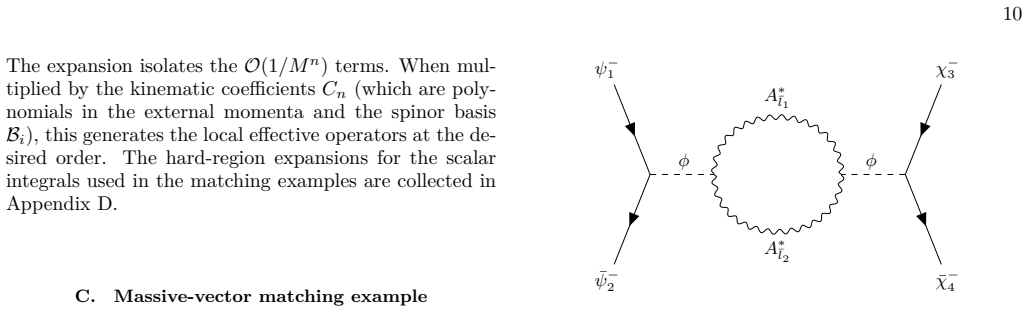
The central claim is that the mass-shift d-dimensional sewing prescription reconstructs the complete local hard-region amplitude at one loop, including rational terms, so that Wilson coefficients can be read off by projection without a separate rational-term reconstruction. In the paper's convention, cut loop legs are on-shell in $d$ dimensions, which means their four-dimensional spinor representatives carry the shifted mass $m_*^2=m^2+\tilde\mu^2$; the $O(\epsilon)$ terms this introduces into the kinematic coefficients multiply the $1/\epsilon$ poles of the scalar integrals and survive in the $\epsilon\to0$ limit as the rational remainder $R$. Those rational pieces are attached to the channel-support set of their parent scalar integrals before the limit, and overlaps between channels are removed by identifying identical masters by their ordered denominator mass pattern. Tadpoles and kinematically independent bubbles are fixed by the on-shell-like subtraction of Section II D. The workflow is validated by the four-photon amplitude in massless sQED, where the total rational term $R_{\rm sQED}=i[13]^2/(4\pi^2[24]^2)$ matches the known one-loop result, and by a massive-vector model whose dimension-six one-loop coefficient $c^{(1)}=2g^2g_1g_2/((4\pi)^2M^4)$ is generated entirely by the rational term.
Load-bearing premise
The method assumes that sewing double cuts with mass-shifted internal states, together with the channel projection and the tadpole/bubble subtraction, captures every one-loop contribution to the local hard-region amplitude, with no sector omitted and no sector double counted.
Editorial extensions
If this is right
- One-loop EFT matching can be done with double-cut sewing alone, eliminating the need for a separate rational-term reconstruction.
- The extra-dimensional loop-momentum component, encoded as the shifted internal mass, automatically reproduces the rational contributions to local Wilson coefficients that four-dimensional cuts would miss.
- Kinematically independent bubbles and tadpoles are fixed by an explicit subtraction convention, so changing that convention only shifts the coefficients by finite local counterterms or field and parameter redefinitions.
- The hard-region expansion can be applied after tensor reduction to scalar masters, so the projection onto on-shell EFT bases yields the Wilson coefficients directly.
- In the massive-vector example the one-loop dimension-six coefficient is entirely rational in origin, showing that strictly four-dimensional on-shell matching is not always sufficient.
Reading between the lines
- This suggests the same prescription should carry over to non-Abelian gauge and gravitational matching, where the extra-dimensional Clifford and polarization algebras are richer; the paper lists these as typical applications but does not demonstrate them.
- A direct stress test would be to apply the pipeline to a one-loop matching problem with several interacting heavy fields and compare the output with a standard Feynman-diagram matching calculation in the same subtraction scheme; a mismatch would localize any sector the cut sewing misses.
- The four-dimensional-limit subtraction of Eq. (A2), which separates spurious $\tilde\mu$ components from those that generate rational terms after integration, is asserted rather than proven; checking its uniqueness on higher-point tree inputs would clarify whether the mass-shift prescription is fully determined.
- For chiral theories with $\gamma_5$ or Levi-Civita tensors the paper notes that evanescent operators and finite scheme choices enter, so those cases would require an additional layer beyond the current framework.
Editorial analysis
A structured set of objections, weighed in public.
Referee Report
Summary. The paper proposes a channel-based on-shell framework for one-loop EFT matching. The central idea is to reconstruct the one-loop hard-region amplitude by sewing double cuts with d-dimensional unitarity, representing d-dimensional internal states through the mass shift m^2 -> m^2 + \tilde{\mu}^2 in four-dimensional spinor variables. The resulting integrand is reduced to a common scalar-integral basis, rational terms are assigned channel support from their parent d-dimensional scalar coefficients before the epsilon -> 0 limit, and KIB/tadpole contributions are fixed by an explicit on-shell-like subtraction convention. The local hard-region amplitude is then projected onto non-redundant on-shell EFT bases. The framework is demonstrated in three examples: the sQED four-photon amplitude, where the rational term reproduces the known result of Ref. [28]; a massive-vector toy model, where the rational term generates the one-loop Wilson coefficient c^(1) = 2 g^2 g1 g2 / ((4 pi)^2 M^4) (Eq. (66)); and a mixed massive-massless four-fermion matching calculation in Appendix B.
Significance. If the framework is correct, it provides a practical unification of on-shell matching: one-loop Wilson coefficients, including rational terms, can be obtained from double-cut sewing without a separate rational-term reconstruction, and the final projection lands on redundancy-free on-shell bases. The paper has genuine strengths: the sQED rational term is tested against a previously published amplitude by a different group, the KIB/tadpole subtraction is presented as an explicit scheme choice with the finite field-redefinition ambiguity identified, and the algorithmic structure (Appendices A-D) is concrete enough to be implemented with standard tensor-reduction tools. The manuscript is also appropriately cautious in Sec. II.C and Appendix E about when rational terms actually affect matching coefficients. However, the central constructive step for rational terms, the four-dimensional-limit subtraction of Eq. (A2), is asserted rather than proven, and the one example in which a rational term drives a Wilson coefficient (massive-vector model) is not independently cross-checked.
major comments (3)
- [Appendix A.2, Eq. (A2)] The construction of A_n^d from A_n^d,pre depends entirely on the assertion that subtracting [lim_{tilde-mu -> 0} A_n^d,pre - A_n^(4)] removes only spurious components while retaining the tilde-mu-dependent terms that generate rational terms after loop integration. This statement is not derived, and the question of branch/convention choices for the massless shifted legs (m_* = sqrt(tilde-mu^2)) is not addressed. Both the sQED rational benchmark (Eq. (29)) and the massive-vector Wilson coefficient (Eq. (66)) are produced from tree inputs built by this prescription; the sQED benchmark tests one helicity configuration, and the massive-vector coefficient is not otherwise checked. I ask the authors either to provide a derivation or a rigorous argument for Eq. (A2), or to supply an independent Feynman-diagram computation of the massive-vector model and a second benchmark with a different tree-input structure.
- [Sec. II.C, Eqs. (14)-(16), (25)-(29)] The claim that rational pieces inherit the channel support of their parent d-dimensional scalar coefficients is a prescription, not a demonstrated property of one-loop amplitudes. In the case where a collected rational remainder receives contributions from several masters, the paper instructs that the parent-attached pieces be kept until after the channel sets are assigned, but it does not prove that the final channel decomposition R_s, R_t, R_u is independent of the routing convention, the tensor-reduction choices, or the symmetric weighting of Eq. (14). Since the total rational term of Eq. (29) is obtained from this weighted sum, a proof of consistency (or at least a nontrivial consistency test) is needed to certify that the rational assignment is not an artifact of the projection convention.
- [Appendix C and Eqs. (21)-(22), (62)] The master integrals in Appendix C are defined with denominators D^0_q = q^2 and D^M_q = q^2 - M^2, while the mass-shift prescription in Appendix A.2.2 instructs that loop-momentum propagators be represented as (l+p)^2 - m^2 - \tilde{\mu}^2. If q in Appendix C denotes the d-dimensional loop momentum, the notation is consistent but should be stated explicitly at the point where the body text uses l for the four-dimensional projection. If q denotes the four-dimensional projection, the tilde-mu^2 terms in the denominators have been dropped, which would affect the rational terms. Please clarify this convention where the sewn expressions are first reduced, e.g., after Eq. (22) and in the derivation of Eq. (62).
minor comments (5)
- [Title and abstract] The word “efficient” is consistently misspelled as “efficient” in the title, abstract, and running text; please correct this typographical issue.
- [Eq. (3)] The integration measure is written as d^4 l1, which can be misread as a strict four-dimensional phase-space cut; the surrounding text explains that this is before the extra-dimensional information is restored, but adding a short parenthetical after Eq. (3) would remove the ambiguity.
- [Eq. (22)] The normalization convention under which \epsilon I_2(s_i) -> 1 as \epsilon -> 0 is only introduced in Appendix C; a forward reference to Appendix C at first use in Eq. (22) would substantially improve readability.
- [Sec. II.D, Eq. (38)] The extension of the KIB subtraction from the two-point function to the three-point vertex is stated very tersely; one additional sentence explaining how the same I_2(0,M^2) subtraction is applied to each external-leg bubble in Eq. (37) would help the reader.
- [Appendix E] The argument that a rank-two triangle numerator forbids a mass factor M in the rational term (leading to Eq. (E1)) is heuristic; it would benefit from a footnote that this is a power-counting/rationality statement rather than a no-go theorem.
Circularity Check
No significant circularity found: rational terms are computed from d-dimensional cut kinematics and benchmarked against an independent published amplitude; the subtraction scheme is an explicit convention.
full rationale
The derivation chain is not circular. The mass-shift rule m^2_* = m^2 + mu~^2 is derived from the d-dimensional on-shell condition (Eq. 19) and then used to build the tree inputs; rational terms are obtained by carrying the mu~-dependent pieces through tensor reduction, not by matching a target coefficient. The sQED four-photon rational term (Eq. 29) is checked against Ref. [28], a published amplitude by a different author set, so it is an external benchmark. In the massive-vector model, c^(1) in Eq. (66) follows from the d-2 numerator contraction and the stated scalar-integral normalization; it is not fitted to a predetermined value. The KIB/tadpole treatment (Sec. II D, Eqs. 30-39) is explicitly a scheme choice, and the paper correctly states that changing it redefines finite local parameters. The closest thing to a missing proof is Appendix A.2, Eq. (A2), where the statement that the subtraction 'removes only the part that incorrectly survives' is asserted rather than demonstrated; this is a completeness or correctness caveat, not a circularity, because Eq. (A2) imposes a four-dimensional-limit boundary condition and does not import the target Wilson coefficient or rational remainder. Self-citations to on-shell amplitude bases ([5], [8], [36]) are not load-bearing: the bases are additionally supported by external references and serve as inputs to the projection step, not as consequences of the sewing calculation.
Assumptions & free parameters
assumptions (6)
- domain assumption BMHV dimensional-regularization conventions: loop momentum splits as lbar = l + mu_tilde with l dot mu_tilde = 0 and lbar^2 = l^2 - mu_tilde^2; the d-dimensional on-shell condition is represented in 4D spinor variables by the shifted mass m*^2 = m^2 + mu_tilde^2 (Eqs. 18-20).
- standard math S-matrix unitarity sewing: the discontinuity of a one-loop amplitude across a channel is the phase-space integral of two sewn on-shell tree amplitudes (Eq. 3), and replacing the on-shell delta functions by Feynman propagators with principal-value removal (Eqs. 4, 16) reconstructs the full amplitude.
- domain assumption Method of regions: expanding the reduced one-loop integrand around loop momentum of order M (the hard region, Eqs. 45-47) and matching, with the soft-region contribution reproducing the EFT loop amplitude, isolates the local Wilson coefficient (Eqs. 43, 48).
- domain assumption Existence and completeness of non-redundant on-shell EFT amplitude bases built by quotienting equations-of-motion and integration-by-parts redundancies (refs [4-10]), used for the final projection in Eq. (41).
- ad hoc to paper Four-dimensional-limit subtraction of Eq. (A2): A_n^d = A_n^d,pre - (lim_{mu_tilde->0} A_n^d,pre - A_n^(4)) removes spurious components while retaining mu_tilde-dependent terms that vanish at tree level but generate rational terms after loop integration.
- domain assumption Absence of chiral/evanescent subtleties: the framework applies as stated only where 4D external state algebra can be combined with BMHV internal states without gamma5 or Levi-Civita tensor choices.
Cite this review
Pith. "Pith review of An Efficient On-shell Framework for EFT Matching." pith.science (2026). https://pith.science/paper/6EWLD7BL
@misc{pith2026250717829,
  author       = {Pith},
  title        = {Pith review of: An Efficient On-shell Framework for EFT Matching},
  year         = {2026},
  howpublished = {\url{https://pith.science/paper/6EWLD7BL}},
  note         = {Machine review of arXiv:2507.17829}
}
read the original abstract
Standard techniques for one-loop EFT matching often have gauge and basis redundancies, while strictly 4-dimensional on-shell methods fail to capture rational terms. To resolve this, we develop an efficient, channel-based on-shell framework for one-loop matching. Our method reconstructs the local hard-region amplitude by sewing tree amplitudes across double cuts, employing a mass-shift prescription to recover d-dimensional internal states. This d-dimensional sewing retains rational terms and integrates them seamlessly with ordinary cut-constructible contributions. The local amplitude is expanded in the hard region and directly projected onto non-redundant, on-shell EFT amplitude bases. With tadpoles and kinematically independent bubbles systematically fixed by an explicit subtraction convention, our framework successfully merges the rigorous extraction of rational Wilson coefficients with the gauge-invariant elegance of modern amplitude methods.
Figures

Forward citations
Cited by 1 Pith paper
-
The Spurion Massive EFT (SMEFT)
SMEFT contact terms are decomposed into spurion structures whose coefficients come from higher-order Higgs singlet combinations, with W/Z masses, mixing, and fermion couplings fully saturated by dimension-eight operators.
Reference graph
Works this paper leans on
- [28]
-
[1]
Consider a generic d-dimensional one- loop amplitude parameterized as A(1,d) = P nC (d) n I (d) n
The origin of rational terms and the mass-shift prescription Rational terms originate from the interplay between ultraviolet (1/ϵ) divergences and O(ϵ) terms generated byd-dimensional tensor contractions in dimensional reg- ularization [ 26]. Consider a generic d-dimensional one- loop amplitude parameterized as A(1,d) = P nC (d) n I (d) n . The scalar int...
-
[2]
The relevant Lagrangian is LsQED = 1 4F µνFµν + (Dµϕ)†Dµϕ
sQED rational term We return to the four-photon scattering example in massless sQED. The relevant Lagrangian is LsQED = 1 4F µνFµν + (Dµϕ)†Dµϕ. In the previous subsection, we found that purely 4-dimensional sewing failed to cap- ture thet- andu-channel contributions because the corre- sponding tree-level amplitudes vanished. We now apply our d-dimensional...
-
[3]
(23) After the channel weights are assigned in the merging prescription, the rational contribution can be written compactly as P weighted t h A(1) t cuts i = 4i 3(4π)2 [13]2 [24]2. (24) For the channel sum, the rational terms are kept attached to the scalar-basis terms from which they originate, as in the weighted prescription of Eq. ( 14). We define Rx b...
-
[4]
!C2(p2) I2(p2;m2 1,m 2 2) I2(p2 0;m2 1,m 2 2) , (39) wherep2 0 is the on-shell value, or zero-invariant threshold value, appropriate to the corresponding external chan- nel. For the massless external legs used below this is p2 0 = 0, giving the subtraction I2(0;M 2,M 2) used in Ap- pendix D. Tadpoles and on-shell bubble limits are set to zero by local cou...
- [5]
- [6]
- [7]
Show all 59 references
- [8]
-
[9]
T. Ma, J. Shu, and M.-L. Xiao, Chin. Phys. C 47, 023105 (2023), arXiv:1902.06752 [hep-ph]
2023 arXiv
-
[10]
Henning and T
B. Henning and T. Melia, Physical Review D 100, 016015 (2019), arXiv:1902.06754
2019 arXiv
-
[11]
Durieux, T
G. Durieux, T. Kitahara, C. S. Machado, Y. Shadmi, and Y. Weiss, JHEP 12 (MITP/20-046, MITP/20-046), 175, arXiv:2008.09652 [hep-ph]
2008 arXiv
-
[12]
Z.-Y. Dong, T. Ma, J. Shu, and Y.-H. Zheng, Phys. Rev. D 106, 116010 (2022) , arXiv:2202.08350
2022 arXiv
-
[13]
H.-L. Li, Z. Ren, J. Shu, M.-L. Xiao, J.-H. Yu, and Y.-H. Zheng, Physical Review D 104, 015026 (2021) , arXiv:2005.00008
2021 arXiv
-
[14]
H. Liu, T. Ma, Y. Shadmi, and M. Waterbury, JHEP 05, 241, arXiv:2301.11349 [hep-ph]
-
[15]
Britto, F
R. Britto, F. Cachazo, and B. Feng, Nucl. Phys. B 725, 275 (2005) , arXiv:hep-th/0412103
2005 arXiv
-
[16]
W. T. Giele, Z. Kunszt, and K. Melnikov, JHEP 04, 049, arXiv:0801.2237 [hep-ph]
-
[17]
S. D. Badger, JHEP 01, 049 , arXiv:0806.4600 [hep-ph]
-
[18]
R. K. Ellis, W. T. Giele, and Z. Kunszt, JHEP 03, 003 , arXiv:0708.2398 [hep-ph]
-
[19]
Z. Bern, D. Kosmopoulos, and A. Zhiboedov, J. Phys. A 54, 344002 (2021) , arXiv:2103.12728 [hep-th]
2021 arXiv
-
[20]
Delle Rose, B
L. Delle Rose, B. von Harling, and A. Pomarol, JHEP 05, 120 , arXiv:2201.10572 [hep-ph]
-
[21]
De Angelis and G
S. De Angelis and G. Durieux, SciPost Phys. 16, 071 (2024), arXiv:2308.00035 [hep-ph]
2024 arXiv
-
[22]
Gerard ’t Hooft and M. J. G. Veltman, Nucl. Phys. B 153, 365 (1979)
1979
-
[23]
K. G. Chetyrkin and F. V. Tkachov, Nucl. Phys. B 192, 159 (1981)
1981
-
[24]
Z. Bern, L. J. Dixon, and D. A. Kosower, Phys. Lett. B 302, 299 (1993) , [Erratum: Phys.Lett.B 318, 649 (1993)], arXiv:hep-ph/9212308
1993 arXiv
-
[25]
Denner and S
A. Denner and S. Dittmaier, Nucl. Phys. B 658, 175 (2003), arXiv:hep-ph/0212259
2003 arXiv
-
[26]
Ochirov, arXiv e-prints (2018) , arXiv:1802.06730 [hep-ph]
A. Ochirov, arXiv e-prints (2018) , arXiv:1802.06730 [hep-ph]
2018 arXiv
-
[27]
Z. Bern, L. J. Dixon, and D. A. Kosower, JHEP 2004 (08), 012, arXiv:hep-ph/0404293
2004 arXiv
-
[29]
Shtabovenko, R
V. Shtabovenko, R. Mertig, and F. Orellana, Comput. Phys. Commun. 207, 432 (2016)
2016
-
[30]
Bern and D
Z. Bern and D. A. Kosower, Nucl. Phys. B 379, 451 (1992)
1992
-
[31]
Bern and A
Z. Bern and A. G. Morgan, Nucl. Phys. B 467, 479 (1996)
1996
-
[32]
Anastasiou, R
C. Anastasiou, R. Britto, B. Feng, Z. Kunszt, and P. Mastrolia, Phys. Lett. B 645, 213 (2007) , arXiv:hep- ph/0609191
2007
-
[33]
Arkani-Hamed, T.-C
N. Arkani-Hamed, T.-C. Huang, and Y.-t. Huang, JHEP 2021 (11), 1, arXiv:1709.04891
2021 arXiv
-
[34]
Skiba, TASI Lectures on Effective Field The- ory and Precision Electroweak Measurements (2010), arXiv:1006.2142 [hep-ph]
W. Skiba, TASI Lectures on Effective Field The- ory and Precision Electroweak Measurements (2010), arXiv:1006.2142 [hep-ph]
2010 arXiv
-
[35]
Chala, J
M. Chala, J. L. Miras, J. Santiago, and F. Vilches, Effi- cient on-shell matching (2024), arXiv:2411.12798
2024 arXiv
-
[36]
V. A. Smirnov, Springer Tracts Mod. Phys. 177, 1 (2002)
2002
-
[37]
Beneke and V
M. Beneke and V. A. Smirnov, Nucl. Phys. B 522, 321 (1998)
1998
-
[38]
Jantzen, JHEP 12 (12), 076, arXiv:1111.2589 [hep- ph]
B. Jantzen, JHEP 12 (12), 076, arXiv:1111.2589 [hep- ph]
-
[39]
Durieux, T
G. Durieux, T. Kitahara, Y. Shadmi, and Y. Weiss, JHEP 2020 (1), 119, arXiv:1909.10551 [hep-ph, physics:hep-th]
2020 arXiv
-
[40]
Z.-Y. Dong, T. Ma, and J. Shu, arXiv:2103.15837 [hep- ph, physics:hep-th] (2021), arXiv:2103.15837 [hep-ph, physics:hep-th]
2021 arXiv
-
[41]
S. A. R. Ellis, J. Quevillon, T. You, and Z. Zhang, Physics Letters B 762, 166 (2016) , arXiv:1604.02445 [hep-ph]
2016 arXiv
-
[42]
Gnendiger, A
C. Gnendiger, A. Signer, D. Stockinger, A. Broggio, A. L. Cherchiglia, F. Driencourt-Mangin, A. R. Fazio, B. Hiller, P. Mastrolia, T. Peraro, R. Pittau, G. M. Pruna, G. Rodrigo, M. Sampaio, G. F. R. Sborlini, W. J. Torres Bobadilla, F. Tramontano, Y. Ulrich, and A. Vis- conti,...
2017 arXiv
-
[43]
Fuentes-Martin, M
J. Fuentes-Martin, M. Konig, J. Pages, A. E. Thom- sen, and F. Wilsch, JHEP 02 (02), 031, arXiv:2211.09144 [hep-ph]
-
[44]
Chen, Y.-t
W.-M. Chen, Y.-t. Huang, and D. A. McGady, Anomalies without an action (2014), arXiv:1402.7062 [hep-th] . 14 Appendix A: The Practical Guide for Recovering D-Dimensional Contribution in T ree-Level Amplitudes In dimensional regularization, a d-dimensional loop momentum ¯l is n...
2014 arXiv
-
[45]
Diagrammatic construction In this subsection, we outline a systematic diagrammatic procedure that recovers the ˜µ contribution of tree-level amplitudes within dimensional regularization:
-
[46]
For the process under consideration, enumerate all tree-level n-point diagrams and use Feynman rules to obtain these amplitudes
Draw the relevant F eynman graphs. For the process under consideration, enumerate all tree-level n-point diagrams and use Feynman rules to obtain these amplitudes
-
[47]
Promote the loop momentum to higher dimension according to the replacement li 7! ¯li, leaving all external wave-functions unmodified
Promote to d dimensions. Promote the loop momentum to higher dimension according to the replacement li 7! ¯li, leaving all external wave-functions unmodified. This yields a partially d-dimensional amplitude in which ˜µ2 enters only through the scalar products of the momentum ¯li
-
[48]
Enforce the on-shell condition ¯l2 i = m2 i and apply the EoMs to the loop spinors, as is collected in Eq
Impose the on-shell conditions. Enforce the on-shell condition ¯l2 i = m2 i and apply the EoMs to the loop spinors, as is collected in Eq. 20. After these simplifications, the tree-level amplitude takes the schematic form A(d) n fλi, ˜λig;λl, ˜λl; ˜µ , where λl, ˜λl encode the...
-
[49]
This on-shell construction is equivalent to the former diagrammatic method
Purely on-shell construction In this subsection, we outline a purely on-shell construction method to restore the ˜µ2 dependence. This on-shell construction is equivalent to the former diagrammatic method
-
[50]
Construct the relevant three-point amplitudes. If states in the 3-point amplitudes involve d-dimensional loop momenta when sewing them to construct the higher-point tree amplitudes, their mass should be shifted via m2 7! m2 + ˜µ2. In particular, massless states involving loop ...
-
[51]
Sew 3-point amplitudes to n-point amplitudes. After sewing the lower-point amplitudes into higher- point amplitudes, the loop momentum factor jlI ]hlI j or jlI i[lI j should be replaced by higher dimensional loop momentum P±/¯l . The denominators of the propagators involving t...
-
[52]
Apply the spinor EoM relations in Eq
Eliminate /¯l . Apply the spinor EoM relations in Eq. 20 and split the higher dimensional momentum ¯l =l +⃗˜µ to express the tree-level amplitudes in terms of l and ˜µ2. The resulting amplitudes are denoted as A(d) n,pre
-
[53]
Spurious components may appear in A(d) n,pre, because the shifted mass- less internal legs are represented by auxiliary massive spinors
Restore the four-dimensional limit. Spurious components may appear in A(d) n,pre, because the shifted mass- less internal legs are represented by auxiliary massive spinors. These components are removed by imposing the four-dimensional limit below. The correct amplitude A(d) n ...
-
[54]
The former preserves a tight con- nection to conventional Feynman rules, whereas the latter integrates naturally with modern generalized-unitarity frameworks
Summary The diagrammatic and on-shell constructions presented above are equivalent. The former preserves a tight con- nection to conventional Feynman rules, whereas the latter integrates naturally with modern generalized-unitarity frameworks. In practice, the on-shell method t...
-
[55]
II C, we shift only mass factors generated by the projected loop kinematics, such as l2 = m2 + ˜µ2, m2 ∗, or an equivalent cut-state relation
Numerator mass-shift check Following Sec. II C, we shift only mass factors generated by the projected loop kinematics, such as l2 = m2 + ˜µ2, m2 ∗, or an equivalent cut-state relation. Lagrangian masses, couplings, counterterms, and Wilson coefficients remain the input paramete...
-
[56]
= ig2 h231] 1 t ˜µ2 1 u ˜µ2 , (B5) ATree(ψ+ 1, ¯ψ− 2,γ ∗ 3,+,ϕ ∗
-
[57]
= p 2ieg ˜µ [13]2 h12i t ˜µ2 1 t ˜µ2 1 u ˜µ2 , (B6) ATree(ψ+ 1, ¯ψ− 2,γ ∗ 3,−,ϕ ∗
-
[58]
(B7) With these tree amplitudes in hand, we reconstruct the one-loop amplitude by sewing the relevant two-particle cuts
= p 2ieg ˜µ h23i2 [12] u ˜µ2 1 t ˜µ2 1 u ˜µ2 . (B7) With these tree amplitudes in hand, we reconstruct the one-loop amplitude by sewing the relevant two-particle cuts. With the chosen external ordering and helicity assignment, the u-channel result follows from the s-channel re...
-
[59]
Appendix C: Scalar-Integral Conventions We collect the scalar master integrals used in the four-fermion matching calculation of Appendix B
h24i , (B13) Choosing µ =M minimizes the logarithm. Appendix C: Scalar-Integral Conventions We collect the scalar master integrals used in the four-fermion matching calculation of Appendix B. We adopt the following convention: the mass labels in each scalar integral are ordere...
Reviewed August 6, 2026 · model on record in the stance chip above.
Discussion (0). Sign in to comment.