REVIEW 2 major objections 5 minor 49 references
h-Flow: Flexible Flow-based Image Editing via Doob's h-Transform
T0 review · 2 major / 5 minor · reviewed 2026-07-14 · grok-4.5
Pith's one-line read Image editing with rectified flows can be cast as Doob-conditioned generation on two terminal events, yielding closed-form reconstruction guidance and an orthogonally decoupled editing velocity.
desk verdict Solid, usable extension of Doob h-transform to rectified flows with a clean orthogonal trade-off; the independence assumption is real but does not sink the practical result. read the letter →
The pith
A machine-rendered reading of the paper's core claim, the machinery that carries it, and where it could break.
The reading
What carries the argument
The RF bridge ODE dxt/dt = v_θ − (t/(1−t)) ∇ log h, with product-of-experts h = h_rec · h_edit, followed by orthogonal projection of the editing direction onto the complement of the reconstruction velocity.
What would settle it
On a suite of edits where source structure and target semantics are known to be statistically dependent, measure whether structural metrics remain invariant while the editing coefficient is swept after orthogonal projection; if those metrics degrade in lockstep with the editing coefficient, the claimed decoupling fails.
Extended reading notes
Core claim
h-Flow shows that deterministic rectified-flow editing can be rewritten as a reverse-time Doob bridge whose harmonic function factorizes into source and target factors; after an equivalent SDE is introduced, the bridge ODE admits closed-form reconstruction guidance and a velocity-difference editing signal that an orthogonal decomposition fully separates, giving independent control of the two objectives without retraining.
Load-bearing premise
The source-image constraint and the target-prompt constraint are treated as independent given the current latent, so their guidance forces simply add; if the two goals are strongly coupled the additive split no longer separates them.
Editorial analysis
A structured set of objections, weighed in public.
Referee Report
Summary. The paper proposes h-Flow, a training-free framework for text-based image editing with pre-trained rectified-flow (RF) models. Editing is cast as conditional generation under two terminal events (source consistency and target alignment) via Doob’s h-transform. Because classical h-transforms require a non-degenerate diffusion coefficient, the authors construct an equivalent Itô SDE that shares the RF marginals (g_eq = sqrt(2t/(1-t))), obtain the bridge PF-ODE (Eq. 11), and design product-of-experts harmonic functions h = h_rec · h_edit. Closed-form reconstruction guidance (Eq. 13–15) and a velocity-difference editing direction Δ_edit (Eq. 16) follow from Tweedie identities; an orthogonal projection (Eq. 17) then decouples the two controls, yielding the final editing ODE (Eq. 19). The method is forward-agnostic and is evaluated on PIE-Bench and PIE-Bench++ against inversion-based and inversion-free baselines, with ablations on λ_rec, λ_edit, projection, and multi-target decomposition.
Significance. If the claims hold, h-Flow supplies a clean theoretical bridge from classical Doob conditioning to deterministic RF editing, together with a practical, plug-and-play algorithm that improves the fidelity–editability trade-off without architecture-specific heuristics or retraining. Strengths include the Fokker–Planck argument for marginal equivalence (Supp. B), explicit Tweedie derivations of both guidance terms (Supp. C), a geometric decoupling proof (Supp. E), and consistent rank-1/2 results on public benchmarks with official baseline code. The free parameters are transparent user knobs rather than fitted quantities, and the forward-agnostic design is a genuine practical contribution for the growing RF editing literature.
major comments (2)
- Sec. 4.1, Eq. (12): the product-of-experts factorization h = h_rec · h_edit treats the terminal events {x0 = x_src} and {prompt = c_edit} as conditionally independent given xt. In ordinary editing these events are strongly dependent (c_edit shares most content with the source), so ∇log h is not the exact Doob correction for the joint terminal law; the missing cross-terms are never recovered by the subsequent orthogonal projection (Eq. 17). The paper should either (i) quantify the approximation error under realistic prompt overlap or (ii) rephrase the theoretical claim from “exact joint conditioning” to “principled additive approximation,” and discuss when the independence assumption is most/least harmful.
- Sec. 4.2 / Supp. C.2: the editing direction Δ_edit is obtained by replacing the unconditional score with the source-conditioned score, yielding a relative CFG-style difference. While the cancellation of time factors is neat, the manuscript never measures how well this relative score approximates the true ∇log p(c_edit | xt) under the RF kernel, nor how the approximation degrades for multi-attribute or long prompts (the very setting that later motivates the decompose-then-project extension in Supp. F). A short diagnostic (e.g., correlation of Δ_edit with finite-difference score estimates, or ablation of the source-baseline choice) would make the central editing signal more credible.
minor comments (5)
- Algorithm 1 and Sec. 5.1: the default forward process is RF-Inversion with n=24 while the backward uses N=28 Euler steps; the partial-inversion schedule and the handling of the t→0 singularity for v_rec are only fully clarified in Supp. E.3. A short paragraph in the main text would improve reproducibility.
- Table 1: UniEdit-Flow obtains the best source-consistency numbers yet ranks lower overall; a brief discussion of why high PSNR/SSIM does not translate into better HPS/AS (or into the average rank) would help readers interpret the trade-off.
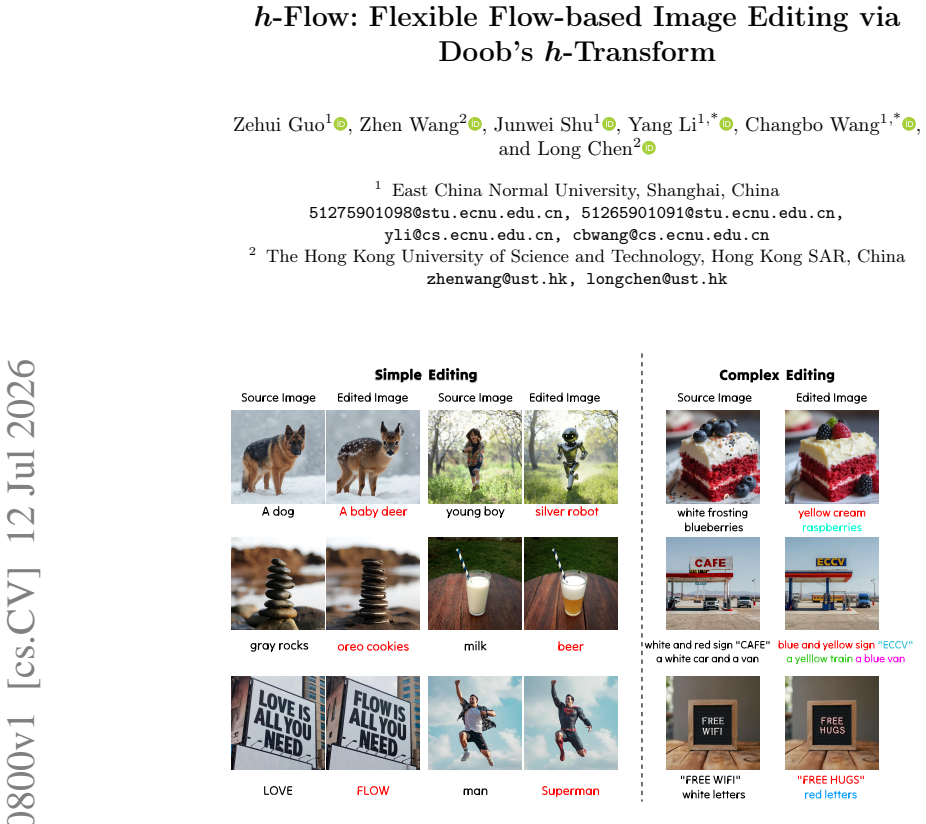
- Fig. 1 and Fig. 3 captions contain several OCR/typo artifacts (“S our c e Imag”, “y elllo w”, “mil bee”); these should be cleaned for the camera-ready version.
- Related work (Sec. 2) correctly positions h-Edit, but a one-sentence contrast with concurrent RF editing methods that also claim theoretical grounding (e.g., DNAEdit, SplitFlow) would sharpen the novelty claim.
- Supp. I failure cases are valuable; moving a short summary of the six modes into the main conclusion would give a more balanced picture of the method’s limits.
Circularity Check
No circularity: derivations follow classical Doob h-transform plus RF identities; free parameters are user knobs, not fitted predictions; evaluations use external public benchmarks.
full rationale
The paper's central construction (equivalent SDE sharing RF marginals, product-of-experts h = h_rec · h_edit, closed-form reconstruction velocity v_rec from the Gaussian kernel and Tweedie, editing direction Δ_edit ≈ v_edit_θ − v_src_θ, and orthogonal projection of Δ_edit) is obtained by direct application of classical Doob theory and standard score–velocity identities already present in the RF literature. No parameter is fitted to a data subset and then re-presented as a prediction; λ_rec and λ_edit are explicit user-chosen trade-off coefficients whose effects are ablated. Empirical superiority is measured on the public PIE-Bench / PIE-Bench++ suites against official baseline code, so the claimed ranking does not reduce by construction to the method's own inputs. Self-citations are absent from the load-bearing steps; the sole related prior (h-Edit) is an external diffusion work that the authors explicitly extend rather than invoke as a uniqueness theorem. The conditional-independence assumption underlying the product factorization is a modeling approximation that may affect correctness, but it is not a circular reduction of a claimed derivation to its own premises.
Assumptions & free parameters
free parameters (3)
- λ_rec =
1.2
- λ_edit =
1.5
- N (Euler steps) =
28
assumptions (3)
- domain assumption There exists an Itô SDE with diffusion coefficient √(2t/(1-t)) whose probability-flow ODE recovers the pre-trained RF velocity field and therefore shares identical marginals {p_t}.
- ad hoc to paper The two terminal events {x_0 = x_src} and {prompt = c_edit} are conditionally independent given the intermediate state x_t, so the joint harmonic function factorizes.
- domain assumption Tweedie posterior means approximated by the learned velocity network are sufficiently accurate for both source- and target-conditioned scores.
Cite this review
Pith. "Pith review of h-Flow: Flexible Flow-based Image Editing via Doob's h-Transform." pith.science (2026). https://pith.science/paper/6EZUZRTR
@misc{pith2026260710800,
  author       = {Pith},
  title        = {Pith review of: h-Flow: Flexible Flow-based Image Editing via Doob's h-Transform},
  year         = {2026},
  howpublished = {\url{https://pith.science/paper/6EZUZRTR}},
  note         = {Machine review of arXiv:2607.10800}
}
abstract
Editing images with pre-trained text-to-image flow models typically requires carefully balancing target alignment with the desired prompt and source consistency with the original image. Existing approaches either rely on inversion-based pipelines or heuristic source-to-target trajectory constructions, which often depend on architecture-specific designs or are sensitive to hyperparameters. In this paper, we propose h-Flow, a training-free and theoretically grounded flow-based editing framework. Inspired by Doob's $h$-Transform, we reformulate image editing as conditional generation under multiple terminal events corresponding to source consistency and target alignment. We first extend the classical $h$-Transform from SDE-based models to the deterministic RF framework by constructing an equivalent SDE with identical marginals. Within this formulation, we design dedicated $h$-functions for source consistency and target alignment, yielding closed-form reconstruction guidance and velocity-based semantic editing signals. We further introduce a velocity orthogonal decomposition to decouple reconstruction and editing directions, enabling a controllable trade-off between the two objectives. Extensive experiments demonstrate that h-Flow achieves effective, robust, and flexible editing across diverse scenarios. The code will be released soon.
Figures


Figures from the paper (4 more)


Reference graph
Works this paper leans on
-
[1]
In: CVPR
Beaudouin, G., Li, M., Kim, J., Yoon, S.H., Wang, M.: Delta rectified flow sampling for text-to-image editing. In: CVPR. pp. 18662–18672 (2026)
2026
-
[2]
NeurIPS36, 68552–68575 (2023)
Chen, S., Chewi, S., Lee, H., Li, Y., Lu, J., Salim, A.: The probability flow ode is provably fast. NeurIPS36, 68552–68575 (2023)
2023
-
[3]
arXiv preprint arXiv:2604.01715 (2026)
Dao, T., Wang, Z., Pham, K.T., Chen, L.: Steerflow: Steering rectified flows for faithful inversion-based image editing. arXiv preprint arXiv:2604.01715 (2026)
arXiv 2026
-
[4]
In: ICML (2025)
Deng, Y., He, X., Mei, C., Wang, P., Tang, F.: Fireflow: Fast inversion of rectified flow for image semantic editing. In: ICML (2025)
2025
-
[5]
NeurIPS 34, 8780–8794 (2021)
Dhariwal, P., Nichol, A.: Diffusion models beat gans on image synthesis. NeurIPS 34, 8780–8794 (2021)
2021
-
[6]
https://github.com/discus0434/aesthetic-predictor-v2-5(2024)
discus0434: Aesthetic predictor v2.5: A siglip-based aesthetic score predictor. https://github.com/discus0434/aesthetic-predictor-v2-5(2024)
2024
-
[7]
Doob, J.L., et al.: Classical potential theory and its probabilistic counterpart, vol. 19. Springer (1984)
1984
-
[8]
In: ICML
Du, Y., Durkan, C., Strudel, R., Tenenbaum, J.B., Dieleman, S., Fergus, R., Sohl- Dickstein, J., Doucet, A., Grathwohl, W.S.: Reduce, reuse, recycle: Compositional generation with energy-based diffusion models and mcmc. In: ICML. pp. 8489–
Show all 49 references
-
[9]
In: ICML (2024)
Esser, P., Kulal, S., Blattmann, A., Entezari, R., Müller, J., Saini, H., Levi, Y., Lorenz, D., Sauer, A., Boesel, F., et al.: Scaling rectified flow transformers for high-resolution image synthesis. In: ICML (2024)
2024
-
[10]
In: ICLR (2023)
Hertz, A., Mokady, R., Tenenbaum, J., Aberman, K., Pritch, Y., Cohen-Or, D.: Prompt-to-prompt image editing with cross-attention control. In: ICLR (2023)
2023
-
[11]
In: NeurIPS Workshop on Deep Generative Models and Downstream Applications (2021)
Ho, J., Salimans, T.: Classifier-free diffusion guidance. In: NeurIPS Workshop on Deep Generative Models and Downstream Applications (2021)
2021
-
[12]
NeurIPS37, 22569– 22595 (2024)
Huang, M., Cai, J., Jia, S., Lokhande, V.S., Lyu, S.: Paralleledits: Efficient multi- aspect text-driven image editing with attention grouping. NeurIPS37, 22569– 22595 (2024)
2024
-
[13]
In: CVPR
Jiang, Y., Wang, Z., Wang, Y., Yu, J., Zhuang, Y., Xiao, J., Chen, L.: Flowdc: Flow-based decoupling-decay for complex image editing. In: CVPR. pp. 25757– 25766 (2026)
2026
-
[14]
Guo et al
Jiao, G., Huang, B., Wang, K.C., Liao, R.: Uniedit-flow: Unleashing inversion and editing in the era of flow models (2025),https://arxiv.org/abs/2504.13109 16 Z. Guo et al
2025 arXiv
-
[15]
In: ICLR (2024)
Ju, X., Zeng, A., Bian, Y., Liu, S., Xu, Q.: Pnp inversion: Boosting diffusion-based editing with 3 lines of code. In: ICLR (2024)
2024
-
[16]
Kieu, D., Do, K., Nguyen, T., Nguyen, D., Nguyen, T.: Bidirectional diffusion bridge models. In: KDD. pp. 1139–1148 (2025)
2025
-
[17]
arXiv preprint arXiv:2505.23145 (2025)
Kim, J., Hong, Y., Park, J., Ye, J.C.: Flowalign: Trajectory-regularized, inversion- free flow-based image editing. arXiv preprint arXiv:2505.23145 (2025)
2025 arXiv
-
[18]
In: ICCV
Kim, J., Park, J., Song, Y., Kwak, N., Rhee, W.: Reflex: Text-guided editing of real images in rectified flow via mid-step feature extraction and attention adaptation. In: ICCV. pp. 15939–15948 (2025)
2025
-
[19]
In: ICCV
Kulikov, V., Kleiner, M., Huberman-Spiegelglas, I., Michaeli, T.: Flowedit: Inversion-free text-based editing using pre-trained flow models. In: ICCV. pp. 19721–19730 (2025)
2025
-
[20]
Labs, B.F.: Flux.https://github.com/black-forest-labs/flux(2024)
2024
-
[21]
arXiv preprint arXiv:2210.02747 (2022)
Lipman, Y., Chen, R.T., Ben-Hamu, H., Nickel, M., Le, M.: Flow matching for generative modeling. arXiv preprint arXiv:2210.02747 (2022)
2022 arXiv
-
[22]
In: ICLR (2023)
Liu, X., Gong, C., Liu, Q.: Flow straight and fast: Learning to generate and transfer data with rectified flow. In: ICLR (2023)
2023
-
[23]
In: ICLR (2023)
Liu, X., Wu, L., Ye, M., Liu, Q.: Learning diffusion bridges on constrained domains. In: ICLR (2023)
2023
-
[24]
In: ICLR (2022)
Meng, C., He, Y., Song, Y., Song, J., Wu, J., Zhu, J.Y., Ermon, S.: Sdedit: Guided image synthesis and editing with stochastic differential equations. In: ICLR (2022)
2022
-
[25]
In: CVPR
Mokady, R., Hertz, A., Aberman, K., Pritch, Y., Cohen-Or, D.: Null-text inversion for editing real images using guided diffusion models. In: CVPR. pp. 6038–6047 (2023)
2023
-
[26]
In: CVPR
Nguyen, T., Do, K., Kieu, D., Nguyen, T.: h-edit: Effective and flexible diffusion- based editing via doob’s h-transform. In: CVPR. pp. 28490–28501 (2025)
2025
-
[27]
In: ICML
Radford, A., Kim, J.W., Hallacy, C., Ramesh, A., Goh, G., Agarwal, S., Sastry, G., Askell, A., Mishkin, P., Clark, J., et al.: Learning transferable visual models from natural language supervision. In: ICML. pp. 8748–8763. PMLR (2021)
2021
-
[28]
Cambridge university press (2000)
Rogers,L.C.G.,Williams,D.:Diffusions,Markovprocesses,andmartingales,vol.2. Cambridge university press (2000)
2000
-
[29]
In: ICLR (2025)
Rout, L., Chen, Y., Ruiz, N., Caramanis, C., Shakkottai, S., Chu, W.S.: Semantic image inversion and editing using rectified stochastic differential equations. In: ICLR (2025)
2025
-
[30]
Särkkä, S., Solin, A.: Applied stochastic differential equations, vol. 10. Cambridge University Press (2019)
2019
-
[31]
In: ICLR (2021)
Song, Y., Sohl-Dickstein, J., Kingma, D.P., Kumar, A., Ermon, S., Poole, B.: Score- based generative modeling through stochastic differential equations. In: ICLR (2021)
2021
-
[32]
In: CVPR
Tumanyan, N., Bar-Tal, O., Bagon, S., Dekel, T.: Splicing vit features for semantic appearance transfer. In: CVPR. pp. 10748–10757 (2022)
2022
-
[33]
In: CVPR
Tumanyan, N., Geyer, M., Bagon, S., Dekel, T.: Plug-and-play diffusion features for text-driven image-to-image translation. In: CVPR. pp. 1921–1930 (2023)
1921
-
[34]
In: ICML
Wang, J., Pu, J., Qi, Z., Guo, J., Ma, Y., Huang, N., Chen, Y., Li, X., Shan, Y.: Taming rectified flow for inversion and editing. In: ICML. pp. 64044–64058. PMLR (2025)
2025
-
[35]
arXiv preprint arXiv:2603.12057 (2026)
Wang, Y., Jiang, Z., Wang, Z., Chen, L.: Coarse-guided visual generation via weighted h-transform sampling. arXiv preprint arXiv:2603.12057 (2026)
2026
-
[36]
IEEE transactions on image processing 13(4), 600–612 (2004) h-Flow: Flexible Flow-based Image Editing via Doob’sh-Transform 17
Wang, Z., Bovik, A.C., Sheikh, H.R., Simoncelli, E.P.: Image quality assessment: from error visibility to structural similarity. IEEE transactions on image processing 13(4), 600–612 (2004) h-Flow: Flexible Flow-based Image Editing via Doob’sh-Transform 17
2004
-
[37]
arXiv preprint arXiv:2306.09341 (2023)
Wu, X., Hao, Y., Sun, K., Chen, Y., Zhu, F., Zhao, R., Li, H.: Human preference score v2: A solid benchmark for evaluating human preferences of text-to-image synthesis. arXiv preprint arXiv:2306.09341 (2023)
2023 arXiv
-
[38]
In: NeurIPS (2025)
Xie, C., Li, M., Li, S., Wu, Y., Yi, Q., Zhang, L.: Dnaedit: Direct noise alignment for text-guided rectified flow editing. In: NeurIPS (2025)
2025
-
[39]
In: CVPR
Xu, P., Jiang, B., Hu, X., Luo, D., He, Q., Zhang, J., Wang, C., Wu, Y., Ling, C., Wang, B.: Unveil inversion and invariance in flow transformer for versatile image editing. In: CVPR. pp. 28479–28489 (2025)
2025
-
[40]
ACM Transactions on Multimedia Computing, Com- munications and Applications (2024)
Xu, Y., Wang, Z., Li, K., Xiao, J., Chen, L.: Freetuner: Any subject in any style with training-free diffusion. ACM Transactions on Multimedia Computing, Com- munications and Applications (2024)
2024
-
[41]
In: AAAI
Yang, K., Shen, B., Li, X., Dai, Y., Luo, Y., Ma, Y., Fang, W., Li, Q., Wang, Z.: Fia-edit: Frequency-interactive attention for efficient and high-fidelity inversion- free text-guided image editing. In: AAAI. vol. 40, pp. 11613–11621 (2026)
2026
-
[42]
In: NeurIPS (2025)
Yoon, S.H., Li, M., Beaudouin, G., Wen, C., Azhar, M.R., Wang, M.: Splitflow: Flow decomposition for inversion-free text-to-image editing. In: NeurIPS (2025)
2025
-
[43]
In: CVPR
Zhang, R., Isola, P., Efros, A.A., Shechtman, E., Wang, O.: The unreasonable effectiveness of deep features as a perceptual metric. In: CVPR. pp. 586–595 (2018)
2018
-
[44]
In: ICLR (2024) 18 Z
Zhou, L., Lou, A., Khanna, S., Ermon, S.: Denoising diffusion bridge models. In: ICLR (2024) 18 Z. Guo et al. Supplementary Material Text-based image editing requires a generated samplex0 to satisfy two terminal constraints att=0: source consistency tox src 0 and target alignm...
2024
-
[45]
The structural fidelity, governed by the velocity component along˜vrec, is absolutely invariant to any changes in the editing strengthλedit
-
[46]
Complex-Proj
Any modification to the reconstruction strengthλrec updates the baseline˜vrec, and the projection dynamically adapts to ensure the editing energy remains entirely orthogonal to the new structural constraint. Proof.For claim (1): The structural fidelity is determined by the sca...
-
[47]
flowers in mouth
Disrupted Source Consistency and Ineffective Editing:When intro- ducing new concepts (e.g., adding "flowers in mouth" to the "dog wearing space suit"), baseline methods frequently struggle to control the editing strength. For instance, FlowEdit applies an excessively aggressiv...
-
[48]
meerkat" into a
Background Distortion during Subject Replacement:In the task of morphing the "meerkat" into a "lion", methods like ODEInv and SDEdit com- pletely fail to retain the source image structure, regenerating an entirely differ- ent scene. Other flow-based methods (e.g., UniEdit and ...
-
[49]
german shepherd dog
Attribute Omission under Complex Multi-Prompt Edits:The bot- tom three rows feature a more challenging dataset requiring simultaneous multi- attribute and compositional modifications. Under these complex prompts, base- line methods frequently struggle to satisfy all textual co...
Reviewed July 14, 2026 · model on record in the stance chip above.
Discussion (0). Sign in to comment.