REVIEW 3 major objections 7 minor 87 references
Accessing Few-Layer CrI$_3$ Magnetoelasticity Through Bulk Single Crystals
T0 review · 3 major / 7 minor · reviewed 2026-07-31 · grok-4.5
Pith's one-line read Magnetostriction in bulk CrI3 is so surface-sensitive that few-layer uniaxial strain physics can be quantified without exfoliation.
desk verdict Solid uniaxial magnetostriction data that cleanly separate surface AFM from bulk FM responses in CrI3 and give usable pressure derivatives; the few-layer-without-exfoliation claim is useful but rests on T*∼J⊥. read the letter →
The pith
A machine-rendered reading of the paper's core claim, the machinery that carries it, and where it could break.
The reading
What carries the argument
The surface magnetostriction discontinuity at the spin-flip field B*, converted by the Clausius-Clapeyron relation into uniaxial pressure derivatives of B* and of the surface interlayer coupling J_SAFM_⊥ (under the identification T* ∼ J_SAFM_⊥).
What would settle it
Apply controlled uniaxial c-axis pressure to the same bulk crystals and remeasure B* and T*; if ∂B*/∂pc and ∂T*/∂pc deviate strongly from 0.5 T/GPa and 44 K/GPa, or if the magnetostriction jump at B* vanishes when surfaces are passivated or removed, the central claim fails.
Extended reading notes
Core claim
Magnetostriction in bulk CrI3 is unexpectedly sensitive to the surface antiferromagnetic phase below T* ≃ 50 K. From the length jump at the surface spin-flip field B* and Clausius-Clapeyron analysis, the authors obtain ∂B*/∂pc = 0.50(6) T/GPa and ∂ln(J_SAFM_⊥)/∂pc ≃ 90 %/GPa, values that exceed bulk ferromagnetic strain effects by a factor of ~30. With supporting ab-initio magnetoelastic couplings and cluster mean-field modeling, this shows that few-layer CrI3 magnetoelasticity can be studied on bulk single crystals without exfoliation.
Load-bearing premise
The surface ordering temperature is set essentially only by the interlayer coupling, so its pressure derivative equals that of J_SAFM_⊥; if other energies dominate T*, the quoted 90 %/GPa does not apply to the coupling.
Editorial extensions
If this is right
- Uniaxial c-axis compression strongly stabilizes antiferromagnetic interlayer order in surface and few-layer CrI3.
- In-plane and out-of-plane uniaxial strain tune bulk and surface magnetism in opposite directions and can be applied selectively.
- Few-layer magnetoelastic parameters can be extracted from bulk crystals instead of only from exfoliated flakes.
- Hydrostatic-pressure results on CrI3 are largely c-axis-dominated and must be read with the large surface contribution in mind.
- The factor-of-30 surface enhancement makes bulk dilatometry a practical proxy for 2D spin-lattice coupling studies.
Reading between the lines
- Other layered magnets that keep a monoclinic surface stacking may show the same surface-dominated magnetostriction, giving a general bulk route to few-layer magnetoelasticity.
- Intentional surface passivation, capping, or stacking control should switch the large magnetostrictive jump on or off, directly testing the surface assignment.
- The large calculated magnetoelastic single-ion and Γ′ terms imply that moment reorientation, not only exchange, is a primary strain handle for anisotropy in CrI3 devices.
Editorial analysis
A structured set of objections, weighed in public.
Referee Report
Summary. The manuscript reports high-resolution capacitance-dilatometry magnetostriction and magnetization measurements on bulk CrI3 single crystals, complemented by DFT-based magnetoelastic calculations and self-consistent cluster mean-field (SCCMFT) simulations. The central experimental observation is that the c-axis magnetostriction shows a pronounced discontinuous jump at the surface-antiferromagnetic (SAFM) spin-flip field B* = 2.1 T — accounting for ~40% of the total magnetostriction although the associated magnetization jump is only ~5% of M_sat — demonstrating that bulk magnetostriction is unexpectedly sensitive to the ~10% surface-layer fraction. Via Maxwell and Clausius-Clapeyron relations the authors extract ∂B*/∂p_c = 0.50(6) T/GPa (Eq. 2), the spin-flip entropy ΔS* = 8.4(12) mJ/mol K (Eq. 3), ∂T*/∂p_c = 44(7) K/GPa (Eq. 4), and — identifying T* with the interlayer coupling scale — ∂ln J_SAFM_⊥/∂p_c ≃ 90%/GPa (Eq. 5), which they contrast with ∂ln T_C/∂p_c ≃ 3%/GPa for the bulk ferromagnet (a factor of ~30). In-plane data separately resolve the bulk anisotropy field and a surface anisotropy field B_a^ab/SAFM = 5.8(7) T, consistent with Raman results on few-layer samples. The theory side reproduces the shapes of dL/L(B) for both field directions and decomposes the response into bulk, surface intralayer, and interlayer contributions. The authors conclude that few-layer CrI3 magnetoelasticity can be accessed through bulk crystals without exfoliation.
Significance. If the interpretation holds, this is a useful and timely contribution: uniaxial-strain response of 2D vdW magnets is a recognized experimental bottleneck (most work is hydrostatic or computational), and the demonstration that a bulk thermodynamic probe can cleanly separate surface (few-layer-like) and bulk magnetic subsystems is genuinely enabling. Strengths that deserve explicit credit: (i) the thermodynamic analysis is parameter-free on the experimental side — Eqs. (2)–(4) use only measured discontinuities obtained by area-conserving constructions, the molar volume, and phase-boundary slopes, with stated uncertainties; I verified the arithmetic of Eqs. (2)–(4) is internally consistent; (ii) the BFM/SAFM assignment is cross-checked against the disappearance of anomalies above T*, the hysteresis at B*, and the agreement of B_a^ab/SAFM with independent Raman data; (iii) the work yields falsifiable numbers (∂B*/∂p_c, ∂T*/∂p_c) directly testable by uniaxial-pressure experiments; (iv) the SCCMFT decomposition (Fig. A7) gives a transparent microscopic rationalization of why the surface channel dominates dL_c/L_c. The theory is honestly presented as fitted rather than predictive in its关键
major comments (3)
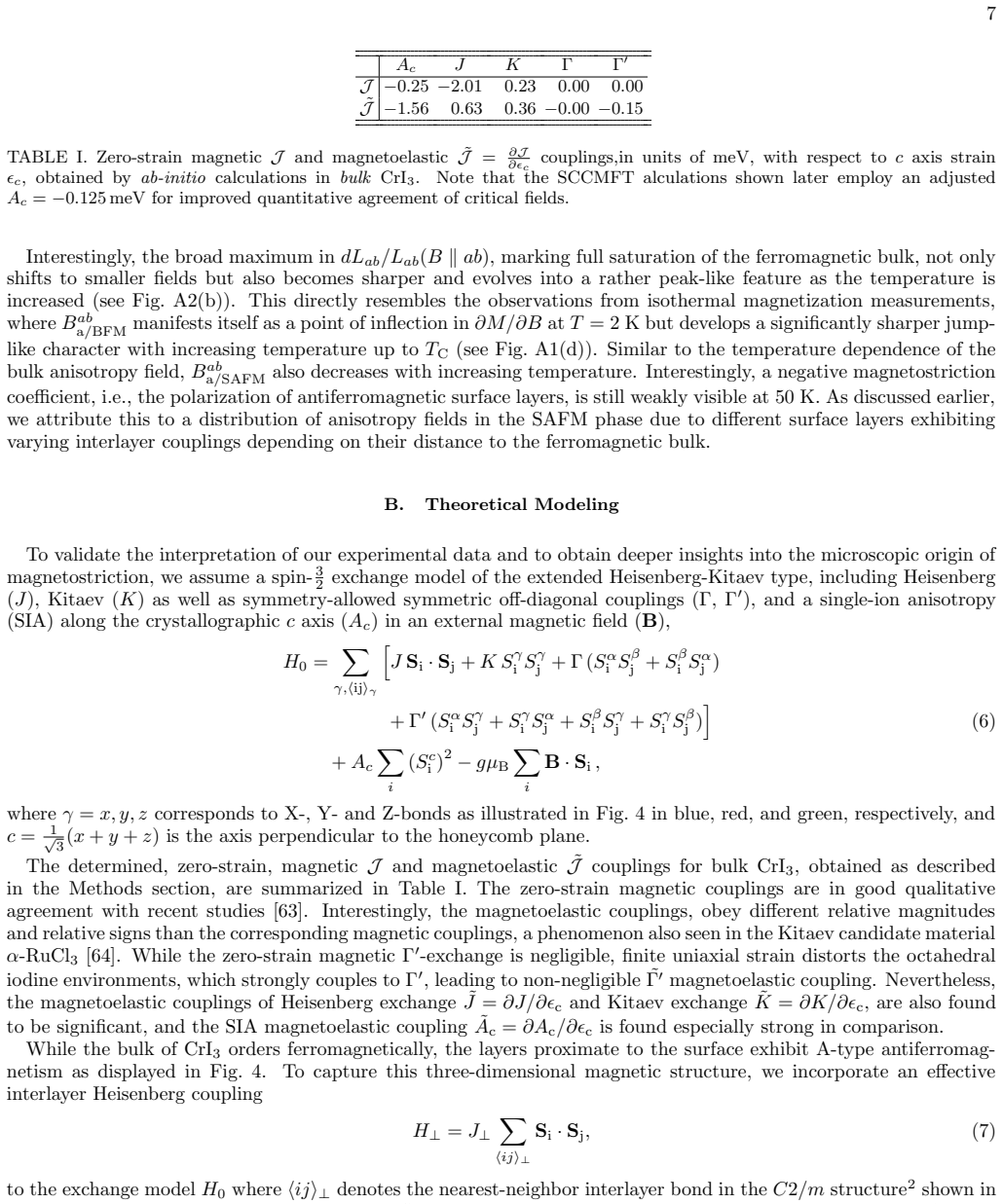
- [§III.A, Eq. (5)] Eq. (5) and the abstract: the step from the measured ∂ln T*/∂p_c = 90%/GPa to ∂ln J_SAFM_⊥/∂p_c = 90%/GPa rests on the assumption that T* is controlled 'essentially only' by J_SAFM_⊥ (T* ~ J_SAFM_⊥). For an A-type antiferromagnet with strong easy-axis single-ion anisotropy (Table I: A_c = -0.25 meV, the largest single coupling after J) and strong intralayer FM exchange, T* in general depends on J_⊥, the intralayer couplings, and A_c; the authors themselves invoke a distribution of layer-dependent J_⊥ (§III.A, discussion of the smeared B_a^ab/SAFM). This identification carries the paper's headline number ('quantify the uniaxial strain dependence of J_SAFM_⊥' in the abstract) and part of the factor-of-30 claim. The authors should either (a) justify it quantitatively — e.g., a mean-field or SCCMFT estimate of how T* scales with J_⊥ versus with A_c and J, given that ˜A_c = -1.56 meV is by fa
- [§III.C (Discussion), Eqs. (10)-(11)] The comparison between theory and experiment for the key quantity is described as 'good agreement' when the numbers are ∂ln J_SAFM_⊥/∂p_c ≃ 50%/GPa (theory) versus 90%/GPa (experiment) — nearly a factor of two apart, and the theory value itself uses ˜J_SAFM_⊥ = -2.0 meV obtained by fitting the SCCMFT output to the experimental magnetostriction (§III.B), so the comparison is not independent. Relatedly, the predicted in-plane magnetostriction overshoots the measured (dL_ab/L_ab)_max by an order of magnitude (Eq. 10 vs. Fig. 1(a)), which the text acknowledges but does not fold into an assessment of the quantitative reliability of the framework. Given that J_SAFM_⊥ (Eq. 8), ˜J_SAFM_⊥, A_c (adjusted to -0.125 meV, Table I footnote), κ_ab/κ_c (order-of-magnitude proxies from hydrostatic CrBr3 data), and C ≈ 0.06 are all fitted or estimated, the paper should present the theory-experiment compar
- [§III.C, paragraph on κ_ab, κ_c, C] The compressibility inputs that convert the SCCMFT magnetostriction coefficients to absolute dL/L values — κ_ab ≈ 0.01 GPa^-1 and κ_c ≈ 0.02 GPa^-1 — are extrapolated from hydrostatic linear compressibilities of CrBr3 (Ref. [65]) via two qualitative corrections (softer compound; uniaxial softer than hydrostatic). Since these enter Eqs. (10)-(11) and the 50%/GPa theory estimate, and since the surface layers may have different elastic properties than the bulk (as the authors note), the absolute-magnitude discussion rests on an uncontrolled input. The authors should either cite or measure CrI3 elastic constants (or bound κ_i from their own thermal-expansion/pressure data, cf. Ref. [38]), or explicitly propagate the uncertainty in κ_i into the quoted theory numbers. This is load-bearing only for the quantitative theory claims, not for the experimental Eqs. (2)-(4).
minor comments (7)
- [§III.A / Eq. (9)] §III.A: the magnetostriction coefficient is defined in the text as λ_i = ∂L_i/∂B (dimensions of length/field), while Eq. (9) defines it as (1/L_i)∂L_i/∂B_j (dimensionless per tesla). Please make the notation consistent throughout.
- [Eqs. (2)-(3)] Eq. (2): the dimensional conversion from ΔM* in μB/f.u. to SI units (needed to obtain T/GPa) is not shown; a brief footnote or explicit conversion factor would help readers verify the Clausius-Clapeyron applications. Similarly, state how ∂B*/∂T entering Eq. (3) was extracted given the weak temperature dependence of B* at low T (fit range, use of hysteresis midpoints).
- [§II (Methods)] Methods: the surface-layer fraction x = 0.9 is estimated from the low-field M/M_s ratio; please quantify the uncertainty on x and note its (minor) impact on the SCCMFT total observables, since x enters Eq. (E1).
- [Various] Typos: 'since the the ferromagnetic bulk moments' (§III.A); Table I note reads 'SCCMFT alculations'; also check 'RESUL TS'/'SUMMAR Y' headings and spacing artifacts (may be PDF-extraction issues, but worth a proofread).
- [Appendix A, Fig. A2] Fig. A2(b): the determination of B_a^ab/SAFM via the 'onset of virtually constant magnetostriction' is inherently subjective for a feature smeared over ~2 T; the quoted uncertainty 5.8(7) T should reflect this (e.g., by showing the construction for more than one temperature). The asterisk-marked experimental artifact should be described in the caption.
- [§III.A] §III.A, QCEP paragraph: the inference from a ~0.1 T hysteresis at 2 K to a quantum-critical-endpoint scenario is plausible but the argument would benefit from stating explicitly what additional measurement (e.g., the T-dependence of ΔB* or of ΔS*) would discriminate QCEP from a simple first-order line.
- [Abstract] Abstract: the 'factor of ~30' compares ∂ln T*/∂p_c with ∂ln T_C/∂p_c (ordering temperatures), while the sentence presents it as the ratio of 'uniaxial strain dependence of J_SAFM_⊥ and B*' to bulk strain effects — please align the wording with what is actually compared.
Circularity Check
Core experimental strain derivatives are independent Clausius–Clapeyron/Maxwell results; only a mild theory-side calibration of J̃_SAFM_⊥ to the same magnetostriction is then re-compared as ‘agreement’.
-
fitted input called prediction
[Sec. III.B (after Eq. 8) and Sec. III.C Discussion (theory–experiment J_SAFM_⊥ pressure comparison)]
"By comparing our cluster-mean field results, discussed further below, to experiments, we further estimate its magnetoelastic coupling as J̃_SAFM_⊥ = −2.0 meV. ... the values used in our simulations, together with the above estimates, yield ∂ln(J_SAFM_⊥)/∂pc ≃ 50 %/GPa, which is in good agreement with the value estimated from our thermodynamic analysis in Eq. 5."
J̃_SAFM_⊥ is tuned so the simulated surface magnetostriction jump matches experiment. The experimental ∂ln(J_SAFM_⊥)/∂pc in Eq. 5 is extracted from that same magnetostriction discontinuity (via Clausius–Clapeyron and T*∼J). Converting the fitted J̃ with estimated κ_c and reporting ‘agreement’ with Eq. 5 is therefore partly by construction, not an independent ab-initio prediction of the surface pressure derivative. The experimental Eq. 5 result itself remains independently measured.
full rationale
The paper’s load-bearing claims—∂B*/∂pc = 0.50(6) T/GPa, ∂T*/∂pc = 44(7) K/GPa, and the inferred ∂ln(J_SAFM_⊥)/∂pc ≃ 90%/GPa—are obtained from measured jumps Δ(dLc/Lc)*, ΔM*, and the B*(T) slope via standard thermodynamic identities (Eqs. 1–5). Those identities do not presuppose the numerical answers. Setting the bare surface interlayer scale by the classical spin-flip condition J_SAFM_⊥ = (1/3)gμ_B B* (Eq. 8) is ordinary parameter fixing, not a claimed first-principles prediction of B*. The only mild circularity is on the theory side: J̃_SAFM_⊥ is adjusted so SCCMFT magnetostriction matches experiment, then converted with estimated κ_c into ∂ln(J_SAFM_⊥)/∂pc ≃ 50%/GPa and called ‘good agreement’ with the thermodynamic 90%/GPa that itself comes from the same length-change discontinuity. That agreement is partly forced by the fit and is not an independent validation; it is not, however, what carries the experimental factor-of-~30 claim. Bulk ab-initio J̃ couplings and the prior thermal-expansion comparison [38] are separate and non-circular. No self-definitional loop or uniqueness-import chain is present. Score 2 reflects one non-load-bearing fitted-input comparison only.
Assumptions & free parameters
free parameters (7)
- J_SAFM_⊥ =
0.08 meV
- ˜J_SAFM_⊥ =
-2.0 meV
- A_c (SCCMFT) =
-0.125 meV
- surface layer fraction x =
0.9
- κ_ab, κ_c uniaxial compressibilities =
≈0.01 and 0.02 GPa^-1
- C (ab vs c magnetoelastic scaling) =
≈0.06
- DFT+U / Kanamori parameters =
U=5 eV, J_H=1 eV, λ_p=0.5 eV
assumptions (6)
- standard math Maxwell relation ∂L_i/∂B_j|_p = -∂M_j/∂p_i|_B and Clausius-Clapeyron for first-order B*(p,T) hold for the measured discontinuities.
- domain assumption T* is dominated by the surface interlayer coupling, T* ∼ J_SAFM_⊥, so logarithmic pressure derivatives are interchangeable (Eq. 5).
- domain assumption Magnetostriction anomalies at B_c_sat, B*, B_a^ab/BFM, and B_a^ab/SAFM map onto bulk FM polarization, surface spin-flip, and surface in-plane anisotropy fields as in prior bulk/few-layer CrI3 studies.
- domain assumption Surface layers of bulk crystals (C2/m, A-type AFM) microscopically represent few-layer CrI3 magnetoelasticity.
- ad hoc to paper Magnetostriction coefficient factorizes as sum over (∂J/∂L)(∂M/∂J) with ∂J/∂L_c = -C ∂J/∂L_ab in the linear elastic regime (Eq. 9).
- domain assumption Interlayer coupling may be treated as a single effective Heisenberg J_⊥ in classical mean-field between quantum intralayer clusters (SCCMFT).
Cite this review
Pith. "Pith review of Accessing Few-Layer CrI$_3$ Magnetoelasticity Through Bulk Single Crystals." pith.science (2026). https://pith.science/paper/6F62MZI7
@misc{pith2026260724222,
  author       = {Pith},
  title        = {Pith review of: Accessing Few-Layer CrI$_3$ Magnetoelasticity Through Bulk Single Crystals},
  year         = {2026},
  howpublished = {\url{https://pith.science/paper/6F62MZI7}},
  note         = {Machine review of arXiv:2607.24222}
}
abstract
The persistence of ferromagnetic long-range order in monolayers of the van der Waals semiconductor CrI$_3$ opens new routes for spintronic applications based on two-dimensional quantum magnets. In the fabrication of such devices, the constituent materials inevitably experience anisotropic strain, which modifies their intrinsic electronic properties. At the same time, strain can serve as a powerful tuning parameter, driving the material to desired regimes. While several theoretical studies have investigated the effect of biaxial in-plane strain on CrI$_3$ numerically, experiments are widely limited to the application of hydrostatic pressure. Here, we perform high-resolution magnetostriction experiments on bulk CrI$_3$ samples, and \textit{ab-initio}-based magnetoelastic calculations, to elucidate the role of uniaxial lattice strain on the magnetic properties. Our data show that magnetostriction in CrI$_3$ is unexpectedly sensitive to surface effects, which enables us to investigate the influence of in-plane and out-of-plane strain separately, in both the bulk ferromagnetic (BFM) phase emerging at $T_{\rm C}=61\,\mathrm{K}$ and the surface antiferromagnetic (SAFM) phase below $T^* \simeq 50\,\mathrm{K}$. In particular, we quantify the uniaxial strain dependence of the surface interlayer coupling $J^{\rm SAFM}_{\perp}$ and the surface spin-flip field $B^*$, which drastically exceed the strain effects in the BFM phase by a factor of $\sim 30$. The large magnetostrictive response allows us to study the magnetoelastic coupling in few-layer CrI$_3$ through experiments on bulk single crystals, without requiring exfoliation.
Figures


Figures from the paper (4 more)


Reference graph
Works this paper leans on
-
[65]
Riedl, D
K. Riedl, D. Amoroso, S. Backes, A. Razpopov, T. P. T. Nguyen, K. Yamauchi, P. Barone, S. M. Winter, S. Picozzi, and R. Valent ´ ı, Microscopic origin of magnetism in monolayer 3d transition metal dihalides, Physical Review B106, 035156 (2022)
2022
-
[38]
Bushick, S
K. Bushick, S. Chae, Z. Deng, J. T. Heron, and E. Kioupakis, Boron arsenide heterostructures: lattice-matched heteroin- terfaces and strain effects on band alignments and mobility, npj Comput. Mater.6, 3 (2020)
2020
-
[1]
Magnetization The simulated magnetization curves for magnetic fields applied out-of-planeB∥c(a) and in-planeB∥ab(b) are displayed in Fig. 5. Each plot displays the total magnetization in black, and its constituent contributions from bulk and surface magnetization in green and yellow, respectively. ComparingM tot with the lowest temperatureT= 2 K experimen...
-
[2]
Magnetostriction Beyond magnetization, we simulated the magnetostriction i.e., the field-induced relative length changes, as measured in the experiment, following the same approximation for the magnetostriction coefficient as in Ref. [64]: 1 Li ∂Li ∂Bj pi = 1 V ∂Mj ∂pi Bj ≈ κi Li V X J ∈{J, K,Γ′,...} ∂J ∂Li ∂M ∂J Bj ,(9) whereVis volume,κ i =− 1 Li ∂Li ∂p...
-
[3]
A1 forB∥c(a,c) andB∥ab(b,d)
Magnetostriction The isothermal magnetization and corresponding (differential) magnetic susceptibility of CrI 3 at various temper- atures is shown in Fig. A1 forB∥c(a,c) andB∥ab(b,d). As forB∥c, the spin-flip transition in the SAFM phase is suppressed and occurs at smaller fieldsB ∗ as the temperature increases. Furthermore, the hysteresis atB ∗ is dimini...
-
[4]
A3 for different static magnetic fields applied along thecaxis
Magnetic susceptibility The real part of the dynamic magnetic susceptibility measured with a small excitation fieldH ac = 5 Oe oscillating atf= 500 Hz is depicted in Fig. A3 for different static magnetic fields applied along thecaxis. AtB= 0 T, upon cooling from high temperatures,χ ′ is characterized by a steep increase atT C = 61 K marking the onset of f...
-
[5]
A4, with results from the above settings, as well as an additional relaxation where we also turn on SOC
Strain relaxation results The structural summary of the relaxations is seen in Fig. A4, with results from the above settings, as well as an additional relaxation where we also turn on SOC. We see that with and without SOC there is no appreciable change. During the relaxation we have kept the conventionalc-axis fixed, seen in panel (a) as a perfectly strai...
-
[6]
Extracting magnetic exchanges Given the aforementioned structural results, we are within the framework used in Ref. [51] to calculate the magnetic exchanges, by using the extracted metal to ligand hoppingsd−pas well as the on-site atomic energy difference between the metaldand ligandpmanifolds, as found from wannierization. An effective I spin-orbit coupl...
Show all 87 references
-
[7]
Solve layerAwith the bare cluster HamiltonianH A and determine its ground state|Ψ A⟩, H0 |ΨA⟩=E A|ΨA⟩.(D1)
-
[8]
Measure the spin expectation value on layerA, ⟨SA j ⟩ ≡ ⟨ΨA|SA j |ΨA⟩.(D2)
-
[9]
Use these expectation values as input to construct the mean-field term acting on layerB, H A→B ⊥ ⟨SA j ⟩, J⊥ =J ⊥ X ⟨ij⟩⊥ ⟨SA j ⟩S i,(D3) whereJ ⊥ denotes the effective interlayer coupling entering the surface SCCMFT description. 18
-
[10]
Solve layerBwith the corresponding mean-field Hamiltonian and obtain the ground state|Ψ B⟩, H0 +H A→B ⊥ |ΨB⟩=E B|ΨB⟩.(D4)
-
[11]
Measure the local spin expectation values on layerB, ⟨SB j ⟩ ≡ ⟨ΨB|SB j |ΨB⟩.(D5) and use them to construct the mean-field term acting back on layerA, H B→A ⊥ ⟨SB j ⟩, J⊥ =J ⊥ X ⟨ij⟩⊥ ⟨SB j ⟩S i,(D6)
-
[12]
Solve layerAagain with the updated Hamiltonian H0 +H B→A ⊥ |ΨA⟩=E A|ΨA⟩,(D7)
-
[13]
At convergence, the resulting pair of states (|ψ A⟩,|ψ B⟩) define the SCCMFT solution for the two coupled layers
Repeat steps 2–6 iteratively until the mean-field terms H B→A ⊥ , H A→B ⊥ ,(D8) or equivalently the moments⟨S A j ⟩and⟨S B j ⟩, no longer change within a chosen numerical toleranceε. At convergence, the resulting pair of states (|ψ A⟩,|ψ B⟩) define the SCCMFT solution for the ...
-
[14]
Huang, G
B. Huang, G. Clark, E. Navarro-Moratalla, D. R. Klein, R. Cheng, K. L. Seyler, D. Zhong, E. Schmidgall, M. A. McGuire, D. H. Cobden, W. Yao, D. Xiao, P. Jarillo-Herrero, and X. Xu, Layer-dependent ferromagnetism in a van der Waals crystal down to the monolayer limit, Nature546...
2017
-
[15]
Marian, D
D. Marian, D. Soriano, E. Cannav´ o, E. G. Marin, and G. Fiori, Electrically tunable lateral spin-valve transistor based on bilayer CrI3, npj 2D Mater. Appl.7, 42 (2023)
2023
-
[16]
M. Zhu, H. Yao, L. Jiang, and Y. Zheng, Theoretical model of spintronic device based on tunable anomalous Hall conduc- tivity of monolayer CrI 3, Appl. Phys. Lett.116, 022404 (2020)
2020
-
[17]
J. F. Sierra, J. Fabian, R. K. Kawakami, S. Roche, and S. O. Valenzuela, Van der waals heterostructures for spintronics and opto-spintronics, Nature Nanotechnology16, 856 (2021)
2021
-
[18]
G.-Y. Hong, S. Zhao, F. Jin, L. Liu, L. Yang, Q. Zhang, M. Tan, K. Li, C. Hu, H.-B. Sun, and L. Lin, Asymmetric valley polarization of excitons and trions in antiferromagnet-semiconductor MoSe 2/CrI3 heterostructures, ACS Nano19, 34880 (2025)
2025
-
[19]
Nnokwe, C
C. Nnokwe, C. J. Cunningham, W. Liu, G. Ye, T. Nguyen, K. Wu, C. Hemesath, C. Sadler, P. Lukashev, Z. Zhai, B. Lv, J.-A. Yan, P. M. Shand, A. J. Stollenwerk, and R. He, Tuning the magnetic properties of CrI3 using Ni thin film deposition for applications in spintronic devices,...
2025
-
[20]
S.-D. Guo, J. He, and Y. S. Ang, Achieving fully compensated ferrimagnetism through two-dimensional CrI 3/CrGeTe3 heterojunctions, Appl. Phys. Lett.127, 232401 (2025)
2025
-
[21]
C ¸ aha, A
I. C ¸ aha, A. U. Ahmad, L. Boddapatti, M. Ba˜ nobre-L´ opez, A. T. Costa, A. N. Enyashin, W. Li, P. Gargiani, M. Valvi- dares, J. Fern´ andez-Rossier, and F. L. Deepak, One-dimensional CrI3 encapsulated within multi-walled carbon nanotubes, Commun. Chem.8, 155 (2025)
2025
-
[22]
N. D. Mermin and H. Wagner, Absence of Ferromagnetism or Antiferromagnetism in One- or Two-Dimensional Isotropic Heisenberg Models, Phys. Rev. Lett.17, 1133 (1966)
1966
-
[23]
J. L. Lado and F. Fernˆ andez-Rossier, On the origin of magnetic anisotropy in two dimensional CrI3, 2D Mater.4, 035002 (2017)
2017
-
[24]
D.-H. Kim, K. Kim, K.-T. Ko, J. Seo, J. S. Kim, T.-H. Jang, Y. Kim, J.-Y. Kim, S.-W. Cheong, and J.-H. Park, Giant Magnetic Anisotropy Induced by LigandLSCoupling in Layered Cr Compounds, Phys. Rev. Lett.122, 207201 (2019)
2019
-
[25]
I. Lee, J. Cen, O. Molchanov, S. Feng, W. L. Huey, J. van Tol, J. E. Goldberger, N. Trivedi, H.-Y. Kee, and P. C. Hammel, Spin-orbit coupling controlled two-dimensional magnetism in chromium trihalides, Phys. Rev. B113, 014401 (2026)
2026
-
[26]
De Vita, S
A. De Vita, S. Stavri´ c, R. Sant, N. B. Brookes, I. Vobornik, G. Panaccione, S. Picozzi, M. Wolf, L. Rettig, R. Ernstorfer, and T. Pincelli, Orbital mixing and strong Hund’s coupling stabilize spin order in the van der Waals ferromagnet CrI 3, Phys. Rev. B113, 205120 (2026)
2026
-
[27]
L. Chen, J. Chung, T. Chen, C. Duan, A. Schneidewind, I. Radelytskyi, D. J. Voneshen, R. A. Ewings, M. B. Stone, A. I. Kolesnikov, B. Winn, S. Chi, R. A. Mole, D. H. Yu, B. Gao, and P. Dai, Magnetic anisotropy in ferromagnetic CrI 3, Phys. Rev. B101, 134418 (2020)
2020
-
[28]
Jonak, E
M. Jonak, E. Walendy, J. Arneth, M. Abdel-Hafiez, and R. Klingeler, Low-energy magnon excitations and emerging anisotropic nature of short-range order in CrI 3, Phys. Rev. B106, 214412 (2022)
2022
-
[29]
Sivadas, S
N. Sivadas, S. Okamoto, X. Xu, C. J. Fennie, and D. Xiao, Stacking-Dependent Magnetism in Bilayer CrI 3, Nano Lett. 18, 7658 (2018)
2018
-
[30]
Jiang, C
P. Jiang, C. Wang, D. Chen, Z. Zhong, Z. Yuan, Z.-Y. Lu, and W. Ji, Stacking tunable interlayer magnetism in bilayer CrI3, Phys. Rev. B99, 144401 (2019)
2019
-
[31]
Soriano, C
D. Soriano, C. Cardoso, and J. Fern´ andez-Rossier, Interplay between interlayer exchange and stacking in CrI 3 bilayers, Solid State Commun.299, 113662 (2019)
2019
-
[32]
M. A. McGuire, H. Dixit, V. R. Cooper, and B. C. Sales, Coupling of Crystal Structure and Magnetism in the Layered, Ferromagnetic Insulator CrI 3, Chemistry of Materials27, 612 (2015)
2015
-
[33]
Y. Liu, L. Wu, X. Tong, J. Li, J. Tao, Y. Zhu, and C. Petrovic, Thickness-dependent magnetic order in CrI3 single crystals, Sci. Rep.9, 13599 (2019)
2019
-
[34]
S. Li, Z. Ye, X. Luo, G. Ye, H. H. Kim, B. Yang, S. Tian, C. Li, H. Lei, A. W. Tsen, K. Sun, R. He, and L. Zhao, Magnetic-Field-Induced Quantum Phase Transitions in a van der Waals Magnet, Phys. Rev. X10, 011075 (2020)
2020
-
[35]
B. Niu, T. Su, B. A. Francisco, S. Ghosh, F. Kargar, X. Huang, M. Lohmann, J. Li, Y. Xu, T. Taniguchi, K. Watanabe, D. Wu, A. Balandin, J. Shi, and Y. Cui, Coexistence of Magnetic Orders in Two-Dimensional Magnet CrI 3, NANO Lett. 20, 553 (2020)
2020
-
[36]
Huang, G
B. Huang, G. Clark, D. R. Klein, D. MacNeill, E. Navarro-Moratalla, K. L. Seyler, N. Wilson, M. A. McGuire, D. H. Cobden, D. Xiao, W. Yao, P. Jarillo-Herrero, and X. Xu, Electrical control of 2D magnetism in bilayer CrI 3, Nature Nanotech.13, 544 (2018)
2018
-
[37]
Zhang, J.-Y
Z. Zhang, J.-Y. You, B. Gu, and G. Su, Emergent magnetic states due to stacking and strain in the van der Waals magnetic trilayer CrI3, Phys. Rev. B104, 174433 (2021)
2021
-
[39]
Yastrubchak, T
O. Yastrubchak, T. Wosi ski, J. Z. Domaga a, E. Usakowska, T. Figielski, B. P´ ecz, and A. L. T´ oth, Misfit strain anisotropy in partially relaxed lattice-mismatched InGaAs/GaAs heterostructures, J. Phys. Condens. Matter16, S1 (2004)
2004
-
[40]
Zhang, W
Y. Zhang, W. Si, Y. Jia, P. Yu, R. Yu, and J. Zhu, Controlling strain relaxation by interface design in highly lattice- mismatched heterostructure, Nano Lett.21, 6867 (2021)
2021
-
[41]
K. Liu, F. Jin, X. Zhang, K. Liu, Z. Zhang, E. Hua, J. Zhang, H. Ye, G. Gao, C. Ma, L. Wang, and W. Wu, Anisotropic Strain-mediated Symmetry Engineering and Enhancement of Ferroelectricity in Hf 0.5Zr0.5O2/La0.67Sr0.33MnO3 het- erostructures, Adv. Funct. Mater.33, 2209925 (2023)
2023
-
[42]
Zhang, Q
W.-B. Zhang, Q. Qu, P. Zhu, and C.-H. Lam, Robust intrinsic ferromagnetism and half semiconductivity in stable two- dimensional single-layer chromium trihalides, J. Mater. Chem. C3, 12457 (2015). 22
2015
-
[43]
Webster and J.-A
L. Webster and J.-A. Yan, Strain-tunable magnetic anisotropy in monolayer CrCl 3, CrBr 3, and CrI 3, Phys. Rev. B98, 144411 (2018)
2018
-
[44]
J. Liu, P. Mo, M. Shi, D. Gao, and J. Lu, Multi-scale analysis of strain-dependent magnetocrystalline anisotropy and strain-induced villari and Nagaoka-Honda effects in a two-dimensional ferromagnetic chromium tri-iodide monolayer, J. Appl. Phys.124, 044303 (2018)
2018
-
[45]
S. I. Vishkayi, Z. Torbatian, A. Qaiumzadeh, and R. Asgari, Strain and electric-field control of spin-spin interactions in monolayer cri3, Phys. Rev. Mater.4, 094004 (2020)
2020
-
[46]
T. Song, Z. Fei, M. Yankowitz, Z. Lin, Q. Jiang, K. Hwangbo, Q. Zhang, B. Sun, T. Taniguchi, K. Watanabe, M. A. McGuire, D. Graf, T. Cao, J. Chu, D. H. Cobden, C. R. Dean, D. Xiao, and X. Xu, Switching 2D magnetic states via pressure tuning of layer stacking, Nat. Mater.18, 12...
2019
-
[47]
T. Li, S. Jiang, N. Sivadas, Z. Wang, Y. Xu, D. Weber, J. Goldberger, K. Watanabe, T. Taniguchi, C. J. Fennie, K. F. Mak, and J. Shan, Pressure controlled interlayer magnetism in atomically thin CrI 3, Nat. Mater.18, 1303 (2019)
2019
-
[48]
Subhan, I
F. Subhan, I. Khan, and J. Hong, Pressure-induced ferromagnetism and enhanced perpendicular magnetic anisotropy of bilayer CrI3, J. Phys.: Condens. Matter31, 355001 (2019)
2019
-
[49]
Mondal, M
S. Mondal, M. Kannan, M. Das, L. Govindaraj, R. Singha, B. Satpati, S. Arumugam, and P. Mandal, Effect of hydrostatic pressure on ferromagnetism in two-dimensional cri 3, Phys. Rev. B99, 180407(R) (2019)
2019
-
[50]
Ghosh, D
A. Ghosh, D. Singh, T. Aramaki, Q. Mu, V. Borisov, Y. Kvashnin, G. Haider, M. Jonak, D. Chareev, S. A. Medvedev, R. Klingeler, M. Mito, E. H. Abdul-Hafidh, J. Vejpravova, M. Kalb` aˇ c, R. Ahuja, O. Eriksson, and M. Abdel-Hafiez, Exotic magnetic and electronic properties of la...
2022
-
[51]
Arneth, M
J. Arneth, M. Jonak, S. Spachmann, M. Abdel-Hafiez, Y. O. Kvashnin, and R. Klingeler, Uniaxial pressure effects in the two-dimensional van der waals ferromagnet cri 3, Phys. Rev. B105, L060404 (2022)
2022
-
[52]
Kocsis, D
V. Kocsis, D. A. S. Kaib, K. Riedl, S. Gass, P. Lampen-Kelley, D. G. Mandrus, S. E. Nagler, N. P´ erez, K. Nielsch, B. B¨ uchner, A. U. B. Wolter, and R. Valent ´ ı, Magnetoelastic coupling anisotropy in the Kitaev materialα−RuCl3, Phys. Rev. B105, 094410 (2022)
2022
-
[53]
Arneth, R
J. Arneth, R. Kalaivanan, R. Sankar, K.-Y. Choi, and R. Klingeler, Competing interactions and the effects of uniaxial out-of-plane perturbations in the honeycomb antiferromagnet Na 2Co2TeO6, Phys. Rev. Mater.9, 094001 (2025)
2025
-
[54]
S. Gass, P. M. Cˆ onsoli, V. Kocsis, L. T. Corredor, P. Lampen-Kelley, D. G. Mandrus, S. E. Nagler, L. Janssen, M. Vojta, B. B¨ uchner, and A. U. B. Wolter, Field-induced transitions in the kitaev materialα−rucl 3 probed by thermal expansion and magnetostriction, Phys. Rev. B1...
2020
-
[55]
Spachmann, A
S. Spachmann, A. Elghandour, S. Selter, B. B¨ uchner, S. Aswartham, and R. Klingeler, Strong effects of uniaxial pressure and short-range correlations in Cr 2Ge2Te6, Phys. Rev. Res.4, L022040 (2022)
2022
-
[56]
Spachmann, S
S. Spachmann, S. Selter, B. B¨ uchner, S. Aswartham, and R. Klingeler, Strong uniaxial pressure dependencies evidencing spin-lattice coupling and spin fluctuations in Cr 2Ge2Te6, Phys. Rev. B107, 184421 (2023)
2023
-
[57]
Arneth, K.-Y
J. Arneth, K.-Y. Choi, R. Kalaivanan, R. Sankar, and R. Klingeler, Signatures of a quantum critical endpoint in the Kitaev candidate Na2Co2TeO6, Phys. Rev. B110, L140402 (2024)
2024
-
[58]
X. Mi, X. Li, L. Zhang, Y. Gu, A. Wang, Y. Li, Y. Chai, and M. He, Precisely tracking critical spin fluctuations using the ac magnetostriction coefficient: A case study on the Kitaev spin liquid candidate Na 3Co2SbO6, Phys. Rev. B111, 014417 (2025)
2025
-
[59]
P. K. Mukharjee, S. Erdmann, L. Wang, J. Kaiser, A. Jesche, P. Puphal, M. Isobe, M. Hepting, B. Keimer, P. Gegenwart, and A. A. Tsirlin, Anisotropic magnetoelastic coupling in the honeycomb magnet Na 3Co2SbO6, Phys. Rev. B113, 205148 (2026)
2026
-
[60]
K¨ uchler, T
R. K¨ uchler, T. Bauer, M. Brando, and F. Steglich, A compact and miniaturized capacitance dilatometer for measuring thermal expansion and magnetostriction, Rev. Sci. Instrum.83, 095102 (2012)
2012
-
[61]
Werner, W
J. Werner, W. Hergett, M. Gertig, J. Park, C. Koo, and R. Klingeler, Anisotropy-governed competition of magnetic phases in the honeycomb quantum magnet Na3Ni2SbO6 studied by dilatometry and high-frequency ESR, Phys. Rev.B95, 214414 (2017)
2017
-
[62]
Kresse and J
G. Kresse and J. Furthm¨ uller, Efficient iterative schemes for ab initio total-energy calculations using a plane-wave basis set, Phys. Rev. B54, 11169 (1996)
1996
-
[63]
Koepernik and H
K. Koepernik and H. Eschrig, Full-potential nonorthogonal local-orbital minimum-basis band-structure scheme, Phys. Rev. B59, 1743 (1999)
1999
-
[64]
P. P. Stavropoulos, X. Liu, and H.-Y. Kee, Magnetic anisotropy in spin-3/2 with heavy ligand in honeycomb Mott insulators: Application to CrI 3, Phys. Rev. Res.3, 013216 (2021)
2021
-
[66]
Liu and C
Y. Liu and C. Petrovic, Three-dimensional magnetic critical behavior in CrI 3, Phys. Rev. B97, 014420 (2018)
2018
-
[67]
Garst and A
M. Garst and A. Rosch, Sign change of the Gr¨ uneisen parameter and magnetocaloric effect near quantum critical points, Phys. Rev. B72, 205129 (2005)
2005
-
[68]
A. J. Millis, A. J. Schofield, G. G. Lonzarich, and S. A. Grigera, Metamagnetic Quantum Criticality in Metals, Phys. Rev. Lett.88, 217204 (2002)
2002
-
[69]
Beneke and M
C. Beneke and M. Vojta, Divergence of the Gr¨ uneisen ratio at symmetry-enhanced first-order quantum phase transitions, Phys. Rev. B103, 174420 (2021)
2021
-
[70]
Gegenwart, F
P. Gegenwart, F. Weickert, M. Garst, R. S. Perry, and Y. Maeno, Metamagnetic Quantum Criticality in Sr3Ru2O7 Studied by Thermal Expansion, Phys. Rev. Lett.96, 136402 (2006). 23
2006
-
[71]
Weickert, M
F. Weickert, M. Brando, F. Steglich, P. Gegenwart, and M. Garst, Universal signatures of the metamagnetic quantum critical endpoint: Application to CeRu 2Si2, Phys. Rev. B81, 134438 (2010)
2010
-
[72]
McCreary, T
A. McCreary, T. T. Mai, F. G. Utermohlen, J. R. Simpson, K. F. Garrity, X. Feng, D. Shcherbakov, Y. Zhu, J. Hu, D. Weber, K. Watanabe, T. Taniguchi, J. E. Goldberger, Z. Mao, C. N. Lau, Y. Lu, N. Trivedi, R. Vald´ es Aguilar, and A. R. Hight Walker, Distinct magneto-Raman sign...
2020
-
[73]
Ghosh, H
A. Ghosh, H. J. M. J¨ onsson, D. J. Mukkattukavil, Y. Kvashnin, D. Phuyal, P. Thunstr¨ om, M. Ag ˚ aker, A. Nicolaou, M. Jonak, R. Klingeler, M. V. Kamalakar, T. Sarkar, A. N. Vasiliev, S. M. Butorin, O. Eriksson, and M. Abdel-Hafiez, Magnetic circular dichroism in theddexcita...
2023
-
[74]
Spachmann, A
S. Spachmann, A. Elghandour, M. Frontzek, W. L¨ oser, and R. Klingeler, Magnetoelastic coupling and phases in the skyrmion lattice magnet Gd 2PdSi3 discovered by high-resolution dilatometry, Phys. Rev. B103, 184424 (2021)
2021
-
[75]
Stockert, N
U. Stockert, N. Leps, L. Wang, G. Behr, S. Wurmehl, B. B¨ uchner, and R. Klingeler, Pr magnetism and its interplay with the Fe spin-density wave in PrFeAsO1−xFx (x= 0,0.15), Phys. Rev. B86, 144407 (2012)
2012
-
[76]
Cen and H.-Y
J. Cen and H.-Y. Kee, Determining Kitaev interaction in spin- S honeycomb Mott insulators, Phys. Rev. B107, 014411 (2023)
2023
-
[77]
D. A. S. Kaib, S. Biswas, K. Riedl, S. M. Winter, and R. Valent ´ ı, Magnetoelastic coupling and effects of uniaxial strain in α−RuCl 3 from first principles, Phys. Rev. B103, L140402 (2021)
2021
-
[78]
O. Lis, D. Kozlenko, S. Kichanov, E. Lukin, I. Zel, and B. Savenko, Structural, Magnetic and Vibrational Properties of Van Der Waals Ferromagnet CrBr3 at High Pressure, Materials16, 454 (2023)
2023
-
[79]
A. M. Le´ on, J. W. Gonz´ alez, J. Mej ´ ıa-L´ opez, F. Crasto de Lima, and E. Su´ arez Morell, Strain-induced phase transition in CrI3 bilayers, 2D Mater.7, 035008 (2020)
2020
-
[80]
Xu, Q.-J
C. Xu, Q.-J. Wang, B. Xu, and J. Hu, Effect of biaxial strain and hydrostatic pressure on the magnetic properties of bilayer CrI3, Front. Phys.16, 53502 (2021)
2021
-
[81]
Ouyang, B.-C
X.-F. Ouyang, B.-C. Lei, X.-M. Li, W.-Z. Zhou, and F.-P. Ouyang, The mechanism of strain tunable magnetic anisotropy and electronic properties of bilayer CrI 3, Physica B Condens. Matter706, 417015 (2025)
2025
-
[82]
Z. Wang, I. Guti´ errez-Lezama, N. Ubrig, M. Kroner, M. Gibertini, T. Taniguchi, K. Watanabe, A. Imamo˘ glu, E. Giannini, and A. F. Morpurgo, Very large tunneling magnetoresistance in layered magnetic semiconductor CrI 3, Nat. Commun.9, 2516 (2018)
2018
-
[83]
Kresse and J
G. Kresse and J. Hafner, Ab initio molecular dynamics for liquid metals, Phys. Rev. B47, 558 (1993)
1993
-
[84]
J. P. Perdew, A. Ruzsinszky, G. I. Csonka, O. A. Vydrov, G. E. Scuseria, L. A. Constantin, X. Zhou, and K. Burke, Restoring the Density-Gradient Expansion for Exchange in Solids and Surfaces, Phys. Rev. Lett.100, 136406 (2008)
2008
-
[85]
S. L. Dudarev, G. A. Botton, S. Y. Savrasov, C. J. Humphreys, and A. P. Sutton, Electron-energy-loss spectra and the structural stability of nickel oxide: An LSDA+U study, Phys. Rev. B57, 1505 (1998)
1998
-
[86]
Opahle, K
I. Opahle, K. Koepernik, and H. Eschrig, Full-potential band-structure calculation of iron pyrite, Phys. Rev. B60, 14035 (1999)
1999
-
[87]
Virtanen, R
P. Virtanen, R. Gommers, T. E. Oliphant, M. Haberland, T. Reddy, D. Cournapeau, E. Burovski, P. Peterson, W. Weckesser, J. Bright, S. J. van der Walt, M. Brett, J. Wilson, K. J. Millman, N. Mayorov, A. R. J. Nelson, E. Jones, R. Kern, E. Larson, C. J. Carey, ˙I. Polat, Y. Feng...
2020
Reviewed July 31, 2026 · model on record in the stance chip above.
Discussion (0). Sign in to comment.