REVIEW 3 major objections 4 minor 84 references
This book argues that the global statistical regularities of real networks emerge from purely local growth rules, and pins the mechanism to one identity: reaching a neighbor of a random node is already preferential attachment.
Reviewed by Pith at T0; open to challenge. T0 means a machine referee read the full paper against a public rubric. the ladder, T0–T4 →
T0 review · deepseek-v4-flash
2026-08-04 19:38 UTC pith:6F7SHTGY
load-bearing objection A serious book with a solid core and a fragile empirical keystone: the community-count exponent needs the nested re-run before it can carry the roughness reading. the 3 major comments →
Local network growth: How simple rules drive network complexity
The pith
A machine-rendered reading of the paper's core claim, the machinery that carries it, and where it could break.
Core claim
The central claim is that a growth rule taking one step outward from a randomly chosen node—to one of its neighbors—attaches preferentially by degree, because a well-connected node belongs to more neighborhoods and is more likely to be hit. Search, triadic closure, and duplication are shown to be instantiations of this single local step, delivering the power-law degree distribution, the inverse-degree clustering hierarchy, and the degree correlations as a package: reaching outward gives disassortative hubs, closing triangles within a neighborhood gives assortative ones. Past a 'Ramsey community number' of a few hundred nodes, communities are all but certain under any local rule with short cy
What carries the argument
The central object is the neighbor-of-a-random-node identity: if a growth rule reaches node i by picking a node at random and stepping to one of its neighbors, the probability of hitting i is k_i / Σ_j k_j—exactly the linear preferential-attachment probability of the standard model. The book shows that random-walk search, triadic closure, and duplication are all instantiations of this one local step, and that the same step generates triangles and degree correlations as a package. The second piece of machinery is the evidence ratio of the degree-corrected block model used as a closed-form formula, which turns the Ramsey community number into an exact crossing between an extensive log-evidence
Load-bearing premise
The load-bearing empirical premise is that real networks carry more communities than self-similarity predicts—B ~ n^β with β ≈ 0.61—and the book itself states that the flat block model used for the count 'cannot report more than of order sqrt(n) groups' and 'is not able to report an asymptotic exponent above one half'; if the instrument ceiling, rather than the networks, sets the counts of the largest systems, the super-fractal finding and the roughness reading built on it co
What would settle it
Re-run the Chapter 6 community census on the same ~100 networks and growing systems with a nested block model that lifts the √n ceiling, as the book itself recommends. If the fitted exponent falls to 1/2 or below, or if the largest networks' community counts stop growing once the ceiling is removed, then β ≈ 0.61 is an instrument artifact and the roughness interpretation α ≈ 0.65 fails with it; the converse—an exponent that survives or rises toward one—would confirm the book's reading.
If this is right
- If locality is the common cause, then no global information needs to be assumed to explain scale-free structure; standard preferential attachment is an effective description, not a mechanism, and models that use it are coarse-grained accounts of a local process.
- The sign of degree correlations becomes a diagnostic of the microscopic move: search and duplication produce disassortative networks, triadic closure produces assortative ones, so one framework covers technological, biological, and social networks with a single dial.
- Communities are a generic consequence of local growth: past a few hundred nodes, any local rule with short cycles—even a triangle-free duplication–split rule—yields communities with near-certainty, while degree-preserving shuffles and global-attachment growth do not.
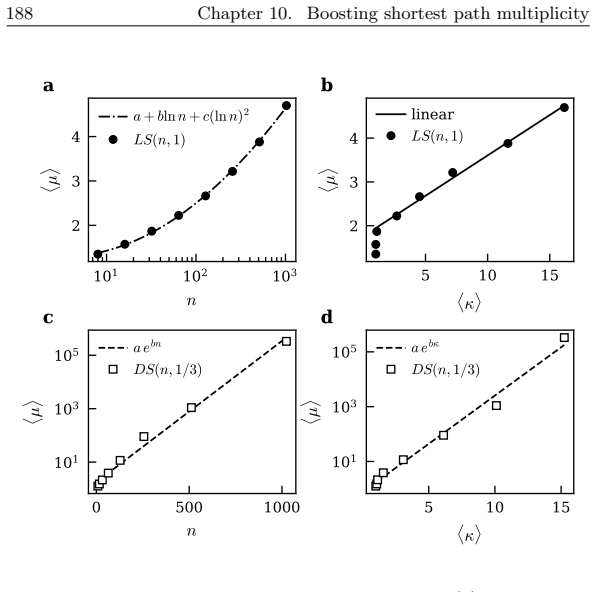
- The number of communities grows as a power of network size (B ~ n^β, β≈0.61 across close to a hundred real networks; β≈0.56–0.60 for the book's local rules), and local growth boosts the multiplicity of shortest paths, tying route redundancy to the same community structure.
- In duplication–split schedules, the critical path becomes a vanishing fraction of large projects and delay risk is governed by network-wide percolation with threshold 1/⟨k⟩—so project performance is a property of the grown activity network, not of any single path.
Where Pith is reading between the lines
- The √n ceiling coincidence implies that the community-count exponent measured with a flat model cannot, by itself, distinguish a network property from a detector limit; the nested-model re-run the book calls 'the obvious next measurement' is the decisive experiment. If the exponent survives above 1/2, the roughness reading α=1/β−1≈0.65 becomes a genuine statement about a non-smooth limit; if it co
- The neighbor-of-a-random-node identity suggests a design rule for the whole space of scale-free mechanisms: any growth rule whose acceptance kernel is a one-step random walk on the existing graph will display effective preferential attachment. The observable that distinguishes mechanisms is therefore not the degree exponent but the correlation sign and the clustering level, which is a wider design
- If motifs and communities are two vocabularies for the same structure, then a testable extension is to track the combined density of motifs-plus-communities on growing real systems (the Internet, co-authorship) and ask whether it is constant while the motif/community balance shifts with instrument—a quantity the book argues survives changes of instrument but does not itself measure over time on re
Editorial analysis
A structured set of objections, weighed in public.
Referee Report
Summary. The manuscript is the third edition of a book-length argument that the macroscopic regularities of real networks—scale-free degree distributions, clustering hierarchy, degree correlations, communities, and shortest-path multiplicity—are not imposed by global preferential attachment but emerge from purely local growth rules in which each newcomer acts only on a reached node and its immediate neighbors. The book develops mean-field theories for search/random-walk, triadic closure, gene duplication, and duplication–split growth; gives exact block-model evidence calculations for the ring, diamond lattice, and pseudofractal web; and reports an empirical census of roughly one hundred networks whose community counts scale as B ~ n^β with β≈0.61. It then interprets β>1/2 as evidence for a non-smooth network limit with roughness α≈0.65. The final chapters discuss nested block models, graphon limits, and the distinction between network structure and detector resolution.
Significance. If the central thesis holds, the book offers a genuine unification: a single local mechanism explains multiple global network regularities, and it provides a concrete microscopic alternative to preferential attachment. The strengths are substantial and deserve explicit credit. The exact evidence-ratio computations for the ring are parameter-free and checkable; I verified that log R ≈ (c−1)n ln 2 matches the stated exact formula for c=1..4. The diamond-lattice renormalization flow and the closed-form Ramsey number r_κ(b,s;q) are elegant, and the pseudofractal comparison between plain and degree-corrected block models is a persuasive warning about null models. The book is also honest in repeatedly flagging the dependence of community numbers on the detection instrument. However, the empirical pillar of the third edition—the super-fractal exponent β>1/2—is built on an estimator whose resolution ceiling has the same functional form as the null hypothesis being tested. That issue is load-bearing, because the roughness reading α=1/β−1 is derived directly from the same exponent.
major comments (3)
- [§6.12, Eq. (6.50); §7.5] The central empirical claim B ∝ n^β with β≈0.61 is measured with a flat degree-corrected SBM, and §7.5 states that this estimator 'cannot report more than of order √n groups' and 'is not able to report an asymptotic exponent above one half.' Since the fractal benchmark being tested is itself B∼√n, a fit over four decades cannot certify an asymptotic exponent above 1/2; the largest networks may be pinned at the detector ceiling. The manuscript is also internally inconsistent about whether the decisive nested re-run has been done: the preface says lifting the ceiling moves the exponent 'from two thirds to one', §6.12 says refitting real networks raises β from 0.63 to 0.80, and §7.5 calls the nested re-run 'the obvious next measurement.' These cannot all be true. The book must either supply the nested-model census for the real networks with full reporting, or explicitly retract the asymptot
- [§7.4–7.5, Eq. (7.6)] The roughness inversion α = 1/β − 1 ≈ 0.65 is directly built on the same measured β. If the flat-SBM ceiling, rather than the networks, sets the community counts at large n, then α is not a property of the network limit but of the estimator. Equation (7.4), α = k* ∝ n^{1/(1+α)}, is derived under a smoothness model for the graphon and a specific risk decomposition; inverting a method-limited exponent to infer network roughness is not valid unless the estimator is known to resolve the true partition. The claim that real networks are 'rough, not smooth' therefore needs an independent estimator (e.g., the nested model) before it can be accepted, or it must be presented as a conditional statement.
- [§4.6, Eq. (4.12)] The unifying mathematical assertion—'the chance that a particular node i is the neighbor of a randomly chosen node is k_i / Σ_j k_j'—is not true for the operation those words describe. If one picks a uniformly random node and then one of its neighbors uniformly, the probability of landing on i is (1/n) Σ_{u∼i} 1/k_u, which is not proportional to k_i (a star is a counterexample). The identity k_i/Σ_j k_j corresponds to choosing a uniformly random edge endpoint, or to the stationary distribution of a degree-biased walk. The book's own search model (§2.4) gives an affine rate A(k) = const + (q_e ν_a/ν_s) k, not exact proportional attachment. The statement should be corrected and its domain of validity stated; as written, it overstates the exactness of the local-to-global equivalence.
minor comments (4)
- [§6.12, Fig. 6.11] The scatter plot of ~100 networks has no per-point error bars and no reporting of the fitted slope's robustness to removing the largest or smallest networks. Since the conclusion is an exponent above 1/2, a sensitivity analysis (e.g., jackknife or removal of the top decade) would be valuable.
- [Ch. 7.5, with §6.12] The three statements about nested re-runs (preface: 'from two thirds to one'; §6.12: 0.63 to 0.80; §7.5: 'obvious next measurement') should be reconciled in one place, with the actual number and estimator specified, rather than appearing in separate chapters.
- [References] Several load-bearing results are cited as 'Vazquez (2026a–e)' or 'Vazquez (2025)' with no bibliographic details. For a self-contained book, these should be listed fully or the results derived in the text; otherwise readers cannot verify the exact claims.
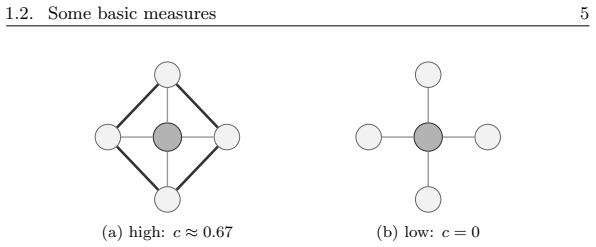
- [Ch. 1, Table 1.1] The corrected clustering coefficient in Eq. (1.8) is undefined when ω_i=0; the table would benefit from stating how such nodes are handled in the averages, especially for low-degree nodes in sparse networks.
Circularity Check
Core local-rule derivations are parameter-free and non-circular; the third edition's empirical super-fractal claim, however, rests on load-bearing self-citations and a detector ceiling that coincides with the null, so the 'roughness' reading is not established.
specific steps
-
self citation load bearing
[Ch 6.12, 'How many communities do real networks have?'; Ch 7.5, 'Five meanings of one number']
"Following Vazquez (2026a), we can now say that it does... refitting the real networks of Figure 6.11 the same way raises the exponent of Eq. (6.50) from 0.63 to 0.80... Only the nested block model, which lifts the ceiling to order n/ln n, can settle that, and re-running the census with it is the obvious next measurement."
The empirical pillar of the third edition—the super-fractal exponent β≈0.61 and the claim that lifting the flat-SBM ceiling moves it to 0.80–1—is attributed to the author's own cited papers (Vazquez 2026a and related self-citations) rather than to reproducible analysis in the book. Ch 6.12 reports the nested rerun as already done, while Ch 7.5 calls it 'the obvious next measurement,' so the load-bearing measurement is not independently established; the claim is supported mainly by an unverified self-citation chain.
full rationale
Most of the book's derivations are self-contained. The Ch2–4 mean-field calculations (Eqs 2.4, 2.7, 2.9, 3.8–3.9, 4.7, 4.9, 4.11) solve explicit balance equations and are checked by simulation; they do not fit the target exponents and then reuse them. Ch5 tests the duplication–split rule by fitting q from each of two degree distributions and checking their agreement and the critical-path scaling, a legitimate consistency test. Ch6's exact solvable cases (ring, diamond, pseudofractal) are pencil-and-paper results (Eqs 6.8, 6.12, 6.21–6.32, 6.36–6.39) with no circularity. The flagged problem is the empirical super-fractal pillar. Ch6.12 measures B∝n^β with the flat degree-corrected SBM, whose resolution ceiling is ~√n; Ch7.5 explicitly states this estimator 'cannot report more than of order √n groups' and 'is not able to report an asymptotic exponent above one half.' Since the fractal null is also √n, the measured β≈0.61 and the derived roughness α=1/β−1 (Ch7.4) cannot be certified as network properties rather than detector behavior. This is a serious limitation, and the book's own statements are inconsistent (Ch6.12 reports the nested rerun done; Ch7.5 calls it 'the obvious next measurement'). The empirical results are also cited to the author's own prior papers rather than reproduced. None of this makes the central local-rule derivations circular, but it means the third edition's headline empirical claim is not independently established.
Axiom & Free-Parameter Ledger
free parameters (9)
- q_e (surfer link-following patience, Ch 2) =
inferred > 0.5 from measured gamma ~ 2.1
- q_v and nu_s/nu_a (Ch 2) =
none
- u (triangle-closing probability, Ch 3) =
none
- q_v (self-interaction probability, Ch 4) =
none
- q_e (retention probability, Ch 4) =
none
- q (duplication probability, Ch 5) =
0.1 to 0.5 across 77 projects, most above 0.2
- epsilon (certainty threshold for r_k) =
0.05
- alpha (Beta prior parameter) =
1 in the ring calculation
- L and W (bubble model dials) =
scanned L = 1..9, W = 1..3
axioms (10)
- domain assumption Mean-field approximation: fluctuating local quantities are replaced by their averages in the growth equations, and the resulting exponents are treated as model predictions.
- domain assumption Nodes arrive at a constant rate, so birth times are uniform, P(n_i = n) = 1/n, used to convert growth laws into degree distributions.
- standard math The stationary visiting probability of a random walk with restarts satisfies the PageRank equation (Eq. 2.1).
- ad hoc to paper The evidence-ratio calculation for whether a network is split uses Beta(alpha,alpha) priors on link probabilities and a Beta prior on the label proportion (Eq. 6.3), with alpha = 1 in the ring analysis.
- domain assumption Community existence is defined detector-relative: r_k is the size where a chosen detection method reports more than one community with 95% probability (Eqs. 6.1-6.2).
- standard math The degree-corrected block model with Gamma(alpha,alpha) priors on block affinities is the null that already knows the degrees (Eq. 6.19).
- domain assumption Real networks are in the sparse, fixed-mean-degree regime, so dense or L_p graphon limits do not apply and finite-size computation is the only instrument.
- domain assumption A network is broken into communities precisely when it carries more links than nodes (extensive cyclomatic number), generalized from the ring to arbitrary networks.
- domain assumption Each network family is governed predominantly by one local rule: search for web and citations, triadic closure for social, duplication for PPI, duplication-split for schedules.
- domain assumption Static networks from a public repository, sampled for size range, are representative for estimating the community-count scaling law.
invented entities (4)
-
potential link (p-state)
no independent evidence
-
Ramsey community number r_k
no independent evidence
-
community fixed point (K,0)
no independent evidence
-
density of communities as the growth limit
no independent evidence
Cite this review
Pith. "Pith review of Local network growth: How simple rules drive network complexity." pith.science (2026). https://pith.science/paper/6F7SHTGY
@misc{pith2026260801853,
  author       = {Pith},
  title        = {Pith review of: Local network growth: How simple rules drive network complexity},
  year         = {2026},
  howpublished = {\url{https://pith.science/paper/6F7SHTGY}},
  note         = {Machine review of arXiv:2608.01853}
}
read the original abstract
The Internet, a living cell, a circle of friends, a billion-dollar construction project: these systems share almost nothing -- yet, drawn as networks, they look astonishingly alike. Each has a few giant hubs among a multitude of sparsely connected nodes, short paths between any two parts, dense local clustering, communities, and many redundant routes. For two decades such patterns have been credited to "preferential attachment," the rich getting richer -- a rule that, taken literally, asks every newcomer to survey the whole network before it links. This book makes a simpler case, and defends it one mechanism at a time: the global regularities of real networks are not imposed from above but emerge from purely local rules, in which each new node acts only on a node it has reached and that node's immediate neighbours. A surfer following links, a friend introducing a friend, a gene copied with its connections -- none consults the network as a whole, yet each builds, in the aggregate, the full and unmistakable signature of a real complex system. Written for the curious reader as much as the specialist, with the ideas told in plain language and the mathematics set aside in boxes that can be skipped, it shows how citation graphs, the web, social ties, protein interactions, and project schedules all grow themselves from the same handful of local rules -- one local decision at a time.
Figures





Reference graph
Works this paper leans on
-
[1]
Statistical mechanics of complex networks , journal =
Albert, R. Statistical mechanics of complex networks , journal =. 2002 , doi =
2002
-
[2]
Computer Networks and ISDN Systems , volume =
Brin, Sergey and Page, Lawrence , title =. Computer Networks and ISDN Systems , volume =. 1998 , doi =
1998
-
[3]
Girvan, Michelle and Newman, M. E. J. , title =. Proceedings of the National Academy of Sciences , volume =. 2002 , doi =
2002
-
[4]
Uncovering the overlapping community structure of complex networks in nature and society , journal =
Palla, Gergely and Der. Uncovering the overlapping community structure of complex networks in nature and society , journal =. 2005 , doi =
2005
-
[5]
and Girvan, Michelle and Newman, M
Jin, Emily M. and Girvan, Michelle and Newman, M. E. J. , title =. Physical Review E , volume =. 2001 , doi =
2001
-
[6]
Karrer, Brian and Newman, M. E. J. , title =. Physical Review E , volume =. 2011 , doi =
2011
-
[7]
and Walker, Morgan R
Kelley, James E. and Walker, Morgan R. , title =. Papers presented at the December 1--3, 1959, Eastern Joint IRE-AIEE-ACM Computer Conference , pages =. 1959 , doi =
1959
-
[8]
Krapivsky, P. L. and Redner, S. , title =. Physical Review E , volume =. 2001 , doi =
2001
-
[9]
de Solla , title =
Price, Derek J. de Solla , title =. Science , volume =. 1965 , doi =
1965
-
[10]
Physical Review E , volume =
Soffer, Sara Nadiv and Vazquez, Alexei , title =. Physical Review E , volume =. 2005 , doi =
2005
-
[11]
A model of large-scale proteome evolution , journal =
Sol. A model of large-scale proteome evolution , journal =. 2002 , doi =
2002
-
[12]
Molecular Biology and Evolution , volume =
Wagner, Andreas , title =. Molecular Biology and Evolution , volume =. 2001 , doi =
2001
-
[13]
ComPlexUs , volume =
Vazquez, Alexei and Flammini, Alessandro and Maritan, Amos and Vespignani, Alessandro , title =. ComPlexUs , volume =. 2003 , doi =
2003
-
[14]
, title =
Rosvall, Martin and Bergstrom, Carl T. , title =. Proceedings of the National Academy of Sciences , volume =. 2008 , doi =
2008
-
[15]
and Cohen, R
Schwartz, N. and Cohen, R. and ben-Avraham, D. and Barab. Percolation in directed scale-free networks , journal =. 2002 , doi =
2002
-
[16]
Physical Review E , volume =
Vazquez, Alexei , title =. Physical Review E , volume =. 2025 , doi =
2025
-
[17]
2026 , eprint =
Vazquez, Alexei , title =. 2026 , eprint =
2026
-
[18]
Scientific Reports , volume =
Vazquez, Alexei and Pozzana, Iacopo and Kalogridis, Georgios and Ellinas, Christos , title =. Scientific Reports , volume =. 2023 , doi =
2023
-
[19]
Physical Review E , volume =
Vazquez, Alexei and Oliveira, Joao Gama and Barabasi, Albert-Laszlo , title =. Physical Review E , volume =. 2005 , doi =
2005
-
[20]
Europhysics Letters , volume =
Vazquez, Alexei , title =. Europhysics Letters , volume =. 2001 , doi =
2001
-
[21]
2000 , eprint =
Vazquez, Alexei , title =. 2000 , eprint =
2000
-
[22]
Error and attack tolerance of complex networks , journal =
Albert, R. Error and attack tolerance of complex networks , journal =. 2000 , doi =
2000
-
[23]
Emergence of scaling in random networks , journal =
Barab. Emergence of scaling in random networks , journal =. 1999 , doi =
1999
-
[24]
Emergence of a small world from local interactions: Modeling acquaintance networks , journal =
Davidsen, J. Emergence of a small world from local interactions: Modeling acquaintance networks , journal =. 2002 , doi =
2002
-
[25]
Community structure unveils the path multiplicity in complex networks , journal =
Deng, Ye and Wu, Jun and Lu, Xin and Holme, Petter and Li, Daqing and Di, Zengru and Chen, Guanrong and Kurths, J. Community structure unveils the path multiplicity in complex networks , journal =. 2026 , doi =
2026
-
[26]
Chaos, Solitons & Fractals , volume =
Dong, Yu and Deng, Ye and Wu, Jun , title =. Chaos, Solitons & Fractals , volume =. 2025 , doi =
2025
-
[27]
Dorogovtsev, S. N. and Goltsev, A. V. and Mendes, J. F. F. , title =. Physical Review E , volume =. 2002 , doi =
2002
-
[28]
and Mendes, Jos
Dorogovtsev, Sergey N. and Mendes, Jos. Evolution of networks , journal =. 2002 , doi =
2002
-
[29]
Production and Operations Management , volume =
Ellinas, Christos , title =. Production and Operations Management , volume =. 2019 , doi =
2019
-
[30]
ACM SIGCOMM Computer Communication Review , volume =
Faloutsos, Michalis and Faloutsos, Petros and Faloutsos, Christos , title =. ACM SIGCOMM Computer Communication Review , volume =. 1999 , doi =
1999
-
[31]
, title =
Granovetter, Mark S. , title =. American Journal of Sociology , volume =. 1973 , doi =
1973
-
[32]
Physical Review E , volume =
Holme, Petter and Kim, Beom Jun , title =. Physical Review E , volume =. 2002 , doi =
2002
-
[33]
The large-scale organization of metabolic networks , journal =
Jeong, Hawoong and Tombor, B. The large-scale organization of metabolic networks , journal =. 2000 , doi =
2000
-
[34]
and Barab
Jeong, Hawoong and Mason, Sean P. and Barab. Lethality and centrality in protein networks , journal =. 2001 , doi =
2001
-
[35]
Science , volume =
Maslov, Sergei and Sneppen, Kim , title =. Science , volume =. 2002 , doi =
2002
-
[36]
Physics Reports , volume =
Fortunato, Santo , title =. Physics Reports , volume =. 2010 , doi =
2010
-
[37]
and Buhl, S
Flyvbjerg, Bent and Skamris Holm, Mette K. and Buhl, S. How common and how large are cost overruns in transport infrastructure projects? , journal =. 2003 , doi =
2003
-
[38]
Bryan and Amores, Angel and Yan, Yi-lin and Postlethwait, John , title =
Force, Allan and Lynch, Michael and Pickett, F. Bryan and Amores, Angel and Yan, Yi-lin and Postlethwait, John , title =. Genetics , volume =. 1999 , doi =
1999
-
[39]
and Krapivsky, P
Kim, J. and Krapivsky, P. L. and Kahng, B. and Redner, S. , title =. Physical Review E , volume =. 2002 , doi =
2002
-
[40]
Ohno, Susumu , title =
-
[41]
Newman, M. E. J. , title =. Proceedings of the National Academy of Sciences , volume =. 2001 , doi =
2001
-
[42]
Newman, M. E. J. , title =. Physical Review Letters , volume =. 2002 , doi =
2002
-
[43]
Newman, M. E. J. , title =. SIAM Review , volume =. 2003 , doi =
2003
-
[44]
Newman, M. E. J. , title =. Proceedings of the National Academy of Sciences , volume =. 2006 , doi =
2006
-
[45]
Physical Review Letters , volume =
Pastor-Satorras, Romualdo and Vazquez, Alexei and Vespignani, Alessandro , title =. Physical Review Letters , volume =. 2001 , doi =
2001
-
[46]
Hierarchical organization in complex networks , journal =
Ravasz, Erzs. Hierarchical organization in complex networks , journal =. 2003 , doi =
2003
-
[47]
Hierarchical organization of modularity in metabolic networks , journal =
Ravasz, Erzs. Hierarchical organization of modularity in metabolic networks , journal =. 2002 , doi =
2002
-
[48]
Physical Review E , volume =
Vazquez, Alexei and Pastor-Satorras, Romualdo and Vespignani, Alessandro , title =. Physical Review E , volume =. 2002 , doi =
2002
-
[49]
Physical Review E , volume =
Vazquez, Alexei , title =. Physical Review E , volume =. 2003 , doi =
2003
-
[50]
2002 , note =
Vazquez, Alexei , title =. 2002 , note =
2002
-
[51]
and Strogatz, Steven H
Watts, Duncan J. and Strogatz, Steven H. , title =. Nature , volume =. 1998 , doi =
1998
-
[52]
Migdal, A. A. , title =. Soviet Physics JETP , volume =
-
[53]
, title =
Kadanoff, Leo P. , title =. Annals of Physics , volume =. 1976 , doi =
1976
-
[54]
Nucleic Acids Research , volume =
Stark, Chris and Breitkreutz, Bobby-Joe and Reguly, Teresa and Boucher, Lorrie and Breitkreutz, Ashton and Tyers, Mike , title =. Nucleic Acids Research , volume =. 2006 , doi =
2006
-
[55]
Leskovec, Jure and Krevl, Andrej , title =
-
[56]
Detecting fuzzy community structures in complex networks with a
Reichardt, J. Detecting fuzzy community structures in complex networks with a. Physical Review Letters , volume =. 2004 , doi =
2004
-
[57]
and Kaufman, Miron , title =
Griffiths, Robert B. and Kaufman, Miron , title =. Physical Review B , volume =. 1982 , doi =
1982
-
[58]
, title =
Peixoto, Tiago P. , title =. 2020 , doi =
2020
-
[59]
, title =
Peixoto, Tiago P. , title =. figshare , year =
-
[60]
Vazquez, Alexei , title =
-
[61]
, title =
Watts, Duncan J. , title =. American Journal of Sociology , volume =. 1999 , doi =
1999
-
[62]
, title =
Peixoto, Tiago P. , title =. Physical Review Letters , volume =. 2013 , doi =
2013
-
[63]
Journal of Combinatorial Theory, Series B , volume =
Lov\'asz, L\'aszl\'o and Szegedy, Bal\'azs , title =. Journal of Combinatorial Theory, Series B , volume =. 2006 , doi =
2006
-
[64]
and Lov\'asz, L\'aszl\'o and S\'os, Vera T
Borgs, Christian and Chayes, Jennifer T. and Lov\'asz, L\'aszl\'o and S\'os, Vera T. and Vesztergombi, Katalin , title =. Advances in Mathematics , volume =. 2008 , doi =
2008
-
[65]
, title =
Aldous, David J. , title =. Journal of Multivariate Analysis , volume =. 1981 , doi =
1981
-
[66]
Rendiconti di Matematica e delle sue Applicazioni , volume =
Diaconis, Persi and Janson, Svante , title =. Rendiconti di Matematica e delle sue Applicazioni , volume =
-
[67]
and Wolfe, Patrick J
Olhede, Sofia C. and Wolfe, Patrick J. , title =. Proceedings of the National Academy of Sciences , volume =. 2014 , doi =
2014
-
[68]
, title =
Gao, Chao and Lu, Yu and Zhou, Harrison H. , title =. The Annals of Statistics , volume =. 2015 , doi =
2015
-
[69]
Chatterjee, Sourav and Varadhan, S. R. S. , title =. European Journal of Combinatorics , volume =. 2011 , doi =
2011
-
[70]
, title =
Peixoto, Tiago P. , title =. Physical Review X , volume =. 2014 , doi =
2014
-
[71]
Electronic Journal of Probability , volume =
Benjamini, Itai and Schramm, Oded , title =. Electronic Journal of Probability , volume =. 2001 , doi =
2001
-
[72]
Sparse graphs using exchangeable random measures , journal =
Caron, Fran. Sparse graphs using exchangeable random measures , journal =. 2017 , doi =
2017
-
[73]
and Cohn, Henry and Zhao, Yufei , title =
Borgs, Christian and Chayes, Jennifer T. and Cohn, Henry and Zhao, Yufei , title =. Transactions of the American Mathematical Society , volume =. 2019 , doi =
2019
-
[74]
and Cohn, Henry and Zhao, Yufei , title =
Borgs, Christian and Chayes, Jennifer T. and Cohn, Henry and Zhao, Yufei , title =. The Annals of Probability , volume =. 2018 , doi =
2018
-
[75]
Proceedings of the National Academy of Sciences , volume =
Palla, Gergely and Lov\'asz, L\'aszl\'o and Vicsek, Tam\'as , title =. Proceedings of the National Academy of Sciences , volume =. 2010 , doi =
2010
-
[76]
Action convergence of operators and graphs , howpublished =
Backhausz,. Action convergence of operators and graphs , howpublished =. 2018 , eprint =
2018
-
[77]
, title =
Peixoto, Tiago P. , title =. Physical Review X , volume =. 2022 , doi =
2022
-
[78]
Karrer, Brian and Newman, M. E. J. , title =. Physical Review E , volume =. 2010 , doi =
2010
-
[79]
Resolution limit in community detection , journal =
Fortunato, Santo and Barth. Resolution limit in community detection , journal =. 2007 , doi =
2007
-
[80]
and Shen-Orr, S
Milo, R. and Shen-Orr, S. and Itzkovitz, S. and Kashtan, N. and Chklovskii, D. and Alon, U. , title =. Science , volume =. 2002 , doi =
2002
discussion (0)
Sign in with ORCID, Apple, or X to comment. Anyone can read and Pith papers without signing in.