REVIEW 2 major objections 5 minor 44 references
High-dimensional permutons: theory and applications
T0 review · 2 major / 5 minor · reviewed 2026-08-10 · deepseek-v4-flash
Pith's one-line read This paper introduces d-dimensional permutons—probability measures on [0,1]^d with uniform one-dimensional marginals—and proves that, as in the two-dimensional case, weak convergence of random d-dimensional permutations is equivalent to…
desk verdict A clean d-dimensional permuton theory plus two genuinely new limit theorems, with one under-proved conditioning transfer in the Schnyder wood proof that needs referee attention. read the letter →
The pith
A machine-rendered reading of the paper's core claim, the machinery that carries it, and where it could break.
The reading
What carries the argument
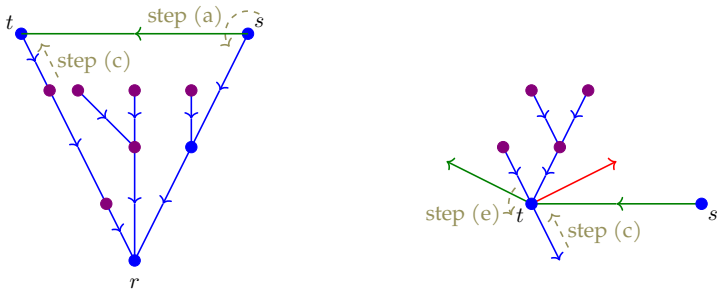
The carrying objects are coalescent-walk processes: collections of one-dimensional random walks that start at specified points, never cross, and stick together once they meet, together with the total orders they induce on their starting points. For Schnyder wood permutations, a bijective chain links triangulations to strings, then to a two-dimensional walk, then to a green and a red coalescent-walk process driven by the same walk in opposite time directions; patterns of the permutation are read from the signs of sample paths at random starting points. The scaling limit of these processes is identified through the SDE system defining skew Brownian permutons, with the conditioning transfer handled by absolute-continuity arguments. For $d$-separable permutations, the bijection with sign trees and swap trees, combined with conditioned Galton--Watson trees whose asymptotic shape is binary, yields the Brownian excursion construction of the Brownian separable $d$-permuton.
What would settle it
Compute the expected frequency of the inversion pattern $(2,1)$ in the green marginal of a large uniform Schnyder wood permutation: the paper predicts $2/3$ because the skew Brownian permuton parameter gives $E[\mathrm{freq}((2,1),\mu^g_{\rho,q})] = 1/3$ and the reflection in Eq. (7) flips it to $2/3$. A Monte Carlo estimate that persistently deviates from $2/3$ as $n$ grows would falsify Theorem 1.9. Alternatively, simulate the limiting coalescent-walk processes driven by a Brownian excursion of correlation $-\sqrt{2}/2$ and compare the induced pattern distribution with $P_{\mu_S}[k]$ for small $k$.
Extended reading notes
Core claim
The central discovery is that a coherent high-dimensional permuton theory exists and has nontrivial, explicit examples. Theorem 1.5 characterizes convergence of random $d$-dimensional permutations by convergence of expected pattern frequencies. Theorem 1.9 identifies the Schnyder wood permuton $\mu_S$ as the limit of uniform Schnyder wood permutations: it is the Lebesgue measure pushed through $(t, \phi^g_{\rho,q}(1-t), 1-\phi^r_{\rho,q}(t))$, where $\phi^g$ and $\phi^r$ come from coupled skew Brownian permutons driven by a Brownian excursion of correlation $\rho = -\sqrt{2}/2$ and its time-reversal, with $q = 1/(1+\sqrt{2})$. Theorem 1.14 shows that uniform $d$-separable permutations converge to the Brownian separable $d$-permuton $\mu^B_{1/2,\dots,1/2}$, built from a single Brownian excursion whose local minima carry independent uniform sign vectors.
Load-bearing premise
The load-bearing premise is that the unconditioned coalescent-walk convergence transfers to the conditioned setting uniformly over the random starting points used to read off patterns; if that conditioning transfer fails, identifying the limiting law of pattern frequencies in Theorem 1.9 breaks.
Editorial extensions
If this is right
- Uniform 3-dimensional Schnyder wood permutations converge in distribution to an explicit random 3-permuton, so the bijective encoding of triangulations has a continuum counterpart at the permuton level.
- The two 2-dimensional marginals of the Schnyder wood permuton are skew Brownian permutons of known parameters, and the full 3-permuton is determined by either one of those marginals.
- Uniform $d$-separable permutations converge to the Brownian separable $d$-permuton with all parameters $1/2$, giving an honest $d$-dimensional random limit whose lower-dimensional marginals do not determine the whole object.
- The high-dimensional permuton theory reduces convergence problems to the computation of expected pattern frequencies, so future families of high-dimensional permutations can be handled by enumerative estimates.
- The results extend known universality of skew Brownian permutons and Brownian separable permutons to higher-dimensional permutation classes.
- The Schnyder wood permuton admits a geometric description in which the two marginals are obtained by comparing space-filling SLE curves of angles $0$, $2\pi/3$, and $4\pi/3$, linking the limit to SLE-decorated Liouville quantum gravity surfaces.
Reading between the lines
- The time-reversal coupling between the two marginals suggests that other decorated planar map encodings might produce high-dimensional permutons whose coordinates are all functions of a single driving excursion; this is an editorial extrapolation, not stated in the paper.
- The Brownian separable $d$-permuton with parameters $1/2$ is a plausible limit for other substitution-closed classes of high-dimensional permutations, with class-specific parameters; the paper states this as a conjecture.
- A testable extension is to estimate, for moderately large $n$, the joint distribution of green and red pattern frequencies in uniform Schnyder wood permutations and compare it with the coupled skew Brownian permuton prediction, which would probe the strength of the dependence between the two marginals.
- The theory likely applies to other high-dimensional permutation models defined via bijections with walks, where a finite set of coalescent-walk processes driven by a single walk could each encode one coordinate of the limiting permuton.
Editorial analysis
A structured set of objections, weighed in public.
Referee Report
Summary. The paper develops a theory of d-dimensional permutons for all d ≥ 2, proving that weak convergence of random d-permuton measures is characterized by convergence of all pattern frequencies, in expectation or in distribution (Theorem 1.5). It then applies this theory to two natural families: uniform 3-dimensional Schnyder wood permutations, which are shown to converge to a random 3-permuton built from two coupled skew Brownian permutons with parameters ρ = −√2/2 and q = 1/(1+√2) (Theorem 1.9), and uniform d-separable permutations, which are shown to converge to the Brownian separable d-permuton with all parameters 1/2 (Theorem 1.14). The proofs use bijections to two-dimensional walks and coalescent-walk processes for the Schnyder wood case, and bijections to conditioned Galton–Watson trees for the separable case.
Significance. This is a substantial contribution if the main results hold. The paper provides the first general high-dimensional permuton framework and identifies explicit random limiting permutons for two combinatorially meaningful classes of high-dimensional permutations. The limiting objects are connected to skew Brownian permutons, SLE-decorated LQG surfaces, and the continuum random tree, giving new evidence for universality of these 2D permuton families. The proof of Theorem 1.5 is detailed and self-contained, and the combinatorial bijections (Proposition 4.1, Proposition 5.4) are nontrivial and well motivated. The paper also contains explicit calculations, such as the expected inversion frequency in Remark 1.16, and it is honest about places where proofs are abbreviated or deferred to previous works.
major comments (2)
- [§4.3, Corollary 4.19] Corollary 4.19 is the load-bearing step in the proof of Theorem 1.9, but its proof is explicitly a sketch. The argument transfers unconditioned coalescent-walk convergence (Proposition 4.9) to the conditioned walk by absolute continuity between Brownian motion and Brownian excursion on [ε, 1−ε], and then asserts that 'measurability of the coalescent-walk processes in terms of the driving walks carries over from the discrete case to the scaling limit.' This is not demonstrated. The delicate point is that the paths are read at the random starting points j_n and 2n−j_n, which are functionals of the conditioned walk itself, and the identification of the limiting signs in Eqs. (35)–(36) requires convergence of the discrete maps W ↦ Z^{(j_n(u))} to the SDE solution map of Eq. (15) in a topology that handles the random starting point. A reference to [Bor22, Appendix E] is not sufficient for a step on which the characterization of ρ_k = P_{μ_S}[k] rests. I ask the authors to provide a complete proof of Corollary 4.19, including the required continuity or uniform-in-u estimates, or to restructure the argument so that this conditioning transfer is proved directly.
- [§5.2, Theorem 1.14 proof] The proof of Theorem 1.14 depends on an unproved structural assertion about the random induced subtree T_{n,I}: that, with high probability, T_{n,I} is a uniform binary plane tree with k leaves plus an extra root vertex, that the relevant internal vertices of T_n are pairwise at distance at least n^{1/4}, and that the parities of the numbers of 1s in the intervening swap sequences are asymptotically independent and uniform. The manuscript says this is 'well-known' and cites [Ald91a] and [BBFS20, Section 4], but the precise form needed here—especially the independence of the parities along long paths in a conditioned Galton–Watson tree—is not stated as a lemma, nor is it derived. Since this is the mechanism that makes the limiting signs uniform and independent in Proposition 5.8 for the case p_i = 1/2, this is another load-bearing point in a main theorem and should be proved or stated with a fully matching reference.
minor comments (5)
- [§4.1, Lemma 4.10] In the proof of Lemma 4.10, the sentence 'which occurs if and only if n − j is a starting point in WCg(W′)' should read '2n − j' rather than 'n − j'.
- [§4.2.1, Definition 4.12] In Definition 4.12, the infinite red coalescent-walk process is denoted Z^{*,r}_n = WCr(W^{*,r}); the subscript n is a typo and should be omitted, since this process is defined on the infinite interval [0,∞).
- [§4.2.2, Proposition 4.17] In the proof of Proposition 4.17, the truncation of the Riemann sum in Eq. (26) by dropping the first and last n^{1/4} terms is stated with an O(n^{-1/4}) error, but the justification is only sketched via the asymptotic bounds P(Z_k = 0) = O(k^{-1/2}). A short explicit estimate would make this easier to verify.
- [§4.3, Corollaries 4.19–4.20] The limiting coalescent-walk paths are defined on [0,1], so the target space C((0,1),R)^2 in Corollary 4.19 is unnecessarily weak; stating convergence in C([0,1],R)^2 would be cleaner and would match the subsequent use of the paths at all times.
- [§1.2.1, Eq. (7)] The notation μ_S = (μ^g_S, μ^r_S) is informal: μ_S is a measure on [0,1]^3, not literally a pair of measures. The intended meaning is clear from Eq. (6), but a short clarifying sentence would avoid confusion.
Circularity Check
No significant circularity; the high-dimensional permuton limits are derived from model bijections and external scaling results, not from the target limits.
full rationale
The derivation chain for Theorem 1.9 starts from a bijective encoding of Schnyder wood triangulations by walks (Propositions 4.1-4.6), proves an unconditioned coalescent-walk scaling limit (Proposition 4.9) with parameters rho = -sqrt(2)/2 and q = 1/(1+sqrt(2)) computed from the step distribution and from [LSW24]/[Bor23] (Remark 3.4, Lemmas 4.14-4.17), and then transfers to the conditioned setting by absolute continuity (Corollary 4.19). The limiting object mu_S is defined in terms of the SDE solutions Z_{rho,q}, but the SDE solutions are not assumed to be the limit; the discrete coalescent walks are shown to converge to them. The transfer in Corollary 4.19 is sketched and partly deferred to [Bor22, Appendix E], a prior paper by one of the authors, and the measurability assertion is not fully expanded; however, this is a technical proof deferral rather than a definitional or fitted-input circularity. The parameters are not fitted to the new target permuton. Similarly, Theorem 1.14 uses the bijection of d-separable permutations with labeled trees (Propositions 5.1 and 5.4), samples uniform trees via conditioned Galton-Watson processes (Proposition 5.7), and identifies the limiting pattern law with that of the Brownian separable d-permuton via Proposition 5.8; the target permuton is defined before and independently of the convergence proof. No load-bearing step reduces by construction to the claimed conclusion.
Assumptions & free parameters
assumptions (5)
- standard math Existence, uniqueness, and non-crossing/coalescence of the SDE system defining skew Brownian permutons.
- domain assumption mu_{rho,q} almost surely determines its driving two-dimensional Brownian excursion.
- domain assumption The SLE/LQG parameter identification q_{gamma=1}(2pi/3) = 1/(1+sqrt(2)).
- domain assumption Brownian excursion and Brownian motion of the same correlation are absolutely continuous on compact subintervals, and coalescent-walk measurability transfers to the scaling limit.
- domain assumption Uniform k-leaf patterns from conditioned Galton-Watson swap trees converge to uniform binary trees with asymptotically independent uniform sign labels.
Cite this review
Pith. "Pith review of High-dimensional permutons: theory and applications." pith.science (2026). https://pith.science/paper/6F7U5UU7
@misc{pith2026241219730,
  author       = {Pith},
  title        = {Pith review of: High-dimensional permutons: theory and applications},
  year         = {2026},
  howpublished = {\url{https://pith.science/paper/6F7U5UU7}},
  note         = {Machine review of arXiv:2412.19730}
}
abstract
Permutons, which are probability measures on the unit square $[0, 1]^2$ with uniform marginals, are the natural scaling limits for sequences of (random) permutations. We introduce a $d$-dimensional generalization of these measures for all $d \ge 2$, which we call $d$-dimensional permutons, and extend -- from the two-dimensional setting -- the theory to prove convergence of sequences of (random) $d$-dimensional permutations to (random) $d$-dimensional permutons. Building on this new theory, we determine the random high-dimensional permuton limits for two natural families of high-dimensional permutations. First, we determine the $3$-dimensional permuton limit for Schnyder wood permutations, which bijectively encode planar triangulations decorated by triples of spanning trees known as Schnyder woods. Second, we identify the $d$-dimensional permuton limit for $d$-separable permutations, a pattern-avoiding class of $d$-dimensional permutations generalizing ordinary separable permutations. Both high-dimensional permuton limits are random and connected to previously studied universal 2-dimensional permutons, such as the Brownian separable permutons and the skew Brownian permutons, and share interesting connections with objects arising from random geometry, including the continuum random tree, Schramm--Loewner evolutions, and Liouville quantum gravity surfaces.
Figures


Figures from the paper (16 more)




Reference graph
Works this paper leans on
-
[1]
D. Aldous. The Continuum random tree II: an overview , page 23–70. London Mathematical Society Lecture Note Series. Cambridge University Press, 1991
work page 1991
-
[2]
D. Aldous. The Continuum Random Tree. I . The Annals of Probability , 19(1):1 -- 28, 1991
work page 1991
-
[3]
A. Asinowski and T. Mansour. Separable d-permutations and guillotine partitions. Annals of Combinatorics , 14(1):17--43, March 2010
work page 2010
-
[4]
D. Avis and M. Newborn. On pop-stacks in series. Utilitas Mathematica , 19:129--140, 1981
work page 1981
-
[5]
F. Bassino, M. Bouvel, V. F \'e ray, L. Gerin, and A. Pierrot. The Brownian limit of separable permutations . The Annals of Probability , 46(4):2134 -- 2189, 2018
work page 2018
-
[6]
F. Bassino, M. Bouvel, V. F \' e ray, L. Gerin, M. Maazoun, and A. Pierrot. Universal limits of substitution-closed permutation classes. Journal of the European Mathematical Society , 22(11):3565--3639, August 2020
work page 2020
-
[7]
F. Bassino, M. Bouvel, V. F \'e ray, L. Gerin, M. Maazoun, and A. Pierrot. Scaling limits of permutation classes with a finite specification: a dichotomy. Advances in Mathematics , 405:108513, 2022
work page 2022
- [8]
Show all 44 references
-
[9]
Borga, E
J. Borga, E. Duchi, and E. Slivken. Almost square permutations are typically square. Annales de l’Institut Henri Poincaré, Probabilités et Statistiques , 57(4), November 2021
2021
-
[10]
Borga and E
J. Borga and E. Gwynne. Reconstructing SLE -decorated L iouville quantum gravity surfaces from random permutons. arXiv preprint:2409.15494 , 2024
2024 arXiv
-
[11]
Borga, E
J. Borga, E. Gwynne, and X. Sun. Permutons, meanders, and SLE -decorated L iouville quantum gravity. arXiv preprint:2207.02319 , 2022
2022 arXiv
-
[12]
Borga, N
J. Borga, N. Holden, X. Sun, and P. Yu. Baxter permuton and L iouville quantum gravity. Probability Theory and Related Fields , 186(3):1225--1273, 2023
2023
-
[13]
Billingsley
P. Billingsley. Convergence of probability measures . Wiley Series in Probability and Statistics: Probability and Statistics. John Wiley & Sons Inc., New York, second edition, 1999. A Wiley-Interscience Publication
1999
-
[14]
Bonichon and P.-J
N. Bonichon and P.-J. Morel. Baxter d -permutations and other pattern avoiding classes. Journal of Integer Sequences , 25(8), 2022
2022
-
[15]
Borga and M
J. Borga and M. Maazoun. Scaling and local limits of Baxter permutations and bipolar orientations through coalescent-walk processes . The Annals of Probability , 50(4):1359 -- 1417, 2022
2022
-
[16]
Bolthausen
E. Bolthausen. On a Functional Central Limit Theorem for Random Walks Conditioned to Stay Positive . The Annals of Probability , 4(3):480 -- 485, 1976
1976
-
[17]
Bonichon
N. Bonichon. A bijection between realizers of maximal plane graphs and pairs of non-crossing D yck paths. Discrete Mathematics , 298(1):104--114, 2005. Formal Power Series and Algebraic Combinatorics 2002 (FPSAC'02)
2005
-
[18]
J. Borga. The permuton limit of strong-Baxter and semi-Baxter permutations is the skew Brownian permuton . Electronic Journal of Probability , 27:1--53, 2022
2022
-
[19]
J. Borga. The skew B rownian permuton: A new universality class for random constrained permutations. Proceedings of the London Mathematical Society , 126, 2023
2023
-
[20]
Borga and E
J. Borga and E. Slivken. Square permutations are typically rectangular. The Annals of Applied Probability , 30(5), October 2020
2020
-
[21]
R. Doney. One-sided local large deviation and renewal theorems in the case of infinite mean. Probability Theory and Related Fields , 107(11):451--465, April 1997
1997
-
[22]
R. A. Doney. Local behaviour of first passage probabilities. Probability Theory and Related Fields , 152:559--588, 2012
2012
-
[23]
Duraj and V
J. Duraj and V. Wachtel. Invariance principles for random walks in cones. Stochastic Processes and their Applications , 130(7):3920--3942, 2020
2020
-
[24]
Elboim and A
D. Elboim and A. Sly. Infinite cycles in the interchange process in five dimensions. arXiv preprint:2211.17023 , 2024
2024 arXiv
-
[25]
Fischer and G
M. Fischer and G. Nappo. On the moments of the modulus of continuity of itô processes. Stochastic Analysis and Applications - STOCHASTIC ANAL APPL , 28, 08 2008
2008
-
[26]
Felsner and F
S. Felsner and F. Zickfeld. Schnyder woods and orthogonal surfaces. Discrete & Computational Geometry , 40:103--126, 2008
2008
-
[27]
Garbe, R
F. Garbe, R. Hancock, J. Hladk\'y, and M. Sharifzadeh. Limits of latin squares. Discrete Analysis , July 2023
2023
-
[28]
Hammond and T
A. Hammond and T. Helmuth. Directed spatial permutations on asymmetric tori. arXiv preprint:2306.03064 , 2024
2024 arXiv
-
[29]
Hoppen, Y
C. Hoppen, Y. Kohayakawa, C. G. Moreira, B. Ráth, and R. Menezes Sampaio . Limits of permutation sequences. Journal of Combinatorial Theory, Series B , 103(1):93--113, 2013
2013
-
[30]
D. P. Kennedy. The D istribution of the M aximum B rownian E xcursion. Journal of Applied Probability , 13(2):371--376, 1976
1976
-
[31]
A. Lejay. On the constructions of the skew Brownian motion . Probability Surveys , 3(none):413 -- 466, 2006
2006
-
[32]
J.-F. Le Gall. Random trees and applications . Probability Surveys , 2(none):245 -- 311, 2005
2005
-
[33]
Y. Li, X. Sun, and S. S. Watson. Schnyder woods, SLE (16), and L iouville quantum gravity . Trans. Am. Math. Soc. , 377(04):2439--2493, April 2024, 1705.03573
2024 arXiv
-
[34]
M. Maazoun. On the B rownian separable permuton. Combinatorics, Probability and Computing , 29(2):241--266, 2020
2020
-
[35]
Miller and S
J. Miller and S. Sheffield. Liouville quantum gravity spheres as matings of finite-diameter trees . Annales de l'Institut Henri Poincaré, Probabilités et Statistiques , 55(3):1712 -- 1750, 2019
2019
-
[36]
L. R. Matheson and R. E. Tarjan. Dominating sets in planar graphs. European Journal of Combinatorics , 17(6):565--568, 1996
1996
-
[37]
Ngo and M
H.-L. Ngo and M. Peign\'e. Limit theorem for perturbed random walks. Theory of Stochastic Processes , 24(2):61--78, 2019
2019
-
[38]
Nagamochi, T
H. Nagamochi, T. Suzuki, and T. Ishii. A simple recognition of maximal planar graphs. Information Processing Letters , 89(5):223--226, 2004
2004
-
[39]
Schnyder
W. Schnyder. Planar graphs and poset dimension. Order , 5(4):323 -- 343, 1989
1989
-
[40]
M. Shimura. Excursions in a cone for two-dimensional Brownian motion . Journal of Mathematics of Kyoto University , 25(3):433 -- 443, 1985
1985
-
[41]
S. Starr. Thermodynamic limit for the M allows model on S_n . Journal of Mathematical Physics , 50(9), July 2009
2009
-
[42]
J. B. Walsh. A diffusion with a discontinuous local time. In Temps locaux , number 52-53 in Ast\'erisque, pages 37--45. Soci\'et\'e math\'ematique de France, 1978
1978
-
[43]
B. Yao, H. Chen, C.-K. Cheng, and R. Graham. Floorplan representations: Complexity and connections. ACM Trans. Des. Autom. Electron. Syst. , 8(1):55–80, January 2003
2003
-
[44]
write newline
" write newline "" before.all 'output.state := FUNCTION output.nonempty.mrnumber duplicate missing pop "" 'skip if duplicate empty 'pop " " swap * " " * write if FUNCTION fin.entry add.period write mrnumber output.nonempty.mrnumber newline FUNCTION new.block output.state befor...
Reviewed August 10, 2026 · model on record in the stance chip above.
Discussion (0). Continue with ORCID to comment.