REVIEW 3 major objections 4 minor 72 references
Deep Optics for Single-shot High-dynamic-range Imaging
T0 review · 3 major / 4 minor · reviewed 2026-08-14 · deepseek-v4-flash
Pith's one-line read The paper claims that a fabricated diffractive optical element, jointly optimized with a neural decoder, lets an ordinary camera recover high-dynamic-range detail from a single saturated exposure.
desk verdict First end-to-end deep optics for single-shot HDR, with a clever learned grating PSF and a real prototype; simulation support is strong, hardware support is qualitative but sufficient to justify peer review. read the letter →
The pith
A machine-rendered reading of the paper's core claim, the machinery that carries it, and where it could break.
The reading
What carries the argument
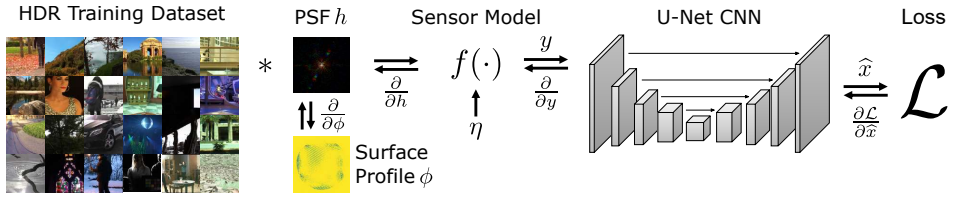
Central machinery is the optimized point spread function, defined through a differentiable wave-optics model: $t_\varphi(u,v,\lambda)=A_\varphi(u,v)\exp(ik(n(\lambda)-1)\varphi(u,v))$ encodes the DOE surface height $\varphi$ as a phase delay, and the full PSF is $h_\varphi=\left|P_{d_s}\{t_l P_{d_\varphi}\{t_\varphi e^{ikz}\}\}\right|^2$, the squared modulus of the propagated field. The height map $\varphi$ is a trainable parameter, so backpropagation can adjust the PSF jointly with the decoder weights. The discovered PSF contains a central peak plus lower-amplitude satellite peaks at wavelength-dependent positions, which is exactly what creates the shifted, scaled image copies; a smoothness penalty on the second spatial derivative of $\varphi$ and clipping of its height range keep the surface manufacturable.
What would settle it
Capture with the fabricated DOE a scene containing a bright patch large enough that the shifted, scaled copies of the patch also saturate; if the decoder then returns smooth hallucinated content instead of recovering the patch's structure, the claim that the PSF preserves saturated detail in single-shot capture fails in exactly the regime the method is designed for.
Extended reading notes
Core claim
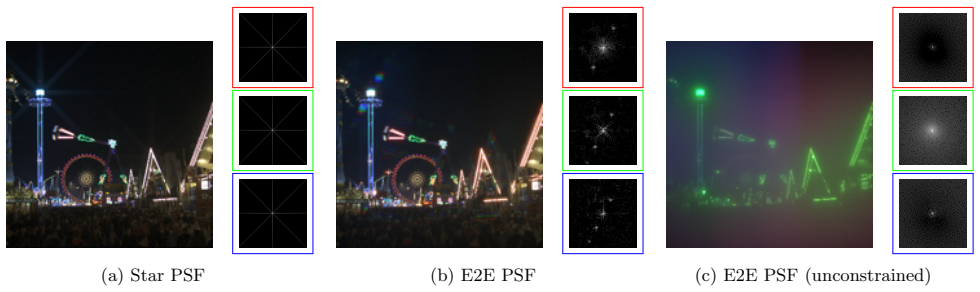
The central discovery is that single-shot HDR recovery need not be an ill-posed inpainting problem. By treating the camera's point spread function as a trainable optical encoder and a convolutional network as the decoder, the optimization discovers a grating-like surface profile whose PSF superimposes several shifted and scaled copies of the scene on the sensor. Bright details that would otherwise saturate are thus carried into unsaturated neighboring pixels as faint copies; the decoder then removes the copies and reconstructs the saturated regions. In the paper's simulations and prototype experiments, this joint design recovers filament and light-source structures that a CNN operating on a conventional LDR frame cannot, because the network is forced to hallucinate rather than decode. The authors report quantitative gains over both the CNN-only baseline and the hand-designed star PSF, under physically realizable height and smoothness constraints on the fabricated element.
Load-bearing premise
The load-bearing premise is that the simulated optics model predicts the real camera's light-spread pattern closely enough that a network trained on simulated images, even after recalibration with a measured pattern, can decode real photographs.
Editorial extensions
If this is right
- A camera fitted with the learned DOE captures information about scene radiance above the sensor's saturation level, so saturated regions can be reconstructed from the encoded copies rather than guessed by the network.
- The optimized PSF acts as a hardware multiplexer: the single sensor frame contains the scene at several effective exposure levels, defined by the positions and relative strengths of the PSF's satellite peaks.
- Because the reconstruction network is matched to a specific PSF, the same fabricated element can be used with an ordinary camera after a comparatively fast recalibration that refines the network using the measured PSF.
- The method's working range is tied to the training data; the authors note that extremely large saturated regions, where even the shifted copies saturate, remain a failure mode.
Reading between the lines
- One implication the authors leave implicit is that the learned grating PSF is a form of exposure bracketing: the positions and relative intensities of the satellite peaks set the effective exposure ratio, so future designs could tune those parameters directly instead of relying on the optimizer.
- The same autoencoder formulation transfers to any sensor bottleneck that destroys information in a known way; a natural next step is to train the optic for saturated spectral channels or for clipping in time-of-flight sensors, replacing the HDR loss with the target task's loss.
- A testable extension suggested by the paper's calibration step is to train the decoder under simulated PSF perturbations such as lens-to-DOE distance errors, focus drift, or temperature-induced surface changes; if the decoder tolerates these, per-camera recalibration could be skipped.
Signed reviews
Editorial analysis
A structured set of objections, weighed in public.
Referee Report
Summary. This paper proposes an end-to-end deep optics pipeline for single-shot high-dynamic-range (HDR) imaging. A diffractive optical element (DOE) with an optimized surface profile is placed in front of a conventional camera, and the resulting point spread function (PSF) is jointly optimized with a U-Net decoder using a differentiable Fourier optics model. The optimized PSF creates several shifted and scaled copies of the scene, encoding information from saturated bright regions into nearby unsaturated pixels. The authors report simulation experiments on a 223-image held-out test set, comparing against LDR images, HDR-CNN, a U-Net baseline, and a star-shaped PSF from Rouf et al., and report improvements in HDR-VDP-2 and PSNR. They also fabricate the DOE from PDMS, attach it to an SLR, calibrate with a measured PSF, and show indoor and outdoor example reconstructions. The paper acknowledges limitations including unknown DOE-lens distance, shift-variant glare, and sensitivity to training-set distribution.
Significance. Assuming the quantitative claims hold after revision, this is a valuable contribution to computational photography. It is, to my knowledge, the first demonstration of end-to-end optimized optics for single-shot HDR imaging, and the learned multiplexing PSF is an elegant solution that turns saturation recovery into a better-conditioned deconvolution problem rather than pure hallucination. The simulation study is well designed: a held-out test set of 223 images, three metrics, and comparisons to a CNN-only method and a prior PSF-engineering baseline, with the U-Net retrained for each PSF for fairness. The physical prototype, including profilometer measurements and measured-PSF refinement, is a significant engineering step. The main gap is that the real-capture evaluation is only qualitative, which currently limits the strength of the paper's central claim.
major comments (3)
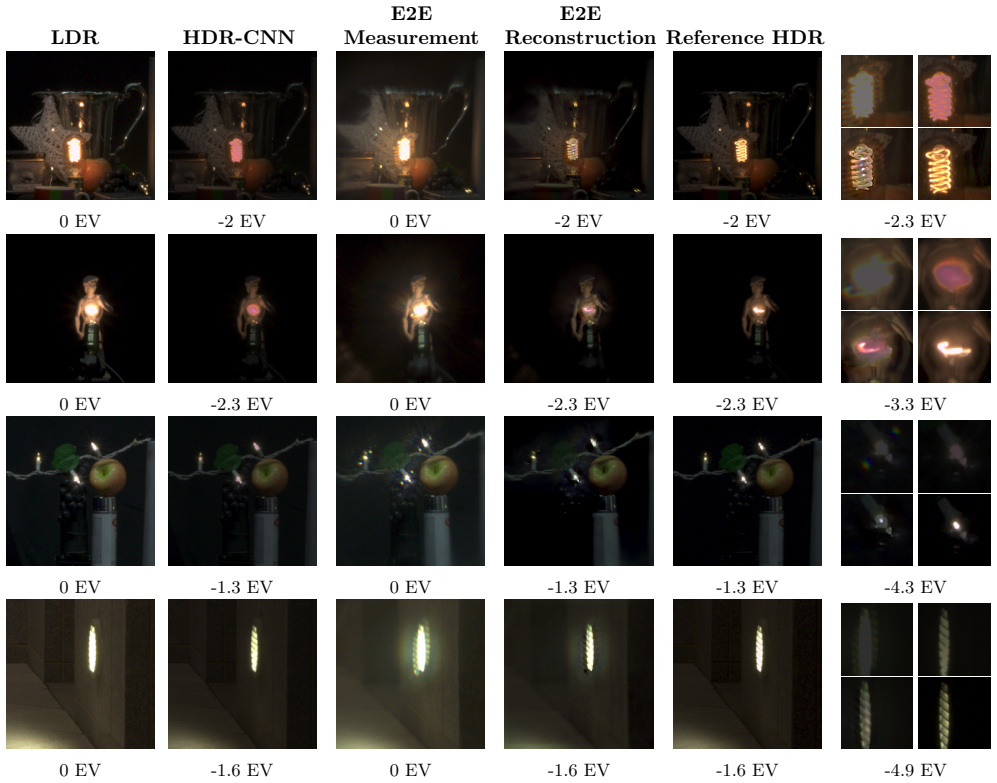
- [Section 6] The physical prototype results in Section 6 and Figures 1 and 7 are presented only as side-by-side images for four scenes. No quantitative metrics are reported for the real captures, and neither HDR-CNN nor the star-PSF baseline is applied to the same real measurements. Since the abstract states that the approach 'outperforms both purely CNN-based approaches and other PSF engineering approaches' and that this is demonstrated 'with a physical prototype,' the real-capture evidence is load-bearing but currently missing a quantitative comparison. Please add a real-capture evaluation using the same metrics as Table 1 (HDR-VDP-2, PSNR in linear and gamma-corrected domains) or a clearly justified alternative, with scene-by-scene results and baselines run on identical captures.
- [Sections 3.1 and 5] The paper acknowledges in Section 5 that the exact DOE-to-lens distance is unknown, that the captured PSF is slightly blurrier and shift-variant because of fabrication errors and glare, and that a more detailed lens model would require proprietary information. This model mismatch is exactly where the physical claim must be stress-tested, yet no experiment quantifies its effect on reconstruction quality. I request an explicit robustness analysis, for example comparing reconstructions obtained with the simulated-PSF-trained network against those obtained with the measured-PSF-refined network on the same test scenes, or measuring reconstruction error as a function of controlled PSF perturbation. This would establish how far the method can be pushed beyond the demonstrated calibration regime.
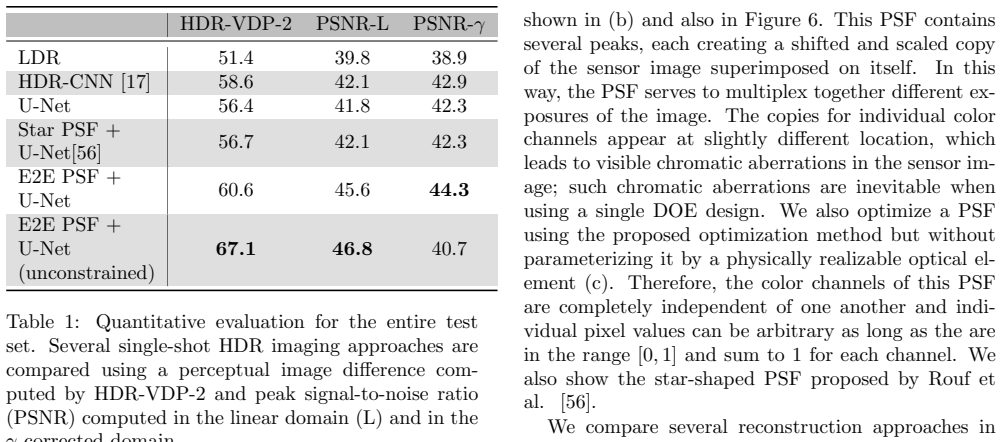
- [Table 1] Table 1 reports only mean scores over the 223-image test set, with no standard deviations, standard errors, or per-image distributions. For the HDR-VDP-2 and PSNR-gamma comparisons, the differences between methods are smaller than the PSNR-linear gap, and without variance information the reader cannot assess whether the reported ordering is statistically reliable. Please report error bars or a significance test, and consider showing per-image scatter plots or box plots for the main comparisons.
minor comments (4)
- [Section 3.1] Eq. (1) uses h for the PSF while Eq. (6) defines h_phi(x,y); please clarify the relationship between these two quantities and state the PSF normalization convention (e.g., energy conservation or sum-to-one for each color channel).
- [Section 3.3] The explanation that the per-batch sum of l2 norms encourages group-sparse solutions and makes the training robust to outliers is plausible but terse; a sentence connecting Eq. (7) to the cited sparse-group lasso framework, or an ablation of the loss exponent, would help the reader understand the design choice.
- [Section 6] In Figure 7, the exposure values are labeled inconsistently across rows (e.g., -2.3 EV, -3.3 EV, -1.3 EV, -4.3 EV). Please define the EV offsets relative to the LDR exposure and apply the same convention to all panels.
- [Section 2] The related work on single-shot HDR discusses reverse tone mapping and CNN hallucination methods, but the quantitative comparison is limited to Eilertsen et al.; if other learning-based single-shot methods are not compared, please state explicitly whether their pre-trained models or training pipelines are unavailable.
Circularity Check
No significant circularity: the central comparison is a held-out simulation benchmark plus an external physical prototype, and no load-bearing step reduces to its own inputs.
full rationale
The paper's main quantitative claim (Table 1) is an evaluation on a 223-image held-out test set that was not used for training, comparing HDR-CNN, U-Net, star-PSF plus U-Net, and the E2E PSF plus U-Net. All reconstruction networks are trained for their respective PSFs, including the star-PSF baseline, so the comparison is not skewed by construction. The E2E PSF is optimized on a training set and then evaluated on separate test images generated through the same forward model; this is a standard empirical evaluation protocol, not a case where a fitted parameter is renamed as a prediction. The physical prototype, despite its qualitative-only experimental reporting, is an external benchmark that is independent of the differentiable simulation used in training, and the paper explicitly acknowledges calibration mismatches, blur, glare, and shift variance rather than suppressing them. Self-citations to prior deep-optics work provide a well-established differentiable-propagation framework and are not used to forbid alternatives or to import an unverified uniqueness theorem. The weakness that real-prototype results lack quantitative metrics is an evidence-strength concern, not a circularity concern. Therefore no circular step is present and the score is 0.
Assumptions & free parameters
free parameters (7)
- DOE surface profile φ(u,v) =
Optimized height map; max height about 6.47 μm (Fig. 6).
- CNN weights θ =
Trained U-Net parameters.
- Smoothness weight ν =
1e9.
- Loss exponent γ =
0.5.
- Training saturation level =
1-2% of pixels saturated.
- DOE-to-lens and lens-to-sensor distances (dφ, ds) =
Not given; physical DOE-to-lens distance unknown.
- U-Net hyperparameters =
5 scales, 64 feature maps per layer, Adam, lr=1e-4, 100 epochs.
assumptions (8)
- domain assumption Scalar Fourier optics propagation model (Eqs. 3-6).
- domain assumption Thin-lens model for the SLR lens (Eq. 5).
- domain assumption Shift-invariant PSF (Eq. 1).
- domain assumption Linear camera response after radiometric calibration, ignoring quantization (Eq. 2).
- domain assumption Signal-independent read noise only.
- domain assumption Scene at optical infinity with plane-wave input to the DOE.
- domain assumption Training data distribution is representative of inference.
- domain assumption The U-Net can learn to invert the optical encoding.
Cite this review
Pith. "Pith review of Deep Optics for Single-shot High-dynamic-range Imaging." pith.science (2026). https://pith.science/paper/6FDVQHES
@misc{pith2026190800620,
  author       = {Pith},
  title        = {Pith review of: Deep Optics for Single-shot High-dynamic-range Imaging},
  year         = {2026},
  howpublished = {\url{https://pith.science/paper/6FDVQHES}},
  note         = {Machine review of arXiv:1908.00620}
}
read the original abstract
High-dynamic-range (HDR) imaging is crucial for many computer graphics and vision applications. Yet, acquiring HDR images with a single shot remains a challenging problem. Whereas modern deep learning approaches are successful at hallucinating plausible HDR content from a single low-dynamic-range (LDR) image, saturated scene details often cannot be faithfully recovered. Inspired by recent deep optical imaging approaches, we interpret this problem as jointly training an optical encoder and electronic decoder where the encoder is parameterized by the point spread function (PSF) of the lens, the bottleneck is the sensor with a limited dynamic range, and the decoder is a convolutional neural network (CNN). The lens surface is then jointly optimized with the CNN in a training phase; we fabricate this optimized optical element and attach it as a hardware add-on to a conventional camera during inference. In extensive simulations and with a physical prototype, we demonstrate that this end-to-end deep optical imaging approach to single-shot HDR imaging outperforms both purely CNN-based approaches and other PSF engineering approaches.
Figures


Figures from the paper (5 more)


Reference graph
Works this paper leans on
-
[1]
Split aperture imaging for high dynamic range
Manoj Aggarwal and Narendra Ahuja. Split aperture imaging for high dynamic range. International Journal of Computer Vision , 58(1):7–17, 2004
work page 2004
- [2]
-
[3]
M. S. Asif, A. Ayremlou, A. Sankaranarayanan, A. Veeraraghavan, and R. G. Baraniuk. Flatcam: Thin, lensless cameras using coded aperture and computa- tion. IEEE Trans. Computational Imaging , 3(3):384– 397, 2017
work page 2017
-
[4]
F. Banterle, A. Artusi, K. Debattista, and A. Chalmers. Advanced High Dynamic Range Imaging: Theory and Practice. AK Peters (CRC Press), 2011
work page 2011
-
[5]
Francesco Banterle, Patrick Ledda, Kurt Debattista, and Alan Chalmers. Inverse tone mapping. In Proc. GRAPHITE, pages 349–356, 2006
work page 2006
-
[6]
D. J. Brady, M. E. Gehm, R. A. Stack, D. L. Marks, D. S. Kittle, D. R. Golish, E. M. Vera, and S. D. Feller. Multiscale gigapixel photography. Nature, 486:386– 389, 2012
work page 2012
-
[7]
Learning sensor multiplexing de- sign through back-propagation
Ayan Chakrabarti. Learning sensor multiplexing de- sign through back-propagation. In Advances in Neu- ral Information Processing Systems, pages 3081–3089, 2016
work page 2016
-
[8]
Julie Chang, Vincent Sitzmann, Xiong Dun, Wolf- gang Heidrich, and Gordon Wetzstein. Hybrid optical- electronic convolutional neural networks with opti- mized diffractive optics for image classification. Sci- entific reports, 8(1):12324, 2018
work page 2018
Show all 72 references
-
[9]
Deep optics for monocular depth estimation and 3d object detection
Julie Chang and Gordon Wetzstein. Deep optics for monocular depth estimation and 3d object detection. In Proc. ICCV, 2019
2019
-
[10]
Jeon, Giljoo Nam, Diego Gutierrez, and Min H
Inchang Choi, Daniel S. Jeon, Giljoo Nam, Diego Gutierrez, and Min H. Kim. High-quality hyperspec- tral reconstruction using a spectral prior. ACM Trans. Graph. (SIGGRAPH Asia) , 36(6):218:1–218:13, 2017
2017
-
[11]
Cossairt, D
O. Cossairt, D. Miau, and S.K. Nayar. Gigapixel com- putational imaging. In Proc. ICCP, 2011
2011
-
[12]
Spectral focal sweep: Extended depth of field from chromatic aberrations
Oliver Cossairt and Shree Nayar. Spectral focal sweep: Extended depth of field from chromatic aberrations. In Proc. ICCP, pages 1–8, 2010
2010
-
[13]
Dif- fusion coded photography for extended depth of field
Oliver Cossairt, Changyin Zhou, and Shree Nayar. Dif- fusion coded photography for extended depth of field. ACM Trans. Graph. (SIGGRAPH) , 29(4):31:1–31:10, 2010
2010
-
[14]
P. Debevec. Image-based lighting. IEEE Computer Graphics and Applications, 22(2):26–34, 2002
2002
-
[15]
Debevec and Jitendra Malik
Paul E. Debevec and Jitendra Malik. Recovering high dynamic range radiance maps from photographs. In Proc. SIGGRAPH, pages 369–378, 1997
1997
-
[16]
Dowski and W
Edward R. Dowski and W. Thomas Cathey. Extended depth of field through wave-front coding. OSA Appl. Opt., 34(11):1859–1866, 1995
1995
-
[17]
Hdr image recon- struction from a single exposure using deep cnns.ACM Transactions on Graphics (TOG) , 36(6):178, 2017
Gabriel Eilertsen, Joel Kronander, Gyorgy Denes, Rafa l K Mantiuk, and Jonas Unger. Hdr image recon- struction from a single exposure using deep cnns.ACM Transactions on Graphics (TOG) , 36(6):178, 2017
2017
-
[18]
Deep reverse tone mapping
Yuki Endo, Yoshihiro Kanamori, and Jun Mitani. Deep reverse tone mapping. ACM Trans. Graph. , 36(6):177:1–177:10, 2017
2017
-
[19]
Artifact-free high dy- namic range imaging
Orazio Gallo, Natasha Gelfandz, Wei-Chao Chen, Marius Tico, and Kari Pulli. Artifact-free high dy- namic range imaging. In Proc. ICCP, pages 1–7, 2009
2009
-
[20]
Introduction to Fourier optics
Joseph W Goodman. Introduction to Fourier optics . Roberts and Company Publishers, 2005
2005
-
[21]
Automatic noise modeling for ghost-free hdr reconstruction
Miguel Granados, Kwang In Kim, James Tompkin, and Christian Theobalt. Automatic noise modeling for ghost-free hdr reconstruction. ACM Trans. Graph., 32(6):201:1–201:10, 2013. 10
2013
-
[22]
H. Haim, S. Elmalem, R. Giryes, A. M. Bronstein, and E. Marom. Depth estimation from a single image using deep learned phase coded mask. IEEE Trans. Computational Imaging, 4(3):298–310, 2018
2018
-
[23]
Adaptive dualiso hdr reconstruction
Saghi Hajisharif, Joel Kronander, and Jonas Unger. Adaptive dualiso hdr reconstruction. EURASIP Jour- nal on Image and Video Processing , 2015, 2015
2015
-
[24]
S. W. Hasinoff, F. Durand, and W. T. Freeman. Noise- optimal capture for high dynamic range photography. In Proc. CVPR, pages 553–560, 2010
2010
-
[25]
Burst photography for high dynamic range and low-light imaging on mo- bile cameras
Samuel W Hasinoff, Dillon Sharlet, Ryan Geiss, An- drew Adams, Jonathan T Barron, Florian Kainz, Ji- awen Chen, and Marc Levoy. Burst photography for high dynamic range and low-light imaging on mo- bile cameras. ACM Transactions on Graphics (TOG), 35(6):192, 2016
2016
-
[26]
Learning depth from single images with deep neural network embedding focal length
Lei He, Guanghui Wang, and Zhanyi Hu. Learning depth from single images with deep neural network embedding focal length. IEEE Transactions on Image Processing, 27(9):4676–4689, 2018
2018
-
[27]
Weiss, Tomer Michaeli, and Yoav Shechtman
Eran Hershko, Lucien E. Weiss, Tomer Michaeli, and Yoav Shechtman. Multicolor localization microscopy and point-spread-function engineering by deep learn- ing. OSA Opt. Express , 27(5):6158–6183, 2019
2019
-
[28]
Convolutional neu- ral networks that teach microscopes how to image
Roarke Horstmeyer, Richard Y Chen, Barbara Kappes, and Benjamin Judkewitz. Convolutional neu- ral networks that teach microscopes how to image. arXiv preprint arXiv:1709.07223 , 2017
2017 arXiv
-
[29]
J. Hu, O. Gallo, K. Pulli, and X. Sun. Hdr deghosting: How to deal with saturation? In Proc. CVPR, 2013
2013
-
[30]
Compact snapshot hyperspectral imaging with diffracted rotation
Daniel S Jeon, Seung-Hwan Baek, Shinyoung Yi, Qiang Fu, Xiong Dun, Wolfgang Heidrich, and Min H Kim. Compact snapshot hyperspectral imaging with diffracted rotation. ACM Transactions on Graphics (TOG), 38(4):117, 2019
2019
-
[31]
Deep high dynamic range imaging of dynamic scenes
Nima Khademi Kalantari and Ravi Ramamoorthi. Deep high dynamic range imaging of dynamic scenes. ACM Trans. Graph. (SIGGRAPH), 36(4), 2017
2017
-
[32]
Patch-based High Dynamic Range Video
Nima Khademi Kalantari, Eli Shechtman, Connelly Barnes, Soheil Darabi, Dan B Goldman, and Pradeep Sen. Patch-based High Dynamic Range Video. ACM Trans. Graph. (SIGGRAPH Asia) , 32(6), 2013
2013
-
[33]
High dynamic range video
Sing Bing Kang, Matthew Uyttendaele, Simon Winder, and Richard Szeliski. High dynamic range video. ACM Trans. Graph. (SIGGRAPH), 22(3):319– 325, 2003
2003
-
[34]
Data-driven design for fourier ptycho- graphic microscopy
Michael Kellman, Emrah Bostan, Michael Chen, and Laura Waller. Data-driven design for fourier ptycho- graphic microscopy. In 2019 IEEE International Con- ference on Computational Photography (ICCP) , pages 1–8. IEEE, 2019
2019
-
[35]
E. A. Khan, A. O. Akyuz, and E. Reinhard. Ghost removal in high dynamic range images. In Proc. ICIP, pages 2005–2008, 2006
2005
-
[36]
Deep recursive hdri: Inverse tone mapping using generative adversarial networks
Siyeong Lee, Gwon Hwan An, and Suk-Ju Kang. Deep recursive hdri: Inverse tone mapping using generative adversarial networks. In Proc. ECCV, pages 596–611, 2018
2018
-
[37]
Anat Levin, Rob Fergus, Fr´ edo Durand, and William T. Freeman. Image and depth from a con- ventional camera with a coded aperture. ACM Trans. Graph. (SIGGRAPH), 26(3), 2007
2007
-
[38]
Hasinoff, Paul Green, Fr´ edo Durand, and William T
Anat Levin, Samuel W. Hasinoff, Paul Green, Fr´ edo Durand, and William T. Freeman. 4d frequency anal- ysis of computational cameras for depth of field exten- sion. ACM Trans. Graph. (SIGGRAPH) , 28(3):97:1– 97:14, 2009
2009
-
[39]
Mann, and R
Mann, Picard, S. Mann, and R. W. Picard. On being ‘undigital’ with digital cameras: Extending dynamic range by combining differently exposed pictures. In Proceedings of IS&T, pages 442–448, 1995
1995
-
[40]
Rempel, and Wolfgang Heidrich
Rafat Mantiuk, Kil Joong Kim, Allan G. Rempel, and Wolfgang Heidrich. Hdr-vdp-2: A calibrated visual metric for visibility and quality predictions in all lumi- nance conditions. ACM Trans. Graph. (SIGGRAPH), 30(4):40:1–40:14, 2011
2011
-
[41]
Kim, Xin Tong, and Diego Gutierrez
Julio Marco, Quercus Hernandez, Adolfo Mu˜ noz, Yue Dong, Adrian Jarabo, Min H. Kim, Xin Tong, and Diego Gutierrez. Deeptof: Off-the-shelf real-time correction of multipath interference in time-of-flight imaging. ACM Trans. Graph. (SIGGRAPH Asia) , 36(6):219:1–219:12, 2017
2017
-
[42]
Compressive light field pho- tography using overcomplete dictionaries and opti- mized projections
Kshitij Marwah, Gordon Wetzstein, Yosuke Bando, and Ramesh Raskar. Compressive light field pho- tography using overcomplete dictionaries and opti- mized projections. ACM Trans. Graph. (SIGGRAPH), 32(4):46:1–46:12, 2013
2013
-
[43]
McGuire, W
M. McGuire, W. Matusik, H. Pfister, B. Chen, J. F. Hughes, and S. K. Nayar. Optical splitting trees for high-precision monocular imaging. IEEE Computer Graphics and Applications, 27(2):32–42, 2007
2007
-
[44]
Ex- posure fusion: A simple and practical alternative to high dynamic range photography
Tom Mertens, Jan Kautz, and Frank Van Reeth. Ex- posure fusion: A simple and practical alternative to high dynamic range photography. In Computer graph- ics forum (Eurographics) , volume 28, pages 161–171. Wiley Online Library, 2009
2009
-
[45]
The reproduction of specular highlights on high dy- namic range displays
Laurence Meylan, Scott Daly, and Sabine S¨ usstrunk. The reproduction of specular highlights on high dy- namic range displays. IS&T/SID 14th Color Imaging Conference (CIC), 2006
2006
-
[46]
Mitsunaga and S
T. Mitsunaga and S. K. Nayar. Radiometric self cali- bration. In Proc. IEEE CVPR , volume 1, pages 374– 380, 1999
1999
-
[47]
S. K. Nayar and T. Mitsunaga. High dynamic range imaging: spatially varying pixel exposures. In Proc. CVPR, volume 1, pages 472–479 vol.1, 2000
2000
-
[48]
Dense three dimensional localization microscopy by deep learning
Elias Nehme, Daniel Freedman, Racheli Gordon, Boris Ferdman, Tomer Michaeli, and Yoav Shechtman. Dense three dimensional localization microscopy by deep learning. arXiv preprint arXiv:1906.09957, 2019
1906 arXiv
-
[49]
Light field pho- tography with a hand-held plenoptic camera
Ren Ng, Marc Levoy, Mathieu Bredif, Gene Duval, Mark Horowitz, and Pat Hanrahan. Light field pho- tography with a hand-held plenoptic camera. Tech Report CSTR 2005-02, 2005
2005
-
[50]
Thompson, Julie S
Sri Rama Prasanna Pavani, Michael A. Thompson, Julie S. Biteen, Samuel J. Lord, Na Liu, Robert J. 11 Twieg, Rafael Piestun, and W. E. Moerner. Three- dimensional, single-molecule fluorescence imaging be- yond the diffraction limit by using a double-helix point spread function. 1...
2009
-
[51]
The diffractive achromat full spectrum compu- tational imaging with diffractive optics
Yifan Peng, Qiang Fu, Felix Heide, and Wolfgang Hei- drich. The diffractive achromat full spectrum compu- tational imaging with diffractive optics. ACM Trans. Graph. (SIGGRAPH), 35(4):31:1–31:11, 2016
2016
-
[52]
Coded exposure photography: Motion deblurring us- ing fluttered shutter
Ramesh Raskar, Amit Agrawal, and Jack Tumblin. Coded exposure photography: Motion deblurring us- ing fluttered shutter. ACM Trans. Graph. (SIG- GRAPH), 25(3):795–804, 2006
2006
-
[53]
High dynamic range imaging: acqui- sition, display, and image-based lighting
Erik Reinhard, Wolfgang Heidrich, Paul De- bevec, Sumanta Pattanaik, Greg Ward, and Karol Myszkowski. High dynamic range imaging: acqui- sition, display, and image-based lighting . Morgan Kaufmann, 2010
2010
-
[54]
Rempel, Matthew Trentacoste, Helge Seet- zen, H
Allan G. Rempel, Matthew Trentacoste, Helge Seet- zen, H. David Young, Wolfgang Heidrich, Lorne Whitehead, and Greg Ward. Ldr2hdr: On-the-fly re- verse tone mapping of legacy video and photographs. ACM Trans. Graph. (SIGGRAPH), 26(3), 2007
2007
-
[55]
U-net: Convolutional networks for biomedical image segmentation
Olaf Ronneberger, Philipp Fischer, and Thomas Brox. U-net: Convolutional networks for biomedical image segmentation. In International Conference on Medical image computing and computer-assisted intervention , pages 234–241. Springer, 2015
2015
-
[56]
Glare encoding of high dynamic range images
Mushfiqur Rouf, Rafa l Mantiuk, Wolfgang Heidrich, Matthew Trentacoste, and Cheryl Lau. Glare encoding of high dynamic range images. In Proc. CVPR 2011 , pages 289–296, 2011
2011
-
[57]
High dynamic range display systems
Helge Seetzen, Wolfgang Heidrich, Wolfgang Stuer- zlinger, Greg Ward, Lorne Whitehead, Matthew Trentacoste, Abhijeet Ghosh, and Andrejs Vorozcovs. High dynamic range display systems. ACM Trans. Graph. (SIGGRAPH), 23(3):760–768, 2004
2004
-
[58]
Goldman, and Eli Shecht- man
Pradeep Sen, Nima Khademi Kalantari, Maziar Yae- soubi, Soheil Darabi, Dan B. Goldman, and Eli Shecht- man. Robust patch-based hdr reconstruction of dy- namic scenes. ACM Trans. Graph. (SIGGRAPH Asia), 31(6):203:1–203:11, 2012
2012
-
[59]
Convolutional sparse coding for high dynamic range imaging
Ana Serrano, Felix Heide, Diego Gutierrez, Gordon Wetzstein, and Belen Masia. Convolutional sparse coding for high dynamic range imaging. In Computer Graphics Forum (Eurographics), pages 153–163, 2016
2016
-
[60]
Sahl, Adam S
Yoav Shechtman, Steffen J. Sahl, Adam S. Backer, and W. E. Moerner. Optimal point spread function design for 3d imaging. Phys. Rev. Lett., 113:133902, 2014
2014
-
[61]
A sparse-group lasso
Noah Simon, Jerome Friedman, Trevor Hastie, and Robert Tibshirani. A sparse-group lasso. Journal of Computational and Graphical Statistics , 22(2):231– 245, 2013
2013
-
[62]
End-to-end optimiza- tion of optics and image processing for achromatic ex- tended depth of field and super-resolution imaging
Vincent Sitzmann, Steven Diamond, Yifan Peng, Xiong Dun, Stephen Boyd, Wolfgang Heidrich, Felix Heide, and Gordon Wetzstein. End-to-end optimiza- tion of optics and image processing for achromatic ex- tended depth of field and super-resolution imaging. ACM Transactions on Graph...
2018
-
[63]
Deep end-to-end time-of-flight imaging
Shuochen Su, Felix Heide, Gordon Wetzstein, and Wolfgang Heidrich. Deep end-to-end time-of-flight imaging. In Proc. CVPR, 2018
2018
-
[64]
Tocci, Chris Kiser, Nora Tocci, and Pradeep Sen
Michael D. Tocci, Chris Kiser, Nora Tocci, and Pradeep Sen. A versatile hdr video production system. ACM Trans. Graph. (SIGGRAPH) , 30(4):41:1–41:10, 2011
2011
-
[65]
Light scattering control with neural networks in trans- mission and reflection
Alex Turpin, Ivan Vishniakou, and Johannes D Seelig. Light scattering control with neural networks in trans- mission and reflection. Arxiv: 180505602 [Cs] , 2018
2018
-
[66]
Dappled photogra- phy: Mask enhanced cameras for heterodyned light fields and coded aperture refocusing
Ashok Veeraraghavan, Ramesh Raskar, Amit Agrawal, Ankit Mohan, and Jack Tumblin. Dappled photogra- phy: Mask enhanced cameras for heterodyned light fields and coded aperture refocusing. ACM Trans. Graph. (SIGGRAPH), 26(3), 2007
2007
-
[67]
Single disperser design for coded aperture snapshot spectral imaging
Ashwin Wagadarikar, Renu John, Rebecca Willett, and David Brady. Single disperser design for coded aperture snapshot spectral imaging. OSA Appl. Opt. , 47(10):B44–B51, 2008
2008
-
[68]
Wetzstein, I
G. Wetzstein, I. Ihrke, and W. Heidrich. Sensor satu- ration in fourier multiplexed imaging. In Proc. CVPR, pages 545–552, 2010
2010
-
[69]
Phasecam3d – learning phase masks for passive single view depth estimation
Yicheng Wu, Vivek Boominathan, Huaijin Chen, Aswin Sankaranarayanan, and Ashok Veeraraghavan. Phasecam3d – learning phase masks for passive single view depth estimation. In Proc. ICCP, 2019
2019
-
[70]
H. Zhao, B. Shi, C. Fernandez-Cull, S. Yeung, and R. Raskar. Unbounded high dynamic range photography using a modulo camera. In Proc. ICCP, pages 1–10, 2015
2015
-
[71]
C. Zhou, S. Lin, and S. K. Nayar. Coded aperture pairs for depth from defocus. In Proc. ICCV, 2009
2009
-
[72]
Zhou and S
C. Zhou and S. Nayar. What are good apertures for defocus deblurring? In Proc. IEEE ICCP , pages 1–8, 2009. 12
2009
Reviewed August 14, 2026 · model on record in the stance chip above.
Discussion (0). Continue with ORCID to comment.