REVIEW 2 major objections 4 minor 36 references
Labeled-Data-Free Meta-Learning: Efficient Task Generation Using Pre-trained Models and Unlabeled Data
T0 review · 2 major / 4 minor · reviewed 2026-07-12 · grok-4.5
Pith's one-line read Meta-learning can skip both labeled data and model inversion by soft-labeling unlabeled examples from pre-trained models and weighting the resulting tasks.
desk verdict Clean new setting that skips model inversion, solid empirical gains, and a simple weighting trick that actually works under the stated domain assumptions. read the letter →
The pith
A machine-rendered reading of the paper's core claim, the machinery that carries it, and where it could break.
The reading
What carries the argument
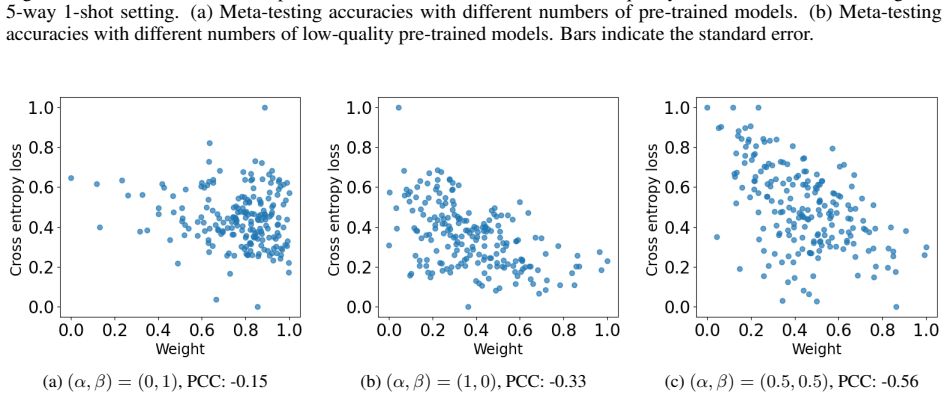
The task weight wt = exp(-α · mean entropy of soft labels + β · entropy of the mean soft label). It scores each soft-labeled task for predictive confidence and class balance, then multiplies the outer meta-loss so that higher-quality tasks dominate the bi-level optimization.
What would settle it
Replace the unlabeled set with images drawn from a completely unrelated domain (for example, medical scans when the targets are natural-image few-shot tasks) while keeping the same pre-trained models; if accuracy then collapses to the level of random initialization or pure unsupervised meta-learning, the domain-relatedness assumption is falsified.
Extended reading notes
Core claim
Assigning soft labels from a pool of pre-trained models to an unlabeled set, then weighting each constructed task by average negative entropy plus the entropy of the mean soft label, yields meta-training tasks that support effective few-shot adaptation without model inversion, delivering both large wall-clock speed-ups and higher accuracy than existing data-free baselines.
Load-bearing premise
The unlabeled data and the pre-trained models must come from the same or closely related application domain as the eventual target tasks; otherwise the soft labels become noise that weighting cannot salvage.
Editorial analysis
A structured set of objections, weighed in public.
Referee Report
Summary. The paper proposes a labeled-data-free meta-learning setting that jointly uses a pool of pre-trained classifiers and an unlabeled dataset from a related domain. Meta-training tasks are formed by assigning soft labels from each pre-trained model to the unlabeled instances (Eq. 1). Because task quality varies, each task is re-weighted by a two-factor entropy score that rewards high average confidence and balanced class occupancy (Eq. 3). The resulting weighted bi-level objective (Eq. 4) is optimized with a Prototypical-Network (or MAML) outer loop that matches soft labels via KL divergence. On Omniglot, miniImageNet and tieredImageNet the method reports 8.4–36.4 % absolute accuracy gains over the strongest DFML baseline (FREE) while reducing training time by up to 104 imes; multi-domain, cross-architecture and low-quality-model ablations further support robustness under moderate domain shift.
Significance. If the empirical gains hold, the work supplies a practical alternative to model-inversion DFML that is both faster and more accurate whenever modest amounts of related unlabeled data are available. The soft-label construction and the entropy-based weighting are simple, architecture-agnostic design choices that transfer across ProtoNet and MAML, and the multi-domain / low-quality-model experiments already probe realistic resource heterogeneity. The contribution is therefore of clear applied interest for privacy-sensitive few-shot settings (medical imaging, etc.) and constitutes a useful intermediate point between pure DFML and unsupervised meta-learning.
major comments (2)
- Section 3 and the paragraph beginning “Overall, the original training data…” state that U and the pre-trained models must share modality and a “related” application domain with the target tasks. All reported experiments (including the multi-domain CUB/CIFAR-FS setting) keep this relatedness relatively mild. The paper would be stronger if it quantified the degradation under a deliberately large domain gap (e.g., ImageNet-pretrained models + medical unlabeled data) so that practitioners can judge when the soft labels become pure noise and the method collapses to a weak unsupervised baseline.
- Table 4 reports a 104-fold wall-clock speedup versus FREE, yet the comparison mixes different hardware utilization patterns and does not isolate the cost of the inversion stage from the subsequent meta-training stage. A more granular breakdown (inversion time vs. meta-training time, memory footprint) would make the computational claim fully reproducible and would clarify how much of the gain is simply the avoidance of high-dimensional generation.
minor comments (4)
- Eq. (3) uses the same symbols α, β for both the balance factors and the later sensitivity analysis; a short clarifying sentence would avoid confusion with the usual learning-rate notation.
- Figure 5 reports Pearson correlations but does not state the number of sampled tasks or the confidence interval; adding these details would strengthen the claim that the weighting correlates with soft-label quality.
- In Algorithm 1 the support/query sizes are hard-coded for the 5-way and 20-way cases; stating them as input parameters would improve generality.
- The abstract claims “8.4 percent to 36.4 percent improvements”; the precise baseline and setting that produce the 36.4 % figure should be cited for transparency.
Circularity Check
No significant circularity; soft-label construction and entropy weighting are design choices evaluated empirically on held-out meta-test tasks.
full rationale
The paper's core claims rest on an empirical method: meta-training tasks are formed by assigning soft labels Mt(xu_n) from pre-trained models to an unlabeled set U (Eqs. 1-2), tasks are reweighted by a fixed entropy formula (Eq. 3) that uses only those soft labels, and the bi-level objective (Eq. 4) with outer KL loss (Eq. 5) and soft prototypes (Eq. 7) is optimized. All quantities are defined from the given inputs (M and U) without fitting parameters to the evaluation targets; performance is measured on disjoint meta-test tasks whose ground-truth labels are never seen during training. Self-citations (e.g., to the authors' prior meta-learning papers) supply background algorithms such as ProtoNets or MAML but do not underwrite uniqueness claims or close any logical loop. Ablations (Tables 7-8, Figures 3-5) and multi-domain/cross-architecture experiments further treat the design choices as falsifiable rather than definitional. Consequently the derivation chain contains no self-definitional steps, no fitted-input-as-prediction, and no load-bearing self-citation circularity.
Assumptions & free parameters
free parameters (3)
- α, β (task-weight balance) =
0.5, 0.5
- number of unlabeled instances N =
100 / 400
- support / query sizes inside each meta-training task =
25/75 or 100/300
assumptions (3)
- domain assumption Unlabeled data and pre-trained models share the same input modality and come from the same or related application domains as the target tasks.
- domain assumption Soft labels produced by a pre-trained model carry more useful supervisory signal than hard pseudo-labels for both inner and outer loops.
- standard math Standard bi-level meta-learning optimization (inner adaptation of ψ, outer update of θ) is a valid way to extract transferable knowledge from the constructed tasks.
invented entities (2)
-
soft-label meta-training task construction (Eq. 1)
-
two-factor entropy task weight (Eq. 3)
Cite this review
Pith. "Pith review of Labeled-Data-Free Meta-Learning: Efficient Task Generation Using Pre-trained Models and Unlabeled Data." pith.science (2026). https://pith.science/paper/6FDYGC2L
@misc{pith2026260702850,
  author       = {Pith},
  title        = {Pith review of: Labeled-Data-Free Meta-Learning: Efficient Task Generation Using Pre-trained Models and Unlabeled Data},
  year         = {2026},
  howpublished = {\url{https://pith.science/paper/6FDYGC2L}},
  note         = {Machine review of arXiv:2607.02850}
}
read the original abstract
Meta-learning without labeled data is crucial for real-world applications, where obtaining labeled datasets can be expensive or restricted due to privacy concerns. Data-Free Meta-Learning (DFML) addresses this challenge by leveraging pre-trained models without access to training data. However, existing DFML methods rely on model inversion to generate training data, a process that is generally difficult and computationally expensive due to the need to generate high-dimensional data matching the original distribution. To address this limitation, we propose a novel meta-learning setting that avoids model inversion by jointly leveraging pre-trained models and unlabeled data. Our method generates meta-training tasks by assigning soft labels from pre-trained models to unlabeled data. Since the quality of these tasks can vary, we introduce a task-weighting mechanism based on task confidence and class distribution balance to ensure effective meta-learning. Extensive experiments demonstrate that our approach substantially reduces computational cost and improves generalization, achieving up to 104-fold speedup and 8.4 percent to 36.4 percent improvements in few-shot classification accuracy compared to state-of-the-art DFML methods.
Figures


Figures from the paper (2 more)

Reference graph
Works this paper leans on
-
[1]
Advances in neural information processing systems , volume=
Prototypical networks for few-shot learning , author=. Advances in neural information processing systems , volume=
-
[2]
International conference on machine learning , pages=
Model-agnostic meta-learning for fast adaptation of deep networks , author=. International conference on machine learning , pages=. 2017 , organization=
2017
-
[3]
arXiv preprint arXiv:1707.09835 , year=
Meta-sgd: Learning to learn quickly for few-shot learning , author=. arXiv preprint arXiv:1707.09835 , year=
-
[4]
International conference on machine learning , pages=
Conditional neural processes , author=. International conference on machine learning , pages=. 2018 , organization=
2018
-
[5]
Proceedings of the IEEE/CVF international conference on computer vision , pages=
Data-free learning of student networks , author=. Proceedings of the IEEE/CVF international conference on computer vision , pages=
-
[6]
Proceedings of the IEEE/CVF conference on computer vision and pattern recognition , pages=
Data-free model extraction , author=. Proceedings of the IEEE/CVF conference on computer vision and pattern recognition , pages=
-
[7]
Proceedings of the IEEE/CVF Conference on Computer Vision and Pattern Recognition , pages=
Architecture, dataset and model-scale agnostic data-free meta-learning , author=. Proceedings of the IEEE/CVF Conference on Computer Vision and Pattern Recognition , pages=
-
[8]
Proceedings of the IEEE/CVF Conference on Computer Vision and Pattern Recognition , pages=
Free: Faster and better data-free meta-learning , author=. Proceedings of the IEEE/CVF Conference on Computer Vision and Pattern Recognition , pages=
Show all 36 references
-
[9]
International Conference on Machine Learning , pages=
Learning to learn from apis: Black-box data-free meta-learning , author=. International Conference on Machine Learning , pages=. 2023 , organization=
2023
-
[10]
Uncertainty in Artificial Intelligence , pages=
Meta-learning without data via wasserstein distributionally-robust model fusion , author=. Uncertainty in Artificial Intelligence , pages=. 2022 , organization=
2022
-
[11]
33rd Annual Meeting of the Cognitive Science Society: Expanding the Space of Cognitive Science, CogSci 2011 , pages=
One shot learning of simple visual concepts , author=. 33rd Annual Meeting of the Cognitive Science Society: Expanding the Space of Cognitive Science, CogSci 2011 , pages=. 2011 , organization=
2011
-
[12]
Advances in neural information processing systems , volume=
Matching networks for one shot learning , author=. Advances in neural information processing systems , volume=
-
[13]
International Conference on Learning Representations , year=
Meta-Learning for Semi-Supervised Few-Shot Classification , author=. International Conference on Learning Representations , year=
-
[14]
Proceedings of the IEEE/CVF conference on computer vision and pattern recognition , pages=
Few-shot classification with feature map reconstruction networks , author=. Proceedings of the IEEE/CVF conference on computer vision and pattern recognition , pages=
-
[15]
Transactions on Machine Learning Research , year=
Meta-Learning under Task Shift , author=. Transactions on Machine Learning Research , year=
-
[16]
2011 , institution =
The Caltech-UCSD Birds-200-2011 Dataset , author =. 2011 , institution =
2011
-
[17]
The Eleventh International Conference on Learning Representations , year=
Unsupervised Meta-learning via Few-shot Pseudo-supervised Contrastive Learning , author=. The Eleventh International Conference on Learning Representations , year=
-
[18]
ECAI 2020 , pages=
Knowledge distillation for model-agnostic meta-learning , author=. ECAI 2020 , pages=. 2020 , publisher=
2020
-
[19]
International Journal of Computer Vision , volume=
Knowledge distillation: A survey , author=. International Journal of Computer Vision , volume=. 2021 , publisher=
2021
-
[20]
International conference on machine learning , pages=
Towards understanding knowledge distillation , author=. International conference on machine learning , pages=. 2019 , organization=
2019
-
[21]
arXiv preprint arXiv:1503.02531 , year=
Distilling the knowledge in a neural network , author=. arXiv preprint arXiv:1503.02531 , year=
-
[22]
, author=
Visualizing data using t-SNE. , author=. Journal of machine learning research , volume=
-
[23]
Advances in Neural Information Processing Systems , volume=
Meta-learning from tasks with heterogeneous attribute spaces , author=. Advances in Neural Information Processing Systems , volume=
-
[24]
Advances in Neural Information Processing Systems , volume=
Sharing knowledge for meta-learning with feature descriptions , author=. Advances in Neural Information Processing Systems , volume=
-
[25]
International Conference on Learning Representations , year=
Unsupervised Learning via Meta-Learning , author=. International Conference on Learning Representations , year=
-
[26]
Advances in neural information processing systems , volume=
Unsupervised meta-learning for few-shot image classification , author=. Advances in neural information processing systems , volume=
-
[27]
Proceedings of the IEEE/CVF Conference on Computer Vision and Pattern Recognition , pages=
Understanding and improving source-free domain adaptation from a theoretical perspective , author=. Proceedings of the IEEE/CVF Conference on Computer Vision and Pattern Recognition , pages=
-
[28]
Proceedings of the IEEE/CVF conference on computer vision and pattern recognition , pages=
C-sfda: A curriculum learning aided self-training framework for efficient source free domain adaptation , author=. Proceedings of the IEEE/CVF conference on computer vision and pattern recognition , pages=
-
[29]
International conference on machine learning , pages=
Confidence score for source-free unsupervised domain adaptation , author=. International conference on machine learning , pages=. 2022 , organization=
2022
-
[30]
Asian Conference on Machine Learning , pages=
Towards data-free domain generalization , author=. Asian Conference on Machine Learning , pages=. 2023 , organization=
2023
-
[31]
Proceedings of the IEEE/CVF Conference on Computer Vision and Pattern Recognition , pages=
Learning to retain while acquiring: Combating distribution-shift in adversarial data-free knowledge distillation , author=. Proceedings of the IEEE/CVF Conference on Computer Vision and Pattern Recognition , pages=
-
[32]
International Conference on Learning Representations , year=
Meta-learning with differentiable closed-form solvers , author=. International Conference on Learning Representations , year=
-
[33]
Proceedings of the IEEE conference on computer vision and pattern recognition , pages=
Deep residual learning for image recognition , author=. Proceedings of the IEEE conference on computer vision and pattern recognition , pages=
-
[34]
arXiv preprint arXiv:1412.6980 , year=
Adam: A method for stochastic optimization , author=. arXiv preprint arXiv:1412.6980 , year=
-
[35]
IEEE transactions on pattern analysis and machine intelligence , volume=
Knowledge distillation and student-teacher learning for visual intelligence: A review and new outlooks , author=. IEEE transactions on pattern analysis and machine intelligence , volume=. 2021 , publisher=
2021
-
[36]
Machine Learning with Applications , volume=
A survey on knowledge distillation: Recent advancements , author=. Machine Learning with Applications , volume=. 2024 , publisher=
2024
Reviewed July 12, 2026 · model on record in the stance chip above.
Discussion (0). Sign in to comment.