REVIEW 3 major objections 3 minor 49 references
Quantum Coherence Witness with Untrusted Measurement Devices
T0 review · 3 major / 3 minor · reviewed 2026-08-14 · deepseek-v4-flash
Pith's one-line read A measurement-device-independent coherence witness certifies and lower-bounds quantum coherence using only one measurement setting, without trusting the measurement device.
desk verdict A sound and useful MDI coherence-witness scheme with a clean experiment, but the 'no assumptions' claim is qualified by a dimension/squashing assumption the paper itself concedes. read the letter →
The pith
A machine-rendered reading of the paper's core claim, the machinery that carries it, and where it could break.
The reading
What carries the argument
The central object is the effective qubit POVM $\{M_0,M_1\}$ obtained from tomography: $M_1 = a_1(I + n_x\sigma_x + n_y\sigma_y + n_z\sigma_z)$, with $a_1$ and $(n_x,n_y,n_z)$ fixed by the four measured probabilities $p(1|j)$. The coherence bound comes from the dual form of a convex optimization over states, $\max_\lambda [-\|\sum_i \Pi_i \exp(-I-\lambda M_1)\Pi_i\| - \lambda \mathrm{tr}(\rho M_1)]$, which lower-bounds the relative entropy of coherence. The decoy-state inequalities provide upper and lower bounds on the single-photon probabilities $p_1(1|j)$ that feed into this optimization, and a squashing model is invoked to justify treating the detector as a two-outcome qubit POVM.
What would settle it
Run the same protocol with a detector known to violate the squashing model—for example, one whose efficiency depends on photon number or on which time bin arrives—and compare the certified lower bound with the true relative entropy of coherence obtained from full state tomography of $\rho$; finding a case where the certified bound exceeds the true coherence would refute the device-independent claim.
Extended reading notes
Core claim
The paper claims that coherence can be witnessed and quantified even when the measurement device is completely untrusted and biased. In the proposed MDICW scheme, Alice prepares the four Pauli eigenstates $\{|0\rangle,|1\rangle,|+\rangle,|+i\rangle\}$ to reconstruct the effective two-outcome POVM $\{M_0,M_1\}$ of the detector from conditional click probabilities, then computes the largest lower bound on the relative entropy of coherence of the unknown state $\rho$ that is compatible with the measured probability $\mathrm{tr}(\rho M_1)$ and the decoy-state constraints. The main experimental result is a certified lower bound of $0.25$ per detected signal state for an unknown time-bin qubit using only a $Y$-basis measurement, and a control experiment mixing $|+i\rangle$ and $|-i\rangle$ yields no coherence, illustrating convexity. The same setup operated as a quantum random number generator produces $320$ kbps of random bits that pass the NIST test suite.
Load-bearing premise
The load-bearing premise is that the unknown state $\rho$ lies in the same two-dimensional support as the four test states, justified only through a squashing model—a theoretical reduction of the detector to a two-outcome qubit measurement; if the real detector is not squashable, or $\rho$ has components outside that subspace, the tomography and the coherence bound stop applying.
Editorial extensions
If this is right
- Coherence can be certified and lower-bounded without calibrating or trusting the measurement device, so basis misalignment or deliberate bias cannot produce a false positive coherence witness.
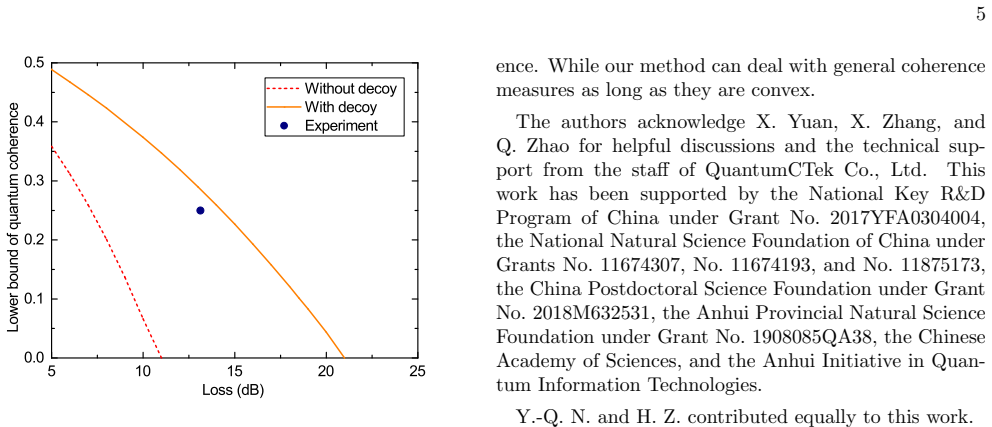
- The decoy-state method makes the witness practical under channel loss: in the experimental conditions with 13.13 dB loss, the no-decoy version could not quantify coherence at all, while the decoy version gave a positive bound.
- The same coherence lower bound converts directly into certified randomness, yielding a measurement-device-independent quantum random number generator with 320 kbps output in the demonstration.
- Because the protocol treats loss and double-click events as zero, it remains valid for lossy channels and inefficient detectors.
- Because the optimization only requires convexity of the coherence measure, the same witness structure can bound other convex coherence measures, not just relative entropy.
Reading between the lines
- Swapping the roles of the trusted and untrusted parties would turn this into a source-independent coherence witness, certifying coherence when the source is suspect but the measurement is trusted.
- If the squashing assumption is dropped, the same tomography idea could be extended to higher-dimensional effective POVMs; more test states would be needed, and the bound would likely be looser.
- The control experiment suggests a practical test for nonclassicality in noisy mixtures: any mixture that still yields a positive bound must have at least one coherent component with enough coherence to survive mixing.
- The same idea might be pushed toward a fully device-independent setting by replacing the trusted test states with an untrusted Bell-state measurement, at the cost of more complexity.
Signed reviews
Editorial analysis
A structured set of objections, weighed in public.
Referee Report
Summary. The manuscript introduces a measurement-device-independent coherence witness (MDICW) protocol in which Alice prepares four Pauli eigenstates to tomograph an untrusted measurement, then lower-bounds the relative entropy of coherence of an unknown state rho by solving a convex optimization with constraints derived from the tomography. A decoy-state method is added to estimate single-photon contributions from weak coherent states, and the protocol is demonstrated experimentally in a time-bin optical system. The experiment reports a coherence lower bound of 0.25 per detected signal state for the state |+i>, while an equal mixture of |+i> and |-i> yields no witnessed coherence; a QRNG application is also demonstrated.
Significance. The idea of extending measurement-device-independent certification from entanglement to coherence is timely, and the decoy-state enhancement is a practical contribution that improves the tightness of the bound. The experimental implementation is careful, with active phase stabilization, intensity optimization, and a control experiment that supports the convexity of coherence. The central caveat is that the protocol is not fully independent of the measurement dimension: it assumes the unknown state lies in the qubit support of the test states, or that the measurement admits a qubit squashing model. Within that scope, the scheme provides a valid way to certify coherence without trusting the calibration of the measurement basis, and the experimental results are consistent with the theory.
major comments (3)
- [Protocol description and remarks after Eq. (7)] The protocol assumes that the unknown state rho lies in the same support as the four test states, an assumption justified only by an appeal to squashing models. For a genuinely untrusted measurement device, four qubit test states determine the POVM only on span{|0>,|1>}; the constraint (4) is then not fixed for a rho with support outside this subspace. The statement 'we can always squash the unknown state into the subspace of {tau}' is not a theorem for arbitrary POVMs; squashing models are known to exist only for specific detector classes (Ref. [41]). Without a proof that the relevant device admits an incoherent squashing map, the lower bound from Eq. (25) does not apply to the original state. The authors should either provide such a proof for a clearly specified detector class, or explicitly restrict the claims to qubit states in the known subspace and state this as a limitation in the abstract and introduction.
- [Eq. (7)] Equation (7) of the main text is missing the factor e^mu in the second term of the lower-bound expression: it reads p_mu(1|j) nu^2/mu^2, while the correct term, as given in Eq. (28) of the Supplemental Material, is p_mu(1|j) e^mu nu^2/mu^2. As printed, the lower bound is looser and could overestimate p_1(1|j), and hence the coherence bound. Please correct the main-text formula and confirm that the reported experimental bound used the correct expression.
- [Eq. (5)] Equation (5) in the main text omits the factor k = ln 2 that appears in the dual problem in Eq. (22) of the Supplemental Material. Without this factor, the objective value is in nats rather than bits, which would make the reported coherence bound and the QRNG rate calculation inconsistent. Please clarify the convention used and align the main text with the supplement.
minor comments (3)
- [Control experiment] The paper reports that no coherence is witnessed for the mixed state rho', but the actual numerical lower bound from the optimization is not given; please state the computed value (e.g., a non-positive lower bound) to make the claim quantitative.
- [Randomness generation section] The Supplement states that finite-size effects in randomness quantification are ignored; this should be noted in the main text wherever the 320 kbps rate is quoted, to avoid overstating the rigor of the QRNG demonstration.
- [Experimental setup and Table II] It would help to state explicitly that the computational basis is the time-bin basis and that |+i> is the equal-superposition time-bin state, so that the coherence basis is unambiguous throughout the main text.
Circularity Check
No significant circularity: the coherence bound is computed from measured probabilities by convex optimization and is not a fitted quantity or self-referential prediction.
full rationale
The paper's central derivation is self-contained: given the measured conditional probabilities p(1|j) for test states and the unknown state, the tomography equations (1)-(2) linearly determine the qubit POVM parameters, and the coherence lower bound is then obtained by solving the convex optimization problem in Eq. (25) under the constraints in Eq. (33). No parameter is fitted to the target coherence value and then relabeled a prediction; the true state is feasible for the optimization, so the optimized value is a genuine lower bound. The decoy-state estimation in Eq. (7) is a standard external QKD technique, and the dual problem follows Refs. [26,27] rather than a self-citation. The paper does cite the authors' earlier MDI-QRNG work [36,37] as inspiration for the tomography step, but that citation is not load-bearing for the coherence-witness derivation. The explicit support/squashing assumption after Eq. (7) is a scope limitation rather than a circular step: the paper states it, and the summary even lists removing the dimension assumption as future work. Thus no circular step is exhibited; the only concerns are correctness/assumption issues, not circularity.
Assumptions & free parameters
free parameters (3)
- signal intensity mu =
0.529
- decoy intensity nu =
0.057
- statistical fluctuation parameter n_sigma =
3.89
assumptions (4)
- domain assumption Unknown state rho and test states share the same qubit support, so the measurement can be described by a two-outcome qubit POVM via a squashing model.
- domain assumption The states are independent and identically distributed across rounds, and the measurement device is memoryless.
- standard math Strong duality holds for the convex optimization problem bounding coherence.
- standard math Phase-randomized weak coherent states have Poisson photon-number statistics, and the decoy-state bound from Ref [28] applies.
Cite this review
Pith. "Pith review of Quantum Coherence Witness with Untrusted Measurement Devices." pith.science (2026). https://pith.science/paper/6FGUPVJS
@misc{pith2026190805022,
  author       = {Pith},
  title        = {Pith review of: Quantum Coherence Witness with Untrusted Measurement Devices},
  year         = {2026},
  howpublished = {\url{https://pith.science/paper/6FGUPVJS}},
  note         = {Machine review of arXiv:1908.05022}
}
read the original abstract
Coherence is a fundamental resource in quantum information processing, which can be certified by a coherence witness. Due to the imperfection of measurement devices, a conventional coherence witness may lead to fallacious results. We show that the conventional witness could mistake an incoherent state as a state with coherence due to the inaccurate settings of measurement bases. In order to make the witness result reliable, we propose a measurement-device-independent coherence witness scheme without any assumptions on the measurement settings. We introduce the decoy-state method to significantly increase the capability of recognizing states with coherence. Furthermore, we experimentally demonstrate the scheme in a time-bin encoding optical system.
Figures


Figures from the paper (5 more)


Reference graph
Works this paper leans on
-
[41]
Z. Cao, H. Zhou, and X. Ma, New J. Phys. 17, 125011 (2015)
2015
-
[1]
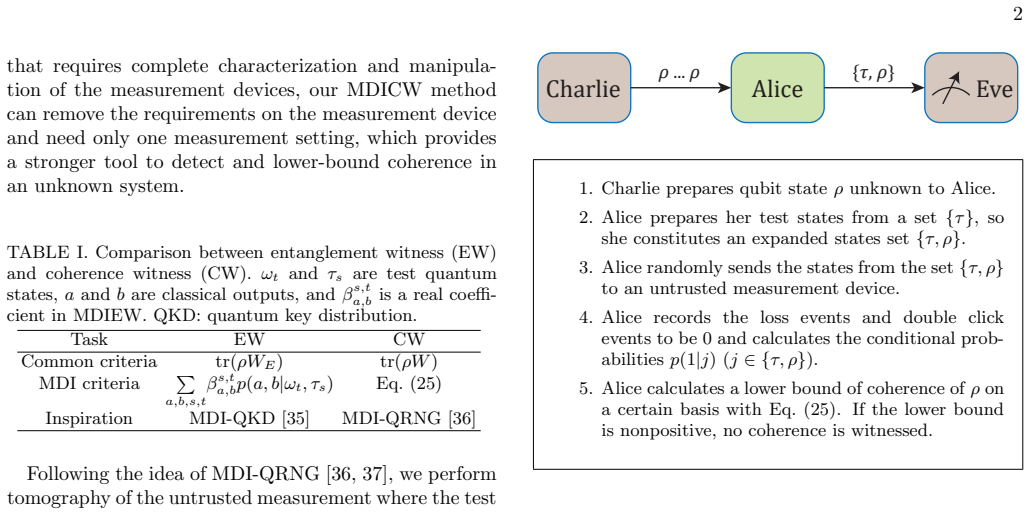
Charlie prepares qubit state ρ unknown to Alice
-
[2]
Alice prepares her test states from a set {τ}, so she constitutes an expanded states set {τ,ρ}
-
[3]
Alice randomly sends the states from the set{τ,ρ} to an untrusted measurement device
-
[4]
Alice records the loss events and double click events to be 0 and calculates the conditional prob- abilities p(1|j) (j∈{τ,ρ})
-
[5]
Alice calculates a lower bound of coherence of ρ on a certain basis with Eq. (25). If the lower bound is nonpositive, no coherence is witnessed. FIG. 1. MDICW scheme. First, we consider an ideal case where the test states {|0⟩,|1⟩,|+⟩,|+i⟩} are perfect qubits. Then, the tomog- raphy result is a qubit POVM uniquely determined by a set of parameters{a1,nx,n...
-
[6]
X. Ma, X. Yuan, Z. Cao, B. Qi, and Z. Zhang, npj Quantum Inf. 2, 16021 (2016)
2016
-
[7]
Herrero-Collantes and J
M. Herrero-Collantes and J. C. Garcia-Escartin, Rev. Mod. Phys. 89, 015004 (2017)
2017
Show all 49 references
-
[8]
Baumgratz, M
T. Baumgratz, M. Cramer, and M. B. Plenio, Phys. Rev. Lett. 113, 140401 (2014)
2014
-
[9]
Streltsov, G
A. Streltsov, G. Adesso, and M. B. Plenio, Rev. Mod. Phys. 89, 041003 (2017)
2017
-
[10]
Streltsov, U
A. Streltsov, U. Singh, H. S. Dhar, M. N. Bera, and G. Adesso, Phys. Rev. Lett. 115, 020403 (2015)
2015
-
[11]
J. Ma, B. Yadin, D. Girolami, V. Vedral, and M. Gu, Phys. Rev. Lett. 116, 160407 (2016)
2016
-
[12]
X. Yuan, H. Zhou, M. Gu, and X. Ma, Phys. Rev. A 97, 012331 (2018)
2018
-
[13]
H. Zhou, X. Yuan, and X. Ma, Phys. Rev. A 99, 022326 (2019)
2019
-
[14]
Chitambar, A
E. Chitambar, A. Streltsov, S. Rana, M. N. Bera, G. Adesso, and M. Lewenstein, Phys. Rev. Lett. 116, 070402 (2016)
2016
-
[15]
X. Yuan, H. Zhou, Z. Cao, and X. Ma, Phys. Rev. A 92, 022124 (2015)
2015
-
[16]
Winter and D
A. Winter and D. Yang, Phys. Rev. Lett. 116, 120404 (2016)
2016
-
[17]
Q. Zhao, Y. Liu, X. Yuan, E. Chitambar, and X. Ma, Phys. Rev. Lett. 120, 070403 (2018)
2018
-
[18]
Regula, K
B. Regula, K. Fang, X. Wang, and G. Adesso, Phys. Rev. Lett. 121, 010401 (2018)
2018
-
[19]
Q. Zhao, Y. Liu, X. Yuan, E. Chitambar, and A. Winter, arXiv:1808.01885 (2018)
2018 arXiv
-
[20]
Addis, G
C. Addis, G. Brebner, P. Haikka, and S. Maniscalco, Phys. Rev. A 89, 024101 (2014)
2014
-
[21]
Hillery, Phys
M. Hillery, Phys. Rev. A 93, 012111 (2016)
2016
-
[22]
E. J. O’Reilly and A. Olaya-Castro, Nat. Commun. 5, 3012 (2014)
2014
-
[23]
Goold, M
J. Goold, M. Huber, A. Riera, L. del Rio, and P. Skrzypczyk, J. Phys. A 49, 143001 (2016)
2016
-
[24]
Napoli, T
C. Napoli, T. R. Bromley, M. Cianciaruso, M. Piani, N. Johnston, and G. Adesso, Phys. Rev. Lett. 116, 150502 (2016)
2016
-
[25]
Ringbauer, T
M. Ringbauer, T. R. Bromley, M. Cianciaruso, L. Lami, 6 W. Y. S. Lau, G. Adesso, A. G. White, A. Fedrizzi, and M. Piani, Phys. Rev. X 8, 041007 (2018)
2018
-
[26]
J. Ma, A. Hakande, X. Yuan, and X. Ma, Phys. Rev. A 99, 022328 (2019)
2019
-
[27]
Wang, J.-S
Y.-T. Wang, J.-S. Tang, Z.-Y. Wei, S. Yu, Z.-J. Ke, X.- Y. Xu, C.-F. Li, and G.-C. Guo, Phys. Rev. Lett. 118, 020403 (2017)
2017
-
[28]
Zheng, Z
W. Zheng, Z. Ma, H. Wang, S.-M. Fei, and X. Peng, Phys. Rev. Lett. 120, 230504 (2018)
2018
-
[29]
See Supplemental Material for detailed theoretical and experimental results
-
[30]
Kurotani, T
Y. Kurotani, T. Sagawa, and M. Ueda, Phys. Rev. A 76, 022325 (2007)
2007
-
[31]
Zorzi, F
M. Zorzi, F. Ticozzi, and A. Ferrante, IEEE Trans. Inf. Theory 60, 357 (2014)
2014
-
[32]
P. J. Coles, E. M. Metodiev, and N. L¨ utkenhaus, Nat. Commun. 7, 11712 (2016)
2016
-
[33]
X. Ma, B. Qi, Y. Zhao, and H.-K. Lo, Phys. Rev. A 72, 012326 (2005)
2005
-
[34]
X. Ma, F. Xu, H. Xu, X. Tan, B. Qi, and H.-K. Lo, Phys. Rev. A 87, 062327 (2013)
2013
-
[35]
Rukhin, J
A. Rukhin, J. Soto, J. Nechvatal, M. Smid, E. Barker, S. Leigh, M. Levenson, M. Vangel, D. Banks, A. Heckert, J. Dray, and S. Vo, NIST Special Publication 800-22 (2001)
2001
- [36]
-
[37]
Matera, D
J. Matera, D. Egloff, N. Killoran, and M. Plenio, Quan- tum Sci. and Technol. 1, 01LT01 (2016)
2016
-
[38]
Branciard, D
C. Branciard, D. Rosset, Y.-C. Liang, and N. Gisin, Phys. Rev. Lett. 110, 060405 (2013)
2013
-
[39]
P. Xu, X. Yuan, L.-K. Chen, H. Lu, X.-C. Yao, X. Ma, Y.- A. Chen, and J.-W. Pan, Phys. Rev. Lett. 112, 140506 (2014)
2014
-
[40]
H.-K. Lo, M. Curty, and B. Qi, Phys. Rev. Lett. 108, 130503 (2012)
2012
-
[42]
Nie, J.-Y
Y.-Q. Nie, J.-Y. Guan, H. Zhou, Q. Zhang, X. Ma, J. Zhang, and J.-W. Pan, Phys. Rev. A 94, 060301(R) (2016)
2016
-
[43]
Hwang, Phys
W.-Y. Hwang, Phys. Rev. Lett. 91, 057901 (2003)
2003
-
[44]
H.-K. Lo, X. Ma, and K. Chen, Phys. Rev. Lett. 94, 230504 (2005)
2005
-
[45]
Wang, Phys
X.-B. Wang, Phys. Rev. Lett. 94, 230503 (2005)
2005
-
[46]
N. J. Beaudry, T. Moroder, and N. L¨ utkenhaus, Phys. Rev. Lett. 101, 093601 (2008)
2008
-
[47]
Liang, J.-H
X.-L. Liang, J.-H. Liu, Q. Wang, D.-B. Du, J. Ma, G. Jin, Z.-B. Chen, J. Zhang, and J.-W. Pan, Rev. Sci. Instrum. 83, 083111 (2012)
2012
-
[48]
Zhang, M
J. Zhang, M. A. Itzler, H. Zbinden, and J.-W. Pan, Light Sci. Appl. 4, e286 (2015). 7 SUPPLEMENT AL MA TERIAL: QUANTUM COHERENCE WITNESS WITH UNTRUSTED MEASUREMENT DEVICES BASIS-ROT A TING A TT ACK ON CONVENTIONAL COHERENCE WITNESS The conventional coherence witness is a certa...
2015
-
[49]
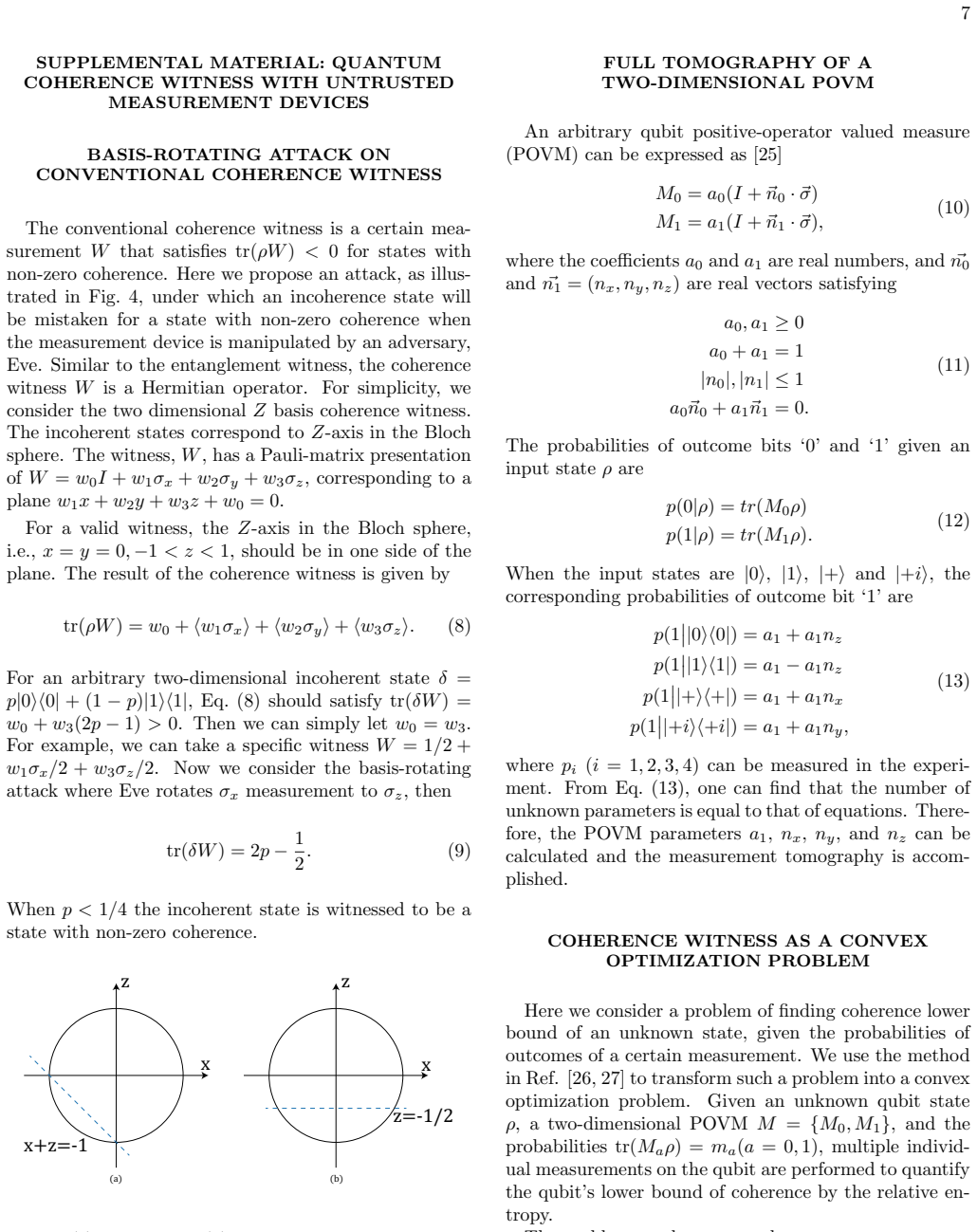
z x x+z=-1 z=-1/2 z x (a) (b) FIG
(9) When p <1/4 the incoherent state is witnessed to be a state with non-zero coherence. z x x+z=-1 z=-1/2 z x (a) (b) FIG. 4. (a) The witness. (b) The actual witness under basis rotating attack. The plane has an intersection with Z-axis within the Bloch sphere. FULL TOMOGRAPH...
Reviewed August 14, 2026 · model on record in the stance chip above.
Discussion (0). Continue with ORCID to comment.