Electronic Structure in a Phase Space, non-Born-Oppenheimer Framework: Geometric Forces and Moody-Shapere-Wilzcek Revisited
Pith reviewed 2026-07-01 15:48 UTC · model grok-4.3
The pith
Phase space electronic structure calculations parameterized by nuclear position and momentum correctly incorporate non-inertial Coriolis and centrifugal forces.
A machine-rendered reading of the paper's core claim, the machinery that carries it, and where it could break.
Core claim
Performing electronic structure calculations parameterized by both the nuclear position vector X and the nuclear momentum vector P incorporates the non-inertial Coriolis and centrifugal forces felt by electrons in a moving nuclear frame, leading to more accurate eigenenergies and electronic angular momenta than Born-Oppenheimer methods allow, while also generalizing the Moody-Shapere-Wilczek magnetic monopole to permit vibrational motion.
What carries the argument
Phase space electronic structure, in which electronic calculations depend on both nuclear position X and nuclear momentum P.
If this is right
- Eigenenergies become more accurate once non-inertial forces are included.
- Electronic angular momenta are recovered with higher fidelity than in position-only calculations.
- Geometric forces such as Coriolis and centrifugal terms appear automatically in the electronic problem.
- The Berry curvature monopole is extended from fixed-length diatomics to vibrating systems.
- Dynamics calculations can track angular momentum flow between nuclei and electrons.
Where Pith is reading between the lines
- The approach may allow practical modeling of spin selectivity effects when nuclear and electronic motions couple through vibrations.
- If the three-body accuracy gains hold for larger systems, the method could reduce errors in simulations of rotating and vibrating molecules.
- Connections to other non-adiabatic dynamics techniques become natural once momentum dependence is explicit.
Load-bearing premise
That electronic structure calculations can be effectively parameterized by nuclear momentum in addition to position and that three-body test results will generalize to realistic multi-nuclei molecules.
What would settle it
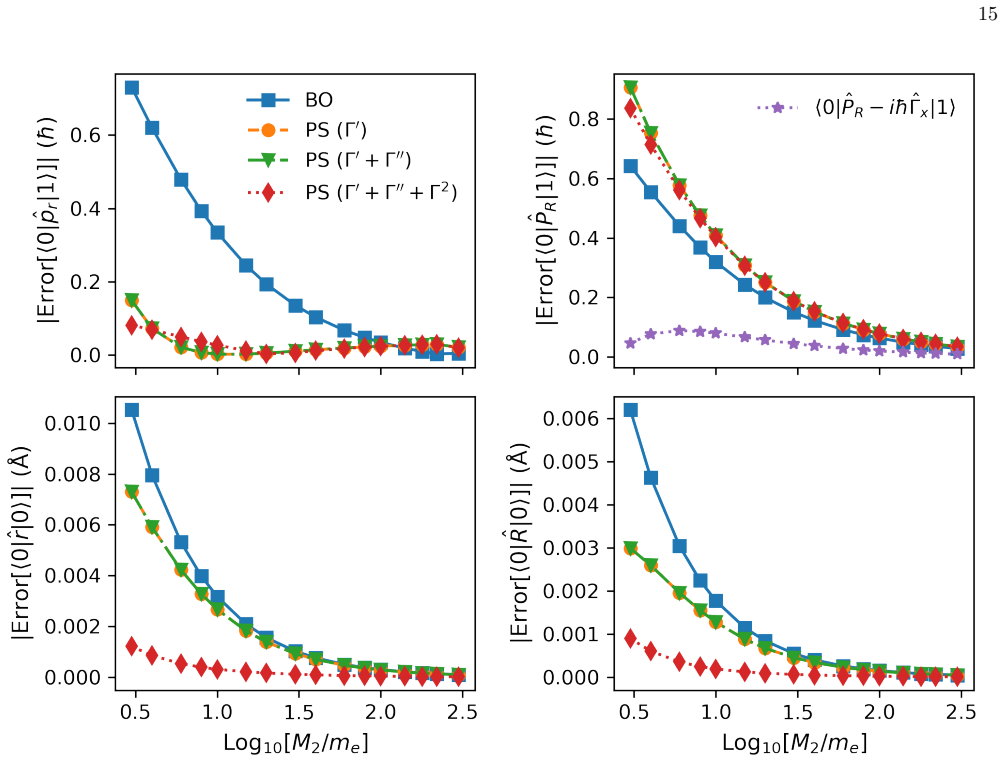
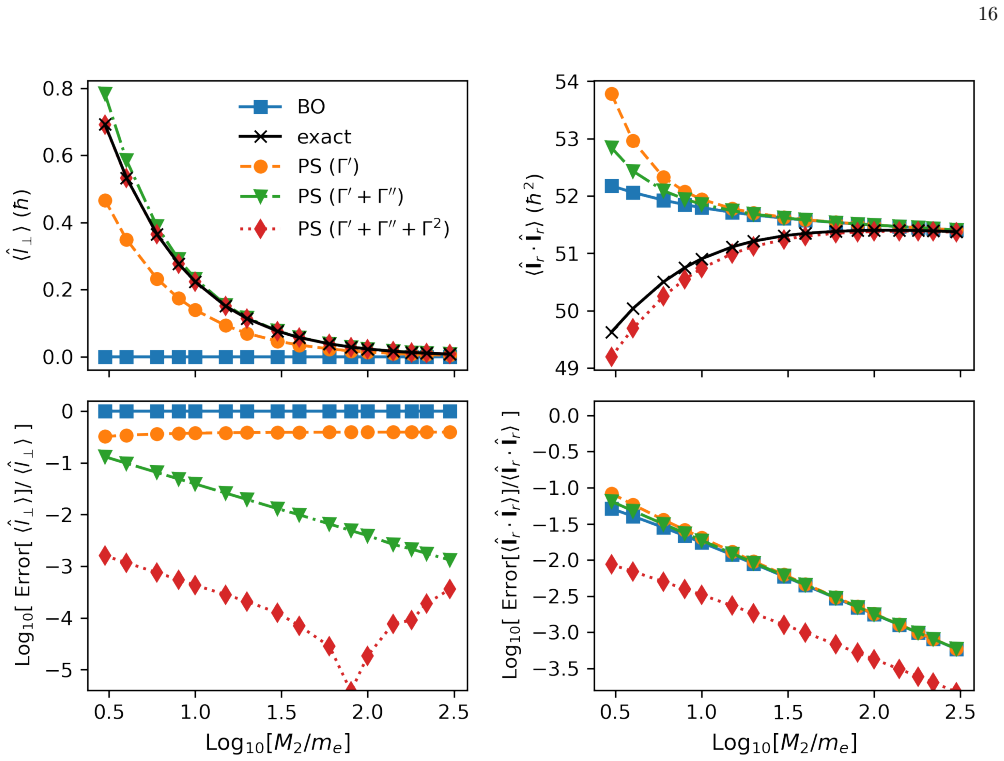
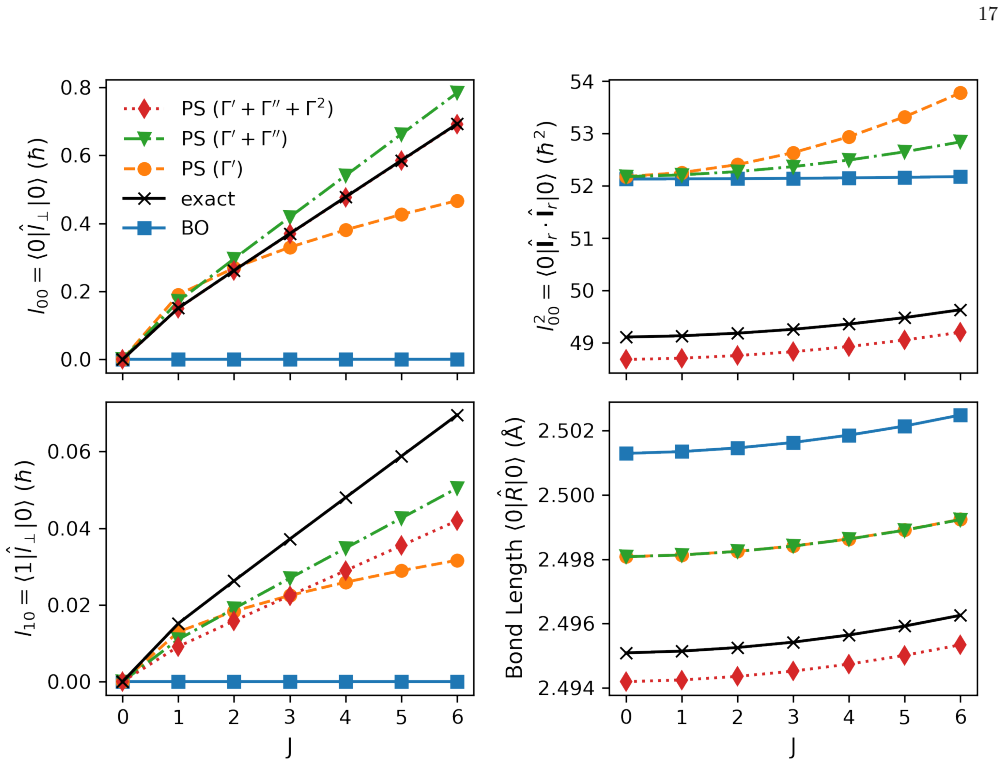
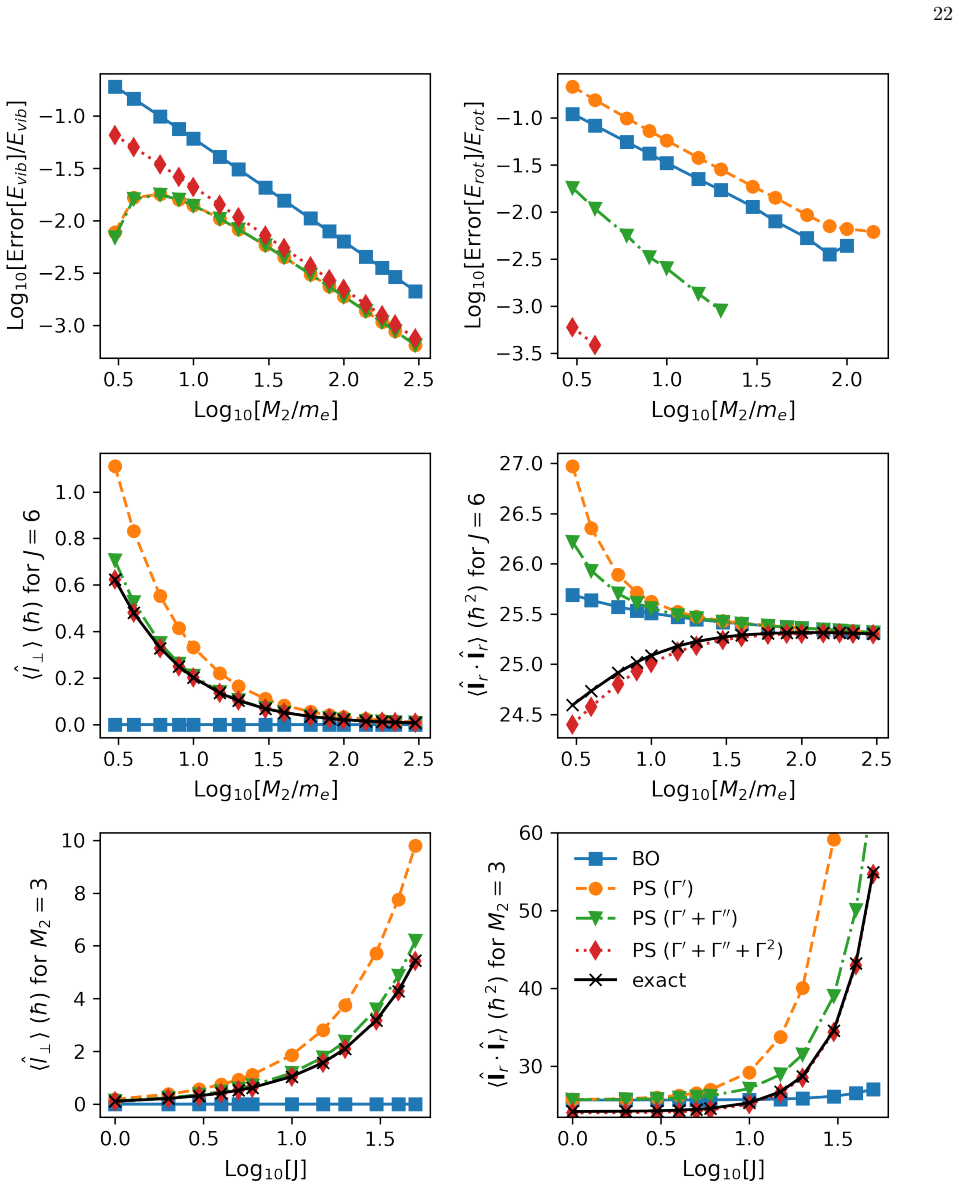
Direct numerical comparison of eigenenergies and electronic angular momenta obtained from phase space calculations against exact diagonalization of the full three-body Hamiltonian.
Figures
read the original abstract
We revisit the three-body problem in quantum mechanics in two and three dimensions, generating both exact eigenvalues and eigenvectors of the Hamiltonian and a series of approximate solutions as calculated with a variety of different schemes to separate heavy ("nuclear") and light ("electronic") particles. We show that, with minimal extra cost, one can go beyond the Born-Oppenheimer approximation by performing electronic structure calculations parameterized by both the nuclear position (${\mathbf X})$ and the nuclear momentum ($\mathbf{P}$), a so-called phase space theory of electronic structure. In particular, we demonstrate that such phase space electronic structure calculations correctly incorporate the non-inertial Coriolis and centrifugal forces felt by electrons in a moving nuclear frame, thus leading to far more accurate eigenenergies and electronic angular momenta than has been possible before. We also demonstrate that our approach naturally incorporates and generalizes the Moody-Shapere-Wilczek magnetic monopole for the non-abelian Berry curvature (now allowing for vibrational motion rather than a diatomic of fixed length). We argue that the resulting approach should be extremely useful for propagating dynamics where angular momentum flows between nuclei and electrons; in particular, if extended to include spin degrees of freedom, the present approach will offer a practical means to study chiral induced spin selectivity through the lens of chiral phonons and coupled nuclear-electronic motion.
Editorial analysis
A structured set of objections, weighed in public.
Referee Report
Summary. The manuscript revisits the three-body problem (one heavy nucleus + electrons) in 2D and 3D quantum mechanics. It generates exact eigenvalues/vectors of the full Hamiltonian and compares them to Born-Oppenheimer and other approximations. The central claim is that electronic structure calculations parameterized by both nuclear position X and momentum P (phase-space electronic structure) incorporate non-inertial Coriolis and centrifugal forces, yielding substantially more accurate eigenenergies and electronic angular momenta than prior methods. The approach is shown to generalize the Moody-Shapere-Wilczek magnetic monopole (now including vibrational motion), and the authors argue it will be useful for nuclear-electronic angular-momentum transfer dynamics, including potential extensions to spin and chiral-induced spin selectivity.
Significance. If the three-body numerical demonstrations hold, the work supplies a concrete, low-cost route to include non-inertial frame effects directly in the electronic Hamiltonian. This addresses a known limitation of standard Born-Oppenheimer treatments when nuclear velocities are appreciable and provides a natural generalization of Berry-phase monopoles to vibrating systems. The explicit comparison against exact three-body benchmarks is a strength; the method could become relevant for dynamics simulations that track angular-momentum flow between nuclei and electrons.
major comments (1)
- [Abstract] Abstract (final paragraph): the assertion that the resulting approach 'should be extremely useful for propagating dynamics where angular momentum flows between nuclei and electrons' is not supported by the calculations, which treat only a single nuclear momentum P. For molecules with multiple nuclei the electronic Hamiltonian would need to be parameterized by a set of independent nuclear momenta; the manuscript provides neither a derivation of the required frame transformations nor numerical tests that would establish whether cross terms between nuclear velocities are automatically captured by a single global P parameterization.
minor comments (2)
- [Abstract] The abstract and introduction would benefit from an explicit statement of the particle content of the three-body Hamiltonian (one nucleus + N electrons) to make the scope of the numerical demonstrations immediately clear.
- Notation for the phase-space electronic Hamiltonian (dependence on both X and P) should be introduced with an equation number in the main text rather than only in the abstract.
Simulated Author's Rebuttal
We thank the referee for their careful reading of the manuscript and for highlighting this important point regarding the scope of our claims. We respond to the major comment below.
read point-by-point responses
-
Referee: [Abstract] Abstract (final paragraph): the assertion that the resulting approach 'should be extremely useful for propagating dynamics where angular momentum flows between nuclei and electrons' is not supported by the calculations, which treat only a single nuclear momentum P. For molecules with multiple nuclei the electronic Hamiltonian would need to be parameterized by a set of independent nuclear momenta; the manuscript provides neither a derivation of the required frame transformations nor numerical tests that would establish whether cross terms between nuclear velocities are automatically captured by a single global P parameterization.
Authors: We agree that the numerical demonstrations are restricted to the three-body problem with a single nuclear momentum P, and that the abstract statement regarding multi-nuclear dynamics is prospective rather than directly supported by the presented calculations. The phase-space framework is formulated in a manner that conceptually extends to multiple nuclei by treating each nuclear momentum independently, but we acknowledge the absence of an explicit multi-nucleus derivation or cross-term tests. We will revise the abstract to qualify the claim as applying to the single-nucleus case demonstrated here, with generalization to multiple nuclei noted as a natural direction for future work. A brief clarifying paragraph will also be added to the discussion section. revision: partial
Circularity Check
No circularity: results derived from explicit three-body Hamiltonian calculations
full rationale
The paper computes exact eigenvalues/eigenvectors of the three-body Hamiltonian and compares them to phase-space parameterized approximations. No load-bearing step reduces by construction to a fitted input, self-citation chain, or ansatz smuggled via prior work. Demonstrations are direct numerical comparisons for the stated cases; the central claim follows from the explicit incorporation of P in the electronic Hamiltonian rather than from redefinition or renaming of known results.
Axiom & Free-Parameter Ledger
axioms (1)
- standard math The three-body quantum Hamiltonian in two and three dimensions admits exact eigenvalues and eigenvectors that can be computed for benchmarking.
Reference graph
Works this paper leans on
-
[1]
molecular center of mass
and [ 18], we can recover the splitting between rota- tional states from the coupling between nuclear rotation motion and electronic angular momentum (spin and or- bital). Our results exhibit reasonable accuracy for the form of ˆΓ postulated in Refs. 23, 24. With regards to the one-dimensional model work in Ref. 19, note that for a small 1D problem, one c...
1928
-
[2]
58 above (with classical nu- clear degrees of freedom) rather than with the standard Born-Oppenheimer electronic Hamiltonian ˆHel
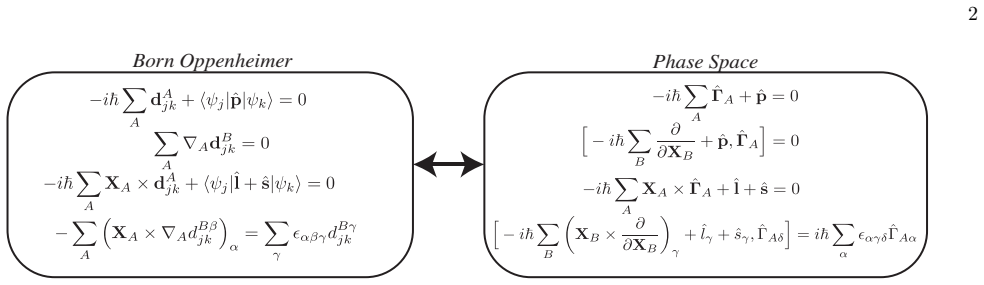
The Basic Framework Taking inspiration from Shenvi’s superadiabatic phase space surface hopping formalism[ 49], the essence of a phase space electronic Hamiltonian is to work with an electronic operator like Eq. 58 above (with classical nu- clear degrees of freedom) rather than with the standard Born-Oppenheimer electronic Hamiltonian ˆHel. That being sai...
-
[3]
talk” to nuclear linear momentum; the second term ˆΓ′′ 1 allows the electronic angular momentum to “talk
Electron translation and rotation factors In practice, for a diatomic molecule without spin, fol- lowing Appendix B (and Ref. 23), the form of ˆΓ1 = ˆΓ′ 1 + ˆΓ′′ 1 for atom 1 is broken into two terms. The first term ˆΓ′ 1 allows electronic linear momentum to “talk” to nuclear linear momentum; the second term ˆΓ′′ 1 allows the electronic angular momentum t...
-
[4]
Here n ˆA, ˆB o = ˆA ˆB + ˆB ˆA is the anticommutator. 9 Simplifying Appendix B for the diatomic case, the ˆΓ′′ term is defined via ˆΓ′′ 1 = −M1 X1 × (I −1 ˆJ1) + X1 × (I −1 ˆJ2) (65) ˆJ1 = −i 2ℏ (ˆr − X1) × ( ˆΘ1 ˆpe + ˆpe ˆΘ1) (66) ˆJ2 = −i 2ℏ (ˆr − X2) × ( ˆΘ2 ˆpe + ˆpe ˆΘ2) (67) and analogously for ˆΓ′′ 2 . Here, I −1 is the inverse moment of inertia ...
-
[5]
59 is the second order term,P A ˆΓA · ˆΓA/(2MA)
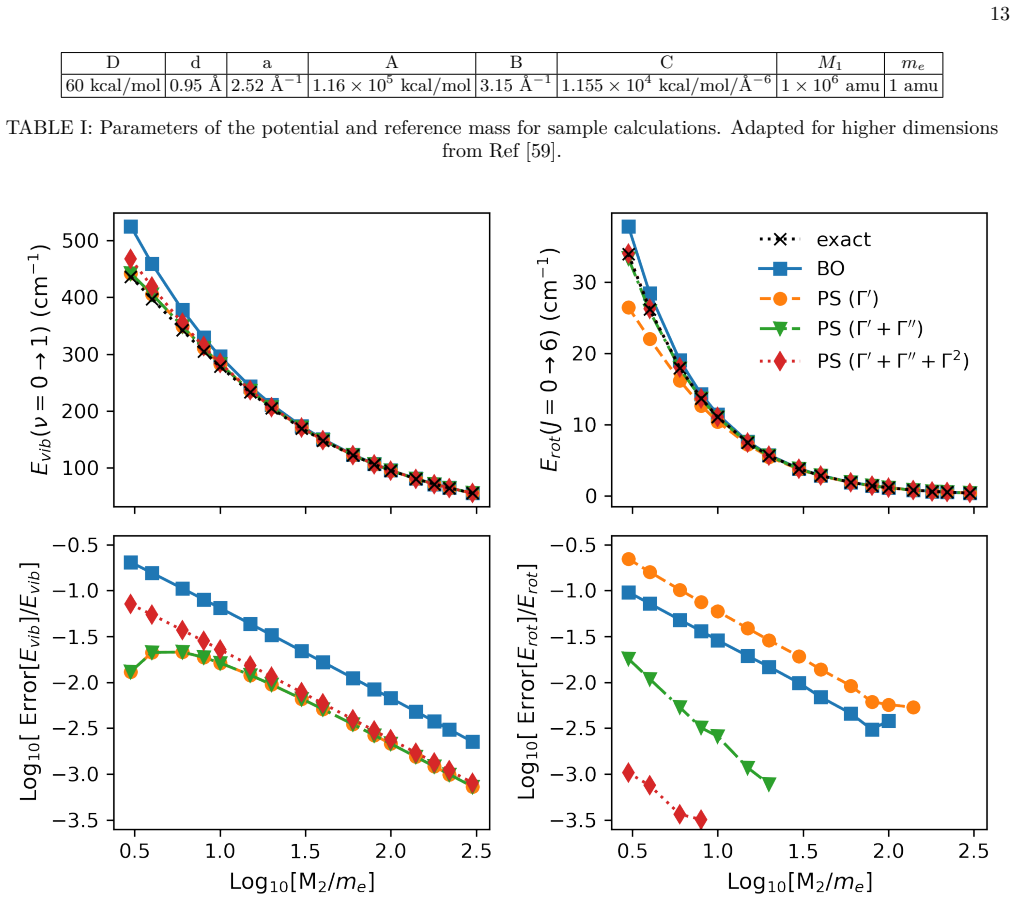
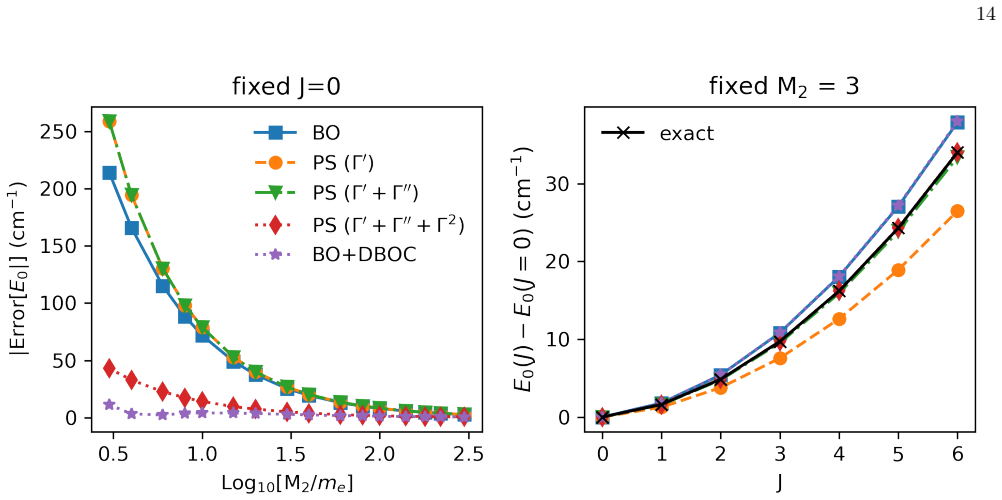
The Second Order Term One of the most interesting facets of the PS elec- tronic Hamiltonian in Eq. 59 is the second order term,P A ˆΓA · ˆΓA/(2MA). In general, this term is smaller than the P · ˆΓ term and thus has often been excluded from past phase space calculations[ 15–19]. That being said, we will show below that these terms can be crucial when the m...
-
[6]
II, one will find rovibrational energies that depend on the quantum num- ber J
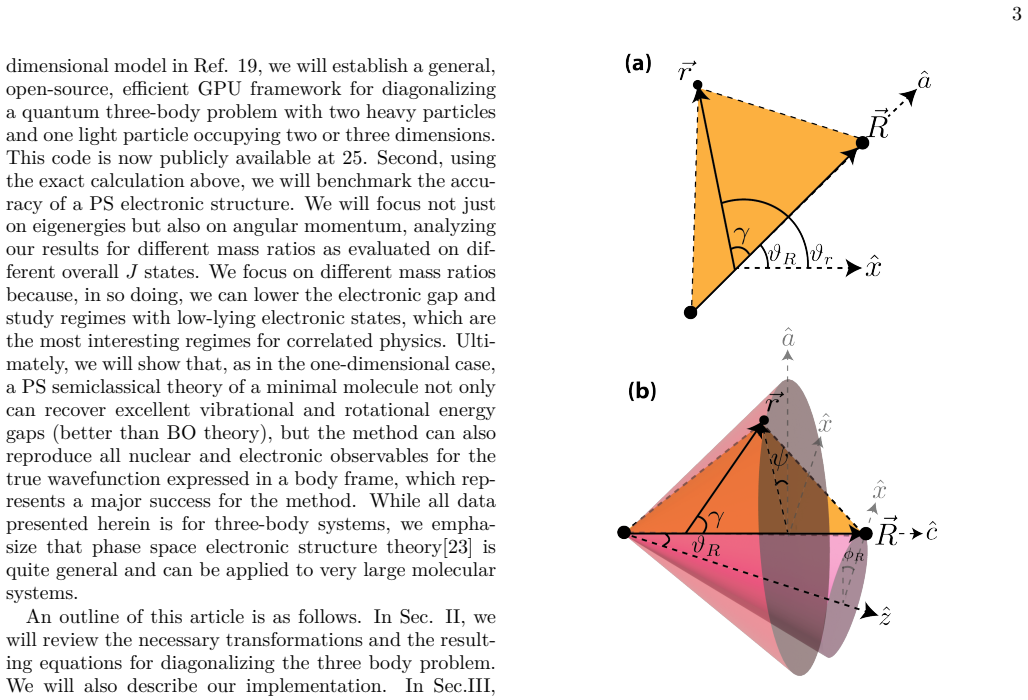
Interpretation of the nuclei and choice of body frame Within the exact calculations from Sec. II, one will find rovibrational energies that depend on the quantum num- ber J. Thus, in order to compare exact results against a phase space electronic structure calculation (or a BO calculation), one requires a conserved nuclear observable within phase space el...
-
[7]
The Form of the Phase Space Electronic Structure Hamiltonian Using Eq. 70 above, the Hamiltonian takes the form: ˆHPS(PR, Pϑ, Pϕ, R, ϑR, ϕR) = PR − iℏˆΓR 2 2µR + ˆHel(ˆx, ˆy, ˆz) (74) = 1 2µR P 2 R + P 2 ϑ R2 + P 2 ϕ R2 sin2 ϑ ! − iℏ µR ˆΓx · PR sin ϑR cos ϕR + Pϑ R cos ϑR cos ϕR − Pϕ R sin θR sin ϕR − iℏ µR ˆΓy · PR sin ϑR sin ϕR + Pϑ R cos ϑR sin ϕR + P...
-
[8]
For 3D, choosing ϑR and ϕR is more involved than in 2D
The Final Equations of Motion: Choice of the Body Frame in 3D The choice of ϑR and ϕR for a PS electronic structure calculation is analogous to specifying a body frame in an exact calculation. For 3D, choosing ϑR and ϕR is more involved than in 2D. The PS equations simplify most when R is aligned with the x-axis, namely when ϑR = π 2 and ϕR = 0 . Under th...
-
[9]
body-frame
Vibrational energies and Nuclear/Electronic Observables In this article, our goal is to compare the nu- clear+electronic eigenenergies and eigenvectors of the ex- act hamiltonian vs those from BO and/or phase space electronic strucure approximations. Now, in order for a phase space calculation to predict a quantized nu- clear+electronic wavefunction, one ...
2025
-
[10]
S. Hammes-Schiffer, Introduction: Proton-coupled elec- tron transfer, Chemical Reviews 110, 6937 (2010), pMID: 21141827, https://doi.org/10.1021/cr100367q
-
[11]
Y. Wu, G. Miao, and J. E. Subotnik, Chemical reaction rates for systems with spin-orbit coupling and an odd number of electrons: Does berry’s phase lead to mean- ingful spin-dependent nuclear dynamics for a two state crossing?, J. Phys. Chem. A 124, 7355 (2020)
2020
-
[12]
Fransson, Vibrational origin of exchange splitting and chiral-induced spin selectivity, Physical Review B 102, 235416 (2020)
J. Fransson, Vibrational origin of exchange splitting and chiral-induced spin selectivity, Physical Review B 102, 235416 (2020)
2020
-
[13]
H. Zhu, J. Yi, M.-Y. Li, J. Xiao, L. Zhang, C.-W. Yang, R. A. Kaindl, L.-J. Li, Y. Wang, and X. Zhang, Obser- vation of chiral phonons, Science 359, 579–582 (2018)
2018
-
[14]
Hammes-Schiffer, Nuclear–electronic orbital methods: Foundations and prospects, The Journal of Chemical Physics 155, 030901 (2021)
S. Hammes-Schiffer, Nuclear–electronic orbital methods: Foundations and prospects, The Journal of Chemical Physics 155, 030901 (2021)
2021
-
[15]
B. P. Bloom, Y. Paltiel, R. Naaman, and D. H. Waldeck, Chiral induced spin selectivity, Chemical Reviews 124, 1950–1991 (2024)
1950
-
[16]
A. Abedi, N. T. Maitra, and E. K. U. Gross, Exact fac- torization of the time-dependent electron-nuclear wave function, Physical Review Letters 105, 10.1103/phys- revlett.105.123002 (2010)
-
[17]
Fatehi, E
S. Fatehi, E. Alguire, Y. Shao, and J. E. Subotnik, An- alytical derivative couplings between configuration in- teraction singles states with built-in translation factors for translational invariance, Journal of Chemical Physics 24 135, 234105 (2011)
2011
-
[18]
Tapavicza, G
E. Tapavicza, G. D. Bellchambers, J. C. Vincent, and F. Furche, Ab initio non-adiabatic molecular dynam- ics, Physical Chemistry and Chemical Physics 15, 18336 (2013)
2013
-
[19]
L. A. Nafie, Adiabatic molecular properties beyond the born–oppenheimer approximation. complete adiabatic wave functions and vibrationally induced electronic cur- rent density, Journal of Chemical Physics 79, 4950 (1983)
1983
-
[20]
Patchkovskii, Electronic currents and born- oppenheimer molecular dynamics, Journal of Chemical Physics 137, 084109 (2012)
S. Patchkovskii, Electronic currents and born- oppenheimer molecular dynamics, Journal of Chemical Physics 137, 084109 (2012)
2012
-
[21]
F. Agostini and B. F. E. Curchod, Chemistry without the born–oppenheimer approximation, Philosophical Trans- actions of the Royal Society A: Mathematical, Physical and Engineering Sciences 380, 10.1098/rsta.2020.0375 (2022)
-
[22]
Takatsuka, Y
K. Takatsuka, Y. Arasaki, T. Yonehara, and K. Hanasaki, Chemical theory beyond the born- oppenheimer paradigm: Nonadiabatic electronic and nuclear dynamics in chemical reactions (WSPC co- published with Now Publisher, Singapore, Singapore, 2015)
2015
-
[23]
X. Bian, T. Duston, N. Bradbury, Z. Tao, M. Bhati, T. Qiu, X. Wu, Y. Wu, and J. E. Subotnik, The phase- space way to electronic structure theory and subse- quently chemical dynamics, Chemical Physics Reviews 7, 10.1063/5.0286240 (2026)
-
[24]
T. Duston, Z. Tao, X. Bian, M. Bhati, J. Rawlinson, R. G. Littlejohn, Z. Pei, Y. Shao, and J. E. Subotnik, A phase-space electronic hamiltonian for vibrational circu- lar dichroism, Journal of Chemical Theory and Compu- tation 10.1021/acs.jctc.4c00662 (2024)
- [25]
-
[26]
L. Peng, T. Qiu, N. Bradbury, X. Bian, M. Bhati, R. Lit- tlejohn, N. M. Kidwell, and J. E. Subotnik, Phase space electronic structure theory: From diatomic lambda- doubling to macroscopic einstein–de haas, The Journal of Physical Chemistry Letters 17, 2799–2811 (2026)
2026
- [27]
-
[28]
X. Bian, C. Khan, T. Duston, J. Rawlinson, R. G. Lit- tlejohn, and J. E. Subotnik, A phase-space view of vi- brational energies without the born–oppenheimer frame- work, Journal of Chemical Theory and Computation 21, 2880–2893 (2025)
2025
-
[29]
R. Littlejohn, J. Rawlinson, and J. Subotnik, Representa- tion and conservation of angular momentum in the born– oppenheimer theory of polyatomic molecules, The Jour- nal of Chemical Physics 158, 10.1063/5.0143809 (2023)
-
[30]
X. Bian, T. Qiu, J. Chen, and J. E. Subotnik, On the meaning of berry force for unrestricted systems treated with mean-field electronic structure, The Journal of Chemical Physics 156, 10.1063/5.0093092 (2022)
-
[31]
Z. Tao, X. Bian, Y. Wu, J. Rawlinson, R. G. Littlejohn, and J. E. Subotnik, Total angular momentum conser- vation in ehrenfest dynamics with a truncated basis of adiabatic states, The Journal of Chemical Physics 160, 10.1063/5.0177778 (2024)
-
[32]
Z. Tao, T. Qiu, X. Bian, T. Duston, N. Bradbury, and J. E. Subotnik, A basis-free phase space electronic hamil- tonian that recovers beyond born–oppenheimer elec- tronic momentum and current density, The Journal of Chemical Physics 162, 10.1063/5.0260731 (2025)
-
[33]
N. C. Bradbury, T. Duston, Z. Tao, J. I. Rawlinson, R. Littlejohn, and J. Subotnik, Symmetry breaking as predicted by a phase space hamiltonian with a spin cori- olis potential, The Journal of Chemical Physics 162, 10.1063/5.0274260 (2025)
-
[34]
V. C. Shabica, M. Bhati, and N. Bradbury, Xebees: exact three-body eigen solver (2026)
2026
-
[35]
Moody, A
J. Moody, A. Shapere, and F. Wilczek, Realizations of magnetic-monopole gauge fields: Diatoms and spin pre- cession, Physical Review Letters 56, 893–896 (1986)
1986
-
[36]
Naaman and D
R. Naaman and D. H. Waldeck, Spintronics and chiral- ity: Spin selectivity in electron transport through chiral molecules, Ann. Rev. Phys. Chem. 66, 263 (2015), pMID: 25622190
2015
-
[37]
E. A. Hylleraas, über den grundzustand des heliumatoms, Zeitschrift für Physik 48, 469–494 (1928)
1928
-
[38]
E. A. Hylleraas, Neue berechnung der energie des heliums im grundzustande, sowie des tiefsten terms von ortho- helium, Zeitschrift für Physik 54, 347–366 (1929)
1929
-
[39]
Breit, Separation of angles in the two-electron prob- lem, Physical Review 35, 569–578 (1930)
G. Breit, Separation of angles in the two-electron prob- lem, Physical Review 35, 569–578 (1930)
1930
-
[40]
Datta Majumdar, The problem of three bodies in quantum mechanics, Zeitschrift f ur Physik 131, 528–537 (1952)
S. Datta Majumdar, The problem of three bodies in quantum mechanics, Zeitschrift f ur Physik 131, 528–537 (1952)
1952
-
[41]
A. K. Bhatia and A. Temkin, Decomposition of the schrödinger equation for two identical particles and a third particle of finite mass, Physical Review 137, A1335–A1343 (1965)
1965
-
[42]
G. C. Schatz and A. Kuppermann, Quantum mechanical reactive scattering for three-dimensional atom plus di- atom systems. i. theory, The Journal of Chemical Physics 65, 4642–4667 (1976)
1976
-
[43]
T. K. Mukherjee and P. K. Mukherjee, Variational equation of states of arbitrary angular momenta for three-particle systems, Physical Review A 51, 4276–4278 (1995)
1995
-
[44]
R. G. Littlejohn and M. Reinsch, Gauge fields in the separation of rotations andinternal motions in the n-body problem, Reviews of Modern Physics 69, 213–276 (1997)
1997
-
[45]
Meremianin and J
A. Meremianin and J. Briggs, The irreducible tensor approach in the separation of collective angles in the quantum n-body problem, Physics Reports 384, 121–195 (2003)
2003
-
[46]
Elimination of angular dependency in the quantum three-body problem made easy
A. Sadhukhan, G. Pestka, R. Podeszwa, and H. A. Witek, Elimination of angular dependency in quantum three- body problem made easy (2025), arXiv:arXiv:2506.23962 [physics.atom-ph]
work page internal anchor Pith review Pith/arXiv arXiv 2025
-
[47]
Kuppermann, G
A. Kuppermann, G. C. Schatz, and M. Baer, Quantum mechanical reactive scattering for planar atom plus di- atom systems. i. theory, The Journal of Chemical Physics 65, 4596–4623 (1976)
1976
-
[48]
Zhang, Theory and application of quantum molecular dynamics (World Scientific Publishing, Singapore, Singa- pore, 1998)
J. Zhang, Theory and application of quantum molecular dynamics (World Scientific Publishing, Singapore, Singa- pore, 1998)
1998
-
[49]
D. A. McQuarrie, Quantum chemistry (University Sci- ence Books, 2008)
2008
-
[50]
Shankar, Principles of quantum mechanics (Springer Science & Business Media, 2012)
R. Shankar, Principles of quantum mechanics (Springer Science & Business Media, 2012). 25
2012
-
[51]
Messiah, Quantum Mechanics (North-Holland Pub- lishing Company, Amsterdam, 1966)
A. Messiah, Quantum Mechanics (North-Holland Pub- lishing Company, Amsterdam, 1966)
1966
-
[52]
Y m ℓ (γ, ψ) = 1√ 2π eimψP m ℓ (γ), with P m ℓ is the nor- malized associated Legendre polynomial, P m ℓ (γ) = fm √ 2ℓ+1(ℓ−|m|)! 2(ℓ+|m|)! P |m| ℓ (cos γ), and fm is the Condon- Shortley phase convention fm = 1 , m ≤ 0 and fm = (−1)m, m > 0
-
[53]
E. R. Davidson, The iterative calculation of a few of the lowest eigenvalues and corresponding eigenvectors of large real-symmetric matrices, Journal of Computational Physics 17, 87–94 (1975)
1975
-
[54]
Y. Wu, J. Rawlinson, R. G. Littlejohn, and J. E. Subotnik, Linear and angular momentum conservation in surface hopping methods, J. Chem. Phys. 160, 10.1063/5.0179599 (2024)
-
[55]
R. Littlejohn, J. Rawlinson, and J. Subotnik, Diagonal- izing the born–oppenheimer hamiltonian via moyal per- turbation theory, nonadiabatic corrections, and trans- lational degrees of freedom, The Journal of Chemical Physics 160, 10.1063/5.0192465 (2024)
-
[56]
Jensen, Introduction to Computational Chemistry (Wiley, England, 1999)
F. Jensen, Introduction to Computational Chemistry (Wiley, England, 1999)
1999
-
[57]
58 is not the Wigner transform of the to- tal nuclear-electronic Hamiltonian
Note that Eq. 58 is not the Wigner transform of the to- tal nuclear-electronic Hamiltonian. As noted in Ref. [ 51], first converting to the adiabatic representation and then taking the Wigner transform is not equivalent to first taking the Wigner transform and then converting to the adiabatic representation
-
[58]
Shenvi, Phase-space surface hopping: Nonadiabatic dynamics in a superadiabatic basis, Journal of Chemical Physics 130, 124117 (2009)
N. Shenvi, Phase-space surface hopping: Nonadiabatic dynamics in a superadiabatic basis, Journal of Chemical Physics 130, 124117 (2009)
2009
-
[59]
B. Barrera, D. P. Arovas, A. Chandran, and A. Polkovnikov, The moving born–oppenheimer approximation, Proceedings of the National Academy of Sciences 123, e2507816123 (2026) , https://www.pnas.org/doi/pdf/10.1073/pnas.2507816123
-
[60]
I. G. Ryabinkin, C.-Y. Hsieh, R. Kapral, and A. F. Izmaylov, Analysis of geometric phase effects in the quantum-classical liouville formalism, J. Chem. Phys. 140, 084104 (2014)
2014
-
[61]
Kapral and G
R. Kapral and G. Ciccotti, Mixed quantum-classical dy- namics, J. Chem. Phys. 110, 8919 (1999)
1999
-
[62]
Y. Wu, X. Bian, J. I. Rawlinson, R. G. Littlejohn, and J. E. Subotnik, A phase-space semiclassical approach for modeling nonadiabatic nuclear dynamics with electronic spin, J. Chem. Phys. 157, 011101 (2022)
2022
-
[63]
Wu and J
Y. Wu and J. E. Subotnik, A quantum-classical liouville formalism in a preconditioned basis and its connection with phase-space surface hopping, J. Chem. Phys. 158, 024115 (2023)
2023
-
[64]
X. Wu, X. Bian, J. Rawlinson, R. G. Littlejohn, and J. E. Subotnik, Recovering exact vibrational energies within a phase space electronic structure framework, Journal of Chemical Theory and Computation 21, 9470–9482 (2025)
2025
-
[65]
R. G. Littlejohn and W. G. Flynn, Geometric phases in the asymptotic theory of coupled wave equations, Phys. Rev. A 44, 5239 (1991)
1991
-
[66]
Such an alternative perspective on center of mass motion within BO theory is detailed in Ref
Another perspective on removing the center of mass mo- mentum is to directly remove the molecular center of mass (MCM) coordinate (rather than the NCM) as done in section II, and take the adiabatic and Wigner trans- forms of the Hamiltonian only after reducing to the co- ordinates R and r. Such an alternative perspective on center of mass motion within BO...
-
[67]
Bunker and P
P. Bunker and P. Jensen, Molecular symmetry and spec- troscopy, 2nd ed. (Canadian Science Publishing (NRC Research Press), Ottawa, ON, Canada, 2006)
2006
-
[68]
D. C. Marinica, M.-P. Gaigeot, and D. Borgis, Gener- ating approximate wigner distributions using gaussian phase packets propagation in imaginary time, Chemical Physics Letters 423, 390–394 (2006)
2006
-
[69]
A. Scherrer, F. Agostini, D. Sebastiani, E. Gross, and R. Vuilleumier, On the mass of atoms in molecules: Be- yond the born-oppenheimer approximation, Physical Re- view X 7, 10.1103/physrevx.7.031035 (2017)
-
[70]
C. A. Mead, The geometric phase in molecular systems, Reviews of Modern Physics 64, 51 (1992)
1992
-
[71]
Note curl terms involving ˆΓNCM all vanish so we only have to consider terms with ˆΓR in them
-
[72]
Tinkham, Introduction to Superconductivity (Dover Publications, 2004)
M. Tinkham, Introduction to Superconductivity (Dover Publications, 2004)
2004
-
[73]
R. W. Field, Spectra and dynamics of small molecules: Alexander von Humboldt Lectures (Springer, 2015)
2015
-
[74]
D. T. Colbert and W. H. Miller, A novel discrete variable representation for quantum mechanical reactive scatter- ing via the s-matrix kohn method, The Journal of Chem- ical Physics 96, 1982–1991 (1992)
1982
discussion (0)
Sign in with ORCID, Apple, or X to comment. Anyone can read and Pith papers without signing in.