Is the coexistence of strange quark stars and hadronic stars favored by astrophysical data? A Bayesian analysis
Pith reviewed 2026-06-26 12:48 UTC · model grok-4.3
The pith
Bayesian analysis favors the two-families scenario of hadronic and strange quark stars over the one-family scenario.
A machine-rendered reading of the paper's core claim, the machinery that carries it, and where it could break.
Core claim
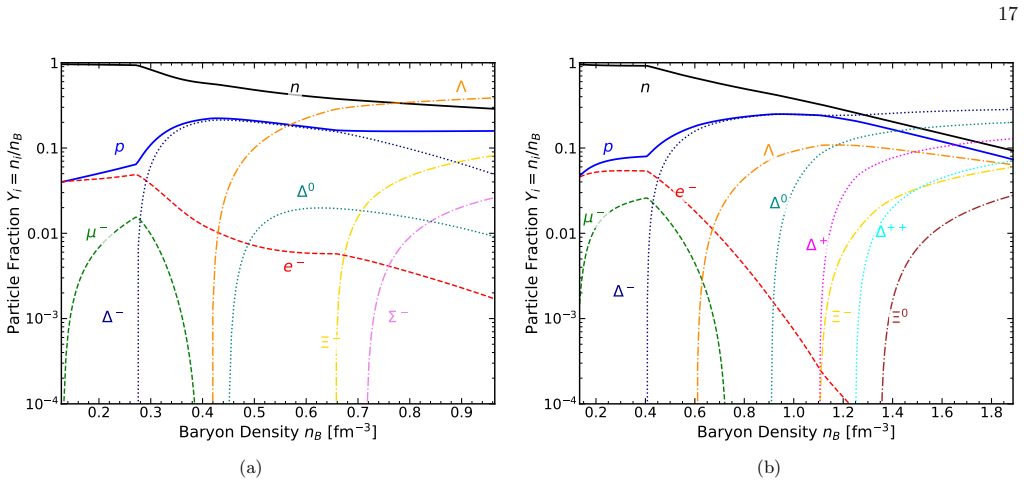
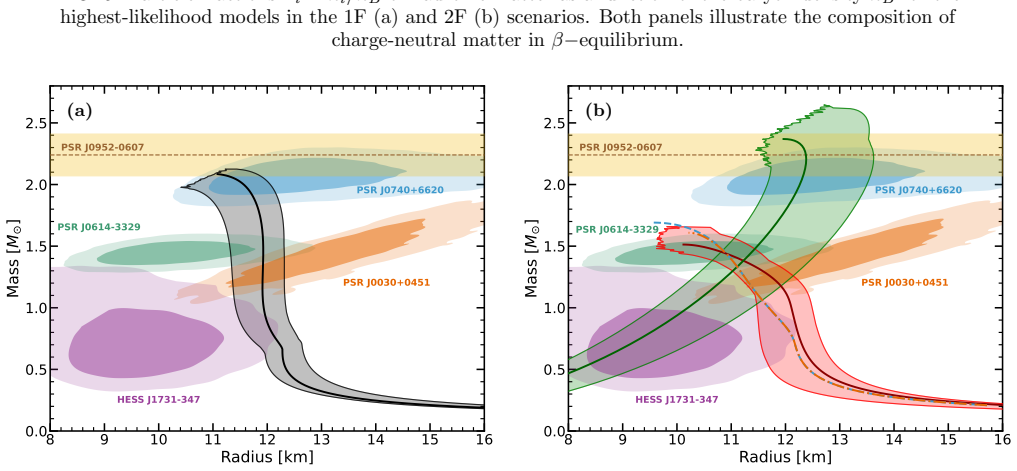
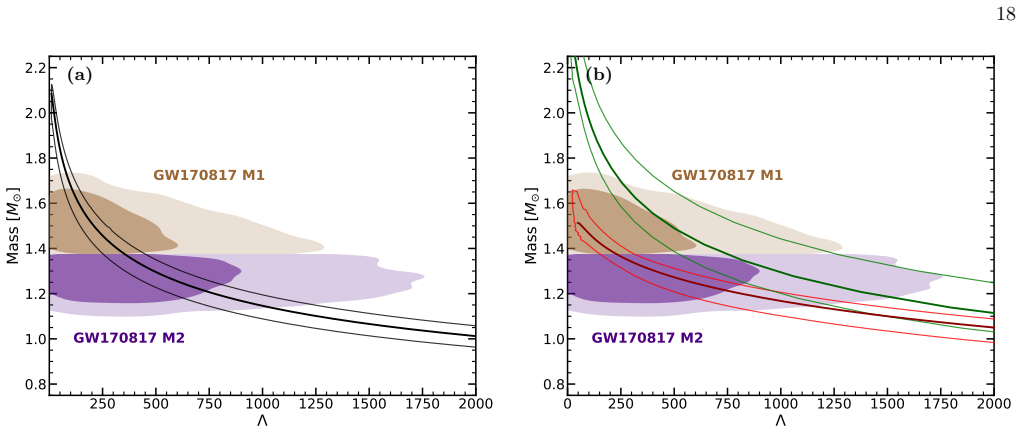
Hadronic stars and strange quark stars could coexist within the so-called two-families scenario, with hadronic matter and strange quark matter as two distinct equilibrium phases described by two different equations of state. The Bayesian analysis finds that while both the one-family and two-families scenarios are compatible with the data, comparison of the Bayes factors favors the two-families scenario. The two-families framework naturally relieves the tension between the intermediate-density softness of the equation of state required by small-radius objects and the high-density stiffness needed to support massive pulsars. Future detections of even more massive compact objects, very compact
What carries the argument
Bayesian comparison of Bayes factors between one-family and two-families equations of state constructed from non-linear relativistic mean field hadronic models (with hyperons and deltas) and bag-like quark models (with possible color superconductivity).
If this is right
- Both one-family and two-families scenarios remain compatible with current astrophysical and laboratory data.
- Bayes factors indicate that the two-families scenario is favored over the one-family scenario.
- The two-families picture removes the requirement that one equation of state be simultaneously soft at intermediate densities and stiff at high densities.
- Detections of even more massive compact objects or very compact ordinary-mass objects would strengthen the case for two families.
- Precise measurements showing two distinct masses at the same radius would provide strong support for the two-families scenario.
Where Pith is reading between the lines
- If the two-families picture holds, radius measurements of individual objects could belong to one of two separate branches rather than tracing a single equation of state.
- Population studies of compact objects might reveal a bimodal distribution in radii at fixed mass once selection effects are accounted for.
- Gravitational-wave signals from mergers could show distinct tidal deformability patterns depending on whether the objects belong to the hadronic or quark family.
Load-bearing premise
The specific non-linear relativistic mean field models for hadronic matter and bag-like models for quark matter are adequate representations of the physics across the relevant density range.
What would settle it
A future observation of a single continuous mass-radius relation for all compact objects that simultaneously accommodates both small radii at ordinary masses and very high masses without requiring two separate branches would falsify the preference for the two-families scenario.
Figures
read the original abstract
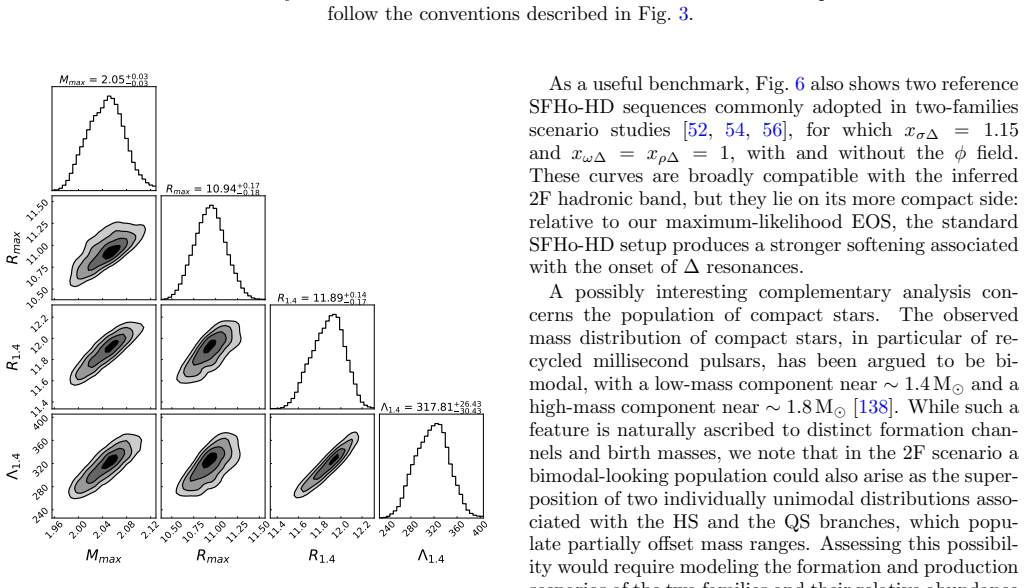
Hadronic stars and strange quark stars could coexist within the so-called two-families scenario. In this respect, hadronic matter and strange quark matter correspond to two distinct equilibrium phases described by two different equations of state. We perform here the first detailed Bayesian analysis that makes use of astrophysical and laboratory data in order to constrain the equations of state adopted within the two-families scenario for hadronic and strange quark matter. In particular, in hadronic matter we consider the possible formation of hyperons and delta resonances (beside nucleons) within a class of non linear relativistic mean field models and in quark matter we consider the possible formation of a color-superconducting phase within a bag-like model. Results of the analysis indicate that while at the moment both the one-family and the two-families scenarios are compatible with the data, by comparing the Bayes factors of both models, the two-families scenario is favored with respect to the one-family scenario. Specifically, the two-families framework naturally relieves the tension between the intermediate-density softness of the equation of state required by small-radius objects and the high-density stiffness needed to support massive pulsars. Ultimately, future detections of even more massive compact objects, very compact ordinary-mass objects, or precise measurements of two distinct masses with the same radius, will provide strong indications in favor of the two-families scenario.
Editorial analysis
A structured set of objections, weighed in public.
Referee Report
Summary. The manuscript performs the first detailed Bayesian analysis constraining equations of state in the two-families scenario, employing nonlinear relativistic mean-field models (with hyperons and deltas) for hadronic matter and bag-like models (with color superconductivity) for strange quark matter. It concludes that both the one-family and two-families scenarios remain compatible with current astrophysical and laboratory data, but that Bayes factors favor the two-families scenario because it naturally relieves the tension between intermediate-density softness (required by small-radius objects) and high-density stiffness (required by massive pulsars).
Significance. If the Bayes-factor comparison holds under the stated modeling assumptions, the work supplies a quantitative argument that the two-families picture is preferred by existing data and offers a resolution to an apparent EOS tension. The explicit use of both laboratory and astrophysical constraints within a Bayesian framework is a methodological strength.
major comments (2)
- [Abstract] Abstract: the central claim that 'by comparing the Bayes factors of both models, the two-families scenario is favored' is load-bearing for the paper's conclusion, yet the abstract (and the provided text) supplies no numerical Bayes-factor values, no list of the data sets entering the likelihood, and no description of prior ranges or convergence diagnostics; without these elements the quantitative preference cannot be verified.
- [Model description] Model construction (hadronic and quark sectors): the Bayes-factor ratio is obtained exclusively inside the restricted class of nonlinear RMF parametrizations (hyperons + deltas) and bag-like quark models (with color superconductivity). The claim that the two-families framework 'naturally relieves the tension' is therefore conditional on these parametrizations being representative across the relevant density range; no robustness test against alternative EOS families is reported, which directly affects the evidential force of the model comparison.
minor comments (2)
- The notation used for the meson-nucleon coupling constants and the bag constant should be collected in a single table for clarity.
- Figure captions should explicitly state which data sets are shown in each panel.
Simulated Author's Rebuttal
We appreciate the referee's insightful comments on our manuscript. Below we address each major comment in detail, indicating where revisions will be made to strengthen the paper.
read point-by-point responses
-
Referee: [Abstract] Abstract: the central claim that 'by comparing the Bayes factors of both models, the two-families scenario is favored' is load-bearing for the paper's conclusion, yet the abstract (and the provided text) supplies no numerical Bayes-factor values, no list of the data sets entering the likelihood, and no description of prior ranges or convergence diagnostics; without these elements the quantitative preference cannot be verified.
Authors: We agree with the referee that the abstract and main text should provide these quantitative details to support the claim. In the revised manuscript, we will include the specific Bayes factor value, list the data sets used in the likelihood, describe the prior ranges, and report on convergence diagnostics. revision: yes
-
Referee: [Model description] Model construction (hadronic and quark sectors): the Bayes-factor ratio is obtained exclusively inside the restricted class of nonlinear RMF parametrizations (hyperons + deltas) and bag-like quark models (with color superconductivity). The claim that the two-families framework 'naturally relieves the tension' is therefore conditional on these parametrizations being representative across the relevant density range; no robustness test against alternative EOS families is reported, which directly affects the evidential force of the model comparison.
Authors: Our analysis is conducted within this established class of models, which are standard for incorporating hyperons, deltas, and color superconductivity in the two-families context. We will add text to the manuscript explaining the rationale for these choices and acknowledging that the preference is within this model class. A full exploration of alternative EOS families is left for future work as it would constitute a separate extensive study. revision: partial
Circularity Check
No circularity: standard Bayesian model comparison with independent evidence ratio
full rationale
The paper conducts a Bayesian parameter estimation and model comparison between one-family and two-families EOS scenarios using astrophysical and laboratory data. The Bayes factor is computed from the marginal likelihoods under each model's prior volume on parameters (nonlinear RMF with hyperons/deltas for hadronic matter; bag model with color superconductivity for quark matter). This is a standard, non-circular procedure: parameters are constrained by data, then evidence ratios quantify relative support. The statement that two-families 'naturally relieves the tension' follows directly from the two-EOS structure allowing separate softness/stiffness regimes, but the quantitative preference is data-driven rather than tautological. No self-citation load-bearing steps, no fitted inputs renamed as predictions, and no ansatz or uniqueness theorems imported from prior author work appear in the derivation. The result remains conditional on the chosen model class (a correctness issue, not circularity).
Axiom & Free-Parameter Ledger
free parameters (2)
- coupling constants and meson masses in non-linear RMF models
- bag constant and superconducting gap parameters in the quark-matter model
axioms (1)
- domain assumption Hadronic matter and strange quark matter correspond to two distinct equilibrium phases described by different equations of state.
invented entities (1)
-
strange quark stars as a distinct family coexisting with hadronic stars
no independent evidence
Reference graph
Works this paper leans on
-
[1]
G. F. Burgio, H. J. Schulze, I. Vidana, and J. B. Wei, Prog. Part. Nucl. Phys.120, 103879 (2021), arXiv:2105.03747 [nucl-th]
arXiv 2021
-
[2]
Kumaret al.(MUSES), Living Rev
R. Kumaret al.(MUSES), Living Rev. Rel.27, 3 (2024), arXiv:2303.17021 [nucl-th]
arXiv 2024
-
[3]
S. Borsanyi, Z. Fodor, J. N. Guenther, R. Kara, S. D. Katz, P. Parotto, A. Pasztor, C. Ratti, and K. K. Szabo, Phys. Rev. Lett.125, 052001 (2020), arXiv:2002.02821 [hep-lat]
arXiv 2020
-
[4]
S. Bors´ anyi, Z. Fodor, J. N. Guenther, R. Kara, S. D. Katz, P. Parotto, A. P´ asztor, C. Ratti, and K. K. Szab´ o, Phys. Rev. Lett.126, 232001 (2021), arXiv:2102.06660 [hep-lat]
arXiv 2021
-
[5]
A. Kurkela, E. S. Fraga, J. Schaffner-Bielich, and A. Vuorinen, Astrophys. J.789, 127 (2014), arXiv:1402.6618 [astro-ph.HE]
Pith/arXiv arXiv 2014
-
[6]
O. Komoltsev and A. Kurkela, Phys. Rev. Lett.128, 202701 (2022), arXiv:2111.05350 [nucl-th]
arXiv 2022
-
[7]
C. Drischler, K. Hebeler, and A. Schwenk, Phys. Rev. Lett.122, 042501 (2019), arXiv:1710.08220 [nucl-th]
Pith/arXiv arXiv 2019
-
[8]
C. Drischler, J. W. Holt, and C. Wellenhofer, Ann. Rev. Nucl. Part. Sci.71, 403 (2021), arXiv:2101.01709 [nucl-th]
arXiv 2021
-
[9]
J. M. Lattimer and Y. Lim, Astrophys. J.771, 51 (2013), arXiv:1203.4286 [nucl-th]
Pith/arXiv arXiv 2013
-
[10]
J. M. Lattimer, Particles6, 30 (2023), arXiv:2301.03666 [nucl-th]
arXiv 2023
-
[11]
P. Danielewicz, R. Lacey, and W. G. Lynch, Science 298, 1592 (2002), arXiv:nucl-th/0208016
Pith/arXiv arXiv 2002
-
[12]
A. Sorensenet al., Prog. Part. Nucl. Phys.134, 104080 (2024), arXiv:2301.13253 [nucl-th]
arXiv 2024
-
[13]
J. M. Lattimer, Ann. Rev. Nucl. Part. Sci.62, 485 (2012), arXiv:1305.3510 [nucl-th]
Pith/arXiv arXiv 2012
-
[14]
M. Oertel, M. Hempel, T. Kl¨ ahn, and S. Typel, Rev. Mod. Phys.89, 015007 (2017), arXiv:1610.03361 [astro- ph.HE]
Pith/arXiv arXiv 2017
-
[15]
B. P. Abbottet al.(LIGO Scientific, Virgo), Phys. Rev. Lett.121, 161101 (2018), arXiv:1805.11581 [gr-qc]
Pith/arXiv arXiv 2018
-
[16]
M. C. Milleret al., Astrophys. J. Lett.887, L24 (2019), arXiv:1912.05705 [astro-ph.HE]
Pith/arXiv arXiv 2019
-
[17]
T. E. Rileyet al., Astrophys. J. Lett.918, L27 (2021), arXiv:2105.06980 [astro-ph.HE]
arXiv 2021
-
[18]
M. C. Milleret al., Astrophys. J. Lett.918, L28 (2021), arXiv:2105.06979 [astro-ph.HE]
Pith/arXiv arXiv 2021
-
[19]
D. Choudhuryet al., Astrophys. J. Lett.971, L20 (2024), arXiv:2407.06789 [astro-ph.HE]. 24
arXiv 2024
-
[20]
S. Vinciguerraet al., Astrophys. J.961, 62 (2024), arXiv:2308.09469 [astro-ph.HE]
arXiv 2024
-
[21]
Antoniadiset al., Science340, 6131 (2013), arXiv:1304.6875 [astro-ph.HE]
J. Antoniadiset al., Science340, 6131 (2013), arXiv:1304.6875 [astro-ph.HE]
Pith/arXiv arXiv 2013
-
[22]
E. Fonsecaet al., Astrophys. J. Lett.915, L12 (2021), arXiv:2104.00880 [astro-ph.HE]
arXiv 2021
-
[23]
R. W. Romani, D. Kandel, A. V. Filippenko, T. G. Brink, and W. Zheng, Astrophys. J. Lett.934, L17 (2022), arXiv:2207.05124 [astro-ph.HE]
arXiv 2022
-
[24]
Doroshenko, V
V. Doroshenko, V. Suleimanov, G. P¨ uhlhofer, and A. Santangelo, Nature Astron.6, 1444 (2022)
2022
-
[25]
F. Di Clemente, A. Drago, and G. Pagliara, Astrophys. J.967, 159 (2024), arXiv:2211.07485 [astro-ph.HE]
arXiv 2024
- [26]
-
[27]
D. Chatterjee and I. Vida˜ na, Eur. Phys. J. A52, 29 (2016), arXiv:1510.06306 [nucl-th]
Pith/arXiv arXiv 2016
-
[28]
I. Vida˜ na, Proc. Roy. Soc. Lond. A474, 0145 (2018), arXiv:1803.00504 [nucl-th]
Pith/arXiv arXiv 2018
-
[29]
L. Tolos and L. Fabbietti, Prog. Part. Nucl. Phys.112, 103770 (2020), arXiv:2002.09223 [nucl-ex]
arXiv 2020
-
[30]
D. Lonardoni, A. Lovato, S. Gandolfi, and F. Pederiva, Phys. Rev. Lett.114, 092301 (2015), arXiv:1407.4448 [nucl-th]
Pith/arXiv arXiv 2015
-
[31]
D. Logoteta, I. Vidana, and I. Bombaci, Eur. Phys. J. A55, 207 (2019), arXiv:1906.11722 [nucl-th]
arXiv 2019
-
[32]
A. Drago, A. Lavagno, G. Pagliara, and D. Pigato, Phys. Rev. C90, 065809 (2014), arXiv:1407.2843 [astro- ph.SR]
Pith/arXiv arXiv 2014
-
[33]
J. J. Li, A. Sedrakian, and F. Weber, Phys. Lett. B 783, 234 (2018), arXiv:1803.03661 [nucl-th]
Pith/arXiv arXiv 2018
- [34]
- [35]
-
[36]
M. G. Alford, S. Han, and M. Prakash, Phys. Rev. D 88, 083013 (2013), arXiv:1302.4732 [astro-ph.SR]
Pith/arXiv arXiv 2013
-
[37]
S. Weissenborn, I. Sagert, G. Pagliara, M. Hempel, and J. Schaffner-Bielich, Astrophys. J. Lett.740, L14 (2011), arXiv:1102.2869 [astro-ph.HE]
Pith/arXiv arXiv 2011
-
[38]
G. Baym, T. Hatsuda, T. Kojo, P. D. Powell, Y. Song, and T. Takatsuka, Rept. Prog. Phys.81, 056902 (2018), arXiv:1707.04966 [astro-ph.HE]
Pith/arXiv arXiv 2018
-
[39]
S. Han, M. A. A. Mamun, S. Lalit, C. Constantinou, and M. Prakash, Phys. Rev. D100, 103022 (2019), arXiv:1906.04095 [astro-ph.HE]
arXiv 2019
-
[40]
C. Constantinou, T. Zhao, S. Han, and M. Prakash, Phys. Rev. D107, 074013 (2023), arXiv:2302.04289 [nucl-th]
arXiv 2023
-
[41]
C. Constantinou, M. Guerrini, T. Zhao, S. Han, and M. Prakash, Phys. Rev. D112, 094014 (2025), arXiv:2506.20418 [nucl-th]
arXiv 2025
-
[42]
A. R. Bodmer, Phys. Rev. D4, 1601 (1971)
1971
-
[43]
Witten, Phys
E. Witten, Phys. Rev. D30, 272 (1984)
1984
-
[44]
Alcock, E
C. Alcock, E. Farhi, and A. Olinto, Astrophys. J.310, 261 (1986)
1986
-
[45]
J. Madsen, Lect. Notes Phys.516, 162 (1999), arXiv:astro-ph/9809032
Pith/arXiv arXiv 1999
-
[46]
F. Weber, Prog. Part. Nucl. Phys.54, 193 (2005), arXiv:astro-ph/0407155
Pith/arXiv arXiv 2005
-
[47]
Haensel, J
P. Haensel, J. L. Zdunik, and R. Schaeffer, Astron. Astrophys.160, 121 (1986)
1986
-
[48]
A. Drago, A. Lavagno, and G. Pagliara, Phys. Rev. D 89, 043014 (2014), arXiv:1309.7263 [nucl-th]
Pith/arXiv arXiv 2014
-
[49]
A. Drago, A. Lavagno, G. Pagliara, and D. Pigato, Eur. Phys. J. A52, 40 (2016), arXiv:1509.02131 [astro- ph.SR]
Pith/arXiv arXiv 2016
-
[50]
A. Drago and G. Pagliara, Eur. Phys. J. A52, 41 (2016), arXiv:1509.02134 [astro-ph.SR]
Pith/arXiv arXiv 2016
-
[51]
G. F. Burgio, A. Drago, G. Pagliara, H. J. Schulze, and J. B. Wei, Astrophys. J.860, 139 (2018), arXiv:1803.09696 [astro-ph.HE]
arXiv 2018
-
[52]
I. Bombaci, A. Drago, D. Logoteta, G. Pagliara, and I. Vida˜ na, Phys. Rev. Lett.126, 162702 (2021), arXiv:2010.01509 [nucl-th]
arXiv 2021
-
[53]
A. Drago and G. Pagliara, Phys. Rev. C92, 045801 (2015), arXiv:1506.08337 [nucl-th]
Pith/arXiv arXiv 2015
-
[54]
Guerrini, G
M. Guerrini, G. Pagliara, A. Lavagno, and A. Drago, in preparation (2026)
2026
-
[55]
R. De Pietri, A. Drago, A. Feo, G. Pagliara, M. Pasquali, S. Traversi, and G. Wiktorowicz, As- trophys. J.881, 122 (2019), arXiv:1904.01545 [astro- ph.HE]
arXiv 2019
-
[56]
L. M. Becerra, F. Cipolletta, A. Drago, M. Guerrini, A. Lavagno, G. Pagliara, and J. A. Rueda, JHEAp50, 100491 (2026), arXiv:2507.22033 [astro-ph.HE]
arXiv 2026
-
[57]
Z. Berezhiani, I. Bombaci, A. Drago, F. Frontera, and A. Lavagno, Astrophys. J.586, 1250 (2003), arXiv:astro-ph/0209257
Pith/arXiv arXiv 2003
-
[58]
G. Pagliara, M. Herzog, and F. K. R¨ opke, Phys. Rev. D87, 103007 (2013), arXiv:1304.6884 [astro-ph.HE]
Pith/arXiv arXiv 2013
-
[59]
A. Drago, G. Pagliara, and S. Traversi, Mem. Soc. Ast. It.89, 236 (2018), arXiv:1802.01696 [astro-ph.HE]
Pith/arXiv arXiv 2018
-
[60]
M. Guerrini, G. Pagliara, A. Lavagno, and A. Drago, Universe11, 258 (2025), arXiv:2506.00139 [nucl-th]
arXiv 2025
-
[61]
I. Bombaci, D. Logoteta, I. Vida˜ na, and C. Providˆ encia, Eur. Phys. J. A52, 58 (2016), arXiv:1601.04559 [astro- ph.HE]
Pith/arXiv arXiv 2016
-
[62]
J. Cartaxo, C. Huang, T. Malik, S. Sourav, W.-L. Yuan, T. Zhou, X. Liu, and C. Providˆ encia, Astrophys. J. Suppl.282, 33 (2026), arXiv:2506.03112 [nucl-th]
arXiv 2026
-
[63]
T. Dietrich, M. W. Coughlin, P. T. H. Pang, M. Bulla, J. Heinzel, L. Issa, I. Tews, and S. Antier, Science370, 1450 (2020), arXiv:2002.11355 [astro-ph.HE]
arXiv 2020
-
[64]
Huthet al., Nature606, 276 (2022), arXiv:2107.06229 [nucl-th]
S. Huthet al., Nature606, 276 (2022), arXiv:2107.06229 [nucl-th]
arXiv 2022
-
[65]
P. T. H. Panget al., (2022), arXiv:2205.08513 [astro- ph.HE]
arXiv 2022
- [66]
-
[67]
G. Raaijmakerset al., Astrophys. J. Lett.887, L22 (2019), arXiv:1912.05703 [astro-ph.HE]
arXiv 2019
-
[68]
G. Raaijmakers, S. K. Greif, K. Hebeler, T. Hinderer, S. Nissanke, A. Schwenk, T. E. Riley, A. L. Watts, J. M. Lattimer, and W. C. G. Ho, Astrophys. J. Lett.918, L29 (2021), arXiv:2105.06981 [astro-ph.HE]
arXiv 2021
-
[69]
L. Brandes, W. Weise, and N. Kaiser, Phys. Rev. D 108, 094014 (2023), arXiv:2306.06218 [nucl-th]
arXiv 2023
-
[70]
P. Landry and R. Essick, Phys. Rev. D99, 084049 (2019), arXiv:1811.12529 [gr-qc]
Pith/arXiv arXiv 2019
- [71]
-
[72]
S. Traversi, P. Char, and G. Pagliara, Astrophys. J. 897, 165 (2020), arXiv:2002.08951 [astro-ph.HE]
arXiv 2020
-
[73]
L. Passarella, J. Margueron, and G. Pagliara, Phys. Rev. C112, 035805 (2025), arXiv:2503.23028 [nucl-th]
arXiv 2025
-
[74]
P. Char, S. Traversi, and G. Pagliara, Particles3, 621 (2020)
2020
- [75]
- [76]
-
[77]
M. V. Beznogov and A. R. Raduta, Phys. Rev. C110, 035805 (2024), arXiv:2403.19325 [nucl-th]
arXiv 2024
-
[78]
J. Margueron, R. Hoffmann Casali, and F. Gulminelli, Phys. Rev. C97, 025805 (2018), arXiv:1708.06894 [nucl- th]
Pith/arXiv arXiv 2018
-
[79]
G. Montefusco, M. Antonelli, and F. Gulminelli, (2026), arXiv:2604.00196 [nucl-th]
arXiv 2026
-
[80]
T. Malik and C. Providˆ encia, Phys. Rev. D106, 063024 (2022), arXiv:2205.15843 [nucl-th]
arXiv 2022
discussion (0)
Sign in with ORCID, Apple, or X to comment. Anyone can read and Pith papers without signing in.