REVIEW 4 major objections 4 minor 118 references
Towards Valid B-Rep Generation: Training-Free Wireframe Anomaly Detection and Repair
T0 review · 4 major / 4 minor · reviewed 2026-08-08 · deepseek-v4-flash
Pith's one-line read A training-free, plug-and-play module that screens intermediate CAD wireframes for geometric and topological anomalies and guides their regeneration raises the fraction of kernel-valid generated B-Rep models by 10.9–26.9 percentage points…
desk verdict Solid, honest empirical paper: WDR's training-free validity gains for multi-stage B-Rep generation are real and well-measured, with the main caveats being unreleased code and the geometric detector's imperfect sensitivity on new distributions. read the letter →
The pith
A machine-rendered reading of the paper's core claim, the machinery that carries it, and where it could break.
The reading
What carries the argument
The load-bearing objects are the two WDR modules. GTAD (Geometric-Topology Anomaly Detector) runs three detectors in parallel: a VLM-based coarse screen that returns a binary fail/pass on multi-view wireframe renderings; a geometric detector that computes the discrete tangent-point energy $E_{\text{geom}}(W) = \frac{1}{|E|} \sum_{e \in E} E_{\text{tpe}}(e)$, with each edge contribution evaluated by endpoint quadrature of the repulsive-curves kernel $k^\alpha_\beta(p,q,T_p) = \|T_p \times (p-q)\|^\alpha / \|p-q\|^\beta$ with $(\alpha,\beta)=(3,6)$, activating the geometry branch when $E_{\text{geom}} > \delta$ with $\delta=7.0$; and a topological detector that sums four violation scores $r_i(W)$ (vertex-edge degree outside $[2,8]$, boundary loops that are not simple cycles with at least three vertices, faces not trimmed by exactly one outer loop, and shell edge-face graphs with more than one connected component), activating the topology branch when $E_{\text{topo}}(W) > 0$. EGGTR (Energy-Guided Geometric-Topology Repair) then performs detector-triggered regeneration: for autoregressive generators, at each token position where an active energy is evaluable it draws $K=4$ distinct candidates and deterministically selects the one minimizing $-\log \pi_t(x) + \Delta E_t(x)$, where $\Delta E_t$ is the masked local energy increment on the partial wireframe; for diffusion geometry generation it applies training-free guidance that tilts the conditional distribution by $\exp(-\lambda_{\text{geom}} E_{\text{geom}}(W(x_0)))$ via noisy-state and clean-estimate gradient terms. The masked-energy construction, which evaluates only primitives complete at the current prefix, is what makes local reranking feasible.
What would settle it
Run WDR with all detector parameters frozen (the same VLM, δ=7.0, and the same four topological checks) on a new multi-stage B-Rep generator whose exposed wireframes come from a different serialization or domain, and measure matched baseline-vs-WDR Valid on 3,000 paired samples. If the Valid gain falls below roughly 5 points while the baseline still shows a comparable invalid fraction, or if the geometric detector's recall on an independent set of interior-crossing test cases drops below its reported 79.5%, the central transferability claim collapses.
Extended reading notes
Core claim
The paper's central claim is that a training-free intervention at the wireframe stage can convert a substantial fraction of would-be-invalid B-Rep outputs into kernel-valid ones. Concretely, WDR combines three complementary risk signals—a vision-language model's coarse visual screening, a discrete tangent-point energy that heuristically scores self-intersection and near-collapse risk, and four validity-inspired topological checks on vertex-edge degree, loop integrity, loop-face trimming, and face-shell connectivity—into a routing decision, then applies detector-triggered guided regeneration: local energy-aware candidate reranking during autoregressive decoding, and training-free diffusion guidance on the geometry branch. The paper reports that on the held-out detector cohort the combined detector reaches an F1 of 81.97% for predicting downstream invalidity, that full routing improves ABC validity from 68.1% to 83.9% with only 79 initially-valid outputs turned invalid (versus 211 for always-on guidance), and that the same recipe transfers to class-conditioned and point-cloud-conditioned settings. The authors state the result as improving unconditional kernel-checked validity by 10.9–26.9 percentage points while largely retaining measured diversity and distributional quality.
Load-bearing premise
The discrete tangent-point energy with endpoint quadrature is only a heuristic proxy for geometric invalidity: the paper's own controlled evaluation shows it flags 79.5% of interior crossings, 83.2% of near-collapsed edges, and mis-flags 6.7% of legal near-contacts, so if this proxy stops correlating with kernel-invalidity on new wireframe distributions, the geometric guidance and routing will no longer translate into validity gains.
Editorial extensions
If this is right
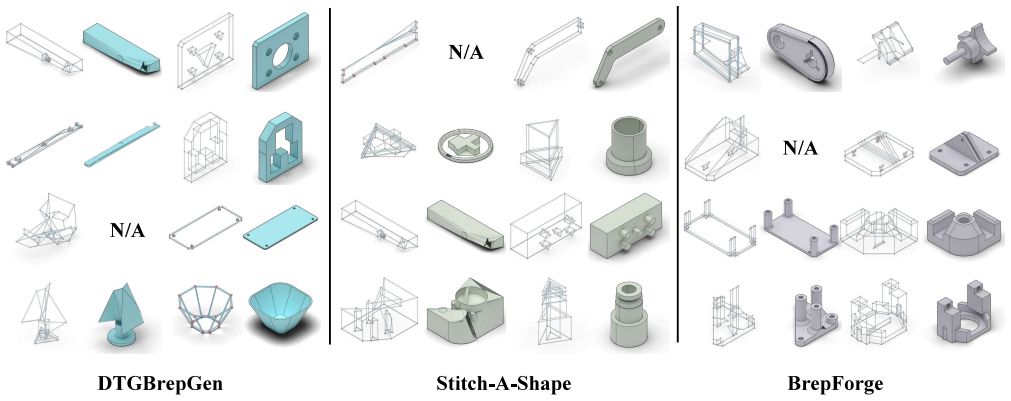
- On unconditional generation over DeepCAD and ABC, WDR raises Valid by 10.9–26.9 percentage points across DTGBrepGen, Stitch-A-Shape, and BrepForge, with Novel, Unique, COV, MMD, and JSD largely unchanged.
- On class-conditioned Furniture generation, WDR improves the ten-class macro-average Valid from 64.36% to 73.63% for DTGBrepGen and from 58.59% to 68.04% for Stitch-A-Shape.
- On 3,000 matched point-cloud conditions for BrepForge, WDR improves Valid from 87.1% to 89.3% and also improves CD, EMD, and F-Score, meaning the extra valid outputs are not bought by drifting from the input.
- The detector ablations show the three signals are complementary: the full GTAD reaches 81.97% downstream-risk F1, above every single or two-signal variant, and detector-informed routing nearly matches always-on guidance (83.9% vs 84.3% Valid) while cutting Valid→Invalid regressions from 211 to 79.
- Local energy-aware resampling (K=4) beats parallel Best-of-4 by 3.2 Valid points and one-retry rejection sampling by 5.7 points, with lower peak memory than Best-of-4.
Reading between the lines
- The same detector-triggered rerank loop is not CAD-specific: any multi-stage generative system with an exposed intermediate structure whose quality predicts final validation (meshes, skeletons, program traces) could be retrofitted with a cheap risk proxy and local energy reranking.
- Because the VLM branch is the latency and data-governance bottleneck (remote inference on rendered geometry), a smaller locally hosted vision model—even at a few F1 points lower—could make the module practical for confidential industrial CAD, at some routing-quality cost the paper's backbone ablation lets you estimate.
- The geometric detector's reported 79.5% recall on interior crossings suggests an exact segment-intersection predicate could replace or augment the tangent-point energy; such a predicate would be exact, and the routing framework would not need to change.
- A testable extension: use the OCCT checker itself as a sparse oracle during routing—run the cheap detectors on the wireframe, and only for the rare samples where all detectors disagree, allow a full construction to be attempted; the paired validity-transition tables in the supplementary suggest this could recover most of the remaining missed crossings at modest cost.
Editorial analysis
A structured set of objections, weighed in public.
Referee Report
Summary. This paper proposes WDR (Wireframe Detection and Repair), a training-free module that intervenes at the intermediate wireframe stage of multi-stage B-Rep generators (DTGBrepGen, Stitch-A-Shape, BrepForge) to improve the kernel-checked validity of final B-Reps. WDR has two coupled phases: GTAD, which combines a VLM-based visual screener, a tangent-point-energy geometric detector (Eq. 4), and four topology constraints (Eq. 5) to predict downstream OCCT invalidity and select guidance branches; and EGGTR, which performs local candidate reranking for autoregressive stages (Eq. 9) and TFG-based guidance for the diffusion stage (Eq. 12). The central claim is that WDR improves unconditional Valid by 10.9-26.9 percentage points across three generators and two datasets, improves macro-average Valid on class-conditioned Furniture (64.36 to 73.63 for DTGBrepGen; 58.59 to 68.04 for Stitch-A-Shape), and improves Valid and fidelity on point-cloud-conditioned reconstruction (Table 3), while largely retaining Novel, Unique, COV, MMD, and JSD. The evaluation is paired by condition ID and base seed, with bootstrap confidence intervals and exact McNemar tests reported in the supplementary for the two main DTGBrepGen transitions.
Significance. If the central claim holds, WDR addresses a real bottleneck: error accumulation in multi-stage B-Rep generation, without retraining large generators. The evaluation is substantially stronger than is typical for this area: seed-matched paired comparisons with bootstrap CIs and McNemar tests; routing controls (always-on versus matched random routing versus GTAD) that isolate detector value; sampling-strategy comparisons (one-retry rejection, Best-of-N, and local reranking) with latency and peak-memory profiles; and a controlled detector cohort in the supplementary that honestly reports the geometric detector's 79.5% recall on interior crossings and 6.7% false-positive rate on legal near-contacts. The limitation statements are substantive rather than boilerplate: the paper explicitly calls E_geom a 'computational risk surrogate, not a complete predicate,' and it distinguishes kernel-checked validity from manufacturability.
major comments (4)
- [Main text, Tables 4-5; Supplementary, 'Implementation Details' and 'Analysis of the GTAD Geometric Detector'] The geometric threshold δ=7.0 and the VLM backbone are selected on a single DTGBrepGen/ABC development cohort, and all direct detector diagnostics (F1 in Table 4, controlled recall in Supplementary Table 2) are measured on ABC only. The same δ and backbone are then applied unchanged to DeepCAD, Furniture, Stitch-A-Shape, and BrepForge. This matters because the geometry and VLM branches jointly contribute a substantial share of the reported gains: geometry-only repair adds +4.8 points (Table 5), and full routing reaches 83.9 versus 78.6 for Geom.+Topo. without the VLM (Supplementary Table 4). The consistent end-to-end gains provide indirect evidence that the detector transfers, but they do not show whether the risk signals remain informative on each distribution; the plug-and-play claim is therefore broader than the detector evidence. The paper should either add per-generator/per-dataset routing ablations or detector F1/sensitivity measurements, or explicitly scope the claim to the DTGBrepGen/ABC-calibrated setting.
- [Supplementary, Tables 9-10; main text, 'Experimental Setup'] The supplementary states that the detector development cohort (2,787 DTGBrepGen/ABC samples) and the held-out detector test cohort (2,787 samples) are disjoint, but it does not state the relationship of either cohort to the 3,000-sample ABC end-to-end evaluation set used for the headline +15.8-point gain in Supplementary Table 10. If any of the 3,000 end-to-end evaluation samples also served as development samples for selecting δ and the VLM backbone, the ABC validity gain would be partially tuned on the evaluation set. Please state explicitly whether the development cohort is disjoint from the 3,000-sample end-to-end evaluation set; if it is not, the headline ABC evaluation should be re-run with development-excluded seeds. A per-dataset δ-sensitivity table would also help establish how robust the routing is to this hyperparameter.
- [Table 3 and 'Point-Cloud-Conditioned Generation'] Under the failure-aware protocol, failed reconstructions receive the worst finite CD/EMD and an F-Score of zero in both arms. Because WDR converts some failures into successes (Valid 87.1 to 89.3), the pooled CD (0.93 to 0.87), EMD (2.45 to 2.19), and F-Score (0.91 to 0.94) improvements are at least partly mechanical consequences of the validity gain rather than evidence of better geometry on the success set. The sentence that the additional kernel-valid outputs do not arise from trading away agreement with the input point cloud should be supported by reporting fidelity metrics conditional on successful construction, or by quantifying the mechanical component of the pooled improvement. Without that, the claim that both validity and fidelity improve is stronger than the evidence supports.
- [Table 4 and 'Ablations on GTAD'] The detector combination results are non-monotonic: VLM+Geom (69.57) is below VLM alone (71.30), and Geom+Topo (69.65) is below Topo alone (74.75), yet the full triple reaches 81.97. The manuscript attributes this to complementary failure patterns, but it does not define the fusion rule used to form the combined binary risk prediction for the F1 evaluation, nor does it analyze how the three detectors' errors overlap. Because GTAD's design as a parallel combination of complementary signals is a core contribution, please state the fusion rule explicitly and provide a brief analysis of the false-positive/false-negative overlap across detectors so that the complementarity claim can be checked rather than inferred from the single triple result.
minor comments (4)
- [Table 1] For DTGBrepGen on ABC, COV decreases from 72.08 to 69.80 and JSD increases from 1.12 to 1.32, the largest distributional shifts in the table; the claim of 'largely retaining' distributional quality would be easier to assess with bootstrap confidence intervals on COV, MMD, and JSD for the paired samples.
- [Supplementary, 'Detector and Guidance Configurations'] The VLM is queried at temperature 1.0 through OpenRouter with default provider routing, so the screening signal is stochastic; the reported end-to-end gains are single-draw outcomes. The paper should either fix the temperature and provider or report the sensitivity of the routing decisions, and hence of the Valid gains, to repeated VLM queries.
- [Method, 'Geometric Detector'] The main text states that δ=7.0 was chosen from a threshold-sensitivity study but does not mention that the VLM backbone was also selected on the same development cohort; a single sentence in the main text identifying these as the only two selector-tuned hyperparameters, both frozen before held-out evaluation, would make the 'training-free' claim easier to scope.
- [Table 1 and 'Quantitative Evaluation'] The headline range of 10.9-26.9 percentage points mixes settings with very different baselines (for example, Stitch-A-Shape/ABC at 56.6 to 83.5 versus BrepForge/ABC at 75.4 to 86.3); reporting relative improvements or per-setting confidence intervals would make the consistency of the effect across generators easier to judge.
Circularity Check
No significant circularity: WDR's validity gains are measured against an external OCCT checker, with detectors as imperfect heuristics and parameters tuned on a disjoint development cohort.
full rationale
WDR's central claim is that a training-free wireframe-stage intervention raises the fraction of generated B-Reps passing the OCCT kernel checker. The evaluation target is external to the method: `Valid` is defined by the pythonocc/occwl checker, while the guiding energies are transparent heuristics (discrete tangent-point energy and four incidence/loop/shell checks). The paper explicitly stops short of identifying these energies with validity, calling E_geom "a computational risk surrogate, not a complete predicate" and the topology criteria "routing heuristics rather than universal validity theorems." The one parameter tuning that exists (delta = 7.0 and the VLM backbone) is performed on a 2,787-sample development cohort and then frozen before evaluation on a disjoint 2,787-sample held-out cohort; end-to-end validity is reported on matched test samples with shared seeds. Since the proxy detectors are imperfect (recall 79.5% for interior crossings, 83.2% for near-collapsed edges; 6.7% false positives on legal near-contacts), the measured validity gains are not forced by construction. The only self-citation (BRep-GD) appears in a related-work list and is not load-bearing. No step reduces by definition to its inputs.
Assumptions & free parameters
free parameters (4)
- Geometric detector threshold delta =
7.0
- VLM backbone =
Qwen3.5-Flash
- Topology calibration ranges =
vertex degree [2,8]; min loop size 3; face loop counts; shell connectedness
- Guidance weights and sampling hyperparameters =
lambda_geom=1, lambda_topo=1, K=4, top-k=4, tau=1, T=250, N_iter=N_recur=2, rho_bar=mu_bar=1, gamma_bar=0.01
assumptions (4)
- domain assumption Multi-stage B-Rep generation factorizes as W=g_wire(z,c), G=g_geom(W,c), and the intermediate wireframe W exposes sufficient geometric and topological information to assess downstream invalidity risk.
- ad hoc to paper Discrete tangent-point energy with endpoint quadrature is a valid soft proxy for self-intersection and edge-collapse risk.
- ad hoc to paper Representation-calibrated topology constraints (degree in [2,8], loop size at least 3, single outer loop, connected shell) are meaningful risk indicators for the evaluated generators.
- ad hoc to paper The local candidate reranking rule in Eq. (9) with K candidates approximates the global energy-tilted distribution q* in Eq. (7).
Cite this review
Pith. "Pith review of Towards Valid B-Rep Generation: Training-Free Wireframe Anomaly Detection and Repair." pith.science (2026). https://pith.science/paper/6GFXGTFF
@misc{pith2026260804955,
  author       = {Pith},
  title        = {Pith review of: Towards Valid B-Rep Generation: Training-Free Wireframe Anomaly Detection and Repair},
  year         = {2026},
  howpublished = {\url{https://pith.science/paper/6GFXGTFF}},
  note         = {Machine review of arXiv:2608.04955}
}
read the original abstract
Multi-stage boundary representation (B-Rep) generation leverages intermediate wireframes to synthesize CAD models. However, geometric and topological risks in these wireframes -- such as self-intersections, edge collapses, and disconnected vertices -- can propagate to invalid final B-Reps. Mitigating such failures by retraining large generative models is computationally prohibitive. We propose Wireframe Detection and Repair (WDR), a training-free framework that intervenes at the intermediate wireframe stage to improve downstream B-Rep validity. WDR features a Geometric-Topology Anomaly Detector (GTAD) that combines parallel VLM-based coarse screening with geometric and topological detectors to predict downstream invalidity risk and route generation to dedicated branches. An Energy-Guided Geometric-Topology Repair (EGGTR) module then performs detector-triggered guided regeneration through geometry and topology branches. By scaling test-time computation via Energy-Guided Resampling and training-free guidance for diffusion models, WDR can be integrated into autoregressive and diffusion pipelines without retraining. Extensive experiments demonstrate consistent improvements in kernel-checked validity while largely retaining the measured diversity and distributional quality of synthesized CAD models. The code will be made publicly available upon acceptance.
Figures


Figures from the paper (10 more)



Reference graph
Works this paper leans on
-
[1]
2023 , eprint =
SolidGen: An Autoregressive Model for Direct B-rep Synthesis , author =. 2023 , eprint =
2023
-
[2]
ACM Trans
Xu, Xiang and Lambourne, Joseph and Jayaraman, Pradeep and Wang, Zhengqing and Willis, Karl and Furukawa, Yasutaka , title =. ACM Trans. Graph. , year =
-
[3]
Proceedings of the IEEE/CVF Conference on Computer Vision and Pattern Recognition , year =
Li, Jing and Fu, Yihang and Chen, Falai , title =. Proceedings of the IEEE/CVF Conference on Computer Vision and Pattern Recognition , year =
-
[4]
ACM Trans
Liu, Yilin and Xu, Duoteng and Yu, Xingyao and Xu, Xiang and Cohen-Or, Daniel and Zhang, Hao and Huang, Hui , title =. ACM Trans. Graph. , year =
-
[5]
Proceedings of the SIGGRAPH Asia 2025 Conference Papers , year =
Xu, Xiang and Jayaraman, Pradeep and Lambourne, Joseph and Liu, Yilin and Malpure, Durvesh and Meltzer, Pete , title =. Proceedings of the SIGGRAPH Asia 2025 Conference Papers , year =
2025
-
[6]
Proceedings of the SIGGRAPH 2025 Conference Papers , year =
Lee, Mingi and Zhang, Dongsu and Jambon, Cl\'. Proceedings of the SIGGRAPH 2025 Conference Papers , year =
2025
-
[7]
Proceedings of the SIGGRAPH 2025 Conference Papers , year =
Li, Pu and Zhang, Wenhao and Chen, Jinglu and Yan, Dongming , title =. Proceedings of the SIGGRAPH 2025 Conference Papers , year =
2025
-
[8]
Advances in Neural Information Processing Systems , year =
Dhariwal, Prafulla and Nichol, Alexander Quinn , title =. Advances in Neural Information Processing Systems , year =
Show all 118 references
-
[9]
and Klasky, Marc Louis and Ye, Jong Chul , title =
Chung, Hyungjin and Kim, Jeongsol and McCann, Michael T. and Klasky, Marc Louis and Ye, Jong Chul , title =. The Eleventh International Conference on Learning Representations , year =
-
[10]
Proceedings of the IEEE/CVF Conference on Computer Vision and Pattern Recognition Workshops , year =
Bansal, Arpit and Chu, Hong-Min and Schwarzschild, Avi and Sengupta, Soumyadip and Goldblum, Micah and Geiping, Jonas and Goldstein, Tom , title =. Proceedings of the IEEE/CVF Conference on Computer Vision and Pattern Recognition Workshops , year =
-
[11]
Proceedings of the IEEE/CVF International Conference on Computer Vision , year =
Yu, Jiwen and Wang, Yinhuai and Zhao, Chen and Ghanem, Bernard and Zhang, Jian , title =. Proceedings of the IEEE/CVF International Conference on Computer Vision , year =
-
[12]
Zico and Salakhutdinov, Ruslan and Ermon, Stefano , title =
He, Yutong and Murata, Naoki and Lai, Chieh-Hsin and Takida, Yuhta and Uesaka, Toshimitsu and Kim, Dongjun and Liao, Wei-Hsiang and Mitsufuji, Yuki and Kolter, J. Zico and Salakhutdinov, Ruslan and Ermon, Stefano , title =. The Twelfth International Conference on Learning Repr...
-
[13]
and Ermon, Stefano , title =
Ye, Haotian and Lin, Haowei and Han, Jiaqi and Xu, Minkai and Liu, Sheng and Liang, Yitao and Ma, Jianzhu and Zou, James Y. and Ermon, Stefano , title =. Advances in Neural Information Processing Systems , year =
-
[14]
Advances in Neural Information Processing Systems , year =
Guo, Yingqing and Yuan, Hui and Yang, Yukang and Chen, Minshuo and Wang, Mengdi , title =. Advances in Neural Information Processing Systems , year =
-
[15]
Advances in Neural Information Processing Systems , year =
Shen, Yifei and Jiang, Xinyang and Yang, Yifan and Wang, Yezhen and Han, Dongqi and Li, Dongsheng , title =. Advances in Neural Information Processing Systems , year =
-
[16]
and Si, Xujie , title =
Zhang, Youyuan and Liu, Zehua and Li, Zenan and Li, Zhaoyu and Clark, James J. and Si, Xujie , title =. Proceedings of the IEEE/CVF Conference on Computer Vision and Pattern Recognition , year =
-
[17]
ACM Trans
Yu, Chris and Schumacher, Henrik and Crane, Keenan , title =. ACM Trans. Graph. , year =
-
[18]
2021 , howpublished =
Yu, Chris and Schumacher, Henrik and Crane, Keenan , title =. 2021 , howpublished =
2021
-
[19]
OpenRouter API Reference , year =
-
[20]
Provider Routing , year =
-
[21]
Data Collection , year =
-
[22]
Zero Data Retention , year =
-
[23]
ACM Trans
Li, Pu and Zhang, Wenhao and Quan, Weize and Zhang, Biao and Wonka, Peter and Yan, Dong-Ming , title =. ACM Trans. Graph. , year =
-
[24]
Proceedings of the SIGGRAPH 2026 Conference Papers , year =
Li, Jing and Fu, Yihang and Chen, Falai , title =. Proceedings of the SIGGRAPH 2026 Conference Papers , year =
2026
-
[25]
2026 , eprint =
Lu, Junran and Li, Yuanqi and Li, Hengji and Guo, Jie and Guo, Yanwen , title =. 2026 , eprint =
2026
-
[26]
Wu, Jianyu and Wang, Yizhou and Yue, Xiangyu and Ma, Xinzhu and Guo, Jinyang and Zhou, Dongzhan and Ouyang, Wanli and Tang, Shixiang , booktitle =
-
[27]
IEEE Transactions on Visualization and Computer Graphics , year =
Qin, Feiwei and Luo, Chenqi and Hou, Junhao and Fang, Meie and Liu, Ligang , title =. IEEE Transactions on Visualization and Computer Graphics , year =
-
[28]
Computational Linguistics , year =
Collins, Michael and Koo, Terry , title =. Computational Linguistics , year =
-
[29]
International Conference on Learning Representations , year =
Snell, Charlie and Lee, Jaehoon and Xu, Kelvin and Kumar, Aviral , title =. International Conference on Learning Representations , year =
-
[30]
Proceedings of the IEEE/CVF International Conference on Computer Vision , year =
Wu, Rundi and Xiao, Chang and Zheng, Changxi , title =. Proceedings of the IEEE/CVF International Conference on Computer Vision , year =
-
[31]
Proceedings of the IEEE/CVF Conference on Computer Vision and Pattern Recognition , year =
Koch, Sebastian and Matveev, Albert and Jiang, Zhongshi and Williams, Francis and Artemov, Alexey and Burnaev, Evgeny and Alexa, Marc and Zorin, Denis and Panozzo, Daniele , title =. Proceedings of the IEEE/CVF Conference on Computer Vision and Pattern Recognition , year =
-
[32]
Advances in Neural Information Processing Systems , year =
Khan, Mohammad Sadil and Sinha, Sankalp and Uddin, Sheikh Talha and Stricker, Didier and Ali, Sk Aziz and Afzal, Muhammad Zeshan , title =. Advances in Neural Information Processing Systems , year =
-
[33]
2024 , eprint =
Xu, Jingwei and Wang, Chenyu and Zhao, Zibo and Liu, Wen and Ma, Yi and Gao, Shenghua , title =. 2024 , eprint =
2024
-
[34]
Proceedings of the IEEE/CVF International Conference on Computer Vision , year =
Rukhovich, Danila and Dupont, Elona and Mallis, Dimitrios and Cherenkova, Kseniya and Kacem, Anis and Aouada, Djamila , title =. Proceedings of the IEEE/CVF International Conference on Computer Vision , year =
-
[35]
Proceedings of the IEEE/CVF Conference on Computer Vision and Pattern Recognition , year =
Li, Jiahao and Ma, Weijian and Li, Xueyang and Lou, Yunzhong and Zhou, Guichun and Zhou, Xiangdong , title =. Proceedings of the IEEE/CVF Conference on Computer Vision and Pattern Recognition , year =
-
[36]
Xu, Xiang and Willis, Karl D. D. and Lambourne, Joseph G. and Cheng, Chin-Yi and Jayaraman, Pradeep Kumar and Furukawa, Yasutaka , title =. Proceedings of the International Conference on Machine Learning , year =
-
[37]
Xu, Xiang and Jayaraman, Pradeep Kumar and Lambourne, Joseph George and Willis, Karl D. D. and Furukawa, Yasutaka , title =. Proceedings of the International Conference on Machine Learning , year =
-
[38]
Graphical Models , year =
Guo, Xufei and Dong, Xiao and Cao, Juan and Chen, Zhonggui , title =. Graphical Models , year =
-
[39]
Willis, Karl D. D. and Pu, Yewen and Luo, Jieliang and Chu, Hang and Du, Tao and Lambourne, Joseph G. and Solar-Lezama, Armando and Matusik, Wojciech , title =. ACM Trans. Graph. , year =
-
[40]
, title =
Li, Changjian and Pan, Hao and Bousseau, Adrien and Mitra, Niloy J. , title =. ACM Trans. Graph. , year =
-
[41]
Lambourne, Joseph George and Willis, Karl D. D. and Jayaraman, Pradeep Kumar and Zhang, Longfei and Sanghi, Aditya and Malekshan, Kamal Rahimi , title =. SIGGRAPH Asia 2022 Conference Papers , year =
2022
-
[42]
Proceedings of the SIGGRAPH Asia 2025 Conference Papers , year =
You, Yang and Uy, Mikaela Angelina and Han, Jiaqi and Thomas, Rahul and Zhang, Haotong and Du, Yi and Chen, Hansheng and Engelmann, Francis and You, Suya and Guibas, Leonidas , title =. Proceedings of the SIGGRAPH Asia 2025 Conference Papers , year =
2025
-
[43]
Qwen3.5: Accelerating Productivity with Native Multimodal Agents , url =
-
[44]
, title =
Weiler, Kevin J. , title =
-
[45]
2022 , url =
Paviot, Thomas , title =. 2022 , url =
2022
-
[46]
2017 , publisher =
Graph Theory , author =. 2017 , publisher =
2017
-
[47]
ACM SIGGRAPH Computer Graphics , year =
Ansaldi, Silvia and De Floriani, Leila and Falcidieno, Bianca , title =. ACM SIGGRAPH Computer Graphics , year =
-
[48]
Computer Graphics Forum , year =
Ansaldi, Silvia and De Floriani, Leila and Falcidieno, Bianca , title =. Computer Graphics Forum , year =
-
[49]
2026 , url =
Introducing. 2026 , url =
2026
-
[50]
Advances in Neural Information Processing Systems , year =
Hong, Yining and Zhen, Haoyu and Chen, Peihao and Zheng, Shuhong and Du, Yilun and Chen, Zhenfang and Gan, Chuang , title =. Advances in Neural Information Processing Systems , year =
-
[51]
Advances in Neural Information Processing Systems , year =
Liu, Haotian and Li, Chunyuan and Wu, Qingyang and Lee, Yong Jae , title =. Advances in Neural Information Processing Systems , year =
-
[52]
and Shen, G
Sakkalis, T. and Shen, G. and Patrikalakis, N. M. , title =. Computer-Aided Design , year =
-
[53]
Advances in Neural Information Processing Systems , year =
Ho, Jonathan and Jain, Ajay and Abbeel, Pieter , title =. Advances in Neural Information Processing Systems , year =
-
[54]
International Conference on Learning Representations , year =
Song, Jiaming and Meng, Chenlin and Ermon, Stefano , title =. International Conference on Learning Representations , year =
-
[55]
Journal of the American Statistical Association , year =
Efron, Bradley , title =. Journal of the American Statistical Association , year =
-
[56]
, title =
Robbins, Herbert E. , title =. Breakthroughs in Statistics: Foundations and Basic Theory , year =
-
[57]
and Salakhutdinov, Ruslan , title =
Dai, Zihang and Yang, Zhilin and Yang, Yiming and Carbonell, Jaime and Le, Quoc V. and Salakhutdinov, Ruslan , title =. Proceedings of the 57th Annual Meeting of the Association for Computational Linguistics , year =
-
[58]
Language Models are Unsupervised Multitask Learners , author =
-
[59]
2025 , month = dec, day =
Gemini 3 Flash: Frontier Intelligence Built for Speed , author =. 2025 , month = dec, day =
2025
-
[60]
2025 , month = oct, day =
Introducing Claude Haiku 4.5 , author =. 2025 , month = oct, day =
2025
-
[61]
Proceedings of the IEEE/CVF Conference on Computer Vision and Pattern Recognition , year =
Park, Joonhyung and Jang, Hyeongwon and Kim, Joowon and Yang, Eunho , title =. Proceedings of the IEEE/CVF Conference on Computer Vision and Pattern Recognition , year =
-
[62]
and Xiong, Caiming and Socher, Richard , title =
Keskar, Nitish Shirish and McCann, Bryan and Varshney, Lav R. and Xiong, Caiming and Socher, Richard , title =. 2019 , eprint =
2019
-
[63]
2022 , eprint =
Ho, Jonathan and Salimans, Tim , title =. 2022 , eprint =
2022
-
[64]
Proceedings of the International Conference on Machine Learning , year =
Song, Jiaming and Zhang, Qinsheng and Yin, Hongxu and Mardani, Morteza and Liu, Ming-Yu and Kautz, Jan and Chen, Yongxin and Vahdat, Arash , title =. Proceedings of the International Conference on Machine Learning , year =
-
[65]
Advances in Neural Information Processing Systems , year =
Gao, Xin and Liu, Jiyao and Li, Guanghao and Lyu, Yueming and Gao, Jianxiong and Yu, Weichen and Xu, Ningsheng and Wang, Liang and Shan, Caifeng and Liu, Ziwei and Si, Chenyang , title =. Advances in Neural Information Processing Systems , year =
-
[66]
Rethinking Fine-Tuning when Scaling Test-Time Compute: Limiting Confidence Improves Mathematical Reasoning , booktitle =
Chen, Feng and Ravent\'. Rethinking Fine-Tuning when Scaling Test-Time Compute: Limiting Confidence Improves Mathematical Reasoning , booktitle =
-
[67]
Proceedings of the 62nd Annual Meeting of the Association for Computational Linguistics (Volume 1: Long Papers) , year =
Wang, Peiyi and Li, Lei and Shao, Zhihong and Xu, Runxin and Dai, Damai and Li, Yifei and Chen, Deli and Wu, Yu and Sui, Zhifang , title =. Proceedings of the 62nd Annual Meeting of the Association for Computational Linguistics (Volume 1: Long Papers) , year =
-
[68]
ACM Transactions on Graphics , volume =
Guo, Haoxiang and Liu, Shilin and Pan, Hao and Liu, Yang and Tong, Xin and Guo, Baining , title =. ACM Transactions on Graphics , volume =. 2022 , month = jul, doi =
2022
-
[69]
MacKay, David J. C. , title =
-
[70]
2026 , eprint =
Zheng, Yujie and Li, Zhuo and Zhang, Shengtao and Wang, Hanjing and Sheng, Junjie and Wang, Jiaqian and Yan, Junchi and Zhang, Weinan and Wen, Ying and Tang, Bo and Wen, Muning , title =. 2026 , eprint =
2026
-
[71]
Ansaldi, S.; De Floriani, L.; and Falcidieno, B. 1985. Geometric Modeling of Solid Objects by Using a Face Adjacency Graph Representation. ACM SIGGRAPH Computer Graphics, 19(3): 131--139
1985
-
[72]
Anthropic . 2025. Introducing Claude Haiku 4.5. Anthropic News. Accessed: 2026-05-05
2025
-
[73]
Collins, M.; and Koo, T. 2005. Discriminative Reranking for Natural Language Parsing. Computational Linguistics, 31(1): 25--70
2005
-
[74]
Doshi, T.; and Gemini Team . 2025. Gemini 3 Flash: Frontier Intelligence Built for Speed. Google Blog. Accessed: 2026-05-05
2025
-
[75]
K.; Lambourne, J
Jayaraman, P. K.; Lambourne, J. G.; Desai, N.; Willis, K. D. D.; Sanghi, A.; and Morris, N. J. W. 2023. SolidGen: An Autoregressive Model for Direct B-rep Synthesis. arXiv:2203.13944
2023 arXiv
-
[76]
Li, J.; Fu, Y.; and Chen, F. 2025. DTGBrepGen : A Novel B -Rep Generative Model through Decoupling Topology and Geometry. In Proceedings of the IEEE/CVF Conference on Computer Vision and Pattern Recognition, 21438--21447
2025
-
[77]
Li, J.; Fu, Y.; and Chen, F. 2026. BrepForge : Factorized B -rep Synthesis via Wireframe Composition and Boundary-Conditioned Surface Instantiation. In Proceedings of the SIGGRAPH 2026 Conference Papers
2026
-
[78]
Li, P.; Zhang, W.; Chen, J.; and Yan, D. 2025. Stitch-A-Shape : Bottom-up Learning for B -Rep Generation. In Proceedings of the SIGGRAPH 2025 Conference Papers, SIGGRAPH Conference Papers '25
2025
-
[79]
MacKay, D. J. C. 2003. Information Theory, Inference and Learning Algorithms. Cambridge University Press
2003
-
[80]
OpenAI . 2026. Introducing GPT-5.4 . Published March 5, 2026. Accessed: 2026-04-28
2026
-
[81]
OpenRouter . 2026 a . Data Collection. Online documentation. Accessed 2026-07-26
2026
-
[82]
OpenRouter . 2026 b . OpenRouter API Reference. Online documentation. Accessed 2026-07-22
2026
-
[83]
OpenRouter . 2026 c . Provider Routing. Online documentation. Accessed 2026-07-22
2026
-
[84]
OpenRouter . 2026 d . Zero Data Retention. Online documentation. Accessed 2026-07-26
2026
-
[85]
Qwen Team . 2026. Qwen3.5: Accelerating Productivity with Native Multimodal Agents
2026
-
[86]
Sakkalis, T.; Shen, G.; and Patrikalakis, N. M. 2000. Representational Validity of Boundary Representation Models. Computer-Aided Design, 32(12): 719--726
2000
-
[87]
Snell, C.; Lee, J.; Xu, K.; and Kumar, A. 2025. Scaling LLM Test-Time Compute Optimally can be More Effective than Scaling Model Parameters. In International Conference on Learning Representations
2025
-
[88]
Song, J.; Meng, C.; and Ermon, S. 2021. Denoising Diffusion Implicit Models. In International Conference on Learning Representations
2021
-
[89]
Xu, X.; Lambourne, J.; Jayaraman, P.; Wang, Z.; Willis, K.; and Furukawa, Y. 2024. BrepGen : A B -rep Generative Diffusion Model with Structured Latent Geometry. ACM Trans. Graph., 43(4)
2024
-
[90]
Y.; and Ermon, S
Ye, H.; Lin, H.; Han, J.; Xu, M.; Liu, S.; Liang, Y.; Ma, J.; Zou, J. Y.; and Ermon, S. 2024. TFG : Unified Training-Free Guidance for Diffusion Models. In Advances in Neural Information Processing Systems, volume 37, 22370--22417
2024
-
[91]
Yu, C.; Schumacher, H.; and Crane, K. 2021 a . Repulsive Curves. ACM Trans. Graph., 40(2)
2021
-
[92]
Yu, C.; Schumacher, H.; and Crane, K. 2021 b . Repulsive Curves: Reference Implementation. GitHub repository. Commit 78a0c15da6edfc19a3f6607aebc59d769b1e59da; accessed 2026-07-22
2021
-
[93]
Chen, F.; Ravent\' o s, A.; Cheng, N.; Ganguli, S.; and Druckmann, S. 2025. Rethinking Fine-Tuning when Scaling Test-Time Compute: Limiting Confidence Improves Mathematical Reasoning. In Advances in Neural Information Processing Systems
2025
-
[94]
Efron, B. 2011. Tweedie's Formula and Selection Bias. Journal of the American Statistical Association, 106(496): 1602--1614
2011
-
[95]
Gao, X.; Liu, J.; Li, G.; Lyu, Y.; Gao, J.; Yu, W.; Xu, N.; Wang, L.; Shan, C.; Liu, Z.; and Si, C. 2025. GOOD : Training-Free Guided Diffusion Sampling for Out-of-Distribution Detection. In Advances in Neural Information Processing Systems
2025
-
[96]
Guo, H.; Liu, S.; Pan, H.; Liu, Y.; Tong, X.; and Guo, B. 2022. ComplexGen : CAD Reconstruction by B-Rep Chain Complex Generation. ACM Transactions on Graphics, 41(4)
2022
-
[97]
Guo, X.; Dong, X.; Cao, J.; and Chen, Z. 2025. CADTrans : A Code Tree-Guided CAD Generative Transformer Model with Regularized Discrete Codebooks. Graphical Models, 139: 101262
2025
-
[98]
Ho, J.; and Salimans, T. 2022. Classifier-Free Diffusion Guidance. arXiv:2207.12598
2022 arXiv
-
[99]
Hong, Y.; Zhen, H.; Chen, P.; Zheng, S.; Du, Y.; Chen, Z.; and Gan, C. 2023. 3D-LLM : Injecting the 3D World into Large Language Models. In Advances in Neural Information Processing Systems, volume 36, 20482--20494
2023
-
[100]
S.; McCann, B.; Varshney, L
Keskar, N. S.; McCann, B.; Varshney, L. R.; Xiong, C.; and Socher, R. 2019. CTRL : A Conditional Transformer Language Model for Controllable Generation. arXiv:1909.05858
2019 arXiv
-
[101]
Koch, S.; Matveev, A.; Jiang, Z.; Williams, F.; Artemov, A.; Burnaev, E.; Alexa, M.; Zorin, D.; and Panozzo, D. 2019. ABC : A Big CAD Model Dataset for Geometric Deep Learning. In Proceedings of the IEEE/CVF Conference on Computer Vision and Pattern Recognition, 9601--9611
2019
-
[102]
Lee, M.; Zhang, D.; Jambon, C.; and Kim, Y. M. 2025. BrepDiff : Single-Stage B -rep Diffusion Model. In Proceedings of the SIGGRAPH 2025 Conference Papers, SIGGRAPH Conference Papers '25
2025
-
[103]
Li, P.; Zhang, W.; Chen, J.; and Yan, D. 2025 a . Stitch-A-Shape : Bottom-up Learning for B -Rep Generation. In Proceedings of the SIGGRAPH 2025 Conference Papers, SIGGRAPH Conference Papers '25
2025
-
[104]
Li, P.; Zhang, W.; Quan, W.; Zhang, B.; Wonka, P.; and Yan, D.-M. 2025 b . BrepGPT : Autoregressive B -rep Generation with Voronoi Half-Patch. ACM Trans. Graph., 44(6): 226:1--226:18
2025
-
[105]
Liu, H.; Li, C.; Wu, Q.; and Lee, Y. J. 2023. Visual Instruction Tuning. In Advances in Neural Information Processing Systems, volume 36, 34892--34916
2023
-
[106]
Liu, Y.; Xu, D.; Yu, X.; Xu, X.; Cohen-Or, D.; Zhang, H.; and Huang, H. 2025. HoLa : B -Rep Generation using a Holistic Latent Representation. ACM Trans. Graph., 44(4)
2025
-
[107]
Park, J.; Jang, H.; Kim, J.; and Yang, E. 2026. Progress by Pieces: Test-Time Scaling for Autoregressive Image Generation. In Proceedings of the IEEE/CVF Conference on Computer Vision and Pattern Recognition
2026
-
[108]
Paviot, T. 2022. pythonocc . Python package for 3D CAD/BIM/PLM/CAM
2022
-
[109]
Qin, F.; Luo, C.; Hou, J.; Fang, M.; and Liu, L. 2026. BRep-GD : A Graph Diffusion Model for CAD Boundary Representation Generation. IEEE Transactions on Visualization and Computer Graphics, 32: 1--17
2026
-
[110]
Song, J.; Zhang, Q.; Yin, H.; Mardani, M.; Liu, M.-Y.; Kautz, J.; Chen, Y.; and Vahdat, A. 2023. Loss-Guided Diffusion Models for Plug-and-Play Controllable Generation. In Proceedings of the International Conference on Machine Learning, volume 202 of Proceedings of Machine Lea...
2023
-
[111]
Wang, P.; Li, L.; Shao, Z.; Xu, R.; Dai, D.; Li, Y.; Chen, D.; Wu, Y.; and Sui, Z. 2024. Math-Shepherd : Verify and Reinforce LLM s Step-by-Step without Human Annotations. In Proceedings of the 62nd Annual Meeting of the Association for Computational Linguistics (Volume 1: Lon...
2024
-
[112]
Weiler, K. J. 1986. Topological Structures for Geometric Modeling. Ph.D. thesis, Rensselaer Polytechnic Institute, Troy, NY
1986
-
[113]
Willis, K. D. D.; Pu, Y.; Luo, J.; Chu, H.; Du, T.; Lambourne, J. G.; Solar-Lezama, A.; and Matusik, W. 2021. Fusion 360 Gallery: A Dataset and Environment for Programmatic CAD Construction from Human Design Sequences. ACM Trans. Graph., 40(4)
2021
-
[114]
Wu, R.; Xiao, C.; and Zheng, C. 2021. DeepCAD : A Deep Generative Network for Computer-Aided Design Models. In Proceedings of the IEEE/CVF International Conference on Computer Vision, 6772--6782
2021
-
[115]
Xu, X.; Jayaraman, P.; Lambourne, J.; Liu, Y.; Malpure, D.; and Meltzer, P. 2025. AutoBrep : Autoregressive B -Rep Generation with Unified Topology and Geometry. In Proceedings of the SIGGRAPH Asia 2025 Conference Papers, SA Conference Papers '25
2025
-
[116]
K.; Lambourne, J
Xu, X.; Jayaraman, P. K.; Lambourne, J. G.; Willis, K. D. D.; and Furukawa, Y. 2023. Hierarchical Neural Coding for Controllable CAD Model Generation. In Proceedings of the International Conference on Machine Learning, volume 202 of Proceedings of Machine Learning Research, 38...
2023
-
[117]
Xu, X.; Willis, K. D. D.; Lambourne, J. G.; Cheng, C.-Y.; Jayaraman, P. K.; and Furukawa, Y. 2022. SkexGen : Autoregressive Generation of CAD Construction Sequences with Disentangled Codebooks. In Proceedings of the International Conference on Machine Learning, volume 162 of P...
2022
-
[118]
Yu, C.; Schumacher, H.; and Crane, K. 2021. Repulsive Curves. ACM Trans. Graph., 40(2)
2021
Reviewed August 8, 2026 · model on record in the stance chip above.
Discussion (0). Continue with ORCID to comment.