REVIEW 3 major objections 6 minor 26 references
Can Large Language Models Understand Internet Buzzwords Through User-Generated Content
T0 review · 3 major / 6 minor · reviewed 2026-08-07 · deepseek-v4-flash
Pith's one-line read Large language models can define Chinese internet buzzwords from social-media posts, but mostly by recalling memorized meanings rather than inferring them.
desk verdict A useful new dataset and a plausible prompting method; the headline RESS gains are real but partly entangled with GPT-4o being both author and judge. read the letter →
The pith
A machine-rendered reading of the paper's core claim, the machinery that carries it, and where it could break.
The reading
What carries the argument
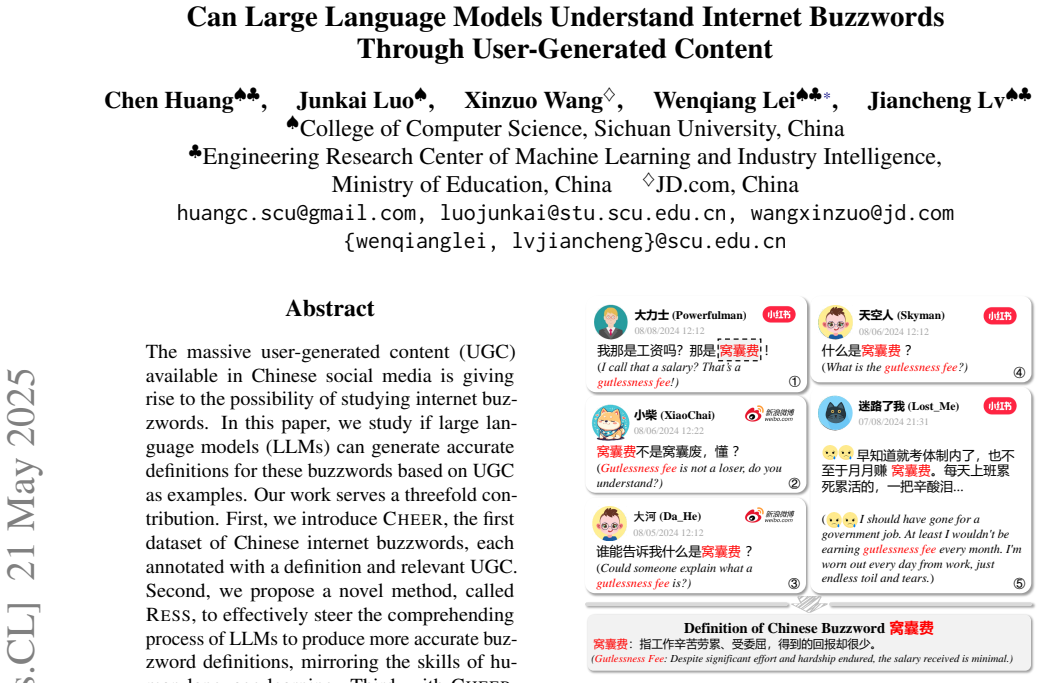
RESS is the central mechanism: a two-stage prompt protocol that decomposes buzzword comprehension into six aspects borrowed from child language acquisition (intention understanding, concept association, language structure, social-cue interpretation, word context, and pronunciation and spelling). In stage one, the LLM reads the UGC examples and produces a definition candidate from each aspect's viewpoint, together with a rationale. In stage two, the six candidates are returned to the model with the same examples, and the model must judge which candidates carry weight and merge them into one definition. The aspect decomposition is what forces the model beyond its first association; the ensemble step is what converts partial views into a complete definition. CHEER is the second load-bearing component: its 1,127 buzzwords, each with a reference definition and an average of 30.7 raw UGC sentences, makes the task concrete and makes the contamination-free split possible.
What would settle it
Construct a set of invented buzzwords with planted meanings, write UGC that exhibits those meanings, and ask the model to define them from the UGC alone. If RESS or any LLM method recovers the planted meaning at accuracy comparable to its score on known buzzwords, the paper's claim that current LLMs over-rely on prior exposure would be weakened; if it fails, the memorization diagnosis is confirmed.
Extended reading notes
Core claim
The central claim is that definition quality improves when an LLM is forced to look at a buzzword from several distinct semantic angles before writing a definition. RESS operationalizes this by asking the model, one aspect at a time, to read the UGC examples and produce both an aspect-specific definition and a reason; then it asks the model to synthesize the six candidates into a single definition, weighing which candidates are actually supported by the examples. The paper reports that this consistently outperforms FOCUS, the strongest prior method, across Qwen2-7B, Qwen2-72B, GPT-4o Mini, and GPT-4o, and that human pairwise evaluation agrees with the automated semantic scores. The paper also claims the improvement is bounded: on contamination-free evaluation, where each model is tested only on buzzwords it could not have seen in training, semantic accuracy and completeness drop sharply across every method, so the dominant mechanism in current LLMs is prior exposure, not inference from user-generated content.
Load-bearing premise
The load-bearing premise is that the reference definitions in CHEER are correct: they were produced by GPT-4o summarizing online dictionary entries, and fewer than 5% were changed by human review, so every semantic score is ultimately agreement with that summary of meaning.
Editorial extensions
If this is right
- If RESS's gains replicate, multi-aspect decomposition plus candidate ensembling becomes a cheap, training-free upgrade for definition generation tasks beyond buzzwords.
- The contamination-free split should become a standard evaluation protocol: any claim about LLMs understanding slang or neologisms needs to be checked on items released after the model's training cutoff.
- Larger models within the same family infer unseen buzzwords better than smaller ones, which is consistent with inference ability scaling with model capacity.
- Both the volume and the quality of UGC matter for definition accuracy, but selecting high-quality UGC without already knowing the word's meaning is an unsolved problem; the paper's WAUS selector helps but does not reliably beat random.
Reading between the lines
- A natural extension the paper leaves implicit is applying the aspect-and-ensemble protocol to English internet slang or to jargon-heavy domains such as medicine and law, where the dictionary signal is even weaker.
- The UGC-selection difficulty forms a chicken-and-egg loop: good examples seem to require knowing the meaning, and knowing the meaning seems to require good examples. A self-training loop, which the paper mentions only as future work, is the obvious next experiment.
- Because the reference definitions are LLM summaries, part of RESS's semantic-accuracy gain may reflect stylistic convergence toward GPT-4o's definition style rather than purely semantic truth; a fully human-authored gold standard would separate these effects.
Editorial analysis
A structured set of objections, weighed in public.
Referee Report
Summary. The paper introduces CHEER, a dataset of 1,127 Chinese internet buzzwords with definitions and 34,607 user-generated content (UGC) examples, and proposes RESS, a method that prompts LLMs to generate definitions from six child-language-acquisition-inspired aspects and then ensembles them. The authors benchmark several baselines (MASS-zh, SDefiner, DP, CoT, FOCUS) across four LLM backbones, reporting that RESS improves semantic accuracy (SA) by an average of +2.51% and semantic completeness (SC) by +3.31% over FOCUS (Table 4). They also report a contamination-free evaluation using post-training buzzwords, showing that all LLM-based methods degrade substantially on unseen words, and an analysis of UGC volume/quality through a proposed WAUS selector. The central claims are that multi-aspect ensembled prompting helps definition generation and that current LLMs rely heavily on memorized exposure when defining buzzwords.
Significance. If the results hold, the paper makes three contributions: a new publicly released Chinese buzzword dataset, a simple prompting method that modestly improves definition quality, and a benchmark exposing LLM limitations on newly coined words. The dataset and code are released, and the contamination-free evaluation is a useful attempt to separate memorization from inference. The human evaluation, while small, provides some external check. However, the main RESS improvement is measured by a GPT-4o judge against GPT-4o-summarized gold definitions, creating a partial circularity that weakens confidence in the headline numbers; the human sample is too small to fully rule out a style-matching artifact. The effect sizes are small and no confidence intervals or significance tests are reported. If the circularity is addressed with stronger independent evaluation, the resource and benchmark would be of clear value to the definition-generation and LLM-evaluation communities.
major comments (3)
- [§5.1, Table 4; Appendix A; Appendix E.1] The central claim that RESS outperforms FOCUS rests on an evaluation loop. The gold definitions in CHEER were produced by GPT-4o summarizing online dictionary descriptions (Appendix A, Definition Collection and Quality Control), the SA/SC judge is GPT-4o (Appendix E.1, Table 17), and one of the four backbones is GPT-4o itself. Because RESS asks the backbone to summarize aspect-specific candidates, its outputs may match the judge's own summarization style more closely than FOCUS's causal-reasoning outputs. The 100-item human evaluation does not fully break this loop: in Table 9, for Qwen2-7b, human-rated SA/SC for RESS (2.55/2.48) are lower than for FOCUS (2.63/2.55). To make the main claim load-bearing, the paper should either add independent human ratings on a larger sample, evaluate with a different judge model (e.g., a non-GPT judge), or demonstrate that the RESS advantage persists when gold definitions are independently authored; in all cases, the authors should report significance tests or confidence intervals for the reported +2.51%/+3.31% gains.
- [§5.2.1, Appendix B, Table 5] The contamination-free evaluation splits known/unseen buzzwords using a manually chosen GPT-4o score threshold of 3, with human review for the labels. Since the same GPT-4o evaluator is used, the unseen set is defined by the same model whose inference ability is being measured, so the measured degradation may reflect the threshold choice. The paper should report sensitivity of the Table 5 conclusions to the threshold (e.g., 2.5, 3.5) and give inter-annotator agreement for the human knows/doesn't-know labels. Without this, the strong claim that LLMs rely on memorization rather than inference is not fully pinned down.
- [§5.2.2, Table 6, Figure 6] The conclusion that higher-quality UGC (via WAUS) improves definition generation is based on very small score differences without significance tests; for example, for RESS on GPT-4o Mini, WAUS selection gives SA 2.66 vs Random 2.64, while for CoT the differences are similarly small and inconsistent across metrics. Since WAUS is a new method, the paper should provide significance tests or effect sizes and a clearer statement of which comparisons are statistically distinguishable; otherwise the UGC-quality finding is not established beyond anecdotal trends.
minor comments (6)
- [§3.2, Evaluation Metrics] The metric name is misspelled 'BLUE' twice; it should be 'BLEU' (also in Appendix E.3).
- [Appendix A, Table 7] The mapping between Chinese aspect names and English labels appears mismatched: '基本学习和记忆' is labeled as Social Cue Interpretation, while '社会线索' is labeled as Word Context, and '上下文' is labeled as Pronunciation and Spelling. This will confuse readers implementing RESS prompts; please align the rows with the definitions in Section 4.
- [§5.1] The first paragraph of Section 5.1 says human evaluation is reported in 'Figure 4', but the actual win-rate figure is Figure 3; Figure 4 is the semantic diversity heatmap. Please correct the cross-reference.
- [Table 3] In the GPT-4o row for DP, BScore 45.22 is an outlier relative to all other BScore values (approximately 64-68) and R-L 67.56 is unusually high; this looks like a transcription error and should be checked.
- [Appendix B] 'Speficically' should be 'Specifically'.
- [Abstract and §5.1] The abstract reports 'average improvement of +2.51% in semantic accuracy and +3.31% in semantic completeness'; these are relative percentages on a 1-5 scale. Please clarify that these are relative improvements, not absolute score increases.
Circularity Check
No circularity found: the RESS benchmark’s same-model evaluation risk is a validity concern, not a reduction by construction.
full rationale
I find no circular step that meets the Pith standard. CHEER’s gold definitions are GPT-4o summaries of descriptions scraped from external online buzzword dictionaries (Appendix A), and the SA/SC scores are produced by a GPT-4o rubric judge (Appendix E.1, Table 17); for the GPT-4o backbone the same model also generates RESS outputs. This creates a genuine style-matching and validity risk, but it is not a reduction by construction: the reference text is grounded in an external dictionary source rather than in RESS’s own outputs, the judge scores against a fixed reference with a rubric rather than choosing whichever candidate is more GPT-4o-like, no parameter is fitted to the SA/SC target, and no load-bearing claim is imported from the authors’ prior work. The RESS-versus-FOCUS ranking is additionally supported, for most backbones, by lexical metrics and by a 100-item pairwise human win-rate evaluation (Figure 3), though the human sample is small and Table 9 shows RESS below FOCUS on absolute human SA/SC for Qwen2-7b. These are correctness and robustness concerns, not circularity, so the appropriate score is 0.
Assumptions & free parameters
free parameters (3)
- Unseen classification threshold =
3 (on GPT-4o SA/SC 1-5 scale)
- Number of RESS aspects =
6
- LLM sampling temperature =
0.7
assumptions (4)
- domain assumption GPT-4o's SA/SC scoring rubrics measure semantic accuracy and completeness reliably.
- domain assumption GPT-4o-summarized definitions from dictionary websites are valid gold references.
- domain assumption UGC from Xiaohongshu and Weibo provides sufficient signal for defining buzzwords.
- ad hoc to paper Six child language acquisition aspects (IU, CA, LS, SCI, WC, PS) are appropriate guides for LLM word comprehension.
invented entities (1)
-
WAUS (Word-meaning Agnostic UGC Selector)
Cite this review
Pith. "Pith review of Can Large Language Models Understand Internet Buzzwords Through User-Generated Content." pith.science (2026). https://pith.science/paper/6GFY3MSQ
@misc{pith2026250515071,
  author       = {Pith},
  title        = {Pith review of: Can Large Language Models Understand Internet Buzzwords Through User-Generated Content},
  year         = {2026},
  howpublished = {\url{https://pith.science/paper/6GFY3MSQ}},
  note         = {Machine review of arXiv:2505.15071}
}
read the original abstract
The massive user-generated content (UGC) available in Chinese social media is giving rise to the possibility of studying internet buzzwords. In this paper, we study if large language models (LLMs) can generate accurate definitions for these buzzwords based on UGC as examples. Our work serves a threefold contribution. First, we introduce CHEER, the first dataset of Chinese internet buzzwords, each annotated with a definition and relevant UGC. Second, we propose a novel method, called RESS, to effectively steer the comprehending process of LLMs to produce more accurate buzzword definitions, mirroring the skills of human language learning. Third, with CHEER, we benchmark the strengths and weaknesses of various off-the-shelf definition generation methods and our RESS. Our benchmark demonstrates the effectiveness of RESS while revealing crucial shared challenges: over-reliance on prior exposure, underdeveloped inferential abilities, and difficulty identifying high-quality UGC to facilitate comprehension. We believe our work lays the groundwork for future advancements in LLM-based definition generation. Our dataset and code are available at https://github.com/SCUNLP/Buzzword.
Figures


Figures from the paper (3 more)


Reference graph
Works this paper leans on
-
[1]
用中文回答 2.你需要根据[例句]一步一步分析该词[参考定义]的重要性,不是所有的[参考定义]都是有价 值的。
-
[2]
Table 1 summarizes the data statistics, while Table 2 provides a specific case from our dataset
Weibo, one of the biggest social media platforms in China with over 582 million monthly active users. Table 1 summarizes the data statistics, while Table 2 provides a specific case from our dataset. The complete dataset and code are available at: https://github.com/SCUNLP/Buzzword. Buzzword Collection and Quality Control. To gather a comprehensive list of...
-
[3]
For example, whether a word is a noun, verb, or adjective, and its relationship with other words)
语法理解 (Language Structure, LS):理解词语在句子中的语法角色和功能,例如词语是名 词、动词还是形容词,以及它与其他词语之间的关系 (Analyzing the buzzword’s grammatical function. For example, whether a word is a noun, verb, or adjective, and its relationship with other words)
-
[4]
基本学习和记忆(Social Cue Interpretation, SCI):从该词语的发音和拼写发出,建立它与相关 概念之间的联系(Establishing connections between orthography, phonology, and meaning)
-
[5]
For example, linking the word ’dog’ to animal categories with specific characteristics)
概念形成(Concept Association, CA):将词语与特定的概念联系起来,例如将“狗”这个词与具 有特定特征的动物类别联系起来(Linking the buzzword to relevant concepts. For example, linking the word ’dog’ to animal categories with specific characteristics)
-
[6]
rubrics (outlined in Table 17)
上下文 (Pronunciation and Spelling, PS):词语出现的具体语境,包括前后文和对话背景等 (Leveraging surrounding text for semantic disambiguation) Table 7: Aspect description used in RESS. rubrics (outlined in Table 17). Definitions scoring below a threshold of 3 are considered indicative of the LLM not understanding the buzzword. Finally, a human review process is implemented to ensu...
-
[8]
社会线索 (Word Context, WC):利用说话者的表情、语气、姿势等社会线索来理解词语的 含义(Inferring social context from UGC such as the speaker’s facial expressions, tone of voice, and gestures.)
-
[11]
你需要从[INPUT_ASPECT]角度一步一步地思考这个词 语的定义,这意味着去理 解[INPUT_ASPECT_EXPLANATION]
Show all 26 references
-
[12]
在观察用法示例时,要彻底解释上下文,以推断短语的微妙含义。将你的推理分解为循序 渐进的逻辑,以达成全面的理解 4.你不能过度解读这个词
-
[13]
词语": "[BUZZWORD]
以Json形式返回结果:{"词语": "[BUZZWORD]", "定义": STRING, "原因":STRING} [生成示例]: [EXAMPLES] ================== [例句]: [UGC_SENTENCES] Based on all the following [Example Sentences], analyze the meaning of the word [BUZZWORD], summarize it into a coherent and easy-to-understand definition, a...
-
[14]
You need to think step by step about the definition of this word from the perspective of [IN- PUT_ASPECT], which means understanding [INPUT_ASPECT_EXPLANATION]
-
[15]
Win/Lose/Tie
We incorporate six aspects, shown in Table 7, drawing inspiration from child language acquisi- tion skills. C.2 Implementation of Word-meaning Agnostic UGC Selector (W AUS) Lacking prior knowledge of the target buzzword, WAUS is trained using a masked strategy, where the targe...
2024
-
[16]
Break down your reasoning into progressive logic to achieve a comprehensive understanding
When observing usage examples, thoroughly explain the context to infer the subtle meaning of the phrase. Break down your reasoning into progressive logic to achieve a comprehensive understanding
-
[17]
You cannot overinterpret this word
-
[18]
Word": "[BUZZWORD]
Return the result in JSON format: {"Word": "[BUZZWORD]", "Definition": STRING, "Reason": STRING} [Example of Generation]: [EXAMPLES] ================== Example Sentences: [UGC_SENTENCES] Table 14: Prompt for RESS and its corresponding translation: Part I. Prompt for ensembling...
-
[19]
在分析时,要结合[例句]和[参考定义],以推断[参考定义]的微妙含义,以达成全面的理 解。
-
[20]
词语": "[BUZZWORD]
以Json形式返回结果:{"词语": "[BUZZWORD]", "定义": STRING, "原因":STRING} [生成示例]: [EXAMPLES] ================== [参考定义]: [CANDIDATE_DEFINITION] [例句]: [UGC_SENTENCES] Based on all the following [Example Sentences], analyze the meaning of the word [BUZZWORD], summarize its [Reference Definitio...
-
[21]
You need to analyze the importance of the word [reference definition] step by step based on [Example Sentences], not all [Reference Definitions] are valuable
-
[22]
When analyzing, it is necessary to combine [example sentence] and [reference definition] to infer the subtle meaning of [reference definition] in order to achieve a comprehensive understanding
-
[23]
Word": "[BUZZWORD]
Return the result in JSON format: {"Word": "[BUZZWORD]", "Definition": STRING, "Reason": STRING} Example of Generation: [EXAMPLES] ================== Reference Definitions: [CANDIDATE_DEFINITION] Example Sentences: [UGC_SENTENCES] Table 15: Prompt for RESS and its correspondin...
-
[24]
be careful,
以json形式返回结果:{’word’: STRING, ’definition’: STRING} 词语:[BUZZWORD] Return definitions of the following Internet buzzwords or phrases. be careful,
-
[25]
The definition you provide needs to be concise and easy to understand
-
[26]
准确性": [INT, WHY],
Return the result in JSON format: {’word ’: STRING,’ definition ’: STRING} Words: [BUZZWORD] Table 16: Prompt for DP-w/o UGC, which is also used in contamination-free evaluation experiments. Prompt for Aspect-specific definition generation 给定一个词语的【定义】和专家给出的【参考定义】,你需要从以下【评估角度和打...
-
[2011]
buzzword
Get the story straight: Contextual repetition promotes word learning from storybooks. Frontiers in Psychology, 2:17. Chen Huang, Peixin Qin, Wenqiang Lei, and Jiancheng Lv. 2024. Towards equipping transformer with the ability of systematic compositionality. Proceedings of the ...
2024 arXiv
-
[2023]
definition modeling: To model definitions
Direct preference optimization: your language model is secretly a reward model. In Proceedings of the 37th International Conference on Neural In- formation Processing Systems, NIPS ’23, Red Hook, NY , USA. Curran Associates Inc. Jessie Ricketts, Dorothy VM Bishop, Hannah Pimpe...
2011 arXiv
-
[2024]
In Proceedings of the 62nd An- nual Meeting of the Association for Computational Linguistics (Volume 4: Student Research Workshop), pages 114–131
Automatically suggesting diverse example sentences for l2 japanese learners using pre-trained language models. In Proceedings of the 62nd An- nual Meeting of the Association for Computational Linguistics (Volume 4: Student Research Workshop), pages 114–131. Paul Bloom. 2000. H...
2000 arXiv
Reviewed August 7, 2026 · model on record in the stance chip above.
Discussion (0). Sign in to comment.