REVIEW 4 major objections 5 minor 97 references
Exceptional horns in $n$-root graphene and Lieb photonic ring lattices
T0 review · 4 major / 5 minor · reviewed 2026-08-02 · deepseek-v4-flash
Pith's one-line read Dirac cones collapse into exceptional horns in n-root lattices
desk verdict Genuinely new n-root construction with exceptional horns and root Landau-level scaling, but the magnetic-flux block structure and the Jordan decomposition are asserted rather than proven. read the letter →
The pith
A machine-rendered reading of the paper's core claim, the machinery that carries it, and where it could break.
The reading
What carries the argument
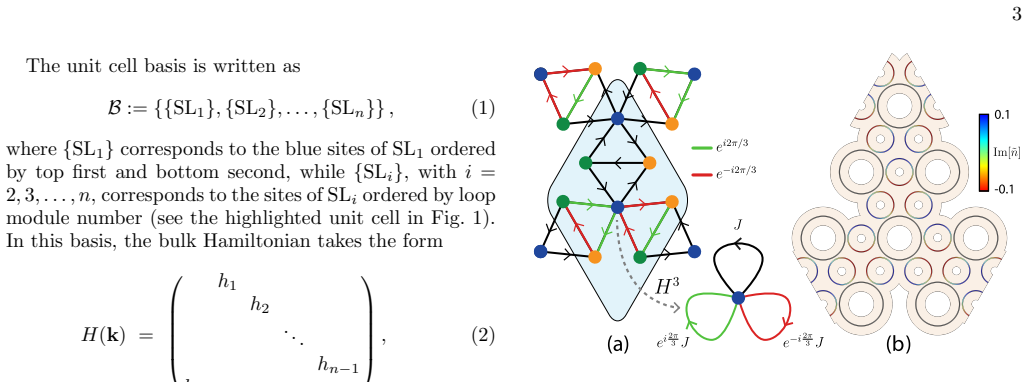
The loop module — a replacement of each parent hopping by n unidirectional couplings of strength J^{1/n} passing through n−1 intermediate sites — is the construction that makes H^n block-diagonal, with the Hermitian parent as the first block. The generalized chiral symmetry C_n (defined by C_n H C_n^{-1} = ω_n^{-1} H, ω_n = e^{2πi/n}) is what forces the n-branch rotation of the spectrum. The phase configuration of the loop couplings is the control knob: it either leaves the parent's energy offset (case i of the perturbation theory in Appendix A, giving Dirac points with renormalized Fermi velocity) or cancels it (case ii, giving zero-energy exceptional points and |q|^{1/n} dispersion). The n
What would settle it
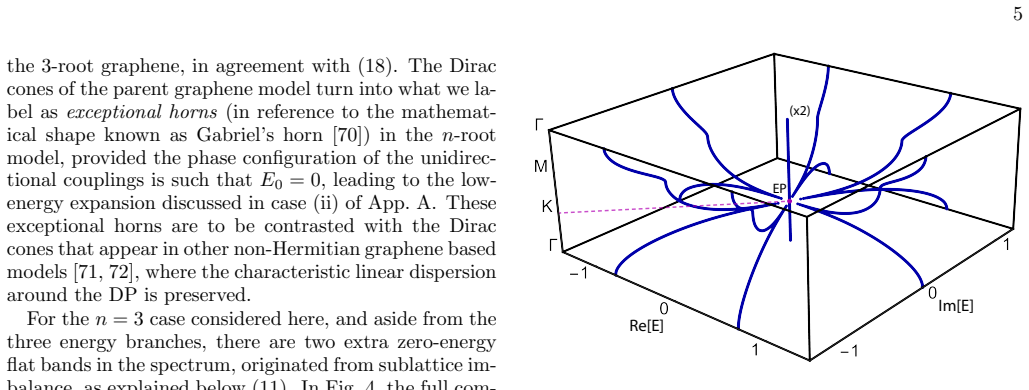
In the photonic 3-root graphene design, zoom into the p=0 branch near the K point: the exceptional-horn claim requires the two approaching bands to separate as |q|^{1/3}; observing any different power law (e.g., linear) would falsify it. Separately, compute the Hofstadter spectrum with flux also threading the loop modules: if the nth power of the butterfly no longer collapses onto the parent graphene (or Lieb) butterfly, the block-diagonal assumption that all Landau-level results rest on is broken.
Extended reading notes
Core claim
For n≥3, the n-root graphene and n-root Lieb lattices are formed by replacing each hopping of the parent with a closed loop of n unidirectional couplings of magnitude J^{1/n}. Because the generalized chiral symmetry C_n imposes that every finite-energy eigenvalue appears in the n-tuple {ω_n^p E}, the spectrum is a union of n branches whose nth powers coincide with the parent's real bands, plus zero-energy flat bands protected by sublattice imbalance. The paper's central discovery is that the fate of the parent's Dirac cone depends on a phase configuration on the loop couplings. If the parent block retains a finite energy offset (3J for graphene), the n-root spectrum has an n-fold set of Dira
Load-bearing premise
The whole magnetic-field analysis assumes the Peierls phase string places flux only on the large plaquettes of the n-root lattice, leaving the loop modules flux-free, so that the nth power of the flux-inserted Hamiltonian still has the Hermitian parent as a block; if that ansatz fails, the derived Landau-level scaling E ~ φ^{1/(2n)} and the exceptional zeroth Landau level are unsupported.
Editorial extensions
If this is right
- The n-root construction produces n rotated branches in the complex energy plane whose nth powers match the parent's real spectrum, so the parent's physics is recovered after an nth-power operation.
- With the parent energy offset intact, each Dirac point survives as an n-tuple of Dirac points with a renormalized Fermi velocity; with the offset cancelled, it becomes a zero-energy exceptional point of order n or higher.
- The dispersion E ~ |q|^{1/n} around the exceptional horns implies a formally infinite Fermi velocity as q→0, in contrast to the constant velocity of a Dirac cone.
- Landau levels follow E ~ φ^{1/(2n)} around the exceptional region, and the n-root Lieb lattice has an exceptional zeroth Landau level.
- Because the generalized chiral symmetry is unbroken by the flux, the zero-energy flat bands remain pinned and mix with the exceptional-point eigenvectors only at the high-symmetry point.
Reading between the lines
- If the photonic implementation is realized, the |q|^{1/n} dispersion near an exceptional horn should make the local density of optical states diverge at zero energy, which could be probed as an enhanced emission or absorption signal at the K point.
- The same loop-module recipe should transplant the mechanism to other parent models with Dirac or nodal degeneracies, such as Weyl semimetals or the Haldane model; the authors list these targets but leave them unexplored.
- Because the exceptional Landau level is pinned at zero energy by symmetry, it may offer a magnetic-field-tunable, symmetry-protected degeneracy that is robust to disorder — a testable alternative to fine-tuned EP sensors.
- The predicted dependence of the zeroth LL on flux (flat at zero) could be checked in circuits or coupled-ring arrays without needing perfect unidirectionality, since the flatness only relies on the block-diagonal structure.
Signed reviews
Editorial analysis
A structured set of objections, weighed in public.
Referee Report
Summary. This paper constructs n-th root tight-binding models (n>=3) for two 2D parent lattices, graphene and the Lieb lattice, built from loop modules of unidirectional couplings. The authors show that the Bloch spectrum consists of n rotated copies of the n-th root of the parent spectrum plus zero-energy flat bands protected by a generalized chiral symmetry. With a suitable phase configuration, the finite-energy Dirac points of the parent can be shifted to zero energy, converting the Dirac cones into 'exceptional horns': zero-energy exceptional points of order n (or higher) with dispersion E ~ |q|^(1/n). The same n-root relation is used to predict Landau-level energies scaling as phi^(1/(2n)) under a uniform magnetic field; for the n-root Lieb lattice a zero-energy exceptional Landau level is identified. A photonic ring-resonator implementation for n=3 is proposed and studied with finite-element simulations.
Significance. Should the results hold, the paper provides a clean, parameter-free algebraic route to high-order exceptional points in two-dimensional lattices, with distinctive sublinear dispersion and unusual Landau-level flux scaling. The spectrum-rooting construction is exact, and the low-energy perturbation theory in Appendix A is analytic and general. The explicit photonic implementation, including quantitative modeling of imperfections in Appendix D, is a strong practical contribution. The main limitations are the unproven Peierls-substitution ansatz and the unproven Jordan-form statements, which gate the Landau-level and EP-order claims.
major comments (4)
- [Sec. II B, first paragraph; Sec. III A, first paragraph] The statement that imposing no flux through the loop modules ensures that the n-th power of the flux-inserted Hamiltonian has the parent Hofstadter Hamiltonian as its H1 block is an assertion, not a derivation. For each loop module the zero-flux condition fixes only the product of Peierls phases around that module, not the phases of the individual h_l entries. The matrix elements of H1 = h1...hn can therefore pick up k-independent or flux-dependent corrections that would change the parent Landau-level spectrum. The LL energies in (21) and (33) and the exceptional LL in Sec. III A depend on this block structure. Please provide an explicit check (e.g., compute H^n for a Peierls-substituted n=3 or n=4 model and verify the H1 block) or derive the gauge constraints under which the identity holds. The numerics in Figs. 5 and 8 support the ansatz only for low flux and specific n.
- [Sec. II A (Jordan form after Eq. (18)); Sec. III (Jordan form before Fig. 7)] The Jordan decompositions J = J_n(0) ⊕ J_{2n-1}(0) for n-root graphene and J = J_1(0) ⊕ J_{2n-1}(0) ⊕ J_{2n-1}(0) for n-root Lieb are central to the claimed EP orders, but they are stated without proof. Without a derivation or construction of generalized eigenvectors, the order of the exceptional points is an assertion rather than a demonstrated result. Please provide a proof or a direct computation of the Jordan form for general n.
- [Sec. II A (Fig. 2(a)) and paragraph after Eq. (18)] The phase configuration that removes the 3J offset in n-root graphene is explicitly shown only for n=3. Since the exceptional-horn phenomenon and the Landau-level analysis are claimed for general n, an explicit general-n phase assignment (analogous to Eq. (24) for the Lieb case) or a proof of its existence is required. The statement that the self-loop contributions cancel for general n is not demonstrated.
- [Sec. III A (around Eq. (36))] The exceptional Landau level result rests on the uniqueness of the zero-energy solution at each LL: 'it is possible to show that there is a single exact solution at each LL'. This is not proven. If there are multiple linearly independent zero-energy states at the m-th LL, they do not coalesce and the level is not exceptional. Please provide the proof of uniqueness or state the result as a conjecture. The lower-bound statement 'at least order n' is acceptable, but the underlying uniqueness must be established.
minor comments (5)
- [Eq. (12)] The eigenvector formula uses E_± in the denominators and is singular at E=0; this is appropriate since these eigenvectors apply to non-zero eigenvalues, but a brief remark would avoid confusion.
- [Sec. II B, Eq. (14)] The Landau-level substitution is applied to h_n and h_1; the ordering of b and b^† for the K' valley should be checked or briefly explained.
- [Sec. II A] The name 'exceptional horn' is evocative but the connection to Gabriel's horn could be clarified: the horn refers to the divergent derivative (infinite group velocity) at the EP, not to a geometric shape of the spectrum.
- [Appendix D, Eq. (D1)] The notation H(phi) -> H^†(-phi) is clear in context, but a one-sentence derivation would improve readability.
- [General] The paper relies heavily on the authors' own generalized index theorem [47]. A short recapitulation of the theorem's statement would make the paper more self-contained.
Circularity Check
No significant circularity: the central scalings are algebraic consequences of the explicit n-root construction, with design conditions and external benchmarks rather than fitted predictions.
full rationale
The claimed derivation chain is self-contained. The spectral relation E^(p)_±(k)=ω^p_n E^{1/n}_{1,±}(k) (Eq. 11) follows from the explicitly written H^n(k)=diag(H1,...,Hn) (Eqs. 6-8), which is an algebraic identity for the h_j blocks (Eqs. 2-4), not from any fitted parameter. The exceptional-horn dispersion E±(q)=±ω_n^{p/2}(v_F|q|)^{1/n} (Eq. 18, App. A case ii) is the Taylor expansion of (E0±v_F|q|)^{1/n} around E0=0; the zero of E0 is engineered by the explicit phase configuration whose self-energy contributions sum to J(1+e^{i2π/3}+e^{-i2π/3})=0 (Sec. II A). The LL formulas (21) and (33) are nth roots of the standard graphene [80] and Lieb [82] LL spectra, and are cross-checked numerically in Figs. 5(c) and 8(b) rather than fitted. The only assumption that could invalidate the LL scaling is the Peierls condition 'no flux goes through the loop modules' (Sec. II B and III A); this is an explicit, testable ansatz, not a circular reuse of the target result — if the bracket structure fails, the parent-block correspondence is lost, but the paper does not define the parent block in terms of the LL energies. Self-citations [38] and [47] supply the loop-module construction and the generalized index theorem; both are prior published results with stated assumptions and are used as ingredients (flat-band counting, chiral symmetry), not as the conclusion being claimed. No step reduces a prediction to an input by construction beyond the intended algebraic n-root identity.
Assumptions & free parameters
free parameters (2)
- α (backward coupling ratio) =
≈0.008 (graphene), ≈0.007 (Lieb)
- J_cc (cross-circulation coupling) =
4×10^{-3} J
assumptions (4)
- domain assumption Generalized index theorem for non-Hermitian n-partite lattices (Ref. [47])
- standard math The nth power of the n-root Hamiltonian is block diagonal with the parent Hamiltonian as the first block (Eqs. (6)-(9))
- ad hoc to paper Peierls substitution on the n-root lattice with flux only through plaquettes yields the parent Hamiltonian with uniform flux in H1
- standard math Perturbation theory for n-partite lattices (Appendix A) assuming a single massless symmetric cone in the parent
Cite this review
Pith. "Pith review of Exceptional horns in $n$-root graphene and Lieb photonic ring lattices." pith.science (2026). https://pith.science/paper/6GPCMI7S
@misc{pith2026260216670,
  author       = {Pith},
  title        = {Pith review of: Exceptional horns in $n$-root graphene and Lieb photonic ring lattices},
  year         = {2026},
  howpublished = {\url{https://pith.science/paper/6GPCMI7S}},
  note         = {Machine review of arXiv:2602.16670}
}
abstract
We present a systematic construction of non-Hermitian tight-binding lattices whose Bloch spectra are $n$th roots of those of Hermitian parent two-dimensional (2D) lattices, namely graphene and the Lieb lattice. The $n$-roots of these models are constructed from connecting loop modules of unidirectional couplings whose geometrical arrangements match that of the corresponding parent system. Their energy spectrum is shown to consist of $n$ rotated and equivalent branches in the complex energy plane, each matching the real spectrum of the parent model when raised to the $n$th power, together with extra zero-energy flat bands (FBs) accounted for by the generalized index theorem. We show how the low-energy Dirac cones of the parent models translate, for an appropriate choice of phase configuration for the couplings of the $n$-root lattices, as what we call an "exceptional horn" appearing at each branch, with the central Dirac point (DP) converted into zero-energy exceptional points (EPs) of order $n$ or higher at high-symmetry momenta. These exceptional horns reflect the behavior of low-lying excitations that scale with momentum as $E\sim\vert \mathbf{q}\vert^{\frac{1}{n}}$, with $n\geq 3$, as opposed to the linear massless modes that characterize a Dirac cone. Moreover, we derive analytic expressions for the associated Landau levels (LLs), whose energies scale with magnetic flux as $E\sim\phi^{\frac{1}{2n}}$. For the case of the $n$-root Lieb lattice, the zeroth LL is shown to be exceptional. These results are analytically derived for both $n$-root models and numerically demonstrated for certain values of $n$. Finally, we propose a realistic photonic implementation based on coupled ring resonators with a split configuration of optical gain and loss.
Figures


Figures from the paper (11 more)


Reference graph
Works this paper leans on
-
[1]
Ara´ ujo and P
M. Ara´ ujo and P. Sacramento,Topology in Condensed Matter(WORLD SCIENTIFIC, 2021)
2021
-
[2]
Arkinstall, M
J. Arkinstall, M. H. Teimourpour, L. Feng, R. El- Ganainy, and H. Schomerus, Topological tight-binding models from nontrivial square roots, Phys. Rev. B95, 165109 (2017)
2017
-
[3]
Kremer, I
M. Kremer, I. Petrides, E. Meyer, M. Heinrich, O. Zil- berberg, and A. Szameit, A square-root topological insu- lator with non-quantized indices realized with photonic aharonov-bohm cages, Nature Communications11, 907 (2020)
2020
-
[4]
Pelegr ´ ı, A
G. Pelegr ´ ı, A. M. Marques, R. G. Dias, A. J. Daley, V. Ahufinger, and J. Mompart, Topological edge states with ultracold atoms carrying orbital angular momentum in a diamond chain, Phys. Rev. A99, 023612 (2019)
2019
-
[5]
Mizoguchi, Y
T. Mizoguchi, Y. Kuno, and Y. Hatsugai, Square-root higher-order topological insulator on a decorated honey- comb lattice, Phys. Rev. A102, 033527 (2020)
2020
-
[6]
Ezawa, Systematic construction of square-root topo- logical insulators and superconductors, Phys
M. Ezawa, Systematic construction of square-root topo- logical insulators and superconductors, Phys. Rev. Re- search2, 033397 (2020)
2020
-
[7]
S. Ke, D. Zhao, J. Fu, Q. Liao, B. Wang, and P. Lu, Topo- logical edge modes in non-hermitian photonic aharonov- bohm cages, IEEE Journal of Selected Topics in Quan- tum Electronics26, 4401008 (2020)
2020
-
[8]
Mizoguchi, T
T. Mizoguchi, T. Yoshida, and Y. Hatsugai, Square-root topological semimetals, Phys. Rev. B103, 045136 (2021)
2021
Show all 97 references
-
[9]
Yoshida, T
T. Yoshida, T. Mizoguchi, Y. Kuno, and Y. Hat- sugai, Square-root topological phase with time-reversal and particle-hole symmetry, Phys. Rev. B103, 235130 (2021)
2021
-
[10]
Z. Lin, S. Ke, X. Zhu, and X. Li, Square-root non-bloch topological insulators in non-hermitian ring resonators, Opt. Express29, 8462 (2021)
2021
-
[11]
H. Wu, G. Wei, Z. Liu, and J.-J. Xiao, Square-root topo- logical state of coupled plasmonic nanoparticles in a dec- orated su-schrieffer-heeger lattice, Opt. Lett.46, 4256 (2021)
2021
-
[12]
R. W. Bomantara, Square-root floquet topological phases and time crystals, Phys. Rev. B106, L060305 (2022)
2022
-
[13]
Zhang, Q.-P
R.-L. Zhang, Q.-P. Wu, M.-R. Liu, X.-B. Xiao, and Z.-F. Liu, Complex-real transformation of eigenenergies and topological edge states in square-root non-hermitian topolectrical circuits, Annalen der Physik534, 2100497 (2022)
2022
-
[14]
Matsumoto, T
D. Matsumoto, T. Mizoguchi, and Y. Hatsugai, Higher- order topological insulator on a martini lattice and its square root descendant, Journal of the Physical Society of Japan92, 034705 (2023)
2023
-
[15]
Geng, Y.-X
Z.-G. Geng, Y.-X. Shen, L. Duan, Z. Chen, and X.-F. Zhu, Third-order square-root topological insulators on decorated diamond sonic crystals, Journal of Physics: Condensed Matter35, 405001 (2023)
2023
-
[16]
Roychowdhury, J
K. Roychowdhury, J. Attig, S. Trebst, and M. J. Lawler, Supersymmetry on the lattice: Geometry, topology, and flat bands, Phys. Rev. Res.6, 043273 (2024)
2024
-
[17]
Y. Zhao, X. Zhang, Z. Cui, C. Wu, and N. Liu, Square- root topological insulator with high winding number, Phys. Rev. B111, 014109 (2025)
2025
-
[18]
M. Yan, X. Huang, L. Luo, J. Lu, W. Deng, and Z. Liu, Acoustic square-root topological states, Phys. Rev. B 102, 180102 (2020)
2020
-
[19]
L. Song, H. Yang, Y. Cao, and P. Yan, Realization of the square-root higher-order topological insulator in electric circuits, Nano Lett.20, 7566 (2020)
2020
-
[20]
W. Yan, D. Song, S. Xia, J. Xie, L. Tang, J. Xu, and Z. Chen, Realization of second-order photonic square- root topological insulators, ACS Photonics8, 3308 (2021)
2021
-
[21]
L. Song, H. Yang, Y. Cao, and P. Yan, Square-root higher-order weyl semimetals, Nature Communications 13, 5601 (2022)
2022
-
[22]
Cheng, R
Z. Cheng, R. W. Bomantara, H. Xue, W. Zhu, J. Gong, and B. Zhang, Observation ofπ/2 modes in an acoustic floquet system, Phys. Rev. Lett.129, 254301 (2022)
2022
-
[23]
J. Kang, T. Liu, M. Yan, D. Yang, X. Huang, R. Wei, J. Qiu, G. Dong, Z. Yang, and F. Nori, Observation of square-root higher-order topological states in pho- tonic waveguide arrays, Laser & Photonics Reviews17, 2200499 (2023)
2023
-
[24]
W. Yan, W. Cheng, W. Liu, Q. Liu, and F. Chen, Square- root higher-order topological insulators in a photonic dec- orated ssh lattice, Opt. Lett.48, 3765 (2023)
2023
-
[25]
Wu, Z.-K
S.-Q. Wu, Z.-K. Lin, Z. Xiong, B. Jiang, and J.-H. Jiang, Square-root higher-order topology in rectangular-lattice acoustic metamaterials, Phys. Rev. Appl.19, 024023 (2023)
2023
-
[26]
S. Guo, G. Pan, J. Huang, R. Huang, F. Zhuang, S. Su, Z. Lin, W. Qiu, and Q. Kan, Realization of the square- root higher-order topology in decorated su-schrieffer- heeger electric circuits, Applied Physics Letters123, 043102 (2023)
2023
-
[27]
W. Yan, W. Cheng, Q. Liu, W. Liu, B. Zhang, X. Ni, and F. Chen, Photonic square-root second-order topological bound states in the continuum, Laser & Photonics Re- views18, 2400950 (2024)
2024
-
[28]
L. Song, H. Yang, Y. Cao, and P. Yan, Realization of the square-root dirac semimetal in electrical circuits, J. Appl. Phys.137, 124902 (2024)
2024
-
[29]
A. M. Marques, L. Madail, and R. G. Dias, One- dimensional 2n-root topological insulators and supercon- ductors, Phys. Rev. B103, 235425 (2021)
2021
-
[30]
A. M. Marques and R. G. Dias, 2 n-root weak, chern, and higher-order topological insulators, and 2 n-root topolog- ical semimetals, Phys. Rev. B104, 165410 (2021)
2021
-
[31]
R. G. Dias and A. M. Marques, Matryoshka approach to sine-cosine topological models, Phys. Rev. B103, 245112 (2021)
2021
-
[32]
A. M. Marques, J. M¨ ogerle, G. Pelegr ´ ı, S. Flannigan, R. G. Dias, and A. J. Daley, Kaleidoscopes of hofs- tadter butterflies and aharonov-bohm caging from 2 n- root topology in decorated square lattices, Phys. Rev. Res.5, 023110 (2023)
2023
-
[33]
Geng, Y.-X
Z.-G. Geng, Y.-X. Shen, Z. Xiong, L. Duan, Z. Chen, and X.-F. Zhu, Quartic-root higher-order topological insula- tors on decorated three-dimensional sonic crystals, APL Mater.12, 021108 (2024)
2024
-
[34]
R. G. Dias, L. Madail, and A. M. Marques, High-root topological edge-state bands, Phys. Rev. B112, 075125 (2025)
2025
-
[35]
tachyonic
and acoustic [36] lattices. Finally, there is the non- Hermitian class ofn-root TIs [37, 38], withn≥3 an integer, whose parent TI, which can be Hermitian, is di- rectly obtained from thenth power of the Hamiltonian. The root operation enlarges the unit cell, introduces uni- di...
2026 arXiv
-
[36]
R. Wei, Q. Zhang, D. Yang, X. Huang, Q. Pan, J. Kang, J. Qiu, Z. Yang, and G. Dong, Realiza- 17 tion of one-dimensional 2n-root topological states in photonic lattices, Science China Technological Sciences 10.1007/s11431-022-2347-4 (2023)
2023 doi
-
[37]
Z. Cui, M. Peng, X. Zhang, Q. Wei, M. Yan, and G. Chen, Realization of multiple topological boundary states in phononic crystals, Phys. Rev. B107, 165414 (2023)
2023
-
[38]
L. Zhou, R. W. Bomantara, and S. Wu,qth-root non- Hermitian Floquet topological insulators, SciPost Phys. 13, 015 (2022)
2022
-
[39]
Viedma, A
D. Viedma, A. M. Marques, R. G. Dias, and V. Ahufin- ger, Topological n-root su-schrieffer-heeger model in a non-hermitian photonic ring system, Nanophotonics13, 51 (2024)
2024
-
[40]
Miri and A
M.-A. Miri and A. Al` u, Exceptional points in optics and photonics, Science363, eaar7709 (2019)
2019
-
[41]
S. Wang, B. Hou, W. Lu, Y. Chen, Z. Q. Zhang, and C. T. Chan, Arbitrary order exceptional point induced by photonic spin-orbit interaction in coupled resonators, Nature Communications10, 832 (2019)
2019
-
[42]
Sayyad and F
S. Sayyad and F. K. Kunst, Realizing exceptional points of any order in the presence of symmetry, Phys. Rev. Res. 4, 023130 (2022)
2022
-
[43]
Tschernig, K
K. Tschernig, K. Busch, D. N. Christodoulides, and A. Perez-Leija, Branching high-order exceptional points in non-hermitian optical systems, Laser & Photonics Re- views16, 2100707 (2022)
2022
-
[44]
Wiersig and W
J. Wiersig and W. Chen, Higher-order exceptional points in composite non-hermitian systems, Phys. Rev. Res.7, 033034 (2025)
2025
-
[45]
Hodaei, A
H. Hodaei, A. U. Hassan, S. Wittek, H. Garcia-Gracia, R. El-Ganainy, D. N. Christodoulides, and M. Kha- javikhan, Enhanced sensitivity at higher-order excep- tional points, Nature548, 187 (2017)
2017
-
[46]
Wiersig, Review of exceptional point-based sensors, Photon
J. Wiersig, Review of exceptional point-based sensors, Photon. Res.8, 1457 (2020)
2020
-
[47]
W. Mao, Z. Fu, Y. Li, F. Li, and L. Yang, Exceptional- point-enhanced phase sensing, Science Advances10, eadl5037 (2024)
2024
-
[48]
A. M. Marques and R. G. Dias, Generalized lieb’s the- orem for noninteracting non-hermitiann-partite tight- binding lattices, Phys. Rev. B106, 205146 (2022)
2022
-
[49]
Zhang, Y
X. Zhang, Y. Tian, J.-H. Jiang, M.-H. Lu, and Y.-F. Chen, Observation of higher-order non-Hermitian skin ef- fect, Nature Communications12, 5377 (2021)
2021
-
[50]
Z. Gu, H. Gao, H. Xue, J. Li, Z. Su, and J. Zhu, Transient non-hermitian skin effect, Nature Communications13, 7668 (2022)
2022
-
[51]
H. Gao, H. Xue, Z. Gu, L. Li, W. Zhu, Z. Su, J. Zhu, B. Zhang, and Y. D. Chong, Anomalous floquet non- hermitian skin effect in a ring resonator lattice, Physical Review B106, 134112 (2022)
2022
-
[52]
Y. G. N. Liu, Y. Wei, O. Hemmatyar, G. G. Pyrialakos, P. S. Jung, D. N. Christodoulides, and M. Khajavikhan, Complex skin modes in non-hermitian coupled laser ar- rays, Light: Science & Applications11, 336 (2022)
2022
-
[53]
Z. Gao, X. Qiao, M. Pan, S. Wu, J. Yim, K. Chen, B. Midya, L. Ge, and L. Feng, Two-dimensional recon- figurable non-hermitian gauged laser array, Phys. Rev. Lett.130, 263801 (2023)
2023
-
[54]
Hofmann, T
T. Hofmann, T. Helbig, C. H. Lee, M. Greiter, and R. Thomale, Chiral voltage propagation and calibration in a topolectrical chern circuit, Phys. Rev. Lett.122, 247702 (2019)
2019
-
[55]
Helbig, T
T. Helbig, T. Hofmann, S. Imhof, M. Abdelghany, T. Kiessling, L. W. Molenkamp, C. H. Lee, A. Szameit, M. Greiter, and R. Thomale, Generalized bulk–boundary correspondence in non-hermitian topolectrical circuits, Nature Physics16, 747 (2020)
2020
-
[56]
J. Liu, X. Mao, J. Zhong, and R. A. R¨ omer, Localization properties in lieb lattices and their extensions, Annals of Physics , 168544 (2021)
2021
-
[57]
D. Zou, T. Chen, W. He, J. Bao, C. H. Lee, H. Sun, and X. Zhang, Observation of hybrid higher-order skin- topological effect in non-hermitian topolectrical circuits, Nature Communications12, 7201 (2021)
2021
-
[58]
Weidemann, M
S. Weidemann, M. Kremer, T. Helbig, T. Hofmann, A. Stegmaier, M. Greiter, R. Thomale, and A. Szameit, Topological funneling of light, Science368, 311 (2020)
2020
-
[59]
Weidemann, M
S. Weidemann, M. Kremer, S. Longhi, and A. Szameit, Topological triple phase transition in non-hermitian flo- quet quasicrystals, Nature601, 354 (2022)
2022
-
[60]
C. Qin, B. Wang, Z. J. Wong, S. Longhi, and P. Lu, Dis- crete diffraction and bloch oscillations in non-hermitian frequency lattices induced by complex photonic gauge fields, Phys. Rev. B101, 064303 (2020)
2020
-
[61]
Zheng, B
L. Zheng, B. Wang, C. Qin, L. Zhao, S. Chen, W. Liu, and P. Lu, Chiral zener tunneling in non-hermitian fre- quency lattices, Opt. Lett.47, 4644 (2022)
2022
-
[62]
S. Ke, W. Wen, D. Zhao, and Y. Wang, Floquet engineer- ing of the non-hermitian skin effect in photonic waveguide arrays, Physical Review A107, 053508 (2023)
2023
-
[63]
Longhi, D
S. Longhi, D. Gatti, and G. D. Valle, Robust light trans- port in non-Hermitian photonic lattices, Scientific Re- ports5, 13376 (2015)
2015
-
[64]
Hafezi, E
M. Hafezi, E. A. Demler, M. D. Lukin, and J. M. Taylor, Robust optical delay lines with topological protection, Nature Physics7, 907 (2011)
2011
-
[65]
Hafezi, S
M. Hafezi, S. Mittal, J. Fan, A. Migdall, and J. M. Tay- lor, Imaging topological edge states in silicon photonics, Nature Photonics7, 1001 (2013)
2013
-
[66]
Mittal, J
S. Mittal, J. Fan, S. Faez, A. Migdall, J. Taylor, and M. Hafezi, Topologically Robust Transport of Photons in a Synthetic Gauge Field, Physical Review Letters113, 087403 (2014)
2014
-
[67]
Andrade, D
E. Andrade, D. Carrasco-Olivera, and C. Manzaneda, On the eigenvectors of generalized circulant matrices, Linear and Multilinear Algebra72, 2639 (2024)
2024
-
[68]
J. T. Gohsrich, J. Fauman, and F. K. Kunst, Exceptional points of any order in a generalized hatano-nelson model (2024), arXiv:2403.12018 [cond-mat.mes-hall]
2024 arXiv
-
[69]
C. T. Mart ´ ınez-Mart ´ ınez, L. A. Moreno-Rodriguez, J. A. M´ endez-Berm´ udez, and H. Benisty, Stability mapping of bipartite tight-binding graphs with losses and gain:PT- symmetry and beyond, Chaos34, 053116 (2024)
2024
-
[70]
J. L. Barnett and R. El-Ganainy,PT-like phase transi- tions from square roots of supersymmetric hamiltonians (2025), arXiv:2511.12833 [physics.optics]
2025
-
[71]
Coll and M
V. Coll and M. Harrison, Gabriel’s horn: A revolutionary tale, Mathematics Magazine87, 263 (2014)
2014
-
[72]
H. Xue, Q. Wang, B. Zhang, and Y. D. Chong, Non- hermitian dirac cones, Phys. Rev. Lett.124, 236403 (2020)
2020
-
[73]
X. Xie, F. Ma, W. B. Rui, Z. Dong, Y. Du, W. Xie, Y. X. Zhao, H. Chen, F. Gao, and H. Xue, Non-hermitian dirac cones with valley-dependent lifetimes, Nature Communi- cations16, 1627 (2025)
2025
-
[74]
J. Moro, J. V. Burke, and M. L. Overton, On the lidskii- vishik-lyusternik perturbation theory for eigenvalues of 18 matrices with arbitrary jordan structure, SIAM Journal on Matrix Analysis and Applications18, 793 (1997)
1997
-
[75]
Ma and A
Y. Ma and A. Edelman, Nongeneric eigenvalue perturba- tions of jordan blocks, Linear Algebra and its Applica- tions273, 45 (1998)
1998
-
[76]
Demange and E.-M
G. Demange and E.-M. Graefe, Signatures of three coa- lescing eigenfunctions, Journal of Physics A: Mathemat- ical and Theoretical45, 025303 (2011)
2011
-
[77]
Jiang,Nonreciprocal dynamics in a cryogenic optome- chanical system, Ph.D
L. Jiang,Nonreciprocal dynamics in a cryogenic optome- chanical system, Ph.D. thesis, Yale University (2020)
2020
-
[78]
G. Jose, R. Malla, V. Srinivasan, A. Sharma, and S. Gan- gadharaiah, Phase diagram for the harper model of the honeycomb lattice, Journal of Physics: Condensed Mat- ter30, 385603 (2018)
2018
-
[79]
Rammal, Landau level spectrum of bloch electrons in a honeycomb lattice, J
R. Rammal, Landau level spectrum of bloch electrons in a honeycomb lattice, J. Phys. France46, 1345 (1985)
1985
-
[80]
Zhang and M
X.-X. Zhang and M. Franz, Non-hermitian exceptional landau quantization in electric circuits, Phys. Rev. Lett. 124, 046401 (2020)
2020
-
[81]
M. O. Goerbig, Electronic properties of graphene in a strong magnetic field, Rev. Mod. Phys.83, 1193 (2011)
2011
-
[82]
H. Aoki, M. Ando, and H. Matsumura, Hofstadter but- terflies for flat bands, Phys. Rev. B54, R17296 (1996)
1996
-
[83]
Goldman, D
N. Goldman, D. F. Urban, and D. Bercioux, Topological phases for fermionic cold atoms on the lieb lattice, Phys. Rev. A83, 063601 (2011)
2011
-
[84]
Bagarello and N
F. Bagarello and N. Hatano,PT-symmetric graphene un- der a magnetic field, Proc. R. Soc. A472, 0365 (2016)
2016
-
[85]
Viedma, A
D. Viedma, A. M. Marques, R. G. Dias, and V. Ahufin- ger, Flux-mediated effective su-schrieffer-heeger model in an impurity decorated diamond chain, APL Photonics9, 120801 (2024)
2024
-
[86]
E. Riva, J. Marconi, and F. Braghin, Enhanced sensi- tivity and wave-structure interaction in nonsingular flat- band lattices with compact localized states, Journal of Sound and Vibration619, 119369 (2025)
2025
-
[87]
J. Ren, Y. G. N. Liu, M. Parto, W. E. Hayenga, M. P. Hokmabadi, D. N. Christodoulides, and M. Khajavikhan, Unidirectional light emission in pt-symmetric microring lasers, Optics Express26, 27153 (2018)
2018
-
[88]
W. E. Hayenga, M. Parto, J. Ren, F. O. Wu, M. P. Hokmabadi, C. Wolff, R. El-Ganainy, N. A. Mortensen, D. N. Christodoulides, and M. Khajavikhan, Direct gen- eration of tunable orbital angular momentum beams in microring lasers with broadband exceptional points, ACS Photonics6,...
2019
-
[89]
Y. G. N. Liu, P. S. Jung, M. Parto, D. N. Christodoulides, and M. Khajavikhan, Gain-induced topological response via tailored long-range interactions, Nature Physics17, 704 (2021)
2021
-
[90]
Nielsen and M
H. Nielsen and M. Ninomiya, The adler-bell-jackiw anomaly and weyl fermions in a crystal, Physics Letters B130, 389 (1983)
1983
-
[91]
Dietl, F
P. Dietl, F. Pi´ echon, and G. Montambaux, New mag- netic field dependence of landau levels in a graphenelike structure, Phys. Rev. Lett.100, 236405 (2008)
2008
-
[92]
Rhim and B.-J
J.-W. Rhim and B.-J. Yang, Singular flat bands, Ad- vances in Physics: X6, 10.1080/23746149.2021.1901606 (2021)
2021
-
[93]
Szameit, M
A. Szameit, M. C. Rechtsman, O. Bahat-Treidel, and M. Segev,PT-symmetry in honeycomb photonic lattices, Phys. Rev. A84, 021806 (2011)
2011
-
[94]
Ramezani, T
H. Ramezani, T. Kottos, V. Kovanis, and D. N. Christodoulides, Exceptional-point dynamics in photonic honeycomb lattices withPTsymmetry, Phys. Rev. A85, 013818 (2012)
2012
-
[95]
McCann, Non-hermitian su-schrieffer-heeger model with the energy levels of free parafermions, Phys
E. McCann, Non-hermitian su-schrieffer-heeger model with the energy levels of free parafermions, Phys. Rev. B113, 045403 (2026)
2026
-
[96]
Yoshida, E
T. Yoshida, E. J. Bergholtz, and T. Bzduˇ sek, Hopf ex- ceptional points, SciPost Phys.20, 001 (2026)
2026
-
[97]
Yang and I
K. Yang and I. Mandal, Enhanced eigenvector sensitivity and algebraic classification of sublattice-symmetric ex- ceptional points, Phys. Rev. B107, 144304 (2023)
2023
Reviewed August 2, 2026 · model on record in the stance chip above.
Discussion (0). Continue with ORCID to comment.