Chemical Vapor Deposition of Ni-doped Iron Germanium Telluride Nanosheets
Pith reviewed 2026-06-26 23:12 UTC · model grok-4.3
The pith
Chemical vapor deposition grows Ni-doped FGT nanosheets with nickel incorporated throughout the bulk.
A machine-rendered reading of the paper's core claim, the machinery that carries it, and where it could break.
Core claim
Chemical vapor deposition on SiO2/Si substrates produces Ni-doped FemGenTe2 nanosheets in which nickel reaches a 4 percent Ni-to-Fe ratio and resides in the bulk of the crystals, as shown by XPS depth profiling, when precursor molar ratios are varied to control iron content.
What carries the argument
Adjusting precursor molar ratios during chemical vapor deposition to incorporate nickel into the FGT lattice while preserving the layered structure.
If this is right
- Ni-doped FGT nanosheets become available with controlled iron concentrations for magnetic studies.
- The same CVD setup can produce both doped and undoped material on the same substrate type.
- Nickel incorporation is shown to survive the growth process and reach the interior of the flakes.
- The method supplies a CMOS-compatible starting point for exploring spintronic applications.
Where Pith is reading between the lines
- Further ratio tuning might allow nickel levels above or below 4 percent while keeping the same phase.
- Bulk nickel placement could produce more stable magnetic ordering than surface-only doping.
- The approach may extend to other transition-metal dopants in related van der Waals tellurides.
Load-bearing premise
That changing the precursor ratios reliably forms the intended FGT crystal phase with nickel atoms distributed uniformly inside the bulk rather than creating mixed phases or surface-only deposits.
What would settle it
Absence of nickel signal in XPS spectra after etching away the top few nanometers of the nanosheets, or an X-ray diffraction pattern that does not match the expected FGT structure.
Figures
read the original abstract
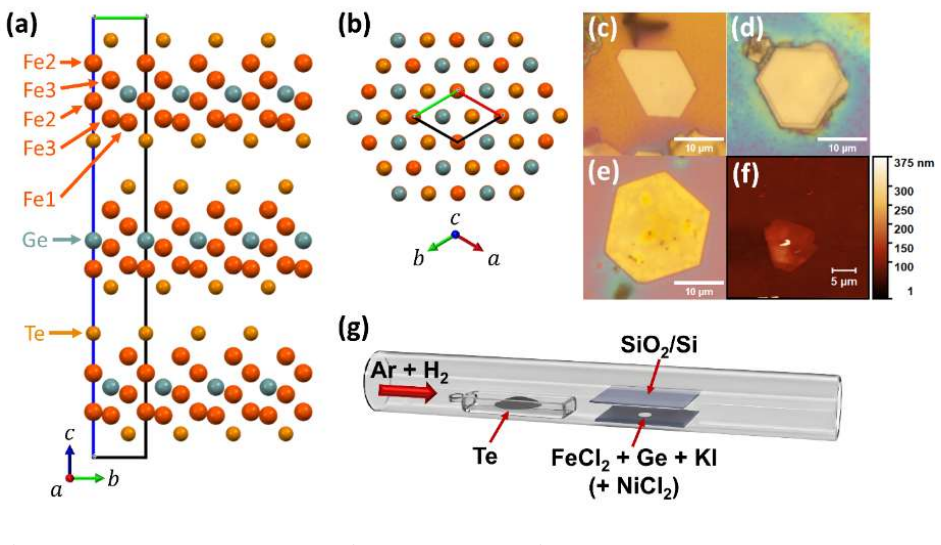
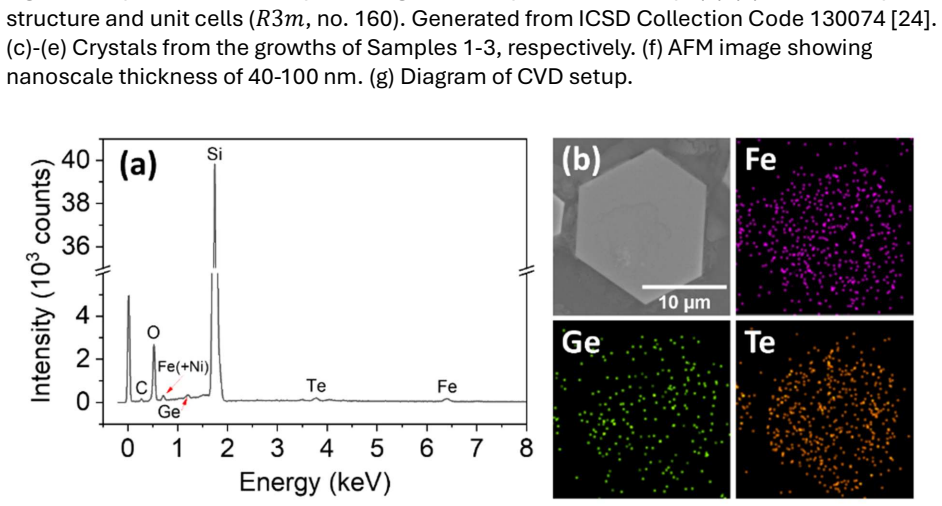
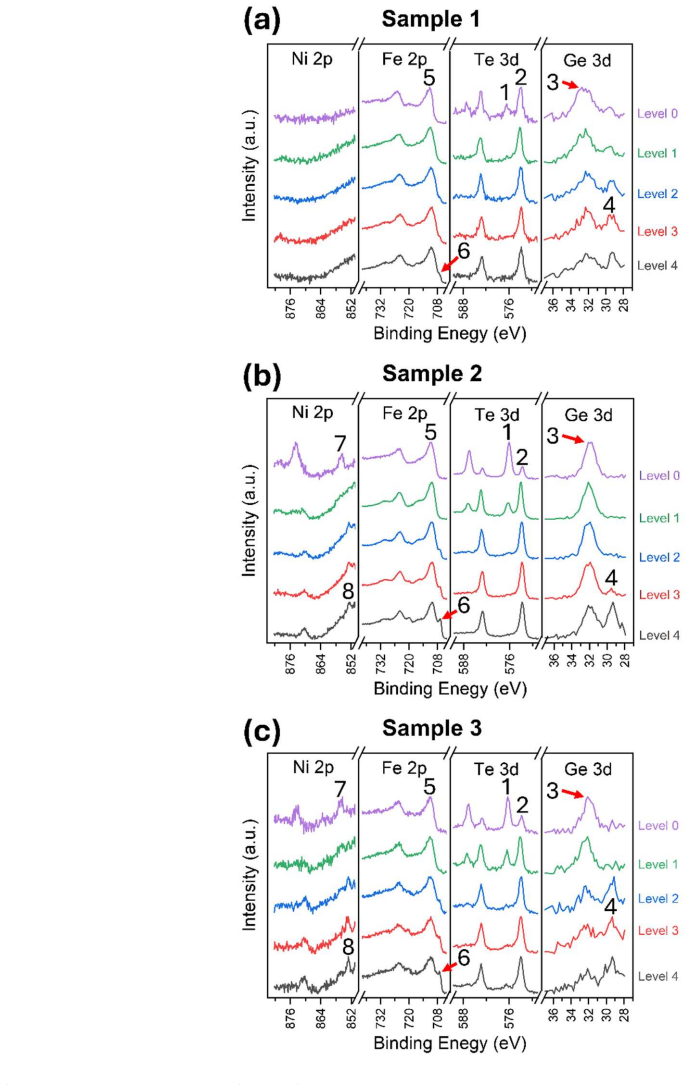
Iron germanium telluride (FGT; FemGenTe2) compounds have attracted significant interest due to their layered van der Waals structure, relatively high Curie temperature, and tunable magnetic properties. Chemical vapor deposition (CVD) is a particularly promising synthesis route owing to its simplicity, low cost, potential for scalability, and widespread adoption in the semiconductor industry, yet it has not been used previously to synthesize FGT with dopants. Here, we report CVD synthesis of both undoped and Ni-doped FGT nanosheets on SiO2/Si substrates. By adjusting precursor molar ratios, we synthesized Ni-doped FGT with multiple Fe concentrations and a 4% Ni-to-Fe ratio. X-ray photoelectron spectroscopy depth profiling further demonstrates that Ni is present in the bulk of the crystals. This straightforward, low-cost, and CMOS-compatible approach demonstrates a route to Ni-doped FGT nanosheets, establishing a foundation for future characterization of Ni-doped FGT and its potential integration into spintronic devices.
Editorial analysis
A structured set of objections, weighed in public.
Referee Report
Summary. The manuscript reports the first use of chemical vapor deposition (CVD) to synthesize both undoped and Ni-doped iron germanium telluride (FGT, Fe_m Ge_n Te_2) nanosheets on SiO2/Si substrates. Precursor molar ratios are adjusted to achieve Ni-doped FGT with multiple Fe concentrations and a fixed 4% Ni-to-Fe ratio. X-ray photoelectron spectroscopy (XPS) depth profiling is presented as evidence that Ni is incorporated throughout the bulk of the crystals rather than being limited to the surface. The work frames the method as simple, low-cost, and CMOS-compatible, providing a foundation for future studies of Ni-doped FGT in spintronic devices.
Significance. If the synthesis protocol and doping control are reproducible and the phase purity and composition claims are substantiated, the result would establish a scalable CVD route to doped van der Waals magnets that has not previously been demonstrated for FGT. This could be relevant for the 2D magnetism and spintronics communities because CVD is already standard in semiconductor processing and offers potential for wafer-scale integration.
major comments (2)
- [Abstract] Abstract: the central claim that varying precursor molar ratios produces phase-pure Ni-doped FGT nanosheets with a controlled 4% Ni-to-Fe ratio and multiple Fe concentrations is unsupported by any structural (XRD, TEM, SAED), compositional (EDS, ICP), or magnetic characterization data, error bars, or quantitative measurements. Without these, the weakest assumption—that the intended crystal phase and uniform bulk doping are achieved—cannot be evaluated.
- [Abstract] Abstract: the statement that XPS depth profiling 'demonstrates that Ni is present in the bulk' lacks supporting details on sputter rate, depth calibration, peak fitting, or comparison to surface-only spectra; surface segregation or incomplete phase formation artifacts cannot be ruled out from the information given.
Simulated Author's Rebuttal
We thank the referee for their detailed review and constructive feedback on our manuscript. We address each major comment below and indicate the revisions we will make.
read point-by-point responses
-
Referee: [Abstract] Abstract: the central claim that varying precursor molar ratios produces phase-pure Ni-doped FGT nanosheets with a controlled 4% Ni-to-Fe ratio and multiple Fe concentrations is unsupported by any structural (XRD, TEM, SAED), compositional (EDS, ICP), or magnetic characterization data, error bars, or quantitative measurements. Without these, the weakest assumption—that the intended crystal phase and uniform bulk doping are achieved—cannot be evaluated.
Authors: The Ni-to-Fe ratio and tunable Fe content are quantified from XPS peak intensities as described in the results section. We acknowledge that the abstract phrasing implies phase purity and uniform doping without supporting structural data such as XRD or TEM. We will revise the abstract to state that the elemental composition matches the target ratios based on XPS, without claiming phase purity. This addresses the concern by aligning the claim with the available evidence. revision: partial
-
Referee: [Abstract] Abstract: the statement that XPS depth profiling 'demonstrates that Ni is present in the bulk' lacks supporting details on sputter rate, depth calibration, peak fitting, or comparison to surface-only spectra; surface segregation or incomplete phase formation artifacts cannot be ruled out from the information given.
Authors: We agree that additional methodological details are required to support the bulk incorporation claim. In the revised manuscript we will add the sputter rate, depth calibration method, peak fitting parameters, and direct comparison of surface versus depth-profiled spectra in the XPS section. revision: yes
Circularity Check
No significant circularity
full rationale
This is a purely experimental materials synthesis paper reporting CVD growth of undoped and Ni-doped FGT nanosheets, precursor ratio adjustments, and XPS depth profiling to confirm bulk Ni incorporation. The manuscript contains no equations, derivations, fitted parameters, predictions, or self-citation chains that could reduce any claim to its own inputs by construction. All central claims are direct experimental outcomes with no load-bearing theoretical steps, so the derivation chain is empty and the work is self-contained against external benchmarks.
Axiom & Free-Parameter Ledger
free parameters (1)
- precursor molar ratios
Reference graph
Works this paper leans on
-
[1]
Nair GKR, Zhang Z, Hou F , Abdelaziem A, Xu X, Wu S, Yang Q, Zhang N, Li W, Zhu C, et al
1. Nair GKR, Zhang Z, Hou F , Abdelaziem A, Xu X, Wu S, Yang Q, Zhang N, Li W, Zhu C, et al. Phase-pure two-dimensional FexGeTe2 magnets with near-room-temperature TC. Nano Res. 2021;15(1):457-464. doi:10.1007/s12274-021-3502-0
discussion (0)
Sign in with ORCID, Apple, or X to comment. Anyone can read and Pith papers without signing in.