REVIEW 4 major objections 7 minor 53 references
ParetoRAG: Leveraging Sentence-Context Attention for Robust and Efficient Retrieval-Augmented Generation
T0 review · 4 major / 7 minor · reviewed 2026-08-08 · deepseek-v4-flash
Pith's one-line read ParetoRAG shows sentence-context blending beats passage retrieval at 30% of the token cost.
desk verdict Simple training-free RAG token-saver with real savings; the accuracy gains rest partly on test-set-tuned alpha and a table/text mismatch. read the letter →
The pith
A machine-rendered reading of the paper's core claim, the machinery that carries it, and where it could break.
The reading
What carries the argument
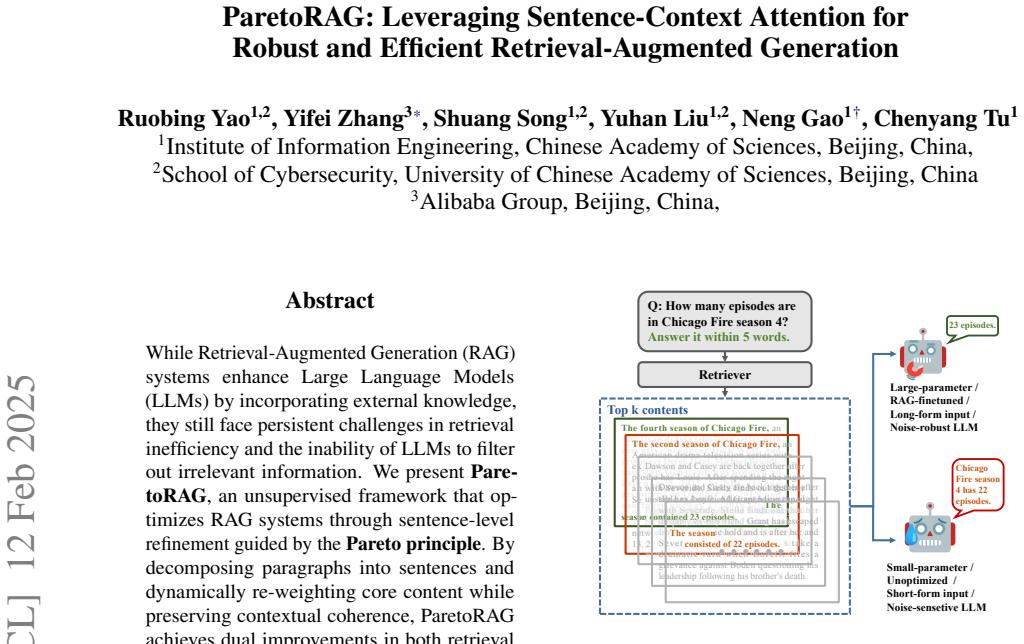
The machinery is the Sentence-Context Weighted Attention representation, a named interpolation used at indexing and retrieval time. Each passage is split into sentences with NLTK; for each sentence, the context is the rest of the passage, or NULL if the passage has only one sentence. The encoder embeds the sentence and the context separately, and the representation used for ranking is $\alpha$ times the sentence embedding plus $(1-\alpha)$ times the context embedding, with $\alpha = 0.8$ by default. This single linear blend does the paper's work: it keeps enough context to resolve anaphora such as 'the season,' while preventing whole-paragraph noise from dominating the similarity score, and it can be precomputed offline with any dense encoder.
What would settle it
Run ParetoRAG and a passage-level baseline on a held-out corpus, such as legal or biomedical text, without re-tuning $\alpha$, then sweep $\alpha$ on that corpus and check whether $\alpha \approx 0.8$ still gives the best recall. If the optimal weight differs substantially from 0.8, or if the accuracy advantage vanishes under an equal-token budget, the claim of corpus-independent gains would be undermined.
Extended reading notes
Core claim
The paper's central claim is that the smallest useful retrieval unit is neither the sentence alone nor the passage alone, but a sentence fused with a fixed fraction of its surrounding passage. For every sentence in a retrieved passage, ParetoRAG builds $h_{\text{weighted}} = 0.8\,h_{\text{core}} + 0.2\,h_{\text{context}}$, where $h_{\text{core}}$ is the encoder embedding of the sentence and $h_{\text{context}}$ is the embedding of all other sentences in the same passage. Retrieval is then dot-product ranking of these weighted vectors, and the top-30 are fed to the LLM. The paper reports that this representation improves accuracy on NQ and HotpotQA, improves fluency and correctness on MS-MARCO, and lowers input tokens to roughly 30 percent of the passage-level baseline, across Contriever, ANCE, and DPR and across Vicuna and Llama2 chat models. It also reports that the improvement persists when the LLM has already been trained to be robust to irrelevant context.
Load-bearing premise
The single fixed weight $\alpha = 0.8$ is assumed to be near-optimal for every corpus and retriever, even though the paper selects it after sweeping values on the evaluation datasets; if the right balance between sentence and context changes across domains, the reported gains may shrink or disappear.
Editorial extensions
If this is right
- If the claim holds, a RAG system can cut its LLM context budget by about 70 percent on open-domain question answering while improving answer accuracy and fluency, directly lowering inference cost and latency.
- The retrieval index can be built from an existing passage corpus by one offline sentence-splitting and embedding pass, with no fine-tuning and no extra model calls at query time.
- Sentence-context weighting is compatible with noise-robust LLMs, so architecture-level retrieval changes and training-level robustness can be combined rather than chosen between.
- The same token budget can include many more distinct evidence units than passage-level retrieval, which should help settings that need evidence from multiple sources.
Reading between the lines
- Beyond the paper's experiments, an adaptive $\alpha$ could replace the global 0.8: choosing the weight per sentence or per domain on a small validation set would test whether the 80/20 split is a property of the data or of the embedding geometry.
- The same weighted-representation idea could be applied to other units, such as clauses or windowed context around a target sentence, to see whether the 80/20 split persists when the context window changes.
- A stricter test than the paper's fixed top-30 comparison is an equal-token budget comparison across a range of k, which would separate the benefit of finer granularity from the benefit of shorter inputs.
Editorial analysis
A structured set of objections, weighed in public.
Referee Report
Summary. The paper proposes ParetoRAG, a training-free sentence-level refinement for RAG. It splits corpus passages into sentences, encodes each sentence both alone and as part of its passage context, and retrieves the weighted representation h_weighted = alpha * h_core + (1 - alpha) * h_context with alpha fixed to 0.8. The top-k scored sentences are fed to an LLM. Experiments span NQ, HotpotQA, and MS-MARCO with Contriever, ANCE, and DPR retrievers and four LLMs, reporting accuracy and fluency gains at roughly 30% of the original token count; a separate experiment tests compatibility with a robustly trained LLM.
Significance. The underlying observation—that sentence-level retrieval with a controlled amount of context can reduce noise and tokens—is plausible and potentially useful, and the paper's evaluation grid (3 datasets x 3 retrievers x 4 LLMs, plus a robustness-trained model) is broad. The token-consumption measurement is a concrete practical contribution. However, the central quantitative claim is weakened by test-set selection of alpha and by the absence of uncertainty estimates; the paper also contains an internal numerical inconsistency in the main results. If the authors supply a held-out alpha choice, variance estimates, and corrected numbers, the contribution would be solid.
major comments (4)
- [Section 3.2, Section 5.2.1, Figure 6, Appendix F] The default alpha=0.8 is selected by sweeping alpha on the same datasets used to report Table 1, using Recall@30 as the criterion. Since Recall@30 requires gold answer spans, this is test-set tuning. Therefore, the Table 1 gains are conditional on a hyperparameter fitted to the evaluation distribution, and the claim of a corpus-independent Pareto-optimal weight is not supported by the reported evidence. Please select alpha on a held-out validation split (or via nested cross-validation), report Table 1 with that alpha, and also show sensitivity of the results to neighboring alpha values.
- [Section 5.1 vs. Table 1] The main-text ROUGE numbers do not match Table 1. Section 5.1 states that Vicuna-13B + ANCE on MS-MARCO ROUGE increases from 46.8 to 55.2, but Table 1 (MS(rouge) columns) reports 36.9 to 43.6 for that same cell. Similarly, Llama2-13B-Chat + ANCE is quoted as improving from 46.1 to 55.1, while Table 1 shows 33.5 to 42.2. Please correct the text or the table and re-verify all quoted deltas.
- [Table 1, Figure 4, Section 4.1] The paper reports no measures of variability, and the evaluation uses only 1,000 sampled questions per dataset. Several headline gaps are small (for example, HotpotQA Vicuna-7B + Contriever is 25.0 vs. 25.4, and NQ Vicuna-13B + Contriever is 37.4 vs. 39.1), so without standard errors, bootstrapped confidence intervals, or significance tests, the claim of consistent improvements is not fully supported. Please add uncertainty estimates, at least for the core Table 1 cells and the Figure 4 comparisons.
- [Section 5.2.1, Appendix F] The appendix itself shows that the optimal alpha is not uniform across datasets and retrievers: MS-MARCO DPR and ANCE recall drops sharply at alpha 0.3–0.6, while HotpotQA behaves differently. This undercuts the paper's appeal to a universal Pareto 80/20 rule and makes the fixed-alpha choice, even if selected on a proper validation set, in need of a robustness analysis across corpora and retrievers. Please report per-dataset and per-retriever alpha sensitivity and avoid claiming a single universal optimum unless it is demonstrated on held-out data.
minor comments (7)
- [Abstract, Section 5.1, Section 4.1] There are several typos: "Futhermore" in the abstract, "datastes" in Section 5.1, and "data paris" in Section 4.1 should be "data pairs".
- [Section 3.1] The notation h_i_core = Enc_theta(s_j_i) omits the passage index; using h^{j,i}_core would disambiguate the sentence index across passages. Also, the context is described as a concatenation but written with set notation; please make the intended string operation explicit.
- [Table 1] The Recomp row for Llama2-7B-Chat appears misaligned: the sequence "25.7 41.2 38.5 36.7 39.2 37.6" seems to blend MAUVE and ROUGE values without clear column separation. Please reformat the table so every cell is unambiguous.
- [Figure 5 caption] The caption reads "The y-axis represents shows the percentage position," which is ungrammatical; it should be "The y-axis shows the percentage position."
- [Appendix B] The appendix refers to "Sentence-RAG" when describing the proposed method; this should be "ParetoRAG" for consistency.
- [Section 5.2.2, Figure 5] The x-axis is said to show a percentage position, yet values near -1 are used for cases where the correct answer is not retrieved. Please clarify how the not-retrieved cases are encoded on a percentage axis.
- [References] The first reference is formatted as "OpenAI Josh Achiam and etl Adler" and should be corrected to the standard GPT-4 technical report citation.
Circularity Check
The main comparison is an external benchmark, but the default alpha=0.8 is chosen by sweeping recall on the same test sets (Figure 6, Appendix F), so part of the reported gain is a fitted hyperparameter rather than an independent prediction.
-
fitted input called prediction
[Section 3.2 (h_weighted definition), Figure 2 caption, Section 5.2.1 'Impact of core sentence weight', Figure 6, Appendix F]
"From the Figure 6 it can be observed that when the weight of core sentences is adjusted to approximately 0.80, the Mean Recall@30 for ANCE, DPR and Contriever methods reaches optimal performance."
The defining equation h_weighted = alpha * h_core + (1 - alpha) * h_context (Section 3.2) is presented with alpha defaulting to 0.8 'based on the Pareto principle' (Figure 2 caption). The actual justification is empirical: Section 5.2.1 selects approximately 0.80 because it maximizes Mean Recall@30 on the evaluation datasets NQ, HotpotQA, and MS-MARCO (Figure 6 and Appendix F). Those are the same datasets whose accuracy and fluency gains are later reported in Table 1 as evidence that the Sentence-Context Weighted Attention mechanism works. Thus the context-weighting contribution is not an independent prediction; its reported success is conditional on a hyperparameter chosen by peeking at the test distributions.
full rationale
The core mechanism is not circular by construction: ParetoRAG does not define its evaluation metric in terms of its own equations, and the headline comparison against Naive RAG is an external empirical benchmark across independent retrievers and LLMs. No self-citation chain or definitional identity was found; the method is self-contained and testable. The main circularity-adjacent concern is the selection of alpha: the paper sweeps Mean Recall@30 on the evaluation datasets themselves (Figure 6, Appendix F), finds that approximately 0.80 is optimal, and then uses that same value to produce Table 1's generation gains. This is test-set tuning of the central hyperparameter, so part of the reported advantage is a fitted value rather than a prediction derived from the labeled 'Pareto principle.' The Pareto framing in Figure 2 is retrospective: the default is not derived from an a-priori 80/20 law but from the data-driven argmax. Because the sentence-level versus passage-level improvement does not depend on this particular alpha, the central claim retains independent content, but the specific contribution of the context-weighting component is not honestly evaluated on held-out data. Also noted without treating it as circularity: Section 5.1 reports Vicuna-13B+ANCE MS-ROUGE as 46.8 to 55.2 while Table 1 shows 36.9 to 43.6 for the same cell, an internal inconsistency that affects the reported magnitude but not the architecture's derivation.
Assumptions & free parameters
free parameters (2)
- alpha (core sentence weight) =
0.80
- top_k (number of retrieved sentences) =
30
assumptions (3)
- domain assumption NLTK sentence segmentation produces meaningful retrieval units that preserve query-relevant content.
- domain assumption Dense retriever embeddings can be combined as alpha*h_core + (1-alpha)*h_context without losing semantic comparability.
- ad hoc to paper The Pareto principle (80/20 rule) applies to RAG contexts, so a fixed 0.8 core weight should be near-optimal.
Cite this review
Pith. "Pith review of ParetoRAG: Leveraging Sentence-Context Attention for Robust and Efficient Retrieval-Augmented Generation." pith.science (2026). https://pith.science/paper/6GQQ7HHI
@misc{pith2026250208178,
  author       = {Pith},
  title        = {Pith review of: ParetoRAG: Leveraging Sentence-Context Attention for Robust and Efficient Retrieval-Augmented Generation},
  year         = {2026},
  howpublished = {\url{https://pith.science/paper/6GQQ7HHI}},
  note         = {Machine review of arXiv:2502.08178}
}
read the original abstract
While Retrieval-Augmented Generation (RAG) systems enhance Large Language Models (LLMs) by incorporating external knowledge, they still face persistent challenges in retrieval inefficiency and the inability of LLMs to filter out irrelevant information. We present ParetoRAG, an unsupervised framework that optimizes RAG systems through sentence-level refinement guided by the Pareto principle. By decomposing paragraphs into sentences and dynamically re-weighting core content while preserving contextual coherence, ParetoRAG achieves dual improvements in both retrieval precision and generation quality without requiring additional training or API resources. This framework has been empirically validated across various datasets, LLMs, and retrievers.
Figures


Figures from the paper (5 more)


Reference graph
Works this paper leans on
-
[1]
OpenAI Josh Achiam and etl Adler. 2023. GPT-4 Technical Report
work page 2023
-
[2]
Akari Asai, Zeqiu Wu, Yizhong Wang, Avirup Sil, and Hannaneh Hajishirzi. 2023. Self- RAG : Learning to Retrieve , Generate , and Critique through Self-Reflection . In The Twelfth International Conference on Learning Representations
work page 2023
-
[3]
Jonathan Berant, Andrew Chou, Roy Frostig, and Percy Liang. 2013. https://doi.org/10.18653/v1/d13-1160 Semantic Parsing on Freebase from Question-Answer Pairs . In Proceedings of the 2013 Conference on Empirical Methods in Natural Language Processing , pages 1533--1544, Seattle, Washington, USA. Association for Computational Linguistics
-
[4]
Jiawei Chen, Hongyu Lin, Xianpei Han, and Le Sun. 2025. https://doi.org/10.1609/aaai.v38i16.29728 Benchmarking large language models in retrieval-augmented generation . In Proceedings of the Thirty-Eighth AAAI Conference on Artificial Intelligence and Thirty-Sixth Conference on Innovative Applications of Artificial Intelligence and Fourteenth Symposium on...
-
[5]
Tong Chen, Hongwei Wang, Sihao Chen, Wenhao Yu, Kaixin Ma, Xinran Zhao, Hongming Zhang, and Dong Yu. 2024. https://doi.org/10.18653/v1/2024.emnlp-main.845 Dense X Retrieval : What Retrieval Granularity Should We Use ? In Proceedings of the 2024 Conference on Empirical Methods in Natural Language Processing , pages 15159--15177, Miami, Florida, USA. Associ...
-
[6]
Eunsol Choi, Jennimaria Palomaki, Matthew Lamm, Tom Kwiatkowski, Dipanjan Das, and Michael Collins. 2021. https://doi.org/10.1162/tacl_a_00377 Decontextualization: Making Sentences Stand-Alone . Transactions of the Association for Computational Linguistics, 9:447--461
-
[7]
Antonia Creswell, Murray Shanahan, and Irina Higgins. 2022. Selection- Inference : Exploiting Large Language Models for Interpretable Logical Reasoning . In The Eleventh International Conference on Learning Representations
work page 2022
-
[8]
Abhimanyu Dubey, Abhinav Jauhri, Abhinav Pandey, Abhishek Kadian, Ahmad Al-Dahle, Aiesha Letman, Akhil Mathur, Alan Schelten, Amy Yang, Angela Fan, et al. 2024. The llama 3 herd of models. arXiv preprint arXiv:2407.21783
arXiv 2024
Show all 53 references
-
[9]
Wenqi Fan, Yujuan Ding, Liangbo Ning, Shijie Wang, Hengyun Li, Dawei Yin, Tat-Seng Chua, and Qing Li. 2024. A survey on rag meeting llms: Towards retrieval-augmented large language models. In Proceedings of the 30th ACM SIGKDD Conference on Knowledge Discovery and Data Mining,...
2024
-
[10]
Feiteng Fang, Yuelin Bai, Shiwen Ni, Min Yang, Xiaojun Chen, and Ruifeng Xu. 2024. https://doi.org/10.18653/v1/2024.acl-long.540 Enhancing Noise Robustness of Retrieval-Augmented Language Models with Adaptive Adversarial Training . In Proceedings of the 62nd Annual Meeting of ...
2024 doi
-
[11]
Kelvin Guu, Kenton Lee, Zora Tung, Panupong Pasupat, and Ming-Wei Chang. 2020. REALM : Retrieval-augmented language model pre-training. In Proceedings of the 37th International Conference on Machine Learning , volume 119 of ICML '20 , pages 3929--3938. JMLR.org
2020
-
[12]
Chao-Wei Huang and Yun-Nung Chen. 2024. https://doi.org/10.18653/v1/2024.findings-emnlp.955 FactAlign : Long-form Factuality Alignment of Large Language Models . In Findings of the Association for Computational Linguistics : EMNLP 2024 , pages 16363--16375, Miami, Florida, USA...
2024 doi
-
[13]
Lei Huang, Weijiang Yu, Weitao Ma, Weihong Zhong, Zhangyin Feng, Haotian Wang, Qianglong Chen, Weihua Peng, Xiaocheng Feng, Bing Qin, and Ting Liu. 2024. https://doi.org/10.1145/3703155 A Survey on Hallucination in Large Language Models : Principles , Taxonomy , Challenges , a...
2024 doi
- [14]
-
[15]
Gautier Izacard, Mathilde Caron, Lucas Hosseini, Sebastian Riedel, Piotr Bojanowski, Armand Joulin, and Edouard Grave. 2021. Unsupervised Dense Information Retrieval with Contrastive Learning . Trans. Mach. Learn. Res
2021
-
[16]
Robin Jia and Percy Liang. 2017. https://doi.org/10.18653/v1/D17-1215 Adversarial Examples for Evaluating Reading Comprehension Systems . In Proceedings of the 2017 Conference on Empirical Methods in Natural Language Processing , pages 2021--2031, Copenhagen, Denmark. Associat...
2017 doi
-
[17]
Bowen Jin, Jinsung Yoon, Jiawei Han, and Sercan O. Arik. 2024. https://arxiv.org/abs/2410.05983 Long-context llms meet rag: Overcoming challenges for long inputs in rag . Preprint, arXiv:2410.05983
2024 arXiv
-
[18]
Mandar Joshi, Eunsol Choi, Daniel Weld, and Luke Zettlemoyer. 2017. https://doi.org/10.18653/v1/P17-1147 TriviaQA : A Large Scale Distantly Supervised Challenge Dataset for Reading Comprehension . In Proceedings of the 55th Annual Meeting of the Association for Computational L...
2017 doi
-
[19]
Vladimir Karpukhin, Barlas Oguz, Sewon Min, Patrick Lewis, Ledell Wu, Sergey Edunov, Danqi Chen, and Wen-tau Yih. 2020. https://doi.org/10.18653/v1/2020.emnlp-main.550 Dense Passage Retrieval for Open-Domain Question Answering . In Proceedings of the 2020 Conference on Empiric...
2020 doi
-
[20]
Smith, Yejin Choi, and Kentaro Inui
Jungo Kasai, Keisuke Sakaguchi, Yoichi Takahashi, Ronan Le Bras, Akari Asai, Xinyan Velocity Yu, Dragomir Radev, Noah A. Smith, Yejin Choi, and Kentaro Inui. 2023. RealTime QA : What 's the Answer Right Now ? In Thirty-Seventh Conference on Neural Information Processing System...
2023
-
[21]
Jaehyung Kim, Jaehyun Nam, Sangwoo Mo, Jongjin Park, Sang-Woo Lee, Minjoon Seo, Jung-Woo Ha, and Jinwoo Shin. 2023. SuRe : Summarizing Retrievals using Answer Candidates for Open-domain QA of LLMs . In The Twelfth International Conference on Learning Representations
2023
-
[22]
Dai, Jakob Uszkoreit, Quoc Le, and Slav Petrov
Tom Kwiatkowski, Jennimaria Palomaki, Olivia Redfield, Michael Collins, Ankur Parikh, Chris Alberti, Danielle Epstein, Illia Polosukhin, Jacob Devlin, Kenton Lee, Kristina Toutanova, Llion Jones, Matthew Kelcey, Ming-Wei Chang, Andrew M. Dai, Jakob Uszkoreit, Quoc Le, and Slav...
2019 doi
-
[23]
Jinhyuk Lee, Alexander Wettig, and Danqi Chen. 2021. https://doi.org/10.18653/v1/2021.emnlp-main.297 Phrase Retrieval Learns Passage Retrieval , Too . In Proceedings of the 2021 Conference on Empirical Methods in Natural Language Processing , pages 3661--3672, Online and Punta...
2021 doi
-
[24]
Mosh Levy, Alon Jacoby, and Yoav Goldberg. 2024. https://doi.org/10.18653/v1/2024.acl-long.818 Same task, more tokens: the impact of input length on the reasoning performance of large language models . In Proceedings of the 62nd Annual Meeting of the Association for Computatio...
2024 doi
-
[25]
u ttler, Mike Lewis, Wen-tau Yih, Tim Rockt \
Patrick Lewis, Ethan Perez, Aleksandra Piktus, Fabio Petroni, Vladimir Karpukhin, Naman Goyal, Heinrich K \"u ttler, Mike Lewis, Wen-tau Yih, Tim Rockt \"a schel, Sebastian Riedel, and Douwe Kiela. 2020 a . Retrieval-augmented generation for knowledge-intensive NLP tasks. In P...
2020
-
[26]
u ttler, Mike Lewis, Wen-tau Yih, Tim Rockt \
Patrick Lewis, Ethan Perez, Aleksandra Piktus, Fabio Petroni, Vladimir Karpukhin, Naman Goyal, Heinrich K \"u ttler, Mike Lewis, Wen-tau Yih, Tim Rockt \"a schel, Sebastian Riedel, and Douwe Kiela. 2020 b . Retrieval-augmented generation for knowledge-intensive NLP tasks. In P...
2020
-
[27]
Chin-Yew Lin. 2004. ROUGE : A Package for Automatic Evaluation of Summaries . In Text Summarization Branches Out , pages 74--81, Barcelona, Spain. Association for Computational Linguistics
2004
-
[28]
Xi Victoria Lin, Xilun Chen, Mingda Chen, Weijia Shi, Maria Lomeli, Richard James, Pedro Rodriguez, Jacob Kahn, Gergely Szilvasy, Mike Lewis, Luke Zettlemoyer, and Wen tau Yih. 2024. https://openreview.net/forum?id=22OTbutug9 RA - DIT : Retrieval-augmented dual instruction tun...
2024
-
[29]
Liu, Kevin Lin, John Hewitt, Ashwin Paranjape, Michele Bevilacqua, Fabio Petroni, and Percy Liang
Nelson F. Liu, Kevin Lin, John Hewitt, Ashwin Paranjape, Michele Bevilacqua, Fabio Petroni, and Percy Liang. 2024 a . https://doi.org/10.1162/tacl_a_00638 Lost in the middle: How language models use long contexts . Transactions of the Association for Computational Linguistics,...
2024 doi
-
[30]
Yanming Liu, Xinyue Peng, Xuhong Zhang, Weihao Liu, Jianwei Yin, Jiannan Cao, and Tianyu Du. 2024 b . https://doi.org/10.18653/v1/2024.findings-acl.281 RA-ISF : Learning to Answer and Understand from Retrieval Augmentation via Iterative Self-Feedback . In Findings of the Assoc...
2024 doi
-
[31]
Hongyin Luo, Tianhua Zhang, Yung-Sung Chuang, Yuan Gong, Yoon Kim, Xixin Wu, Helen Meng, and James Glass. 2023. https://doi.org/10.18653/v1/2023.findings-emnlp.242 Search Augmented Instruction Learning . In Findings of the Association for Computational Linguistics : EMNLP 2023...
2023 doi
-
[32]
Sewon Min, Kalpesh Krishna, Xinxi Lyu, Mike Lewis, Wen-tau Yih, Pang Koh, Mohit Iyyer, Luke Zettlemoyer, and Hannaneh Hajishirzi. 2023. https://doi.org/10.18653/v1/2023.emnlp-main.741 FActScore : Fine-grained Atomic Evaluation of Factual Precision in Long Form Text Generation ...
2023 doi
-
[33]
Tri Nguyen, Mir Rosenberg, Xia Song, Jianfeng Gao, Saurabh Tiwary, Rangan Majumder, and Li Deng. 2016. Ms marco: A human-generated machine reading comprehension dataset
2016
-
[34]
Patil, Tianjun Zhang, Xin Wang, and Joseph E
Shishir G. Patil, Tianjun Zhang, Xin Wang, and Joseph E. Gonzalez. 2024. Gorilla: Large Language Model Connected with Massive APIs . In The Thirty-eighth Annual Conference on Neural Information Processing Systems
2024
-
[35]
Krishna Pillutla, Swabha Swayamdipta, Rowan Zellers, John Thickstun, Sean Welleck, Yejin Choi, and Zaid Harchaoui. 2021. MAUVE : Measuring the Gap Between Neural Text and Human Text using Divergence Frontiers . In Advances in Neural Information Processing Systems , volume 34, ...
2021
-
[36]
Pranav Rajpurkar, Jian Zhang, Konstantin Lopyrev, and Percy Liang. 2016. https://doi.org/10.18653/v1/D16-1264 SQuAD : 100,000+ Questions for Machine Comprehension of Text . In Proceedings of the 2016 Conference on Empirical Methods in Natural Language Processing , pages 2383--...
2016 doi
-
[37]
Ori Ram, Yoav Levine, Itay Dalmedigos, Dor Muhlgay, Amnon Shashua, Kevin Leyton-Brown , and Yoav Shoham. 2023. https://doi.org/10.1162/tacl_a_00605 In- Context Retrieval-Augmented Language Models . Transactions of the Association for Computational Linguistics, 11:1316--1331
2023 doi
-
[38]
Freda Shi, Xinyun Chen, Kanishka Misra, Nathan Scales, David Dohan, Ed Chi, Nathanael Sch\" a rli, and Denny Zhou. 2023. Large language models can be easily distracted by irrelevant context. In Proceedings of the 40th International Conference on Machine Learning, ICML'23. JMLR.org
2023
-
[39]
Gemini Team, Petko Georgiev, Ving Ian Lei, Ryan Burnell, Libin Bai, Anmol Gulati, Garrett Tanzer, Damien Vincent, Zhufeng Pan, Shibo Wang, et al. 2024. Gemini 1.5: Unlocking multimodal understanding across millions of tokens of context. arXiv preprint arXiv:2403.05530
2024 arXiv
-
[40]
Stone, Peter Albert, Amjad Almahairi, Yasmine Babaei, Nikolay Bashlykov, Soumya Batra, Prajjwal Bhargava, Shruti Bhosale, D
Hugo Touvron, Louis Martin, Kevin R. Stone, Peter Albert, Amjad Almahairi, Yasmine Babaei, Nikolay Bashlykov, Soumya Batra, Prajjwal Bhargava, Shruti Bhosale, D. Bikel, Lukas Blecher, Cristian Cant \'o n Ferrer, Moya Chen, Guillem Cucurull, David Esiobu, Jude Fernandes, Jeremy...
2023
-
[41]
Chi, Quoc V Le, and Denny Zhou
Jason Wei, Xuezhi Wang, Dale Schuurmans, Maarten Bosma, brian ichter, Fei Xia, Ed H. Chi, Quoc V Le, and Denny Zhou. 2022. https://openreview.net/forum?id=_VjQlMeSB_J Chain of thought prompting elicits reasoning in large language models . In Advances in Neural Information Proc...
2022
- [42]
-
[43]
Fangyuan Xu, Weijia Shi, and Eunsol Choi. 2024. https://openreview.net/forum?id=mlJLVigNHp RECOMP : Improving retrieval-augmented LM s with context compression and selective augmentation . In The Twelfth International Conference on Learning Representations
2024
-
[44]
Zhilin Yang, Peng Qi, Saizheng Zhang, Yoshua Bengio, William Cohen, Ruslan Salakhutdinov, and Christopher D. Manning. 2018. https://doi.org/10.18653/v1/D18-1259 HotpotQA : A Dataset for Diverse , Explainable Multi-hop Question Answering . In Proceedings of the 2018 Conference ...
2018 doi
-
[45]
Xunjian Yin, Baizhou Huang, and Xiaojun Wan. 2023. https://doi.org/10.18653/v1/2023.emnlp-main.87 ALCUNA : Large Language Models Meet New Knowledge . In Proceedings of the 2023 Conference on Empirical Methods in Natural Language Processing , pages 1397--1414, Singapore. Associ...
2023 doi
-
[46]
Ori Yoran, Tomer Wolfson, Ori Ram, and Jonathan Berant. 2024. https://openreview.net/forum?id=Ez6fkqltwV Making retrieval-augmented language models robust to irrelevant context . In ICLR 2024 Workshop on Large Language Model (LLM) Agents
2024
-
[47]
Wenhao Yu, Hongming Zhang, Xiaoman Pan, Peixin Cao, Kaixin Ma, Jian Li, Hongwei Wang, and Dong Yu. 2024. https://doi.org/10.18653/v1/2024.emnlp-main.813 Chain-of- Note : Enhancing Robustness in Retrieval-Augmented Language Models . In Proceedings of the 2024 Conference on Empi...
2024 doi
-
[48]
Gonzalez
Tianjun Zhang, Shishir G Patil, Naman Jain, Sheng Shen, Matei Zaharia, Ion Stoica, and Joseph E. Gonzalez. 2024. https://openreview.net/forum?id=rzQGHXNReU RAFT : Adapting language model to domain specific RAG . In First Conference on Language Modeling
2024
-
[49]
Gonzalez, and Ion Stoica
Lianmin Zheng, Wei-Lin Chiang, Ying Sheng, Siyuan Zhuang, Zhanghao Wu, Yonghao Zhuang, Zi Lin, Zhuohan Li, Dacheng Li, Eric Xing, Hao Zhang, Joseph E. Gonzalez, and Ion Stoica. 2023. Judging LLM-as-a-Judge with MT-Bench and Chatbot Arena . Advances in Neural Information Proces...
2023
-
[50]
Chen Zhu, Yu Cheng, Zhe Gan, Siqi Sun, Tom Goldstein, and Jingjing Liu. 2019. FreeLB : Enhanced Adversarial Training for Natural Language Understanding . In International Conference on Learning Representations
2019
- [51]
-
[52]
online" 'onlinestring :=
ENTRY address archivePrefix author booktitle chapter edition editor eid eprint eprinttype howpublished institution journal key month note number organization pages publisher school series title type volume year doi pubmed url lastchecked label extra.label sort.label short.list...
-
[53]
write newline
" write newline "" before.all 'output.state := FUNCTION n.dashify 't := "" t empty not t #1 #1 substring "-" = t #1 #2 substring "--" = not "--" * t #2 global.max substring 't := t #1 #1 substring "-" = "-" * t #2 global.max substring 't := while if t #1 #1 substring * t #2 gl...
Reviewed August 8, 2026 · model on record in the stance chip above.
Discussion (0). Continue with ORCID to comment.