REVIEW 4 major objections 8 minor 38 references
Precision Neural Network Quantization via Learnable Adaptive Modules
T0 review · 4 major / 8 minor · reviewed 2026-08-16 · deepseek-v4-flash
Pith's one-line read A quantization-aware training scheme with adaptive activation step sizes and square-root-of-two weight levels can make 4-bit ImageNet models match or beat full-precision baselines.
desk verdict A genuinely novel per-input activation step-size idea, undermined by an ill-defined quantizer equation and inconsistent headline numbers; worth a careful revision. read the letter →
The pith
A machine-rendered reading of the paper's core claim, the machinery that carries it, and where it could break.
The reading
What carries the argument
The load-bearing pieces are the Adapter and the POST quantizer. The Adapter is a one- or two-layer linear module that takes a layer's activation tensor and emits a scalar $\beta$, which rescales the trainable step size $s$ via $s_a = s\cdot\beta$; the paper does not specify how the tensor is reduced to that scalar. POST is a non-uniform quantizer whose levels are $\alpha\times\{0, \pm\sqrt{2}^{\,-2^{b-1}+1}, \ldots, \pm 1\}$, a power-of-square-root-of-two ladder that keeps only coarse levels near zero at higher bit widths; a look-up table handles the odd-exponent multiplications so inference stays close to power-of-two cost.
What would settle it
Re-run the 4-bit ResNet34 training recipe described in the paper on ImageNet and check the Top-1 accuracy against the reported 74.1% (with the 73.3% full-precision baseline and the abstract's claimed +1.2% improvement); separately, implement Algorithm 1's Adapter on the full activation tensor and measure its FLOPs to test the claimed 0.07% added compute.
Extended reading notes
Core claim
The central claim is that quantization-aware training can be made input-adaptive at almost no inference cost. A trainable adapter produces a scalar $\beta$ that multiplies the learned step size $s$, so each layer's quantizer adjusts to the activation distribution of the current input; the same straight-through-estimator gradient machinery used by LSQ still applies. For weights, the paper replaces power-of-two levels with power-of-$\sqrt{2}$ levels, giving coarser resolution near zero and a better fit to the bell-shaped weight distribution, and uses a look-up table for odd exponents to keep multiplications cheap. The headline result is a 4-bit quantized ResNet34 that improves on its full-precision baseline by 1.2% on ImageNet as stated in the abstract; the detailed results table reports a +0.8% gain for that configuration.
Load-bearing premise
The method assumes that a small module can reduce an entire layer's activations to a single rescaling number without an expensive operation, but the paper never specifies how the tensor is reduced or the module's exact architecture.
Editorial extensions
If this is right
- 4-bit and 3-bit ImageNet classifiers can be deployed at roughly one-eighth and one-tenth of full-precision memory while staying within a few tenths of a point of full precision, and sometimes above it.
- Because the adapter rescales per input, the method can adapt to shifts in activation distribution between training and deployment without retraining the quantizer.
- POST's coarse near-zero levels mean its benefits increase with bit width, consistent with the paper's larger gains at 4 and 8 bits.
- On MobileNet-V2, ASQ+POST raises 4-bit Top-1 accuracy to 70.1% from LSQ's 69.5%, indicating the approach helps compact architectures too.
Reading between the lines
- The per-layer scalar adapter could be generalized to per-channel or per-token scales; the paper only tests the per-layer version, so there is likely room to extend the same idea.
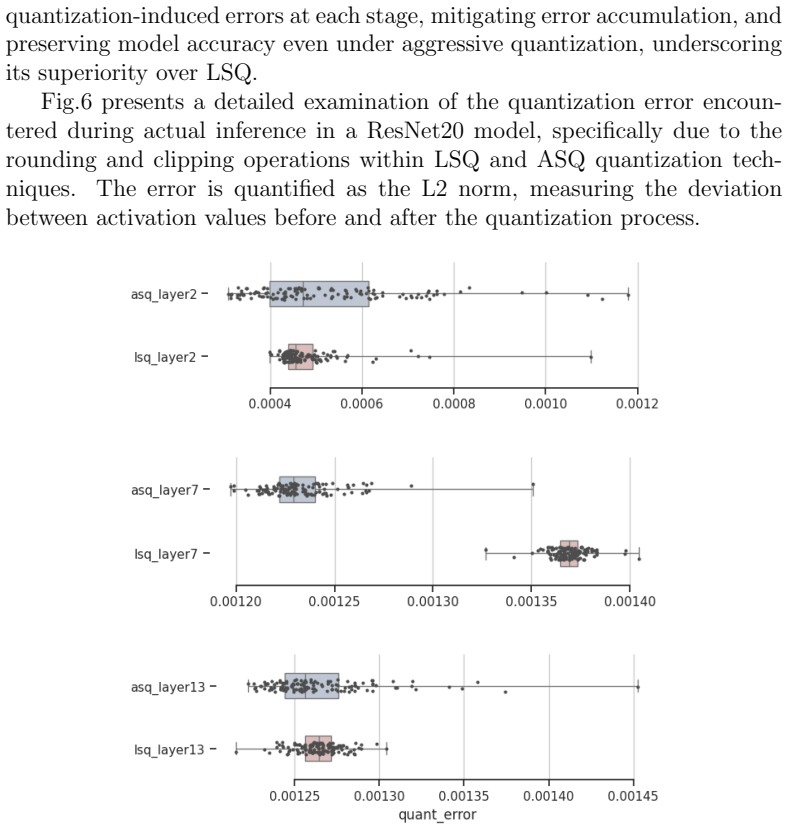
- Because the paper finds ASQ can increase per-layer quantization error while improving end-to-end accuracy, layerwise error appears to be the wrong optimization proxy and input-dependent rescaling likely shifts error into directions the task loss tolerates.
- The same adapter mechanism could transfer to transformer-like models, where activation distributions vary strongly across tokens; the paper reports experiments only for CNNs.
Signed reviews
Editorial analysis
A structured set of objections, weighed in public.
Referee Report
Summary. The paper proposes a quantization-aware training (QAT) method, Adaptive Step Size Quantization (ASQ), which uses a small learned adapter module to produce an input-dependent multiplicative factor for the activation quantization step size, and a non-uniform weight quantizer, POST, based on powers of the square root of two. The authors report experiments on ImageNet and CIFAR-10 with ResNet and MobileNet-V2, claiming state-of-the-art accuracy at low bit widths, including better-than-full-precision results at 4-bit and 8-bit on ResNet models, as well as negligible computational overhead for the adapter.
Significance. If the method is sound and reproducible, the core idea is interesting: input-adaptive activation step sizes are a plausible way to handle the variability of activation distributions across inputs, and the POST quantizer with a LUT-based implementation could offer a useful efficiency-accuracy trade-off. The empirical results, assuming they hold, would be competitive with the QAT literature. However, the manuscript as written does not specify the adapter architecture or input reduction, contains an internally inconsistent forward/backward definition, and reports a headline number that contradicts the table in the paper. These issues currently prevent verification of the central empirical claims, so the significance is conditional on a careful revision that resolves them.
major comments (4)
- [Section 3.2, Eqs. (4)-(6) and Algorithm 1] The forward fake-quantization operator is internally inconsistent. Quantization and clipping in Eq. (5) use the adaptive step size sa = s·β, while dequantization in Eq. (6) multiplies the integer code by the non-adaptive step size s. Unless β = 1, the reconstructed value x̂ is not on the sa grid used to produce xint, so the operator does not implement a standard quantization/dequantization round trip. The gradient in Eq. (7) is also not a correct STE derivative under either interpretation: if x̂ = xint·s, the in-range derivative of x̂ with respect to sa is −s·x/sa², not the expression given; if x̂ = xint·sa was intended, Eq. (6) is wrong and the in-range derivative should be −x/sa + round(x/sa). Additionally, the symbol v in Eq. (7) is undefined. Since Algorithm 1 step 4 calls Quantize(A, sa, ba) and implicitly relies on Eq. (6), the training and inference forward/backward passes are ambiguous. The authors must state explicitly whether dequantization uses sa or s, in both training and inference, and correct the gradient formulas and the undefined variable accordingly.
- [Section 3.2, Algorithm 1 step 2] The adapter is underspecified to the point of non-reproducibility. The call Adapter(A, W_adapter, B_adapter) takes the activation tensor A, but the paper never states how A is reduced to the scalar (or vector) β: global average pooling, flattening, channel-wise aggregation, or per-tensor versus per-channel prediction are all plausible but mutually different designs. The architecture is also unspecified (one or two linear layers, hidden size, nonlinearity). These choices directly determine the accuracy and the computational overhead: if the adapter ingests raw feature maps, the flattening and matrix multiplication cost can be substantial for large activations, contradicting the 'negligible overhead' claim in Section 3.2.2 and Table 1; if it pools first, the pooling choice is an untested design decision on which the reported accuracies likely depend. The authors should specify the exact adapter architecture and input reduction, and verify the overhead calculation against that concrete design.
- [Abstract vs. Section 4.2, Table 2] The abstract's headline claim is contradicted by the paper's own results. The abstract states that 'its 4-bit quantized ResNet34 model improving accuracy by 1.2% on ImageNet.' Table 2 reports ResNet34 ASQ+POST at 4-bit as +0.8% (74.1 vs. 73.3) and ASQ at 4-bit as +0.6% (73.9 vs. 73.3). The +1.2% figure corresponds to ResNet18 ASQ+POST at 4-bit (71.0 vs. 69.8) or ResNet18 ASQ at 8-bit (71.0 vs. 69.8). The abstract should be corrected to match the table, or the discrepancy should be explained.
- [Section 4.4 and Table 5] There is a bit-width inconsistency in the ablation study. The text states 'we conducted a thorough ablation study on the 4-bit quantized ResNet20 network,' but Table 5's caption and header say 'the final performance of a 3-bit quantized ResNet-20 network.' The reported accuracy values (Baseline+POST+ASQ 93.0 vs. real-valued 92.6) are consistent with the text's +0.4% claim, but the bit-width must be clarified. This matters because the ablation is used to attribute gains to ASQ and POST, and the reader cannot tell which quantization setting produced those numbers.
minor comments (8)
- [Section 4.1 heading] The heading 'Implimention Details' contains a typo; it should read 'Implementation Details.'
- [Section 5] The conclusion contains the typo 'poposed' and the introduction contains the grammatical error 'The researches on QAT'; these should be corrected.
- [Section 4.3 heading] The heading appears as 'Evaluation on CIF AR-10' with an unwanted space; it should be 'CIFAR-10.'
- [Eqs. (3) and (17)] The exponent notation in the quantization level sets is ambiguous in the rendering, e.g., '±2−2b−1+1' is hard to parse as a superscript. Please use clear superscript formatting (e.g., ±2^{-2^{b-1}+1}) and verify the exponents, especially in Eq. (17) where the exponent appears to simplify to -2b.
- [Section 3.2.1, Eq. (7)] The variable v in Eq. (7) is undefined; if it is intended to be x/s or x/s_a, this should be stated explicitly.
- [Table 1 and Section 3.3.1] The overhead analysis in Table 1 only covers the ASQ adapter; the POST quantizer's LUT storage cost is only described qualitatively ('a slight increase in space utilization'). Please quantify the LUT size and memory overhead for the bit widths used in the experiments.
- [Table 2 and Section 4.2] Several baseline numbers are marked as 'our re-implementation,' but the paper does not describe how these re-implementations were configured or verified against the original papers. For a fair comparison, please provide details on the re-implementation protocol and, where available, cite the original reported numbers.
- [Algorithm 1] Algorithm 1 lists Wadapter and Badapter as trainable parameters and updates them, but the backpropagation path through β to these adapter parameters is not shown. Eqs. (8)-(9) only give ∂x̂/∂s and ∂x̂/∂β; the update of Wadapter requires ∂β/∂W_adapter, which is standard but should be stated for completeness.
Circularity Check
No circularity: benchmark accuracies are empirical held-out results, not reductions to fitted inputs or self-citations.
full rationale
The paper's central claims are benchmark accuracies produced by training a quantized network with the proposed adapter-based activation step size and POST weight quantizer, then evaluating on held-out test sets. No quantity is fitted to the test set and subsequently reported as a prediction; the adapter parameters and step sizes are learned from training data by ordinary supervised optimization, and the test accuracies are external measurements. The related-work citations, including several by overlapping authors (e.g., [35]-[37]), are used as comparison baselines rather than as load-bearing premises for the method. POST is defined directly by Eq. (17), and ASQ is defined by Eqs. (4)-(9); no uniqueness theorem or prior result is invoked to force the design. There are internal inconsistencies that affect reproducibility and correctness rather than circularity: Eq. (6) dequantizes with s while Eq. (5) quantizes with sa, the gradient formulas in Eqs. (8)-(9) correspond to neither scale consistently, and the abstract's claimed 1.2% ResNet34 gain differs from Table 2's +0.8% for ASQ+POST and +0.6% for ASQ. Missing implementation details, such as the adapter's input reduction, further weaken reproducibility but do not constitute circular derivation. Because the reported gains come from external benchmark evaluation and are not constructed from the inputs being predicted, the circularity score is 0.
Assumptions & free parameters
free parameters (2)
- POST quantization base =
sqrt(2)
- Adapter architecture and input reduction =
one or two linear layers; unspecified
assumptions (3)
- domain assumption Weight distributions are bell-shaped and concentrated around zero in trained networks.
- domain assumption The straight-through estimator provides a serviceable gradient for the non-differentiable rounding operation.
- domain assumption Pre-trained full-precision weights are a valid starting point for QAT training.
invented entities (2)
-
Input-adaptive step-size adapter (ASQ module)
-
POST (Power Of Square root of Two) quantizer
Cite this review
Pith. "Pith review of Precision Neural Network Quantization via Learnable Adaptive Modules." pith.science (2026). https://pith.science/paper/6HAKESZZ
@misc{pith2026250417263,
  author       = {Pith},
  title        = {Pith review of: Precision Neural Network Quantization via Learnable Adaptive Modules},
  year         = {2026},
  howpublished = {\url{https://pith.science/paper/6HAKESZZ}},
  note         = {Machine review of arXiv:2504.17263}
}
read the original abstract
Quantization Aware Training (QAT) is a neural network quantization technique that compresses model size and improves operational efficiency while effectively maintaining model performance. The paradigm of QAT is to introduce fake quantization operators during the training process, allowing the model to autonomously compensate for information loss caused by quantization. Making quantization parameters trainable can significantly improve the performance of QAT, but at the cost of compromising the flexibility during inference, especially when dealing with activation values with substantially different distributions. In this paper, we propose an effective learnable adaptive neural network quantization method, called Adaptive Step Size Quantization (ASQ), to resolve this conflict. Specifically, the proposed ASQ method first dynamically adjusts quantization scaling factors through a trained module capable of accommodating different activations. Then, to address the rigid resolution issue inherent in Power of Two (POT) quantization, we propose an efficient non-uniform quantization scheme. We utilize the Power Of Square root of Two (POST) as the basis for exponential quantization, effectively handling the bell-shaped distribution of neural network weights across various bit-widths while maintaining computational efficiency through a Look-Up Table method (LUT). Extensive experimental results demonstrate that the proposed ASQ method is superior to the state-of-the-art QAT approaches. Notably that the ASQ is even competitive compared to full precision baselines, with its 4-bit quantized ResNet34 model improving accuracy by 1.2\% on ImageNet.
Figures


Figures from the paper (3 more)


Reference graph
Works this paper leans on
-
[1]
Z. Zang, C. Lin, C. Tang, T. Wang, J. Lv, Zero-shot aerial object detection with visual description regularization, Proceedings of the AAAI Conference on Artificial Intelligence 38 (7) (2024) 6926–6934. doi:10.1609/aaai.v38i7.28518. URL https://ojs.aaai.org/index.php/AAAI/article/view/28518
-
[2]
C. Tang, Z. He, Y. Li, J. Lv, Zero-shot learning via structure-aligned generative adversarial network, IEEE Transactions on Neural Networks and Learning Systems 33 (11) (2022) 6749–6762. doi:10.1109/TNNLS. 2021.3083367
arXiv 2022
-
[3]
Vaswani, Attention is all you need, arXiv preprint arXiv:1706.03762 (2017)
A. Vaswani, Attention is all you need, arXiv preprint arXiv:1706.03762 (2017)
arXiv 2017
-
[4]
R. D. Peacocke, D. H. Graf, An introduction to speech and speaker recognition, in: Readings in human–computer interaction, Elsevier, 1995, pp. 546–553
work page 1995
-
[5]
J. Choi, Z. Wang, S. Venkataramani, P. I. Chuang, V. Srinivasan, K. Gopalakrishnan, PACT: parameterized clipping activation for quan- tized neural networks, CoRR abs/1805.06085 (2018). arXiv:1805. 06085. URL http://arxiv.org/abs/1805.06085
arXiv 2018
-
[6]
S. K. Esser, J. L. McKinstry, D. Bablani, R. Appuswamy, D. S. Modha, Learned step size quantization, CoRR abs/1902.08153 (2019). arXiv: 1902.08153. URL http://arxiv.org/abs/1902.08153
arXiv 2019
-
[7]
T. Gale, E. Elsen, S. Hooker, The state of sparsity in deep neural net- works, CoRR abs/1902.09574 (2019). arXiv:1902.09574. URL http://arxiv.org/abs/1902.09574
arXiv 2019
-
[8]
D. Blalock, J. J. Gonzalez Ortiz, J. Frankle, J. Guttag, What is the state of neural network pruning?, in: I. Dhillon, D. Papailiopoulos, V. Sze 21 (Eds.), Proceedings of Machine Learning and Systems, Vol. 2, 2020, pp. 129–146
work page 2020
Show all 38 references
-
[9]
S. Ahn, S. X. Hu, A. Damianou, N. D. Lawrence, Z. Dai, Variational information distillation for knowledge transfer, in: Proceedings of the IEEE/CVF Conference on Computer Vision and Pattern Recognition (CVPR), 2019
2019
-
[10]
H. Yin, P. Molchanov, J. M. Alvarez, Z. Li, A. Mallya, D. Hoiem, N. K. Jha, J. Kautz, Dreaming to distill: Data-free knowledge transfer via deepinversion, in: Proceedings of the IEEE/CVF Conference on Com- puter Vision and Pattern Recognition (CVPR), 2020
2020
-
[11]
T. N. Sainath, B. Kingsbury, V. Sindhwani, E. Arisoy, B. Ramabhad- ran, Low-rank matrix factorization for deep neural network training with high-dimensional output targets, in: 2013 IEEE International Confer- ence on Acoustics, Speech and Signal Processing, 2013, pp. 6655–6659...
2013
-
[12]
Elsken, J
T. Elsken, J. H. Metzen, F. Hutter, Neural architecture search: A sur- vey, Journal of Machine Learning Research 20 (55) (2019) 1–21. URL http://jmlr.org/papers/v20/18-598.html
2019
-
[13]
Howard, M
A. Howard, M. Sandler, G. Chu, L.-C. Chen, B. Chen, M. Tan, W. Wang, Y. Zhu, R. Pang, V. Vasudevan, Q. V. Le, H. Adam, Search- ing for mobilenetv3, in: Proceedings of the IEEE/CVF International Conference on Computer Vision (ICCV), 2019
2019
-
[14]
Y. Li, S. Xu, M. Lin, X. Cao, C. Liu, X. Sun, B. Zhang, Bi-vit: Pushing the limit of vision transformer quantization, Proceedings of the AAAI Conference on Artificial Intelligence 38 (4) (2024) 3243–3251. doi:10. 1609/aaai.v38i4.28109. URL https://ojs.aaai.org/index.php/AAAI/a...
2024
-
[15]
Gholami, S
A. Gholami, S. Kim, Z. Dong, Z. Yao, M. W. Mahoney, K. Keutzer, A survey of quantization methods for efficient neural network inference, in: Low-Power Computer Vision, Chapman and Hall/CRC, 2022, pp. 291–326. 22
2022
-
[16]
Bhalgat, J
Y. Bhalgat, J. Lee, M. Nagel, T. Blankevoort, N. Kwak, Lsq+: Improv- ing low-bit quantization through learnable offsets and better initializa- tion, in: Proceedings of the IEEE/CVF Conference on Computer Vision and Pattern Recognition (CVPR) Workshops, 2020
2020
-
[17]
Bengio, N
Y. Bengio, N. L´ eonard, A. C. Courville, Estimating or propagating gra- dients through stochastic neurons for conditional computation, CoRR abs/1308.3432 (2013). arXiv:1308.3432. URL http://arxiv.org/abs/1308.3432
2013 arXiv
-
[18]
S. K. Esser, P. A. Merolla, J. V. Arthur, A. S. Cassidy, R. Appuswamy, A. Andreopoulos, D. J. Berg, J. L. McKinstry, T. Melano, D. R. Barch, et al., From the cover: Convolutional networks for fast, energy-efficient neuromorphic computing, Proceedings of the National Academy of...
2016
-
[19]
J. L. McKinstry, S. K. Esser, R. Appuswamy, D. Bablani, J. V. Arthur, I. B. Yildiz, D. S. Modha, Discovering low-precision networks close to full-precision networks for efficient embedded inference, CoRR abs/1809.04191 (2018). arXiv:1809.04191. URL http://arxiv.org/abs/1809.04191
2018 arXiv
-
[20]
S. Jung, C. Son, S. Lee, J. Son, J.-J. Han, Y. Kwak, S. J. Hwang, C. Choi, Learning to quantize deep networks by optimizing quantization intervals with task loss, in: Proceedings of the IEEE/CVF Conference on Computer Vision and Pattern Recognition (CVPR), 2019
2019
-
[21]
Zhang, J
D. Zhang, J. Yang, D. Ye, G. Hua, Lq-nets: Learned quantization for highly accurate and compact deep neural networks, in: Proceedings of the European Conference on Computer Vision (ECCV), 2018
2018
-
[22]
Miyashita, E
D. Miyashita, E. H. Lee, B. Murmann, Convolutional neural networks using logarithmic data representation, CoRR abs/1603.01025 (2016). arXiv:1603.01025. URL http://arxiv.org/abs/1603.01025
2016 arXiv
-
[23]
Y. Li, X. Dong, W. Wang, Additive powers-of-two quantization: An efficient non-uniform discretization for neural networks, arXiv preprint arXiv:1909.13144 (2019). 23
2019 arXiv
-
[24]
Y. Chen, X. Dai, M. Liu, D. Chen, L. Yuan, Z. Liu, Dynamic con- volution: Attention over convolution kernels, in: Proceedings of the IEEE/CVF Conference on Computer Vision and Pattern Recognition (CVPR), 2020
2020
-
[25]
S. Zhou, Z. Ni, X. Zhou, H. Wen, Y. Wu, Y. Zou, Dorefa-net: Training low bitwidth convolutional neural networks with low bitwidth gradients, CoRR abs/1606.06160 (2016). arXiv:1606.06160. URL http://arxiv.org/abs/1606.06160
2016 arXiv
-
[26]
R. Gong, X. Liu, S. Jiang, T. Li, P. Hu, J. Lin, F. Yu, J. Yan, Dif- ferentiable soft quantization: Bridging full-precision and low-bit neural networks, in: Proceedings of the IEEE/CVF International Conference on Computer Vision (ICCV), 2019
2019
-
[27]
A. Zhou, A. Yao, Y. Guo, L. Xu, Y. Chen, Incremental network quantization: Towards lossless cnns with low-precision weights, CoRR abs/1702.03044 (2017). arXiv:1702.03044. URL http://arxiv.org/abs/1702.03044
2017 arXiv
-
[28]
K. He, X. Zhang, S. Ren, J. Sun, Deep residual learning for image recog- nition, in: Proceedings of the IEEE Conference on Computer Vision and Pattern Recognition (CVPR), 2016
2016
-
[29]
Sandler, A
M. Sandler, A. Howard, M. Zhu, A. Zhmoginov, L.-C. Chen, Mo- bilenetv2: Inverted residuals and linear bottlenecks, in: Proceedings of the IEEE Conference on Computer Vision and Pattern Recognition (CVPR), 2018
2018
-
[30]
J. Deng, W. Dong, R. Socher, L.-J. Li, K. Li, L. Fei-Fei, Imagenet: A large-scale hierarchical image database, in: 2009 IEEE Conference on Computer Vision and Pattern Recognition, 2009, pp. 248–255. doi: 10.1109/CVPR.2009.5206848
2009
-
[31]
Krizhevsky, et al., Learning multiple layers of features from tiny images (2009)
A. Krizhevsky, et al., Learning multiple layers of features from tiny images (2009)
2009
-
[32]
Loshchilov, F
I. Loshchilov, F. Hutter, Sgdr: Stochastic gradient descent with warm restarts, arXiv preprint arXiv:1608.03983 (2016). 24
2016 arXiv
-
[33]
J. L. McKinstry, S. K. Esser, R. Appuswamy, D. Bablani, J. V. Arthur, I. B. Yildiz, D. S. Modha, Discovering low-precision networks close to full-precision networks for efficient inference, in: 2019 Fifth Workshop on Energy Efficient Machine Learning and Cognitive Computing - ...
2019
-
[34]
D. Kim, J. Lee, B. Ham, Distance-aware quantization, in: Proceedings of the IEEE/CVF International Conference on Computer Vision (ICCV), 2021, pp. 5271–5280
2021
-
[35]
C. Tang, K. Ouyang, Z. Wang, Y. Zhu, W. Ji, Y. Wang, W. Zhu, Mixed- precision neural network quantization via learned layer-wise importance, in: S. Avidan, G. Brostow, M. Ciss´ e, G. M. Farinella, T. Hassner (Eds.), Computer Vision – ECCV 2022, Springer Nature Switzerland, Cha...
2022
-
[36]
C. Tang, K. Ouyang, Z. Chai, Y. Bai, Y. Meng, Z. Wang, W. Zhu, Seam: Searching transferable mixed-precision quantization policy through large margin regularization, in: Proceedings of the 31st ACM International Conference on Multimedia, MM ’23, Association for Computing Machin...
2023
-
[37]
C. Tang, Y. Meng, J. Jiang, S. Xie, R. Lu, X. Ma, Z. Wang, W. Zhu, Retraining-free model quantization via one-shot weight-coupling learn- ing, in: Proceedings of the IEEE/CVF Conference on Computer Vision and Pattern Recognition (CVPR), 2024, pp. 15855–15865
2024
-
[38]
J. Shin, J. So, S. Park, S. Kang, S. Yoo, E. Park, Nipq: Noise proxy-based integrated pseudo-quantization, in: Proceedings of the IEEE/CVF Conference on Computer Vision and Pattern Recognition (CVPR), 2023, pp. 3852–3861. 25
2023
Reviewed August 16, 2026 · model on record in the stance chip above.
Discussion (0). Continue with ORCID to comment.