REVIEW 3 major objections 5 minor 2 cited by
Fine-structure Line Atlas for Multi-wavelength Extragalactic Study (FLAMES) I: Comprehensive Low and High Redshift Catalogs and Empirical Relations for Probing Gas Conditions
T0 review · 3 major / 5 minor · reviewed 2026-08-06 · deepseek-v4-flash
Pith's one-line read Ion abundance, not gas density, sets far-infrared line ratios.
desk verdict A solid, useful catalog paper that deserves review; the AGN decomposition is model-dependent enough that the AGN fractions should be treated as illustrative until robustness tests are added. read the letter →
The pith
A machine-rendered reading of the paper's core claim, the machinery that carries it, and where it could break.
The reading
What carries the argument
The load-bearing identity is the line-ratio decomposition in Eq. (1): $L_X/L_Y = (X/Y)\cdot(\mathrm{ICF})\cdot(\varepsilon_X/\varepsilon_Y)$. It separates a ratio's dependence on elemental abundance, ionization correction factor, and line emissivity, and the analysis uses it to decide which diagnostics isolate density, temperature, radiation hardness, or abundance. The second mechanism is the additive AGN decomposition $L_{\rm line} = L_{\rm SF} + L_{\rm AGN}$, calibrated by plotting high-ionization lines against the AGN-only anchors $[\mathrm{Ne\,V}]_{14}$ and $[\mathrm{O\,IV}]_{26}$ with $[\mathrm{Ne\,II}]_{12}$ or $[\mathrm{C\,II}]$ as the star-forming normalizer; a first-order polynomial fit separates the star-forming and AGN branches and yields AGN fractions for $[\mathrm{O\,III}]_{88}$ and $[\mathrm{O\,I}]_{63}$.
What would settle it
Compare galaxies with matched N/O and O/H but very different radiation-hardness indicators, for example AGN-dominated versus pure starburst systems: if $[\mathrm{O\,III}]_{88}/[\mathrm{C\,II}]$ and $[\mathrm{N\,II}]/[\mathrm{C\,II}]$ still differ by large factors after applying the paper's AGN correction, then abundance is not the primary driver. A more direct test would spatially resolve a nearby galaxy and measure $[\mathrm{O\,III}]_{88}$ and $[\mathrm{N\,II}]_{122/205}$ at matched local N/O to see whether local density variations produce ratio changes the global analysis would miss.
Extended reading notes
Core claim
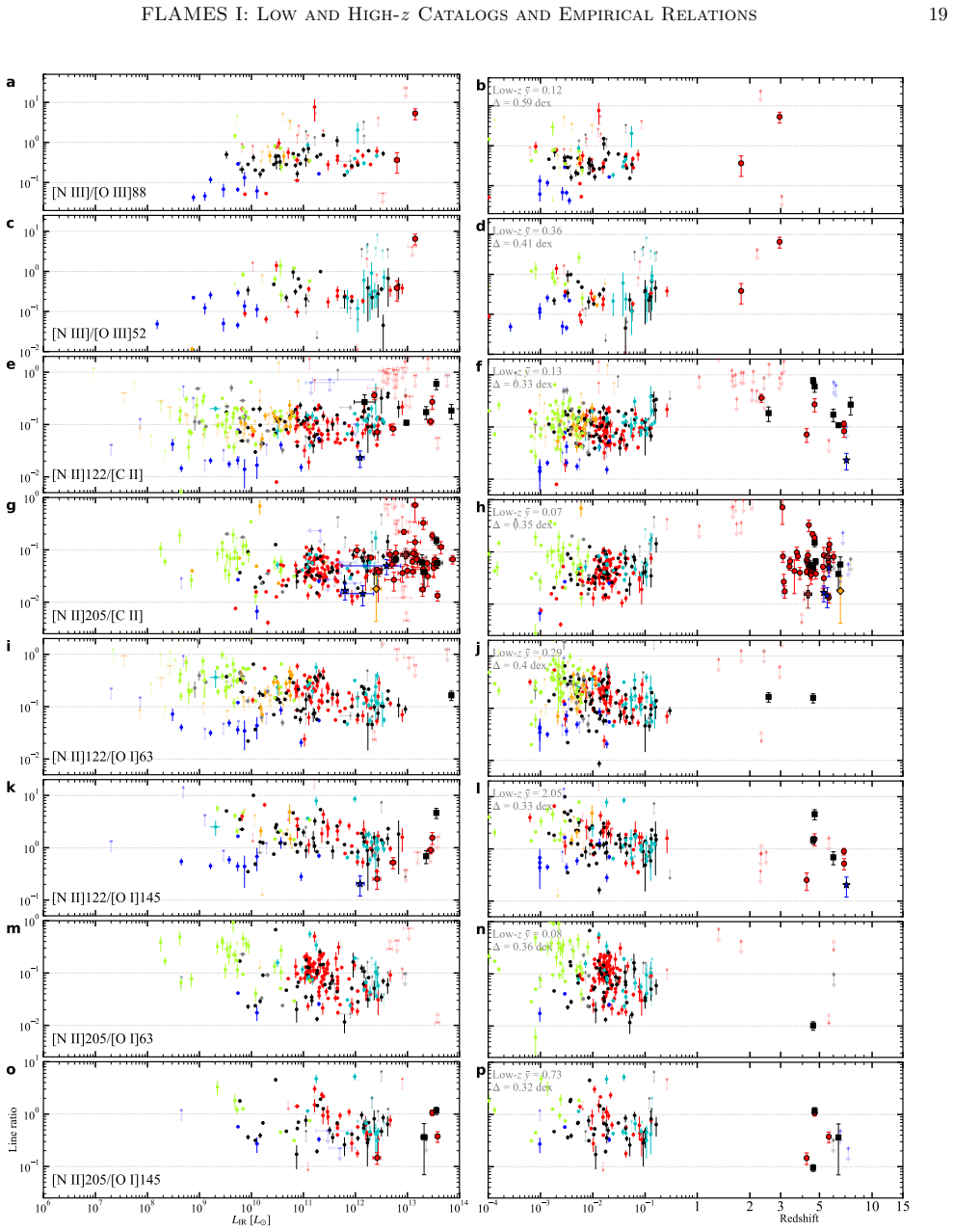
The central claim is that observed variations in far-infrared fine-structure line ratios (for example $[\mathrm{O\,III}]_{88}/[\mathrm{C\,II}]$, $[\mathrm{N\,II}]/[\mathrm{C\,II}]$, and $[\mathrm{N\,III}]/[\mathrm{O\,III}]_{88}$) are dominated by the relative abundances of the emitting ions, expressed through the elemental abundance ratio and the ionization correction factor in the line-ratio identity, with emissivity variations playing a secondary role. This is why the ratios work as empirical metallicity and radiation-field tracers. Supporting evidence includes tight correlations between FIR ratios and N/O, agreement between FIR and optical $[\mathrm{O\,III}]$-to-low-ionization ratios, and a demonstration that most density-sensitive ratios sit near their low-density limits; the $[\mathrm{N\,II}]_{122/205}$ ratio instead gives a nearly constant median electron density of about $50\,\mathrm{cm^{-3}}$. The paper further claims that AGN activity contributes measurably to $[\mathrm{O\,III}]_{88}$ and $[\mathrm{O\,I}]_{63}$, and that this contamination can be decomposed and removed using $[\mathrm{Ne\,V}]_{14}$ and $[\mathrm{O\,IV}]_{26}$ as AGN-only anchors.
Load-bearing premise
The AGN corrections and the abundance interpretation assume each galaxy's line luminosity splits cleanly into a star-forming plus an AGN component, with $[\mathrm{Ne\,V}]$ and $[\mathrm{O\,IV}]$ emitted only by the AGN, $[\mathrm{Ne\,II}]$ and $[\mathrm{C\,II}]$ representing star-forming ISM, and star-forming line ratios staying constant; if the AGN heats $[\mathrm{Ne\,II}]$ or very hard star-forming regions produce $[\mathrm{Ne\,V}]$ or $[\mathrm{O\,IV}]$, the corrected ratios and the abundance conclusion shift.
Editorial extensions
If this is right
- The ratio $[\mathrm{N\,III}]/[\mathrm{O\,III}]_{88}$ works as a direct N/O diagnostic with roughly 0.25 dex scatter, matching the theoretical emissivity ratio and avoiding the need for [O iii]52.
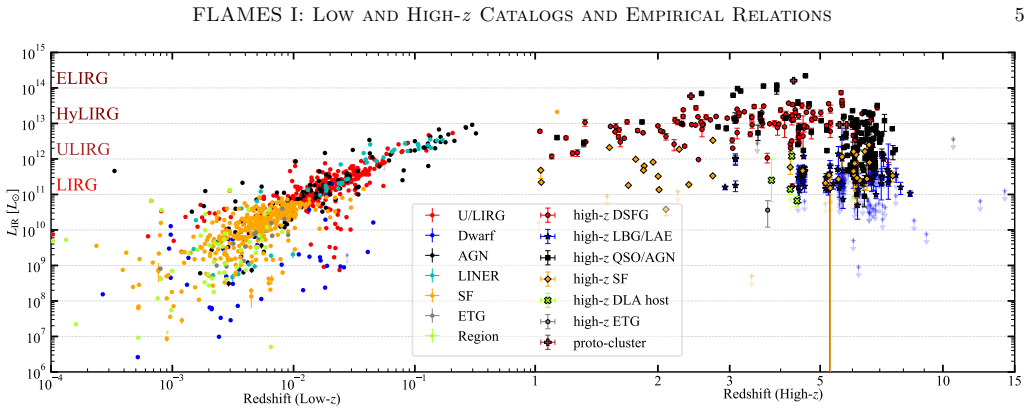
- The 'deficit' seen in [C ii]/IR is not unique: all major FIR FSLs decline relative to IR luminosity above $L_{\rm IR}\sim10^{11}\,L_\odot$, with the high-redshift branch shifted to higher luminosity.
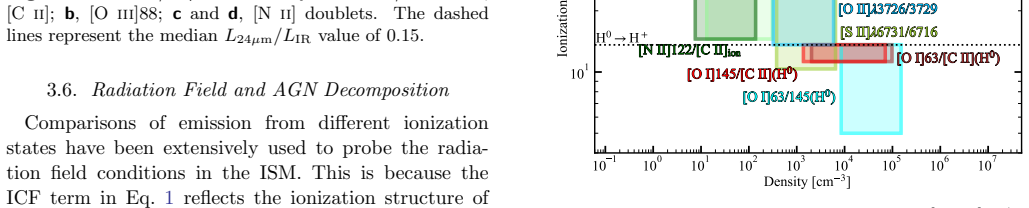
- Most published electron densities from high-ionization tracers such as [O iii]52/88, [Ne v]14/24, and [S iii]18/33 are unreliable for galaxy-integrated gas; the [N ii]122/205 ratio is the robust exception, giving a median density near 50 cm$^{-3}$ with little variation.
- AGN contamination in [O iii]88 and [O i]63 can be corrected using the fitted decomposition, and [S iv]10 is almost always AGN-dominated, making it a useful mid-infrared AGN indicator.
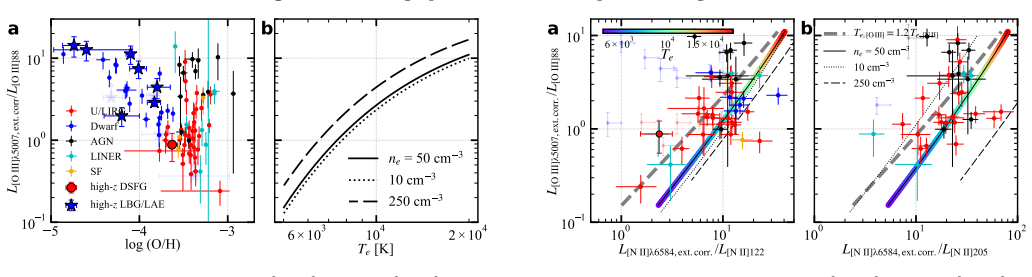
- FIR and optical forbidden-line ratios track each other over two orders of magnitude, so optical ionization-parameter diagnostics can be extended into dusty, high-SFR galaxies using FIR lines.
Reading between the lines
- The paper leaves implicit that published single-line SFR and gas-mass calibrations, especially those using [C ii], may need metallicity corrections because line luminosity changes with ion abundance at fixed star formation rate.
- Extending the AGN correction to high redshift could revise some reported ionizing-photon production rates, since [O iii]88 detections attributed to star formation may partly trace AGN activity.
- The FIR-optical concordance suggests rest-frame optical metallicity diagnostics could be calibrated against FIR ratios for heavily obscured galaxies, extending abundance measurements to populations inaccessible to optical spectroscopy.
Editorial analysis
A structured set of objections, weighed in public.
Referee Report
Summary. The paper presents FLAMES I, a compilation of 1273 low-redshift and 543 high-redshift galaxy-integrated fine-structure line (FSL) measurements drawn from the literature, supplemented with MIR/optical lines, photometry, dust temperatures, metallicities, and ancillary properties. It uses this atlas to re-examine empirical scaling relations: the [C II]/IR "deficit," line equivalent widths, density diagnostics, radiation-field and abundance diagnostics, electron-temperature probes, FIR-optical concordance, and low-z versus high-z ISM properties. The central empirical claim is that variations in FIR FSL ratios are primarily driven by the relative abundances of emitting ions, with radiation-field hardness playing a secondary role, while density and temperature variations are subdominant. A second key result is an empirical decomposition of AGN contributions to [O III]88 and [O I]63 using [Ne V]14 and [O IV]26 as AGN tracers.
Significance. If the results hold, this would be the most comprehensive FSL reference catalog currently available and a useful set of empirical calibrations bridging FIR and optical diagnostics. The paper's strengths are its breadth, the explicit discussion of selection effects and caveats, the use of PyNeb atomic-emissivity calculations for the theoretical curves, and the demonstration that many FIR line ratios track optical diagnostics over two orders of magnitude. The AGN decomposition, if robust, would provide a practical correction for [O III]88 and [O I]63 in AGN hosts, which is directly relevant to high-redshift studies. However, the absence of the machine-readable catalogs in the submitted version and the load-bearing assumptions in the AGN decomposition currently limit the strength of the central claim.
major comments (3)
- [Sec. 4.2, Fig. 27] The AGN decomposition assumes L_line = L_SF + L_AGN, with L_AGN proportional to L[Ne V]14 (or L[O IV]26) and L_SF proportional to L[C II] (or L[Ne II]12 for the MIR lines). The paper itself notes that [O IV]26 can arise in intense or low-metallicity star-forming environments and that [O I] is enhanced in X-ray-dominated regions near AGNs, where [C II] is also expected to be enhanced. Because [C II] is the denominator for the corrected [O III]88/[C II] and [O I]63/[C II] ratios used in the subsequent abundance and radiation-field analysis, an AGN contribution to [C II] would bias the fitted slope and intercept and hence the derived f_AGN values. Please provide a sensitivity test, for example by allowing a free AGN component in [C II] proportional to L[Ne V] or by repeating the decomposition after excluding all known AGN hosts, and state explicitly how the abundance-driven interpretation changes.
- [Appendices A and B] The primary products of this catalog paper, the full low-z and high-z value-added tables, are not included in the submitted manuscript; the text states that the full machine-readable tables will be available in the online published version and can be obtained by contacting the corresponding author. This prevents the reader from verifying the claimed sample sizes (1273 and 543 entries), the estimated >95% and >90% literature coverage, and the empirical relations that form the basis of the paper's conclusions. Please submit the complete catalogs as machine-readable ancillary files.
- [Appendix B.5] For high-z DSFGs believed to be lensed but lacking a lens model, a default magnification of mu = 6 is assigned and used to compute intrinsic luminosities. This placeholder affects LIR and line luminosities of high-z sources in Figures 1, 6, and 7 and therefore the claimed roughly one-decade offset of the high-z "deficit" branch. If the low-z/high-z comparisons use line ratios that cancel magnification, this should be stated explicitly; otherwise, please quantify the sensitivity of the high-z conclusions by repeating the relevant plots with alternative assumptions (e.g., mu = 1 and mu = 10).
minor comments (5)
- [Sec. 3.5, Eq. (2)] The weighted-average density formula is difficult to read as printed; the summation indices and the quantity being averaged should be written out unambiguously.
- [Sec. 2.2] The statement that the O3N2 index overestimates O/H by 0.15 dex and the N2 index by 0.2 dex is applied without a citation; please provide the calibration comparison used to derive these offsets.
- [Sec. 3.5 and Fig. 13] The assumed values Te/TH0 = 66.6, neTe = nH0 TH0, and a [C II] neutral fraction of 80% are introduced in the figure caption; please state them in the main text and note how sensitive the [O I]/[C II] comparison is to these choices.
- [Sec. 3.7] Many literature metallicities and N/O values lack error bars, a point the paper acknowledges; the reported 0.25 dex scatter in the N/O calibrations likely includes this systematic component, and this should be stated where the calibrations are quoted.
- [Throughout] Several typographical errors should be fixed: "beacause" in Sec. 4.3, "refshift" in Appendix B.6, "Our analysis focus" in the abstract, and the missing sigma symbol in the panel annotations of Figs. 12-22 and similar figures.
Circularity Check
No significant circularity: the catalog's empirical relations and AGN decomposition are self-contained and do not reduce to their own inputs.
full rationale
The paper is an empirical atlas paper whose derivation chain is self-contained. The central claim that FSL ratio variations are primarily driven by ionic abundances rests on three independent lines of evidence: (i) correlations with optically derived N/O and O/H calibrations (Sec. 3.7), (ii) concordance between FIR and optical line ratios (Sec. 4.3), and (iii) the small observed scatter in density diagnostics, which limits the dynamic range of the emissivity term in Eq. 1. None of these defines the target ratio in terms of itself. The N/O calibration N/O = 0.66 x [N iii]/[O iii]88 is an empirical fit whose normalization is explicitly checked against the PyNeb emissivity ratio (1.47), and it is presented as a calibration rather than as a prediction from first principles. The AGN decomposition in Sec. 4.2 is an explicit two-component model L_line = L_SF + L_AGN with distinct anchors ([Ne ii]12 and [C ii] for SF; [Ne v]14 and [O iv]26 for AGN). The fitted slope and intercept are used to compute AGN fractions, which is a model inference, not a self-consistency loop, and the AGN-dominated branch is checked against the external Spoon et al. (2022) scaling. The skeptical concern that [C ii] could carry an AGN component is a model-robustness caveat, not a circularity: the decomposition assumes a pure SF anchor, so a violation would bias the fitted fractions, but the derivation does not assume its own conclusion. Self-citations (Peng et al. 2021; Lamarche et al. 2022) are data and calibration references and are not load-bearing; the N3O3 diagnostic is re-derived in this paper from PyNeb atomic data. No step reduces to its own input by construction, no uniqueness theorem is imported, and no ansatz is smuggled in via citation. Accordingly, the circularity score is 0.
Assumptions & free parameters
free parameters (8)
- OT-MBB emissivity index beta =
2
- OT-MBB LIR correction factor =
1.4
- Line continuum color to S60/S100 power-law fits =
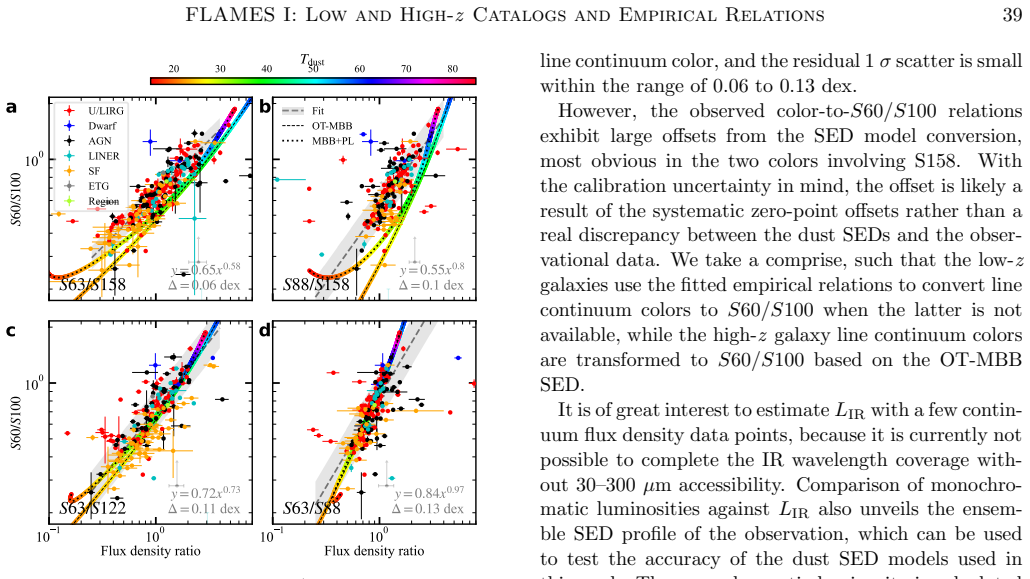
e.g. S63/S158 = 0.65 x (S60/S100)^0.58
- AGN decomposition coefficients =
[Ne III]15/[Ne V]14 = 1.7; [S IV]10 intercept 0.016, slope 0.85; [O III]88/[C II] intercept 0.16, slope 1.08; [O…
- Median L24/LIR =
0.15
- Default lensing magnification for high-z DSFGs =
6
- Assumed [C II] neutral fraction =
0.8
- Metallicity calibration offsets =
O3N2: +0.15 dex, N2: +0.2 dex
assumptions (7)
- domain assumption Line ratio decomposition in Eq. 1: L(X)/L(Y) = abundance ratio times ICF ratio times emissivity ratio
- standard math Atomic data and collisional rates from PyNeb, Barinovs et al. 2005, Abrahamsson et al. 2007, and Draine 2011
- ad hoc to paper AGN tracer purity: [Ne v]14 and [O iv]26 trace only AGN activity or strong shocks, and [Ne ii]12 represents the star-forming ISM
- ad hoc to paper Constant star-forming component ratio to [Ne ii]12 in the AGN decomposition
- ad hoc to paper Fixed Te/TH0 = 66.6 and pressure equilibrium neTe = nH0 TH0 for neutral gas diagnostics
- domain assumption Case B Balmer decrement H alpha/H beta = 2.86 and Calzetti et al. 2000 extinction law
- domain assumption Completeness estimates of more than 95% of low-z and more than 90% of high-z FSL data
Cite this review
Pith. "Pith review of Fine-structure Line Atlas for Multi-wavelength Extragalactic Study (FLAMES) I: Comprehensive Low and High Redshift Catalogs and Empirical Relations for Probing Gas Conditions." pith.science (2026). https://pith.science/paper/6HHZDIC3
@misc{pith2026250710702,
  author       = {Pith},
  title        = {Pith review of: Fine-structure Line Atlas for Multi-wavelength Extragalactic Study (FLAMES) I: Comprehensive Low and High Redshift Catalogs and Empirical Relations for Probing Gas Conditions},
  year         = {2026},
  howpublished = {\url{https://pith.science/paper/6HHZDIC3}},
  note         = {Machine review of arXiv:2507.10702}
}
read the original abstract
Far-infrared (FIR) and mid-infrared (MIR) fine-structure lines (FSLs) are widely used for studying galaxies nearby and faraway. However, interpreting these lines is complicated by factors including sample and data bias, mismatch between resolved calibrations and unresolved observations, limitations in generalizing from case studies, and unresolved issues like the origin of [C II] emission and the so-called ``deficit.''In this series of papers, we assemble and analyze the most comprehensive atlas of FSL data to date. We explore their empirical correlations (paper I), compare them with photoionization models that cover multiphase gas (paper II), and discuss their physical origins and the new perspectives they offer for studying physical properties (paper III). The first paper introduces value-added catalogs of global FSL data of low- and high-z galaxies compiled from the literature, covering most of the existing observations, supplemented with ancillary ultraviolet to FIR information. Our analysis focus on commonly used diagnostics, such as electron density, radiation field strength, metallicity, and electron temperature. We present their distributions across different galaxy samples and redshifts, and cross-validate the reliability of these diagnostics in measuring physical conditions. By examining empirical relations, we identify the contribution of active galactic nuclei (AGN) to the FIR FSLs [O III]88 and [O I]63, and reveal a bias in density measurements. FIR FSLs show good concordance with their optical counterparts. Our findings indicate that variations in FSL ratios are primarily driven by the relative abundances of emitting ions, underscoring their value as tracers of metallicity and radiation field strength. Finally, we compare the FIR FSL properties of low- and high-z galaxies, discussing both their similarities and differences.
Figures


Figures from the paper (27 more)










Forward citations
Cited by 2 Pith papers
-
Fine-structure Line Atlas for Multi-wavelength Extragalactic Study (FLAMES) III: [C II] as Tracer, Crisis of SFR, [O III]/[C II] at High-z, New Answers and New Questions
A universal gas-line deficit relative to infrared luminosity, seen in [C II], [O I], [N II], and extinction-corrected H-alpha, breaks standard SFR calibrations in the brightest dusty galaxies and implies a metallicity...
-
Fine-structure Line Atlas for Multi-wavelength Extragalactic Study (FLAMES) II: Photoionization Model View of Ionized to Neutral Gas Emission
A 20,446-model photoionization grid with power-law fits shows FIR fine-structure line ratios are set by three composite quantities (U1, ne, N/O) while U, Q1/Q0, and O/H remain degenerate without MIR or optical data.
Reference graph
Works this paper leans on
-
[1]
Abel, N. P., Ferland, G. J., Shaw, G., & van Hoof, P. A. M. 2005, ApJS, 161, 65, doi: 10.1086/432913
doi:10.1086/432913 2005
-
[2]
Abrahamsson, E., Krems, R. V., & Dalgarno, A. 2007, ApJ, 654, 1171, doi: 10.1086/509631
doi:10.1086/509631 2007
-
[3]
B., Fujimoto, S., Finlator, K., et al
Akins, H. B., Fujimoto, S., Finlator, K., et al. 2022, ApJ, 934, 64, doi: 10.3847/1538-4357/ac795b
-
[4]
Alaghband-Zadeh, S., Chapman, S. C., Swinbank, A. M., et al. 2013, MNRAS, 435, 1493, doi: 10.1093/mnras/stt1390
-
[5]
2025, arXiv e-prints, arXiv:2501.10508, doi: 10.48550/arXiv.2501.10508
Algera, H., Rowland, L., Stefanon, M., et al. 2025, arXiv e-prints, arXiv:2501.10508, doi: 10.48550/arXiv.2501.10508
-
[6]
Algera, H. S. B., Inami, H., Sommovigo, L., et al. 2024a, MNRAS, 527, 6867, doi: 10.1093/mnras/stad3111
-
[7]
Algera, H. S. B., Inami, H., De Looze, I., et al. 2024b, MNRAS, 533, 3098, doi: 10.1093/mnras/stae1994
-
[8]
Allam, S. S., Tucker, D. L., Lin, H., et al. 2007, ApJL, 662, L51, doi: 10.1086/519520 ´Alvarez-M´ arquez, J., Crespo G´ omez, A., Colina, L., et al. 2023, A&A, 671, A105, doi: 10.1051/0004-6361/202245400 ´Alvarez-M´ arquez, J., Colina, L., Crespo G´ omez, A., et al. 2024, A&A, 686, A85, doi: 10.1051/0004-6361/202347946
doi:10.1086/519520 2007
Show all 297 references
-
[9]
W., et al
Amvrosiadis, A., Lange, S., Nightingale, J. W., et al. 2025, MNRAS, 537, 1163, doi: 10.1093/mnras/staf048
2025 doi
-
[10]
2008, A&A, 491, 747, doi: 10.1051/0004-6361:200810482
Ao, Y., Weiß, A., Downes, D., et al. 2008, A&A, 491, 747, doi: 10.1051/0004-6361:200810482
2008 doi
-
[11]
2008, A&A, 491, 173, doi: 10.1051/0004-6361:200810628
Aravena, M., Bertoldi, F., Schinnerer, E., et al. 2008, A&A, 491, 173, doi: 10.1051/0004-6361:200810628
2008 doi
-
[12]
S., Bethermin, M., et al
Aravena, M., Spilker, J. S., Bethermin, M., et al. 2016, MNRAS, 457, 4406, doi: 10.1093/mnras/stw275 Arellano-C´ ordova, K. Z., & Rodr ´ ıguez, M. 2020, MNRAS, 497, 672, doi: 10.1093/mnras/staa1759
2016 doi
-
[13]
M., Evans, A
Armus, L., Mazzarella, J. M., Evans, A. S., et al. 2009, PASP, 121, 559, doi: 10.1086/600092
2009 doi
-
[14]
2024, A&A, 688, A146, doi: 10.1051/0004-6361/202348824
Arribas, S., Perna, M., Rodr ´ ıguez Del Pino, B., et al. 2024, A&A, 688, A146, doi: 10.1051/0004-6361/202348824
2024 doi
-
[15]
J., & Scott, P
Asplund, M., Grevesse, N., Sauval, A. J., & Scott, P. 2009, ARA&A, 47, 481, doi: 10.1146/annurev.astro.46.060407.145222 Astropy Collaboration, Robitaille, T. P., Tollerud, E. J., et al. 2013, A&A, 558, A33, doi: 10.1051/0004-6361/201322068 Astropy Collaboration, Price-Whelan, ...
2009
-
[16]
M., et al
Baier-Soto, R., Herrera-Camus, R., F¨ orster Schreiber, N. M., et al. 2022, A&A, 664, L5, doi: 10.1051/0004-6361/202243642
2022 doi
-
[17]
Bakx, T. J. L. C., Tamura, Y., Hashimoto, T., et al. 2020, MNRAS, 493, 4294, doi: 10.1093/mnras/staa509
2020 doi
-
[18]
Bakx, T. J. L. C., Sommovigo, L., Carniani, S., et al. 2021, MNRAS, 508, L58, doi: 10.1093/mnrasl/slab104
2021 doi
-
[19]
Bakx, T. J. L. C., Zavala, J. A., Mitsuhashi, I., et al. 2023, MNRAS, 519, 5076, doi: 10.1093/mnras/stac3723
2023 doi
-
[20]
Bakx, T. J. L. C., Algera, H. S. B., Venemans, B., et al. 2024a, MNRAS, 532, 2270, doi: 10.1093/mnras/stae1613
-
[21]
Bakx, T. J. L. C., Amvrosiadis, A., Bendo, G. J., et al. 2024b, MNRAS, 535, 1533, doi: 10.1093/mnras/stae2409
-
[22]
A., Phillips, M
Baldwin, J. A., Phillips, M. M., & Terlevich, R. 1981, PASP, 93, 5, doi: 10.1086/130766
1981 doi
-
[23]
2024, arXiv e-prints, arXiv:2408.12299, doi: 10.48550/arXiv.2408.12299 42 Peng et al
Banados, E., Khusanova, Y., Decarli, R., et al. 2024, arXiv e-prints, arXiv:2408.12299, doi: 10.48550/arXiv.2408.12299 42 Peng et al. Barinovs, ˘G., van Hemert, M. C., Krems, R., & Dalgarno, A. 2005, ApJ, 620, 537, doi: 10.1086/426860
-
[24]
L., Capak, P
Barisic, I., Faisst, A. L., Capak, P. L., et al. 2017, ApJ, 845, 41, doi: 10.3847/1538-4357/aa7eda
2017 doi
-
[25]
1992, ApJL, 399, L19, doi: 10.1086/186596
Barvainis, R., Antonucci, R., & Coleman, P. 1992, ApJL, 399, L19, doi: 10.1086/186596
1992 doi
-
[26]
J., et al
Beelen, A., Cox, P., Benford, D. J., et al. 2006, ApJ, 642, 694, doi: 10.1086/500636
2006 doi
-
[27]
W., Moiseev, A., et al
Belokurov, V., Evans, N. W., Moiseev, A., et al. 2007, ApJL, 671, L9, doi: 10.1086/524948
2007 doi
-
[28]
A., Pogge, R
Berg, D. A., Pogge, R. W., Skillman, E. D., et al. 2020, ApJ, 893, 96, doi: 10.3847/1538-4357/ab7eab
2020 doi
-
[29]
2023, ApJ, 952, 84, doi: 10.3847/1538-4357/acd643
Bergamini, P., Acebron, A., Grillo, C., et al. 2023, ApJ, 952, 84, doi: 10.3847/1538-4357/acd643
2023 doi
-
[30]
N., Longair, M
Best, P. N., Longair, M. S., & Roettgering, H. J. A. 1998, MNRAS, 295, 549, doi: 10.1046/j.1365-8711.1998.01245.x B´ ethermin, M., De Breuck, C., Gullberg, B., et al. 2016, A&A, 586, L7, doi: 10.1051/0004-6361/201527739 B´ ethermin, M., Fudamoto, Y., Ginolfi, M., et al. 2020, ...
1998
-
[31]
2024, A&A, 686, A3, doi: 10.1051/0004-6361/202348845
Bik, A., ´Alvarez-M´ arquez, J., Colina, L., et al. 2024, A&A, 686, A3, doi: 10.1051/0004-6361/202348845
2024 doi
-
[32]
K., Hashimoto, T., et al
Binggeli, C., Inoue, A. K., Hashimoto, T., et al. 2021, A&A, 646, A26, doi: 10.1051/0004-6361/202038180
2021 doi
-
[33]
E., Hutchison, T
Birkin, J. E., Hutchison, T. A., Welch, B., et al. 2023, ApJ, 958, 64, doi: 10.3847/1538-4357/acf712
2023 doi
- [34]
-
[35]
2018, A&A, 617, A82, doi: 10.1051/0004-6361/201833249
Bischetti, M., Piconcelli, E., Feruglio, C., et al. 2018, A&A, 617, A82, doi: 10.1051/0004-6361/201833249
2018 doi
-
[36]
2024, ApJ, 970, 9, doi: 10.3847/1538-4357/ad4a77
Bischetti, M., Choi, H., Fiore, F., et al. 2024, ApJ, 970, 9, doi: 10.3847/1538-4357/ad4a77
2024 doi
- [37]
-
[38]
W., Dey, A., et al
Borys, C., Blain, A. W., Dey, A., et al. 2006, ApJ, 636, 134, doi: 10.1086/497983
2006 doi
-
[39]
Bosman, S. E. I., ´Alvarez-M´ arquez, J., Colina, L., et al. 2024, Nature Astronomy, 8, 1054, doi: 10.1038/s41550-024-02273-0
2024 doi
-
[40]
J., Smit, R., Schouws, S., et al
Bouwens, R. J., Smit, R., Schouws, S., et al. 2022, ApJ, 931, 160, doi: 10.3847/1538-4357/ac5a4a
2022 doi
-
[41]
Bowler, R. A. A., Bourne, N., Dunlop, J. S., McLure, R. J., & McLeod, D. J. 2018, MNRAS, 481, 1631, doi: 10.1093/mnras/sty2368
2018 doi
-
[42]
Bowler, R. A. A., Cullen, F., McLure, R. J., Dunlop, J. S., & Avison, A. 2022, MNRAS, 510, 5088, doi: 10.1093/mnras/stab3744 Bradaˇ c, M., Garcia-Appadoo, D., Huang, K.-H., et al. 2017, ApJL, 836, L2, doi: 10.3847/2041-8213/836/1/L2 Bradaˇ c, M., Strait, V., Mowla, L., et al. ...
2022 doi
-
[43]
D., Bouwens, R
Bradley, L. D., Bouwens, R. J., Ford, H. C., et al. 2008, ApJ, 678, 647, doi: 10.1086/533519
2008 doi
-
[44]
D., Bouwens, R
Bradley, L. D., Bouwens, R. J., Zitrin, A., et al. 2012, ApJ, 747, 3, doi: 10.1088/0004-637X/747/1/3
2012 doi
-
[45]
R., Dale, D
Brauher, J. R., Dale, D. A., & Helou, G. 2008a, ApJS, 178, 280, doi: 10.1086/590249 —. 2008b, ApJS, 178, 280, doi: 10.1086/590249
-
[46]
J., Saxena, A., Cameron, A
Bunker, A. J., Saxena, A., Cameron, A. J., et al. 2023, A&A, 677, A88, doi: 10.1051/0004-6361/202346159
2023 doi
-
[47]
S., P´ erez-Fournon, I., Amber, S., et al
Bussmann, R. S., P´ erez-Fournon, I., Amber, S., et al. 2013, ApJ, 779, 25, doi: 10.1088/0004-637X/779/1/25
2013 doi
-
[48]
S., Riechers, D., Fialkov, A., et al
Bussmann, R. S., Riechers, D., Fialkov, A., et al. 2015, ApJ, 812, 43, doi: 10.1088/0004-637X/812/1/43
2015 doi
-
[49]
A., Fu, H., Cooray, A., et al
Calanog, J. A., Fu, H., Cooray, A., et al. 2014, ApJ, 797, 138, doi: 10.1088/0004-637X/797/2/138
2014 doi
-
[50]
C., et al
Calzetti, D., Armus, L., Bohlin, R. C., et al. 2000, ApJ, 533, 682, doi: 10.1086/308692
2000 doi
-
[51]
J., Katz, H., Rey, M
Cameron, A. J., Katz, H., Rey, M. P., & Saxena, A. 2023, MNRAS, 523, 3516, doi: 10.1093/mnras/stad1579
2023 doi
-
[52]
L., Riechers, D., Scoville, N
Capak, P. L., Riechers, D., Scoville, N. Z., et al. 2011, Nature, 470, 233, doi: 10.1038/nature09681
2011 doi
-
[53]
L., Carilli, C., Jones, G., et al
Capak, P. L., Carilli, C., Jones, G., et al. 2015, Nature, 522, 455, doi: 10.1038/nature14500
2015 doi
-
[54]
L., Lewis, G
Carilli, C. L., Lewis, G. F., Djorgovski, S. G., et al. 2003, Science, 300, 773, doi: 10.1126/science.1082600
2003 doi
-
[55]
L., Riechers, D., Walter, F., et al
Carilli, C. L., Riechers, D., Walter, F., et al. 2013, ApJ, 763, 120, doi: 10.1088/0004-637X/763/2/120
2013 doi
-
[56]
L., & Walter, F
Carilli, C. L., & Walter, F. 2013, ARA&A, 51, 105, doi: 10.1146/annurev-astro-082812-140953
2013 doi
-
[57]
L., Daddi, E., Riechers, D., et al
Carilli, C. L., Daddi, E., Riechers, D., et al. 2010, ApJ, 714, 1407, doi: 10.1088/0004-637X/714/2/1407
2010 doi
-
[58]
2018a, ApJL, 854, L7, doi: 10.3847/2041-8213/aaab45
Carniani, S., Maiolino, R., Smit, R., & Amor ´ ın, R. 2018a, ApJL, 854, L7, doi: 10.3847/2041-8213/aaab45
-
[59]
2013, A&A, 559, A29, doi: 10.1051/0004-6361/201322320
Carniani, S., Marconi, A., Biggs, A., et al. 2013, A&A, 559, A29, doi: 10.1051/0004-6361/201322320
2013 doi
-
[60]
2017, A&A, 605, A42, doi: 10.1051/0004-6361/201630366
Carniani, S., Maiolino, R., Pallottini, A., et al. 2017, A&A, 605, A42, doi: 10.1051/0004-6361/201630366
2017 doi
-
[61]
2018b, MNRAS, 478, 1170, doi: 10.1093/mnras/sty1088
Carniani, S., Maiolino, R., Amorin, R., et al. 2018b, MNRAS, 478, 1170, doi: 10.1093/mnras/sty1088
-
[62]
2024, Nature, 633, 318, doi: 10.1038/s41586-024-07860-9
Carniani, S., Hainline, K., D’Eugenio, F., et al. 2024, Nature, 633, 318, doi: 10.1038/s41586-024-07860-9
2024 doi
-
[64]
2024, ApJ, 972, 143, doi: 10.3847/1538-4357/ad5f88
Castellano, M., Napolitano, L., Fontana, A., et al. 2024, ApJ, 972, 143, doi: 10.3847/1538-4357/ad5f88
2024 doi
-
[65]
H., Lower, S., et al
Cathey, J., Gonzalez, A. H., Lower, S., et al. 2024, ApJ, 967, 11, doi: 10.3847/1538-4357/ad33c9 FLAMES I: Low and High-z Catalogs and Empirical Relations 43
2024 doi
-
[66]
L., Pope, A., Scott, D., et al
Chapin, E. L., Pope, A., Scott, D., et al. 2009, MNRAS, 398, 1793, doi: 10.1111/j.1365-2966.2009.15267.x
2009
-
[67]
2022, Nature Astronomy, 6, 844, doi: 10.1038/s41550-022-01679-y
Chartab, N., Cooray, A., Ma, J., et al. 2022, Nature Astronomy, 6, 844, doi: 10.1038/s41550-022-01679-y
2022 doi
-
[68]
2020, ApJ, 898, 33, doi: 10.3847/1538-4357/ab980b
Cheng, C., Cao, X., Lu, N., et al. 2020, ApJ, 898, 33, doi: 10.3847/1538-4357/ab980b
2020 doi
-
[69]
2015, A&A, 574, A14, doi: 10.1051/0004-6361/201424980
Cicone, C., Maiolino, R., Gallerani, S., et al. 2015, A&A, 574, A14, doi: 10.1051/0004-6361/201424980
2015 doi
-
[70]
Clark, C. J. R., Schofield, S. P., Gomez, H. L., & Davies, J. I. 2016, MNRAS, 459, 1646, doi: 10.1093/mnras/stw647
2016 doi
-
[71]
Clark, C. J. R., Verstocken, S., Bianchi, S., et al. 2018, A&A, 609, A37, doi: 10.1051/0004-6361/201731419
2018 doi
-
[72]
E., Ade, P
Clegg, P. E., Ade, P. A. R., Armand, C., et al. 1996, A&A, 315, L38
1996
-
[73]
D., et al
Combes, F., Rex, M., Rawle, T. D., et al. 2012, A&A, 538, L4, doi: 10.1051/0004-6361/201118750
2012 doi
-
[74]
D., et al
Conley, A., Cooray, A., Vieira, J. D., et al. 2011, ApJL, 732, L35, doi: 10.1088/2041-8205/732/2/L35
2011 doi
-
[75]
Coppin, K. E. K., Danielson, A. L. R., Geach, J. E., et al. 2012, MNRAS, 427, 520, doi: 10.1111/j.1365-2966.2012.21977.x
2012
-
[76]
C., Lebouteiller, V., et al
Cormier, D., Madden, S. C., Lebouteiller, V., et al. 2015, A&A, 578, A53, doi: 10.1051/0004-6361/201425207
2015 doi
-
[77]
P., Hony, S., et al
Cormier, D., Abel, N. P., Hony, S., et al. 2019, A&A, 626, A23, doi: 10.1051/0004-6361/201834457
2019 doi
-
[78]
E., Valentino, F., et al
Cortzen, I., Magdis, G. E., Valentino, F., et al. 2020, A&A, 634, L14, doi: 10.1051/0004-6361/201937217
2020 doi
-
[79]
L., Hu, E
Cowie, L. L., Hu, E. M., & Songaila, A. 2011, ApJL, 735, L38, doi: 10.1088/2041-8205/735/2/L38
2011 doi
-
[80]
G., et al
Cox, P., Omont, A., Djorgovski, S. G., et al. 2002, A&A, 387, 406, doi: 10.1051/0004-6361:20020382
2002 doi
-
[81]
2011, ApJ, 740, 63, doi: 10.1088/0004-637X/740/2/63 Crespo G´ omez, A., Colina, L.,´Alvarez-M´ arquez, J., et al
Cox, P., Krips, M., Neri, R., et al. 2011, ApJ, 740, 63, doi: 10.1088/0004-637X/740/2/63 Crespo G´ omez, A., Colina, L.,´Alvarez-M´ arquez, J., et al. 2024, A&A, 691, A325, doi: 10.1051/0004-6361/202449750
2011 doi
-
[82]
V., Smith, J
Croxall, K. V., Smith, J. D., Pellegrini, E., et al. 2017, ApJ, 845, 96, doi: 10.3847/1538-4357/aa8035
2017 doi
-
[83]
Cunningham, D. J. M., Chapman, S. C., Aravena, M., et al. 2020, MNRAS, 494, 4090, doi: 10.1093/mnras/staa820
2020 doi
-
[84]
2017, MNRAS, 465, 1384, doi: 10.1093/mnras/stw2766
Curti, M., Cresci, G., Mannucci, F., et al. 2017, MNRAS, 465, 1384, doi: 10.1093/mnras/stw2766
2017 doi
-
[85]
2009, ApJ, 694, 1517, doi: 10.1088/0004-637X/694/2/1517
Daddi, E., Dannerbauer, H., Stern, D., et al. 2009, ApJ, 694, 1517, doi: 10.1088/0004-637X/694/2/1517
2009 doi
-
[86]
A., Aniano, G., Engelbracht, C
Dale, D. A., Aniano, G., Engelbracht, C. W., et al. 2012, ApJ, 745, 95, doi: 10.1088/0004-637X/745/1/95
2012 doi
-
[87]
2022, MNRAS, 512, 989, doi: 10.1093/mnras/stac537 De Breuck, C., Maiolino, R., Caselli, P., et al
Dayal, P., Ferrara, A., Sommovigo, L., et al. 2022, MNRAS, 512, 989, doi: 10.1093/mnras/stac537 De Breuck, C., Maiolino, R., Caselli, P., et al. 2011, A&A, 530, L8, doi: 10.1051/0004-6361/201116868 De Breuck, C., Bertoldi, F., Carilli, C., et al. 2004, A&A, 424, 1, doi: 10.105...
2022 doi
-
[88]
P., Rawlings, S., Garrett, M
Deane, R. P., Rawlings, S., Garrett, M. A., et al. 2013, MNRAS, 434, 3322, doi: 10.1093/mnras/stt1241
2013 doi
-
[89]
2012, ApJ, 752, 2, doi: 10.1088/0004-637X/752/1/2
Decarli, R., Walter, F., Neri, R., et al. 2012, ApJ, 752, 2, doi: 10.1088/0004-637X/752/1/2
2012 doi
-
[90]
2014, ApJL, 782, L17, doi: 10.1088/2041-8205/782/2/L17
Decarli, R., Walter, F., Carilli, C., et al. 2014, ApJL, 782, L17, doi: 10.1088/2041-8205/782/2/L17
2014 doi
-
[91]
P., et al
Decarli, R., Walter, F., Venemans, B. P., et al. 2017, Nature, 545, 457, doi: 10.1038/nature22358 —. 2018, ApJ, 854, 97, doi: 10.3847/1538-4357/aaa5aa
2017 doi
-
[92]
2022, A&A, 662, A60, doi: 10.1051/0004-6361/202142871
Decarli, R., Pensabene, A., Venemans, B., et al. 2022, A&A, 662, A60, doi: 10.1051/0004-6361/202142871
2022 doi
-
[94]
2015, A&A, 577, A50, doi: 10.1051/0004-6361/201424661 D’Eugenio, C., Daddi, E., Liu, D., & Gobat, R
Dessauges-Zavadsky, M., Zamojski, M., Schaerer, D., et al. 2015, A&A, 577, A50, doi: 10.1051/0004-6361/201424661 D’Eugenio, C., Daddi, E., Liu, D., & Gobat, R. 2023, A&A, 678, L9, doi: 10.1051/0004-6361/202347233 D ´ ıaz-Santos, T., Assef, R. J., Blain, A. W., et al. 2016, ApJ...
2015 doi
-
[95]
M., Adams, N
Diego, J. M., Adams, N. J., Willner, S. P., et al. 2024, A&A, 690, A114, doi: 10.1051/0004-6361/202349119
2024 doi
-
[96]
Dimaratos, A., Cormier, D., Bigiel, F., & Madden, S. C. 2015, A&A, 580, A135, doi: 10.1051/0004-6361/201526447
2015 doi
-
[97]
J., Geach, J
Doherty, M. J., Geach, J. E., Ivison, R. J., & Dye, S. 2020, ApJ, 905, 152, doi: 10.3847/1538-4357/abc5b9
2020 doi
-
[98]
A., Kewley, L
Dopita, M. A., Kewley, L. J., Heisler, C. A., & Sutherland, R. S. 2000, ApJ, 542, 224, doi: 10.1086/309538 44 Peng et al
2000 doi
-
[99]
J., & Shaver, P
Downes, D., Neri, R., Wiklind, T., Wilner, D. J., & Shaver, P. A. 1999a, ApJL, 513, L1, doi: 10.1086/311896
- [100]
-
[101]
Draine, B. T. 2011, Physics of the Interstellar and Intergalactic Medium
2011
-
[102]
M., & Casey, C
Drew, P. M., & Casey, C. M. 2022, ApJ, 930, 142, doi: 10.3847/1538-4357/ac6270
2022 doi
-
[103]
2016, A&A, 593, A109, doi: 10.1051/0004-6361/201526880
Drouart, G., Rocca-Volmerange, B., De Breuck, C., et al. 2016, A&A, 593, A109, doi: 10.1051/0004-6361/201526880
2016 doi
-
[104]
2014, A&A, 566, A53, doi: 10.1051/0004-6361/201323310
Drouart, G., De Breuck, C., Vernet, J., et al. 2014, A&A, 566, A53, doi: 10.1051/0004-6361/201323310
2014 doi
-
[105]
J., Windhorst, R
Duncan, K. J., Windhorst, R. A., Koekemoer, A. M., et al. 2023, MNRAS, 522, 4548, doi: 10.1093/mnras/stad1267
2023 doi
-
[106]
A., Crone Odekon, M., et al
Durbala, A., Finn, R. A., Crone Odekon, M., et al. 2020, AJ, 160, 271, doi: 10.3847/1538-3881/abc018
2020 doi
-
[107]
F., Decarli, R., et al
Eilers, A.-C., Hennawi, J. F., Decarli, R., et al. 2020, ApJ, 900, 37, doi: 10.3847/1538-4357/aba52e
2020 doi
-
[108]
A., Yue, M., et al
Eilers, A.-C., Simcoe, R. A., Yue, M., et al. 2023, ApJ, 950, 68, doi: 10.3847/1538-4357/acd776
2023 doi
- [109]
-
[110]
P., Lyu, J., et al
Endsley, R., Stark, D. P., Lyu, J., et al. 2023, MNRAS, 520, 4609, doi: 10.1093/mnras/stad266
2023 doi
-
[111]
S., Solomon, P
Evans, A. S., Solomon, P. M., Tacconi, L. J., Vavilkin, T., & Downes, D. 2006, AJ, 132, 2398, doi: 10.1086/508416
2006 doi
-
[112]
S., Frayer, D
Evans, A. S., Frayer, D. T., Charmandaris, V., et al. 2022, ApJL, 940, L8, doi: 10.3847/2041-8213/ac9971
2022 doi
-
[113]
S., Baker, A
Fadely, R., Allam, S. S., Baker, A. J., et al. 2010, ApJ, 723, 729, doi: 10.1088/0004-637X/723/1/729
2010 doi
-
[114]
L., Fudamoto, Y., Oesch, P
Faisst, A. L., Fudamoto, Y., Oesch, P. A., et al. 2020, MNRAS, 498, 4192, doi: 10.1093/mnras/staa2545
2020 doi
-
[115]
D., et al
Falkendal, T., De Breuck, C., Lehnert, M. D., et al. 2019, A&A, 621, A27, doi: 10.1051/0004-6361/201732485
2019 doi
-
[116]
Farrah, D., Bernard-Salas, J., Spoon, H. W. W., et al. 2007, ApJ, 667, 149, doi: 10.1086/520834
2007 doi
-
[117]
Farrah, D., Lebouteiller, V., Spoon, H. W. W., et al. 2013, ApJ, 776, 38, doi: 10.1088/0004-637X/776/1/38
2013 doi
-
[118]
G., Hora, J
Fazio, G. G., Hora, J. L., Allen, L. E., et al. 2004, ApJS, 154, 10, doi: 10.1086/422843
2004 doi
-
[119]
2015, ApJ, 806, 260, doi: 10.1088/0004-637X/806/2/260
Ferkinhoff, C., Brisbin, D., Nikola, T., et al. 2015, ApJ, 806, 260, doi: 10.1088/0004-637X/806/2/260
2015 doi
-
[120]
2010, ApJL, 714, L147, doi: 10.1088/2041-8205/714/1/L147
Ferkinhoff, C., Hailey-Dunsheath, S., Nikola, T., et al. 2010, ApJL, 714, L147, doi: 10.1088/2041-8205/714/1/L147
2010 doi
-
[121]
2011, ApJL, 740, L29, doi: 10.1088/2041-8205/740/1/L29 Fern´ andez Aranda, R., D ´ ıaz Santos, T., Hatziminaoglou, E., et al
Ferkinhoff, C., Brisbin, D., Nikola, T., et al. 2011, ApJL, 740, L29, doi: 10.1088/2041-8205/740/1/L29 Fern´ andez Aranda, R., D ´ ıaz Santos, T., Hatziminaoglou, E., et al. 2024, A&A, 682, A166, doi: 10.1051/0004-6361/202347869 Fern´ andez-Ontiveros, J. A., Spinoglio, L., Per...
2011 doi
-
[122]
L., Papovich, C., Rudnick, G., et al
Finkelstein, S. L., Papovich, C., Rudnick, G., et al. 2009, ApJ, 700, 376, doi: 10.1088/0004-637X/700/1/376
2009 doi
-
[123]
2018, Journal of Astronomical Instrumentation, 7, 1840003, doi: 10.1142/S2251171718400032
Fischer, C., Beckmann, S., Bryant, A., et al. 2018, Journal of Astronomical Instrumentation, 7, 1840003, doi: 10.1142/S2251171718400032
2018 doi
-
[124]
P., Gonz´ alez-Alfonso, E., et al
Fischer, J., Abel, N. P., Gonz´ alez-Alfonso, E., et al. 2014, ApJ, 795, 117, doi: 10.1088/0004-637X/795/2/117 F¨ orster Schreiber, N. M., Genzel, R., Bouch´ e, N., et al. 2009, ApJ, 706, 1364, doi: 10.1088/0004-637X/706/2/1364
2014 doi
-
[125]
2021, A&A, 647, A194, doi: 10.1051/0004-6361/202039807
Fraternali, F., Karim, A., Magnelli, B., et al. 2021, A&A, 647, A194, doi: 10.1051/0004-6361/202039807
2021 doi
-
[126]
T., Ivison, R
Frayer, D. T., Ivison, R. J., Scoville, N. Z., et al. 1998, ApJL, 506, L7, doi: 10.1086/311639 —. 1999, ApJL, 514, L13, doi: 10.1086/311940
1998 doi
-
[127]
2012, ApJ, 753, 134, doi: 10.1088/0004-637X/753/2/134
Fu, H., Jullo, E., Cooray, A., et al. 2012, ApJ, 753, 134, doi: 10.1088/0004-637X/753/2/134
2012 doi
-
[128]
2013, Nature, 498, 338, doi: 10.1038/nature12184
Fu, H., Cooray, A., Feruglio, C., et al. 2013, Nature, 498, 338, doi: 10.1038/nature12184
2013 doi
-
[129]
A., Schouws, S., et al
Fudamoto, Y., Oesch, P. A., Schouws, S., et al. 2021, Nature, 597, 489, doi: 10.1038/s41586-021-03846-z
2021 doi
-
[130]
K., Coe, D., et al
Fudamoto, Y., Inoue, A. K., Coe, D., et al. 2024a, ApJ, 961, 71, doi: 10.3847/1538-4357/ad0f95
-
[131]
A., Walter, F., et al
Fudamoto, Y., Oesch, P. A., Walter, F., et al. 2024b, MNRAS, 530, 340, doi: 10.1093/mnras/stae556
- [132]
-
[133]
2019, ApJ, 887, 107, doi: 10.3847/1538-4357/ab480f
Fujimoto, S., Ouchi, M., Ferrara, A., et al. 2019, ApJ, 887, 107, doi: 10.3847/1538-4357/ab480f
2019 doi
-
[134]
2021, ApJ, 911, 99, doi: 10.3847/1538-4357/abd7ec
Fujimoto, S., Oguri, M., Brammer, G., et al. 2021, ApJ, 911, 99, doi: 10.3847/1538-4357/abd7ec
2021 doi
-
[135]
B., Watson, D., et al
Fujimoto, S., Brammer, G. B., Watson, D., et al. 2022, Nature, 604, 261, doi: 10.1038/s41586-022-04454-1
2022 doi
-
[136]
2024a, ApJ, 964, 146, doi: 10.3847/1538-4357/ad235c
Fujimoto, S., Ouchi, M., Nakajima, K., et al. 2024a, ApJ, 964, 146, doi: 10.3847/1538-4357/ad235c
- [137]
-
[138]
2025, ApJS, 278, 45, doi: 10.3847/1538-4365/adc677
Fujimoto, S., Bezanson, R., Labbe, I., et al. 2025, ApJS, 278, 45, doi: 10.3847/1538-4365/adc677
2025 doi
-
[139]
2012, A&A, 543, A114, doi: 10.1051/0004-6361/201118705 FLAMES I: Low and High-z Catalogs and Empirical Relations 45
Gallerani, S., Neri, R., Maiolino, R., et al. 2012, A&A, 543, A114, doi: 10.1051/0004-6361/201118705 FLAMES I: Low and High-z Catalogs and Empirical Relations 45
2012 doi
-
[140]
2011, ApJ, 738, 125, doi: 10.1088/0004-637X/738/2/125
Gavazzi, R., Cooray, A., Conley, A., et al. 2011, ApJ, 738, 125, doi: 10.1088/0004-637X/738/2/125
2011 doi
-
[141]
E., Narayanan, D., Matsuda, Y., et al
Geach, J. E., Narayanan, D., Matsuda, Y., et al. 2016, ApJ, 832, 37, doi: 10.3847/0004-637X/832/1/37
2016 doi
-
[142]
I., & Stutzki, J
Genzel, R., Harris, A. I., & Stutzki, J. 1989, in Infrared Spectroscopy in Astronomy, ed. E. B¨ ohm-Vitense, 115
1989
-
[143]
1998, ApJ, 498, 579, doi: 10.1086/305576
Genzel, R., Lutz, D., Sturm, E., et al. 1998, ApJ, 498, 579, doi: 10.1086/305576
1998 doi
-
[144]
D., Ivison, R
George, R. D., Ivison, R. J., Hopwood, R., et al. 2013, MNRAS, 436, L99, doi: 10.1093/mnrasl/slt122 Gim´ enez-Arteaga, C., Fujimoto, S., Valentino, F., et al. 2024, A&A, 686, A63, doi: 10.1051/0004-6361/202349135
2013 doi
-
[145]
C., B´ ethermin, M., et al
Ginolfi, M., Jones, G. C., B´ ethermin, M., et al. 2020, A&A, 643, A7, doi: 10.1051/0004-6361/202038284
2020 doi
-
[146]
2023, ApJ, 943, 151, doi: 10.3847/1538-4357/aca53f
Giulietti, M., Lapi, A., Massardi, M., et al. 2023, ApJ, 943, 151, doi: 10.3847/1538-4357/aca53f
2023 doi
-
[147]
L., et al
Glazer, K., Brad˘ ac, M., Sanders, R. L., et al. 2024, MNRAS, 531, 945, doi: 10.1093/mnras/stae1178 G´ omez-Guijarro, C., Toft, S., Karim, A., et al. 2018, ApJ, 856, 121, doi: 10.3847/1538-4357/aab206 Gonz´ alez-L´ opez, J., Bauer, F. E., Romero-Ca˜ nizales, C., et al. 2017, A...
2024 doi
-
[148]
W., & Lawrence, C
Gorjian, V., Cleary, K., Werner, M. W., & Lawrence, C. R. 2007, ApJL, 655, L73, doi: 10.1086/511975
2007 doi
-
[149]
J., Abergel, A., Abreu, A., et al
Griffin, M. J., Abergel, A., Abreu, A., et al. 2010, A&A, 518, L3, doi: 10.1051/0004-6361/201014519
2010 doi
-
[150]
2020, A&A, 643, A8, doi: 10.1051/0004-6361/202038487
Gruppioni, C., B´ ethermin, M., Loiacono, F., et al. 2020, A&A, 643, A8, doi: 10.1051/0004-6361/202038487
2020 doi
-
[151]
D., et al
Gullberg, B., De Breuck, C., Vieira, J. D., et al. 2015, MNRAS, 449, 2883, doi: 10.1093/mnras/stv372
2015 doi
-
[152]
M., Smail, I., et al
Gullberg, B., Swinbank, A. M., Smail, I., et al. 2018, ApJ, 859, 12, doi: 10.3847/1538-4357/aabe8c
2018 doi
-
[153]
2023, A&A, 676, A89, doi: 10.1051/0004-6361/202346449 G¨ usten, R., Nyman, L.˚A., Schilke, P., et al
Gururajan, G., Bethermin, M., Sulzenauer, N., et al. 2023, A&A, 676, A89, doi: 10.1051/0004-6361/202346449 G¨ usten, R., Nyman, L.˚A., Schilke, P., et al. 2006, A&A, 454, L13, doi: 10.1051/0004-6361:20065420
2023 doi
-
[154]
J., et al
Hailey-Dunsheath, S., Nikola, T., Stacey, G. J., et al. 2010, ApJL, 714, L162, doi: 10.1088/2041-8205/714/1/L162
2010 doi
-
[155]
N., Shapley, A
Hainline, K. N., Shapley, A. E., Kornei, K. A., et al. 2009, ApJ, 701, 52, doi: 10.1088/0004-637X/701/1/52
2009 doi
-
[156]
K., et al
Harikane, Y., Ouchi, M., Inoue, A. K., et al. 2020, ApJ, 896, 93, doi: 10.3847/1538-4357/ab94bd
2020 doi
-
[157]
L., Ellis, R., et al
Harikane, Y., Sanders, R. L., Ellis, R., et al. 2025, arXiv e-prints, arXiv:2505.09186, doi: 10.48550/arXiv.2505.09186
2025 doi
-
[158]
C., Vishwas, A., Weiß, A., et al
Harrington, K. C., Vishwas, A., Weiß, A., et al. 2019, MNRAS, 488, 1489, doi: 10.1093/mnras/stz1740
2019 doi
-
[159]
I., Baker, A
Harris, A. I., Baker, A. J., Frayer, D. T., et al. 2012, ApJ, 752, 152, doi: 10.1088/0004-637X/752/2/152
2012 doi
-
[160]
S., et al
Harshan, A., Tripodi, R., Martis, N. S., et al. 2024, ApJL, 977, L36, doi: 10.3847/2041-8213/ad9741
2024 doi
-
[161]
K., Tamura, Y., et al
Hashimoto, T., Inoue, A. K., Tamura, Y., et al. 2019a, PASJ, 71, 109, doi: 10.1093/pasj/psz094
-
[162]
2018, Nature, 557, 392, doi: 10.1038/s41586-018-0117-z
Hashimoto, T., Laporte, N., Mawatari, K., et al. 2018, Nature, 557, 392, doi: 10.1038/s41586-018-0117-z
2018 doi
-
[163]
K., Mawatari, K., et al
Hashimoto, T., Inoue, A. K., Mawatari, K., et al. 2019b, PASJ, 71, 71, doi: 10.1093/pasj/psz049
-
[164]
2023, ApJL, 955, L2, doi: 10.3847/2041-8213/acf57c
Hashimoto, T., ´Alvarez-M´ arquez, J., Fudamoto, Y., et al. 2023, ApJL, 955, L2, doi: 10.3847/2041-8213/acf57c
2023 doi
-
[165]
2015, PASJ, 67, 93, doi: 10.1093/pasj/psv061
Hatsukade, B., Tamura, Y., Iono, D., et al. 2015, PASJ, 67, 93, doi: 10.1093/pasj/psv061
2015 doi
-
[166]
P., Giovanelli, R., Kent, B
Haynes, M. P., Giovanelli, R., Kent, B. R., et al. 2018, ApJ, 861, 49, doi: 10.3847/1538-4357/aac956
2018 doi
-
[167]
Madden, S. C. 2021, ApJ, 922, 147, doi: 10.3847/1538-4357/ac2231
2021 doi
-
[168]
E., Gim´ enez-Arteaga, C., Fujimoto, S., et al
Heintz, K. E., Gim´ enez-Arteaga, C., Fujimoto, S., et al. 2023, ApJL, 944, L30, doi: 10.3847/2041-8213/acb2cf
2023 doi
-
[169]
1986, ApJL, 311, L33, doi: 10.1086/184793
Helou, G. 1986, ApJL, 311, L33, doi: 10.1086/184793
1986 doi
-
[170]
J., Oesch, P
Herard-Demanche, T., Bouwens, R. J., Oesch, P. A., et al. 2025, MNRAS, 537, 788, doi: 10.1093/mnras/staf030
2025 doi
-
[171]
D., Wolfire, M
Herrera-Camus, R., Bolatto, A. D., Wolfire, M. G., et al. 2015, ApJ, 800, 1, doi: 10.1088/0004-637X/800/1/1
2015 doi
-
[172]
D., et al
Herrera-Camus, R., Bolatto, A., Smith, J. D., et al. 2016, ApJ, 826, 175, doi: 10.3847/0004-637X/826/2/175
2016 doi
-
[173]
2018, ApJ, 861, 94, doi: 10.3847/1538-4357/aac0f6
Herrera-Camus, R., Sturm, E., Graci´ a-Carpio, J., et al. 2018, ApJ, 861, 94, doi: 10.3847/1538-4357/aac0f6
2018 doi
-
[174]
2021, A&A, 649, A31, doi: 10.1051/0004-6361/202039704
Herrera-Camus, R., F¨ orster Schreiber, N., Genzel, R., et al. 2021, A&A, 649, A31, doi: 10.1051/0004-6361/202039704
2021 doi
-
[175]
M., Price, S
Herrera-Camus, R., F¨ orster Schreiber, N. M., Price, S. H., et al. 2022, A&A, 665, L8, doi: 10.1051/0004-6361/202142562
2022 doi
-
[176]
2013, ApJS, 208, 19, doi: 10.1088/0067-0049/208/2/19
Hinshaw, G., Larson, D., Komatsu, E., et al. 2013, ApJS, 208, 19, doi: 10.1088/0067-0049/208/2/19
2013 doi
-
[177]
Ho, L. C. 2007, ApJ, 669, 821, doi: 10.1086/521917
2007 doi
-
[178]
2011, ApJL, 728, L4, doi: 10.1088/2041-8205/728/1/L4
Hopwood, R., Wardlow, J., Cooray, A., et al. 2011, ApJL, 728, L4, doi: 10.1088/2041-8205/728/1/L4
2011 doi
-
[179]
R., Roellig, T
Houck, J. R., Roellig, T. L., Van Cleve, J., et al. 2004, in Society of Photo-Optical Instrumentation Engineers (SPIE) Conference Series, Vol. 5487, Optical, Infrared, and Millimeter Space Telescopes, ed. J. C. Mather, 62–76, doi: 10.1117/12.550517
2004 doi
-
[180]
H., Armus, L., Mazzarella, J
Howell, J. H., Armus, L., Mazzarella, J. M., et al. 2010, ApJ, 715, 572, doi: 10.1088/0004-637X/715/1/572
2010 doi
-
[181]
C., et al
Huang, K.-H., Bradaˇ c, M., Lemaux, B. C., et al. 2016, ApJ, 817, 11, doi: 10.3847/0004-637X/817/1/11
2016 doi
-
[182]
M., Baes, M., Schirm, M
Hughes, T. M., Baes, M., Schirm, M. R. P., et al. 2016, A&A, 587, A45, doi: 10.1051/0004-6361/201527644 46 Peng et al
2016 doi
-
[183]
Hygate, A. P. S., Hodge, J. A., da Cunha, E., et al. 2023, MNRAS, 524, 1775, doi: 10.1093/mnras/stad1212
2023 doi
-
[184]
2021, MNRAS, 507, 3830, doi: 10.1093/mnras/stab2376
Iani, E., Zanella, A., Vernet, J., et al. 2021, MNRAS, 507, 3830, doi: 10.1093/mnras/stab2376
2021 doi
-
[185]
2025, A&A, 693, A237, doi: 10.1051/0004-6361/202451811
Ikeda, R., Tadaki, K.-i., Mitsuhashi, I., et al. 2025, A&A, 693, A237, doi: 10.1051/0004-6361/202451811
2025 doi
-
[186]
2013, ApJ, 777, 156, doi: 10.1088/0004-637X/777/2/156
Inami, H., Armus, L., Charmandaris, V., et al. 2013, ApJ, 777, 156, doi: 10.1088/0004-637X/777/2/156
2013 doi
-
[187]
Inami, H., Algera, H. S. B., Schouws, S., et al. 2022a, MNRAS, 515, 3126, doi: 10.1093/mnras/stac1779
-
[188]
2022b, ApJL, 940, L6, doi: 10.3847/2041-8213/ac9389
Inami, H., Surace, J., Armus, L., et al. 2022b, ApJL, 940, L6, doi: 10.3847/2041-8213/ac9389
-
[189]
K., Hashimoto, T., Chihara, H., & Koike, C
Inoue, A. K., Hashimoto, T., Chihara, H., & Koike, C. 2020, MNRAS, 495, 1577, doi: 10.1093/mnras/staa1203
2020 doi
-
[190]
K., Tamura, Y., Matsuo, H., et al
Inoue, A. K., Tamura, Y., Matsuo, H., et al. 2016, Science, 352, 1559, doi: 10.1126/science.aaf0714
2016 doi
-
[191]
S., Elvis, M., et al
Iono, D., Yun, M. S., Elvis, M., et al. 2006, ApJL, 645, L97, doi: 10.1086/506344
2006 doi
-
[192]
S., Aretxaga, I., et al
Iono, D., Yun, M. S., Aretxaga, I., et al. 2016, ApJL, 829, L10, doi: 10.3847/2041-8205/829/1/L10
2016 doi
-
[193]
G., Priddey, R
Isaak, K. G., Priddey, R. S., McMahon, R. G., et al. 2002, MNRAS, 329, 149, doi: 10.1046/j.1365-8711.2002.04966.x
2002
-
[194]
2025, PASJ, 77, 139, doi: 10.1093/pasj/psae105
Ishii, N., Hashimoto, T., Ferkinhoff, C., et al. 2025, PASJ, 77, 139, doi: 10.1093/pasj/psae105
2025 doi
-
[195]
P., Rosenberg, M
Israel, F. P., Rosenberg, M. J. F., & van der Werf, P. 2015, A&A, 578, A95, doi: 10.1051/0004-6361/201425175
2015 doi
-
[197]
J., Swinbank, A
Ivison, R. J., Swinbank, A. M., Swinyard, B., et al. 2010b, A&A, 518, L35, doi: 10.1051/0004-6361/201014548
-
[198]
J., Swinbank, A
Ivison, R. J., Swinbank, A. M., Smail, I., et al. 2013, ApJ, 772, 137, doi: 10.1088/0004-637X/772/2/137
2013 doi
-
[199]
J., Lewis, A
Ivison, R. J., Lewis, A. J. R., Weiss, A., et al. 2016, ApJ, 832, 78, doi: 10.3847/0004-637X/832/1/78
2016 doi
-
[200]
2018, PASJ, 70, 36, doi: 10.1093/pasj/psy026
Izumi, T., Onoue, M., Shirakata, H., et al. 2018, PASJ, 70, 36, doi: 10.1093/pasj/psy026
2018 doi
-
[201]
2019, PASJ, 71, 111, doi: 10.1093/pasj/psz096 —
Izumi, T., Onoue, M., Matsuoka, Y., et al. 2019, PASJ, 71, 111, doi: 10.1093/pasj/psz096 —. 2021a, ApJ, 908, 235, doi: 10.3847/1538-4357/abd7ef
2019 doi
-
[202]
2021b, ApJ, 914, 36, doi: 10.3847/1538-4357/abf6dc
Izumi, T., Matsuoka, Y., Fujimoto, S., et al. 2021b, ApJ, 914, 36, doi: 10.3847/1538-4357/abf6dc
-
[203]
2022, A&A, 661, A80, doi: 10.1051/0004-6361/202142663
Jakobsen, P., Ferruit, P., Alves de Oliveira, C., et al. 2022, A&A, 661, A80, doi: 10.1051/0004-6361/202142663
2022 doi
-
[204]
2024, MNRAS, 535, 881, doi: 10.1093/mnras/stae2375 Jim´ enez-Andrade, E
Ji, X., ¨Ubler, H., Maiolino, R., et al. 2024, MNRAS, 535, 881, doi: 10.1093/mnras/stae2375 Jim´ enez-Andrade, E. F., Zavala, J. A., Magnelli, B., et al. 2020, ApJ, 890, 171, doi: 10.3847/1538-4357/ab6dec
2024 doi
-
[205]
2017a, A&A, 602, A46, doi: 10.1051/0004-6361/201630225
Verstraete, L. 2017a, A&A, 602, A46, doi: 10.1051/0004-6361/201630225
-
[206]
C., Willott, C
Jones, G. C., Willott, C. J., Carilli, C. L., et al. 2017b, ApJ, 845, 175, doi: 10.3847/1538-4357/aa7d0d
-
[207]
C., ¨Ubler, H., Perna, M., et al
Jones, G. C., ¨Ubler, H., Perna, M., et al. 2024a, A&A, 682, A122, doi: 10.1051/0004-6361/202347838
-
[208]
C., Bowler, R., Bunker, A
Jones, G. C., Bowler, R., Bunker, A. J., et al. 2024b, arXiv e-prints, arXiv:2412.15027, doi: 10.48550/arXiv.2412.15027
-
[209]
C., Bunker, A
Jones, G. C., Bunker, A. J., Telikova, K., et al. 2025, MNRAS, 540, 3311, doi: 10.1093/mnras/staf899
2025 doi
-
[210]
2010a, ApJL, 725, L176, doi: 10.1088/2041-8205/725/2/L176
Jones, T., Ellis, R., Jullo, E., & Richard, J. 2010a, ApJL, 725, L176, doi: 10.1088/2041-8205/725/2/L176
-
[211]
Stark, D. P. 2010b, MNRAS, 404, 1247, doi: 10.1111/j.1365-2966.2010.16378.x
2010
-
[212]
K., Vlemmings, W., et al
Kade, K., Knudsen, K. K., Vlemmings, W., et al. 2023, A&A, 673, A116, doi: 10.1051/0004-6361/202141839
2023 doi
-
[213]
R., & Conley, A
Kamenetzky, J., Rangwala, N., Glenn, J., Maloney, P. R., & Conley, A. 2016, ApJ, 829, 93, doi: 10.3847/0004-637X/829/2/93
2016 doi
-
[214]
R., & Carilli, C
Kanekar, N., Wagg, J., Chary, R. R., & Carilli, C. L. 2013, ApJL, 771, L20, doi: 10.1088/2041-8205/771/2/L20
2013 doi
-
[215]
J., et al
Kashikawa, N., Ishizaki, Y., Willott, C. J., et al. 2015, ApJ, 798, 28, doi: 10.1088/0004-637X/798/1/28
2015 doi
-
[216]
J., Simcoe, R
Kashino, D., Lilly, S. J., Simcoe, R. A., et al. 2023, Nature, 617, 261, doi: 10.1038/s41586-023-05901-3
2023 doi
-
[217]
2020, PASJ, 72, 84, doi: 10.1093/pasj/psaa074
Kato, N., Matsuoka, Y., Onoue, M., et al. 2020, PASJ, 72, 84, doi: 10.1093/pasj/psaa074
2020 doi
-
[218]
Luhman, M. L. 1999, ApJ, 527, 795, doi: 10.1086/308102
1999 doi
-
[219]
2009, ApJ, 703, 1672, doi: 10.1088/0004-637X/703/2/1672
Kennicutt, Robert C., J., Hao, C.-N., Calzetti, D., et al. 2009, ApJ, 703, 1672, doi: 10.1088/0004-637X/703/2/1672
2009 doi
-
[220]
C., Calzetti, D., Aniano, G., et al
Kennicutt, R. C., Calzetti, D., Aniano, G., et al. 2011, PASP, 123, 1347, doi: 10.1086/663818
2011 doi
-
[221]
F., Steinz, J
Kessler, M. F., Steinz, J. A., Anderegg, M. E., et al. 1996, A&A, 315, L27
1996
- [222]
-
[223]
J., Groves, B., Kauffmann, G., & Heckman, T
Kewley, L. J., Groves, B., Kauffmann, G., & Heckman, T. 2006, MNRAS, 372, 961, doi: 10.1111/j.1365-2966.2006.10859.x
2006
-
[224]
J., Nicholls, D
Kewley, L. J., Nicholls, D. C., & Sutherland, R. S. 2019, ARA&A, 57, 511, doi: 10.1146/annurev-astro-081817-051832
2019 doi
-
[225]
2022, A&A, 664, A39, doi: 10.1051/0004-6361/202243660
Khusanova, Y., Ba˜ nados, E., Mazzucchelli, C., et al. 2022, A&A, 664, A39, doi: 10.1051/0004-6361/202243660
2022 doi
-
[226]
2023, MNRAS, 521, 2526, doi: 10.1093/mnras/stad687
Killi, M., Watson, D., Fujimoto, S., et al. 2023, MNRAS, 521, 2526, doi: 10.1093/mnras/stad687
2023 doi
-
[227]
E., Lacy, M., Lonsdale, C
Kimball, A. E., Lacy, M., Lonsdale, C. J., & Macquart, J. P. 2015, MNRAS, 452, 88, doi: 10.1093/mnras/stv1160 FLAMES I: Low and High-z Catalogs and Empirical Relations 47
2015 doi
-
[228]
2025, arXiv e-prints, arXiv:2504.03156, doi: 10.48550/arXiv.2504.03156
Kiyota, T., Ouchi, M., Xu, Y., et al. 2025, arXiv e-prints, arXiv:2504.03156, doi: 10.48550/arXiv.2504.03156
2025 doi
-
[229]
P., Mellier, Y., Fort, B., & Mathez, G
Kneib, J. P., Mellier, Y., Fort, B., & Mathez, G. 1993, A&A, 273, 367
1993
-
[230]
K., Richard, J., Kneib, J.-P., et al
Knudsen, K. K., Richard, J., Kneib, J.-P., et al. 2016, MNRAS, 462, L6, doi: 10.1093/mnrasl/slw114
2016 doi
-
[231]
K., Watson, D., Frayer, D., et al
Knudsen, K. K., Watson, D., Frayer, D., et al. 2017, MNRAS, 466, 138, doi: 10.1093/mnras/stw3066
2017 doi
-
[232]
P., Gladders, M
Koester, B. P., Gladders, M. D., Hennawi, J. F., et al. 2010, ApJL, 723, L73, doi: 10.1088/2041-8205/723/1/L73
2010 doi
-
[233]
2025, A&A, 695, A201, doi: 10.1051/0004-6361/202452374 K¨ onig, S., Greve, T
Kolupuri, S., Decarli, R., Neri, R., et al. 2025, A&A, 695, A201, doi: 10.1051/0004-6361/202452374 K¨ onig, S., Greve, T. R., Seymour, N., et al. 2012, in Journal of Physics Conference Series, Vol. 372, Journal of Physics Conference Series (IOP), 012064, doi: 10.1088/1742-6596...
2025 doi
-
[234]
S., Staveley-Smith, L., Kilborn, V
Koribalski, B. S., Staveley-Smith, L., Kilborn, V. A., et al. 2004, AJ, 128, 16, doi: 10.1086/421744
2004 doi
-
[235]
2015, ApJ, 799, 38, doi: 10.1088/0004-637X/799/1/38
Kubo, M., Yamada, T., Ichikawa, T., et al. 2015, ApJ, 799, 38, doi: 10.1088/0004-637X/799/1/38
2015 doi
-
[236]
J., Vishwas, A., et al
Lamarche, C., Stacey, G. J., Vishwas, A., et al. 2019, ApJ, 882, 1, doi: 10.3847/1538-4357/ab3389
2019 doi
-
[237]
2018, ApJ, 867, 140, doi: 10.3847/1538-4357/aae394
Lamarche, C., Verma, A., Vishwas, A., et al. 2018, ApJ, 867, 140, doi: 10.3847/1538-4357/aae394
2018 doi
-
[238]
D., Kreckel, K., et al
Lamarche, C., Smith, J. D., Kreckel, K., et al. 2022, ApJ, 925, 194, doi: 10.3847/1538-4357/ac3b4f
2022 doi
-
[239]
S., Posses, A., Aravena, M., et al
Lambert, T. S., Posses, A., Aravena, M., et al. 2023, MNRAS, 518, 3183, doi: 10.1093/mnras/stac3016
2023 doi
-
[240]
C., Young, L
Lapham, R. C., Young, L. M., & Crocker, A. 2017, ApJ, 840, 51, doi: 10.3847/1538-4357/aa6d83
2017 doi
-
[241]
A., Ellis, R
Laporte, N., Meyer, R. A., Ellis, R. S., et al. 2021a, MNRAS, 505, 3336, doi: 10.1093/mnras/stab1239
-
[242]
S., Boone, F., et al
Laporte, N., Ellis, R. S., Boone, F., et al. 2017, ApJL, 837, L21, doi: 10.3847/2041-8213/aa62aa
2017 doi
-
[243]
S., et al
Laporte, N., Katz, H., Ellis, R. S., et al. 2019, MNRAS, 487, L81, doi: 10.1093/mnrasl/slz094
2019 doi
-
[244]
S., et al
Laporte, N., Zitrin, A., Ellis, R. S., et al. 2021b, MNRAS, 505, 4838, doi: 10.1093/mnras/stab191 Le F` evre, O., B´ ethermin, M., Faisst, A., et al. 2020, A&A, 643, A1, doi: 10.1051/0004-6361/201936965
2020 doi
-
[245]
2024, ApJ, 972, 111, doi: 10.3847/1538-4357/ad5be5
Lee, K., Akiyama, M., Kohno, K., et al. 2024, ApJ, 972, 111, doi: 10.3847/1538-4357/ad5be5
2024 doi
-
[246]
M., Nagao, T., De Breuck, C., et al
Lee, M. M., Nagao, T., De Breuck, C., et al. 2019, ApJL, 883, L29, doi: 10.3847/2041-8213/ab412e —. 2021, ApJ, 913, 41, doi: 10.3847/1538-4357/abe7ea
2019 doi
-
[247]
M., Fraternali, F., et al
Lelli, F., Di Teodoro, E. M., Fraternali, F., et al. 2021, Science, 371, 713, doi: 10.1126/science.abc1893 Le´ sniewska, A., & Micha lowski, M. J. 2019, A&A, 624, L13, doi: 10.1051/0004-6361/201935149
2021 doi
-
[248]
F., Dinerstein, H
Lester, D. F., Dinerstein, H. L., Werner, M. W., Watson, D. M., & Genzel, R. L. 1983, ApJ, 271, 618, doi: 10.1086/161229
1983 doi
-
[249]
L., Thanjavur, K., et al
Lestrade, J.-F., Carilli, C. L., Thanjavur, K., et al. 2011, ApJL, 739, L30, doi: 10.1088/2041-8205/739/1/L30
2011 doi
-
[250]
F., Combes, F., Salom´ e, P., et al
Lestrade, J. F., Combes, F., Salom´ e, P., et al. 2010, A&A, 522, L4, doi: 10.1051/0004-6361/201015673
2010 doi
-
[251]
P., Walter, F., et al
Li, J., Venemans, B. P., Walter, F., et al. 2022, ApJ, 930, 27, doi: 10.3847/1538-4357/ac61d7
2022 doi
-
[252]
2020, ApJ, 900, 131, doi: 10.3847/1538-4357/ababac
Li, J., Wang, R., Cox, P., et al. 2020, ApJ, 900, 131, doi: 10.3847/1538-4357/ababac
2020 doi
-
[253]
2024, ApJ, 976, 70, doi: 10.3847/1538-4357/ad7fee
Li, J., Da Cunha, E., Gonz´ alez-L´ opez, J., et al. 2024, ApJ, 976, 70, doi: 10.3847/1538-4357/ad7fee
2024 doi
-
[254]
S., et al
Lin, H., Buckley-Geer, E., Allam, S. S., et al. 2009, ApJ, 699, 1242, doi: 10.1088/0004-637X/699/2/1242
2009 doi
-
[255]
C., Marrone, D
Litke, K. C., Marrone, D. P., Spilker, J. S., et al. 2019, ApJ, 870, 80, doi: 10.3847/1538-4357/aaf057
2019 doi
-
[256]
C., Marrone, D
Litke, K. C., Marrone, D. P., Aravena, M., et al. 2022, ApJ, 928, 179, doi: 10.3847/1538-4357/ac58f9 —. 2023, ApJ, 949, 87, doi: 10.3847/1538-4357/acc93a
2022 doi
-
[257]
2019, ApJS, 244, 40, doi: 10.3847/1538-4365/ab42da
Liu, D., Lang, P., Magnelli, B., et al. 2019, ApJS, 244, 40, doi: 10.3847/1538-4365/ab42da
2019 doi
-
[258]
2024, ApJ, 976, 33, doi: 10.3847/1538-4357/ad7de4
Liu, W., Fan, X., Yang, J., et al. 2024, ApJ, 976, 33, doi: 10.3847/1538-4357/ad7de4
2024 doi
-
[259]
C., Jones, T
Livermore, R. C., Jones, T. A., Richard, J., et al. 2015, MNRAS, 450, 1812, doi: 10.1093/mnras/stv686
2015 doi
-
[260]
2024, A&A, 685, A121, doi: 10.1051/0004-6361/202348535
Loiacono, F., Decarli, R., Mignoli, M., et al. 2024, A&A, 685, A121, doi: 10.1051/0004-6361/202348535
2024 doi
-
[261]
2017a, ApJS, 230, 1, doi: 10.3847/1538-4365/aa6476 —
Lu, N., Zhao, Y., D ´ ıaz-Santos, T., et al. 2017a, ApJS, 230, 1, doi: 10.3847/1538-4365/aa6476 —. 2017b, ApJL, 842, L16, doi: 10.3847/2041-8213/aa77fc
-
[262]
2018, ApJ, 864, 38, doi: 10.3847/1538-4357/aad3c9
Lu, N., Cao, T., D ´ ıaz-Santos, T., et al. 2018, ApJ, 864, 38, doi: 10.3847/1538-4357/aad3c9
2018 doi
-
[263]
Luridiana, V., Morisset, C., & Shaw, R. A. 2015, A&A, 573, A42, doi: 10.1051/0004-6361/201323152
2015 doi
-
[264]
J., et al
Lutz, D., Sturm, E., Tacconi, L. J., et al. 2007, ApJL, 661, L25, doi: 10.1086/518537
2007 doi
-
[265]
H., Spilker, J
Ma, J., Gonzalez, A. H., Spilker, J. S., et al. 2015, ApJ, 812, 88, doi: 10.1088/0004-637X/812/1/88
2015 doi
-
[266]
2024, ApJ, 975, 87, doi: 10.3847/1538-4357/ad7b32
Ma, Z., Sun, B., Cheng, C., et al. 2024, ApJ, 975, 87, doi: 10.3847/1538-4357/ad7b32
2024 doi
-
[267]
2014, ARA&A, 52, 415, doi: 10.1146/annurev-astro-081811-125615
Madau, P., & Dickinson, M. 2014, ARA&A, 52, 415, doi: 10.1146/annurev-astro-081811-125615
2014 doi
-
[268]
C., R´ emy-Ruyer, A., Galametz, M., et al
Madden, S. C., R´ emy-Ruyer, A., Galametz, M., et al. 2013, PASP, 125, 600, doi: 10.1086/671138
2013 doi
-
[269]
C., Cormier, D., Hony, S., et al
Madden, S. C., Cormier, D., Hony, S., et al. 2020, A&A, 643, A141, doi: 10.1051/0004-6361/202038860
2020 doi
-
[270]
E., Daddi, E., Elbaz, D., et al
Magdis, G. E., Daddi, E., Elbaz, D., et al. 2011, ApJL, 740, L15, doi: 10.1088/2041-8205/740/1/L15 48 Peng et al
2011 doi
-
[271]
E., Daddi, E., B´ ethermin, M., et al
Magdis, G. E., Daddi, E., B´ ethermin, M., et al. 2012, ApJ, 760, 6, doi: 10.1088/0004-637X/760/1/6
2012 doi
-
[272]
E., Rigopoulou, D., Hopwood, R., et al
Magdis, G. E., Rigopoulou, D., Hopwood, R., et al. 2014, ApJ, 796, 63, doi: 10.1088/0004-637X/796/1/63
2014 doi
-
[273]
2009, A&A, 500, L1, doi: 10.1051/0004-6361/200912265
Maiolino, R., Caselli, P., Nagao, T., et al. 2009, A&A, 500, L1, doi: 10.1051/0004-6361/200912265
2009 doi
-
[274]
2005, A&A, 440, L51, doi: 10.1051/0004-6361:200500165
Maiolino, R., Cox, P., Caselli, P., et al. 2005, A&A, 440, L51, doi: 10.1051/0004-6361:200500165
2005 doi
-
[275]
2012, MNRAS, 425, L66, doi: 10.1111/j.1745-3933.2012.01303.x
Maiolino, R., Gallerani, S., Neri, R., et al. 2012, MNRAS, 425, L66, doi: 10.1111/j.1745-3933.2012.01303.x
2012
-
[276]
2015, MNRAS, 452, 54, doi: 10.1093/mnras/stv1194
Maiolino, R., Carniani, S., Fontana, A., et al. 2015, MNRAS, 452, 54, doi: 10.1093/mnras/stv1194
2015 doi
-
[277]
E., Finkelstein, K., et al
Malhotra, S., Rhoads, J. E., Finkelstein, K., et al. 2017, ApJ, 835, 110, doi: 10.3847/1538-4357/835/1/110
2017 doi
- [278]
-
[279]
2022, A&A, 663, A172, doi: 10.1051/0004-6361/202243336
Markov, V., Carniani, S., Vallini, L., et al. 2022, A&A, 663, A172, doi: 10.1051/0004-6361/202243336
2022 doi
-
[280]
P., Spilker, J
Marrone, D. P., Spilker, J. S., Hayward, C. C., et al. 2018, Nature, 553, 51, doi: 10.1038/nature24629
2018 doi
-
[281]
A., Perna, M., Willott, C
Marshall, M. A., Perna, M., Willott, C. J., et al. 2023, A&A, 678, A191, doi: 10.1051/0004-6361/202346113
2023 doi
-
[282]
A., Yue, M., Eilers, A.-C., et al
Marshall, M. A., Yue, M., Eilers, A.-C., et al. 2024, arXiv e-prints, arXiv:2410.11035, doi: 10.48550/arXiv.2410.11035
2024 doi
-
[283]
2016, ApJ, 828, 26, doi: 10.3847/0004-637X/828/1/26 —
Matsuoka, Y., Onoue, M., Kashikawa, N., et al. 2016, ApJ, 828, 26, doi: 10.3847/0004-637X/828/1/26 —. 2018a, PASJ, 70, S35, doi: 10.1093/pasj/psx046
2016 doi
-
[284]
2018b, ApJS, 237, 5, doi: 10.3847/1538-4365/aac724
Matsuoka, Y., Iwasawa, K., Onoue, M., et al. 2018b, ApJS, 237, 5, doi: 10.3847/1538-4365/aac724
-
[285]
2019, ApJL, 872, L2, doi: 10.3847/2041-8213/ab0216
Matsuoka, Y., Onoue, M., Kashikawa, N., et al. 2019, ApJL, 872, L2, doi: 10.3847/2041-8213/ab0216
2019 doi
-
[286]
2017, ApJ, 851, 145, doi: 10.3847/1538-4357/aa9931
Matthee, J., Sobral, D., Boone, F., et al. 2017, ApJ, 851, 145, doi: 10.3847/1538-4357/aa9931
2017 doi
-
[287]
A., et al
Matthee, J., Sobral, D., Boogaard, L. A., et al. 2019, ApJ, 881, 124, doi: 10.3847/1538-4357/ab2f81
2019 doi
-
[288]
P., et al
Mazzucchelli, C., Ba˜ nados, E., Venemans, B. P., et al. 2017, ApJ, 849, 91, doi: 10.3847/1538-4357/aa9185
2017 doi
-
[289]
2025, A&A, 694, A171, doi: 10.1051/0004-6361/202451290
Mazzucchelli, C., Decarli, R., Belladitta, S., et al. 2025, A&A, 694, A171, doi: 10.1051/0004-6361/202451290
2025 doi
-
[290]
McGaugh, S. S. 1991, ApJ, 380, 140, doi: 10.1086/170569
1991 doi
-
[291]
Meijerink, R., Spaans, M., & Israel, F. P. 2007, A&A, 461, 793, doi: 10.1051/0004-6361:20066130
2007 doi
-
[292]
1991, ApJ, 380, 334, doi: 10.1086/170592 M´ endez-Delgado, J
Mellier, Y., Fort, B., Soucail, G., Mathez, G., & Cailloux, M. 1991, ApJ, 380, 334, doi: 10.1086/170592 M´ endez-Delgado, J. E., Esteban, C., Garc ´ ıa-Rojas, J.,
1991 doi
-
[293]
2023, Nature, 618, 249, doi: 10.1038/s41586-023-05956-2
Kreckel, K., & Peimbert, M. 2023, Nature, 618, 249, doi: 10.1038/s41586-023-05956-2
2023 doi
-
[294]
2014, A&A, 568, A92, doi: 10.1051/0004-6361/201424410
Messias, H., Dye, S., Nagar, N., et al. 2014, A&A, 568, A92, doi: 10.1051/0004-6361/201424410
2014 doi
-
[295]
2025, ApJ, 980, 20, doi: 10.3847/1538-4357/ada351
Walter, F. 2025, ApJ, 980, 20, doi: 10.3847/1538-4357/ada351
2025 doi
-
[296]
A., Walter, F., Cicone, C., et al
Meyer, R. A., Walter, F., Cicone, C., et al. 2022, ApJ, 927, 152, doi: 10.3847/1538-4357/ac4e94
2022 doi
-
[297]
E., et al
Miley, G., Neugebauer, G., Clegg, P. E., et al. 1984, ApJL, 278, L79, doi: 10.1086/184228
1984 doi
-
[298]
K., Neugebauer, G., & Soifer, B
Miley, G. K., Neugebauer, G., & Soifer, B. T. 1985, ApJL, 293, L11, doi: 10.1086/184481
1985 doi
-
[299]
B., Chapman, S
Miller, T. B., Chapman, S. C., Hayward, C. C., et al. 2020, ApJ, 889, 98, doi: 10.3847/1538-4357/ab63dd
2020 doi
-
[300]
B., Chapman, S
Miller, T. B., Chapman, S. C., Aravena, M., et al. 2018, Nature, 556, 469, doi: 10.1038/s41586-018-0025-2
2018 doi
Reviewed August 6, 2026 · model on record in the stance chip above.
Discussion (0). Sign in to comment.