REVIEW 2 major objections 4 minor 20 references
Magnetic Dissipation in Ferrofluids
T0 review · 2 major / 4 minor · reviewed 2026-08-07 · deepseek-v4-flash
Pith's one-line read The paper shows that SAR computed from AC susceptibility measurements matches direct calorimetric heating measurements in a ferrofluid, so the two techniques can be combined to extend the frequency range of dissipation characterization.
desk verdict The paper's headline claim—that AC-susceptibility-derived SAR matches calorimetry—is contradicted by a factor-of-100 field amplitude mismatch, and the missing fit parameters and error bars further sink the quantitative comparison. read the letter →
The pith
A machine-rendered reading of the paper's core claim, the machinery that carries it, and where it could break.
The reading
What carries the argument
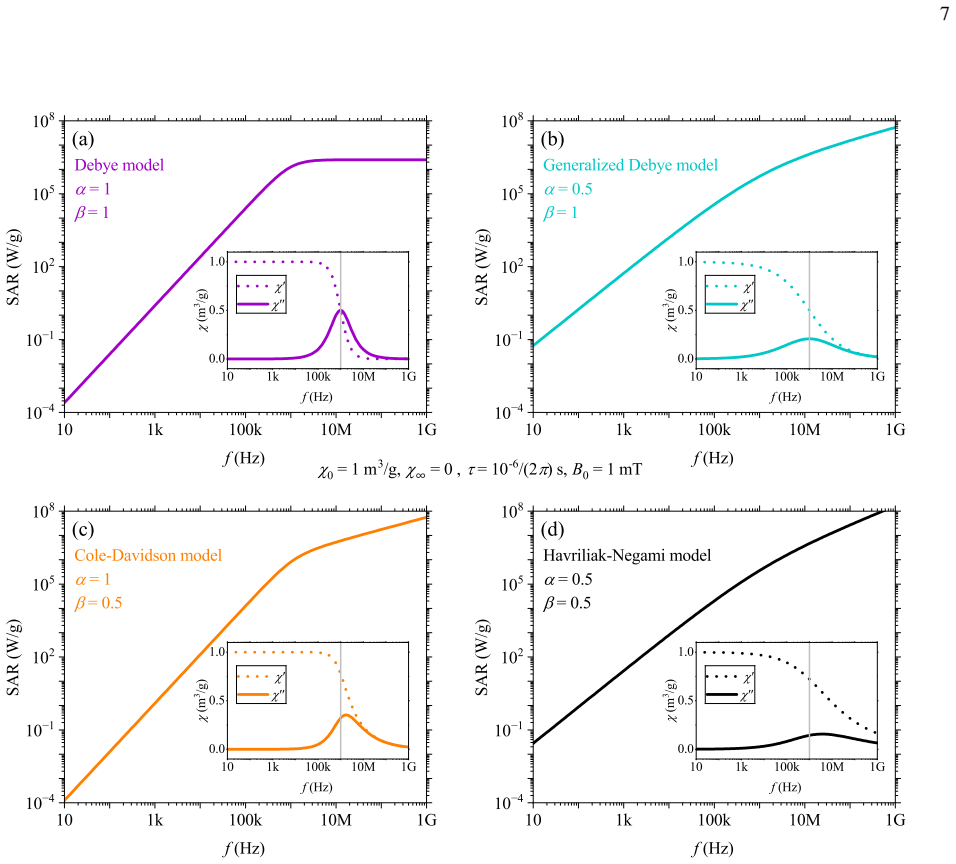
The load-bearing object is the complex AC magnetic susceptibility $\tilde{\chi}(\omega)=\chi'-i\chi''$, whose imaginary part sets the dissipated power per cycle: $\text{SAR}(\omega)=\tfrac{1}{2}\mu_0\omega H_0^2\chi''(\omega)$. Because the measured range (10 Hz to 10 kHz) does not overlap the calorimetric frequencies (96 and 282 kHz), the paper uses the Havriliak-Negami model, an empirical broadening of the Debye relaxation line with stretching exponents $\alpha$ and $\beta$, to extrapolate $\chi''$ beyond the data. The Havriliak-Negami fit is therefore what connects the two measurements; the paper also uses the extrapolated spectrum to generate dynamic hysteresis loops that are open ellipses, showing that dissipation in a superparamagnetic ferrofluid is purely dynamic, with no static hysteresis contribution.
What would settle it
Measure the AC susceptibility of the same ferrofluid directly at 96 and 282 kHz and compare the measured imaginary part $\chi''$ with the Havriliak-Negami extrapolation; a disagreement larger than the stated uncertainties would show the extrapolation, and therefore the claimed match, is not reliable.
Extended reading notes
Core claim
The central claim is that dissipation predicted from magnetometry-based studies matches direct, frequency-dependent calorimetric results, expanding the available frequency range of characterization. Concretely, for a water-based ferrofluid of 10.6 nm magnetite nanoparticles at 30 mg/mL, the authors fit the measured AC susceptibility spectrum with the Havriliak-Negami model, extrapolate the imaginary part $\chi''(\omega)$ to 96 kHz and 282 kHz, convert it to SAR through $\text{SAR}(\omega)=\tfrac{1}{2}\mu_0\omega H_0^2\chi''(\omega)$, and find that the values agree with calorimetric heating rates measured under the same field amplitude. The agreement is presented as evidence that the two techniques can serve as reliable extensions of each other for determining dynamic magnetic dissipation in ferrofluids.
Load-bearing premise
The mathematical curve used to describe the measured magnetic response is assumed to stay correct at 96 and 282 kHz even though it was only fitted to data up to 10 kHz, and the fitted parameters are not reported, so the extrapolation cannot be checked.
Editorial extensions
If this is right
- SAR values for ferrofluids can be obtained from AC susceptibility measurements alone, avoiding the thermal-exchange corrections that complicate calorimetry.
- Magnetometry and calorimetry together extend the characterisable frequency range beyond either method alone, up to at least a few hundred kilohertz for this system.
- In superparamagnetic ferrofluids, dynamic hysteresis fully accounts for dissipation; no static (DC) hysteresis needs to be included when evaluating heating.
- Because the Havriliak-Negami model predicts SAR that keeps rising with frequency (except in the pure Debye limit), the analysis implies that using the highest feasible field frequency maximizes heating in hyperthermia applications.
Reading between the lines
- If the extrapolation is confirmed by direct high-frequency susceptibility measurements, AC magnetometry could replace calorimetry as a faster screening tool for nanoparticle heating, since it avoids thermal-environment corrections.
- The framework should extend to other single-domain nanoparticle dispersions, but polydisperse samples with multiple relaxation mechanisms may need a multi-peak susceptibility model rather than a single Havriliak-Negami curve.
- A natural next test is to measure the same ferrofluid at intermediate frequencies (for example, 20 to 80 kHz) where neither method currently operates, to check the extrapolation continuously rather than at two isolated points.
Editorial analysis
A structured set of objections, weighed in public.
Referee Report
Summary. The paper presents a theoretical and experimental study of magnetic dissipation in ferrofluids, developing a framework based on the complex magnetic susceptibility and reviewing static and dynamic hysteresis mechanisms. The central experimental claim, stated in the abstract and Section VII, is that SAR values predicted from AC susceptibility magnetometry (measured from 10 Hz to 10 kHz and extrapolated to higher frequencies with a Havriliak-Negami model) agree with direct calorimetric SAR measurements at 96 kHz and 282 kHz, thereby extending the available frequency range of magnetic dissipation characterization. The demonstration uses a dilute water-based ferrofluid of 10.6 nm magnetite nanoparticles.
Significance. If the claimed agreement were correct, the work would provide a practical route to predicting high-frequency heating performance from low-frequency magnetometry, which is valuable for magnetic hyperthermia and ferrofluid applications. The paper also offers a pedagogical review of dissipation mechanisms and susceptibility models. However, the experimental validation is undermined by a factor-of-100 discrepancy in excitation amplitudes and by an unreproducible, unconstrained extrapolation; as presented, the central claim is not supported.
major comments (2)
- [Materials and Methods; Eq. (13)] The AC susceptibility measurements used an excitation amplitude of 10 Oe, while the calorimetry experiments used a field amplitude of 10 mT, which equals 100 Oe in vacuum. Equation (13) explicitly computes the magnetometry-derived SAR using H0 = 10 Oe. Since SAR is proportional to H0^2, the magnetometry values in Figure 8(c) are a factor of 100 smaller than they would be at the calorimetric field of 100 Oe. The comparison is made without any rescaling, and the statement that the two techniques yield consistent results is therefore contradicted by the paper's own equations. Recomputing the magnetometry SAR at the calorimetric field would shift the plotted points up by two orders of magnitude, eliminating the claimed agreement.
- [Section VI, Figure 6(d)] The Havriliak-Negami fit to AC susceptibility data over 10 Hz–10 kHz is extrapolated to 96 kHz and 282 kHz, roughly two decades beyond the measured range. The fitted parameters (χ0, χ∞, τ, α, β) are not reported anywhere in the manuscript, so the extrapolation cannot be reproduced or independently assessed. Although the fit quality is high within the measured band, the HN model is empirical and its high-frequency behavior is not constrained by the data; the claimed agreement with calorimetry in Figure 8(c) rests on this unverified extrapolation.
minor comments (4)
- [Table I] Table I lists adjusted R² values for the different models but not the fitted parameter values; reporting these in a table or appendix would make the extrapolation reproducible and allow readers to assess the physical plausibility of the parameters.
- [Appendix A] The text refers to 'iron content' and then uses the nanoparticle concentration C = 30 mg/mL; please clarify whether the normalization is to the nanoparticle mass or specifically to the iron mass, since magnetite contains roughly 72% iron by mass.
- [Eq. (12)] The calorimetric SAR is obtained from the initial slope of the temperature derivative, but the uncertainty in this procedure is not quantified; the blanket statement that 'measurement uncertainties were negligible' is too vague for a quantitative comparison.
- [Figure 6] The axis labels in the provided version of Figure 6 appear garbled or corrupted; please ensure all subplots have clear, correct axis labels.
Circularity Check
No circularity: magnetometry-derived SAR and calorimetric SAR are independent measurements; extrapolation and field-amplitude concerns are correctness issues, not circularity.
full rationale
The paper's central comparison is between two independent determinations of SAR. On the magnetometry side, the AC susceptibility spectrum is measured over 10 Hz to 10 kHz, fitted with a Havriliak-Negami model, extrapolated to 96 kHz and 282 kHz, and converted to SAR using Eq. (10)/(13). On the calorimetry side, SAR is obtained directly from the initial slope of the temperature rise via Eq. (12). The calorimetric data do not enter the susceptibility fit or the conversion formula, so the magnetometry-based prediction is not forced to match the calorimetric result by construction. The Havriliak-Negami function is an empirical fitting model with parameters determined from the susceptibility data alone; it is not defined in terms of the calorimetric SAR, and no calorimetric value is used to tune the extrapolation. The only self-citation, Ref. 36, is used to note that similar nanoparticles were previously characterized and is not load-bearing for the dissipation comparison. The concerns raised by the text and by the analysis—that the HN extrapolation extends roughly two decades beyond the measured range, that fitted parameters are not reported, and that the ACMS field amplitude of 10 Oe differs from the calorimetric field amplitude of 10 mT while SAR scales as H0^2—are accuracy, reproducibility, and consistency concerns rather than circularity. They do not make the predicted quantity equal to an input by definition. Accordingly, no circular step is identified, and the circularity score is 0.
Assumptions & free parameters
free parameters (4)
- Havriliak-Negami parameters (χ0, χ∞, τ, α, β)
- Specific heat of ferrofluid c =
4.184 J/gK
- Ferrofluid density ρ =
997 kg/m3
- Nanoparticle concentration C =
30 kg/m3
assumptions (5)
- domain assumption Linear response theory is valid at the excitation amplitudes used, so M(ω)=χ(ω)H(ω) and SAR=1/2 μ0 ω H0^2 χ''.
- ad hoc to paper The Havriliak-Negami empirical model with 0<α,β≤1 describes the full susceptibility spectrum, including frequencies outside the measured range.
- domain assumption A single effective relaxation time or a stretched distribution (HN) captures the particle dynamics; Brownian and Néel relaxation times are given by Eqs 7 and 8.
- domain assumption Fourier's law of heat conduction and use of the initial slope dT/dt at t=0 correctly isolates the magnetic heating from environmental thermal exchange.
- ad hoc to paper Sample density and specific heat are equal to those of water.
Cite this review
Pith. "Pith review of Magnetic Dissipation in Ferrofluids." pith.science (2026). https://pith.science/paper/6HLAKE4Y
@misc{pith2026250605028,
  author       = {Pith},
  title        = {Pith review of: Magnetic Dissipation in Ferrofluids},
  year         = {2026},
  howpublished = {\url{https://pith.science/paper/6HLAKE4Y}},
  note         = {Machine review of arXiv:2506.05028}
}
read the original abstract
Ferrofluids, composed of magnetic nanoparticles suspended in a non-magnetic carrier liquid, have attracted considerable attention since their discovery in the 1960s. Their combination of liquid and magnetic properties gives rise to complex behaviors and unique functionalities, enabling a wide range of technological applications. Among these is the ability of the magnetic material to be moved by and to absorb heat when exposed to an external magnetic field -- a process that can occur through various dissipation mechanisms depending on the system. A detailed understanding of these mechanisms is crucial for tailoring materials to specific applications. We provide a comprehensive overview of the theoretical principles underlying different energy dissipation processes and propose a coherent framework for their interpretation. Particular attention is devoted to describing the frequency-dependent susceptibility, which is the key parameter to describe dissipation. We demonstrate that dissipation, predicted from magnetometry-based studies, matches well with direct, frequency-dependent calorimetric results, expanding the available frequency range of the characterization. The demonstrating measurements were carried out with a dilute ferrofluid containing magnetite nanoparticles of a mean diameter of 10.6 nm.
Figures


Figures from the paper (6 more)



Reference graph
Works this paper leans on
-
[5]
10D. Ortega and Q. A. Pankhurst, “Magnetic hyperthermia,” in NANOSCIENCE, VOL 1: NANOSTRUCTURES THROUGH CHEMISTRY , ser. Nanoscience- Specialist Periodical Reports, P. OBrien, Ed. Royal Society of Chemistry, 2013, vol. 1, pp. 60–88. 11A. Hajalilou, L. P. Ferreira, M. E. M. Jorge, C. P. Reis, and M. M. Cruz, “Superparamagnetic ag-fe3o4 composites nanoparti...
work page 2013
-
[13]
Time domain characterization of the cole-cole dielectric model,
[Online]. Available: https://doi.org/10.1088/1361-648x/aaed96 30S. Holm, “Time domain characterization of the cole-cole dielectric model,” Journal of Electrical Bioimpedance, vol. 11, no. 1, pp. 101–105,
-
[15]
Magnetic particle hyperthermia—biophysical limitations of a visionary tumour therapy,
[Online]. Available: http://dx.doi.org/10.1039/D1BM01963E 32R. Hergt and S. Dutz, “Magnetic particle hyperthermia—biophysical limitations of a visionary tumour therapy,” Journal of Magnetism and Magnetic Materials, vol. 311, no. 1, pp. 187–192, 2007, proceedings of the Sixth International Conference on the Scientific and Clinical Applications of Magnetic ...
-
[75]
Theoretical single-domain grain size range in magnetite and titanomagnetite,
20R. F. Butler and S. K. Banerjee, “Theoretical single-domain grain size range in magnetite and titanomagnetite,” Journal of Geophysical Research (1896-1977), vol. 80, no. 29, pp. 4049–4058,
work page 1977
-
[1975]
Some theoretical aspects of rock-magnetism,
[Online]. Available: https://agupubs.onlinelibrary.wiley.com/doi/abs/10.1029/JB080i029p04049 21L. N ´eel, “Some theoretical aspects of rock-magnetism,” Advances in Physics , vol. 4, pp. 191–243,
-
[1990]
Heat capacity standards for the range 14 to 1200° k
38J. S´olyom, Fundamentals of the Physics of Solids: Volume II: Electronic Properties, ser. Fundamentals of the Physics of Solids. Springer Berlin Heidelberg, 2008, pp. 14–16. 39D. C. Ginnings and G. T. Furukawa, “Heat capacity standards for the range 14 to 1200° k.” Journal of the American Chemical Society , vol. 75, no. 3, pp. 522–527,
work page 2008
-
[1994]
41C. P. Slichter,Principles of Magnetic Resonance, 3rd ed., ser. Springer Series in Solid-State Sciences. Springer-Verlag, 1990, vol
work page 1990
-
[1996]
[Online]. Available: https://doi.org/10.1021/cm960077f 23A. Aharoni, “Brown’s “fundamental theorem” revisited,”Journal of Applied Physics, vol. 90, no. 9, pp. 4645–4650, Nov
Show all 20 references
-
[2004]
Available: http://www.amazon.com/Introduction-Solid-Physics-Charles-Kittel/ dp/047141526X/ref=dp ob title bk 19J
[Online]. Available: http://www.amazon.com/Introduction-Solid-Physics-Charles-Kittel/ dp/047141526X/ref=dp ob title bk 19J. S´olyom, Fundamentals of the Physics of Solids: Volume I: Structure and Dynamics, ser. Fundamentals of the Physics of Solids. Springer Berlin Heidelberg, 2007, p
2007
-
[2006]
Magnetization relaxation dynamics in polydisperse ferrofluids,
[Online]. Available: https://dx.doi.org/10.1088/0953-8984/18/20/016 27A. O. Ivanov and P. J. Camp, “Magnetization relaxation dynamics in polydisperse ferrofluids,”Physical Review E, vol. 107, 3
-
[2010]
Structure, synthetic methods, magnetic properties and biomedical applications of ferrofluids,
[Online]. Available: https://doi.org/10.1021/cm9031557 8H. Shokrollahi, “Structure, synthetic methods, magnetic properties and biomedical applications of ferrofluids,” Materials Science and Engineering: C , vol. 33, no. 5, pp. 2476–2487,
-
[2012]
Incidence of the brownian relaxation process on the magnetic properties of ferrofluids,
[Online]. Available: https://doi.org/10.1021/jp310771p 36L. Vajtai, N. M. Nemes, M. d. P. Morales, K. Moln´ar, B. G. Pinke, and F. Simon, “Incidence of the brownian relaxation process on the magnetic properties of ferrofluids,” Nanomaterials, vol. 14, no. 7,
-
[2013]
Magnetic resonance imaging contrast agents based on iron oxide superparamagnetic ferrofluids,
[Online]. Available: https://doi.org/10.1371/journal.pone.0057070 7M. F. Casula, P. Floris, C. Innocenti, A. Lascialfari, M. Marinone, M. Corti, R. A. Sperling, W. J. Parak, and C. Sangregorio, “Magnetic resonance imaging contrast agents based on iron oxide superparamagnetic f...
-
[2014]
Systematic analysis of ferrofluid: a visualization review, advances engineering applications, and challenges,
[Online]. Available: http://dx.doi.org/10.1039/C4SM01308E 4W. Yang, Y . Zhang, X. Yang, C. Sun, and Y . Chen, “Systematic analysis of ferrofluid: a visualization review, advances engineering applications, and challenges,” Journal of Nanoparticle Research, vol. 24, no. 6, p. 102, 05
-
[2015]
Study of heating efficiency as a function of concentration, size, and applied field in γ-fe2o3 nanoparticles,
[Online]. Available: https://doi.org/10.1021/jp5115515 13 35P. de la Presa, Y . Luengo, M. Multigner, R. Costo, M. P. Morales, G. Rivero, and A. Hernando, “Study of heating efficiency as a function of concentration, size, and applied field in γ-fe2o3 nanoparticles,” The Journa...
-
[2018]
Magnetic nanoparticles for precision oncology: Theranostic magnetic iron oxide nanoparticles for image-guided and targeted cancer therapy,
13L. Zhu, Z. Zhou, H. Mao, and L. Y . and, “Magnetic nanoparticles for precision oncology: Theranostic magnetic iron oxide nanoparticles for image-guided and targeted cancer therapy,”Nanomedicine, vol. 12, no. 1, pp. 73–87, 2017, pMID: 27876448. [Online]. Available: https://do...
2017 doi
-
[2020]
Superparamagnetic iron oxide nanoparticles for magnetic hyperthermia: recent advancements, molecular effects, and future directions in the omics era,
[Online]. Available: https://doi.org/10.2478/joeb-2020-0015 31C. Pucci, A. Degl’Innocenti, M. Belenli G ¨um¨us ¸, and G. Ciofani, “Superparamagnetic iron oxide nanoparticles for magnetic hyperthermia: recent advancements, molecular effects, and future directions in the omics e...
2020 doi
-
[2022]
Magnetic fluids,
[Online]. Available: https://doi.org/10.1007/s11051-022-05477-5 5R. E. Rosensweig, “Magnetic fluids,” Scientific American, vol. 247, pp. 136–145,
-
[2023]
A.c. susceptibility as a probe of low-frequency magnetic dynamics,
28M. I. Shliomis, Ferrohydrodynamics: Retrospective and Issues . Berlin, Heidelberg: Springer Berlin Heidelberg, 2002, pp. 85–111. [Online]. Available: https://doi.org/10.1007/3-540-45646-5 5 29C. V . Topping and S. J. Blundell, “A.c. susceptibility as a probe of low-frequency...
2002 doi
-
[2024]
On fourier’s law of heat conduction,
[Online]. Available: https://www.mdpi.com/2079-4991/14/7/634 37I.-S. Liu, “On fourier’s law of heat conduction,”Continuum mechanics and Thermodynamics, vol. 2, pp. 301–305,
Reviewed August 7, 2026 · model on record in the stance chip above.
Discussion (0). Sign in to comment.