REVIEW 3 major objections 6 minor 82 references
Mask TextSpotter: An End-to-End Trainable Neural Network for Spotting Text with Arbitrary Shapes
T0 review · 3 major / 6 minor · reviewed 2026-08-14 · deepseek-v4-flash
Pith's one-line read This paper claims that a fully end-to-end trainable network can spot scene text of arbitrary shapes—horizontal, rotated, and curved—by performing both detection and recognition in two-dimensional space via shared semantic segmentation.
desk verdict Solid empirical extension of the ECCV18 Mask TextSpotter, but the 'first fully end-to-end trainable' headline is only as strong as an unverified claim about FOTS. read the letter →
The pith
A machine-rendered reading of the paper's core claim, the machinery that carries it, and where it could break.
The reading
What carries the argument
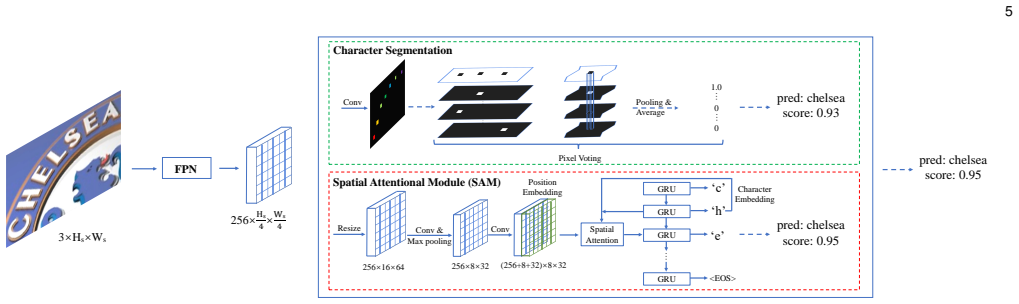
Central machinery is a single mask branch shared by three tasks: it predicts a binary text-instance mask, so detections are arbitrary polygons rather than boxes; per-character class maps, supervised locally where character annotations exist; and, through a Spatial Attention Module, a character sequence decoded directly from the two-dimensional feature map with position embeddings and a recurrent decoder. During inference the text-instance mask is contoured into a polygon, character maps are read by a pixel-voting algorithm that assigns each connected region its highest-scoring class, and the two recognition outputs are combined by confidence. A weighted edit distance then matches any lexicon. The design's work is to let detection and recognition share one feature space and one differentiable loss.
What would settle it
A direct test is to generate synthetic text wrapped around circles and spirals with varying radius and word length, then plot end-to-end accuracy against curvature and length; if accuracy collapses as curvature grows beyond the benchmark range, or the predicted masks clip characters at the ends of the minimal horizontal rectangle, the arbitrary-shapes claim is bounded by the proposal assumption.
Extended reading notes
Core claim
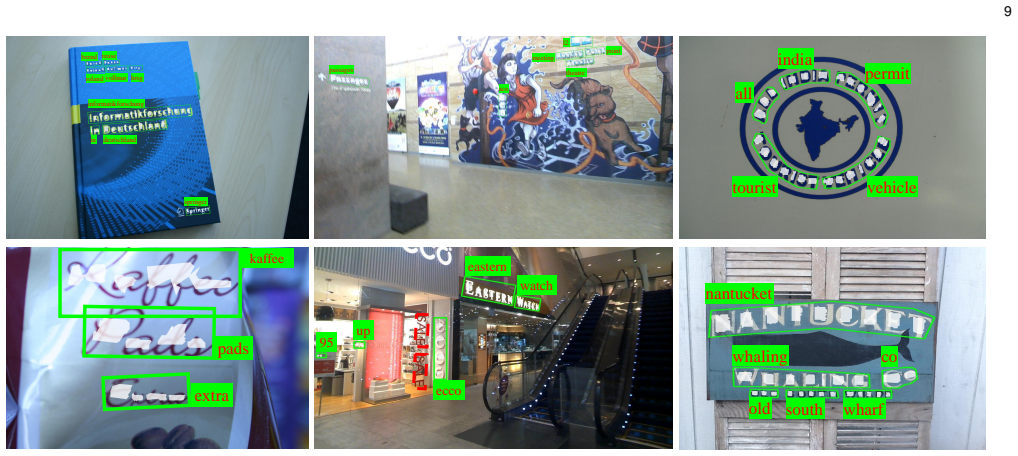
The paper's central discovery is that text detection and recognition can be unified in an instance-segmentation architecture in which a single mask branch simultaneously outputs a text instance mask, per-character segmentation maps, and a character sequence produced by a spatial attention module. Because detection is instance segmentation, the predicted region can take any shape; because recognition decodes a two-dimensional feature map rather than a flattened one-dimensional sequence, curved and perspective text can be read without rectification. The paper further claims that this is the first completely end-to-end trainable text spotter, and that joint training improves detection accuracy, evidenced by comparisons with a detection-only variant. On ICDAR2015 with a generic lexicon, it reports gains of 8.6 points in word spotting and 10.5 points in end-to-end recognition over the previous best.
Load-bearing premise
The method assumes that for every text instance, however curved or elongated, a single axis-aligned horizontal rectangle from the region proposal network can cover the whole word tightly enough for the mask and recognition branches to read it.
Editorial extensions
If this is right
- A single model can be trained once and deployed on datasets combining horizontal, oriented, and curved text, because detection is shape-agnostic and recognition reads two-dimensional maps.
- Joint optimization means recognition errors can help suppress false-positive detections; the paper's ablation shows detection f-measure rises when the recognition branch is present.
- Because the Spatial Attention Module needs only word-level labels, training scales to datasets without character-level annotation; ablations show only small losses when real character annotations are withheld.
- On large or missing lexicons, the method is comparatively strong: it reports its largest gains over prior work precisely in the no-lexicon and generic-lexicon settings.
Reading between the lines
- Editorial inference: The horizontal-rectangle proposal step is the likely ceiling of the arbitrary-shapes claim, because very long or tightly curved words could produce proposals that either include large background regions or clip the text, and the paper does not analyze failure rates along that dimension.
- Editorial inference: The two-dimensional attention design suggests a natural stress test: text laid out vertically, diagonally, or wrapped around a circle, where left-to-right pixel voting would struggle but global attention might still decode; a synthetic dataset could probe this directly.
- Editorial inference: The recognition module could be detached and paired with a stronger proposal generator, since it decodes from feature maps; one could verify whether end-to-end spotting gains exactly match the detector's improvement.
Signed reviews
Editorial analysis
A structured set of objections, weighed in public.
Referee Report
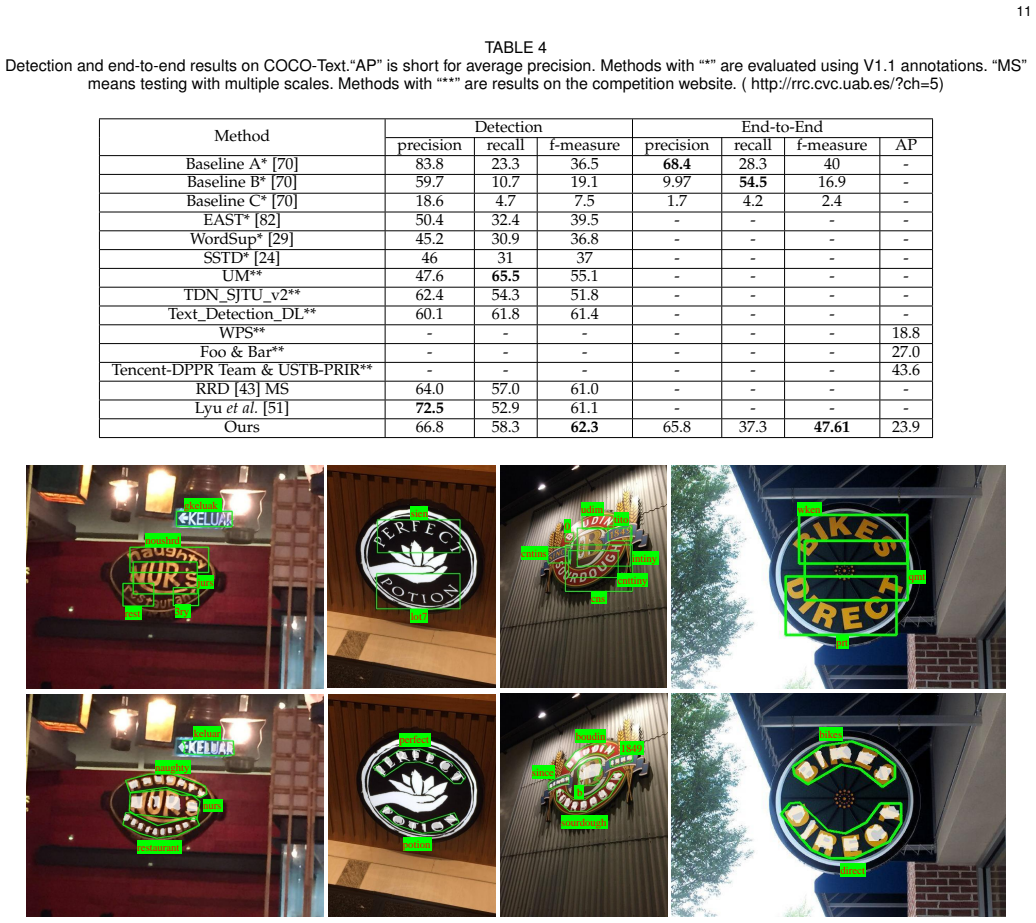
Summary. The paper presents Mask TextSpotter, an extension of the authors' ECCV 2018 work, in which text detection, character segmentation, and text-sequence recognition are integrated into a single Mask R-CNN-style network with a shared FPN backbone. Detection is performed by text-instance segmentation; recognition is performed jointly by a character-segmentation branch and a new Spatial Attention Module (SAM) that decodes sequences in two-dimensional space. The paper claims that this is the first completely end-to-end trainable text spotting framework, that it handles arbitrary-shaped (including curved) text, and that it achieves state-of-the-art results on ICDAR2013, ICDAR2015, COCO-Text, Total-Text, and MLT for detection/spotting, plus seven standard recognition benchmarks. The experiments include ablations on the attention module, position embedding, weighted edit distance, and the need for character-level annotations.
Significance. If the claims hold, the contribution is substantial: a single network with shared features obtains competitive or state-of-the-art detection and recognition on horizontal, oriented, and curved text, while reducing the need for character-level annotations. The paper's strengths include the breadth of evaluation (five spotting/detection datasets and seven recognition benchmarks), the explicit comparisons against the authors' conference version and ASTER under matched training data, and the ablations isolating the effects of SAM, position embedding, weighted edit distance, and real-world character annotations. The standalone recognition experiments (Table 9) are especially convincing in showing consistent gains on irregular text. However, the headline novelty claim depends on a factual characterization of prior work that is not substantiated in the manuscript, and the specification of one proposed component is incomplete.
major comments (3)
- [§2.1 and Introduction] The claim that Mask TextSpotter is 'the first framework that is completely end-to-end trainable for text spotting' rests on the sentence in §2.1 that prior methods 'train the recognition part with the ground truth text regions instead of the predicted proposals [46]' and the corresponding statement in the Introduction. This is a factual claim about how FOTS [46] trains its recognition branch, and no citation-level evidence is provided. FOTS is described in its own abstract as a unified network with a differentiable RoIRotate module, and the distinction depends entirely on whether the recognition branch consumes predicted text regions during training. If FOTS is trained on predicted proposals, the 'first' claim is false and the dichotomy in §2.1 collapses. Please verify this architectural detail against the FOTS paper or public code and either provide direct evidence for the characterization or revise the novelty claim.
- [§3.5 and §3.7.1] The 'arbitrary shapes' claim is implemented through axis-aligned horizontal rectangles: ground-truth polygons are converted to minimal-area horizontal rectangles in §3.5, and at inference the mask branch receives the Fast R-CNN boxes as proposals in §3.7.1. For long or strongly curved words, such a rectangle can include substantial background or cut off parts of the glyphs, but no analysis is given of how performance degrades with curvature or word length, and the failure cases in §4.11 do not address this dimension. Please add a quantitative analysis of this failure mode, for example performance stratified by curvature or by box-occupancy ratio, or qualify the claim that the method 'easily handles text instances of irregular shapes.'
- [§3.7.3, Eq. (20)] The weighted edit distance is a stated contribution and is credited in §4.8 with consistent gains, but the algorithm is not fully specified. The text says that the deletion, insertion, and replacement costs Cd, Ci, and Cr depend on the character probabilities pc_index, yet Eq. (20) only defines the recurrence and no formula is given for how the costs are computed from those probabilities. As written, the method cannot be reproduced. Please provide the exact cost definitions.
minor comments (6)
- [§4.3, Table 2] Several conclusions rest on differences of 0.1–0.3 percentage points, such as Ours versus the Conference version on ICDAR2013 word spotting with strong and weak lexicons, and the paper itself attributes these to the small test set. Since all numbers come from a single training run, please report variance across multiple runs or soften the comparative wording.
- [§3.3.1, Eqs. (1)–(2)] The onehot notation is under-specified: please state whether indices i and j are 0-based or 1-based, since the embedding shape (Wp+Hp, Hp, Wp) depends on this choice.
- [§3.5, Eqs. (13)–(14)] The notation (rx, ry) for the proposal vertices is ambiguous because r is used both as a proposal and as a matched rectangle; please rename to avoid confusion.
- [§2.1] The citation [5] (Bengio et al., curriculum learning) is a general learning method, not a text-spotting system; the sentence 'They adopt the curriculum learning paradigm [5], [26], [39]' would be clearer if [5] were cited as the source of the paradigm rather than as an example of a text-spotting method.
- [§4.2.1] The text says 'extra 1162 images (SCUT)' but cites [81] (DeepText); please provide the correct reference for the SCUT dataset.
- [§4.11] The two failure cases are illustrative, but the section would benefit from a short discussion of the most frequent failure types and their frequency, especially in view of the paper's 'arbitrary shapes' claim.
Circularity Check
No circularity: Mask TextSpotter is an empirical system paper whose claims are validated against external benchmarks; its novelty assertion is a literature claim, not a derivation from its own inputs.
full rationale
The paper's central contributions are architectural and empirical: an end-to-end trainable text spotter using instance segmentation, character segmentation, and a spatial attention module, evaluated on ICDAR2013, ICDAR2015, COCO-Text, Total-Text, MLT, and standard recognition benchmarks. The method is not derived from its own outputs, and no equation is defined in terms of the result it is meant to predict. The headline novelty claim, that Mask TextSpotter is 'the first framework that is completely end-to-end trainable for text spotting,' rests on a characterization of prior methods such as FOTS as 'train[ing] the recognition part with the ground truth text regions instead of the predicted proposals [46].' This is a factual claim about another paper's training procedure, not a definitional or self-referential step in the present derivation. If the characterization of FOTS is inaccurate, that is a correctness or attribution issue, not circularity. The paper also cites its own conference version [50] extensively, but only as a baseline for ablation-style comparisons (e.g., Tables 1, 2, 3, 5, 7) and as the starting point for the stated extension (SAM); these self-citations are not load-bearing in the sense of making the central results true by definition. The SAM module is explicitly inspired by prior attention work [13], [73], which is normal scientific borrowing rather than an ansatz smuggled in via self-citation. All quantitative claims are checked against independent public benchmarks with standard train/test splits, and the ablation studies isolate components such as the recognition branch, character annotations, weighted edit distance, backbone, and RoI size. No prediction is a renamed fit: the method's outputs (masks, character maps, sequences) are produced by the trained network and compared externally. Under the stated criteria, there is no circular step to exhibit, so the appropriate finding is no significant circularity.
Assumptions & free parameters
free parameters (4)
- beta2 =
0.2
- Binarization threshold for pixel voting =
0.75
- Beam search width =
6
- ICDAR2015 input scales =
720, 1000, 1600
assumptions (4)
- domain assumption Text instances can be represented as pixel-level masks, and character classes can be predicted per pixel from within an RoI.
- domain assumption A spatial attention mechanism over a 2D feature map can decode a character sequence in the correct order, including for curved text, when trained only with word-level labels.
- domain assumption Synthetic data (SynthText and Synth90k) provide sufficient supervision to pretrain the model for real-world text.
- standard math Standard backpropagation with SGD/Adam converges for this multi-task loss.
Cite this review
Pith. "Pith review of Mask TextSpotter: An End-to-End Trainable Neural Network for Spotting Text with Arbitrary Shapes." pith.science (2026). https://pith.science/paper/6HMEAT24
@misc{pith2026190808207,
  author       = {Pith},
  title        = {Pith review of: Mask TextSpotter: An End-to-End Trainable Neural Network for Spotting Text with Arbitrary Shapes},
  year         = {2026},
  howpublished = {\url{https://pith.science/paper/6HMEAT24}},
  note         = {Machine review of arXiv:1908.08207}
}
read the original abstract
Unifying text detection and text recognition in an end-to-end training fashion has become a new trend for reading text in the wild, as these two tasks are highly relevant and complementary. In this paper, we investigate the problem of scene text spotting, which aims at simultaneous text detection and recognition in natural images. An end-to-end trainable neural network named as Mask TextSpotter is presented. Different from the previous text spotters that follow the pipeline consisting of a proposal generation network and a sequence-to-sequence recognition network, Mask TextSpotter enjoys a simple and smooth end-to-end learning procedure, in which both detection and recognition can be achieved directly from two-dimensional space via semantic segmentation. Further, a spatial attention module is proposed to enhance the performance and universality. Benefiting from the proposed two-dimensional representation on both detection and recognition, it easily handles text instances of irregular shapes, for instance, curved text. We evaluate it on four English datasets and one multi-language dataset, achieving consistently superior performance over state-of-the-art methods in both detection and end-to-end text recognition tasks. Moreover, we further investigate the recognition module of our method separately, which significantly outperforms state-of-the-art methods on both regular and irregular text datasets for scene text recognition.
Figures


Figures from the paper (7 more)





Reference graph
Works this paper leans on
-
[46]
X. Liu, D. Liang, S. Yan, D. Chen, Y. Qiao, and J. Yan. Fots: Fast oriented text spotting with a unified network. In Proc. CVPR , pages 5676–5685, 2018
work page 2018
-
[1]
Almaz ´an, A
J. Almaz ´an, A. Gordo, A. Forn ´es, and E. Valveny. Word spotting and recognition with embedded attributes. IEEE T rans. Pattern Anal. Mach. Intell. , 36(12):2552–2566, 2014
2014
-
[2]
D. Bahdanau, K. Cho, and Y. Bengio. Neural machine translation by jointly learning to align and translate. CoRR, abs/1409.0473, 2014
arXiv 2014
-
[3]
F. Bai, Z. Cheng, Y. Niu, S. Pu, and S. Zhou. Edit probability for scene text recognition. In Proc. CVPR, 2018
2018
-
[4]
X. Bai, M. Yang, P . Lyu, Y. Xu, and J. Luo. Integrating scene text and visual appearance for fine-grained image classification. IEEE Access, 2018
work page 2018
- [5]
-
[6]
A. Bissacco, M. Cummins, Y. Netzer, and H. Neven. Photoocr: Reading text in uncontrolled conditions. In Proc. ICCV, pages 785– 792, 2013
work page 2013
- [7]
Show all 82 references
-
[8]
Cheng, F
Z. Cheng, F. Bai, Y. Xu, G. Zheng, S. Pu, and S. Zhou. Focusing attention: Towards accurate text recognition in natural images. In ICCV, pages 5086–5094, 2017
2017
-
[9]
Cheng, Y
Z. Cheng, Y. Xu, F. Bai, Y. Niu, S. Pu, and S. Zhou. Aon: Towards arbitrarily-oriented text recognition. In Proc. CVPR , pages 5571– 5579, 2018
2018
-
[10]
C. K. Chng and C. S. Chan. Total-text: A comprehensive dataset for scene text detection and recognition. In Proc. ICDAR , pages 935–942, 2017
2017
-
[11]
J. Dai, K. He, Y. Li, S. Ren, and J. Sun. Instance-sensitive fully convolutional networks. In Proc. ECCV, pages 534–549, 2016
2016
-
[12]
Y. Dai, Z. Huang, Y. Gao, Y. Xu, K. Chen, J. Guo, and W. Qiu. Fused text segmentation networks for multi-oriented scene text detection. In Proc. ICPR, pages 3604–3609, 2018
2018
-
[13]
Donahue, L
J. Donahue, L. Anne Hendricks, S. Guadarrama, M. Rohrbach, S. Venugopalan, K. Saenko, and T. Darrell. Long-term recurrent convolutional networks for visual recognition and description. In Proc. CVPR, pages 2625–2634, 2015
2015
-
[14]
Gehring, M
J. Gehring, M. Auli, D. Grangier, D. Yarats, and Y. N. Dauphin. Convolutional sequence to sequence learning. In Proc. ICML , pages 1243–1252, 2017
2017
-
[15]
R. B. Girshick. Fast R-CNN. In Proc. ICCV, pages 1440–1448, 2015
2015
-
[16]
R. B. Girshick, J. Donahue, T. Darrell, and J. Malik. Rich feature hi- erarchies for accurate object detection and semantic segmentation. In Proc. CVPR, pages 580–587, 2014
2014
-
[17]
G ´omez and D
L. G ´omez and D. Karatzas. Textproposals: a text-specific selective search algorithm for word spotting in the wild.Pattern Recognition, 70:60–74, 2017
2017
-
[18]
Gomez, B
R. Gomez, B. Shi, L. Gomez, L. Numann, A. Veit, J. Matas, S. Belongie, and D. Karatzas. Icdar2017 robust reading challenge on coco-text. In Proc. ICDAR , volume 1, pages 1435–1443. IEEE, 2017
2017
-
[19]
A. Gordo. Supervised mid-level features for word image repre- sentation. In CVPR, 2015
2015
-
[20]
Graves, S
A. Graves, S. Fern ´andez, F. J. Gomez, and J. Schmidhuber. Con- nectionist temporal classification: labelling unsegmented sequence data with recurrent neural networks. In Proc. ICML , pages 369– 376, 2006
2006
-
[21]
Gupta, A
A. Gupta, A. Vedaldi, and A. Zisserman. Synthetic data for text localisation in natural images. In Proc. CVPR , pages 2315–2324, 2016
2016
-
[22]
K. He, G. Gkioxari, P . Doll ´ar, and R. B. Girshick. Mask R-CNN. In Proc. ICCV, pages 2980–2988, 2017
2017
-
[23]
K. He, X. Zhang, S. Ren, and J. Sun. Deep residual learning for image recognition. In Proc. CVPR, pages 770–778, 2016
2016
-
[24]
P . He, W. Huang, T. He, Q. Zhu, Y. Qiao, and X. Li. Single shot text detector with regional attention. In Proc. ICCV, pages 3066–3074, 2017
2017
-
[25]
P . He, W. Huang, Y. Qiao, C. C. Loy, and X. Tang. Reading scene text in deep convolutional sequences. In Proc. AAAI, 2016
2016
-
[26]
T. He, Z. Tian, W. Huang, C. Shen, Y. Qiao, and C. Sun. An end- to-end textspotter with explicit alignment and attention. In Proc. CVPR, pages 5020–5029, 2018
2018
-
[27]
W. He, X. Zhang, F. Yin, and C. Liu. Deep direct regression for multi-oriented scene text detection. In Proc. ICCV, pages 745–753, 2017
2017
-
[28]
Hochreiter and J
S. Hochreiter and J. Schmidhuber. Long short-term memory. Neural Computation, 9(8):1735–1780, 1997
1997
-
[29]
H. Hu, C. Zhang, Y. Luo, Y. Wang, J. Han, and E. Ding. Wordsup: Exploiting word annotations for character based text detection. In Proc. ICCV, pages 4950–4959, 2017
2017
-
[30]
Huang, Y
W. Huang, Y. Qiao, and X. Tang. Robust scene text detection with convolution neural network induced MSER trees. In Proc. ECCV, pages 497–511, 2014
2014
-
[31]
Jaderberg, K
M. Jaderberg, K. Simonyan, A. Vedaldi, and A. Zisserman. Syn- thetic data and artificial neural networks for natural scene text recognition. CoRR, abs/1406.2227, 2014
2014 arXiv
-
[32]
Jaderberg, K
M. Jaderberg, K. Simonyan, A. Vedaldi, and A. Zisserman. Deep structured output learning for unconstrained text recognition. In ICLR, 2015
2015
-
[33]
Jaderberg, K
M. Jaderberg, K. Simonyan, A. Vedaldi, and A. Zisserman. Read- ing text in the wild with convolutional neural networks. IJCV, 116(1):1–20, 2016
2016
-
[34]
Jaderberg, K
M. Jaderberg, K. Simonyan, A. Zisserman, et al. Spatial trans- former networks. In Proc. NIPS, pages 2017–2025, 2015
2017
-
[35]
Jaderberg, A
M. Jaderberg, A. Vedaldi, and A. Zisserman. Deep features for text spotting. In Proc. ECCV, pages 512–528, 2014
2014
-
[36]
Karatzas, L
D. Karatzas, L. Gomez-Bigorda, A. Nicolaou, S. K. Ghosh, A. D. Bagdanov, M. Iwamura, J. Matas, L. Neumann, V . R. Chan- drasekhar, S. Lu, F. Shafait, S. Uchida, and E. Valveny. ICDAR 2015 competition on robust reading. In Proc. ICDAR, pages 1156– 1160, 2015
2015
-
[37]
Karatzas, F
D. Karatzas, F. Shafait, S. Uchida, M. Iwamura, L. G. i Bigorda, S. R. Mestre, J. Mas, D. F. Mota, J. A. Almazan, and L. P . de las Heras. Icdar 2013 robust reading competition. In ICDAR, pages 1484–1493, 2013
2013
-
[38]
Lee and S
C. Lee and S. Osindero. Recursive recurrent nets with attention modeling for OCR in the wild. In Proc. CVPR , pages 2231–2239, 2016
2016
-
[39]
H. Li, P . Wang, and C. Shen. Towards end-to-end text spotting with convolutional recurrent neural networks. In Proc. ICCV , pages 5248–5256, 2017
2017
-
[40]
Y. Li, H. Qi, J. Dai, X. Ji, and Y. Wei. Fully convolutional instance- aware semantic segmentation. In Proc. CVPR , pages 4438–4446, 2017
2017
-
[41]
M. Liao, B. Shi, and X. Bai. Textboxes++: A single-shot oriented scene text detector. IEEE T rans. Image Processing, 27(8):3676–3690, 2018
2018
-
[42]
M. Liao, B. Shi, X. Bai, X. Wang, and W. Liu. Textboxes: A fast text detector with a single deep neural network. In Proc. AAAI, pages 4161–4167, 2017
2017
-
[43]
M. Liao, Z. Zhu, B. Shi, G.-s. Xia, and X. Bai. Rotation-sensitive 16 regression for oriented scene text detection. In Proc. CVPR, pages 5909–5918, 2018
2018
-
[44]
T. Lin, P . Doll ´ar, R. B. Girshick, K. He, B. Hariharan, and S. J. Belongie. Feature pyramid networks for object detection. In Proc. CVPR, pages 936–944, 2017
2017
-
[45]
W. Liu, D. Anguelov, D. Erhan, C. Szegedy, S. E. Reed, C. Fu, and A. C. Berg. SSD: single shot multibox detector. In Proc. ECCV , pages 21–37, 2016
2016
-
[47]
J. Long, E. Shelhamer, and T. Darrell. Fully convolutional networks for semantic segmentation. In Proc. CVPR, 2015
2015
-
[48]
S. Long, J. Ruan, W. Zhang, X. He, W. Wu, and C. Yao. Textsnake: A flexible representation for detecting text of arbitrary shapes. In Proc. ECCV, pages 19–35, 2018
2018
-
[49]
S. M. Lucas, A. Panaretos, L. Sosa, A. Tang, S. Wong, and R. Young. ICDAR 2003 robust reading competitions. In Proc. ICDAR, pages 682–687, 2003
2003
-
[50]
P . Lyu, M. Liao, C. Yao, W. Wu, and X. Bai. Mask textspotter: An end-to-end trainable neural network for spotting text with arbitrary shapes. In Proc. ECCV, pages 71–88, 2018
2018
-
[51]
P . Lyu, C. Yao, W. Wu, S. Yan, and X. Bai. Multi-oriented scene text detection via corner localization and region segmentation. In Proc. CVPR, pages 7553–7563, 2018
2018
-
[52]
Mishra, K
A. Mishra, K. Alahari, and C. V . Jawahar. Scene text recognition using higher order language priors. In Proc. BMVC, 2012
2012
-
[53]
Mishra, K
A. Mishra, K. Alahari, and C. V . Jawahar. Top-down and bottom- up cues for scene text recognition. In Proc. CVPR, 2012
2012
-
[54]
Nayef, F
N. Nayef, F. Yin, I. Bizid, H. Choi, Y. Feng, D. Karatzas, Z. Luo, U. Pal, C. Rigaud, J. Chazalon, W. Khlif, M. M. Luqman, J. Burie, C. Liu, and J. Ogier. ICDAR2017 robust reading challenge on multi-lingual scene text detection and script identification - RRC- MLT. In Proc. ICD...
2017
-
[55]
Neumann and J
L. Neumann and J. Matas. A method for text localization and recognition in real-world images. In Proc. ACCV , pages 770–783, 2010
2010
-
[56]
Neumann and J
L. Neumann and J. Matas. Real-time scene text localization and recognition. In Proc. CVPR, pages 3538–3545, 2012
2012
-
[57]
Neumann and J
L. Neumann and J. Matas. Real-time lexicon-free scene text localization and recognition. IEEE T rans. Pattern Anal. Mach. Intell., 38(9):1872–1885, 2016
2016
-
[58]
Patel, M
Y. Patel, M. Busta, and J. Matas. E2E-MLT - an uncon- strained end-to-end method for multi-language scene text. CoRR, abs/1801.09919, 2018
2018 arXiv
-
[59]
Quy Phan, P
T. Quy Phan, P . Shivakumara, S. Tian, and C. Lim Tan. Recognizing text with perspective distortion in natural scenes. In Proc. ICCV , pages 569–576, 2013
2013
-
[60]
Redmon, S
J. Redmon, S. K. Divvala, R. B. Girshick, and A. Farhadi. You only look once: Unified, real-time object detection. In Proc. CVPR, pages 779–788, 2016
2016
-
[61]
S. Ren, K. He, R. B. Girshick, and J. Sun. Faster R-CNN: towards real-time object detection with region proposal networks. IEEE T rans. Pattern Anal. Mach. Intell., 39(6):1137–1149, 2017
2017
-
[62]
Risnumawan, P
A. Risnumawan, P . Shivakumara, C. S. Chan, and C. L. Tan. A robust arbitrary text detection system for natural scene images. Expert Syst. Appl. , 41(18):8027–8048, 2014
2014
-
[63]
J. A. Rodr ´ıguez-Serrano, A. Gordo, and F. Perronnin. Label embedding: A frugal baseline for text recognition. Int. J. Comput. Vision, 113(3):193–207, 2015
2015
-
[64]
B. Shi, X. Bai, and S. J. Belongie. Detecting oriented text in natural images by linking segments. In Proc. CVPR, pages 3482–3490, 2017
2017
-
[65]
B. Shi, X. Bai, and C. Yao. An end-to-end trainable neural network for image-based sequence recognition and its application to scene text recognition. IEEE T rans. Pattern Anal. Mach. Intell. , 39(11):2298–2304, 2017
2017
-
[66]
B. Shi, M. Yang, X. Wang, P . Lyu, C. Yao, and X. Bai. Aster: An attentional scene text recognizer with flexible rectification. IEEE T rans. Pattern Anal. Mach. Intell., 2018
2018
-
[67]
Su and S
B. Su and S. Lu. Accurate scene text recognition based on recurrent neural network. In ACCV, 2014
2014
-
[68]
Su and S
B. Su and S. Lu. Accurate recognition of words in scenes without character segmentation using recurrent neural network. Pattern Recognition, 63:397–405, 2017
2017
-
[69]
Z. Tian, W. Huang, T. He, P . He, and Y. Qiao. Detecting text in natural image with connectionist text proposal network. In Proc. ECCV, pages 56–72, 2016
2016
-
[70]
A. Veit, T. Matera, L. Neumann, J. Matas, and S. J. Belongie. Coco- text: Dataset and benchmark for text detection and recognition in natural images. CoRR, abs/1601.07140, 2016
2016 arXiv
-
[71]
K. Wang, B. Babenko, and S. Belongie. End-to-end scene text recognition. In Proc. ICCV, pages 1457–1464, 2011
2011
-
[72]
T. Wang, D. J. Wu, A. Coates, and A. Y. Ng. End-to-end text recognition with convolutional neural networks. In ICPR, 2012
2012
-
[73]
Wojna, A
Z. Wojna, A. N. Gorban, D.-S. Lee, K. Murphy, Q. Yu, Y. Li, and J. Ibarz. Attention-based extraction of structured information from street view imagery. In Proc. ICDAR , volume 1, pages 844–850. IEEE, 2017
2017
-
[74]
C. Xue, S. Lu, and F. Zhan. Accurate scene text detection through border semantics awareness and bootstrapping. In Proc. ECCV , pages 370–387, 2018
2018
-
[75]
X. Yang, D. He, Z. Zhou, D. Kifer, and C. L. Giles. Learning to read irregular text with attention mechanisms. In Proc. IJCAI , pages 3280–3286, 2017
2017
-
[76]
C. Yao, X. Bai, and W. Liu. A unified framework for multioriented text detection and recognition. IEEE T rans. Image Processing , 23(11):4737–4749, 2014
2014
-
[77]
C. Yao, X. Bai, B. Shi, and W. Liu. Strokelets: A learned multi-scale representation for scene text recognition. In Proc. CVPR , pages 4042–4049, 2014
2014
-
[78]
Yu and V
F. Yu and V . Koltun. Multi-scale context aggregation by dilated convolutions. CoRR, abs/1511.07122, 2015
2015 arXiv
-
[79]
Zhang, C
Z. Zhang, C. Zhang, W. Shen, C. Yao, W. Liu, and X. Bai. Multi- oriented text detection with fully convolutional networks. In Proc. CVPR, pages 4159–4167, 2016
2016
-
[80]
H. Zhao, J. Shi, X. Qi, X. Wang, and J. Jia. Pyramid scene parsing network. In Proc. CVPR, pages 2881–2890, 2017
2017
-
[81]
Zhong, L
Z. Zhong, L. Jin, S. Zhang, and Z. Feng. Deeptext: A unified framework for text proposal generation and text detection in natural images. CoRR, abs/1605.07314, 2016
2016 arXiv
-
[82]
X. Zhou, C. Yao, H. Wen, Y. Wang, S. Zhou, W. He, and J. Liang. EAST: an efficient and accurate scene text detector. In Proc. CVPR, pages 2642–2651, 2017
2017
Reviewed August 14, 2026 · model on record in the stance chip above.
Discussion (0). Continue with ORCID to comment.