REVIEW 3 major objections 4 minor 71 references
Two Datasets Are Better Than One: Method of Double Moments for 3-D Reconstruction in Cryo-EM
T0 review · 3 major / 4 minor · reviewed 2026-08-04 · deepseek-v4-flash
Pith's one-line read The method of double moments proves that two second-order moments from two differently oriented cryo-EM datasets uniquely determine a bandlimited 3-D molecular structure up to rotation and reflection.
desk verdict Genuinely novel two-dataset fusion idea for cryo-EM, but the uniqueness theorem's induction step has a full column/row rank error and the base case is unrigorous; fixable, but Theorem 4.1 is not proven as written. read the letter →
The pith
A machine-rendered reading of the paper's core claim, the machinery that carries it, and where it could break.
The reading
What carries the argument
The paper expands the volume in spherical harmonics and the orientation density in Wigner U-matrix entries, which reduces the second moment to a sum over azimuthal modes of bilinear forms Aℓ(r)B^n_{ℓ,ℓ'}A_{ℓ'}(r')^H, with B^n built from Clebsch-Gordan coefficients and orientation-distribution coefficients. Two technical lemmas drive the induction: Lemma 4.5 establishes that the map from the top coefficient B2L to B^n_{L,L} is injective, and Lemma 4.6 gives a full-column-rank condition that forces the orthogonal ambiguity to vanish at the new bandlimit. The induction base is a 331-equation polynomial system verified by floating-point homotopy continuation.
What would settle it
Explicitly exhibit, for L=3, a bandlimited potential Φ and distribution ρ2 satisfying Assumption 2.5 together with a different pair (Φ',ρ2') that yields identical moments m1[Φ,ρ1], m2[Φ,ρ1], m2[Φ,ρ2]. Alternatively, solve the polynomial system (4.19) in exact arithmetic and show the solution set contains more than the trivial solution for some valid B2,B4,B6.
Extended reading notes
Core claim
Theorem 4.1 states that under Assumption 2.5, the population moments m1[Φ,ρ1], m2[Φ,ρ1], and m2[Φ,ρ2] uniquely identify the structure Φ and the low-pass component ρ2^{↓2L} of the non-uniform orientation distribution, up to SO(3) action and chirality. The proof applies Kam's method to recover radial spherical-harmonic coefficients up to orthogonal matrices Oℓ, uses the first moment to fix O0 and a gauge choice to set O1=I, then matches the second moment from the non-uniform dataset. Matching these moments yields polynomial equations that force all remaining Oℓ=I and all B2L to match the ground truth, by an induction on the bandlimit L. The base case L=3 is verified numerically rather than rig
Load-bearing premise
The uniqueness theorem rests on an induction whose L=3 base case is checked only by floating-point homotopy continuation on pseudo-random parameters (Remark 4.4); if the polynomial system (4.19) has additional non-trivial solutions for some valid parameters, the induction collapses.
Editorial extensions
If this is right
- Sample complexity of structure recovery drops from O(SNR^{-3}) to O(SNR^{-2}), reducing the number of micrographs needed at high noise.
- Unique recovery (up to rotation and reflection) is guaranteed generically from second-order statistics alone, unlike earlier second-moment methods that only give finite or ambiguous solutions.
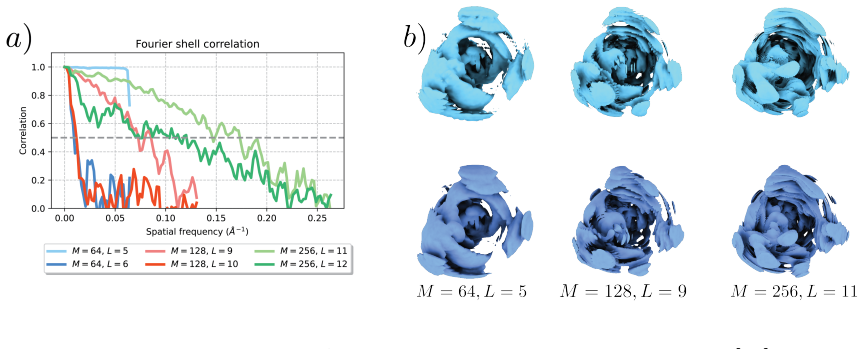
- A practical alternating optimization algorithm with convex relaxation recovers bandlimited structures up to a bandlimit set by image size, as shown on simulated EMD-2660 and EMD-32743 data.
- The data-fusion principle extends beyond cryo-EM to modalities such as XFEL and multimodal reconstruction, as the authors suggest.
Reading between the lines
- The theorem implies the non-uniform orientation distribution itself is identifiable up to degree 2L, which could be leveraged to diagnose and correct preferred orientation in real cryo-EM experiments.
- The uniformity assumption on the first dataset may be relaxable; a natural test is whether two non-uniform, in-plane-uniform distributions with generic coefficients also yield unique recovery.
- The non-rigorous base case is a concrete vulnerability: turning the floating-point homotopy verification into an exact symbolic or interval-certified proof would make the uniqueness theorem fully rigorous.
- MoDM suggests a new experimental design philosophy: instead of pursuing a single perfectly uniform dataset, one might deliberately collect two datasets with different orientation biases and extract more information per image.
Editorial analysis
A structured set of objections, weighed in public.
Referee Report
Summary. The paper introduces the method of double moments (MoDM) for cryo-EM 3-D reconstruction. It assumes two datasets of the same molecule: one with uniformly distributed viewing directions and one with an unknown, non-uniform, in-plane-uniform, chirality-invariant distribution. The population moments considered are m1[Φ,ρ1], m2[Φ,ρ1], and m2[Φ,ρ2]. The paper claims (Theorem 4.1) that these moments generically uniquely identify the bandlimited structure Φ and the low-passed distribution ρ_2^{↓2L} up to a global rotation and reflection. The proof is by induction on the bandlimit L, with a computational base case at L=3. An algorithm is also proposed: step 1 applies Kam's method from the uniform second moment; step 2 sets up a least-squares problem from the non-uniform second moment; step 3 uses alternating updates with orthogonal Procrustes projections. Numerical experiments on simulated EMD datasets are reported.
Significance. If Theorem 4.1 is correct, the result is significant: it would show that two second-order moments plus one first-order moment generically determine a bandlimited cryo-EM structure, avoiding third-order moments and their ω(SNR^{-3}) sample complexity. The paper provides explicit analytic formulas for the moments in Wigner/spherical-harmonic bases, a concrete algorithm, and reproducible code. However, the proof as written contains a load-bearing mathematical gap: Lemma 4.6 is stated and used with the wrong rank condition, and the computational base case is explicitly non-rigorous. These issues undermine the central uniqueness claim in its present form, although they appear fixable with a corrected statement and certified computation.
major comments (3)
- [Section 4, Lemma 4.6 and induction step] The induction step concludes: 'By Lemma 4.6, the concatenation has full column rank. Thus Q_L^H O_L^T Q_L = I.' This is a non sequitur. The concatenated matrix in (4.4) has 2L+1 rows and, for L≥4, many more columns; e.g. for L=4, taking ℓ'=0,2 and the admissible n already gives more columns than rows. Full column rank is therefore impossible. The condition needed to conclude Q_L^H O_L^T Q_L = I from the fixed-point equation is full row rank, and Appendix B.3 indeed verifies rank 2L+1, i.e. full row rank. Lemma 4.6 must be corrected to 'full row rank' and its proof adjusted; as written, the induction step is invalid.
- [Remark 4.4 and Appendix B.3] The proof of Theorem 4.1 rests on a base case L=3 verified by floating-point homotopy continuation on pseudo-random parameters. Remark 4.4 explicitly concedes that this 'falls short of providing a completely rigorous proof.' The transfer from one random instance to a Zariski-generic statement via [59, Theorem A.14.10] requires certified exact computation or a rigorous numerical certificate, which is not supplied. Similarly, the rank checks for L=4,5 in Appendix B.3 are random floating-point verifications, not exact-arithmetic proofs. These checks support Lemma 4.6 and hence the induction. Thus Theorem 4.1 is presently conditional; it should either be proved with certified computation or restated as a computational conjecture.
- [Section 1 (Introduction), sample complexity claim] The paper states 'The sample complexity of our method scales as ω(SNR^{-2})' and contrasts this with higher-order moment methods, but no sample-complexity theorem or analysis appears anywhere in the manuscript. Section 3.4 is a computational-complexity analysis, not a statistical sample-complexity analysis, and Section 3.5 is empirical. If this is a claimed contribution, it needs a precise statement with assumptions and a proof, or it should be removed or explicitly qualified.
minor comments (4)
- [Section 3.1, Eq. (3.4)] The algorithm applies Cholesky factorization to the sample matrix rCℓ, which may not be positive semidefinite due to finite-sample noise. The manuscript should specify a projection, regularization, or fallback (e.g., symmetrization plus eigenvalue clipping) for this step.
- [Section 4, Eq. (4.8)] The notation U_ℓ(J^ϵ S) is used before its definition for orthogonal matrices with determinant ±1; a brief definition or reference would improve readability.
- [Figure 3.1 caption] Typo: 'reconstructins' should be 'reconstructions'.
- [Assumption 2.5(2)] The linear-independence assumption on the radial functions A_m^ℓ(r) should specify the function space (e.g., L²[0,r_max]) and confirm that it is meant as linear independence over C or R; this is used critically in the deduction of Eq. (4.17).
Circularity Check
No circularity found; the central derivation is self-contained, with non-circular proof-certification caveats.
full rationale
The paper's observables are defined directly from the forward image-formation model (Eqs. (1.7)-(1.10)) and are not defined in terms of the target structure or of each other. Theorem 4.1 uses the classical Kam factorization [33] only to reduce the uniform second-order moment to coefficient matrices up to unknown orthogonal factors; the non-uniform second-order moment is an additional independent datum used to resolve those factors. No fitted parameter is renamed as a prediction: the algorithm solves for (O_ell, B_{p,u}) by matching the non-uniform moment, and the numerical experiments compare against known ground-truth structures. The generic-uniqueness proof is a parameterized polynomial-system argument (Eq. (4.19)); the random-instance base case is a verification over the parameter space, not a fit of the conclusion. Self-citations [7], [22], and [53] are contextual or support minor technical facts: [53] is used for comparison and for optional positivity constraints, while [22, Lemma D.1] supplies a parity fact in the moment expansion. Neither imports the theorem's conclusion. I also flag two proof-correctness caveats, which are not circularity: Remark 4.4 concedes that the L=3 base case is a floating-point/pseudo-random check that 'falls short of providing a completely rigorous proof,' and Lemma 4.6 states 'full column rank' while Appendix B.3 actually verifies rank 2L+1 (full row rank), making the induction inference 'By Lemma 4.6 ... Thus Q_L^H O_L^T Q_L=I' dimensionally problematic as written. These are certification/gap issues, not reductions of the claimed result to its inputs.
Assumptions & free parameters
assumptions (6)
- domain assumption Structure Φ is bandlimited, expressible as (2.1) for some L≥3.
- domain assumption The radial functions A_m^ℓ(r) are linearly independent.
- domain assumption Dataset 1 has Haar/uniform rotation distribution ρ1.
- domain assumption Dataset 2 rotation distribution ρ2 is in-plane uniform, chirality-invariant, bandlimited with P≥2L, and its expansion coefficients are Zariski-generic.
- domain assumption Images are perfectly centered and CTF effects are pre-corrected.
- ad hoc to paper The L=3 base case can be established by floating-point homotopy continuation on random instances.
Cite this review
Pith. "Pith review of Two Datasets Are Better Than One: Method of Double Moments for 3-D Reconstruction in Cryo-EM." pith.science (2026). https://pith.science/paper/6HMMUTAV
@misc{pith2026251107438,
  author       = {Pith},
  title        = {Pith review of: Two Datasets Are Better Than One: Method of Double Moments for 3-D Reconstruction in Cryo-EM},
  year         = {2026},
  howpublished = {\url{https://pith.science/paper/6HMMUTAV}},
  note         = {Machine review of arXiv:2511.07438}
}
read the original abstract
Cryo-electron microscopy (cryo-EM) is a powerful imaging technique for reconstructing three-dimensional molecular structures from noisy tomographic projection images of randomly oriented particles. We introduce a new data fusion framework, termed the method of double moments (MoDM), which reconstructs molecular structures from two instances of the second-order moment of projection images obtained under distinct orientation distributions: one uniform, the other non-uniform and unknown. We prove that these moments generically uniquely determine the underlying structure, up to a global rotation and reflection, and we develop a convex-relaxation-based algorithm that achieves accurate recovery using only second-order statistics. Our results demonstrate the advantage of collecting and modeling multiple datasets under different experimental conditions, illustrating that leveraging dataset diversity can substantially enhance reconstruction quality in computational imaging tasks.
Figures


Figures from the paper (1 more)

Reference graph
Works this paper leans on
-
[53]
Method of moments for 3D single particle ab initio modeling with non-uniform distribution of viewing angles.Inverse Problems, 36(4):044003, 2020
Nir Sharon, Joe Kileel, Yuehaw Khoo, Boris Landa, and Amit Singer. Method of moments for 3D single particle ab initio modeling with non-uniform distribution of viewing angles.Inverse Problems, 36(4):044003, 2020
2020
-
[1]
Estimation in the group action channel
Emmanuel Abbe, Joao M Pereira, and Amit Singer. Estimation in the group action channel. In2018 IEEE International Symposium on Information Theory (ISIT), pages 561–565. IEEE, 2018. 28
2018
-
[2]
Overcoming resolution attenuation during tilted cryo-EM data collection.Nature Communications, 15(1):389, 2024
Sriram Aiyer, Philip R Baldwin, Shi Min Tan, Zelin Shan, Juntaek Oh, Atousa Mehrani, Marianne E Bowman, Gordon Louie, Dario Oliveira Passos, Selena Dordevi´ c-Marquardt, et al. Overcoming resolution attenuation during tilted cryo-EM data collection.Nature Communications, 15(1):389, 2024
2024
-
[3]
How cryo-EM is revolutionizing structural biology.Trends in Biochemical Sciences, 40(1):49–57, 2015
Xiao-Chen Bai, Greg McMullan, and Sjors HW Scheres. How cryo-EM is revolutionizing structural biology.Trends in Biochemical Sciences, 40(1):49–57, 2015
2015
-
[4]
Non-uniformity of projection distributions at- tenuates resolution in cryo-EM.Progress in Biophysics and Molecular Biology, 150:160– 183, 2020
Philip R Baldwin and Dmitry Lyumkis. Non-uniformity of projection distributions at- tenuates resolution in cryo-EM.Progress in Biophysics and Molecular Biology, 150:160– 183, 2020
2020
-
[5]
Estimation under group actions: Recovering orbits from invari- ants.Applied and Computational Harmonic Analysis, 66:236–319, 2023
Afonso S Bandeira, Ben Blum-Smith, Joe Kileel, Jonathan Niles-Weed, Amelia Perry, and Alexander S Wein. Estimation under group actions: Recovering orbits from invari- ants.Applied and Computational Harmonic Analysis, 66:236–319, 2023
2023
-
[6]
The sample complexity of sparse multireference align- ment and single-particle cryo-electron microscopy.SIAM Journal on Mathematics of Data Science, 6(2):254–282, 2024
Tamir Bendory and Dan Edidin. The sample complexity of sparse multireference align- ment and single-particle cryo-electron microscopy.SIAM Journal on Mathematics of Data Science, 6(2):254–282, 2024
2024
-
[7]
Tamir Bendory, Yuehaw Khoo, Joe Kileel, Oscar Mickelin, and Amit Singer. Autocor- relation analysis for cryo-EM with sparsity constraints: Improved sample complexity and projection-based algorithms.Proceedings of the National Academy of Sciences, 120(18):e2216507120, 2023
2023
Show all 71 references
-
[8]
Orthogonal matrix retrieval in cryo- electron microscopy
Tejal Bhamre, Teng Zhang, and Amit Singer. Orthogonal matrix retrieval in cryo- electron microscopy. In2015 IEEE 12th International Symposium on Biomedical Imag- ing (ISBI), pages 1048–1052. IEEE, 2015
2015
-
[9]
Denoising and covariance estimation of single particle cryo-EM images.Journal of Structural Biology, 195(1):72–81, 2016
Tejal Bhamre, Teng Zhang, and Amit Singer. Denoising and covariance estimation of single particle cryo-EM images.Journal of Structural Biology, 195(1):72–81, 2016
2016
-
[10]
Anisotropic twicing for single particle reconstruction using autocorrelation analysis.arXiv preprint arXiv:1704.07969, 2017
Tejal Bhamre, Teng Zhang, and Amit Singer. Anisotropic twicing for single particle reconstruction using autocorrelation analysis.arXiv preprint arXiv:1704.07969, 2017
2017 arXiv
-
[11]
Cambridge University Press, 1984
Lawrence C Biedenharn, James D Louck, and Peter A Carruthers.Angular Momentum in Quantum Physics: Theory and Application. Cambridge University Press, 1984
1984
-
[12]
Springer Science & Business Media, 2013
Arno B¨ ohm.Quantum Mechanics: Foundations and Applications. Springer Science & Business Media, 2013
2013
-
[13]
Homotopycontinuation.jl: A package for homotopy continuation in Julia
Paul Breiding and Sascha Timme. Homotopycontinuation.jl: A package for homotopy continuation in Julia. InMathematical Software–ICMS 2018: 6th International Confer- ence, South Bend, IN, USA, July 24-27, 2018, Proceedings 6, pages 458–465. Springer, 2018. 29
2018
-
[14]
Revolutionary cryo-EM is taking over structural biology.Nature, 578(7794):201–202, 2020
Ewen Callaway. Revolutionary cryo-EM is taking over structural biology.Nature, 578(7794):201–202, 2020
2020
-
[15]
standard
Bridget Carragher, Yifan Cheng, Adam Frost, Robert M Glaeser, Gabriel C Lander, Eva Nogales, and H-W Wang. Current outcomes when optimizing “standard” sample preparation for single-particle cryo-EM.Journal of Microscopy, 276(1):39–45, 2019
2019
-
[16]
Courier Dover Publications, 2016
Gregory S Chirikjian and Alexander B Kyatkin.Harmonic Analysis for Engineers and Applied Scientists: Updated and Expanded Edition. Courier Dover Publications, 2016
2016
-
[17]
Maximum likelihood from incomplete data via the EM algorithm.Journal of the Royal Statistical Society: Series B (Methodological), 39(1):1–22, 1977
Arthur P Dempster, Nan M Laird, and Donald B Rubin. Maximum likelihood from incomplete data via the EM algorithm.Journal of the Royal Statistical Society: Series B (Methodological), 39(1):1–22, 1977. [18]NIST Digital Library of Mathematical Functions. http://dlmf.nist.gov/, Re...
1977
-
[19]
Iterative phasing for fluctua- tion X-ray scattering.Proceedings of the National Academy of Sciences, 112(33):10286– 10291, 2015
Jeffrey J Donatelli, Peter H Zwart, and James A Sethian. Iterative phasing for fluctua- tion X-ray scattering.Proceedings of the National Academy of Sciences, 112(33):10286– 10291, 2015
2015
-
[20]
Cryo-electron microscopy for GPCR research and drug discovery in endocrinology and metabolism.Nature Reviews Endocrinology, 20(6):349–365, 2024
Jia Duan, Xin-Heng He, Shu-Jie Li, and H Eric Xu. Cryo-electron microscopy for GPCR research and drug discovery in endocrinology and metabolism.Nature Reviews Endocrinology, 20(6):349–365, 2024
2024
-
[21]
Orbit recovery for band-limited functions.SIAM Journal on Applied Algebra and Geometry, 8(3):733–755, 2024
Dan Edidin and Matthew Satriano. Orbit recovery for band-limited functions.SIAM Journal on Applied Algebra and Geometry, 8(3):733–755, 2024
2024
-
[22]
Maximum like- lihood for high-noise group orbit estimation and single-particle cryo-EM.Annals of Statistics, 52(1):52–77, 2024
Zhou Fan, Roy R Lederman, Yi Sun, Tianhao Wang, and Sheng Xu. Maximum like- lihood for high-noise group orbit estimation and single-particle cryo-EM.Annals of Statistics, 52(1):52–77, 2024
2024
-
[23]
Oxford University Press, 2006
Joachim Frank.Three-Dimensional Electron Microscopy of Macromolecular Assemblies: Visualization of Biological Molecules in Their Native State. Oxford University Press, 2006
2006
-
[24]
Opinion: Hazards faced by macromolecules when confined to thin aqueous films.Biophysics Reports, 3:1–7, 2017
Robert M Glaeser and Bong-Gyoon Han. Opinion: Hazards faced by macromolecules when confined to thin aqueous films.Biophysics Reports, 3:1–7, 2017
2017
-
[25]
Macaulay2, a software system for research in algebraic geometry
Daniel R Grayson and Michael E Stillman. Macaulay2, a software system for research in algebraic geometry. Available athttp://www2.macaulay2.com
-
[26]
Geometrical structure of Laplacian eigenfunctions
Denis S Grebenkov and B-T Nguyen. Geometrical structure of Laplacian eigenfunctions. SIAM Review, 55(4):601–667, 2013. 30
2013
-
[27]
Structures of Omicron spike complexes and implications for neutralizing antibody development.Cell Reports, 39(5):110770, 2022
Hangtian Guo, Yan Gao, Tinghan Li, Tingting Li, Yuchi Lu, Le Zheng, Yue Liu, Tingt- ing Yang, Feiyang Luo, Shuyi Song, et al. Structures of Omicron spike complexes and implications for neutralizing antibody development.Cell Reports, 39(5):110770, 2022
2022
-
[28]
Outrunning protein diffusion to the air–water interface in cryo-EM.Proceedings of the National Academy of Sciences, 122(43):e2516900122, 2025
Anastasiia Gusach, Kasim Sader, and Christopher J Russo. Outrunning protein diffusion to the air–water interface in cryo-EM.Proceedings of the National Academy of Sciences, 122(43):e2516900122, 2025
2025
-
[29]
Centering noisy images with applica- tion to cryo-EM.SIAM Journal on Imaging Sciences, 14(2):689–716, 2021
Ayelet Heimowitz, Nir Sharon, and Amit Singer. Centering noisy images with applica- tion to cryo-EM.SIAM Journal on Imaging Sciences, 14(2):689–716, 2021
2021
-
[30]
Sub- space method of moments for ab initio 3-D single-particle cryo-EM reconstruction.arXiv preprint arXiv:2410.06889, 2024
Jeremy Hoskins, Yuehaw Khoo, Oscar Mickelin, Amit Singer, and Yuguan Wang. Sub- space method of moments for ab initio 3-D single-particle cryo-EM reconstruction.arXiv preprint arXiv:2410.06889, 2024
2024
-
[31]
Orthogonal matrix retrieval with spatial consensus for 3D unknown view tomography.SIAM Journal on Imaging Sciences, 16(3):1398–1439, 2023
Shuai Huang, Mona Zehni, Ivan Dokmani´ c, and Zhizhen Zhao. Orthogonal matrix retrieval with spatial consensus for 3D unknown view tomography.SIAM Journal on Imaging Sciences, 16(3):1398–1439, 2023
2023
-
[32]
Overcoming air-water interface-induced artifacts in Cryo-EM with protein nanocrates.bioRxiv preprint, 2025
Matthew C Jenkins, Daija Bobe, Jake D Johnston, Jonah Cheung, Akira Karasawa, Christina M Zimanyi, ¨Omer Dermanci, MG Finn, Alex de Marco, and Mykhailo Kopylov. Overcoming air-water interface-induced artifacts in Cryo-EM with protein nanocrates.bioRxiv preprint, 2025
2025
-
[33]
The reconstruction of structure from electron micrographs of randomly ori- ented particles.Journal of Theoretical Biology, 82(1):15–39, 1980
Zvi Kam. The reconstruction of structure from electron micrographs of randomly ori- ented particles.Journal of Theoretical Biology, 82(1):15–39, 1980
1980
-
[34]
Cross-validation of data com- patibility between small angle X-ray scattering and cryo-electron microscopy.Journal of Computational Biology, 24(1):13–30, 2017
Jin Seob Kim, Bijan Afsari, and Gregory S Chirikjian. Cross-validation of data com- patibility between small angle X-ray scattering and cryo-electron microscopy.Journal of Computational Biology, 24(1):13–30, 2017
2017
-
[35]
The resolution revolution.Science, 343(6178):1443–1444, 2014
Werner K¨ uhlbrandt. The resolution revolution.Science, 343(6178):1443–1444, 2014
2014
-
[36]
Solu- tion of the phase problem for coherent scattering from a disordered system of identical particles.New Journal of Physics, 15(1):013059, 2013
RP Kurta, R Dronyak, Massimo Altarelli, Edgar Weckert, and IA Vartanyants. Solu- tion of the phase problem for coherent scattering from a disordered system of identical particles.New Journal of Physics, 15(1):013059, 2013
2013
-
[37]
Correlations in scattered X-ray laser pulses reveal nanoscale structural features of viruses.Physical Review Letters, 119(15):158102, 2017
Ruslan P Kurta, Jeffrey J Donatelli, Chun Hong Yoon, Peter Berntsen, Johan Bielecki, Benedikt J Daurer, Hasan DeMirci, Petra Fromme, Max Felix Hantke, Filipe RNC Maia, et al. Correlations in scattered X-ray laser pulses reveal nanoscale structural features of viruses.Physical ...
2017
-
[38]
Lawson, Ardan Patwardhan, Matthew L
Catherine L. Lawson, Ardan Patwardhan, Matthew L. Baker, Corey Hryc, Ed- uardo Sanz Garcia, Brian P. Hudson, Ingvar Lagerstedt, Steven J. Ludtke, Grigore Pintilie, Raul Sala, et al. EMDataBank unified data resource for 3DEM.Nucleic Acids Research, 44(D1):D396–D403, 2016. 31
2016
-
[39]
3D ab initio modeling in cryo-EM by autocorrelation analysis
Eitan Levin, Tamir Bendory, Nicolas Boumal, Joe Kileel, and Amit Singer. 3D ab initio modeling in cryo-EM by autocorrelation analysis. In2018 IEEE 15th International Symposium on Biomedical Imaging (ISBI 2018), pages 1569–1573. IEEE, 2018
2018
-
[40]
Effect of charge on protein preferred orientation at the air–water interface in cryo-electron microscopy.Journal of Structural Biology, 213(4):107783, 2021
Bufan Li, Dongjie Zhu, Huigang Shi, and Xinzheng Zhang. Effect of charge on protein preferred orientation at the air–water interface in cryo-electron microscopy.Journal of Structural Biology, 213(4):107783, 2021
2021
-
[41]
Deformed grids for single-particle cryo-electron microscopy of specimens exhibiting a preferred orientation.Journal of Structural Biol- ogy, 182(3):255–258, 2013
Ying Liu, Xing Meng, and Zheng Liu. Deformed grids for single-particle cryo-electron microscopy of specimens exhibiting a preferred orientation.Journal of Structural Biol- ogy, 182(3):255–258, 2013
2013
-
[42]
Cross-modal fusion between data in SAXS and cryo-EM for biomolecular structure determination.arXiv preprint arXiv:1908.03306, 2019
Shengnan Lyu, Christian W¨ ulker, Yuqing Pan, Amitesh S Jayaraman, Jianhao Zheng, Yilin Cai, and Gregory S Chirikjian. Cross-modal fusion between data in SAXS and cryo-EM for biomolecular structure determination.arXiv preprint arXiv:1908.03306, 2019
1908 arXiv
-
[43]
Challenges and opportunities in cryo-EM single-particle analysis
Dmitry Lyumkis. Challenges and opportunities in cryo-EM single-particle analysis. Journal of Biological Chemistry, 294(13):5181–5197, 2019
2019
-
[44]
Fast principal component analysis for cryo-electron microscopy images.Biological Imaging, 3:e2, 2023
Nicholas F Marshall, Oscar Mickelin, Yunpeng Shi, and Amit Singer. Fast principal component analysis for cryo-electron microscopy images.Biological Imaging, 3:e2, 2023
2023
-
[45]
Breaking cryo-EM resolution barriers to facilitate drug discovery.Cell, 165(7):1698–1707, 2016
Alan Merk, Alberto Bartesaghi, Soojay Banerjee, Veronica Falconieri, Prashant Rao, Mindy I Davis, Rajan Pragani, Matthew B Boxer, Lesley A Earl, Jacqueline LS Milne, et al. Breaking cryo-EM resolution barriers to facilitate drug discovery.Cell, 165(7):1698–1707, 2016
2016
-
[46]
SIAM, 2001
Frank Natterer.The Mathematics of Computerized Tomography. SIAM, 2001
2001
-
[47]
Rou- tine single particle cryo-EM sample and grid characterization by tomography.eLife, 7:e34257, 2018
Alex J Noble, Venkata P Dandey, Hui Wei, Julia Brasch, Jillian Chase, Priyamvada Acharya, Yong Zi Tan, Zhening Zhang, Laura Y Kim, Giovanna Scapin, et al. Rou- tine single particle cryo-EM sample and grid characterization by tomography.eLife, 7:e34257, 2018
2018
-
[48]
cryoSPARC: Algorithms for rapid unsupervised cryo-EM structure determination.Nature Methods, 14(3):290–296, 2017
Ali Punjani, John L Rubinstein, David J Fleet, and Marcus A Brubaker. cryoSPARC: Algorithms for rapid unsupervised cryo-EM structure determination.Nature Methods, 14(3):290–296, 2017
2017
-
[49]
Cryo-EM in drug discovery: Achievements, limitations and prospects.Nature Reviews Drug Discovery, 17(7):471–492, 2018
Jean-Paul Renaud, Ashwin Chari, Claudio Ciferri, Wen-ti Liu, Herv´ e-William R´ emigy, Holger Stark, and Christian Wiesmann. Cryo-EM in drug discovery: Achievements, limitations and prospects.Nature Reviews Drug Discovery, 17(7):471–492, 2018
2018
-
[50]
Recon- structing an icosahedral virus from single-particle diffraction experiments.Optics Ex- press, 19(18):17318–17335, 2011
DK Saldin, H-C Poon, Peter Schwander, Miraj Uddin, and Marius Schmidt. Recon- structing an icosahedral virus from single-particle diffraction experiments.Optics Ex- press, 19(18):17318–17335, 2011. 32
2011
-
[51]
RELION: Implementation of a Bayesian approach to cryo-EM struc- ture determination.Journal of Structural Biology, 180(3):519–530, 2012
Sjors HW Scheres. RELION: Implementation of a Bayesian approach to cryo-EM struc- ture determination.Journal of Structural Biology, 180(3):519–530, 2012
2012
-
[52]
A generalized solution of the orthogonal Procrustes problem
Peter H Sch¨ onemann. A generalized solution of the orthogonal Procrustes problem. Psychometrika, 31(1):1–10, 1966
1966
-
[54]
Cryo-EM structure of SARS-CoV-2 postfusion spike in membrane.Nature, 619(7969):403–409, 2023
Wei Shi, Yongfei Cai, Haisun Zhu, Hanqin Peng, Jewel Voyer, Sophia Rits-Volloch, Hong Cao, Megan L Mayer, Kangkang Song, Chen Xu, et al. Cryo-EM structure of SARS-CoV-2 postfusion spike in membrane.Nature, 619(7969):403–409, 2023
2023
-
[55]
Ab-initio contrast estimation and denoising of cryo-EM images.Computer Methods and Programs in Biomedicine, 224:107018, 2022
Yunpeng Shi and Amit Singer. Ab-initio contrast estimation and denoising of cryo-EM images.Computer Methods and Programs in Biomedicine, 224:107018, 2022
2022
-
[56]
A maximum-likelihood approach to single-particle image refinement
Fred J Sigworth. A maximum-likelihood approach to single-particle image refinement. Journal of Structural Biology, 122(3):328–339, 1998
1998
-
[57]
Principles of cryo-EM single-particle image processing.Journal of Electron Microscopy, 65(1):57–67, 2015
Fred J Sigworth. Principles of cryo-EM single-particle image processing.Journal of Electron Microscopy, 65(1):57–67, 2015
2015
-
[58]
Mathematics for cryo-electron microscopy
Amit Singer. Mathematics for cryo-electron microscopy. InProceedings of the Inter- national Congress of Mathematicians: Rio de Janeiro 2018, pages 3995–4014. World Scientific, 2018
2018
-
[59]
World Scientific, 2005
Andrew J Sommese and Charles W Wampler.The Numerical Solution of Systems of Polynomials Arising in Engineering and Science. World Scientific, 2005
2005
-
[60]
Laser flash melting cryo-EM samples to overcome preferred orientation.Nature Methods, pages 1–7, 2025
Monique S Straub, Oliver F Harder, Nathan J Mowry, Sarah V Barrass, Jakub Hruby, Marcel Drabbels, and Ulrich J Lorenz. Laser flash melting cryo-EM samples to overcome preferred orientation.Nature Methods, pages 1–7, 2025
2025
-
[61]
Kenneth A Taylor and Robert M Glaeser. Retrospective on the early development of cryoelectron microscopy of macromolecules and a prospective on opportunities for the future.Journal of Structural Biology, 163(3):214–223, 2008
2008
-
[62]
Cryo-EM as a powerful tool for drug discovery
John H Van Drie and Liang Tong. Cryo-EM as a powerful tool for drug discovery. Bioorganic & Medicinal Chemistry Letters, 30(22):127524, 2020
2020
-
[63]
Single particle electron cryomicroscopy: Trends, issues and future perspective.Quarterly Reviews of Biophysics, 49:e13, 2016
Kutti R Vinothkumar and Richard Henderson. Single particle electron cryomicroscopy: Trends, issues and future perspective.Quarterly Reviews of Biophysics, 49:e13, 2016
2016
-
[64]
Structure deter- mination from single molecule X-ray scattering with three photons per image.Nature Communications, 9(1):2375, 2018
Benjamin von Ardenne, Martin Mechelke, and Helmut Grubm¨ uller. Structure deter- mination from single molecule X-ray scattering with three photons per image.Nature Communications, 9(1):2375, 2018. 33
2018
-
[65]
Overcoming preferred orientation in cryo-EM with ultrasonic excitation during vitrification.bioRxiv preprint, 2025
Harry M Williams, Wyatt A Curtis, Michal Haubner, Jakub Hruby, Marcel Drabbels, and Ulrich J Lorenz. Overcoming preferred orientation in cryo-EM with ultrasonic excitation during vitrification.bioRxiv preprint, 2025
2025
-
[66]
Cryo-EM structure of the Plasmodium falciparum 80s ribosome bound to the anti-protozoan drug emetine.eLife, 3:e03080, 2014
Wilson Wong, Xiao-chen Bai, Alan Brown, Israel S Fernandez, Eric Hanssen, Melanie Condron, Yan Hong Tan, Jake Baum, and Sjors HW Scheres. Cryo-EM structure of the Plasmodium falciparum 80s ribosome bound to the anti-protozoan drug emetine.eLife, 3:e03080, 2014
2014
-
[67]
Cryo-EM structure of the 2019-nCoV spike in the prefusion conformation.Science, 367(6483):1260–1263, 2020
Daniel Wrapp, Nianshuang Wang, Kizzmekia S Corbett, Jory A Goldsmith, Ching-Lin Hsieh, Olubukola Abiona, Barney S Graham, and Jason S McLellan. Cryo-EM structure of the 2019-nCoV spike in the prefusion conformation.Science, 367(6483):1260–1263, 2020
2019
-
[68]
Misspecified maximum likelihood estimation for non-uniform group orbit recovery.arXiv preprint arXiv:2509.22945, 2025
Sheng Xu, Anderson Ye Zhang, and Amit Singer. Misspecified maximum likelihood estimation for non-uniform group orbit recovery.arXiv preprint arXiv:2509.22945, 2025
2025
-
[69]
Moment-based metrics for molecules computable from cryo-EM images.Biological Imaging, pages 1–22, 2024
Andy Zhang, Oscar Mickelin, Joe Kileel, Eric J Verbeke, Nicholas F Marshall, Marc Aur` ele Gilles, and Amit Singer. Moment-based metrics for molecules computable from cryo-EM images.Biological Imaging, pages 1–22, 2024
2024
-
[70]
Structure deter- mination using high-order spatial correlations in single-particle X-ray scattering.Inter- national Union of Crystallography Journal, 11(1):92–108, 2024
Wenyang Zhao, Osamu Miyashita, Miki Nakano, and Florence Tama. Structure deter- mination using high-order spatial correlations in single-particle X-ray scattering.Inter- national Union of Crystallography Journal, 11(1):92–108, 2024
2024
-
[71]
Fast steerable principal component analysis.IEEE Transactions on Computational Imaging, 2(1):1–12, 2016
Zhizhen Zhao, Yoel Shkolnisky, and Amit Singer. Fast steerable principal component analysis.IEEE Transactions on Computational Imaging, 2(1):1–12, 2016
2016
-
[72]
ÿ 0ďℓďmintL,Pu AℓprqpBℓqH,(A.8) where the terms AℓprqPC 1ˆp2ℓ`1q andB ℓPC 1ˆp2ℓ`1q for 0ďℓďmintL, Puare defined by pAℓprqqm“A m ℓprq,(A.9) N 0 ℓ “N 0 ℓ ¨1tℓ
Gao Zikai, Ma Lijuan, Fu Hang, Yang Chenguang, Ma Dongfei, Zhu Hongtao, Wang Yumei, Sun Dapeng, Hu Shuxin, Xu Chunhua, et al. Liposome encapsulation enables near-native cryo-EM structural determination by shielding macromolecules from non- physiological interfaces.bioRxiv prep...
2025
Reviewed August 4, 2026 · model on record in the stance chip above.
Discussion (0). Continue with ORCID to comment.