REVIEW 3 major objections 6 minor 40 references
BAFPN: Bi directional alignment of features to improve localization accuracy
T0 review · 3 major / 6 minor · reviewed 2026-08-12 · deepseek-v4-flash
Pith's one-line read A feature pyramid that first aligns features bottom-up at the global scale, then aligns them semantically top-down, raises high-IoU detection accuracy on rotated objects, with AP75 up 1.68 points on DOTAv1.5.
desk verdict Solid incremental FPN variant; the global-alignment claim is softer than the paper admits, but the empirical gains warrant referee time. read the letter →
The pith
A machine-rendered reading of the paper's core claim, the machinery that carries it, and where it could break.
The reading
What carries the argument
The load-bearing object is the bottom-up Spatial Feature Alignment Module (SPAM) cascade. Within SPAM, a spatial-to-depth downsampler (STDDS) with spatial and channel attention downsamples the shallower feature map without discarding detail; a small network then predicts an offset field and sampling weights from the concatenation of this downsampled shallow map and the deeper map; deformable convolution re-samples the deeper map so its target positions and edges match the shallow map. Since SPAM is applied repeatedly from the finest level to the coarsest, each deeper level inherits alignment back to the shallowest level, which is the mechanism the paper calls global alignment. After the top-down path begins, the Fine-grained Semantic Alignment Module (SEAM) computes channel-level and pixel-level global masks, root-combines them, and applies the product to the deep feature before adding it to the shallow feature, suppressing aliasing while preserving diversity. The Group Aggregation Lateral Connection Module (GALM) groups channels by shared semantics and learns aggregation weights, replacing channel-compressing 1x1 lateral connections.
What would settle it
Measure, per pyramid level, the center-point offset and shape distortion of the same objects in features produced by FPN and by BAFPN relative to the original image. If the bottom-up SPAM cascade does not reduce those errors at every deeper level, the claimed global-alignment mechanism is not what produces the AP75 gain. A second check is an ablation that replaces the bottom-up cascade with simple pairwise adjacent-level alignment; if AP75 stays the same, the 'global' part of the claim is not load-bearing.
Extended reading notes
Core claim
The central claim is that misalignment of deep features with the original image—positional shifts and shape distortion accumulated through many convolutions—limits high-IoU localization in rotated-object detection, and that a feature pyramid can repair this by aligning adjacent levels bottom-up before any top-down fusion. BAFPN implements this claim: the Spatial Feature Alignment Module (SPAM), chained from the finest backbone feature to the coarsest, resamples each deeper map to its shallower reference using deformable convolution driven by an offset field and sampling weights, so every level ends up aligned back to the lowest-level features. On DOTAv1.5, replacing FPN in Oriented R-CNN with BAFPN raises AP75 from 40.22% to 41.90%, AP50 from 66.67% to 68.12%, and mAP from 39.42% to 40.84%. The paper reports consistent AP75 gains on Rotated Faster R-CNN, Rotated RetinaNet, Rotated FCOS, Gliding Vertex, and RoI Transformer, with the largest gains for anchor-free detectors, and interprets this as evidence that correcting global feature alignment improves localization accuracy rather than merely adding parameters.
Load-bearing premise
The argument assumes the shallowest backbone feature map is already correctly aligned with the original image, because the entire bottom-up cascade uses that layer as its reference; if the finest feature is itself shifted or distorted, the chain cannot restore true global alignment.
Editorial extensions
If this is right
- If BAFPN's alignment account is right, high-IoU metrics such as AP75 are the place to look for gains, and the reported +1.68 point AP75 over the Oriented R-CNN baseline is the direct signature of improved localization rather than improved classification.
- The paper's account implies anchor-free detectors are the most sensitive to feature misalignment, since their center-ness and point-based predictions depend on where fused features land; Rotated FCOS gains about 3 points in AP when FPN is replaced by BAFPN.
- Deepening the backbone should make the alignment problem worse, and the paper's ResNet101 result—roughly 1 point mAP and AP75 gain, over 2 points AP50 gain—fits that prediction.
- Because BAFPN adds only about 3 MB over the PAFPN-based version and still beats NAS-FPN and PAFPN on AP75, the localization gain is attributed to the alignment mechanism rather than to model size.
Reading between the lines
- Inference: if global alignment is the operative mechanism, the advantage should grow at even stricter overlap thresholds, so evaluating BAFPN at AP90 or with a localization-only metric would be a sharper test than the reported AP75.
- Inference: the bottom-up cascade treats the shallowest feature map as the trusted reference; a test that shifts or distorts only that finest level would reveal how much residual error the chain can correct.
- Inference: the same design could transfer to generic small-object detection, but the expected gain depends on how much geometric drift a backbone introduces; comparing BAFPN's AP75 delta across datasets with different backbone strides would separate the alignment effect from the fusion effect.
Signed reviews
Editorial analysis
A structured set of objections, weighed in public.
Referee Report
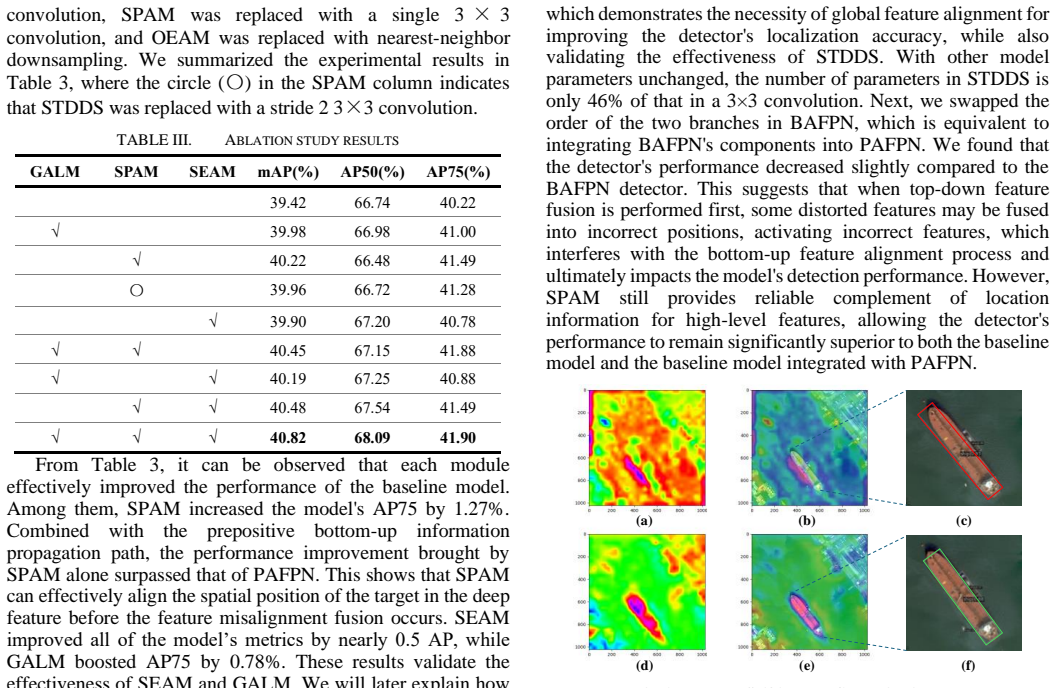
Summary. The paper proposes BAFPN, a modified feature pyramid network for oriented object detection in remote sensing images. BAFPN adds a bottom-up spatial-alignment path in which a Spatial Feature Alignment Module (SPAM) aligns each adjacent feature map using Spatial-to-Depth Down-Sampling (STDDS) and deformable convolution, followed by a top-down Fine-Grained Semantic Alignment Module (SEAM) that generates channel-and-pixel-level masks, plus a Grouped Aggregation Lateral Connection Module (GALM) that replaces the standard 1x1 lateral convolution. On DOTAv1.5, the authors report that replacing FPN in Oriented R-CNN improves AP75 from 40.22 to 41.90, AP50 from 66.74 to 68.12, and mAP from 39.42 to 40.84, with additional gains on five other rotated detectors. The paper includes a module-level ablation, qualitative feature visualizations, and a comparison with NAS-FPN and PAFPN.
Significance. If the results are reproducible and the interpretation is accurate, BAFPN is a useful, low-cost improvement to FPN-style necks for oriented detection: the gains are consistent across six detectors and two backbones, the ablations support a role for each of the three modules, and the model-size overhead relative to PAFPN is small (about 3 MB). The paper also gives a clear explanation of how its components interact. The main weaknesses are the absence of quantitative evidence for the central 'global alignment to the original image' claim, small effect sizes without error bars, numerical inconsistencies between the abstract, text, and tables, and the lack of code or multi-seed runs. These issues prevent the paper from being accepted in its current form.
major comments (3)
- [III-B (and abstract, Section I)] The paper's central claim of 'global-scale' alignment rests on the assertion that aligning each feature level to the immediately shallower level, cascaded bottom-up, aligns all levels to the lowest-layer feature (P2). This is stated explicitly in Section III-B: 'SPAM only align two adjacent feature maps, but in BAFPN, the alignment process is performed from bottom to top, which allows the targets in each feature layer to adjust their spatial positions based on the features of the lowest layer.' The load-bearing premise is that P2 is itself aligned to the input image. The manuscript provides no quantitative evidence for this: Figures 7, 8, and 10 are selected qualitative visualizations, and there is no measurement of alignment error (e.g., centroid offset or mask IoU between feature activations and ground-truth object regions) at any pyramid level. If P2 carries a residual shift or distortion, the cascade propagates that bias and does not restore alignment to the original image. I request either (i) a direct quantitative alignment-error comparison between FPN and BAFPN at each level relative to ground-truth boxes or masks, or (ii) a revised formulation that claims only adjacent-level alignment and drops the 'global to original image' wording.
- [IV-C, Tables 1-2, abstract] The headline numbers are inconsistent. The abstract reports improvements of +1.68 AP75, +1.45 AP50, and +1.34 mAP over the Oriented R-CNN baseline. Table 2 lists baseline (ORC, ResNet50) as 40.22 AP75, 66.74 AP50, 39.42 mAP and ORC* as 41.90, 68.12, 40.84, giving differences of +1.68, +1.38, and +1.42. Section IV-C states AP50 increased from 66.67 to 68.12 and mAP from 39.6 to 40.84. These discrepancies must be reconciled because they directly affect the paper's quantitative claim.
- [IV-B, IV-C, Tables 1-3] All comparisons are single-run, single-dataset (DOTAv1.5), with no error bars, no multi-seed results, and no code release. Many reported gains are small: for example, Table 2 shows RFR* mAP 36.73 vs 35.98 (+0.75) and ORC* AP75 +1.68; Table 3 contains differences of 0.1-0.2 AP. Without variance estimates, it is not possible to assess whether these differences are statistically meaningful. The authors should report mean ± standard deviation over at least three seeds, or clearly qualify the results as single-run observations. This is important because the central claim is an improvement over existing FPN variants.
minor comments (6)
- [III-A] In the GALM equations, C_i^j = ψ1(Ĉ_i^j) uses C_i^j for both the input group and the output with different dimensions; please rename one of the variables to avoid confusion.
- [III-B] There are typos: 'Spatial-to-Deepth' should be 'Spatial-to-Depth', and Figure 3's caption reads 'Spacial Features Align Module' instead of 'Spatial Feature Alignment Module'.
- [III-C] The range for the saliency weakening factor is written as 'k(1 ≤ k ≤ 0)', which is impossible; it should be '0 ≤ k ≤ 1'.
- [IV-D, Table 3] The symbol 〇 in the SPAM column is explained in the caption, but the text refers to 'OEAM replaced with nearest-neighbor downsampling'; the notation should be made consistent (the intended module is SEAM or STDDS as appropriate).
- [IV-C, Figure 6] The paper compares model size versus AP75 but does not report inference speed or FLOPs; a full efficiency comparison would be more informative for a module intended to be lightweight.
- [Figures 7-8] The feature visualizations are selected examples; a quantitative overlay, such as centroid error or activation-IoU against ground-truth boxes, would strengthen the claim that BAFPN reduces position shift and shape distortion.
Circularity Check
No significant circularity: the paper's performance claims are empirical measurements on a public benchmark, and each module is defined by its own equations without any fitted quantity being relabeled as a prediction.
full rationale
The central claim of the paper is that BAFPN improves AP75, AP50, and mAP on DOTAv1.5 relative to an Oriented R-CNN baseline. This is an experimentally measured result on an external benchmark, not a quantity derived from the model's own fitted parameters. The three proposed modules (SPAM, SEAM, GALM) are each defined by explicit equations (Section III) and are trained end-to-end; no parameter is fit to a subset of data and then used to predict a closely related quantity. The paper contains no self-citations: all references are to prior external work (DCN, CBAM, SE-Net, FPN variants, detectors), and no load-bearing argument relies on the authors' own prior results or on an imported uniqueness theorem. The global-alignment claim in Section III-B is a qualitative architectural rationale supported by ablations and feature visualizations; even if one disputes whether the cascade truly restores global alignment or whether the shallowest layer is an undistorted reference, that is a correctness or verification concern, not a circularity. The ablation study in Table III isolates each module's contribution against a baseline, which is the standard empirical methodology and does not reduce to the paper's inputs by construction. No step in the derivation chain equates an output with an input by definition, and no fitted input is renamed as a prediction. Therefore the paper shows no significant circularity.
Assumptions & free parameters
free parameters (3)
- Number of semantic groups g in GALM =
not reported
- SEAM pixel-branch kernel size and group count =
7x7, C_out groups
- STDDS output channel count =
matched to deep feature
assumptions (4)
- domain assumption Deep backbone features accumulate positional shifts and shape distortions relative to the input image.
- domain assumption Aligning adjacent pyramid levels bottom-up yields global alignment to the original image.
- domain assumption Semantic gaps between adjacent feature levels cause aliasing that hurts localization, and masking can reduce this without losing diversity.
- domain assumption AP50, AP75, and mAP on DOTAv1.5 are the right proxies for localization accuracy.
invented entities (4)
-
Spatial Feature Alignment Module (SPAM)
independent evidence
-
Spatial-to-Depth Down-Sampling (STDDS)
independent evidence
-
Fine-Grained Semantic Alignment Module (SEAM)
independent evidence
-
Grouped Aggregation Lateral Connection Module (GALM)
independent evidence
Cite this review
Pith. "Pith review of BAFPN: Bi directional alignment of features to improve localization accuracy." pith.science (2026). https://pith.science/paper/6I3DSTDN
@misc{pith2026241201859,
  author       = {Pith},
  title        = {Pith review of: BAFPN: Bi directional alignment of features to improve localization accuracy},
  year         = {2026},
  howpublished = {\url{https://pith.science/paper/6I3DSTDN}},
  note         = {Machine review of arXiv:2412.01859}
}
read the original abstract
Current state-of-the-art vision models often utilize feature pyramids to extract multi-scale information, with the Feature Pyramid Network (FPN) being one of the most widely used classic architectures. However, traditional FPNs and their variants (e.g., AUGFPN, PAFPN) fail to fully address spatial misalignment on a global scale, leading to suboptimal performance in high-precision localization of objects. In this paper, we propose a novel Bidirectional Alignment Feature Pyramid Network (BAFPN), which aligns misaligned features globally through a Spatial Feature Alignment Module (SPAM) during the bottom-up information propagation phase. Subsequently, it further mitigates aliasing effects caused by cross-scale feature fusion via a fine-grained Semantic Alignment Module (SEAM) in the top-down phase. On the DOTAv1.5 dataset, BAFPN improves the baseline model's AP75, AP50, and mAP by 1.68%, 1.45%, and 1.34%, respectively. Additionally, BAFPN demonstrates significant performance gains when applied to various other advanced detectors.
Figures


Figures from the paper (6 more)




Reference graph
Works this paper leans on
-
[1]
Lin T Y, Dollá r P, Girshick R, et al. Feature pyramid networks for object detection[C]//Proceedings of the IEEE conference on computer vision and pattern recognition. 2017: 2117-2125
work page 2017
-
[2]
Info-FPN: An Informative Feature Pyramid Network for object detection in remote sensing images[J]
Chen S, Zhao J, Zhou Y, et al. Info-FPN: An Informative Feature Pyramid Network for object detection in remote sensing images[J]. Expert Systems with Applications, 2023, 214: 119132
work page 2023
-
[3]
CE -FPN: enhancing channel information for object detection[J]
Luo Y, Cao X, Zhang J, et al. CE -FPN: enhancing channel information for object detection[J]. Multimedia Tools and Applications, 2022, 81(21): 30685-30704
work page 2022
-
[4]
Huang S, Lu Z, Cheng R, et al. Fapn: Feature -aligned pyramid network for dense image prediction[C]//Proceedings of the IEEE/CVF international conference on computer vision. 2021: 864-873
work page 2021
-
[5]
Guo C, Fan B, Zhang Q, et al. Augfpn: Improving multi -scale feature learning for object detection[C]//Proceedings of the IEEE/CVF conference on computer vision and pattern recognition. 2020: 12595 - 12604
work page 2020
-
[6]
Hu M, Li Y, Fang L, et al. A2-FPN: Attention aggregation based feature pyramid network for instance segmentation[C]//Proceedings of the IEEE/CVF conference on computer vision and pattern recognition. 2021: 15343-15352
work page 2021
-
[7]
Feature alignment FPN for oriented object detection in remote sensing images[J]
Li Z, Li E, Xu T, et al. Feature alignment FPN for oriented object detection in remote sensing images[J]. IEEE Geoscience and Remote Sensing Letters, 2023, 20: 1-5
work page 2023
-
[8]
Arbitrary -oriented scene text detection via rotation proposals[J]
Ma J, Shao W, Ye H, et al. Arbitrary -oriented scene text detection via rotation proposals[J]. IEEE transactions on multimedia, 2018, 20(11): 3111-3122
work page 2018
Show all 40 references
-
[9]
H2rbox: Horizontal box annotation is all you need for oriented object detection[J]
Yang X, Zhang G, Li W, et al. H2rbox: Horizontal box annotation is all you need for oriented object detection[J]. arXiv preprint arXiv:2210.06742, 2022
2022 arXiv
-
[10]
Building a bridge of bounding box regression between oriented and horizontal object detection in remote sensing images[J]
Qian X, Wu B, Cheng G, et al. Building a bridge of bounding box regression between oriented and horizontal object detection in remote sensing images[J]. IEEE Transactions on Geoscience and Remote Sensing, 2023, 61: 1-9
2023
-
[11]
Arbitrary-oriented object detection with circular smooth label[C]//Computer Vision –ECCV 2020: 16th European Conference, Glasgow, UK, August 23–28, 2020, Proceedings, Part VIII 16
Yang X, Yan J. Arbitrary-oriented object detection with circular smooth label[C]//Computer Vision –ECCV 2020: 16th European Conference, Glasgow, UK, August 23–28, 2020, Proceedings, Part VIII 16. Springer International Publishing, 2020: 677-694
2020
-
[12]
Task interleaving and orientation estimation for high-precision oriented object detection in aerial images[J]
Ming Q, Miao L, Zhou Z, et al. Task interleaving and orientation estimation for high-precision oriented object detection in aerial images[J]. ISPRS Journal of Photogrammetry and Remote Sensing, 2023, 196: 241- 255
2023
-
[13]
Rethinking rotated object detection with gaussian wasserstein distance loss[C]//International conference on machine learning
Yang X, Yan J, Ming Q, et al. Rethinking rotated object detection with gaussian wasserstein distance loss[C]//International conference on machine learning. PMLR, 2021: 11830-11841
2021
-
[14]
Learning modulated loss for rotated object detection[C]//Proceedings of the AAAI conference on artificial intelligence
Qian W, Yang X, Peng S, et al. Learning modulated loss for rotated object detection[C]//Proceedings of the AAAI conference on artificial intelligence. 2021, 35(3): 2458-2466
2021
-
[15]
Kim B, Lee J, Lee S, et al. TricubeNet: 2D kernel -based object representation for weakly -occluded oriented object detection[C]//Proceedings of the IEEE/CVF winter conference on applications of computer vision. 2022: 167-176
2022
-
[16]
Adaptive rotated convolution for rotated object detection[C]//Proceedings of the IEEE/CVF International Conference on Computer Vision
Pu Y, Wang Y, Xia Z, et al. Adaptive rotated convolution for rotated object detection[C]//Proceedings of the IEEE/CVF International Conference on Computer Vision. 2023: 6589-6600
2023
-
[17]
Large selective kernel network for remote sensing object detection[C]//Proceedings of the IEEE/CVF International Conference on Computer Vision
Li Y, Hou Q, Zheng Z, et al. Large selective kernel network for remote sensing object detection[C]//Proceedings of the IEEE/CVF International Conference on Computer Vision. 2023: 16794-16805
2023
-
[19]
A2-FPN for semantic segmentation of fine- resolution remotely sensed images[J]
Li R, Wang L, Zhang C, et al. A2-FPN for semantic segmentation of fine- resolution remotely sensed images[J]. International journal of remote sensing, 2022, 43(3): 1131-1155
2022
-
[20]
Cross -layer feature pyramid network for salient object detection[J]
Li Z, Lang C, Liew J H, et al. Cross -layer feature pyramid network for salient object detection[J]. IEEE Transactions on Image Processing, 2021, 30: 4587-4598
2021
-
[21]
Lr -fpn: Enhancing remote sensing object detection with location refined feature pyramid network[J]
Li H, Zhang R, Pan Y, et al. Lr -fpn: Enhancing remote sensing object detection with location refined feature pyramid network[J]. arXiv preprint arXiv:2404.01614, 2024
2024 arXiv
-
[22]
ssFPN: Scale sequence (S 2) feature-based feature pyramid network for object detection[J]
Park H J, Kang J W, Kim B G. ssFPN: Scale sequence (S 2) feature-based feature pyramid network for object detection[J]. Sensors, 2023, 23(9): 4432
2023
-
[23]
Detectors: Detecting objects with recursive feature pyramid and switchable atrous convolution[C]//Proceedings of the IEEE/CVF conference on computer vision and pattern recognition
Qiao S, Chen L C, Yuille A. Detectors: Detecting objects with recursive feature pyramid and switchable atrous convolution[C]//Proceedings of the IEEE/CVF conference on computer vision and pattern recognition. 2021: 10213-10224
2021
-
[24]
Nas -fpn: Learning scalable feature pyramid architecture for object detection[C]//Proceedings of the IEEE/CVF conference on computer vision and pattern recognition
Ghiasi G, Lin T Y, Le Q V. Nas -fpn: Learning scalable feature pyramid architecture for object detection[C]//Proceedings of the IEEE/CVF conference on computer vision and pattern recognition. 2019: 7036-7045
2019
-
[25]
Auto-fpn: Automatic network architecture adaptation for object detection beyond classification[C]//Proceedings of the IEEE/CVF international conference on computer vision
Xu H, Yao L, Zhang W, et al. Auto-fpn: Automatic network architecture adaptation for object detection beyond classification[C]//Proceedings of the IEEE/CVF international conference on computer vision. 2019: 6649- 6658
2019
-
[26]
Effective fusion factor in FPN for tiny object detection[C]//Proceedings of the IEEE/CVF winter conference on applications of computer vision
Gong Y, Yu X, Ding Y, et al. Effective fusion factor in FPN for tiny object detection[C]//Proceedings of the IEEE/CVF winter conference on applications of computer vision. 2021: 1160-1168
2021
-
[27]
Retro-fpn: Retrospective feature pyramid network for point cloud semantic segmentation[C]//Proceedings of the IEEE/CVF international conference on computer vision
Xiang P, Wen X, Liu Y S, et al. Retro-fpn: Retrospective feature pyramid network for point cloud semantic segmentation[C]//Proceedings of the IEEE/CVF international conference on computer vision. 2023: 17826 - 17838
2023
-
[28]
Deformable convolutional networks[C]//Proceedings of the IEEE international conference on computer vision
Dai J, Qi H, Xiong Y, et al. Deformable convolutional networks[C]//Proceedings of the IEEE international conference on computer vision. 2017: 764-773
2017
-
[29]
Cbam: Convolutional block attention module[C]//Proceedings of the European conference on computer vision (ECCV)
Woo S, Park J, Lee J Y, et al. Cbam: Convolutional block attention module[C]//Proceedings of the European conference on computer vision (ECCV). 2018: 3-19
2018
-
[30]
Squeeze -and-excitation networks[C]//Proceedings of the IEEE conference on computer vision and pattern recognition
Hu J, Shen L, Sun G. Squeeze -and-excitation networks[C]//Proceedings of the IEEE conference on computer vision and pattern recognition. 2018: 7132-7141
2018
-
[31]
Faster r -cnn: Towards real -time object detection with region proposal networks[J]
Ren S. Faster r -cnn: Towards real -time object detection with region proposal networks[J]. arXiv preprint arXiv:1506.01497, 2015
2015 arXiv
-
[32]
Learning RoI transformer for oriented object detection in aerial images[C]//Proceedings of the IEEE/CVF conference on computer vision and pattern recognition
Ding J, Xue N, Long Y, et al. Learning RoI transformer for oriented object detection in aerial images[C]//Proceedings of the IEEE/CVF conference on computer vision and pattern recognition. 2019: 2849-2858
2019
-
[33]
Gliding vertex on the horizontal bounding box for multi -oriented object detection[J]
Xu Y, Fu M, Wang Q, et al. Gliding vertex on the horizontal bounding box for multi -oriented object detection[J]. IEEE transactions on pattern analysis and machine intelligence, 2020, 43(4): 1452-1459
2020
-
[34]
Focal Loss for Dense Object Detection[J]
Lin T. Focal Loss for Dense Object Detection[J]. arXiv preprint arXiv:1708.02002, 2017
2017 arXiv
-
[35]
FCOS: Fully convolutional one -stage object detection
Tian Z, Shen C, Chen H, et al. FCOS: Fully convolutional one -stage object detection. arXiv 2019[J]. arXiv preprint arXiv:1904.01355, 2019
2019 arXiv
-
[36]
Oriented R -CNN for object detection[C]//Proceedings of the IEEE/CVF international conference on computer vision
Xie X, Cheng G, Wang J, et al. Oriented R -CNN for object detection[C]//Proceedings of the IEEE/CVF international conference on computer vision. 2021: 3520-3529
2021
-
[37]
DOTA: A large -scale dataset for object detection in aerial images[C]//Proceedings of the IEEE conference on computer vision and pattern recognition
Xia G S, Bai X, Ding J, et al. DOTA: A large -scale dataset for object detection in aerial images[C]//Proceedings of the IEEE conference on computer vision and pattern recognition. 2018: 3974-3983
2018
-
[38]
Path aggregation network for instance segmentation[C]//Proceedings of the IEEE conference on computer vision and pattern recognition
Liu S, Qi L, Qin H, et al. Path aggregation network for instance segmentation[C]//Proceedings of the IEEE conference on computer vision and pattern recognition. 2018: 8759-8768
2018
-
[39]
Deep residual learning for image recognition[C]//Proceedings of the IEEE conference on computer vision and pattern recognition
He K, Zhang X, Ren S, et al. Deep residual learning for image recognition[C]//Proceedings of the IEEE conference on computer vision and pattern recognition. 2016: 770-778
2016
-
[40]
AFPN: Asymptotic feature pyramid network for object detection[C]//2023 IEEE International Conference on Systems, Man, and Cybernetics (SMC)
Yang G, Lei J, Zhu Z, et al. AFPN: Asymptotic feature pyramid network for object detection[C]//2023 IEEE International Conference on Systems, Man, and Cybernetics (SMC). IEEE, 2023: 2184-2189
2023
-
[41]
Improving language models by retrieving from trillions of tokens[C]//International conference on machine learning
Borgeaud S, Mensch A, Hoffmann J, et al. Improving language models by retrieving from trillions of tokens[C]//International conference on machine learning. PMLR, 2022: 2206-2240. Jiakun Li: Bachelor of Engineering , graduated from Shandong University of Science and Technology,...
2022
Reviewed August 12, 2026 · model on record in the stance chip above.
Discussion (0). Continue with ORCID to comment.