Computational Analysis of Heart Rate Variability in Healthy Adults
Pith reviewed 2026-06-26 05:19 UTC · model grok-4.3
The pith
Specific HRV indices best represent global, low-frequency and high-frequency components in healthy adults.
A machine-rendered reading of the paper's core claim, the machinery that carries it, and where it could break.
Core claim
The study establishes that time-domain and nonlinear HRV indices, particularly those for global and low-frequency components, follow normal distributions with some gender differences, remain stable except for high-frequency related measures, show high correlations among HF indices that suggest selecting only one, reproduce with less than 10 percent error against the Fantasia database for most cases, and exhibit low inter-study variability unlike frequency-domain indices. It identifies ApEn and IRRR for global variability, HRVi and SD2 for LF, and MADRR or rMSSD for HF as the indices best suited to represent HRV components and enhance clinical and research relevance.
What carries the argument
Computational evaluation of time-domain, frequency-domain, and nonlinear HRV indices from ECG recordings in 40 healthy adults, testing the five properties of normality, stability, correlation, reproducibility, and consistency.
If this is right
- Time-domain and nonlinear indices can be used reliably due to their normal distributions and stability.
- Only one high-frequency index is needed in analyses because of high correlations indicating redundancy.
- Frequency-domain indices should be interpreted cautiously for cross-study comparisons given their high variability.
- The recommended set of indices increases the clinical utility of HRV for disease diagnosis.
Where Pith is reading between the lines
- The gender differences in distributions could support development of separate reference ranges for men and women.
- These indices might be tested in wearable monitoring systems to check if they improve real-time cardiac assessment.
- Applying the same evaluation to patient groups with cardiac conditions could identify whether the same indices remain optimal.
Load-bearing premise
The sample of 40 healthy adults aged 30-50 provides sufficient statistical power and representativeness to generalize properties of HRV indices.
What would settle it
A larger study of healthy adults aged 30-50 that finds different normality results or error rates above 10 percent for the recommended indices when compared to the Fantasia database would falsify the selection.
Figures
read the original abstract
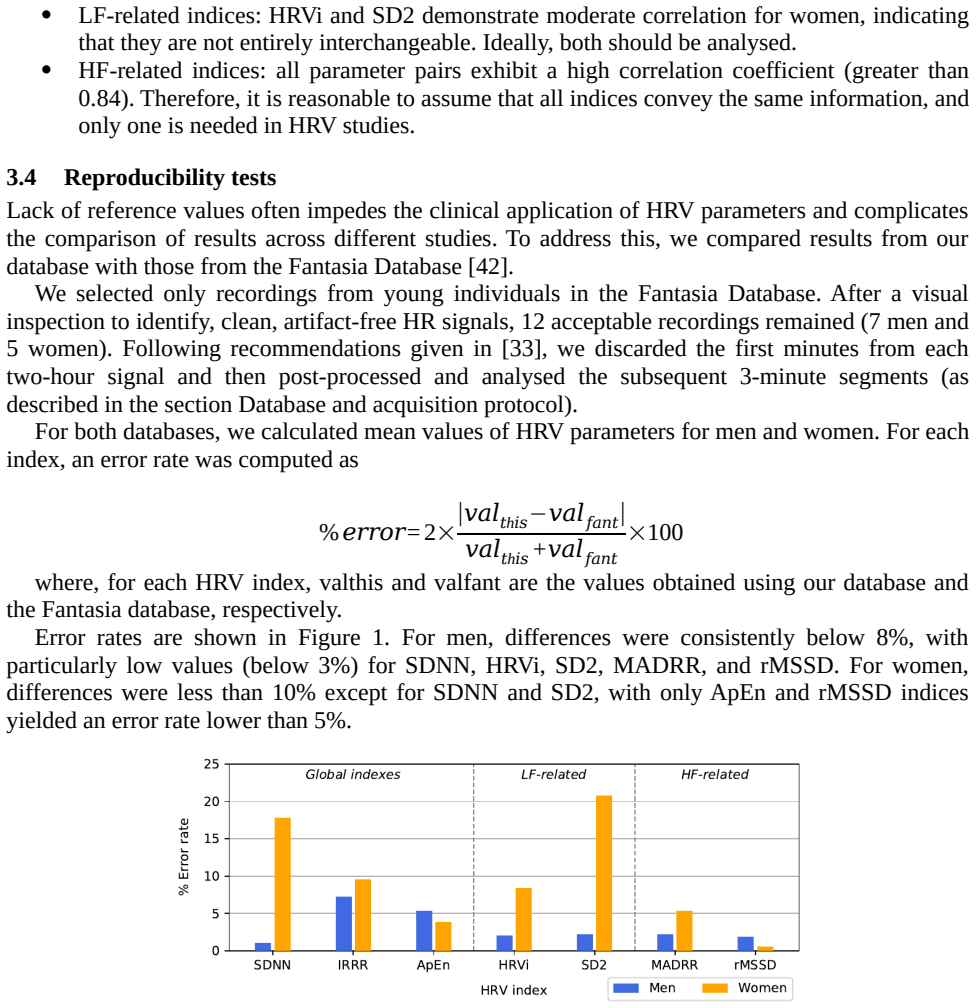
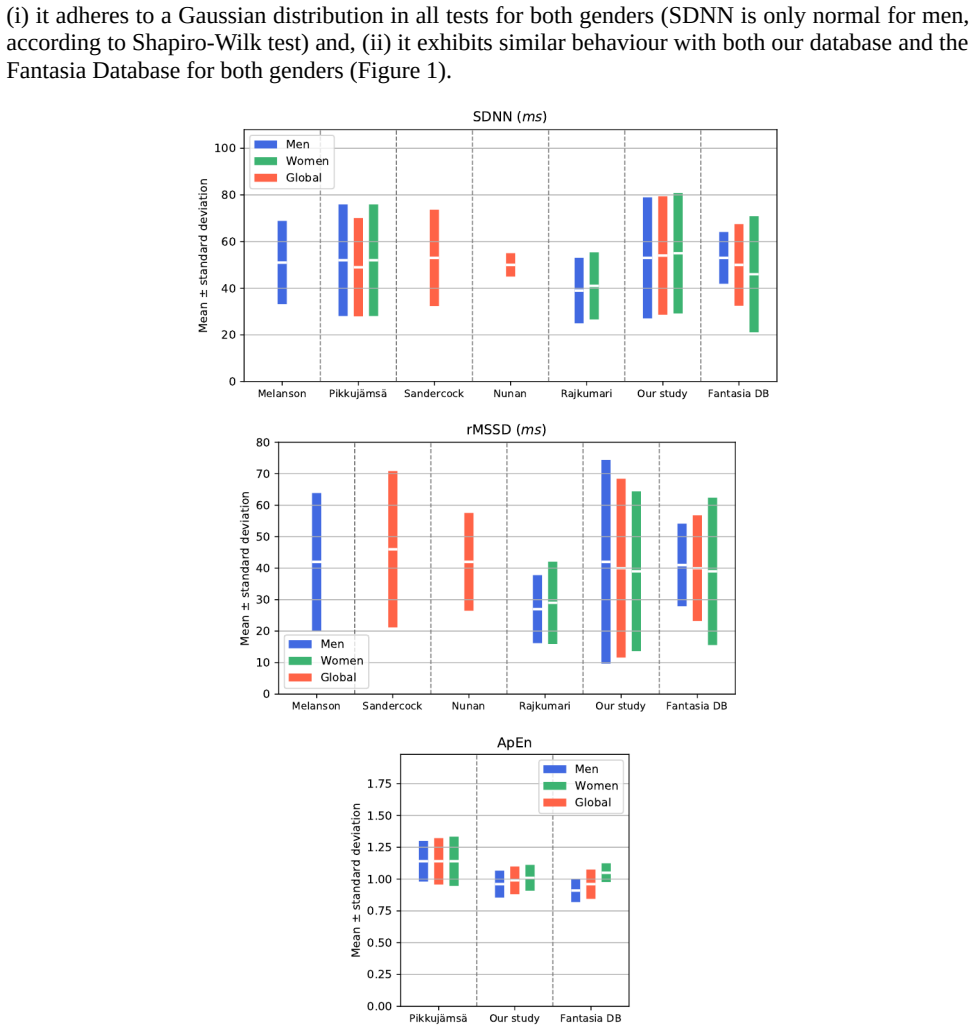
Heart Rate Variability (HRV) analysis is a key indicator of cardiac physiological state and aids in disease diagnosis. However, research on HRV parameters in healthy individuals remains limited, and no gold standard exists. This study evaluates HRV indices in 40 healthy adults (20 men, 20 women, aged 30-50) to improve HRV's clinical utility. Using computational methods for signal processing and data analysis, time, frequency, and nonlinear indices were analyzed to address five questions: (1) normality, (2) stability, (3) correlation, (4) reproducibility, and (5) consistency. Key findings: (1) Time-domain and nonlinear indices, particularly global and LF (low frequency), follow normal distributions, with gender differences noted. (2) Most indices are stable except HF (high frequency)-related ones. (3) High correlations in HF-related indices suggest redundancy, indicating only one is necessary in studies. (4) Comparisons with the Fantasia database revealed less than 10% error for most indices, except SD2 and SDNN in women (greater than 15%). (5) Time-domain and nonlinear indices show low inter-study variability, while frequency-domain indices exhibit high variability, limiting cross-study comparisons. The selected indices-ApEn and IRRR (global variability), HRVi and SD2 (LF), and MADRR or rMSSD (HF)-are best suited for accurately representing HRV components and enhancing its clinical and research relevance.
Editorial analysis
A structured set of objections, weighed in public.
Referee Report
Summary. The manuscript presents a computational analysis of heart rate variability (HRV) indices in 40 healthy adults (20 men, 20 women, aged 30-50). It evaluates time-, frequency-, and nonlinear-domain indices against five criteria—normality of distributions, stability, inter-index correlations, reproducibility versus the Fantasia database (<10% error for most indices, >15% for SD2/SDNN in women), and cross-study consistency—and concludes that ApEn and IRRR (global), HRVi and SD2 (LF), and MADRR or rMSSD (HF) are the indices best suited for clinical and research use.
Significance. If the empirical findings hold after methodological clarification, the work could offer practical guidance for standardizing HRV index selection by highlighting indices with favorable statistical properties (normality, low inter-study variability). The computational signal-processing pipeline is a positive aspect, but the absence of detailed statistical procedures and the small cohort limit the strength of the generalizability claim.
major comments (3)
- [Abstract] Abstract: the abstract states specific quantitative findings such as normality distributions, <10% error for most indices, and >15% for SD2/SDNN in women, but provides no details on statistical tests, data exclusion rules, or error bar calculations; full methods absent.
- [Abstract] Abstract (study design): the gender-stratified analyses (n=20 per group) are used to support claims about normality (Shapiro-Wilk), correlations, and reproducibility error rates; this sample size is marginal for reliable inference and generalization of HRV index properties.
- [Abstract] Abstract (reproducibility): the Fantasia database serves as the external benchmark for the <10% error threshold, yet differences in age range and recording conditions are not addressed, weakening the interpretation of reproducibility and the exceptions noted for women.
minor comments (1)
- [Abstract] Abstract: acronyms for the recommended indices (ApEn, IRRR, HRVi, SD2, MADRR, rMSSD) are introduced without prior definition, reducing immediate clarity for readers outside the HRV subfield.
Simulated Author's Rebuttal
We thank the referee for the constructive comments on our manuscript. We address each major comment below and indicate the revisions made to strengthen the presentation of methods, limitations, and reproducibility analysis.
read point-by-point responses
-
Referee: [Abstract] Abstract: the abstract states specific quantitative findings such as normality distributions, <10% error for most indices, and >15% for SD2/SDNN in women, but provides no details on statistical tests, data exclusion rules, or error bar calculations; full methods absent.
Authors: The full manuscript includes a Methods section specifying the Shapiro-Wilk test for normality, correlation procedures, percentage-error reproducibility metric against Fantasia, and preprocessing steps. The abstract summarizes results at a high level. We will revise the abstract to include a brief reference to the primary statistical tests employed and ensure all quantitative claims are traceable to the detailed methods. revision: yes
-
Referee: [Abstract] Abstract (study design): the gender-stratified analyses (n=20 per group) are used to support claims about normality (Shapiro-Wilk), correlations, and reproducibility error rates; this sample size is marginal for reliable inference and generalization of HRV index properties.
Authors: We agree that n=20 per gender is modest and limits statistical power for generalization. The cohort was assembled for an exploratory computational analysis of index properties rather than definitive normative values. We will add an explicit limitations paragraph discussing sample size, power considerations for the gender-stratified results, and the need for larger validation studies. revision: yes
-
Referee: [Abstract] Abstract (reproducibility): the Fantasia database serves as the external benchmark for the <10% error threshold, yet differences in age range and recording conditions are not addressed, weakening the interpretation of reproducibility and the exceptions noted for women.
Authors: The referee correctly notes that demographic (age) and protocol differences between our cohort and Fantasia were not discussed. We will add a paragraph in the Discussion comparing the datasets and qualifying the reproducibility results, while retaining the practical <10% threshold as an internal benchmark and acknowledging its interpretive limits. revision: yes
Circularity Check
No significant circularity in empirical HRV index evaluation
full rationale
This paper is a purely empirical data-processing study. It computes standard HRV indices (time-domain, frequency-domain, nonlinear) directly from ECG signals recorded in 40 healthy adults, applies statistical tests for normality/stability/correlation/reproducibility/consistency, and compares results to the external Fantasia database. No mathematical derivations, fitted parameters presented as predictions, ansatzes, or self-citation chains appear in the load-bearing steps. All claims rest on direct computation and external benchmarks, so the analysis is self-contained with no reduction of outputs to inputs by construction.
Axiom & Free-Parameter Ledger
axioms (1)
- domain assumption Standard statistical tests for normality, stability, and correlation are appropriate and correctly applied to the computed HRV indices.
Reference graph
Works this paper leans on
-
[1]
Inteligencia artificial en la salud mental: oportunidades, dificultades y cuestionamientos
Canabal A, Delgado EA, Alonso González M. Inteligencia artificial en la salud mental: oportunidades, dificultades y cuestionamientos. Inteligencia Artificial 1(2): 1–20, 2024. doi: 10.4114/intartif.vol27iss74pp133-151
-
[2]
Deep learning for healthcare applications based on physiological signals: A review
Faust O, Hagiwara Y , Hong TJ, Lih OS, Acharya UR. Deep learning for healthcare applications based on physiological signals: A review. Comput Methods Programs Biomed 161:1–13, 2018. doi: 10.1016/j.cmpb.2018.04.005
-
[3]
Principles of clinical electrocardiography, Lange Medical Publications, 1986
Goldman MJ. Principles of clinical electrocardiography, Lange Medical Publications, 1986
1986
-
[4]
Malik M, Bigger JT, Camm AJ, Kleiger RE, Malliani A, Moss AJ, Schwartz PJ. Heart rate variability. Standards of measurement, physiological interpretation, and clinical use, Eur Heart J, 17:354-381, 1996. doi: 10.1093/oxfordjournals.eurheartj.a014868
-
[5]
Malik M, Camm AJ. Components of heart rate variability--what they really mean and what we really measure, Am J Cardiol, 72:821-822, 1993. doi: 10.1016/0002-9149(93)91070-x
-
[6]
Heart rate variability analysis with the R package RHRV , Springer, 2017
García-Martínez CA, Otero-Quintana A, Vila XA, Lado MJ, Rodríguez-Liñares L, Rodríguez- Presedo JM, Méndez AJ. Heart rate variability analysis with the R package RHRV , Springer, 2017
2017
-
[7]
An Overview of Heart Rate Variability Metrics and Norms, Front Public Health, 5:258, 2017
Shaffer F, Ginsberg JP. An Overview of Heart Rate Variability Metrics and Norms, Front Public Health, 5:258, 2017. doi: 10.3389/fpubh.2017.00258
-
[8]
Heart rate variability and obstructive sleep apnea: Current perspectives and novel technologies, J Sleep Res , 30:e13274,
Ucak S, Dissanayake HU, Sutherland K, de Chazal P, Cistulli PA. Heart rate variability and obstructive sleep apnea: Current perspectives and novel technologies, J Sleep Res , 30:e13274,
-
[9]
doi: 10.1111/jsr.13274
-
[10]
Hajdu M, Garmpis K, Vértes V , V orobcsuk-Varga N, Molnár GA, Hejjel L, Wittmann I, Faludi R. Determinants of the heart rate variability in type 1 diabetes mellitus, Front Endocrinol , 14:1247054, 2023. doi: 10.3389/fendo.2023.1247054
-
[11]
Yugar LBT, Yugar-Toledo JC, Dinamarco N, Sedenho-Prado LG, Moreno BVD, Rubio TA, Fattori A, Rodrigues B, Vilela-Martin JF, Moreno H. The Role of Heart Rate Variability (HRV) in Different Hypertensive Syndromes, Diagnostics, 13:785, 2023. doi: 10.3390/diagnostics13040785
-
[12]
Huang CH, Lin LY , Tsai MS, Hsu CY , Chen HW, Wang TD, Chang WT, Cheng TJ, Chen WJ. Acute cardiac dysfunction after short-term diesel exhaust particles exposure, Toxicol Lett, 192:349-355, 2010. doi: 10.1016/j.toxlet.2009.11.008
-
[13]
Analysis of myocardial infarction using discrete wavelet transform, J Med Syst, 34:985-992, 2010
Jayachandran ES, Joseph KP, Acharya UR. Analysis of myocardial infarction using discrete wavelet transform, J Med Syst, 34:985-992, 2010. doi: 10.1007/s10916-009-9314-5
-
[14]
Lundstrom CJ, Foreman NA, Biltz G. Practices and Applications of Heart Rate Variability Monitoring in Endurance Athletes, Int J Sports Med, 44:9-19, 2023. doi: 10.1055/a-1864-9726
-
[15]
Mattos S, Rabello da Cunha M, Barreto Silva MI, Serfaty F, Tarvainen MP, Klein MRST, Neves MF. Effects of weight loss through lifestyle changes on heart rate variability in overweight and obese patients: A systematic review, Clin Nutr , 41:2577-2586, 2022. doi: 10.1016/j.clnu.2022.09.009
-
[16]
Wang Z, Morey AC, Srivastava J. Motivated selective attention during political ad processing: The dynamic interplay between emotional ad content and candidate evaluation, Commun Res , 41:119-156, 2014. doi: 10.1177/0093650212441793 11
-
[17]
Rajkumari R, Keithellakpam S, Devi LS, Srivastava A. A preliminary study on the effect of age and heart rate on the short-term heart rate variability, IOSR J Dent Med Sci, 18:24-28, 2019. doi: 10.9790/0853-1809042428
-
[18]
Williams DP, Joseph N, Gerardo GM, Hill LK, Koenig J, Thayer JF. Gender Differences in Cardiac Chronotropic Control: Implications for Heart Rate Variability Research, Appl Psychophysiol Biofeedback, 47:65-75, 2022. doi: 10.1007/s10484-021-09528-w
-
[19]
Heart rate variability related to effort at work, Appl Ergon, 42:830-838, 2011
Uusitalo A, Mets T, Martinmäki K, Mauno S, Kinnunen U, Rusko H. Heart rate variability related to effort at work, Appl Ergon, 42:830-838, 2011. doi: 10.1016/j.apergo.2011.01.005
-
[20]
Porto AA, Benjamim CJR, Gonzaga LA, Luciano de Almeida M, Bueno Júnior CR, Garner DM, Valenti VE. Caffeine intake and its influences on heart rate variability recovery in healthy active adults after exercise: A systematic review and meta-analysis, Nutr Metab Cardiovasc Dis, 32:1071-1082, 2022. doi: 10.1016/j.numecd.2022.01.015
-
[21]
Sandercock GR, Shelton C, Bromley P, Brodie DA. Agreement between three commercially available instruments for measuring short-term heart rate variability, Physiol Meas , 25:1115- 1124, 2004. doi: 10.1088/0967-3334/25/5/003
-
[22]
Kumar P, Das AK, Halder S. Statistical heart rate variability analysis for healthy person: Influence of gender and body posture, J Electrocardiol , 79:81-88, 2023. doi: 10.1016/j.jelectrocard.2023.03.011
-
[23]
Pikkujämsä SM, Mäkikallio TH, Airaksinen KE, Huikuri HV . Determinants and interindividual variation of R-R interval dynamics in healthy middle-aged subjects, Am J Physiol Heart Circ Physiol, 280:H1400-1406, 2001. doi: 10.1152/ajpheart.2001.280.3.H1400
-
[24]
A quantitative systematic review of normal values for short-term heart rate variability in healthy adults, Pacing Clin Electrophysiol , 33:1407-1417,
Nunan D, Sandercock GR, Brodie DA. A quantitative systematic review of normal values for short-term heart rate variability in healthy adults, Pacing Clin Electrophysiol , 33:1407-1417,
-
[25]
doi: 10.1111/j.1540-8159.2010.02841.x
-
[26]
Sammito S, Böckelmann I. Reference values for time- and frequency-domain heart rate variability measures, Heart Rhythm, 13:1309-1316, 2016. doi: 10.1016/j.hrthm.2016.02.006
-
[27]
Reference values of heart rate variability, Heart Rhythm, 14:302-303, 2017
Bauer A, Camm AJ, Cerutti S, Guzik P, Huikuri H, Lombardi F, Malik M, Peng CK, Porta A, Sassi R, Schmidt G, Schwartz PJ, Stein PK, Yamamoto Y . Reference values of heart rate variability, Heart Rhythm, 14:302-303, 2017. doi: 10.1016/j.hrthm.2016.12.015
-
[28]
Sammito S, Böckelmann I. New reference values of heart rate variability during ordinary daily activity, Heart Rhythm, 14:304-307, 2017. doi: 10.1016/j.hrthm.2016.12.016
-
[29]
Tegegne BS, Man T, van Roon AM, Riese H, Snieder H. Determinants of heart rate variability in the general population: The Lifelines Cohort Study, Heart Rhythm, 15:1552-1558, 2018. doi: 10.1016/j.hrthm.2018.05.006
-
[30]
Michels N, Clays E, De Buyzere M, Huybrechts I, Marild S, Vanaelst B, De Henauw S, Sioen I. Determinants and reference values of short-term heart rate variability in children, Eur J Appl Physiol, 113:1477-1488, 2013. doi: 10.1007/s00421-012-2572-9
-
[31]
Melanson EL. Resting heart rate variability in men varying in habitual physical activity, Med Sci Sports Exerc, 32:1894-1901, 2000. doi: 10.1097/00005768-200011000-00012
-
[32]
Heathers JA. Everything Hertz: methodological issues in short-term frequency-domain HRV , Front Physiol, 5:177, 2014. doi: 10.3389/fphys.2014.00177
-
[33]
Laborde S, Mosley E, Thayer JF. Heart Rate Variability and Cardiac Vagal Tone in Psychophysiological Research - Recommendations for Experiment Planning, Data Analysis, and Data Reporting, Front Psychol, 8:213, 2017. doi: 10.3389/fpsyg.2017.00213 12
-
[34]
Billman GE, Huikuri HV , Sacha J, Trimmel K. An introduction to heart rate variability: methodological considerations and clinical applications, Front Physiol , 6:55, 2015. doi: 10.3389/fphys.2015.00055
-
[35]
Vila XA, Lado MJ, Cuesta-Morales P. Evidence Based Recommendations for Designing Heart Rate Variability Studies, J Med Syst, 43:311, 2019. doi: 10.1007/s10916-019-1437-8
-
[36]
Multiclasificación de arritmias cardíacas usando una red neuronal y la tarjeta MyRio -1900
Flores -Calero M, Leppe B, Pilla M, Gualsaquí M, Zabala -Blanco D, Albuja A. Multiclasificación de arritmias cardíacas usando una red neuronal y la tarjeta MyRio -1900. Inteligencia Artificial 24(67):129–146, 2021. doi: 10.4114/intartif.vol24iss67pp129-146
-
[37]
Available from: https://www.polar.com/en/sensors/h10- heart-rate-sensor
Polar H10 Heart Rate Sensor, 2023. Available from: https://www.polar.com/en/sensors/h10- heart-rate-sensor
2023
-
[38]
Vila Blanco N, Rodríguez-Liñares L, Cuesta P, Lado MJ, Méndez AJ, Vila XA. gV ARVI: A graphical software tool for the acquisition of the heart rate in response to external stimuli, Comput Methods Programs Biomed, 132:197-205, 2016. doi: 10.1016/j.cmpb.2016.05.005
-
[39]
Available from: https://www.r-project.org/
The R Project for Statistical Computing, 2023. Available from: https://www.r-project.org/
2023
-
[40]
Time-frequency analysis of heart-rate variability, IEEE Eng Med Biol Mag, 16:119-126, 1997
Vila J, Palacios F, Presedo J, Fernández-Delgado M, Felix P, Barro S. Time-frequency analysis of heart-rate variability, IEEE Eng Med Biol Mag, 16:119-126, 1997. doi: 10.1109/51.620503
-
[41]
Welch P. The use of fast Fourier transform for the estimation of power spectra: a method based on time averaging over short, modified periodograms, IEEE Trans Audio Electroacoust , 15:70- 73, 1967. doi: 10.1109/TAU.1967.1161901
-
[42]
Power comparisons of Shapiro-Wilk, Kolmogorov-Smirnov, Lilliefors and Anderson-Darling tests, J Stat Model Analytics, 2:21-33, 2011
Razali NM, Wah YB. Power comparisons of Shapiro-Wilk, Kolmogorov-Smirnov, Lilliefors and Anderson-Darling tests, J Stat Model Analytics, 2:21-33, 2011
2011
-
[43]
Statistics corner: A guide to appropriate use of correlation coefficient in medical research, Malawi Med J, 24:69-71, 2012
Mukaka MM. Statistics corner: A guide to appropriate use of correlation coefficient in medical research, Malawi Med J, 24:69-71, 2012
2012
-
[44]
Iyengar N, Peng CK, Morin R, Goldberger AL, Lipsitz LA. Age-related alterations in the fractal scaling of cardiac interbeat interval dynamics, Am J Physiol , 271:R1078-R1084, 1996. doi: 10.1152/ajpregu.1996.271.4.R1078
-
[45]
Goswami, M., Szafer, K., Choudhry, A., Cai, Y ., Li, S., and Dubrawski, A
Goldberger AL, Amaral LA, Glass L, Hausdorff JM, Ivanov PC, Mark RG, Mietus JE, Moody GB, Peng CK, Stanley HE. PhysioBank, PhysioToolkit, and PhysioNet: components of a new research resource for complex physiologic signals, Circulation, 101:E215-E220, 2000. doi: 10.1161/01.cir.101.23.e215
-
[46]
Fantasia [Film], Walt Disney Animation Studios, 1940
Disney W, producer. Fantasia [Film], Walt Disney Animation Studios, 1940
1940
-
[47]
Antelmi I, de Paula RS, Shinzato AR, Peres CA, Mansur AJ, Grupi CJ. Influence of age, gender, body mass index, and functional capacity on heart rate variability in a cohort of subjects without heart disease, Am J Cardiol, 93:381-385, 2004. doi: 10.1016/j.amjcard.2003.09.065
-
[48]
Influence of age and gender on autonomic regulation of heart, J Clin Monit Comput, 27:259-264,
Abhishekh HA, Nisarga P, Kisan R, Meghana A, Chandran S, Trichur Raju, Sathyaprabha TN. Influence of age and gender on autonomic regulation of heart, J Clin Monit Comput, 27:259-264,
-
[49]
doi: 10.1007/s10877-012-9424-3 13
discussion (0)
Sign in with ORCID, Apple, or X to comment. Anyone can read and Pith papers without signing in.