REVIEW 3 major objections 4 minor 13 references
Investigation of the Excited States of $^{114}\mathrm{Sn}$ Using the GRIFFIN Spectrometer at TRIUMF
T0 review · 3 major / 4 minor · reviewed 2026-08-16 · deepseek-v4-flash
Pith's one-line read Gating on a 856.2-keV gamma ray places two previously unassigned transitions in the level scheme of 114Sn, linking the deformed 0+3 state to its feeding and ground-state transitions.
desk verdict A small, honest confirmation paper: two transitions are placed in 114Sn from beta decay, but they were already placed in a 1990 (n,n'gamma) experiment; the new data support the placement but lack gate-purity analysis. read the letter →
The pith
A machine-rendered reading of the paper's core claim, the machinery that carries it, and where it could break.
The reading
What carries the argument
The mechanism that carries the argument is gamma-gamma coincidence gating: GRIFFIN records gamma rays within a 250 ns coincidence window, and the add-back spectrum in coincidence with a selected transition shows only transitions that share a decay cascade. Here the gate on 856.2 keV selects events in which that gamma ray is emitted, and the appearance of 1299.8 keV and 1405.0 keV in that gated spectrum is what fixes the relative energies and ordering of the levels. The same method underlies the newly observed transitions seen in the 1299.8-keV gated spectrum, which the authors plan to place in the full level-scheme analysis.
What would settle it
Look at the 856.2-keV peak for doublet structure or background contamination and test the reverse gates: gating on 1405.0 keV should reproduce the 1299.8-keV and 856.2-keV lines, and gating on 1299.8 keV should show both. If the 1405.0-keV gate does not show 856.2 keV and 1299.8 keV with consistent relative intensities, the claimed cascade fails.
Extended reading notes
Core claim
The central discovery is that two gamma transitions observed but never placed in earlier beta-decay work are now fixed in the 114Sn level scheme by coincidence: gating on 856.2 keV reveals the 1299.8-keV ground-state transition and a 1405.0-keV transition, establishing that 856.2 keV depopulates the 0+3 state at 2156.0 keV to the 2+1 state, and that 1405.0 keV feeds that state from 3561.0 keV. This places the decay of the deformed 0+3 intruder state in the beta-decay path and anchors the cascade used to study shape coexistence in this semi-magic nucleus.
Load-bearing premise
The 856.2-keV gate is assumed to be a single, clean transition of 114Sn; if any other gamma ray from the mixed beam or another decay path overlaps it, the coincidences no longer prove the placement.
Editorial extensions
If this is right
- If the placement holds, the 0+3 state at 2156.0 keV is firmly connected to the ground-state band through the 2+1 level, fixing its decay branch in the beta-decay path.
- The 1405.0-keV transition places a level at 3561.0 keV above the 0+3 state, and future log ft and angular-correlation analysis can determine its spin and parity.
- The coincidence spectrum gated on 1299.8 keV shows several newly observed transitions that the authors state will be incorporated into an expanded level scheme beyond 4 MeV, extending the experimental reach of shape-coexistence studies in 114Sn.
- The demonstrated quality of the GRIFFIN beta-decay data makes it possible to measure branching ratios and log ft values for the deformed intruder states, quantities that constrain the mixing between spherical and deformed configurations.
Reading between the lines
- If the cascade is confirmed, the 3561.0-keV state is a natural candidate for the next member of the 2p-2h intruder band built on the 0+3 state; a lifetime measurement of this state could test whether it has the enhanced collectivity expected for a deformed band member.
- The same gating strategy could be applied to known (p,p'gamma) and (n,n'gamma) datasets to cross-check whether the 3561.0-keV state appears in those reactions, tying the beta-decay and in-beam studies together.
- A purified beam without the 114In and 95Sr19F components would permit a cleaner test of the 856.2-keV gate and may reveal additional weak transitions to or from the 0+3 state that are currently hidden under the cocktail background.
- The energy sum 1405.0 + 856.2 + 1299.8 = 3561.0 keV is consistent within rounding; if a later high-precision measurement finds a small discrepancy, the cascade order or a doublet in one of the transitions would need revision.
Signed reviews
Editorial analysis
A structured set of objections, weighed in public.
Referee Report
Summary. The paper reports a preliminary gamma-ray spectroscopy study of 114Sn populated by the beta-plus/electron-capture decay of 114Sb produced at TRIUMF-ISAC and detected with the GRIFFIN spectrometer. The authors identify two previously unplaced transitions, 856.2 keV and 1405.0 keV, and place them in the 114Sn level scheme: 856.2 keV depopulates the proposed 0+3 level at 2156.0 keV to the 2+1 level at 1299.8 keV, and 1405.0 keV is placed between a level at 3561.0 keV and the 2156.0-keV level. The placement rests on a gamma-gamma coincidence spectrum gated on 856.2 keV that shows coincident 1299.8-keV and 1405.0-keV peaks. The paper also describes the cocktail-beam composition and singles spectra used to characterize the beam, and it outlines future work on intensities, log ft values, and angular correlations.
Significance. If the assignments are correct, the result removes a minor discrepancy between an older beta-decay study and a later (n,n'γ) study, and it provides a starting point for studying decay patterns of excited 0+ states in 114Sn. The paper's value is incremental rather than transformative: it is a short, preliminary report whose central evidence is a single coincidence gate. The experiment itself benefits from high statistics and the well-characterized GRIFFIN array, and the placement is physically plausible given Ref. [13] and the Ritz combination 856.2+1299.8=2156.0. No code or machine-checked proofs are involved; the key requirement is that the coincidence data be shown to be robust against contamination and background.
major comments (3)
- [Section 3, Fig. 4] The 856.2-keV gate is not demonstrated to be pure. Section 2 states that the beam contains 114Sb, 114In isomers, and 95Sr19F, so the gate may include contributions from these species, and no peak-shape fit, peak-purity analysis, background subtraction, or chance-coincidence correction is shown. Because 856.2 + 1299.8 = 2156.0 keV is a known level energy, a contaminated gate could still display the 1299.8-keV line through a related cascade, and the 1405.0-keV line could arise from a different sequence. Without these controls, the coincidence spectrum in Fig. 4 does not uniquely determine the placement; a reverse gate on 1405.0 keV or a detailed analysis of the 1299.8-keV gate is needed.
- [Section 3, Fig. 4] No uncertainties are given for the energies or intensities of the transitions used in the placement, and no quantitative measure of peak significance (e.g., peak area, background level, or number of counts) is provided. The central claim is a two-point energy sum plus a coincidence observation; at minimum the energies should be quoted with uncertainties from a calibration fit, and the 1405.0-keV peak should be shown to be statistically significant above the local background.
- [Section 3] The paper does not present a coincidence spectrum gated on the 1405.0-keV transition or a spectrum gated on the 1299.8-keV transition showing the 856.2-keV and 1405.0-keV lines. The single forward gate shown in Fig. 4 is the only evidence for mutual coincidence; a mutual-coincidence check is standard and would directly address the cocktail-beam contamination concern.
minor comments (4)
- [Abstract and Section 3] The notation 'β+−decay' in Section 3 is a typo and should be typeset consistently as 'β+ decay'.
- [Fig. 2] The caption mentions a 'yellow star' marker, but the marker is not clearly visible in the printed figure; please adjust the figure or caption for clarity.
- [Fig. 4] The inset showing the 856.2-keV gate is too small to read the gate limits clearly; the energy scale and gate boundaries should be enlarged and labelled.
- [Section 2] The isomeric-state labels '114Inm1' and '114Inm2' should use a consistent superscript notation (e.g., 114Inm1) throughout the text and references.
Circularity Check
No circularity: the transition placements follow from measured gamma-ray coincidence energies and known level spacings, not from a fitted model or self-citation.
full rationale
The paper's central claim is the assignment of the 856.2-keV and 1405.0-keV transitions to the 114Sn level scheme based on gamma-gamma coincidence data. The placement uses energy conservation: gating on 856.2 keV shows coincident 1299.8-keV and 1405.0-keV transitions, and the sums 856.2 + 1299.8 = 2156.0 keV and 1405.0 + 2156.0 = 3561.0 keV match previously established level energies. This is the standard Ritz combination principle applied to measured gamma-ray energies; it is not derived from a model parameter, from a fit to the target transitions, or from any calculation whose output equals the input. The cited prior work [10, 11, 12, 13] provides external, independently obtained level energies and placements; even though [13] already placed these transitions, the present paper does not claim to derive them from that placement, but rather reports their observation in the GRIFFIN beta-decay data. No equation in the paper reduces to its own inputs, no parameter is fitted and then renamed as a prediction, and no load-bearing premise is justified solely by a self-citation. The skeptically noted gate-purity concern is a missing-evidence or systematic-uncertainty issue about cocktail-beam contamination, not a circularity: an imperfect gate would make the placement less certain, but it would not make the argument logically self-referential. The analysis is therefore self-contained against external benchmarks and warrants a score of 0.
Assumptions & free parameters
assumptions (3)
- domain assumption Energy and efficiency calibration using 56Co, 60Co, 133Ba, and 152Eu standard sources is accurate over the relevant range.
- domain assumption The 856.2-keV gate is uncontaminated by other gamma-ray transitions from the cocktail beam or other 114Sn decay paths.
- domain assumption The 250 ns coincidence window correctly associates cascade gamma rays with negligible chance coincidences.
Cite this review
Pith. "Pith review of Investigation of the Excited States of $^{114}\mathrm{Sn}$ Using the GRIFFIN Spectrometer at TRIUMF." pith.science (2026). https://pith.science/paper/6ISHN5M6
@misc{pith2026250417174,
  author       = {Pith},
  title        = {Pith review of: Investigation of the Excited States of $^114\mathrmSn$ Using the GRIFFIN Spectrometer at TRIUMF},
  year         = {2026},
  howpublished = {\url{https://pith.science/paper/6ISHN5M6}},
  note         = {Machine review of arXiv:2504.17174}
}
abstract
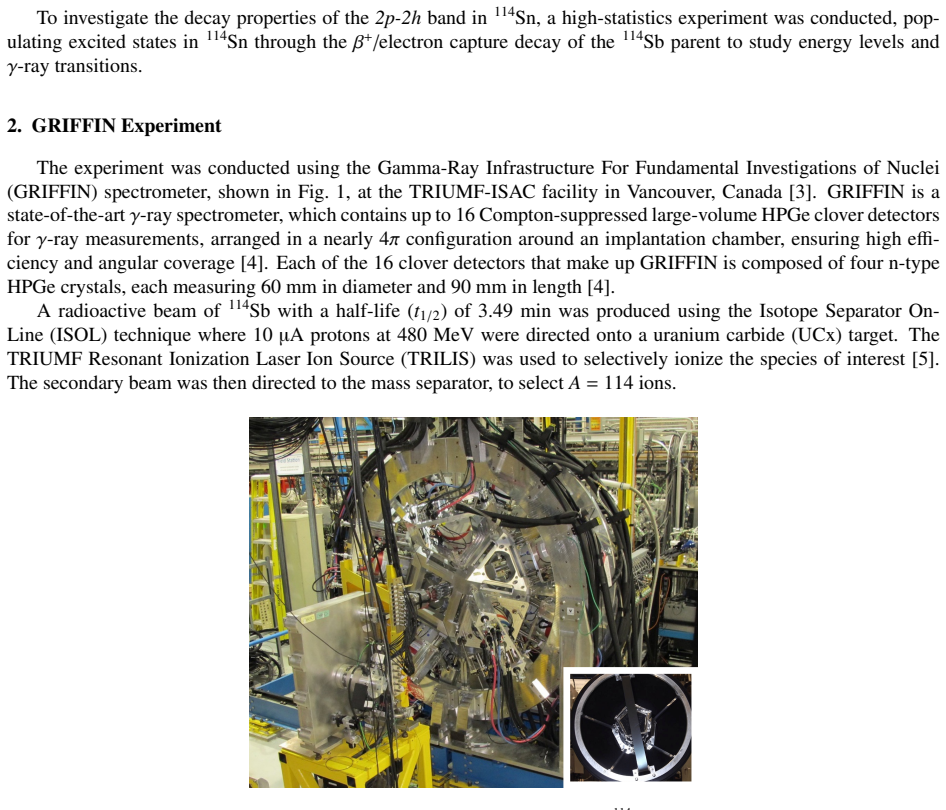
The semi-magic $^{110-122}\mathrm{Sn}$ isotopes display signs of shape coexistence in their excited $0^+$ states, which, in contrast to the spherical $0^+$ ground states, are deformed. This paper investigates the nuclear structure of $^{114}\mathrm{Sn}$ using the competing $\beta^+$ decay and electron capture of a radioactive beam of $^{114}\mathrm{Sb}$ produced at the TRIUMF-ISAC facility using the GRIFFIN spectrometer. This study will allow for an in-depth understanding of the excited $0^+$ states in $^{114}\mathrm{Sn}$, by focusing on their decay patterns. In the present experiment, transitions at 856.2-keV and 1405.0-keV, which were observed in an earlier $\beta^+$ decay study but not placed in the $^{114}\mathrm{Sn}$ level scheme, have been assigned to the level scheme in connection to the $0^+_3$ level at 2156.0-keV. Properly assigning these transitions refines the level scheme and enhances our understanding of the nuclear structure in $^{114}\mathrm{Sn}$.
Figures


Figures from the paper (1 more)

Reference graph
Works this paper leans on
-
[13]
Araddad, et al., Mixtures of multipoles inγtransitions from the reaction 114Sn(n, n’γ), Bull
S. Araddad, et al., Mixtures of multipoles inγtransitions from the reaction 114Sn(n, n’γ), Bull. Acad. Sci. USSR Phys.Ser. 54 (1990) 156. 5
work page 1990
-
[1]
K. Ortner, et al., Collective 2p-2h intruder states in 118Sn studied viaβdecay of 118In using the GRIFFIN spectrometer at TRIUMF, Phys. Rev. C 102 (2020) 024323. 4
work page 2020
-
[2]
J. L. Pore, et al., Study of the decay of 116m1In: A new interpretation of low-lying 0 + states in 116Sn, Eur. Phys. J. 53 (2017) :27
work page 2017
-
[3]
Garnsworthy, et al., The GRIFFIN facility for decay-spectroscopy studies at TRIUMF-ISAC, Nuc
A. Garnsworthy, et al., The GRIFFIN facility for decay-spectroscopy studies at TRIUMF-ISAC, Nuc. Instrum. Meth. A 918 (2019) 9–29
work page 2019
-
[4]
Rizwan, et al., Characteristics of GRIFFIN high-purity germanium clover detectors, Nuc
U. Rizwan, et al., Characteristics of GRIFFIN high-purity germanium clover detectors, Nuc. Instrum. Meth. A 820 (2016) 126–131
work page 2016
-
[5]
J. Lassen, et al., Developments at TRIUMF’s laser resonance ionization ion source & multi-element operation, Nuc. Instrum. Meth. B 541 (2023) 137–140
work page 2023
-
[6]
GRIFFIN experiment, Griffin experiment webpage,https://www.physics.uoguelph.ca/griffin, ac- cessed: 2025-04-10 (2020)
work page 2020
-
[7]
P. G. Bricault, et al., Rare isotope beams at ISAC—target & ion source systems, Springer Netherlands, Dor- drecht, 2014, pp. 25–49
work page 2014
Show all 13 references
-
[8]
Blachot, NDS, 113,515 (2012)
J. Blachot, NDS, 113,515 (2012)
2012
-
[9]
A. A. S. S. K. Basu, G. Mukherjee, NDS, 111,2555 (2010)
2010
-
[10]
M. E. J. Wigmans, et al., Decay of 111,112,113,114,115Sb, Phys. Rev. C 14 (1976) 229–242
1976
-
[11]
D. S. Andreev, et al., An investigation of the coulomb excitation of nuclear levels by means of accelerated, multi-charged ions, Izvest. Akad. Nauk. S.S.S.R., Ser. Fiz. 25 (1961)
1961
-
[12]
Spieker, et al., Shape coexistence and collective low-spin states in112,114Sn studied with the (p,p ′ γ) Doppler- shift attenuation coincidence technique, Phys
M. Spieker, et al., Shape coexistence and collective low-spin states in112,114Sn studied with the (p,p ′ γ) Doppler- shift attenuation coincidence technique, Phys. Rev. C 97 (2018) 054319
2018
Reviewed August 16, 2026 · model on record in the stance chip above.
Discussion (0). Continue with ORCID to comment.