REVIEW 3 minor 68 references
Photon avalanche triggered by a single photon in a bistable nonlinear optical cavity
T0 review · 0 major / 3 minor · reviewed 2026-06-29 · grok-4.3
Pith's one-line read A single incident photon can trigger a giant jump from the low- to high-photon-number state in a bistable nonlinear optical cavity.
desk verdict Quantum master equation numerics show a single photon can trigger a bistable jump in a driven nonlinear cavity, with the detector suggestion left underdeveloped. read the letter →
The pith
A machine-rendered reading of the paper's core claim, the machinery that carries it, and where it could break.
The reading
What carries the argument
The optical bistability loop of the nonlinear cavity, in which a single-photon-stimulated jump occurs between the two stable photon-number states.
What would settle it
An experiment that injects a single photon into the driven cavity near the bistability threshold and measures whether the transmitted or reflected intensity switches from the low- to the high-photon-number regime with high probability.
Extended reading notes
Core claim
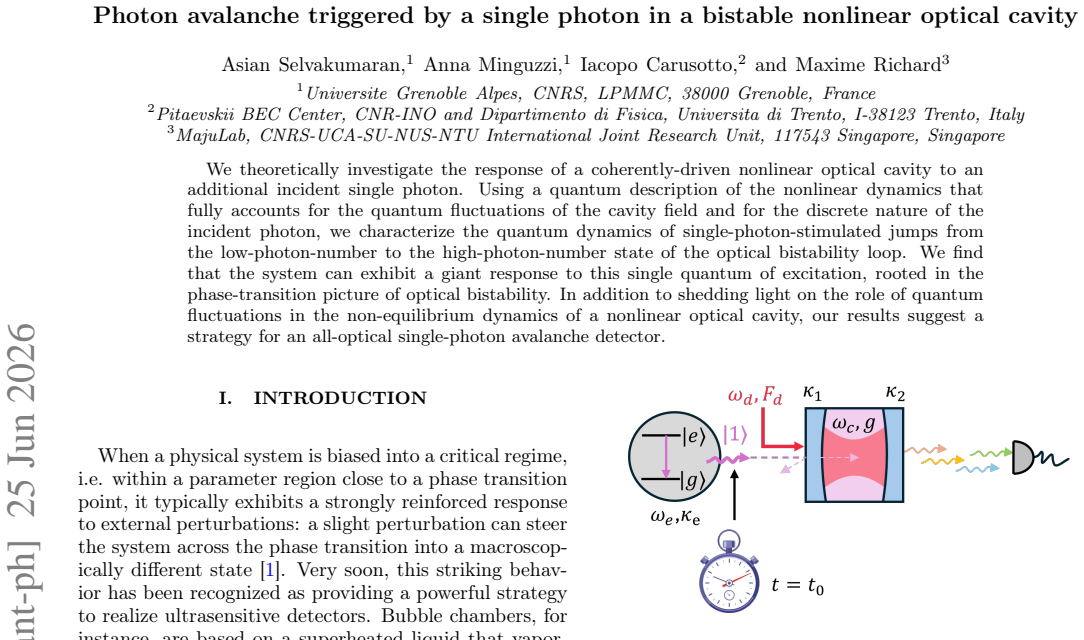
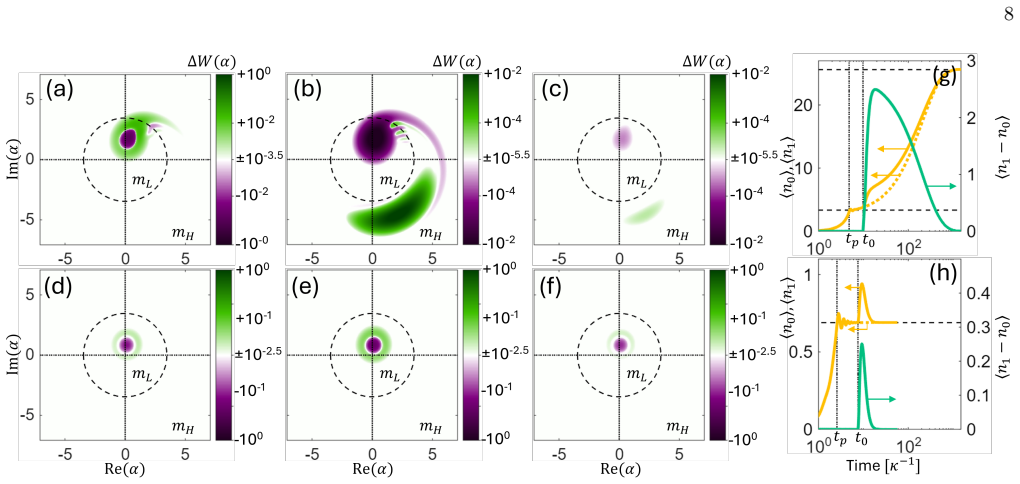
The quantum dynamics of the cavity allow a single photon to stimulate a jump across the bistability loop, producing a macroscopic change in photon number rooted in the non-equilibrium phase-transition picture of optical bistability.
Load-bearing premise
A quantum description that fully accounts for cavity-field fluctuations and the discrete nature of the incident photon is sufficient to produce and characterize the jump from the low- to high-photon-number state.
Editorial extensions
If this is right
- The cavity exhibits a giant response to single-photon excitation.
- Quantum fluctuations drive the non-equilibrium jump dynamics across the bistability loop.
- The mechanism supplies a concrete strategy for realizing an all-optical single-photon avalanche detector.
- The results clarify how quantum effects shape the switching behavior of nonlinear optical cavities.
Reading between the lines
- The same bistability mechanism could be tested in other cavity platforms to check whether the switching probability depends on the precise timing of the added photon.
- If the avalanche works, it may extend to related bistable systems such as driven atomic ensembles or semiconductor microcavities for single-particle sensing.
- The approach suggests a route to photon-number amplification that might be combined with existing cavity-QED techniques to build controlled single-photon switches.
Signed reviews
Editorial analysis
A structured set of objections, weighed in public.
Referee Report
Summary. The manuscript claims that a full quantum treatment via the master equation for a coherently driven nonlinear (Kerr-type) optical cavity, with an incident single photon introduced as an initial Fock component or short pulse, produces a stimulated jump from the low- to high-photon-number attractor of the bistability loop. Numerical propagation of the density matrix is used to characterize the dynamics, yielding a giant response framed in the phase-transition picture of optical bistability, with suggested application to an all-optical single-photon avalanche detector.
Significance. If the central numerical result holds, the work provides a concrete quantum-mechanical illustration of how cavity-field fluctuations and the discrete nature of the trigger photon enable an avalanche-like transition between bistable states. This strengthens the connection between non-equilibrium phase-transition concepts and single-photon-level control in driven-dissipative systems and offers a falsifiable route toward a new class of photon detector.
minor comments (3)
- [§2] §2 (model Hamiltonian): the precise form of the single-photon input term (coherent pulse versus Fock-state addition) and its normalization should be stated explicitly so that the initial condition can be reproduced.
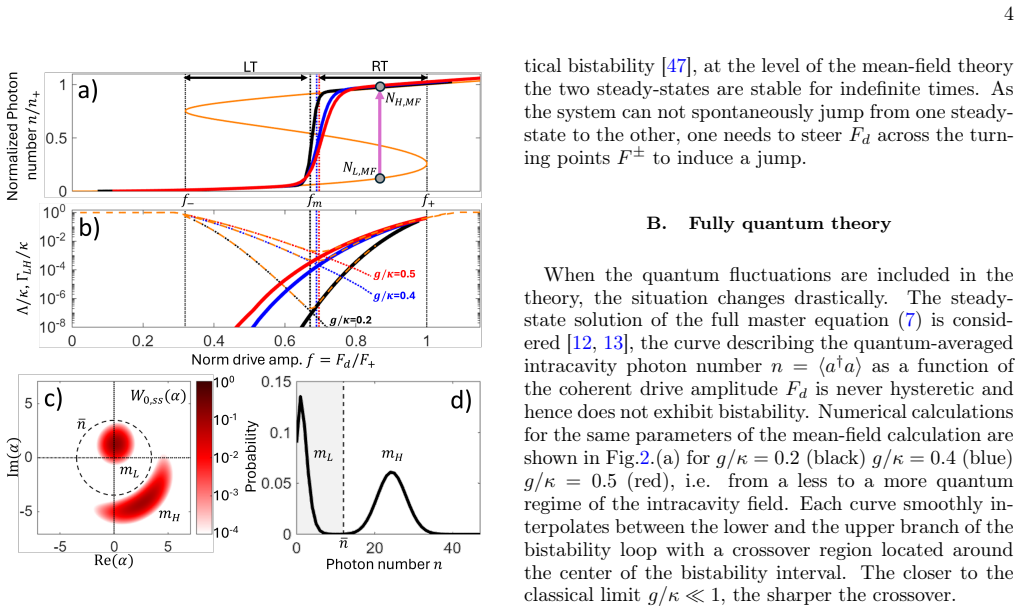
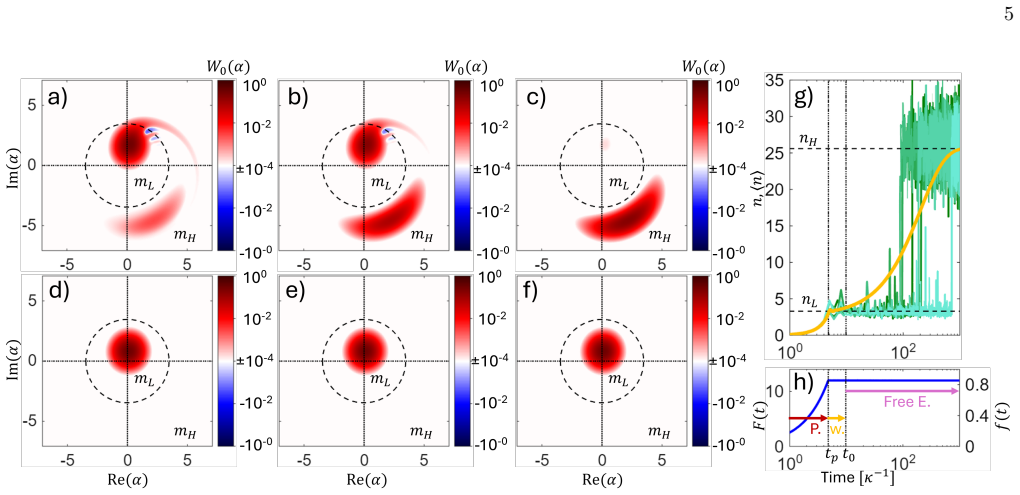
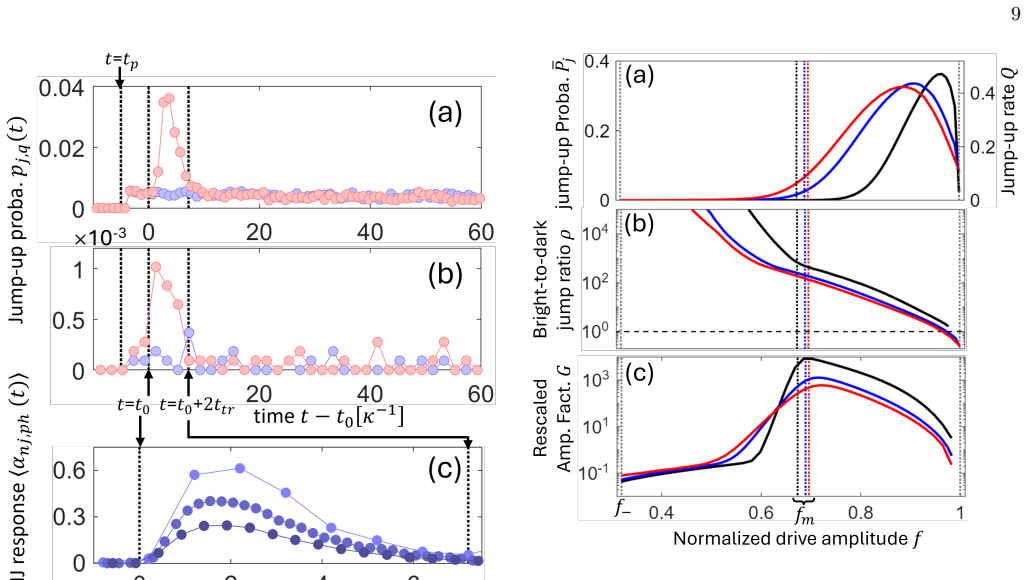
- [Figure 2] Figure 2 caption and surrounding text: the photon-number histograms before and after the trigger should include the steady-state values of the two attractors obtained from the semiclassical bistability curve for direct comparison.
- [§3.2] §3.2 (parameter scan): the range of detuning and drive strength over which the single-photon jump occurs should be shown as a phase diagram rather than selected traces, to clarify the robustness of the effect.
Simulated Author's Rebuttal
We thank the referee for their positive evaluation of our manuscript, including the assessment of its significance in connecting quantum fluctuations to non-equilibrium phase transitions and the suggestion of an all-optical single-photon avalanche detector. The recommendation for minor revision is noted. No specific major comments were raised in the report.
Circularity Check
No significant circularity detected
full rationale
The manuscript computes the quantum dynamics of a driven Kerr cavity via the master equation, with the single-photon trigger introduced explicitly as an initial Fock component or short pulse; the observed jump between the low- and high-photon-number attractors is obtained by direct numerical propagation of the density matrix. No fitted parameters are renamed as predictions, no self-definitional relations appear in the equations, and the bistability loop itself is recovered from the standard driven-dissipative model without reduction to prior self-citations. The derivation chain is therefore self-contained against external benchmarks.
Assumptions & free parameters
Cite this review
Pith. "Pith review of Photon avalanche triggered by a single photon in a bistable nonlinear optical cavity." pith.science (2026). https://pith.science/paper/6IZYFLM7
@misc{pith2026260627555,
  author       = {Pith},
  title        = {Pith review of: Photon avalanche triggered by a single photon in a bistable nonlinear optical cavity},
  year         = {2026},
  howpublished = {\url{https://pith.science/paper/6IZYFLM7}},
  note         = {Machine review of arXiv:2606.27555}
}
read the original abstract
We theoretically investigate the response of a coherently-driven nonlinear optical cavity to an additional incident single photon. Using a quantum description of the nonlinear dynamics that fully accounts for the quantum fluctuations of the cavity field and for the discrete nature of the incident photon, we characterize the quantum dynamics of single-photon-stimulated jumps from the low-photon-number to the high-photon-number state of the optical bistability loop. We find that the system can exhibit a giant response to this single quantum of excitation, rooted in the phase-transition picture of optical bistability. In addition to shedding light on the role of quantum fluctuations in the non-equilibrium dynamics of a nonlinear optical cavity, our results suggest a strategy for an all-optical single-photon avalanche detector.
Figures
Figures from the paper (4 more)
Reference graph
Works this paper leans on
-
[1]
Huang, Statistical Mechanics, 2nd Ed (Wiley India Pvt
K. Huang, Statistical Mechanics, 2nd Ed (Wiley India Pvt. Limited, 2008)
2008
-
[2]
C. T. R. Wilson, Proc. R. Soc. Lond. A Math. Phys. Sci. 85, 285 (1911)
1911
-
[3]
D. A. Glaser and D. C. Rahm, Phys. Rev.97, 474 (1955)
1955
-
[4]
K. D. Irwin, Applied Physics Letters66, 1998 (1995)
1998
-
[5]
C. M. Natarajan, M. G. Tanner, and R. H. Hadfield, Su- perconductor Science and Technology25, 063001 (2012)
2012
-
[6]
D.F.WallsandG.J.Milburn, Quantum optics(Springer Science & Business Media, 2008)
2008
-
[7]
Carusotto and C
I. Carusotto and C. Ciuti, Rev. Mod. Phys.85, 299 (2013)
2013
-
[8]
Bloch, I
J. Bloch, I. Carusotto, and M. Wouters, Nature Reviews Physics4, 470 (2022)
2022
Show all 68 references
-
[9]
Graham and H
R. Graham and H. Haken, Zeitschrift für Physik237, 31 (1970)
1970
-
[10]
DeGiorgio and M
V. DeGiorgio and M. O. Scully, Phys. Rev. A2, 1170 (1970)
1970
-
[11]
Gatti and L
A. Gatti and L. Lugiato, Phys. Rev. A52, 1675 (1995)
1995
-
[12]
Bonifacio and L
R. Bonifacio and L. A. Lugiato, Phys. Rev. Lett.40, 1023 (1978)
1978
-
[13]
P. D. Drummond and D. F. Walls, Journal of Physics A: Mathematical and General13, 725 (1980)
1980
-
[14]
Bartolo, F
N. Bartolo, F. Minganti, W. Casteels, and C. Ciuti, Phys. Rev. A94, 033841 (2016)
2016
-
[15]
Beaulieu, F
G. Beaulieu, F. Minganti, S. Frasca, V. Savona, S. Fe- licetti, R. Di Candia, and P. Scarlino, Nature Communi- cations16, 1954 (2025)
1954
-
[16]
Casteels, R
W. Casteels, R. Fazio, and C. Ciuti, Phys. Rev. A95, 012128 (2017)
2017
-
[17]
Bakemeier, A
L. Bakemeier, A. Alvermann, and H. Fehske, Phys. Rev. A85, 043821 (2012)
2012
-
[18]
Puebla, M.-J
R. Puebla, M.-J. Hwang, J. Casanova, and M. B. Plenio, Phys. Rev. Lett.118, 073001 (2017)
2017
-
[19]
A. D. Greentree, C. Tahan, J. H. Cole, and L. C. L. Hollenberg, Nature Physics2, 856 (2006)
2006
-
[20]
D. G. Angelakis, M. F. Santos, and S. Bose, Phys. Rev. A76, 10.1103/PhysRevA.76.031805 (2007)
2007 doi
-
[21]
M. J. Hartmann, F. G. S. L. Brandão, and M. B. Plenio, Nature Phys.2, 849 (2006)
2006
-
[22]
Lebreuilly, A
J. Lebreuilly, A. Biella, F. Storme, D. Rossini, R. Fazio, C. Ciuti, and I. Carusotto, Physical Review A96, 033828 (2017)
2017
-
[23]
Biella, F
A. Biella, F. Storme, J. Lebreuilly, D. Rossini, R. Fazio, I. Carusotto, and C. Ciuti, Physical Review A96, 023839 (2017)
2017
-
[24]
H. J. Carmichael, Phys. Rev. X5, 031028 (2015)
2015
-
[25]
R. Ma, B. Saxberg, C. Owens, N. Leung, Y. Lu, J. Simon, and D. I. Schuster, Nature566, 51 (2019)
2019
-
[26]
Wiesenfeld and B
K. Wiesenfeld and B. McNamara, Phys. Rev. Lett.55, 13 (1985)
1985
-
[27]
Vijay, M
R. Vijay, M. H. Devoret, and I. Siddiqi, Review of Scien- tific Instruments80, 111101 (2009)
2009
-
[28]
Zanardi, M
P. Zanardi, M. G. A. Paris, and L. Campos Venuti, Phys. Rev. A78, 042105 (2008)
2008
-
[29]
Garbe, M
L. Garbe, M. Bina, A. Keller, M. G. A. Paris, and S. Fe- licetti, Phys. Rev. Lett.124, 120504 (2020)
2020
-
[30]
A. Roy, S. Jahani, C. Langrock, M. Fejer, and A. Marandi, Nature Communications12, 835 (2021)
2021
-
[31]
Felicetti, npj Quantum Information9, 23 (2023)
R.DiCandia, F.Minganti, K.Petrovnin, G.S.Paraoanu, and S. Felicetti, npj Quantum Information9, 23 (2023)
2023
-
[32]
Beaulieu, F
G. Beaulieu, F. Minganti, S. Frasca, M. Scigliuzzo, S. Fe- licetti, R. Di Candia, and P. Scarlino, PRX Quantum6, 020301 (2025)
2025
-
[33]
S.-B. Tang, H. Qin, B.-B. Liu, D.-Y. Wang, K. Cui, S.-L. Su, L.-L. Yan, and G. Chen, Phys. Rev. A108, 053514 (2023)
2023
-
[34]
Petrovnin, J
K. Petrovnin, J. Wang, M. Perelshtein, P. Hakonen, and G. S. Paraoanu, PRX Quantum5, 020342 (2024)
2024
-
[35]
Vogel and H
K. Vogel and H. Risken, Physical Review A38, 2409 (1988)
1988
-
[36]
Vogel and H
K. Vogel and H. Risken, Physical Review A39, 4675 (1989)
1989
-
[37]
S. R. K. Rodriguez, W. Casteels, F. Storme, N. Car- lon Zambon, I. Sagnes, L. Le Gratiet, E. Galopin, A. Lemaître, A. Amo, C. Ciuti, and J. Bloch, Physical Review Letters118, 247402 (2017)
2017
-
[38]
Fitzpatrick, N
M. Fitzpatrick, N. M. Sundaresan, A. C. Y. Li, J. Koch, and A. A. Houck, Phys. Rev. X7, 011016 (2017)
2017
-
[39]
T. Fink, A. Schade, S. Höfling, C. Schneider, and A. Imamoglu, Nature Physics14, 365 (2018)
2018
-
[40]
H. J. Carmichael, Phys. Rev. Lett.70, 2273 (1993)
1993
-
[41]
Breuer and F
H.-P. Breuer and F. Petruccione, The theory of open quantum systems (OUP Oxford, 2002)
2002
-
[42]
H.Carmichael, An open systems approach to quantum optics (Springer, 1993)
1993
-
[43]
Gardiner, Physical review letters70, 2269 (1993)
C. Gardiner, Physical review letters70, 2269 (1993)
1993
-
[44]
Johansson, P
J. Johansson, P. Nation, and F. Nori, Computer Physics Communications183, 1760 (2012)
2012
-
[45]
Johansson, P
J. Johansson, P. Nation, and F. Nori, Computer Physics Communications184, 1234 (2013)
2013
-
[46]
Lambert, E
N. Lambert, E. Giguère, P. Menczel, B. Li, P. Hopf, G. Suárez, M. Gali, J. Lishman, R. Gadhvi, R. Agarwal, A. Galicia, N. Shammah, P. Nation, J. R. Johansson, S. Ahmed, S. Cross, A. Pitchford, and F. Nori, Physics Reports1153, 1 (2026)
2026
-
[47]
R. W. Boyd,Nonlinear Optics (2), Vol. 611
-
[48]
Claude, M
F. Claude, M. J. Jacquet, R. Usciati, I. Carusotto, E. Gi- acobino, A. Bramati, and Q. Glorieux, Physical Review Letters129, 103601 (2022)
2022
-
[49]
A. Baas, J. P. Karr, H. Eleuch, and E. Giacobino, Phys. Rev. A69, 023809 (2004)
2004
-
[50]
Togan, H.-T
E. Togan, H.-T. Lim, S. Faelt, W. Wegscheider, and A. Imamoglu, Phys. Rev. Lett.121, 227402 (2018)
2018
-
[51]
Rosenberg, D
I. Rosenberg, D. Liran, Y. Mazuz-Harpaz, K. West, L. Pfeiffer, and R. Rapaport, Science Advances4, eaat8880 (2018), https://www.science.org/doi/pdf/10.1126/sciadv.aat8880
2018 doi
-
[52]
L. B. Tan, O. Cotlet, A. Bergschneider, R. Schmidt, P. Back, Y. Shimazaki, M. Kroner, and A. m. c. İmamoğlu, Phys. Rev. X10, 021011 (2020)
2020
-
[53]
Munoz-Matutano, A
G. Munoz-Matutano, A. Wood, M. Johnsson, X. Vidal, B. Q. Baragiola, A. Reinhard, A. Lemaître, J. Bloch, A. Amo, G. Nogues, B. Besga, M. Richard, and T. Volz, Nature Materials18, 213 (2019)
2019
-
[54]
Delteil, T
A. Delteil, T. Fink, A. Schade, S. Höfling, C. Schneider, and A. Imamoglu, Nature Materials18, 219 (2019)
2019
-
[55]
Datta, M
B. Datta, M. Khatoniar, P. Deshmukh, F. Thouin, R. Bushati, S. De Liberato, S. K. Cohen, and V. M. Menon, Nature Communications13, 6341 (2022)
2022
-
[56]
Inomata, Z
K. Inomata, Z. Lin, K. Koshino, W. D. Oliver, J.-S. Tsai, T. Yamamoto, and Y. Nakamura, Nature Communica- tions7, 12303 (2016)
2016
-
[57]
Lescanne, S
R. Lescanne, S. Deléglise, E. Albertinale, U. Réglade, T. Capelle, E. Ivanov, T. Jacqmin, Z. Leghtas, and E. Flurin, Phys. Rev. X10, 021038 (2020)
2020
-
[58]
Besse, S
J.-C. Besse, S. Gasparinetti, M. C. Collodo, T. Walter, P. Kurpiers, M. Pechal, C. Eichler, and A. Wallraff, Phys. Rev. X8, 021003 (2018)
2018
-
[59]
Oppliger, W
F. Oppliger, W. Jang, A. Tarascio, F. D. Palma, C. Re- ichl, W. Wegscheider, V. F. Maisi, D. Zumbühl, and P.Scarlino,High-efficiencytunablemicrowavephotonde- tector based on a semiconductor double quantum dot coupled to a superconducting high-impedance cavity (2025), arXiv:2506.19828
2025 arXiv
-
[60]
Matern, A
S. Matern, A. Biella, P. Scarlino, I. Carusotto, and G. Rastelli, arXiv preprint arXiv:2511.19128 (2025)
2025
-
[61]
Zeller, L
H. Zeller, L. Danner, M. Hofheinz, C. Padurariu, J. Ankerhold, and B. Kubala, Stroboscopic detection of itinerant microwave photons (2026), arXiv:2603.16522 [quant-ph]
2026
-
[62]
Blais, A
A. Blais, A. L. Grimsmo, S. M. Girvin, and A. Wallraff, Reviews of Modern Physics93, 025005 (2021)
2021
-
[63]
Zenesini, A
A. Zenesini, A. Berti, R. Cominotti, C. Rogora, I. G. Moss, T. P. Billam, I. Carusotto, G. Lamporesi, A. Re- cati, G.Ferrari,andetal.,NaturePhysics20,558(2024)
2024
-
[64]
Lagnese, F
G. Lagnese, F. M. Surace, M. Kormos, and P. Calabrese, Phys. Rev. B104, L201106 (2021)
2021
-
[65]
C.Johansen, A.Recati, I.Carusotto,andA.Biella,arXiv preprint arXiv:2508.13780 (2025)
2025
-
[66]
Maertens, J
D. Maertens, J. Haegeman, and K. Van Acoleyen, arXiv preprint arXiv:2508.13645 (2025)
2025
-
[67]
Coleman, Phys
S. Coleman, Phys. Rev. D15, 2929 (1977)
1977
-
[68]
Devoto, S
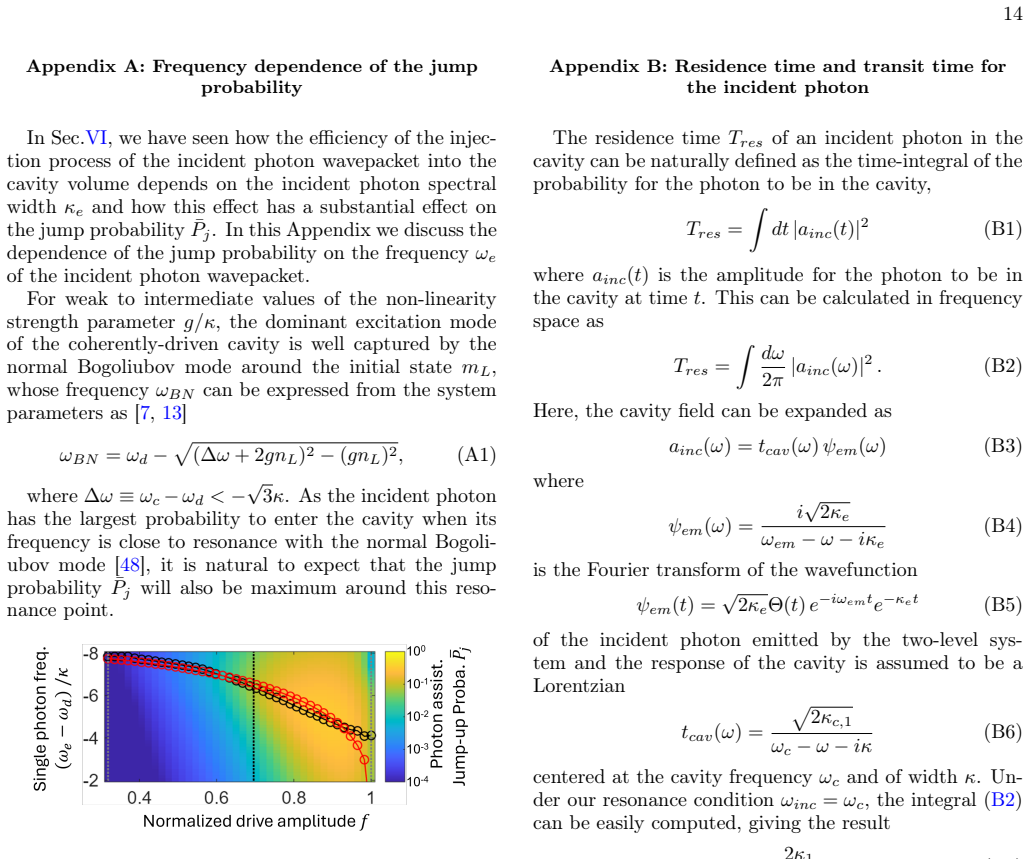
F. Devoto, S. Devoto, L. Di Luzio, and G. Ridolfi, J. Phys. G: Nucl. Part. Phys.49, 103001 (2022). 14 Appendix A: Frequency dependence of the jump probability In Sec.VI, we have seen how the efficiency of the injec- tion process of the incident photon wavepacket into the cavit...
2022
Reviewed June 29, 2026 · model on record in the stance chip above.
Discussion (0). Continue with ORCID to comment.