Analysis of Laser-Satellite Deconfliction for Astronomical Observatories
Pith reviewed 2026-06-25 22:07 UTC · model grok-4.3
The pith
Exposure duration and keep-out cone size determine the fraction of open time available for laser astronomy amid satellites.
A machine-rendered reading of the paper's core claim, the machinery that carries it, and where it could break.
Core claim
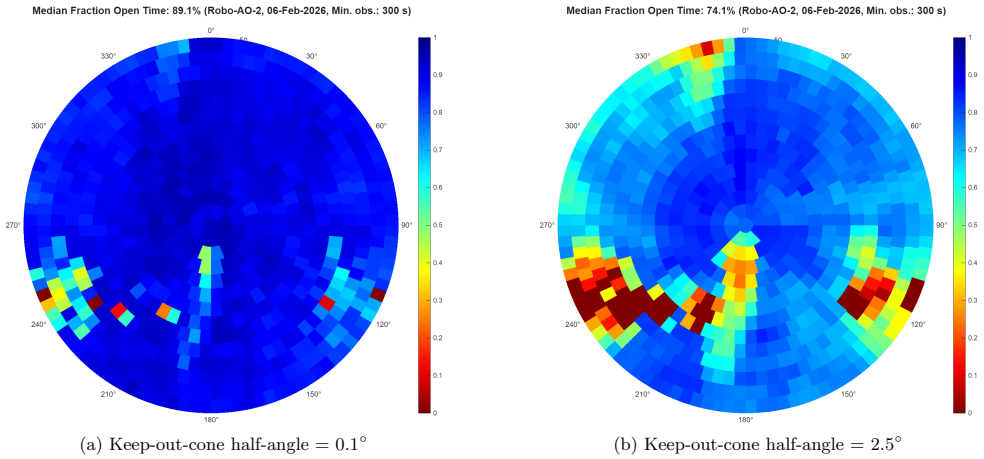
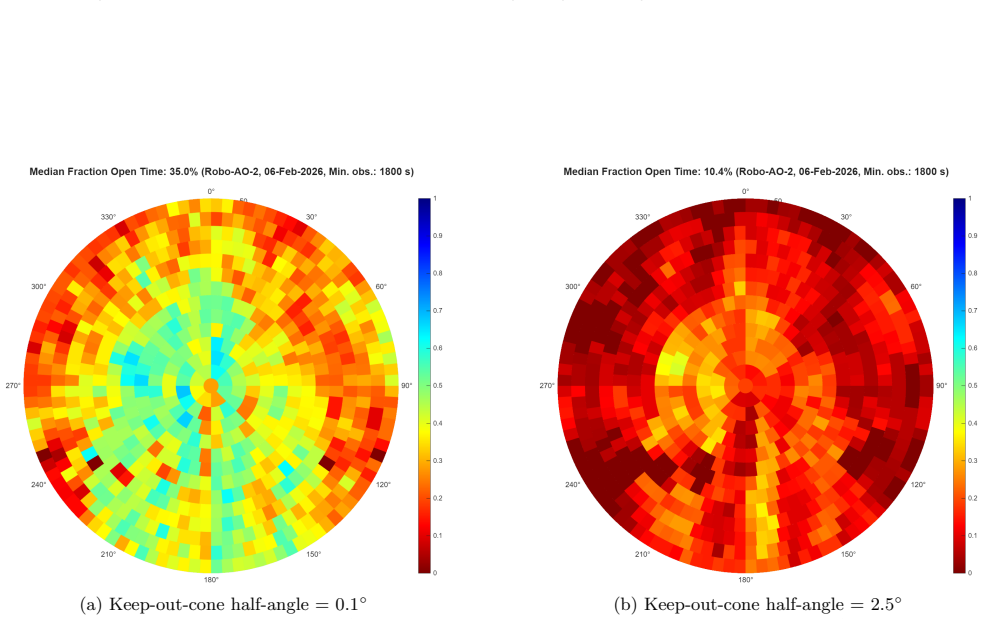
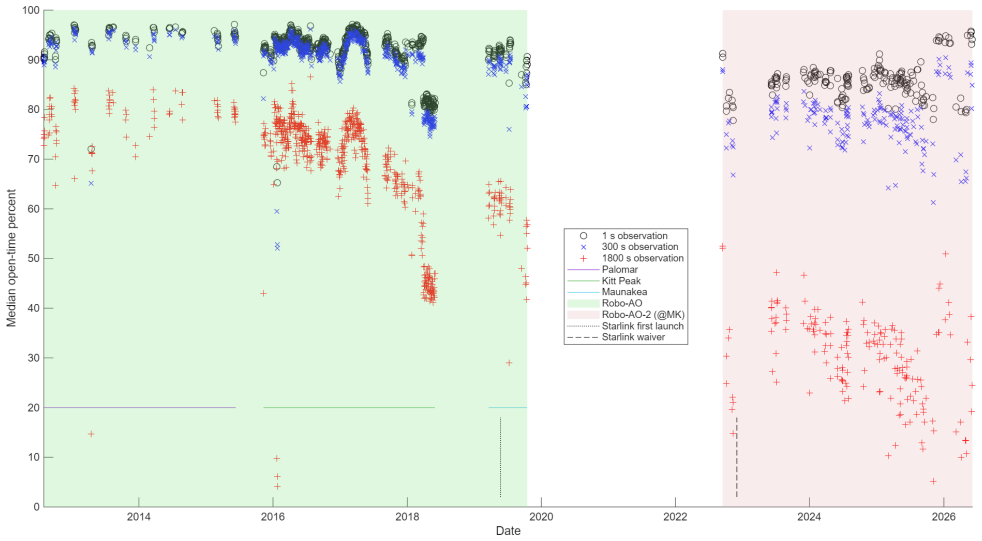
We present an analysis of laser-satellite deconfliction across three astronomical laser observatories for right ascension and declination targets and fixed azimuth and elevation ranges. This study uses new visualization tools to evaluate how different science exposure durations impact the total percentage of available open-time during observing nights. We further assess the operational efficiency of laser keep-out-cone half-angles from the default 2.5 degrees down to the 0.1-degree minimum. We also directly compare the open-time differences of right ascension and declination targets vs. fixed azimuth and elevation ranges. Finally, we analyze historical trends to quantify the growing effect o
What carries the argument
Keep-out-cone geometries that mark forbidden laser directions around predicted satellite positions, combined with visualization tools that sum the resulting open-time fractions for chosen exposures and target types.
If this is right
- Longer science exposure durations reduce the percentage of available open-time during observing nights.
- Reducing keep-out-cone half-angles from 2.5 degrees to 0.1 degrees increases the available open-time.
- Right ascension and declination targets produce different open-time percentages than fixed azimuth and elevation ranges.
- Growth in satellite mega-constellations lowers the fraction of open-time over successive years.
- Waiver protocols can recover some of the open-time lost to satellite interference.
Where Pith is reading between the lines
- Scheduling systems at these observatories could favor shorter exposures when satellite density is high to protect total usable time.
- The same modeling approach could forecast when projected constellation growth would make certain long-exposure laser programs operationally unviable.
- Comparing the calculated losses against non-laser facilities would show the relative operational penalty borne only by laser-equipped sites.
Load-bearing premise
The models of satellite positions, keep-out-cone geometries, and historical mega-constellation trends accurately reflect real operational constraints without post-hoc adjustments or unstated data selection rules.
What would settle it
Direct comparison of the model's predicted open-time percentage for one observatory on one night against the actual measured fraction of time the laser remained unblocked by satellites under the same exposure and cone settings.
Figures
read the original abstract
We present an analysis of laser-satellite deconfliction across three astronomical laser observatories for right ascension and declination targets and fixed azimuth and elevation ranges. This study uses new visualization tools to evaluate how different science exposure durations impact the total percentage of available open-time during observing nights. We further assess the operational efficiency of laser keep-out-cone half-angles from the default 2.5 degrees down to the 0.1-degree minimum. We also directly compare the open-time differences of right ascension and declination targets vs. fixed azimuth and elevation ranges. Finally, we analyze historical trends to quantify the growing effect of satellite mega-constellations and the efficacy of specific waiver protocols on ground-based laser astronomy.
Editorial analysis
A structured set of objections, weighed in public.
Referee Report
Summary. The manuscript presents an analysis of laser-satellite deconfliction at three astronomical observatories. It quantifies the fraction of available open observing time as a function of science exposure duration, keep-out-cone half-angle (default 2.5° down to 0.1°), target type (RA/Dec versus fixed azimuth/elevation), and historical mega-constellation growth, while evaluating waiver protocols and introducing visualization tools for deconfliction assessment.
Significance. If the satellite ephemeris and cone models are shown to be reliable, the quantitative trends would supply observatory operators with concrete estimates of scheduling losses and the potential benefit of narrower cones or waivers, directly informing operational policy for laser facilities under increasing constellation density.
major comments (2)
- [Methods] Methods section: the open-time percentages for all exposure durations, cone angles, and target classes rest on satellite position models and keep-out-cone geometries, yet no validation against on-sky logs, cross-checks with independent propagators, or sensitivity tests to catalog choice is reported. This is load-bearing for every numerical result.
- [Results] Results section (historical trends paragraph): the quantification of mega-constellation growth effects and waiver efficacy is presented without stated data sources, parameterization details, or uncertainty ranges, preventing assessment of whether the reported trends are robust to reasonable variations in input assumptions.
minor comments (2)
- [Abstract] The abstract lists the three observatories and the visualization tools but does not name the observatories or describe the tools; adding these specifics would improve immediate clarity.
- Figure captions should explicitly state the data sources and any filtering applied to the satellite catalog used for each panel.
Simulated Author's Rebuttal
We thank the referee for the detailed report and the opportunity to clarify and strengthen the manuscript. We address each major comment below.
read point-by-point responses
-
Referee: [Methods] Methods section: the open-time percentages for all exposure durations, cone angles, and target classes rest on satellite position models and keep-out-cone geometries, yet no validation against on-sky logs, cross-checks with independent propagators, or sensitivity tests to catalog choice is reported. This is load-bearing for every numerical result.
Authors: We agree that explicit validation details are needed. Satellite positions rely on standard SGP4 propagation of public TLEs; in revision we will add a Methods subsection with cross-checks against an independent propagator for sample cases and sensitivity tests to catalog choice. On-sky log validation is not feasible here due to limited access to observatory-specific logs, but we will document the model basis and limitations clearly. revision: partial
-
Referee: [Results] Results section (historical trends paragraph): the quantification of mega-constellation growth effects and waiver efficacy is presented without stated data sources, parameterization details, or uncertainty ranges, preventing assessment of whether the reported trends are robust to reasonable variations in input assumptions.
Authors: The trends use the public Space-Track catalog with growth rates derived from observed launches through 2023. We will revise the paragraph to state the exact data source, parameterization (observed launch cadence with linear extrapolation), and uncertainty ranges from alternative deployment scenarios. revision: yes
Circularity Check
No circularity: analysis uses external models and data
full rationale
The paper conducts a direct computational analysis of open-time percentages based on satellite ephemeris models, keep-out-cone geometries, and historical mega-constellation trends. No equations or results reduce by construction to fitted parameters from the same dataset, no self-citations form load-bearing uniqueness claims, and no ansatz or renaming of known results is presented as a derivation. The work is self-contained against external benchmarks as an observational study rather than a closed-loop prediction.
Axiom & Free-Parameter Ledger
Reference graph
Works this paper leans on
-
[1]
IAU Symposium , year = 2026, editor =
The impact and mitigation of satellite constellations on astronomical laser propagation. IAU Symposium , year = 2026, editor =. doi:10.1017/S1743921324000887 , adsurl =
-
[2]
32nd General Assembly International Union (IAUGA 2024) , year = 2024, month = aug, eid =
The scientific importance of Laser Guide Star AO Systems and impacts arising from the protection of LEO satellites. 32nd General Assembly International Union (IAUGA 2024) , year = 2024, month = aug, eid =
2024
-
[3]
2026 , url =
https://www.space-track.org/documentation\#/lch , author =. 2026 , url =
2026
-
[4]
The Robo-AO-2 facility for rapid visible/near-infrared AO imaging and the demonstration of hybrid techniques. Adaptive Optics Systems VI , year = 2018, editor =. doi:10.1117/12.2312835 , archivePrefix =. 1806.01957 , primaryClass =
work page internal anchor Pith review Pith/arXiv arXiv doi:10.1117/12.2312835 2018
-
[5]
Adaptive Optics Systems IX , year = 2024, editor =
US adaptive optics roadmap to achieve Astro2020. Adaptive Optics Systems IX , year = 2024, editor =
2024
-
[6]
Adaptive Optics Systems IX , year = 2024, editor =
The evolution of robotic adaptive optics: Robo-AO 2.0 and SIGHT. Adaptive Optics Systems IX , year = 2024, editor =
2024
-
[7]
Automated Adaptive Optics. The WSPC Handbook of Astronomical Instrumentation, Volume 2: UV, Optical & IR Instrumentation: Part 1 , publisher= "World Scientific Publishing", year = 2021, editor =. doi:10.1142/9789811203787_0015 , adsurl =
-
[8]
High-efficiency Autonomous Laser Adaptive Optics
High-efficiency Autonomous Laser Adaptive Optics. ApJL , keywords =. doi:10.1088/2041-8205/790/1/L8 , archivePrefix =. 1407.8179 , primaryClass =
work page internal anchor Pith review Pith/arXiv arXiv doi:10.1088/2041-8205/790/1/l8 2041
-
[9]
The Performance of the Robo-AO Laser Guide Star Adaptive Optics System at the Kitt Peak 2.1 m Telescope. AJ , keywords =. doi:10.3847/1538-3881/aa9be6 , archivePrefix =. 1703.08867 , primaryClass =
work page internal anchor Pith review Pith/arXiv arXiv doi:10.3847/1538-3881/aa9be6
-
[10]
The Robo-AO software: fully autonomous operation of a laser guide star adaptive optics and science system. Adaptive Optics Systems III , year = 2012, editor =. doi:10.1117/12.925475 , archivePrefix =. 1301.6790 , primaryClass =
work page internal anchor Pith review Pith/arXiv arXiv doi:10.1117/12.925475 2012
-
[11]
Adaptive Optics Systems IX , year = 2024, editor =
Commissioning results from the Robo-AO-2 facility for rapid visible and near-infrared AO imaging. Adaptive Optics Systems IX , year = 2024, editor =. doi:10.1117/12.3019346 , archivePrefix =. 2407.00582 , primaryClass =
-
[12]
Astronomical Journal , keywords =
Large Adaptive Optics Survey for Substellar Objects around Young, Nearby, Low-mass Stars with Robo-AO. Astronomical Journal , keywords =. doi:10.3847/1538-3881/ac0445 , archivePrefix =. 2105.13364 , primaryClass =
discussion (0)
Sign in with ORCID, Apple, or X to comment. Anyone can read and Pith papers without signing in.