REVIEW 4 major objections 7 minor 1 cited by
RemoteSAM: Towards Segment Anything for Earth Observation
T0 review · 4 major / 7 minor · reviewed 2026-08-07 · deepseek-v4-flash
Pith's one-line read RemoteSAM proposes that a single referring-expression-segmentation model, trained on 270K remote-sensing triplets, can unify pixel-, region-, and image-level perception tasks and beat billion-parameter vision-language models on several…
desk verdict Genuinely interesting paradigm, but the benchmark numbers are compromised by train/test overlap and an internal inconsistency. read the letter →
The pith
A machine-rendered reading of the paper's core claim, the machinery that carries it, and where it could break.
The reading
What carries the argument
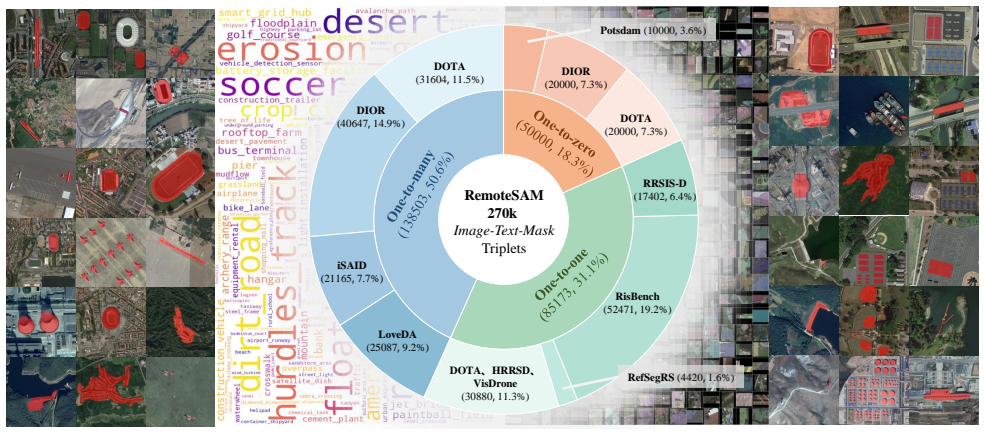
The load-bearing device is the referring-expression-segmentation interface: input an image and a free-form text prompt, output a binary mask. The paper defines a generalized triplet regime—one-to-one, one-to-many (all instances of a category), and one-to-zero (absent categories, to suppress spurious masks)—which lets one model answer "segment this thing," "find everything of this class," and "this class is not here." Around that mask the authors wrap deterministic converters: mask-to-bbox for grounding, contour refinement plus mask-to-bbox for object detection, per-class mask aggregation for semantic segmentation, and max-plus-average confidence pooling for classification and counting.
What would settle it
Train RemoteSAM-270K after deleting every image that overlaps the RRSISD, RisBench, DOTA, DIOR, and iSAID test splits, then rerun the reported benchmarks; if the mIoU gains (71.75 and 71.46) shrink to parity with prior methods, the SOTA claim is explained by train/test leakage. A public check could also compare image hashes between the released dataset and the official test sets.
Extended reading notes
Core claim
RemoteSAM's central claim is that pixel-level masks are the fundamental output unit of vision, so every region- and image-level task can be derived from a mask by deterministic post-processing. The model is trained only for referring expression segmentation on RemoteSAM-270K, and at inference it turns the mask into a bounding box (mask-to-bbox), a semantic map (aggregating per-class masks), a multi-label prediction (pooling class confidence), an object count, and a caption. On benchmarks, it reports 71.75 mIoU on RRSISD and 71.46 on RisBench, surpassing prior referring-segmentation methods by more than 3 points; it also reports 94% and 95% multi-label accuracy on DIOR and DOTAv2, 74.36 AP50 on RSVG grounding, 62.0% counting accuracy on DIOR, and state-of-the-art zero-shot semantic segmentation on Potsdam (91.80 mF1), all with 180M parameters.
Load-bearing premise
The central numbers assume the RRSISD and RisBench test images never appear in RemoteSAM-270K's training triplets, since the paper builds the dataset from those same benchmarks and reports no held-out split.
Editorial extensions
If this is right
- If RemoteSAM is right, a single foundation model can serve pixel-, region-, and image-level remote sensing tasks without per-task decoders or LLM backbones.
- The scale and semantic breadth of RemoteSAM-270K is claimed to be the main driver of generalization: more categories and attributes transfer to unseen datasets, as shown by zero-shot classification on SATIN and open-vocabulary segmentation on Vaihingen, UDD5, and DeepGlobe.
- Because mask-based outputs are deterministic, the model's behavior on detection, counting, and classification is directly traceable to its segmentation quality; errors in masks become errors in all downstream tasks.
- The parameter efficiency claim becomes concrete for deployment: 180M parameters versus 7B for vision-language rivals, which is material when processing high-resolution remote sensing imagery.
- The RSVocab-1K vocabulary provides a reusable instrument for measuring whether any remote sensing dataset has enough category and attribute coverage to support foundation-model training.
Reading between the lines
- Left implicit: the mask-first interface could extend to multispectral, multitemporal, or radar imagery without changing the architecture, since band-specific or time-specific attributes can be expressed in the text prompt.
- Testable extension: applying the same mask-conversion pipeline to natural-image referring-segmentation benchmarks would reveal whether task unification is a general vision principle or specific to remote sensing.
- An unstated corollary: because image-level outputs are pooled from masks, referring-segmentation mIoU is the single health metric; gains there should propagate upward to detection, counting, and classification, making segmentation accuracy a sufficient optimization target.
- The paper's transfer claims would be strengthened by explicitly reporting which images from RRSISD, RisBench, DOTA, DIOR, and iSAID were excluded from RemoteSAM-270K, since the dataset is built directly from those benchmarks.
Editorial analysis
A structured set of objections, weighed in public.
Referee Report
Summary. The paper proposes RemoteSAM, a referring-expression-segmentation (RES) foundation model for Earth observation, together with a new large-scale dataset RemoteSAM-270K built by integrating existing remote sensing segmentation and detection annotations and by using VLM-generated expressions. The authors claim that a single 180M-parameter model, without task-specific heads, can unify pixel-level (referring and semantic segmentation), region-level (grounding, detection), and image-level (multi-label classification, counting, captioning) tasks, and they report state-of-the-art results on RRSISD, RisBench, iSAID, DIOR, DOTAv2, and Potsdam.
Significance. If the empirical claims were valid, the work would be significant: the RES-centered unification paradigm is conceptually clean, the dataset is substantially larger than prior referring segmentation resources, and the reported parameter efficiency (180M versus 7B VLMs) is attractive. The authors also ship models and data publicly, and they provide a hierarchical remote sensing vocabulary (RSVocab-1K) as a coverage-analysis tool. These are real strengths. However, the central empirical evidence is compromised by apparent train/test overlap between RemoteSAM-270K and the benchmarks used for the headline tables, and by hyperparameter selection on the same evaluation sets. The claimed SOTA results are therefore not currently supported.
major comments (4)
- [Section 3.1.1 and Tables 3, 4, 6, 7] The evaluation is not held-out with respect to the training corpus. Section 3.1.1 states that RemoteSAM-270K is built by directly integrating existing referring segmentation annotations from RefSegRS, RRSISD, and RisBench, and by converting detection/instance masks from DOTA, iSAID, DIOR, LoveDA, and Potsdam into mask triplets. Tables 3, 4, 6, and 7 then report performance on RRSISD, RisBench, iSAID, Potsdam, DIOR, and DOTAv2 without disclosing any train/test split. The headline numbers (e.g., 71.75 mIoU on RRSISD, 71.46 mIoU on RisBench, 64.72 mIoU on iSAID, 94%/95% multi-label accuracy on DIOR/DOTAv2) are indistinguishable from recognition of training images. The paper must provide per-image split provenance and re-run the evaluation under a protocol where no benchmark image appears in RemoteSAM-270K.
- [Appendix C, Table 14 vs Table 3] There is an internal inconsistency in the reported performance of the same architecture on the same dataset. Table 14 states that BERT+Swin-Base achieves 76.21 oIoU / 64.79 mIoU on RRSISD, while Table 3 reports RemoteSAM, which uses BERT+Swin-Base per Section 5.1.1, at 80.04 oIoU / 71.75 mIoU on RRSISD. The manuscript does not explain the protocol difference (e.g., training on a subset versus the full RemoteSAM-270K, different epochs, or different evaluation splits). This discrepancy undermines the reproducibility of the main table and must be resolved before the results can be trusted.
- [Section 4.3, Eq. (3), Fig. 22, Table 6] Hyperparameters are tuned on evaluation data. The balance factor lambda in Eq. (3) is selected by experiments on DIOR and UCM shown in Fig. 22, and the resulting model is then evaluated on DIOR and DOTAv2 in Table 6. Likewise, the classification threshold tau_cls in Eq. (4) is set on the same benchmarks. This means the reported multi-label and image classification accuracies partly reflect thresholds fitted to the test set, inflating the measured performance. The authors should either fix these hyperparameters a priori or tune them on a separate validation split, and then report results on a truly disjoint test set.
- [Appendix C, Table 16 vs Table 6] A large discrepancy between two tables reporting the same task is unexplained. Table 16 reports that the prob-level multi-label classification strategy achieves 94.042% on DIOR and 75.752% on DOTAv2, whereas Table 6 reports RemoteSAM at 94% and 95% on the same datasets. If these numbers came from different protocols (e.g., different label sets, different image subsets, or different thresholds), the paper must say so; otherwise the inconsistency calls both tables into question.
minor comments (7)
- [Section 3.2] The vocabulary is named 'RSVocab-1K' in the text but appears as 'RSBocab-1K' in one instance; please fix the typo.
- [Section 3.1.2] The word 'Supplymentary' should be 'Supplementary'.
- [Appendix C] The phrase 'lass-wise probability aggregation function' should be 'class-wise probability aggregation function'.
- [Fig. 22] The right panel of Fig. 22 is labeled 'UCM' but the text does not state which task or metric it reports (e.g., multi-label accuracy or scene classification accuracy); please clarify the axis and the task.
- [Section 5.1.2] The evaluation setup lists DOTA, DIOR, iSAID, Potsdam, and RSVG but omits RRSISD and RisBench, which are used in Table 3 and the appendix; the dataset list should be complete.
- [Table 1] The column '#Attr/Sample' for RemoteSAM-270K is 3.17, but the paper also reports 16 attribute types; please define whether this is the average number of attributes per expression and clarify the counting method.
- [Table 4] The 'Pre-trained Data' column for RemoteSAM is 'RemoteSAM-270K', which includes iSAID and Potsdam images; since these are also the evaluation datasets in the same table, a footnote is needed to state that these results are not held-out.
Circularity Check
Benchmark predictions are partly fitted inputs: RRSISD/RisBench annotations are integrated into RemoteSAM-270K and then evaluated with no disclosed held-out split, and DIOR accuracy uses lambda tuned on DIOR.
-
fitted input called prediction
[Section 3.1.1 (One-to-One strategy) vs Section 5.1.2 and Table 3]
"'One-to-One': Directly integrate existing referring segmentation annotations from RefSegRS [79], RRSISD [43], and RisBench [17]. ... We compared our approach against previous SOTA referring segmentation models across two large-scale datasets: RRSISD [43] and RisBench [17]."
The training set RemoteSAM-270K is explicitly built by integrating the RRSISD and RisBench ground-truth referring annotations as training triplets. The same two datasets are then used as the evaluation benchmarks in Table 3, with no disclosed train/test split. The reported SOTA values (RRSISD 71.75 mIoU, RisBench 71.46 mIoU) are therefore measured on data whose annotations entered the training set: the 'prediction' is recognition of training samples rather than held-out generalization. This is further aggravated by the internal inconsistency that Table 14 reports the same BERT+Swin-Base architecture at 76.21 oIoU / 64.79 mIoU on RRSISD while Table 3 gives 80.04 oIoU / 71.75 mIoU for the same architecture and dataset, indicating an undisclosed protocol difference.
-
fitted input called prediction
[Appendix C, Fig. 22 and Eq. 3 vs Table 6]
"To ascertain the optimal balance factor values for classification, we conduct experiments by varying the balance factor λ within the lass-wise probability aggregation function (Eq.3). The experimental results are illustrated in Fig. 22. The results indicate that when λ is set to 0.5 and 1, Multi-Label Classification and Image Classification achieved the highest accuracy, respectively. Therefore, we adopt this set of parameters for our final test results."
The pooling balance parameter λ in Eq. 3 is selected by optimizing accuracy on DIOR (shown in Fig. 22, where the DIOR accuracy curve is plotted against λ) and on UCM. Table 6 then reports RemoteSAM's 94% multi-label accuracy on DIOR as a benchmark result. Because the free parameter governing the classification decision was fitted to the evaluation set, the reported DIOR number is a fitted value rather than a genuine prediction; the same issue applies to the threshold τ_cls defaulting to 0.5 in Eq. 4, which was not validated on a held-out split.
full rationale
The central SOTA claim is partly circular by construction. Section 3.1.1 states that the RemoteSAM-270K training set is built by directly integrating existing referring segmentation annotations from RefSegRS, RRSISD, and RisBench, yet Section 5.1.2 and Table 3 evaluate on RRSISD and RisBench without disclosing a held-out split. Consequently, the headline referring-segmentation results are not independent evidence of generalization. Similarly, the multi-label DIOR accuracy in Table 6 depends on λ tuned on DIOR in Fig. 22, so that number is a fitted value. These issues reduce the force of the paper's 'new SoTA' claim on those specific benchmarks. However, not all evidence is circular: Table 2 evaluates semantic segmentation on unseen datasets (Vaihingen, UDD5, DeepGlobe), Table 5 evaluates visual grounding on RSVG, and Fig. 7 evaluates zero-shot classification on SATIN, all of which are outside RemoteSAM-270K and provide independent support for the model's generalization. The mask-to-bbox conversion in Eq. 2 and the counting/classification post-processing are algorithmic transformations, not circular derivations. The self-citations (e.g., RemoteCLIP for M2B, EPOC from a co-author, PoCa captioning) are implementation details and are not load-bearing for the central claim. There is no self-citation chain that forces the architecture; the main problem is benchmark overlap and hyperparameter selection on evaluation data. Hence the score is 6: several headline predictions reduce to training or tuning inputs, but meaningful independent evaluation exists elsewhere, so the paper is not wholly circular.
Assumptions & free parameters
free parameters (4)
- lambda (classification balance factor) =
0.5 (multi-label), 1.0 (image classification)
- tau_cls (classification threshold) =
0.5 (default)
- tau_seg (semantic segmentation threshold) =
not reported
- SigLIP2 similarity cutoff for data filtering =
not reported
assumptions (4)
- domain assumption Pseudo-labels from expert models (GroundedSAM2, RMSIN, etc.) are accurate enough to serve as ground truth for training.
- domain assumption Qwen2-VL-generated referring expressions are semantically correct and aligned with the masks.
- domain assumption A pixel-level mask is a sufficient output representation from which region and image level task labels can be faithfully derived.
- ad hoc to paper RemoteSAM-270K category coverage transfers to unseen remote sensing domains.
Cite this review
Pith. "Pith review of RemoteSAM: Towards Segment Anything for Earth Observation." pith.science (2026). https://pith.science/paper/6JCUHFYM
@misc{pith2026250518022,
  author       = {Pith},
  title        = {Pith review of: RemoteSAM: Towards Segment Anything for Earth Observation},
  year         = {2026},
  howpublished = {\url{https://pith.science/paper/6JCUHFYM}},
  note         = {Machine review of arXiv:2505.18022}
}
read the original abstract
We aim to develop a robust yet flexible visual foundation model for Earth observation. It should possess strong capabilities in recognizing and localizing diverse visual targets while providing compatibility with various input-output interfaces required across different task scenarios. Current systems cannot meet these requirements, as they typically utilize task-specific architecture trained on narrow data domains with limited semantic coverage. Our study addresses these limitations from two aspects: data and modeling. We first introduce an automatic data engine that enjoys significantly better scalability compared to previous human annotation or rule-based approaches. It has enabled us to create the largest dataset of its kind to date, comprising 270K image-text-mask triplets covering an unprecedented range of diverse semantic categories and attribute specifications. Based on this data foundation, we further propose a task unification paradigm that centers around referring expression segmentation. It effectively handles a wide range of vision-centric perception tasks, including classification, detection, segmentation, grounding, etc, using a single model without any task-specific heads. Combining these innovations on data and modeling, we present RemoteSAM, a foundation model that establishes new SoTA on several earth observation perception benchmarks, outperforming other foundation models such as Falcon, GeoChat, and LHRS-Bot with significantly higher efficiency. Models and data are publicly available at https://github.com/1e12Leon/RemoteSAM.
Figures


Figures from the paper (21 more)




Forward citations
Cited by 1 Pith paper
-
PixDLM: A Dual-Path Multimodal Language Model for UAV Reasoning Segmentation
The work introduces the UAV Reasoning Segmentation task, the DRSeg benchmark dataset, and PixDLM as a baseline dual-path multimodal language model for reasoning-based segmentation in aerial imagery.
Reference graph
Works this paper leans on
-
[1]
Fmars: Annotating remote sensing images for disas- ter management using foundation models
Edoardo Arnaudo, Jacopo Lungo Vaschetti, Lorenzo Inno- centi, Luca Barco, Davide Lisi, Vanina Fissore, and Claudio Rossi. Fmars: Annotating remote sensing images for disas- ter management using foundation models. InIEEE IGARSS, pages 3920–3924. IEEE, 2024. 1
2024
-
[2]
Foundation models defining a new era in vision: a survey and outlook
Muhammad Awais, Muzammal Naseer, Salman Khan, Rao Muhammad Anwer, Hisham Cholakkal, Mubarak Shah, Ming-Hsuan Yang, and Fahad Shahbaz Khan. Foundation models defining a new era in vision: a survey and outlook. IEEE TPAMI, 2025. 1, 3
2025
-
[3]
Grounding everything: Emerging localiza- tion properties in vision-language transformers
Walid Bousselham, Felix Petersen, Vittorio Ferrari, and Hilde Kuehne. Grounding everything: Emerging localiza- tion properties in vision-language transformers. InCVPR, page 3828–3837. IEEE, 2024. 7
2024
-
[4]
Learned embed- ding fields for multi-source, multi-temporal earth observa- tion imagery
Christopher Brown, Michal Kazmierski, William Rucklidge, Valerie Pasquarella, and Evan Shelhamer. Learned embed- ding fields for multi-source, multi-temporal earth observa- tion imagery. InICLR Workshop on Machine Learning for Remote Sensing (ML4RS), 2024. 1
2024
-
[5]
A billion-scale foundation model for remote sensing images
Keumgang Cha, Junghoon Seo, and Taekyung Lee. A billion-scale foundation model for remote sensing images. IEEE JSTARS, page 1–17, 2024. 3
2024
-
[6]
What makes for good image captions?, 2024
Delong Chen, Samuel Cahyawijaya, Etsuko Ishii, Ho Shu Chan, Yejin Bang, and Pascale Fung. What makes for good image captions?, 2024. 4
2024
-
[7]
Subobject-level image tokeniza- tion.arXiv preprint arXiv:2402.14327, 2024
Delong Chen, Samuel Cahyawijaya, Jianfeng Liu, Baoyuan Wang, and Pascale Fung. Subobject-level image tokeniza- tion.arXiv preprint arXiv:2402.14327, 2024. 6
arXiv 2024
-
[8]
Remote sensing of diverse urban environments: From the single city to multiple cities.RSE, 305:114108,
Gang Chen, Yuyu Zhou, James A V oogt, and Eleanor C Stokes. Remote sensing of diverse urban environments: From the single city to multiple cities.RSE, 305:114108,
Show all 88 references
-
[9]
Fleet, and Ge- offrey Hinton
Ting Chen, Saurabh Saxena, Lala Li, David J. Fleet, and Ge- offrey Hinton. Pix2seq: A language modeling framework for object detection, 2022. 2
2022
-
[10]
Fleet, and Geoffrey Hinton
Ting Chen, Saurabh Saxena, Lala Li, Tsung-Yi Lin, David J. Fleet, and Geoffrey Hinton. A unified sequence interface for vision tasks, 2022. 2
2022
-
[11]
Mask grounding for referring image seg- mentation
Yong Xien Chng, Henry Zheng, Yizeng Han, Xuchong Qiu, and Gao Huang. Mask grounding for referring image seg- mentation. InCVPR, pages 26573–26583, 2024. 2, 3
2024
-
[12]
Cross-aware early fusion with stage-divided vision and language trans- former encoders for referring image segmentation.IEEE TMM, 26:5823–5833, 2023
Yubin Cho, Hyunwoo Yu, and Suk-Ju Kang. Cross-aware early fusion with stage-divided vision and language trans- former encoders for referring image segmentation.IEEE TMM, 26:5823–5833, 2023. 8
2023
-
[13]
Functional map of the world
Gordon Christie, Neil Fendley, James Wilson, and Ryan Mukherjee. Functional map of the world. InCVPR, pages 6172–6180, 2018. 8
2018
-
[14]
Satmae: Pre-training transformers for tem- poral and multi-spectral satellite imagery.NeurIPS, 35:197– 211, 2022
Yezhen Cong, Samar Khanna, Chenlin Meng, Patrick Liu, Erik Rozi, Yutong He, Marshall Burke, David Lobell, and Stefano Ermon. Satmae: Pre-training transformers for tem- poral and multi-spectral satellite imagery.NeurIPS, 35:197– 211, 2022. 2, 3, 8
2022
-
[15]
Imagenet: A large-scale hierarchical image database
Jia Deng, Wei Dong, Richard Socher, Li-Jia Li, Kai Li, and Li Fei-Fei. Imagenet: A large-scale hierarchical image database. InCVPR, pages 248–255. Ieee, 2009. 8
2009
-
[16]
Bert: Pre-training of deep bidirectional trans- formers for language understanding
Jacob Devlin, Ming-Wei Chang, Kenton Lee, and Kristina Toutanova. Bert: Pre-training of deep bidirectional trans- formers for language understanding. InNAACL-HLT, pages 4171–4186, 2019. 7
2019
-
[17]
Cross-modal bidirectional interaction model for referring remote sensing image segmentation.arXiv preprint arXiv:2410.08613, 2024
Zhe Dong, Yuzhe Sun, Yanfeng Gu, and Tianzhu Liu. Cross-modal bidirectional interaction model for referring remote sensing image segmentation.arXiv preprint arXiv:2410.08613, 2024. 1, 3, 4, 5, 7, 8
2024 arXiv
-
[18]
Minicpm: Unveiling the potential of small language models with scalable training strategies.arXiv preprint arXiv:2404.06395, 2024
Shengding Hu, Yuge Tu, Xu Han, Chaoqun He, Ganqu Cui, Xiang Long, Zhi Zheng, Yewei Fang, Yuxiang Huang, Weilin Zhao, et al. Minicpm: Unveiling the potential of small language models with scalable training strategies.arXiv preprint arXiv:2404.06395, 2024. 8, 9
2024 arXiv
-
[19]
Beyond one-to-one: Re- thinking the referring image segmentation
Yutao Hu, Qixiong Wang, Wenqi Shao, Enze Xie, Zhenguo Li, Jungong Han, and Ping Luo. Beyond one-to-one: Re- thinking the referring image segmentation. InICCV, pages 4067–4077, 2023. 2, 4, 5
2023
-
[20]
Bi-directional relationship inferring network for referring image segmentation
Zhiwei Hu, Guang Feng, Jiayu Sun, Lihe Zhang, and Huchuan Lu. Bi-directional relationship inferring network for referring image segmentation. InCVPR, pages 4424– 4433, 2020. 8
2020
-
[21]
Look before you leap: Learning landmark features for one-stage visual grounding
Binbin Huang, Dongze Lian, Weixin Luo, and Shenghua Gao. Look before you leap: Learning landmark features for one-stage visual grounding. InCVPR, pages 16888–16897,
-
[22]
Referring im- age segmentation via cross-modal progressive comprehen- sion
Shaofei Huang, Tianrui Hui, Si Liu, Guanbin Li, Yunchao Wei, Jizhong Han, Luoqi Liu, and Bo Li. Referring im- age segmentation via cross-modal progressive comprehen- sion. InCVPR, pages 10488–10497, 2020. 8
2020
-
[23]
Linguistic structure guided context modeling for referring image segmentation
Tianrui Hui, Si Liu, Shaofei Huang, Guanbin Li, Sansi Yu, Faxi Zhang, and Jizhong Han. Linguistic structure guided context modeling for referring image segmentation. InECCV, pages 59–75. Springer, 2020. 8
2020
-
[24]
A survey of methods for addressing the chal- lenges of referring image segmentation.Neurocomputing, 583:127599, 2024
Lixia Ji, Yunlong Du, Yiping Dang, Wenzhao Gao, and Han Zhang. A survey of methods for addressing the chal- lenges of referring image segmentation.Neurocomputing, 583:127599, 2024. 2, 3
2024
-
[25]
Geochat: Grounded large vision-language model for remote sensing
Kartik Kuckreja, Muhammad Sohail Danish, Muzammal Naseer, Abhijit Das, Salman Khan, and Fahad Shahbaz Khan. Geochat: Grounded large vision-language model for remote sensing. InCVPR, pages 27831–27840, 2024. 1, 2, 3, 7, 8, 9
2024
-
[26]
Clearclip: Decom- posing clip representations for dense vision-language infer- ence
Mengcheng Lan, Chaofeng Chen, Yiping Ke, Xinjiang Wang, Litong Feng, and Wayne Zhang. Clearclip: Decom- posing clip representations for dense vision-language infer- ence. InECCV, pages 143–160. Springer, 2024. 7
2024
-
[27]
Exploring fine-grained image-text alignment for referring remote sensing image segmentation
Sen Lei, Xinyu Xiao, Tianlin Zhang, Heng-Chao Li, Zhen- wei Shi, and Qing Zhu. Exploring fine-grained image-text alignment for referring remote sensing image segmentation. IEEE TGRS, 2024. 3, 7
2024
-
[28]
Object detection in optical remote sensing images: A survey and a new benchmark.ISPRS PRS, 159:296–307,
Ke Li, Gang Wan, Gong Cheng, Liqiu Meng, and Junwei Han. Object detection in optical remote sensing images: A survey and a new benchmark.ISPRS PRS, 159:296–307,
-
[29]
Segearth-ov: Towards training-free open-vocabulary segmentation for remote sens- ing images.arXiv preprint arXiv:2410.01768, 2024
Kaiyu Li, ruixun Liu, Xiangyong Cao, Xueru Bai, Feng Zhou, Deyu Meng, and Zhi Wang. Segearth-ov: Towards training-free open-vocabulary segmentation for remote sens- ing images.arXiv preprint arXiv:2410.01768, 2024. 7
2024 arXiv
-
[30]
Referring transformer: A one- step approach to multi-task visual grounding.NeurIPS, 34: 19652–19664, 2021
Muchen Li and Leonid Sigal. Referring transformer: A one- step approach to multi-task visual grounding.NeurIPS, 34: 19652–19664, 2021. 8
2021
-
[31]
Co- training transformer for remote sensing image classification, segmentation and detection.IEEE TGRS, 62:1–18, 2024
Qingyun Li, Yushi Chen, Xin He, and Lingbo Huang. Co- training transformer for remote sensing image classification, segmentation and detection.IEEE TGRS, 62:1–18, 2024. 8
2024
-
[32]
Toward open vocabulary aerial object detection with clip-activated student-teacher learning
Yan Li, Weiwei Guo, Xue Yang, Ning Liao, Dunyun He, Jiaqi Zhou, and Wenxian Yu. Toward open vocabulary aerial object detection with clip-activated student-teacher learning. InECCV, pages 431–448. Springer, 2024. 1
2024
-
[33]
Masked angle-aware autoen- coder for remote sensing images
Zhihao Li, Biao Hou, Siteng Ma, Zitong Wu, Xianpeng Guo, Bo Ren, and Licheng Jiao. Masked angle-aware autoen- coder for remote sensing images. InECCV, pages 260–278. Springer, 2024. 2, 3, 7, 8
2024
-
[34]
A real-time cross-modality correlation fil- tering method for referring expression comprehension
Yue Liao, Si Liu, Guanbin Li, Fei Wang, Yanjie Chen, Chen Qian, and Bo Li. A real-time cross-modality correlation fil- tering method for referring expression comprehension. In CVPR, pages 10880–10889, 2020. 8
2020
-
[35]
Progressive language-customized visual feature learn- ing for one-stage visual grounding.IEEE TIP, 31:4266– 4277, 2022
Yue Liao, Aixi Zhang, Zhiyuan Chen, Tianrui Hui, and Si Liu. Progressive language-customized visual feature learn- ing for one-stage visual grounding.IEEE TIP, 31:4266– 4277, 2022. 8
2022
-
[36]
Sphinx: The joint mixing of weights, tasks, and visual embeddings for multi-modal large language models.arXiv preprint arXiv:2311.07575, 2023
Ziyi Lin, Chris Liu, Renrui Zhang, Peng Gao, Longtian Qiu, Han Xiao, Han Qiu, Chen Lin, Wenqi Shao, Keqin Chen, et al. Sphinx: The joint mixing of weights, tasks, and visual embeddings for multi-modal large language models.arXiv preprint arXiv:2311.07575, 2023. 8, 9
2023 arXiv
-
[37]
Gres: Gen- eralized referring expression segmentation
Chang Liu, Henghui Ding, and Xudong Jiang. Gres: Gen- eralized referring expression segmentation. InCVPR, pages 23592–23601, 2023. 4
2023
-
[38]
Re- moteclip: A vision language foundation model for remote sensing.IEEE TGRS, 2024
Fan Liu, Delong Chen, Zhangqingyun Guan, Xiaocong Zhou, Jiale Zhu, Qiaolin Ye, Liyong Fu, and Jun Zhou. Re- moteclip: A vision language foundation model for remote sensing.IEEE TGRS, 2024. 1, 6, 7, 8
2024
-
[39]
Scale-invariant feature disentan- glement via adversarial learning for uav-based object detec- tion.arXiv preprint arXiv:2405.15465, 2024
Fan Liu, Liang Yao, Chuanyi Zhang, Ting Wu, Xinlei Zhang, Xiruo Jiang, and Jun Zhou. Scale-invariant feature disentan- glement via adversarial learning for uav-based object detec- tion.arXiv preprint arXiv:2405.15465, 2024. 3
2024 arXiv
-
[40]
Few-shot adaptation of multi-modal foundation models: A survey.Ar- tificial Intelligence Review, 57(10):268, 2024
Fan Liu, Tianshu Zhang, Wenwen Dai, Chuanyi Zhang, Wenwen Cai, Xiaocong Zhou, and Delong Chen. Few-shot adaptation of multi-modal foundation models: A survey.Ar- tificial Intelligence Review, 57(10):268, 2024. 3
2024
-
[41]
Visual instruction tuning, 2023
Haotian Liu, Chunyuan Li, Qingyang Wu, and Yong Jae Lee. Visual instruction tuning, 2023. 8, 9
2023
-
[42]
Cross-modal progressive comprehension for referring segmentation.IEEE TPAMI, 44(9):4761–4775,
Si Liu, Tianrui Hui, Shaofei Huang, Yunchao Wei, Bo Li, and Guanbin Li. Cross-modal progressive comprehension for referring segmentation.IEEE TPAMI, 44(9):4761–4775,
-
[43]
Rotated multi-scale interaction network for referring remote sensing image seg- mentation
Sihan Liu, Yiwei Ma, Xiaoqing Zhang, Haowei Wang, Ji- ayi Ji, Xiaoshuai Sun, and Rongrong Ji. Rotated multi-scale interaction network for referring remote sensing image seg- mentation. InCVPR, pages 26658–26668, 2024. 2, 3, 4, 5, 7, 8
2024
-
[44]
Caris: Context-aware re- ferring image segmentation
Sun-Ao Liu, Yiheng Zhang, Zhaofan Qiu, Hongtao Xie, Yongdong Zhang, and Ting Yao. Caris: Context-aware re- ferring image segmentation. InACM MM, pages 779–788,
-
[45]
Swin transformer: Hierarchical vision transformer using shifted windows
Ze Liu, Yutong Lin, Yue Cao, Han Hu, Yixuan Wei, Zheng Zhang, Stephen Lin, and Baining Guo. Swin transformer: Hierarchical vision transformer using shifted windows. In ICCV, pages 10012–10022, 2021. 7
2021
-
[46]
On creating benchmark dataset for aerial image interpretation: Reviews, guidances, and million-aid.IEEE JSTARS, 14:4205–4230, 2021
Yang Long, Gui-Song Xia, Shengyang Li, Wen Yang, Michael Ying Yang, Xiao Xiang Zhu, Liangpei Zhang, and Deren Li. On creating benchmark dataset for aerial image interpretation: Reviews, guidances, and million-aid.IEEE JSTARS, 14:4205–4230, 2021. 8
2021
-
[47]
Change- aware sampling and contrastive learning for satellite images
Utkarsh Mall, Bharath Hariharan, and Kavita Bala. Change- aware sampling and contrastive learning for satellite images. InCVPR, pages 5261–5270, 2023. 8
2023
-
[48]
Seasonal contrast: Un- supervised pre-training from uncurated remote sensing data
Oscar Manas, Alexandre Lacoste, Xavier Gir ´o-i Nieto, David Vazquez, and Pau Rodriguez. Seasonal contrast: Un- supervised pre-training from uncurated remote sensing data. InICCV, pages 9414–9423, 2021. 8
2021
-
[49]
Prompting directsam for semantic contour extraction in remote sensing images
Shiyu Miao, Delong Chen, Fan Liu, Chuanyi Zhang, Yanhui Gu, Shengjie Guo, and Jun Zhou. Prompting directsam for semantic contour extraction in remote sensing images. In ICASSP, pages 1–5. IEEE, 2025. 3
2025
-
[50]
Lhrs-bot: Empowering remote sensing with vgi-enhanced large multimodal language model
Dilxat Muhtar, Zhenshi Li, Feng Gu, Xueliang Zhang, and Pengfeng Xiao. Lhrs-bot: Empowering remote sensing with vgi-enhanced large multimodal language model. InECCV, pages 440–457. Springer, 2024. 1, 2, 3, 7, 8, 9
2024
-
[51]
Rethinking transformers pre-training for multi- spectral satellite imagery
Mubashir Noman, Muzammal Naseer, Hisham Cholakkal, Rao Muhammad Anwar, Salman Khan, and Fahad Shah- baz Khan. Rethinking transformers pre-training for multi- spectral satellite imagery. InCVPR, pages 27811–27819,
-
[52]
Sentinel-2 data for land cover/use mapping: A review.Re- mote sensing, 12(14):2291, 2020
Darius Phiri, Matamyo Simwanda, Serajis Salekin, Vin- cent R Nyirenda, Yuji Murayama, and Manjula Ranagalage. Sentinel-2 data for land cover/use mapping: A review.Re- mote sensing, 12(14):2291, 2020. 8
2020
-
[53]
Scale-mae: A scale-aware masked autoencoder for multiscale geospatial representation learning
Colorado J Reed, Ritwik Gupta, Shufan Li, Sarah Brock- man, Christopher Funk, Brian Clipp, Kurt Keutzer, Salvatore Candido, Matt Uyttendaele, and Trevor Darrell. Scale-mae: A scale-aware masked autoencoder for multiscale geospatial representation learning. InICCV, pages 4065–4...
2023
-
[54]
Scale-mae: A scale-aware masked autoencoder for multiscale geospatial representation learning
Colorado J Reed, Ritwik Gupta, Shufan Li, Sarah Brock- man, Christopher Funk, Brian Clipp, Kurt Keutzer, Salvatore Candido, Matt Uyttendaele, and Trevor Darrell. Scale-mae: A scale-aware masked autoencoder for multiscale geospatial representation learning. InICCV, pages 4088–4...
2023
-
[55]
Grounded sam: Assembling open-world models for diverse visual tasks,
Tianhe Ren, Shilong Liu, Ailing Zeng, Jing Lin, Kun- chang Li, He Cao, Jiayu Chen, Xinyu Huang, Yukang Chen, Feng Yan, Zhaoyang Zeng, Hao Zhang, Feng Li, Jie Yang, Hongyang Li, Qing Jiang, and Lei Zhang. Grounded sam: Assembling open-world models for diverse visual tasks,
-
[56]
Satin: A multi-task metadataset for classifying satellite imagery using vision-language models.arXiv preprint arXiv:2304.11619,
Jonathan Roberts, Kai Han, and Samuel Albanie. Satin: A multi-task metadataset for classifying satellite imagery using vision-language models.arXiv preprint arXiv:2304.11619,
-
[57]
Cus- tomized sam 2 for referring remote sensing image segmenta- tion, 2025
Fu Rong, Meng Lan, Qian Zhang, and Lefei Zhang. Cus- tomized sam 2 for referring remote sensing image segmenta- tion, 2025. 8
2025
-
[58]
Zero-shot ground- ing of objects from natural language queries
Arka Sadhu, Kan Chen, and Ram Nevatia. Zero-shot ground- ing of objects from natural language queries. InICCV, pages 4694–4703, 2019. 8
2019
-
[59]
Ringmo: A remote sensing foundation model with masked image modeling.IEEE TGRS, 61:1–22, 2022
Xian Sun, Peijin Wang, Wanxuan Lu, Zicong Zhu, Xiao- nan Lu, Qibin He, Junxi Li, Xuee Rong, Zhujun Yang, Hao Chang, et al. Ringmo: A remote sensing foundation model with masked image modeling.IEEE TGRS, 61:1–22, 2022. 1, 7, 8
2022
-
[60]
Ringmo: A remote sensing foundation model with masked image modeling.IEEE TGRS, 61:1–22, 2023
Xian Sun, Peijin Wang, Wanxuan Lu, Zicong Zhu, Xiao- nan Lu, Qibin He, Junxi Li, Xuee Rong, Zhujun Yang, Hao Chang, Qinglin He, Guang Yang, Ruiping Wang, Jiwen Lu, and Kun Fu. Ringmo: A remote sensing foundation model with masked image modeling.IEEE TGRS, 61:1–22, 2023. 3
2023
-
[61]
Siglip 2: Multilingual vision- language encoders with improved semantic understand- ing, localization, and dense features.arXiv preprint arXiv:2502.14786, 2025
Michael Tschannen, Alexey Gritsenko, Xiao Wang, Muham- mad Ferjad Naeem, Ibrahim Alabdulmohsin, Nikhil Parthasarathy, Talfan Evans, Lucas Beyer, Ye Xia, Basil Mustafa, Olivier H ´enaff, Jeremiah Harmsen, Andreas Steiner, and Xiaohua Zhai. Siglip 2: Multilingual vision- languag...
2025 arXiv
-
[62]
Arti- ficial intelligence to advance earth observation: A review of models, recent trends, and pathways forward.IEEE GRSM,
Devis Tuia, Konrad Schindler, Beg ¨um Demir, Xiao Xiang Zhu, Mrinalini Kochupillai, Sa ˇso Dˇzeroski, Jan N van Rijn, Holger H Hoos, Fabio Del Frate, Mihai Datcu, et al. Arti- ficial intelligence to advance earth observation: A review of models, recent trends, and pathways for...
-
[63]
Remote sensing for agriculture in the era of industry 5.0–a survey.IEEE JSTARS, 2024
Nancy Victor, Praveen Kumar Reddy Maddikunta, Delphin Raj Kesari Mary, Ramalingam Murugan, Rajeswari Chengo- den, Thippa Reddy Gadekallu, Nitin Rakesh, Yaodong Zhu, and Jeongyeup Paek. Remote sensing for agriculture in the era of industry 5.0–a survey.IEEE JSTARS, 2024. 1
2024
-
[64]
Advancing plain vision transformer toward remote sensing foundation model.IEEE TGRS, 61:1–15, 2022
Di Wang, Qiming Zhang, Yufei Xu, Jing Zhang, Bo Du, Dacheng Tao, and Liangpei Zhang. Advancing plain vision transformer toward remote sensing foundation model.IEEE TGRS, 61:1–15, 2022. 8
2022
-
[65]
Samrs: Scaling-up re- mote sensing segmentation dataset with segment anything model.NeurIPS, 36:8815–8827, 2023
Di Wang, Jing Zhang, Bo Du, Minqiang Xu, Lin Liu, Dacheng Tao, and Liangpei Zhang. Samrs: Scaling-up re- mote sensing segmentation dataset with segment anything model.NeurIPS, 36:8815–8827, 2023. 4, 8
2023
-
[66]
Sclip: Rethink- ing self-attention for dense vision-language inference.arXiv preprint arXiv:2312.01597, 2023
Feng Wang, Jieru Mei, and Alan Yuille. Sclip: Rethink- ing self-attention for dense vision-language inference.arXiv preprint arXiv:2312.01597, 2023. 7
2023 arXiv
-
[67]
Loveda: A remote sensing land-cover dataset for domain adaptive semantic segmentation.arXiv preprint arXiv:2110.08733, 2021
Junjue Wang, Zhuo Zheng, Ailong Ma, Xiaoyan Lu, and Yanfei Zhong. Loveda: A remote sensing land-cover dataset for domain adaptive semantic segmentation.arXiv preprint arXiv:2110.08733, 2021. 4
2021 arXiv
-
[68]
Ofa: Unifying architectures, tasks, and modalities through a simple sequence-to-sequence learning framework
Peng Wang, An Yang, Rui Men, Junyang Lin, Shuai Bai, Zhikang Li, Jianxin Ma, Chang Zhou, Jingren Zhou, and Hongxia Yang. Ofa: Unifying architectures, tasks, and modalities through a simple sequence-to-sequence learning framework. InICML, pages 23318–23340. PMLR, 2022. 2
2022
-
[69]
Ssl4eo- s12: A large-scale multimodal, multitemporal dataset for self-supervised learning in earth observation [software and data sets].IEEE GRSM, 11(3):98–106, 2023
Yi Wang, Nassim Ait Ali Braham, Zhitong Xiong, Cheny- ing Liu, Conrad M Albrecht, and Xiao Xiang Zhu. Ssl4eo- s12: A large-scale multimodal, multitemporal dataset for self-supervised learning in earth observation [software and data sets].IEEE GRSM, 11(3):98–106, 2023. 8
2023
-
[70]
isaid: A large- scale dataset for instance segmentation in aerial images
Syed Waqas Zamir, Aditya Arora, Akshita Gupta, Salman Khan, Guolei Sun, Fahad Shahbaz Khan, Fan Zhu, Ling Shao, Gui-Song Xia, and Xiang Bai. isaid: A large- scale dataset for instance segmentation in aerial images. In CVPRW, pages 28–37, 2019. 4, 7
2019
-
[71]
Towards robust referring image seg- mentation.IEEE TIP, 2024
Jianzong Wu, Xiangtai Li, Xia Li, Henghui Ding, Yunhai Tong, and Dacheng Tao. Towards robust referring image seg- mentation.IEEE TIP, 2024. 2, 8
2024
-
[72]
Dota: A large-scale dataset for object detection in aerial images
Gui-Song Xia, Xiang Bai, Jian Ding, Zhen Zhu, Serge Be- longie, Jiebo Luo, Mihai Datcu, Marcello Pelillo, and Liang- pei Zhang. Dota: A large-scale dataset for object detection in aerial images. InCVPR, pages 3974–3983, 2018. 4, 7
2018
-
[73]
Qwen2.5 tech- nical report, 2025
An Yang, Baosong Yang, Beichen Zhang, Binyuan Hui, Bo Zheng, Bowen Yu, and Chengyuan Li et al. Qwen2.5 tech- nical report, 2025. 2, 3, 4, 8
2025
-
[74]
Graph adversarial self-supervised learning.NeurIPS, 34:14887– 14899, 2021
Longqi Yang, Liangliang Zhang, and Wenjing Yang. Graph adversarial self-supervised learning.NeurIPS, 34:14887– 14899, 2021. 8
2021
-
[75]
Lavt: Language-aware vi- sion transformer for referring image segmentation
Zhao Yang, Jiaqi Wang, Yansong Tang, Kai Chen, Heng- shuang Zhao, and Philip HS Torr. Lavt: Language-aware vi- sion transformer for referring image segmentation. InCVPR, pages 18155–18165, 2022. 8
2022
-
[76]
Falcon: A remote sensing vision-language foun- dation model.arXiv preprint arXiv:2503.11070, 2025
Kelu Yao, Nuo Xu, Rong Yang, Yingying Xu, Zhuoyan Gao, Titinunt Kitrungrotsakul, Yi Ren, Pu Zhang, Jin Wang, Ning Wei, et al. Falcon: A remote sensing vision-language foun- dation model.arXiv preprint arXiv:2503.11070, 2025. 1, 2, 7, 8
2025
-
[77]
Domain-invariant progressive knowledge distillation for uav-based object detection.IEEE GRSL, 2024
Liang Yao, Fan Liu, Chuanyi Zhang, Zhiquan Ou, and Ting Wu. Domain-invariant progressive knowledge distillation for uav-based object detection.IEEE GRSL, 2024. 3
2024
-
[78]
Shifting more attention to visual backbone: Query-modulated refinement networks for end-to-end visual grounding
Jiabo Ye, Junfeng Tian, Ming Yan, Xiaoshan Yang, Xuwu Wang, Ji Zhang, Liang He, and Xin Lin. Shifting more attention to visual backbone: Query-modulated refinement networks for end-to-end visual grounding. InCVPR, pages 15502–15512, 2022. 8
2022
-
[79]
Rrsis: Referring remote sensing image seg- mentation.IEEE TGRS, 2024
Zhenghang Yuan, Lichao Mou, Yuansheng Hua, and Xiao Xiang Zhu. Rrsis: Referring remote sensing image seg- mentation.IEEE TGRS, 2024. 2, 3, 4, 5, 8
2024
-
[80]
Rsvg: Exploring data and models for visual grounding on remote sensing data
Yang Zhan, Zhitong Xiong, and Yuan Yuan. Rsvg: Exploring data and models for visual grounding on remote sensing data. IEEE TGRS, 61:1–13, 2023. 7, 8, 9
2023
-
[81]
Skyeyegpt: Uni- fying remote sensing vision-language tasks via instruction tuning with large language model.ISPRS PRS, 221:64–77,
Yang Zhan, Zhitong Xiong, and Yuan Yuan. Skyeyegpt: Uni- fying remote sensing vision-language tasks via instruction tuning with large language model.ISPRS PRS, 221:64–77,
-
[82]
Vision-language models for vision tasks: A survey.IEEE TPAMI, 2024
Jingyi Zhang, Jiaxing Huang, Sheng Jin, and Shijian Lu. Vision-language models for vision tasks: A survey.IEEE TPAMI, 2024. 1
2024
-
[83]
Earthgpt: A universal multi-modal large lan- guage model for multi-sensor image comprehension in re- mote sensing domain.IEEE TGRS, 2024
Wei Zhang, Miaoxin Cai, Tong Zhang, Yin Zhuang, and Xuerui Mao. Earthgpt: A universal multi-modal large lan- guage model for multi-sensor image comprehension in re- mote sensing domain.IEEE TGRS, 2024. 2
2024
-
[84]
Hierarchical and robust convolutional neural network for very high-resolution remote sensing object detection.IEEE TGRS, 57(8):5535–5548, 2019
Yuanlin Zhang, Yuan Yuan, Yachuang Feng, and Xiaoqiang Lu. Hierarchical and robust convolutional neural network for very high-resolution remote sensing object detection.IEEE TGRS, 57(8):5535–5548, 2019. 4
2019
-
[85]
Rs5m and georsclip: A large scale vision-language dataset and a large vision-language model for remote sensing.IEEE TGRS, 2024
Zilun Zhang, Tiancheng Zhao, Yulong Guo, and Jianwei Yin. Rs5m and georsclip: A large scale vision-language dataset and a large vision-language model for remote sensing.IEEE TGRS, 2024. 1
2024
-
[86]
Extract free dense labels from clip
Chong Zhou, Chen Change Loy, and Bo Dai. Extract free dense labels from clip. InECCV, 2022. 7
2022
-
[87]
Geoground: A unified large vision-language model
Yue Zhou, Mengcheng Lan, Xiang Li, Yiping Ke, Xue Jiang, Litong Feng, and Wayne Zhang. Geoground: A unified large vision-language model. for remote sensing visual grounding. arXiv preprint arXiv:2411.11904, 2024. 7, 8
2024 arXiv
-
[88]
aircraft
Deyao Zhu, Jun Chen, Xiaoqian Shen, Xiang Li, and Mo- hamed Elhoseiny. Minigpt-4: Enhancing vision-language understanding with advanced large language models.arXiv preprint arXiv:2304.10592, 2023. 3, 8, 9 Appendix A. Quantitative comparison results for remaining tasks In this ...
2023 arXiv
Reviewed August 7, 2026 · model on record in the stance chip above.
Discussion (0). Sign in to comment.