Physics-Guided Dual-Stream Heterogeneous Graph Neural Network for Predicting Full-Field Structural Response of Stiffened Panels
Pith reviewed 2026-06-26 17:56 UTC · model grok-4.3
The pith
DS-HGNN uses dual-stream message passing on physics-guided heterogeneous graphs to predict full-field stress and displacement in stiffened panels with lower error than benchmarks.
A machine-rendered reading of the paper's core claim, the machinery that carries it, and where it could break.
Core claim
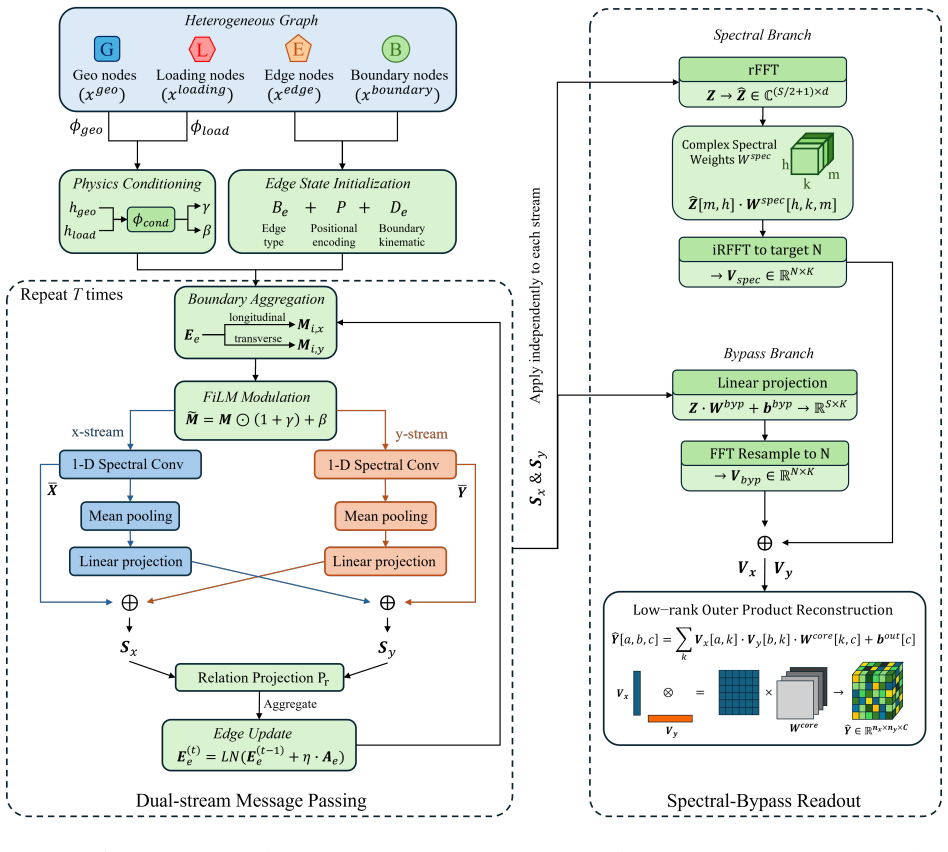
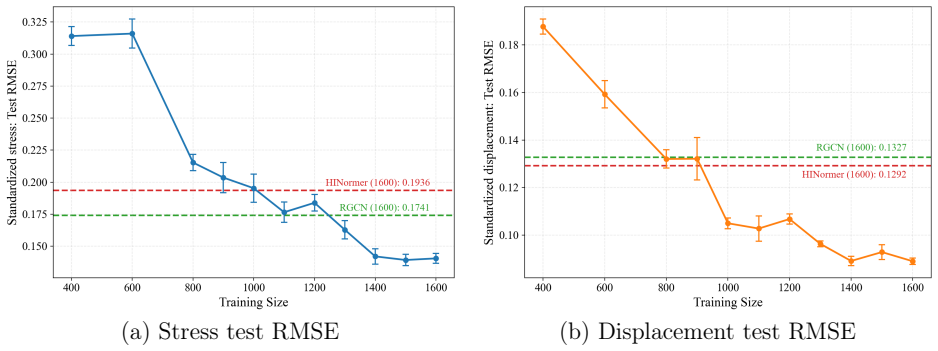
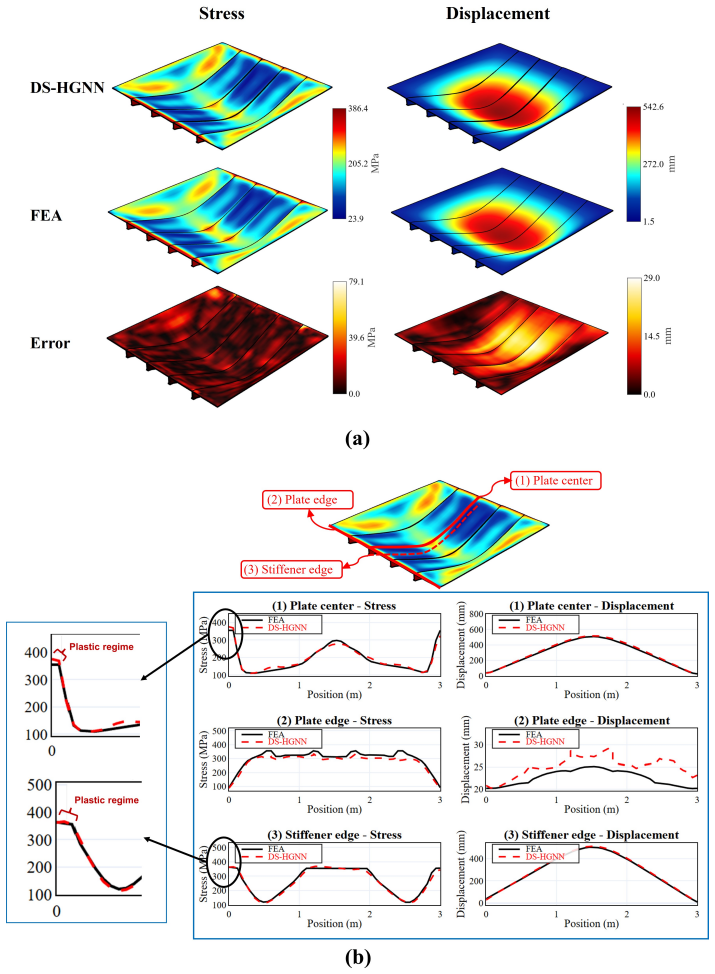
The Dual-Stream Heterogeneous Graph Neural Network, built on panel-level heterogeneous graph representations with physics-guided edge initialization and dual-stream message passing that separates longitudinal and transverse flows while allowing cross-stream exchange, together with FiLM-conditioned spectral convolutions and spectral-bypass readout, achieves the lowest stress and displacement RMSE on stiffened-panel datasets that vary in geometry, boundary kinematics, loading, and material nonlinearity; it reaches accuracy comparable to the strongest benchmarks while using 19-38 percent fewer training samples and captures yield and post-yield stress features.
What carries the argument
Dual-stream message passing on physics-guided heterogeneous graphs that separates longitudinal and transverse structural information while permitting cross-stream exchange, conditioned by Feature-wise Linear Modulation for geometry and loading effects.
If this is right
- DS-HGNN records the lowest stress and displacement root-mean-square error among six compared heterogeneous graph neural network models on the stiffened panel test sets.
- The model reaches accuracy comparable to the strongest benchmarks while requiring 19 to 38 percent fewer training samples.
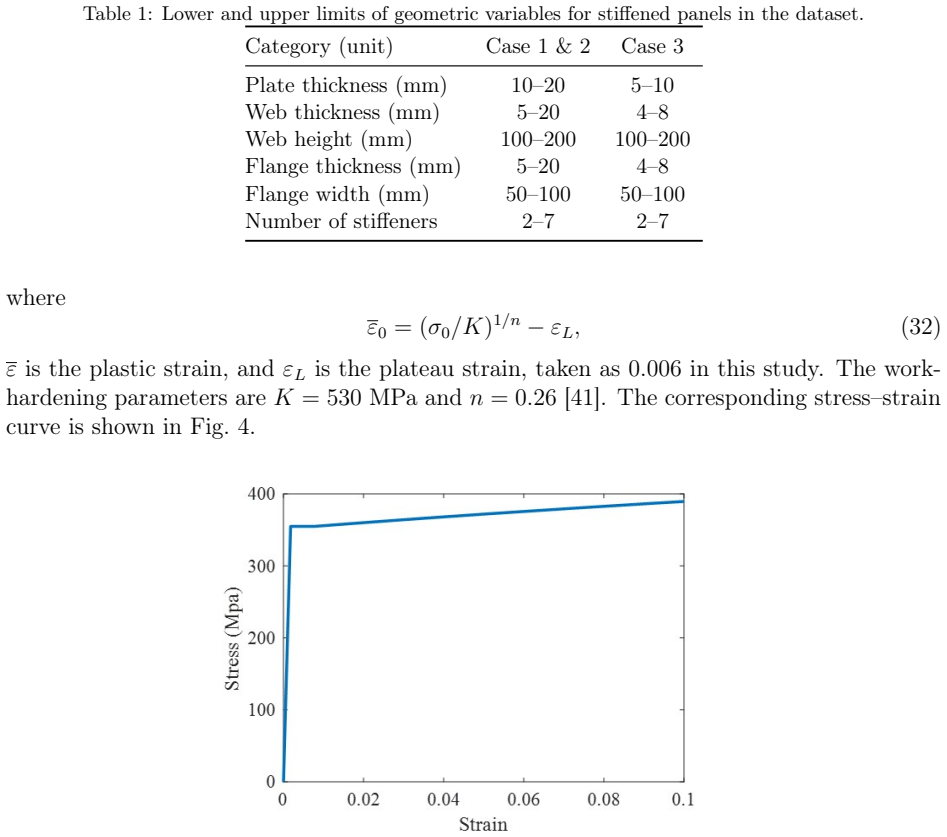
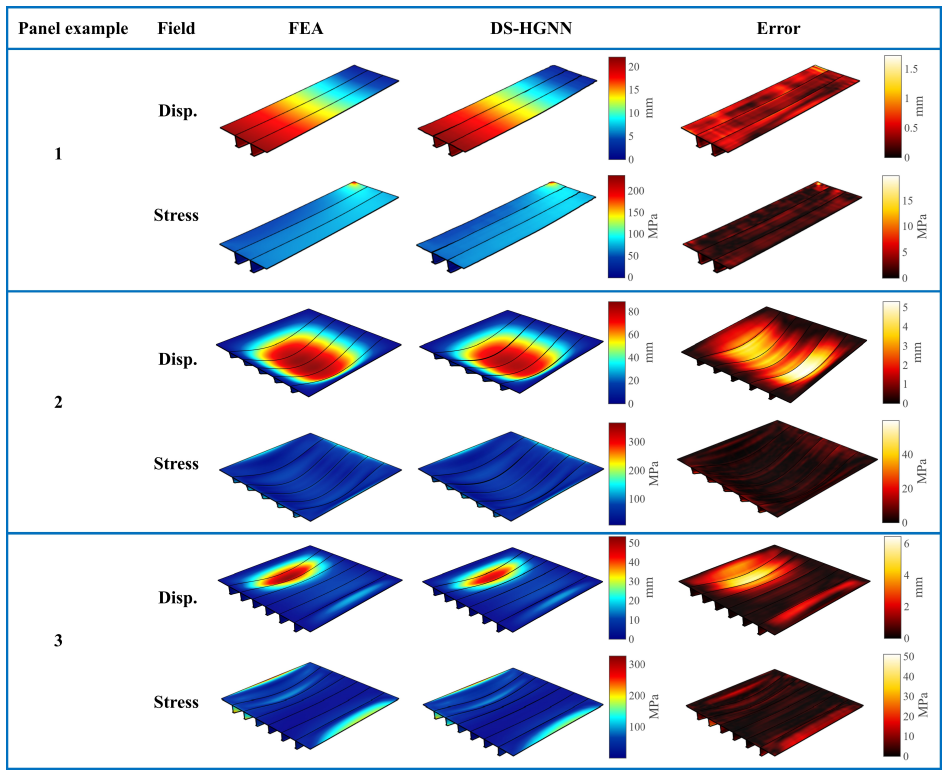
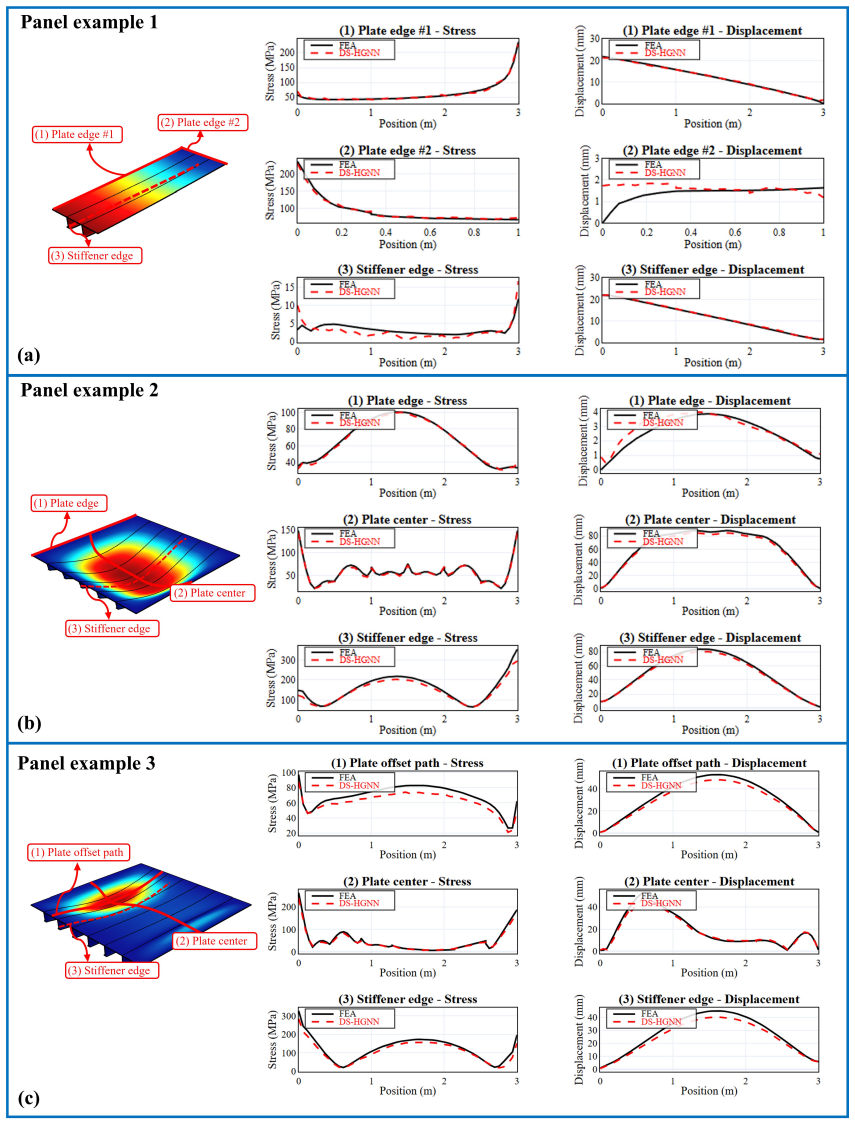
- Targeted checks confirm that DS-HGNN reproduces yield and post-yield stress features under nonlinear material response.
- The architecture handles datasets that differ in geometry, boundary conditions, and loading without retraining from scratch.
Where Pith is reading between the lines
- Such a surrogate could shorten iterative optimization loops in ship or aircraft structural design by replacing repeated full finite-element runs with near-real-time field predictions.
- The explicit separation of directional streams may transfer to other thin-walled or orthotropic components where length-wise and width-wise mechanics differ markedly.
- Lower data requirements could make physics-guided graph models viable in settings where only limited high-fidelity simulation results are available.
- The spectral readout and FiLM conditioning suggest a route to extend the same framework to dynamic or three-dimensional loading cases.
Load-bearing premise
The panel-level heterogeneous graph representations plus the chosen physics-guided edge initialization and dual-stream separation are sufficient to capture varying topologies, complex boundary conditions, and material nonlinear responses across the evaluated datasets without overfitting to the specific training distributions.
What would settle it
A new test set of stiffened panels with stiffener layouts or support conditions outside the training distribution where DS-HGNN RMSE exceeds the best benchmark model would falsify the claim that the chosen representations and streams suffice.
Figures
read the original abstract
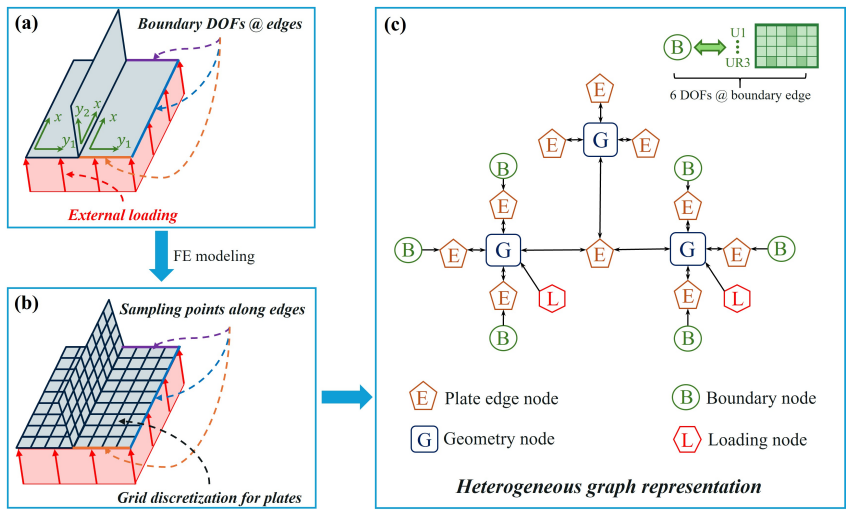
Iterative design and optimization of large, complex structures require fast and accurate prediction of stress, displacement, and other fields. Finite element analysis (FEA) is computationally expensive for this task. Existing neural network surrogates often struggle with varying topologies and complex boundary conditions. This study proposes the novel Dual-Stream Heterogeneous Graph Neural Network (DS-HGNN) for full-field stress and displacement prediction in thin-walled structures, demonstrated on box beams made of stiffened panels. DS-HGNN operates on panel-level heterogeneous graph representations and introduces physics-guided edge states initialized from edge types, spatial information, and boundary kinematics. These states are updated through dual-stream message passing that separates longitudinal and transverse structural information while allowing cross-stream exchange. Geometry and loading effects are incorporated through Feature-wise Linear Modulation (FiLM)-conditioned 1-D spectral convolutions, and physical fields are reconstructed using a spectral-bypass low-rank readout. The model is evaluated on stiffened panel datasets with different geometries, boundary kinematics, loading conditions, and material nonlinear responses. DS-HGNN achieves the lowest stress and displacement RMSE compared with six benchmark heterogeneous graph neural network models. It also reaches comparable accuracy to the strongest benchmark models using 19%-38% fewer training samples. A targeted evaluation further shows that DS-HGNN captures yield and post-yield stress features.
Editorial analysis
A structured set of objections, weighed in public.
Referee Report
Summary. The paper proposes the Dual-Stream Heterogeneous Graph Neural Network (DS-HGNN) for full-field stress and displacement prediction on stiffened panels. It constructs panel-level heterogeneous graphs, initializes physics-guided edge states from edge types, spatial information and boundary kinematics, performs dual-stream message passing that separates longitudinal/transverse information while permitting cross-stream exchange, incorporates geometry/loading via FiLM-conditioned 1-D spectral convolutions, and reconstructs fields with a spectral-bypass low-rank readout. The model is evaluated on stiffened-panel datasets spanning different geometries, boundary conditions, loadings and material nonlinear responses; it reports the lowest stress/displacement RMSE versus six benchmark heterogeneous GNNs, comparable accuracy to the strongest baselines with 19-38% fewer training samples, and the ability to capture yield and post-yield stress features.
Significance. If the empirical claims survive rigorous controls on dataset scale, statistical testing and out-of-distribution protocols, the work would provide a practically useful surrogate for iterative structural design that reduces expensive FEA calls while handling varying topologies and nonlinear regimes. The explicit separation of longitudinal/transverse streams and the physics-guided edge initialization constitute a domain-informed architectural contribution that could be adopted in other thin-walled-structure modeling tasks.
major comments (2)
- [Evaluation / Experiments section] The central performance claims (lowest RMSE, 19-38% sample-efficiency gains, capture of yield/post-yield features) are presented without accompanying information on dataset sizes, number of training/validation/test samples, statistical significance of reported improvements, exact baseline implementations, or confirmation that train/test splits avoid leakage. These omissions are load-bearing for any empirical comparison and must be supplied before the claims can be assessed.
- [Dataset description and evaluation protocol] The abstract asserts evaluation on 'different geometries' yet supplies no quantitative measure of topological diversity (e.g., statistics on node/edge counts, graph-edit distances, or inter-dataset similarity) and no explicit out-of-distribution test protocol. Without such measures it is impossible to determine whether the reported gains arise from the dual-stream and physics-guided mechanisms or from distribution matching within the evaluated collection.
Simulated Author's Rebuttal
We thank the referee for the constructive and detailed feedback. We agree that additional details on the experimental setup and dataset characterization are needed to fully substantiate the empirical claims. We will revise the manuscript accordingly and address each major comment below.
read point-by-point responses
-
Referee: [Evaluation / Experiments section] The central performance claims (lowest RMSE, 19-38% sample-efficiency gains, capture of yield/post-yield features) are presented without accompanying information on dataset sizes, number of training/validation/test samples, statistical significance of reported improvements, exact baseline implementations, or confirmation that train/test splits avoid leakage. These omissions are load-bearing for any empirical comparison and must be supplied before the claims can be assessed.
Authors: We agree that these details are essential for rigorous assessment of the claims. The revised manuscript will expand the Experiments section to report: total dataset size and exact train/validation/test sample counts with split ratios; results of statistical significance tests (e.g., paired t-tests or Wilcoxon signed-rank tests with p-values) on the RMSE improvements; full implementation details for all six benchmark models including architectures, hyperparameters, and training procedures; and explicit confirmation that splits were performed at the graph level with no leakage (e.g., no shared nodes/edges or identical subgraphs across sets). Standard deviations across multiple random seeds will also be added where applicable. revision: yes
-
Referee: [Dataset description and evaluation protocol] The abstract asserts evaluation on 'different geometries' yet supplies no quantitative measure of topological diversity (e.g., statistics on node/edge counts, graph-edit distances, or inter-dataset similarity) and no explicit out-of-distribution test protocol. Without such measures it is impossible to determine whether the reported gains arise from the dual-stream and physics-guided mechanisms or from distribution matching within the evaluated collection.
Authors: We acknowledge this limitation in the current presentation. The revised manuscript will add to the Dataset and Evaluation sections: quantitative statistics on topological diversity including mean, standard deviation, and range of node/edge counts across geometry classes; inter-geometry similarity measures such as average graph-edit distances and graph kernel similarities; and an explicit out-of-distribution protocol (e.g., training on a subset of geometries and testing on completely held-out geometries). These additions will help isolate the contribution of the proposed dual-stream and physics-guided components. revision: yes
Circularity Check
No circularity detected in empirical model evaluation
full rationale
The paper proposes DS-HGNN as a new architecture with physics-guided edge initialization, dual-stream message passing, FiLM-conditioned spectral convolutions, and spectral-bypass readout, then reports empirical RMSE and data-efficiency results against six benchmark HGNN models on stiffened-panel datasets. No equations, self-citations, or claims reduce the reported performance metrics to quantities defined by the model's own fitted parameters or by construction. The central claims rest on external benchmark comparisons and dataset evaluations rather than any self-definitional, fitted-input, or self-citation load-bearing step. This is a standard empirical ML paper with independent validation content.
Axiom & Free-Parameter Ledger
free parameters (1)
- model hyperparameters (layers, dimensions, modulation parameters)
axioms (2)
- domain assumption Panel-level heterogeneous graphs plus edge-type and boundary-kinematics initialization capture the essential mechanics for varying topologies and boundary conditions.
- domain assumption The chosen datasets with different geometries, boundary kinematics, loading, and material nonlinearity are representative for the target use case.
Reference graph
Works this paper leans on
-
[1]
O. F. Hughes, Ship Structural Design: A Rationally-Based, Computer-Aided Optimiza- tion Approach, The Society of Naval Architects and Marine Engineers, Jersey City, NJ, 2005, previously published by John Wiley & Sons, Inc., 1983
2005
-
[2]
R. W. Clough, Original formulation of the finite element method, Finite elements in analysis and design 7 (2) (1990) 89–101
1990
-
[3]
M. K. Thompson, J. M. Thompson, ANSYS mechanical APDL for finite element anal- ysis, Butterworth-Heinemann, 2017
2017
-
[4]
Jelovica, Y
J. Jelovica, Y. Cai, Improved multi-objective structural optimization with adaptive repair-based constraint handling, Engineering Optimization 56 (1) (2024) 118–137
2024
-
[5]
Y. Cai, J. Jelovica, Neural network-enabled discovery of mapping between variables and constraints for autonomous repair-based constraint handling in multi-objective struc- tural optimization, Knowledge-Based Systems 280 (2023) 111032
2023
-
[6]
Hornik, M
K. Hornik, M. Stinchcombe, H. White, Multilayer feedforward networks are universal approximators, Neural networks 2 (5) (1989) 359–366
1989
-
[7]
Papadrakakis, N
M. Papadrakakis, N. D. Lagaros, Y. Tsompanakis, Structural optimization using evo- lution strategies and neural networks, Computer methods in applied mechanics and engineering 156 (1-4) (1998) 309–333
1998
-
[8]
H. T. Mai, Q. X. Lieu, J. Kang, J. Lee, A robust unsupervised neural network framework for geometrically nonlinear analysis of inelastic truss structures, Applied Mathematical Modelling 107 (2022) 332–352
2022
-
[9]
M. H. Shojaeefard, R. A. Behnagh, M. Akbari, M. K. B. Givi, F. Farhani, Modelling and pareto optimization of mechanical properties of friction stir welded aa7075/aa5083 butt joints using neural network and particle swarm algorithm, Materials & Design 44 (2013) 190–198
2013
-
[10]
M. A. B. Kabir, A. S. Hasan, A. M. Billah, Failure mode identification of column base plate connection using data-driven machine learning techniques, Engineering Structures 240 (2021) 112389
2021
-
[11]
Z. Sun, Z. Lei, R. Bai, H. Jiang, J. Zou, Y. Ma, C. Yan, Prediction of compression buckling load and buckling mode of hat-stiffened panels using artificial neural network, Engineering Structures 242 (2021) 112275
2021
-
[12]
Y. Cai, N. Mokhtari, J. Jelovica, Comparison of a few deep learning models for stress predictions in stiffened panels, in: Innovations in the Analysis and Design of Marine Structures, CRC Press, 2025, pp. 535–542
2025
-
[13]
Mokhtari, Y
N. Mokhtari, Y. Cai, J. Jelovica, Comparison of deep learning techniques for prediction of stress distribution in stiffened panels, Thin-Walled Structures (2025) 113494. 32
2025
-
[14]
Gilmer, S
J. Gilmer, S. S. Schoenholz, P. F. Riley, O. Vinyals, G. E. Dahl, Neural message passing for quantum chemistry, in: International conference on machine learning, PMLR, 2017, pp. 1263–1272
2017
-
[15]
Hamilton, Z
W. Hamilton, Z. Ying, J. Leskovec, Inductive representation learning on large graphs, Advances in neural information processing systems 30 (2017)
2017
-
[16]
K. Xu, W. Hu, J. Leskovec, S. Jegelka, How powerful are graph neural networks?, arXiv preprint arXiv:1810.00826 (2018)
Pith/arXiv arXiv 2018
-
[17]
P. W. Battaglia, J. B. Hamrick, V. Bapst, A. Sanchez-Gonzalez, V. Zambaldi, M. Ma- linowski, A. Tacchetti, D. Raposo, A. Santoro, R. Faulkner, et al., Relational inductive biases, deep learning, and graph networks, arXiv preprint arXiv:1806.01261 (2018)
Pith/arXiv arXiv 2018
-
[18]
M. Lino, C. Cantwell, A. A. Bharath, S. Fotiadis, Simulating continuum mechanics with multi-scale graph neural networks, arXiv preprint arXiv:2106.04900 (2021)
arXiv 2021
-
[19]
X. Wang, H. Ji, C. Shi, B. Wang, Y. Ye, P. Cui, P. S. Yu, Heterogeneous graph attention network, in: The world wide web conference, 2019, pp. 2022–2032
2019
-
[20]
Z. Hu, Y. Dong, K. Wang, Y. Sun, Heterogeneous graph transformer, in: Proceedings of the International World Wide Web Conference (WWW), 2020, pp. 2704–2710
2020
-
[21]
X. Fu, J. Zhang, Z. Meng, I. King, Magnn: Metapath aggregated graph neural network for heterogeneous graph embedding, in: Proceedings of the web conference 2020, 2020, pp. 2331–2341
2020
-
[22]
P. Veličković, G. Cucurull, A. Casanova, A. Romero, P. Lio, Y. Bengio, Graph attention networks, arXiv preprint arXiv:1710.10903 (2017)
Pith/arXiv arXiv 2017
-
[23]
S. Brody, U. Alon, E. Yahav, How attentive are graph attention networks?, arXiv preprint arXiv:2105.14491 (2021)
Pith/arXiv arXiv 2021
-
[24]
Y. Cai, J. Jelovica, Efficient graph representation in graph neural networks for stress predictions in stiffened panels, Thin-Walled Structures 203 (2024) 112157
2024
-
[25]
Y. Cai, J. Jelovica, Heterogeneous graph representation of stiffened panels with non- uniform boundary conditions and loads, Engineering with Computers 42 (1) (2026) 5
2026
-
[26]
Y. Cai, J. Jelovica, A hybrid global–local computational framework for ship hull struc- tural analysis using homogenized model and graph neural network, Marine Structures 109 (2026) 104077
2026
-
[27]
Raissi, P
M. Raissi, P. Perdikaris, G. E. Karniadakis, Physics-informed neural networks: A deep learning framework for solving forward and inverse problems involving nonlinear partial differential equations, Journal of Computational physics 378 (2019) 686–707
2019
-
[28]
G. E. Karniadakis, I. G. Kevrekidis, L. Lu, P. Perdikaris, S. Wang, L. Yang, Physics- informed machine learning, Nature Reviews Physics 3 (6) (2021) 422–440. 33
2021
-
[29]
Haghighat, M
E. Haghighat, M. Raissi, A. Moure, H. Gomez, R. Juanes, A physics-informed deep learning framework for inversion and surrogate modeling in solid mechanics, Computer Methods in Applied Mechanics and Engineering 379 (2021) 113741
2021
-
[30]
S. Wang, X. Yu, P. Perdikaris, When and why pinns fail to train: A neural tangent kernel perspective, Journal of Computational Physics 449 (2022) 110768
2022
-
[31]
A. D. Jagtap, E. Kharazmi, G. E. Karniadakis, Conservative physics-informed neural networks on discrete domains for conservation laws: Applications to forward and inverse problems, Computer Methods in Applied Mechanics and Engineering 365 (2020) 113028
2020
-
[32]
Moseley, A
B. Moseley, A. Markham, T. Nissen-Meyer, Finite basis physics-informed neural net- works (fbpinns): a scalable domain decomposition approach for solving differential equa- tions, Advances in Computational Mathematics 49 (4) (2023) 62
2023
-
[33]
Z. Li, N. Kovachki, K. Azizzadenesheli, B. Liu, K. Bhattacharya, A. Stuart, A. Anand- kumar, Fourier neural operator for parametric partial differential equations, in: Inter- national Conference on Learning Representations, 2021
2021
-
[34]
Kovachki, Z
N. Kovachki, Z. Li, B. Liu, K. Azizzadenesheli, K. Bhattacharya, A. Stuart, A. Anand- kumar, Neural operator: Learning maps between function spaces with applications to pdes, Journal of Machine Learning Research 24 (89) (2023) 1–97
2023
-
[35]
Z. Li, H. Zheng, N. Kovachki, D. Jin, H. Chen, B. Liu, K. Azizzadenesheli, A. Anandku- mar, Physics-informed neural operator for learning partial differential equations, ACM / IMS Journal of Data Science 1 (3) (2024) 1–27. doi:10.1145/3648506
- [36]
- [37]
-
[38]
M. Lino, S. Fotiadis, A. A. Bharath, C. D. Cantwell, Multi-scale rotation-equivariant graph neural networks for unsteady eulerian fluid dynamics, Physics of Fluids 34 (8) (2022)
2022
-
[39]
R. Gao, I. K. Deo, R. K. Jaiman, Node-element hypergraph message passing for fluid dynamics simulations, arXiv:2212.14545 (2022)
arXiv 2022
-
[40]
Perez, F
E. Perez, F. Strub, H. De Vries, V. Dumoulin, A. Courville, Film: Visual reasoning with a general conditioning layer, in: Proceedings of the AAAI conference on artificial intelligence, Vol. 32, 2018
2018
-
[41]
Putranto, M
T. Putranto, M. Kõrgesaar, J. Jelovica, Ultimate strength assessment of stiffened panels using equivalent single layer approach under combined in-plane compression and shear, Thin-Walled Structures 180 (2022) 109943. 34
2022
-
[42]
Schlichtkrull, T
M. Schlichtkrull, T. N. Kipf, P. Bloem, R. Van Den Berg, I. Titov, M. Welling, Mod- eling relational data with graph convolutional networks, in: European semantic web conference, Springer, 2018, pp. 593–607
2018
-
[43]
Q. Mao, Z. Liu, C. Liu, J. Sun, Hinormer: Representation learning on heterogeneous in- formation networks with graph transformer, in: Proceedings of the ACM web conference 2023, 2023, pp. 599–610
2023
-
[44]
X. Yang, M. Yan, S. Pan, X. Ye, D. Fan, Simple and efficient heterogeneous graph neural network, in: Proceedings of the AAAI conference on artificial intelligence, Vol. 37, 2023, pp. 10816–10824
2023
-
[45]
M. Fey, J. E. Lenssen, Fast graph representation learning with PyTorch Geometric, in: ICLR Workshop on Representation Learning on Graphs and Manifolds, 2019. 35
2019
discussion (0)
Sign in with ORCID, Apple, or X to comment. Anyone can read and Pith papers without signing in.