REVIEW 3 major objections 5 minor 40 references
CompetitorFormer: Competitor Transformer for 3D Instance Segmentation
T0 review · 3 major / 5 minor · reviewed 2026-08-12 · deepseek-v4-flash
Pith's one-line read The paper claims that three plug-in modules, QCL, RRE, and RCA, reduce inter-query competition in transformer-based 3D instance segmentation and that adding them to existing baselines improves mAP on four benchmark datasets.
desk verdict Consistent direction of gains, but 'significant' is not supported by single-run mAP differences; worth a referee if the authors add seeds and error bars. read the letter →
The pith
A machine-rendered reading of the paper's core claim, the machinery that carries it, and where it could break.
The reading
What carries the argument
The central machinery is the per-layer competition state constructed from query pairs. It is built from two matrices: a signed leader/laggard matrix derived from the difference of each query's max classification score times predicted IoU, and an unsigned mask-IoU matrix that tells which queries are predicting the same object. QCL converts these into ordered leader and laggard lists that realign two static embeddings before fusing them with the query features; RRE quantizes the signed IoU into discrete bins and looks up a learned relation table to bias self-attention weights; RCA takes the raw dot-product similarities between queries and pooled scene features, min-max normalizes them across queries, and multiplies the similarities by this normalized rank signal before softmax. Together they widen the gap between the winning query and its rivals at each decoder step, so the winner absorbs richer features and the laggards fade.
What would settle it
Track, over the first training epochs of an unmodified baseline, the rank correlation between pair-wise IoU of predicted masks at decoder layer one and the event that the two queries are eventually matched to the same ground-truth instance; if the correlation is near zero early in training, the QCL and RRE signals are assigning leader/laggard labels before useful information exists and the mAP gain would need another explanation. A complementary check is to replace the mask-IoU competitor selection with random pairs while keeping the modules, which should collapse the gain if the competition signal is load-bearing.
Extended reading notes
Core claim
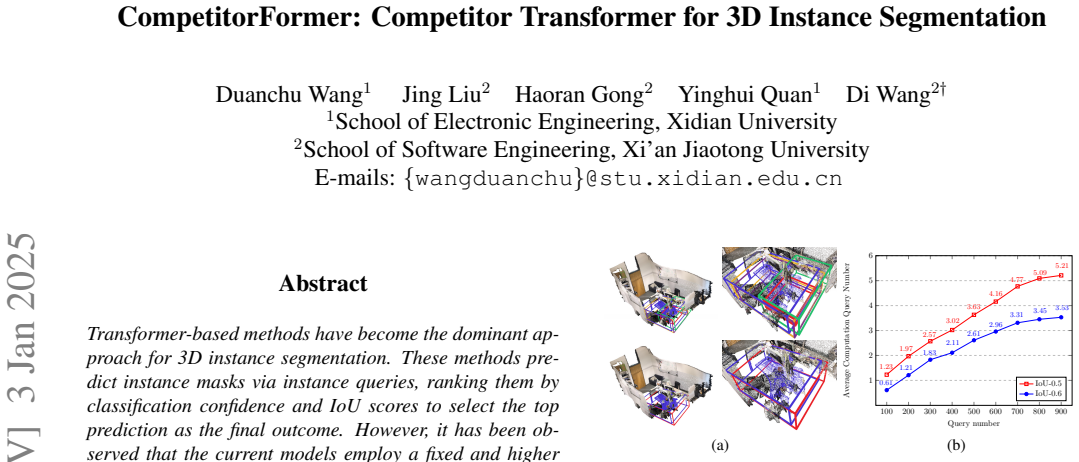
The central claim is that inter-query competition is an identifiable and correctable failure mode in transformer-based 3D instance segmentation. When multiple query tokens predict overlapping masks for the same instance, only one query is kept in the final output, yet the others still draw gradients and hold scores close to the winner in shallow decoder layers; the authors call this harmful and set out to suppress it. Their solution is to compute, before each decoder layer, a pairwise competition state from the IoU of the masks predicted by every two queries and from a leader/laggard sign based on each query's classification-confidence-times-IoU score. This state drives three modules: QCL reorders two static leader and laggard embeddings and fuses them into the queries, RRE quantizes the signed IoU into learned relative-relation biases added inside self-attention, and RCA normalizes the dot-product similarity between queries and pooling features along the query axis before the spatial softmax. The reported result is that these modules, alone or combined, shift classification scores so that matched queries score higher and unmatched queries score lower, and improve mAP across four benchmarks.
Load-bearing premise
The load-bearing assumption is that the overlap between masks predicted by two queries in the previous decoder layer reliably indicates which queries are true competitors, and that this signal is accurate early enough in training for the leader/laggard labels to guide learning before masks stabilize.
Editorial extensions
If this is right
- Adding the three modules to an existing transformer-based segmenter improves mAP without changing the training schedule or hyperparameters, according to the paper's experiments.
- The largest reported improvement is +3.1 mAP over the SPFormer baseline on the ScanNetv2 hidden test set, with +2.7 mAP on the validation set.
- Each module contributes independently: adding QCL, RRE, or RCA alone to SPFormer gives roughly +1.0 to +1.3 mAP on ScanNetv2 validation, and using all three gives +2.6 mAP.
- The modules work by changing which query wins: matched-query classification scores move upward while unmatched-query scores move downward, and the IoU of the winning query with its target mask increases.
- Because the modules are plug-in by design, they can be layered onto future transformer-based 3D segmenters that keep a fixed query count.
Reading between the lines
- The same over-querying and bipartite-matching setup appears in 2D mask transformers, so the competition-state mechanism is likely transferable to 2D instance or panoptic segmentation; the paper only demonstrates it in 3D.
- Part of the mAP gain may come from a re-ranking effect: by widening score gaps early, the model changes which query is selected at inference without necessarily improving the underlying masks; separating these effects would clarify the mechanism.
- The reported gains are largest on frameworks with many queries, while Mask3D's smaller query count showed smaller gains, suggesting the benefit scales with the amount of redundant query capacity; varying query count under fixed modules would test this.
- The paper's two static embeddings are randomly initialized per layer; a natural extension is to initialize them from semantic label embeddings so the leader/laggard signal incorporates class semantics from the start.
Editorial analysis
A structured set of objections, weighed in public.
Referee Report
Summary. The paper proposes CompetitorFormer, a set of three plug-and-play modules (query competition layer, QCL; relative relationship encoding, RRE; and rank cross attention, RCA) designed to reduce inter-query competition in transformer-based 3D instance segmentation. The modules use per-query classification scores and mask IoUs to identify leader/laggard query pairs, reorder static embeddings, inject relative relationship biases into self-attention, and renormalize cross-attention similarities. The method is evaluated by adding the modules to SPFormer, Mask3D, MAFT, and OneFormer3D on ScanNetv2, ScanNet200, S3DIS, and STPLS3D, with ablations on ScanNetv2 val. The reported improvements are up to +3.1 mAP on the ScanNet hidden test set for C-SPFormer, but several gains are small (+0.2 to +0.8 mAP).
Significance. If the reported gains are reproducible, the paper makes a useful empirical contribution by showing that explicit competition-aware query interactions can improve several strong transformer-based 3D instance segmentation baselines. The plug-and-play nature of the modules, the breadth of the evaluation across four datasets and four baselines, and the per-layer analyses of matched/unmatched query scores are strengths. The paper does not claim a new state-of-the-art architecture but rather a generally applicable mechanism, and the consistent positive direction of the reported gains across most baselines suggests the idea is worth pursuing. However, the central empirical claim of 'significant performance improvements' is currently supported only by single-run mAP differences, with no seed variance, confidence intervals, or significance tests; several gains are within the typical run-to-run noise for these benchmarks.
major comments (3)
- The claim that integrating the designs 'consistently resulted in significant performance improvements' is not supported by the evidence reported. All results are single runs: no standard deviations, multiple seeds, or statistical tests are given. Several reported gains are very small, e.g., C-Mask3D on STPLS3D (+0.2 mAP, +0.1 mAP50, Table 4b), C-Mask3D on S3DIS (+0.3 mAP, Table 3), C-Mask3D on ScanNetv2 val (+0.8 mAP, Table 2), and C-OneFormer3D on ScanNetv2 val (+0.7 mAP, Table 2). For transformer-based instance segmentation, run-to-run variance on these datasets is typically on the order of 0.5-1.5 mAP, so these gains are indistinguishable from noise. The abstract and conclusion should either be reworded to 'reported improvements' without 'significant', or the authors should add error bars and a paired significance test (or at least multiple seeds) for the key comparisons. This is load-bearing because the paper's main contribution is the empirical improvement claim.
- The notation in Eqs. (5)-(6) is not well-defined and appears to contain an error. Eq. (5) writes B^{l-1} = max_{j=0}^{n-1}(C^{l-1}_{IoU}(i,j)), but n is never defined (should presumably be N', the number of queries), and the expression as written is a scalar max rather than an index set. Eq. (6) then uses A[B] with the explanation 'arrangement of A in accordance with the index of B', which is nonstandard and ambiguous. Since the leader/laggard lists I_leader and I_laggard in Eqs. (7)-(8) are constructed from these quantities, the correctness of the QCL algorithm cannot be verified without a precise definition. Please rewrite Eqs. (5)-(6) with explicit index sets and define all variables.
- The relative relationship encoding depends on two free hyperparameters, the quantization size v and the table length Y, but no sensitivity analysis or ablation is provided for them. The default values are not even stated in the implementation details section. Since RRE contributes a nontrivial part of the reported gain (e.g., +1.1 mAP when added alone in Table 5b), the choice of v and Y could materially affect the results, and the reader cannot judge how robust the improvement is to these settings. Please report the values used and include an ablation or sensitivity study for at least one dataset.
minor comments (5)
- The text says 'the sparse query distribution limit the performance of ComeptitorFormer'; 'ComeptitorFormer' is a typo for 'CompetitorFormer', and the sentence should read 'limits' for subject-verb agreement.
- There are several spacing typos: 'V oxels are applied as superpoint on STPLS3D' should be 'Voxels are applied as superpoints on STPLS3D', and 'the query decoder' section header has an extra space.
- In the QueryFormer row, the mAP50 column contains '57,7' with a comma instead of a decimal point; the formatting should be consistent with the rest of the table.
- The caption says 'The color of each fraction matches the corresponding bounding box's color'; 'fraction' should likely be 'prediction' or 'box'.
- The reference to 'SPFormer' as [24] in the related work (Jieru Mei et al., 'SPFormer: Enhancing vision transformer with superpixel representation') is confusing because the same name is used for the superpoint transformer baseline [30] in the main text; please clarify whether these are different works or use distinct names.
Circularity Check
No significant circularity: empirical gains are measured on held-out benchmarks; the self-referential competition signal is a training mechanism, not a derivation from fitted constants.
full rationale
The paper's claimed contribution is a set of architectural modules (QCL, RRE, RCA) whose effectiveness is evaluated by adding them to SPFormer, Mask3D, MAFT, and OneFormer3D and measuring mAP on held-out ScanNetv2 test/val, ScanNet200, S3DIS Area 5, and STPLS3D splits. No parameter is fitted to the reported test/val numbers and then renamed as a prediction. The competition score K = max(p) * s_IoU and the mask-IoU matrix C_IoU are computed from the model's own predictions and used to define leader/laggard relationships; this is self-referential in mechanism but not circular in the paper's reasoning, because the paper does not claim those quantities are external ground truth, and the final claim is an empirical performance comparison. The modules do not assume the conclusion that competition is mitigated; they are trained and tested. The conclusion's limitation passage explicitly states QCL is incompatible with variable-query frameworks such as OneFormer3D, which is a scope constraint, not a circular step. The only notable weakness is statistical: gains like +0.2 and +0.8 mAP are reported as single runs without error bars or significance tests, so 'significant improvements' is overstated, but that is a correctness and evidence concern, not circularity. The paper is not built on self-citations: cited works are external baselines and prior 2D/3D methods, and no load-bearing claim reduces to the authors' own prior results. Accordingly, no circular step can be exhibited with the required quote-and-reduction standard.
Assumptions & free parameters
free parameters (2)
- RRE quantization size v
- RRE relationship table length Y
assumptions (3)
- domain assumption Transformer-based 3D instance segmentation models use more queries than instances, so multiple queries predict the same instance and compete.
- domain assumption The IoU between masks predicted by two queries is a valid and sufficiently reliable measure of inter-query competition.
- domain assumption Suppressing laggard queries and amplifying leading queries improves final instance segmentation accuracy.
Cite this review
Pith. "Pith review of CompetitorFormer: Competitor Transformer for 3D Instance Segmentation." pith.science (2026). https://pith.science/paper/6KXUBYBU
@misc{pith2026241114179,
  author       = {Pith},
  title        = {Pith review of: CompetitorFormer: Competitor Transformer for 3D Instance Segmentation},
  year         = {2026},
  howpublished = {\url{https://pith.science/paper/6KXUBYBU}},
  note         = {Machine review of arXiv:2411.14179}
}
read the original abstract
Transformer-based methods have become the dominant approach for 3D instance segmentation. These methods predict instance masks via instance queries, ranking them by classification confidence and IoU scores to select the top prediction as the final outcome. However, it has been observed that the current models employ a fixed and higher number of queries than the instances present within a scene. In such instances, multiple queries predict the same instance, yet only a single query is ultimately optimized. The close scores of queries in the lower-level decoders make it challenging for the dominant query to distinguish itself rapidly, which ultimately impairs the model's accuracy and convergence efficiency. This phenomenon is referred to as inter-query competition. To address this challenge, we put forth a series of plug-and-play competition-oriented designs, collectively designated as the CompetitorFormer, with the aim of reducing competition and facilitating a dominant query. Experiments showed that integrating our designs with state-of-the-art frameworks consistently resulted in significant performance improvements in 3D instance segmentation across a range of datasets.
Figures

Reference graph
Works this paper leans on
-
[1]
3d instance segmentation via enhanced spatial and semantic supervision
Salwa Al Khatib, Mohamed El Amine Boudjoghra, Jean La- houd, and Fahad Shahbaz Khan. 3d instance segmentation via enhanced spatial and semantic supervision. In Proceed- ings of the IEEE/CVF International Conference on Com- puter Vision, pages 541–550, 2023. 1, 2
work page 2023
-
[2]
3d seman- tic parsing of large-scale indoor spaces
Iro Armeni, Ozan Sener, Amir R Zamir, Helen Jiang, Ioan- nis Brilakis, Martin Fischer, and Silvio Savarese. 3d seman- tic parsing of large-scale indoor spaces. In Proceedings of the IEEE conference on computer vision and pattern recog- nition, pages 1534–1543, 2016. 5, 6
work page 2016
-
[3]
Align-detr: Improving detr with sim- ple iou-aware bce loss, 2023
Zhi Cai, Songtao Liu, Guodong Wang, Zheng Ge, Xiangyu Zhang, and Di Huang. Align-detr: Improving detr with sim- ple iou-aware bce loss, 2023. 2
work page 2023
-
[4]
Stpls3d: A large-scale synthetic and real aerial photogrammetry 3d point cloud dataset
Meida Chen, Qingyong Hu, Zifan Yu, Hugues THOMAS, Andrew Feng, Yu Hou, Kyle McCullough, Fengbo Ren, and Lucio Soibelman. Stpls3d: A large-scale synthetic and real aerial photogrammetry 3d point cloud dataset. In 33rd British Machine Vision Conference 2022, BMVC 2022, Lon- don, UK, November 21-24, 2022 . BMV A Press, 2022. 5, 6, 7
work page 2022
-
[5]
Hierarchical aggregation for 3d instance segmentation
Shaoyu Chen, Jiemin Fang, Qian Zhang, Wenyu Liu, and Xinggang Wang. Hierarchical aggregation for 3d instance segmentation. In Proceedings of the IEEE/CVF Interna- tional Conference on Computer Vision, pages 15467–15476,
-
[6]
Schwing, Alexan- der Kirillov, and Rohit Girdhar
Bowen Cheng, Ishan Misra, Alexander G. Schwing, Alexan- der Kirillov, and Rohit Girdhar. Masked-attention mask transformer for universal image segmentation. In Proceed- ings of the IEEE/CVF Conference on Computer Vision and Pattern Recognition (CVPR), pages 1290–1299, 2022. 1
2022
-
[7]
Box2mask: Weakly supervised 3d se- mantic instance segmentation using bounding boxes
Julian Chibane, Francis Engelmann, Tuan Anh Tran, and Gerard Pons-Moll. Box2mask: Weakly supervised 3d se- mantic instance segmentation using bounding boxes. In Eu- ropean Conference on Computer Vision (ECCV) . Springer,
-
[8]
4d spatio-temporal convnets: Minkowski convolutional neural networks
Christopher Choy, JunYoung Gwak, and Silvio Savarese. 4d spatio-temporal convnets: Minkowski convolutional neural networks. In 2019 IEEE/CVF Conference on Computer Vi- sion and Pattern Recognition (CVPR), 2019. 3
work page 2019
Show all 40 references
-
[9]
Scannet: Richly-annotated 3d reconstructions of indoor scenes
Angela Dai, Angel X Chang, Manolis Savva, Maciej Hal- ber, Thomas Funkhouser, and Matthias Nießner. Scannet: Richly-annotated 3d reconstructions of indoor scenes. In Proceedings of the IEEE conference on computer vision and pattern recognition, pages 5828–5839, 2017. 5, 6
2017
-
[10]
3d-mpa: Multi-proposal ag- gregation for 3d semantic instance segmentation
Francis Engelmann, Martin Bokeloh, Alireza Fathi, Bastian Leibe, and Matthias Nießner. 3d-mpa: Multi-proposal ag- gregation for 3d semantic instance segmentation. In Pro- ceedings of the IEEE/CVF conference on computer vision and pattern recognition, pages 9031–9040, 2020. 1, 2
2020
-
[11]
Tood: Task-aligned one-stage object detec- tion
Chengjian Feng, Yujie Zhong, Yu Gao, Matthew R Scott, and Weilin Huang. Tood: Task-aligned one-stage object detec- tion. In 2021 IEEE/CVF International Conference on Com- puter Vision (ICCV), pages 3490–3499. IEEE Computer So- ciety, 2021. 2
2021
-
[12]
Ease-detr: Easing the competition among object queries
Yulu Gao, Yifan Sun, Xudong Ding, Chuyang Zhao, and Si Liu. Ease-detr: Easing the competition among object queries. In Proceedings of the IEEE/CVF Conference on Computer Vision and Pattern Recognition , pages 17282– 17291, 2024. 1, 2, 5
2024
-
[13]
DyCo3d: Robust instance segmentation of 3d point clouds through dynamic convolution
Tong He, Chunhua Shen, and Anton van den Hengel. DyCo3d: Robust instance segmentation of 3d point clouds through dynamic convolution. In Proceedings of the IEEE Conference on Computer Vision and Pattern Recognition (CVPR), 2021. 1, 2
2021
-
[14]
3d-sis: 3d se- mantic instance segmentation of rgb-d scans
Ji Hou, Angela Dai, and Matthias Nießner. 3d-sis: 3d se- mantic instance segmentation of rgb-d scans. InProceedings of the IEEE/CVF conference on computer vision and pattern recognition, pages 4421–4430, 2019. 1, 2
2019
-
[15]
Pointgroup: Dual-set point grouping for 3d instance segmentation
Li Jiang, Hengshuang Zhao, Shaoshuai Shi, Shu Liu, Chi- Wing Fu, and Jiaya Jia. Pointgroup: Dual-set point grouping for 3d instance segmentation. In Proceedings of the IEEE/CVF conference on computer vision and Pattern recognition, pages 4867–4876, 2020. 1, 2, 7
2020
-
[16]
Oneformer3d: One transformer for unified point cloud segmentation
Maxim Kolodiazhnyi, Anna V orontsova, Anton Konushin, and Danila Rukhovich. Oneformer3d: One transformer for unified point cloud segmentation. In Proceedings of the IEEE/CVF Conference on Computer Vision and Pattern Recognition, pages 20943–20953, 2024. 1, 2, 3, 5, 6, 7
2024
-
[17]
Top-down beats bottom-up in 3d in- stance segmentation
Maksim Kolodiazhnyi, Anna V orontsova, Anton Konushin, and Danila Rukhovich. Top-down beats bottom-up in 3d in- stance segmentation. In Proceedings of the IEEE/CVF Win- ter Conference on Applications of Computer Vision , pages 3566–3574, 2024. 1, 2
2024
-
[18]
Mask-attention-free transformer for 3d in- stance segmentation
Xin Lai, Yuhui Yuan, Ruihang Chu, Yukang Chen, Han Hu, and Jiaya Jia. Mask-attention-free transformer for 3d in- stance segmentation. In Proceedings of the IEEE/CVF Inter- national Conference on Computer Vision, pages 3693–3703,
-
[19]
Large-scale point cloud semantic segmentation with superpoint graphs
Loic Landrieu and Martin Simonovsky. Large-scale point cloud semantic segmentation with superpoint graphs. In 2018 IEEE/CVF Conference on Computer Vision and Pat- tern Recognition, 2018. 3
2018
-
[20]
Generalized focal loss: Learning qualified and distributed bounding boxes for dense object detection
Xiang Li, Wenhai Wang, Lijun Wu, Shuo Chen, Xiaolin Hu, Jun Li, Jinhui Tang, and Jian Yang. Generalized focal loss: Learning qualified and distributed bounding boxes for dense object detection. Advances in Neural Information Processing Systems, 33:21002–21012, 2020. 2
2020
-
[21]
Clustseg: Clustering for universal segmentation,
James Liang, Tianfei Zhou, Dongfang Liu, and Wenguan Wang. Clustseg: Clustering for universal segmentation,
-
[22]
Instance segmentation in 3d scenes using semantic superpoint tree networks
Zhihao Liang, Zhihao Li, Songcen Xu, Mingkui Tan, and Kui Jia. Instance segmentation in 3d scenes using semantic superpoint tree networks. In Proceedings of the IEEE/CVF International Conference on Computer Vision, pages 2783– 2792, 2021. 1, 2
2021
-
[23]
Query refinement transformer for 3d in- stance segmentation
Jiahao Lu, Jiacheng Deng, Chuxin Wang, Jianfeng He, and Tianzhu Zhang. Query refinement transformer for 3d in- stance segmentation. In Proceedings of the IEEE/CVF In- ternational Conference on Computer Vision , pages 18516– 18526, 2023. 1, 2, 3, 6
2023
-
[24]
SPFormer: Enhancing vision transformer with superpixel representation, 2024
Jieru Mei, Liang-Chieh Chen, Alan Yuille, and Cihang Xie. SPFormer: Enhancing vision transformer with superpixel representation, 2024. 3
2024
-
[25]
Isbnet: a 3d point cloud instance segmentation network with instance- aware sampling and box-aware dynamic convolution
Tuan Duc Ngo, Binh-Son Hua, and Khoi Nguyen. Isbnet: a 3d point cloud instance segmentation network with instance- aware sampling and box-aware dynamic convolution. InPro- ceedings of the IEEE/CVF Conference on Computer Vision and Pattern Recognition, pages 13550–13559, 2023. 7
2023
-
[26]
Rank-detr for high quality object detection
Yifan Pu, Weicong Liang, Yiduo Hao, Yuhui Yuan, Yukang Yang, Chao Zhang, Han Hu, and Gao Huang. Rank-detr for high quality object detection. Advances in Neural Informa- tion Processing Systems, 36, 2024. 2
2024
-
[27]
Language- grounded indoor 3d semantic segmentation in the wild
David Rozenberszki, Or Litany, and Angela Dai. Language- grounded indoor 3d semantic segmentation in the wild. 2022. 5, 6, 7
2022
-
[28]
Mask3d: Mask trans- former for 3d semantic instance segmentation
Jonas Schult, Francis Engelmann, Alexander Hermans, Or Litany, Siyu Tang, and Bastian Leibe. Mask3d: Mask trans- former for 3d semantic instance segmentation. In 2023 IEEE International Conference on Robotics and Automation (ICRA), pages 8216–8223. IEEE, 2023. 1, 2, 5, 6, 7
2023
-
[29]
Spherical mask: Coarse-to- fine 3d point cloud instance segmentation with spherical rep- resentation
Sangyun Shin, Kaichen Zhou, Madhu Vankadari, Andrew Markham, and Niki Trigoni. Spherical mask: Coarse-to- fine 3d point cloud instance segmentation with spherical rep- resentation. In Proceedings of the IEEE/CVF Conference on Computer Vision and Pattern Recognition , pages 406...
2024
-
[30]
Superpoint transformer for 3d scene instance segmentation
Jiahao Sun, Chunmei Qing, Junpeng Tan, and Xiangmin Xu. Superpoint transformer for 3d scene instance segmentation. In Proceedings of the AAAI Conference on Artificial Intelli- gence, pages 2393–2401, 2023. 1, 2, 5, 6
2023
-
[31]
Neuralbf: Neural bilateral filtering for top- down instance segmentation on point clouds
Weiwei Sun, Daniel Rebain, Renjie Liao, Vladimir Tankovich, Soroosh Yazdani, Kwang Moo Yi, and Andrea Tagliasacchi. Neuralbf: Neural bilateral filtering for top- down instance segmentation on point clouds. In Proceed- ings of the IEEE/CVF Winter Conference on Applications of C...
2023
-
[32]
Softgroup for 3d instance segmentation on point clouds
Thang Vu, Kookhoi Kim, Tung M Luu, Thanh Nguyen, and Chang D Yoo. Softgroup for 3d instance segmentation on point clouds. In Proceedings of the IEEE/CVF Conference on Computer Vision and Pattern Recognition , pages 2708– 2717, 2022. 1, 2
2022
-
[33]
Groupvit: Semantic segmentation emerges from text supervision
Jiarui Xu, Shalini De Mello, Sifei Liu, Wonmin Byeon, Thomas Breuel, Jan Kautz, and Xiaolong Wang. Groupvit: Semantic segmentation emerges from text supervision. In Proceedings of the IEEE/CVF Conference on Computer Vi- sion and Pattern Recognition, pages 18134–18144, 2022. 3
2022
-
[34]
Learning ob- ject bounding boxes for 3d instance segmentation on point clouds
Bo Yang, Jianan Wang, Ronald Clark, Qingyong Hu, Sen Wang, Andrew Markham, and Niki Trigoni. Learning ob- ject bounding boxes for 3d instance segmentation on point clouds. 2019. 1, 2
2019
-
[35]
Li Yi, Wang Zhao, He Wang, Minhyuk Sung, and Leonidas J. Guibas. Gspn: Generative shape proposal network for 3d instance segmentation in point cloud. In 2019 IEEE/CVF Conference on Computer Vision and Pattern Recognition (CVPR), pages 3942–3951, 2019. 1, 2
2019
-
[36]
Cmt-deeplab: Clustering mask transformers for panoptic segmentation
Qihang Yu, Huiyu Wang, Dahun Kim, Siyuan Qiao, Maxwell Collins, Yukun Zhu, Hartwig Adam, Alan Yuille, and Liang-Chieh Chen. Cmt-deeplab: Clustering mask transformers for panoptic segmentation. In Proceedings of the IEEE/CVF Conference on Computer Vision and Pattern Recognition...
2022
-
[37]
k-means mask transformer
Qihang Yu, Huiyu Wang, Siyuan Qiao, Maxwell Collins, Yukun Zhu, Hartwig Adam, Alan Yuille, and Liang-Chieh Chen. k-means mask transformer. In European Conference on Computer Vision, pages 288–307. Springer, 2022. 2
2022
-
[38]
Varifocalnet: An iou-aware dense object detector
Haoyang Zhang, Ying Wang, Feras Dayoub, and Niko Sun- derhauf. Varifocalnet: An iou-aware dense object detector. In Proceedings of the IEEE/CVF conference on computer vi- sion and pattern recognition, pages 8514–8523, 2021. 2
2021
-
[39]
Dino: Detr with improved denoising anchor boxes for end-to-end object detection
Hao Zhang, Feng Li, Shilong Liu, Lei Zhang, Hang Su, Jun Zhu, Lionel M Ni, and Heung-Yeung Shum. Dino: Detr with improved denoising anchor boxes for end-to-end object detection. arXiv preprint arXiv:2203.03605, 2022. 2
2022 arXiv
-
[40]
Maskgroup: Hierarchical point grouping and masking for 3d instance segmentation
Min Zhong, Xinghao Chen, Xiaokang Chen, Gang Zeng, and Yunhe Wang. Maskgroup: Hierarchical point grouping and masking for 3d instance segmentation. In 2022 IEEE Inter- national Conference on Multimedia and Expo (ICME), pages 1–6, 2022. 1, 2 10
2022
Reviewed August 12, 2026 · model on record in the stance chip above.
Discussion (0). Continue with ORCID to comment.