Observation of resonant monopole-dipole energy transfer between Rydberg atoms and polar molecules
Pith reviewed 2026-05-21 21:52 UTC · model grok-4.3
The pith
Resonant energy transfer is observed between Rydberg helium atoms and ammonia molecules through a monopole-dipole interaction at low temperatures.
A machine-rendered reading of the paper's core claim, the machinery that carries it, and where it could break.
Core claim
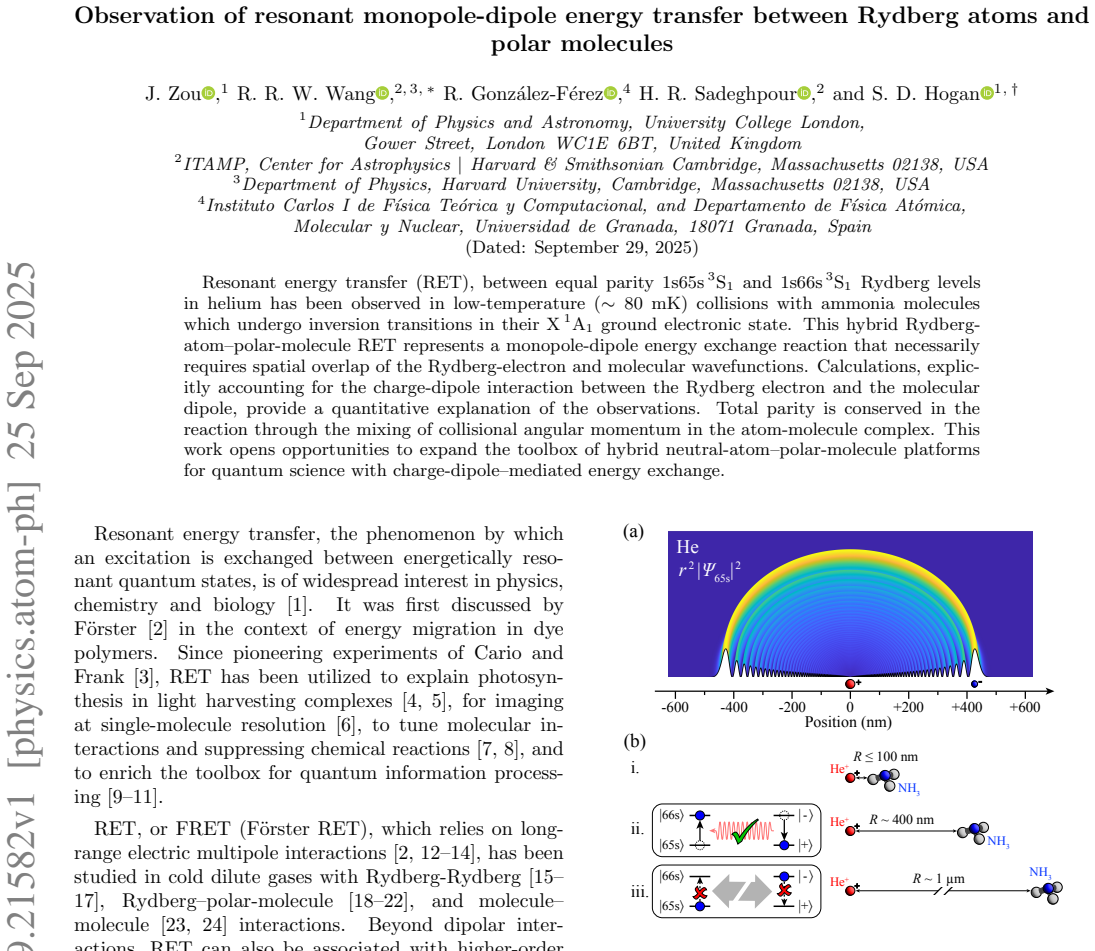
Resonant energy transfer (RET), between equal parity 1s65s³S₁ and 1s66s³S₁ Rydberg levels in helium has been observed in low-temperature (~80 mK) collisions with ammonia molecules which undergo inversion transitions in their X¹A₁ ground electronic state. This hybrid Rydberg-atom-polar-molecule RET represents a monopole-dipole energy exchange reaction that necessarily requires spatial overlap of the Rydberg-electron and molecular wavefunctions. Calculations that account explicitly for the charge-dipole interaction between the Rydberg electron and the molecule provide a quantitative explanation of the observations. Total parity is conserved in the reaction through the mixing of collisional 2l+
What carries the argument
The charge-dipole interaction between the Rydberg electron and the polar molecule, which mediates the monopole-dipole energy exchange while requiring wavefunction overlap.
If this is right
- The reaction conserves total parity through mixing of collisional angular momentum in the atom-molecule complex.
- Calculations that include the charge-dipole term match the measured rates without additional parameters.
- This channel requires spatial overlap of the Rydberg-electron and molecular wavefunctions.
- The platform enables controlled energy exchange between neutral atoms and polar molecules.
Where Pith is reading between the lines
- Similar overlaps could be engineered in other Rydberg-polar-molecule pairs to control state-to-state transfer rates.
- The mechanism may extend to studies of ultracold reactions where electron-molecule forces dominate over van der Waals terms.
- Hybrid systems could use this exchange to couple atomic and molecular qubits without direct laser addressing of the molecule.
Load-bearing premise
The detected signal comes specifically from the charge-dipole force between the Rydberg electron and the molecule rather than from unrelated collision or light-induced effects.
What would settle it
A measurement showing that the observed transfer rate remains unchanged when the ammonia inversion transition is detuned or when the molecular dipole moment is absent.
Figures


read the original abstract
Resonant energy transfer (RET), between equal parity 1s65s$^3\mathrm{S}_1$ and 1s66s$^3\mathrm{S}_1$ Rydberg levels in helium has been observed in low-temperature ($\sim80$ mK) collisions with ammonia molecules which undergo inversion transitions in their X$^1$A$_1$ ground electronic state. This hybrid Rydberg-atom-polar-molecule RET represents a monopole-dipole energy exchange reaction that necessarily requires spatial overlap of the Rydberg-electron and molecular wavefunctions. Calculations, that account explicitly for the charge-dipole interaction between the Rydberg electron and the molecule, provide a quantitative explanation of the observations. Total parity is conserved in the reaction through the mixing of collisional angular momentum in the atom-molecule complex. This work opens opportunities to expand the toolbox for quantum science with charge-dipole-mediated energy exchange in hybrid neutral-atom-polar-molecule platforms.
Editorial analysis
A structured set of objections, weighed in public.
Referee Report
Summary. The manuscript reports the observation of resonant energy transfer (RET) between equal-parity Rydberg levels 1s65s³S₁ and 1s66s³S₁ in helium during low-temperature (~80 mK) collisions with ammonia molecules undergoing inversion transitions. This is interpreted as a monopole-dipole energy exchange process requiring spatial overlap of the Rydberg electron and molecular wavefunctions. Calculations that explicitly incorporate the charge-dipole interaction are stated to provide a quantitative explanation of the data, with total parity conserved via mixing of collisional angular momentum in the atom-molecule complex.
Significance. If the experimental data and mechanism attribution hold, the result would be significant for hybrid quantum platforms, demonstrating charge-dipole-mediated RET as a new tool for energy exchange between neutral atoms and polar molecules. The explicit inclusion of the charge-dipole term in the calculations, rather than a purely phenomenological fit, is a positive feature that allows for testable predictions of rates and cross sections.
major comments (2)
- Abstract: The central claim of an experimental observation of RET is presented without reference to specific figures, tables, or sections detailing the apparatus, collision conditions, signal statistics, background subtraction, or error bars. This makes it impossible to assess whether the observed signal is statistically significant and distinguishable from other processes at the reported low density and temperature.
- Theory/Mechanism discussion (likely near the calculations section): The attribution of the signal specifically to the monopole-dipole (charge-dipole) interaction rests on the assumption that alternative channels such as higher multipoles or van der Waals scattering are negligible. No direct comparison of predicted rates or cross sections with and without the charge-dipole term is referenced, leaving the mechanism specificity as an untested assumption rather than a demonstrated exclusion.
Simulated Author's Rebuttal
We thank the referee for their careful reading of the manuscript and for the constructive comments, which help to clarify the presentation of the experimental evidence and the theoretical mechanism. We respond to each major comment below.
read point-by-point responses
-
Referee: Abstract: The central claim of an experimental observation of RET is presented without reference to specific figures, tables, or sections detailing the apparatus, collision conditions, signal statistics, background subtraction, or error bars. This makes it impossible to assess whether the observed signal is statistically significant and distinguishable from other processes at the reported low density and temperature.
Authors: The abstract is a concise summary and does not contain cross-references to figures or detailed statistical information. The full experimental apparatus, collision conditions at ~80 mK, data acquisition, background subtraction procedures, signal statistics, and error analysis are described in the Experimental section of the manuscript, with quantitative results and error bars shown in the associated figures. We will revise the abstract to include brief references to the relevant sections and figures so that readers can more readily locate the supporting evidence for the statistical significance of the observed RET signal. revision: yes
-
Referee: Theory/Mechanism discussion (likely near the calculations section): The attribution of the signal specifically to the monopole-dipole (charge-dipole) interaction rests on the assumption that alternative channels such as higher multipoles or van der Waals scattering are negligible. No direct comparison of predicted rates or cross sections with and without the charge-dipole term is referenced, leaving the mechanism specificity as an untested assumption rather than a demonstrated exclusion.
Authors: The calculations presented in the manuscript explicitly incorporate the charge-dipole interaction between the Rydberg electron and the ammonia molecule and yield rates in quantitative agreement with the measured data. While a side-by-side comparison of rates computed with and without the charge-dipole term was not included, the long-range nature of the monopole-dipole term makes it the dominant contribution at the relevant internuclear distances; omitting it produces rates that are orders of magnitude smaller and incompatible with the observations. We will add this explicit comparison (either in the main text or as supplementary material) in the revised manuscript to demonstrate the necessity of the charge-dipole term. revision: yes
Circularity Check
No circularity: experimental observation with independent explanatory calculations
full rationale
The paper's central claim is an experimental observation of resonant energy transfer between specific Rydberg helium levels and ammonia inversion transitions at ~80 mK. This is supported by measured signals rather than any derivation that reduces to fitted parameters or self-referential inputs. The abstract states that calculations accounting for the charge-dipole interaction provide a quantitative explanation of the observations, but these are presented as post-hoc explanatory tools, not as the source of the result itself or as predictions forced by construction from the data. No self-definitional steps, fitted inputs renamed as predictions, load-bearing self-citations, or uniqueness theorems imported from prior author work are present in the provided text. The derivation chain is self-contained as an empirical result with supporting theory that does not loop back to the observations by definition.
Axiom & Free-Parameter Ledger
axioms (1)
- domain assumption Total parity is conserved in the atom-molecule collision complex through mixing of collisional angular momentum.
Lean theorems connected to this paper
-
IndisputableMonolith/Cost/FunctionalEquationwashburn_uniqueness_aczel unclear?
unclearRelation between the paper passage and the cited Recognition theorem.
Calculations that account explicitly for the charge-dipole interaction between the Rydberg electron and the molecule provide a quantitative explanation... V_CD(r,R) = -μ_NH3 · E_Ryd(r,R)
-
IndisputableMonolith/Foundation/AlexanderDualityalexander_duality_circle_linking unclear?
unclearRelation between the paper passage and the cited Recognition theorem.
Total parity is conserved... through the mixing of collisional angular momentum
What do these tags mean?
- matches
- The paper's claim is directly supported by a theorem in the formal canon.
- supports
- The theorem supports part of the paper's argument, but the paper may add assumptions or extra steps.
- extends
- The paper goes beyond the formal theorem; the theorem is a base layer rather than the whole result.
- uses
- The paper appears to rely on the theorem as machinery.
- contradicts
- The paper's claim conflicts with a theorem or certificate in the canon.
- unclear
- Pith found a possible connection, but the passage is too broad, indirect, or ambiguous to say the theorem truly supports the claim.
Reference graph
Works this paper leans on
-
[1]
G. A. Jones and D. S. Bradshaw, Resonance Energy Transfer: From Fundamental Theory to Recent Appli- cations, Front. Phys.7, 100 (2019)
work page 2019
-
[2]
Forster, Energiewanderung und Fluoreszenz, Natur- wissenschaften33, 166 (1946)
T. Forster, Energiewanderung und Fluoreszenz, Natur- wissenschaften33, 166 (1946)
work page 1946
-
[3]
G. Cario and J. Franck, ¨Uber Zerlegung von Wasserstoff- molek¨ ulen durch angeregte Quecksilberatome, Z. Phys. 11, 161 (1922)
work page 1922
-
[4]
M. S ¸ener, J. Str¨ umpfer, J. Hsin, D. Chandler, S. Scheur- ing, C. N. Hunter, and K. Schulten, F¨ orster energy trans- fer theory as reflected in the structures of photosyn- thetic light-harvesting systems, ChemPhysChem12, 518 (2011)
work page 2011
-
[5]
T. Mirkovic, E. E. Ostroumov, J. M. Anna, R. van Gron- delle, Govindjee, and G. D. Scholes, Light absorption and energy transfer in the antenna complexes of photosyn- thetic organisms, Chem. Rev.117, 249 (2017)
work page 2017
-
[6]
T. Ha, J. Fei, S. Schmid, N. K. Lee, R. L. Gonzalez, S. Paul, and S. Yeou, Fluorescence resonance energy transfer at the single-molecule level, Nat. Rev. Methods Primers4, 21 (2024)
work page 2024
-
[7]
J.-R. Li, W. G. Tobias, K. Matsuda, C. Miller, G. Val- tolina, L. De Marco, R. R. W. Wang, L. Lassabli` ere, G. Qu´ em´ ener, J. L. Bohn, and J. Ye, Tuning of dipolar in- teractions and evaporative cooling in a three-dimensional molecular quantum gas, Nature Phys.17, 1144 (2021)
work page 2021
-
[8]
L. Lassabli` ere and G. Qu´ em´ ener, Model for two-body collisions between ultracold dipolar molecules around a F¨ orster resonance in an electric field, Phys. Rev. A106, 033311 (2022)
work page 2022
-
[9]
A. N. Carroll, H. Hirzler, C. Miller, D. Wellnitz, S. R. Muleady, J. Lin, K. P. Zamarski, R. R. W. Wang, J. L. Bohn, A. M. Rey, and J. Ye, Observation of generalized t-Jspin dynamics with tunable dipolar interactions, Sci- ence388, 381 (2025)
work page 2025
-
[10]
A. Guttridge, D. K. Ruttley, A. C. Baldock, R. Gonz´ alez- F´ erez, H. R. Sadeghpour, C. S. Adams, and S. L. Cornish, Observation of Rydberg Blockade Due to the Charge-Dipole Interaction between an Atom and a Polar Molecule, Phys. Rev. Lett.131, 013401 (2023)
work page 2023
-
[11]
L. R. B. Picard, A. J. Park, G. E. Patenotte, S. Gebret- sadkan, D. Wellnitz, A. M. Rey, and K.-K. Ni, Entangle- ment and iSWAP gate between molecular qubits, Nature 637, 821 (2025)
work page 2025
-
[12]
Perrin, Fluorescence et induction mol´ eculaire par r´ esonance, C
J. Perrin, Fluorescence et induction mol´ eculaire par r´ esonance, C. R. Hebd. S´ eances Acad. Sci.184, 1097 (1927)
work page 1927
-
[13]
H. Kallmann and F. London, ¨Uber quantenmechanis- che Energie¨ ubertragung zwischen atomaren Systemen, Z. Phys. Chem.2B, 207 (1929)
work page 1929
-
[14]
Perrin, Th´ eorie quantique des transferts d’activation entre mol´ ecules de mˆ eme esp` ece
F. Perrin, Th´ eorie quantique des transferts d’activation entre mol´ ecules de mˆ eme esp` ece. Cas des solutions fluo- rescentes, Ann. Phys.10, 283 (1932)
work page 1932
-
[15]
C. S. E. van Ditzhuijzen, A. F. Koenderink, J. V. Hern´ andez, F. Robicheaux, L. D. Noordam, and H. B. van Linden van den Heuvell, Spatially Resolved Ob- servation of Dipole-Dipole Interaction between Rydberg Atoms, Phys. Rev. Lett.100, 243201 (2008)
work page 2008
- [16]
-
[17]
S. de L´ es´ eleuc, D. Barredo, V. Lienhard, A. Browaeys, and T. Lahaye, Optical Control of the Resonant Dipole- Dipole Interaction between Rydberg Atoms, Phys. Rev. Lett.119, 053202 (2017)
work page 2017
-
[18]
V. Zhelyazkova and S. D. Hogan, Electrically tuned F¨ orster resonances in collisions of NH3 with Rydberg He atoms, Phys. Rev. A95, 042710 (2017)
work page 2017
-
[19]
F. Jarisch and M. Zeppenfeld, State resolved investiga- tion of F¨ orster resonant energy transfer in collisions be- tween polar molecules and Rydberg atoms, New J. Phys. 20, 113044 (2018)
work page 2018
- [20]
- [21]
- [22]
-
[23]
B. Yan, S. A. Moses, B. Gadway, J. P. Covey, K. R. A. Hazzard, A. M. Rey, D. S. Jin, and J. Ye, Observation of dipolar spin-exchange interactions with lattice-confined polar molecules, Nature501, 521 (2013)
work page 2013
-
[24]
L. Christakis, J. S. Rosenberg, R. Raj, S. Chi, A. Morn- ingstar, D. A. Huse, Z. Z. Yan, and W. S. Bakr, Probing site-resolved correlations in a spin system of ultracold molecules, Nature614, 64 (2023)
work page 2023
-
[25]
T. F. Gallagher, G. A. Ruff, and K. A. Safinya, Resonant electronic to vibrational energy transfer from Na to CH 4 and CD4, Phys. Rev. A22, 843 (1980)
work page 1980
-
[26]
J. Deiglmayr, H. Saßmannshausen, P. Pillet, and F. Merkt, Observation of Dipole-Quadrupole Interaction in an Ultracold Gas of Rydberg Atoms, Phys. Rev. Lett. 113, 193001 (2014)
work page 2014
-
[27]
W. Maineult, B. Pelle, R. Faoro, E. Arimondo, P. Pillet, and P. Cheinet, Dipole–quadrupole F¨ orster resonance in cesium Rydberg gas, J. Phys. B: At. Mol. Opt. Phys.49, 214001 (2016)
work page 2016
-
[28]
K. Wang, C. P. Williams, L. R. B. Picard, N. Y. Yao, and K.-K. Ni, Enriching the Quantum Toolbox of Ultra- cold Molecules with Rydberg Atoms, PRX Quantum3, 030339 (2022)
work page 2022
-
[29]
C. Zhang and M. R. Tarbutt, Quantum Computation in a Hybrid Array of Molecules and Rydberg Atoms, PRX Quantum3, 030340 (2022)
work page 2022
-
[30]
E. Kuznetsova, S. T. Rittenhouse, H. R. Sadeghpour, and S. F. Yelin, Rydberg-atom-mediated nondestructive readout of collective rotational states in polar-molecule arrays, Phys. Rev. A94, 032325 (2016)
work page 2016
-
[31]
S. T. Rittenhouse and H. R. Sadeghpour, Ultracold Gi- ant Polyatomic Rydberg Molecules: Coherent Control of Molecular Orientation, Phys. Rev. Lett.104, 243002 (2010)
work page 2010
-
[32]
V. Zhelyazkova, F. B. V. Martins, J. A. Agner, H. Schmutz, and F. Merkt, Multipole-moment effects in ion–molecule reactions at low temperatures: part I – ion-dipole enhancement of the rate coefficients of the He++NH3 and He ++ND3 reactions at collisional ener- giesE coll/kB near 0 K, Phys. Chem. Chem. Phys.23, 21606 (2021)
work page 2021
-
[33]
K. Gawlas and S. D. Hogan, Rydberg-state-resolved res- onant energy transfer in cold electric-field-controlled in- trabeam collisions of NH 3 with Rydberg He atoms, J. Phys. Chem. Lett.11, 83 (2019)
work page 2019
-
[34]
T. Halfmann, J. Koensgen, and K. Bergmann, A source for a high-intensity pulsed beam of metastable helium atoms, Meas. Sci. Technol.11, 1510 (2000)
work page 2000
-
[35]
S. D. Hogan, Y. Houston, and B. Wei, Laser photoexcita- tion of Rydberg states in helium withn >400, J. Phys. B: At. Mol. Opt. Phys.51, 145002 (2018)
work page 2018
-
[36]
K. A. Smith, F. G. Kellert, R. D. Rundel, F. B. Dun- ning, and R. F. Stebbings, Discrete Energy Transfer in Collisions of Xe(nf) Rydberg Atoms with NH3 Molecules, Phys. Rev. Lett.40, 1362 (1978)
work page 1978
-
[37]
J. W. Simmons and W. Gordy, Structure of the Inversion Spectrum of Ammonia, Phys. Rev.73, 713 (1948)
work page 1948
-
[38]
See Supplemental Material
- [39]
-
[40]
R. R. W. Wang and J. L. Bohn, Anisotropic thermaliza- tion of dilute dipolar gases, Phys. Rev. A103, 063320 (2021)
work page 2021
-
[41]
J. Mizrahi, C. Senko, B. Neyenhuis, K. G. Johnson, W. C. Campbell, C. W. S. Conover, and C. Monroe, Ultra- fast Spin-Motion Entanglement and Interferometry with a Single Atom, Phys. Rev. Lett.110, 203001 (2013)
work page 2013
- [42]
- [43]
- [44]
-
[45]
R. Gonz´ alez-F´ erez, H. R. Sadeghpour, and P. Schmelcher, Rotational hybridization, and control of alignment and orientation in triatomic ultralong-range Rydberg molecules, New J. Phys.17, 013021 (2015)
work page 2015
-
[46]
V. Bendkowsky, B. Butscher, J. Nipper, J. P. Shaffer, R. L¨ ow, and T. Pfau, Observation of ultralong-range Ry- dberg molecules, Nature458, 1005 (2009)
work page 2009
-
[47]
L. Anderegg, L. W. Cheuk, Y. Bao, S. Burchesky, W. Ketterle, K.-K. Ni, and J. M. Doyle, An optical tweezer array of ultracold molecules, Science365, 1156 (2019)
work page 2019
-
[48]
L. Anderegg, S. Burchesky, Y. Bao, S. S. Yu, T. Karman, E. Chae, K.-K. Ni, W. Ketterle, and J. M. Doyle, Ob- servation of microwave shielding of ultracold molecules, Science373, 779 (2021)
work page 2021
-
[49]
D. Bluvstein, H. Levine, G. Semeghini, T. T. Wang, S. Ebadi, M. Kalinowski, A. Keesling, N. Maskara, H. Pichler, M. Greiner, V. Vuleti´ c, and M. D. Lukin, A quantum processor based on coherent transport of en- tangled atom arrays, Nature604, 451 (2022)
work page 2022
-
[50]
D. K. Ruttley, A. Guttridge, S. Spence, R. C. Bird, C. R. Le Sueur, J. M. Hutson, and S. L. Cornish, Formation of Ultracold Molecules by Merging Optical Tweezers, Phys. Rev. Lett.130, 223401 (2023)
work page 2023
-
[51]
D. K. Ruttley, A. Guttridge, T. R. Hepworth, and S. L. Cornish, Enhanced Quantum Control of Individual Ul- tracold Molecules Using Optical Tweezer Arrays, PRX Quantum5, 020333 (2024)
work page 2024
-
[52]
D. K. Ruttley, T. R. Hepworth, A. Guttridge, and S. L. Cornish, Long-lived entanglement of molecules in magic- wavelength optical tweezers, Nature637, 827 (2025)
work page 2025
-
[53]
A. Guttridge, T. R. Hepworth, D. K. Ruttley, A. A. T. Durst, M. T. Eiles, and S. L. Cornish, Individual As- sembly of Two-Species Rydberg Molecules Using Optical Tweezers, Phys. Rev. Lett.134, 133401 (2025)
work page 2025
- [54]
-
[55]
M. D. Lukin, M. Fleischhauer, R. Cote, L. M. Duan, D. Jaksch, J. I. Cirac, and P. Zoller, Dipole Blockade and 7 Quantum Information Processing in Mesoscopic Atomic Ensembles, Phys. Rev. Lett.87, 037901 (2001)
work page 2001
-
[56]
C. Ates, T. Pohl, T. Pattard, and J. M. Rost, Antiblock- ade in Rydberg Excitation of an Ultracold Lattice Gas, Phys. Rev. Lett.98, 023002 (2007)
work page 2007
- [57]
-
[58]
E. Fermi and E. Teller, The Capture of Negative Mesotrons in Matter, Phys. Rev.72, 399 (1947)
work page 1947
-
[59]
G. W. F. Drake, High precision theory of atomic helium, Phys. Scr.1999, 83 (1999)
work page 1999
-
[60]
Green, Energy transfer in NH 3-He collisions, J
S. Green, Energy transfer in NH 3-He collisions, J. Chem. Phys.73, 2740 (1980)
work page 1980
-
[61]
A. P. Hickman, Theory of angular momentum mixing in Rydberg-atom-rare-gas collisions, Phys. Rev. A18, 1339 (1978)
work page 1978
-
[62]
A. P. Hickman, Relation between low-energy-electron scattering andℓ-changing collisions of Rydberg atoms, Phys. Rev. A19, 994 (1979)
work page 1979
-
[63]
A. Tsikritea, J. A. Diprose, T. P. Softley, and B. R. Hea- zlewood, Capture theory models: An overview of their development, experimental verification, and applications to ion–molecule reactions, J. Chem. Phys.157, 060901 (2022). Appendix A: Charge-dipole induced resonant monopole-dipole transition The resonant monopole-dipole energy transfer re- ported i...
work page 2022
discussion (0)
Sign in with ORCID, Apple, or X to comment. Anyone can read and Pith papers without signing in.