REVIEW 2 major objections 4 minor 92 references
Sorting topological stabilizer models in three dimensions
T0 review · 2 major / 4 minor · reviewed 2026-08-14 · deepseek-v4-flash
Pith's one-line read Bulk commutation quantities sort 3D topological stabilizer models into four phase classes.
desk verdict Genuinely useful coarse-graining diagnostics for 3D stabilizer models, with the main caveat honestly stated: the sorting is certified only up to finite width and finite order. read the letter →
The pith
A machine-rendered reading of the paper's core claim, the machinery that carries it, and where it could break.
The reading
What carries the argument
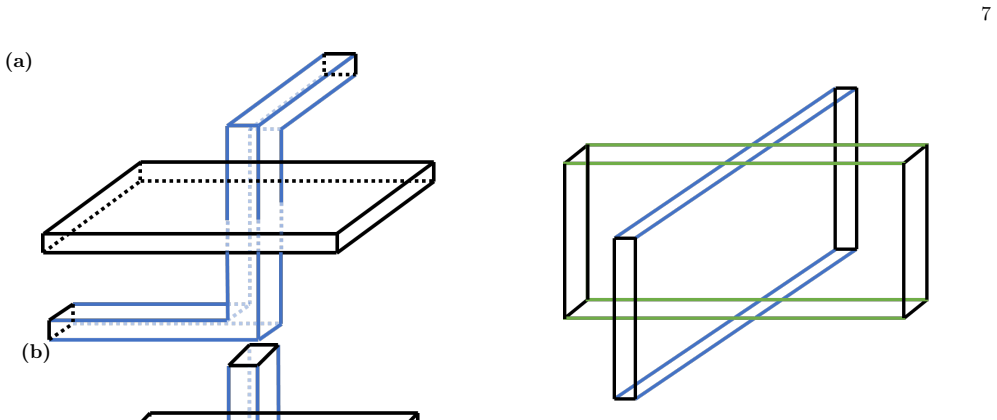
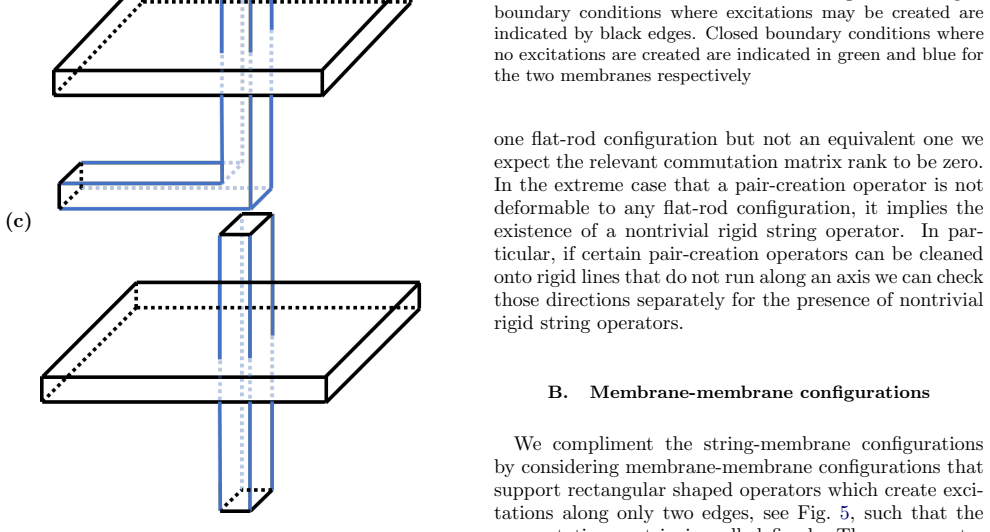
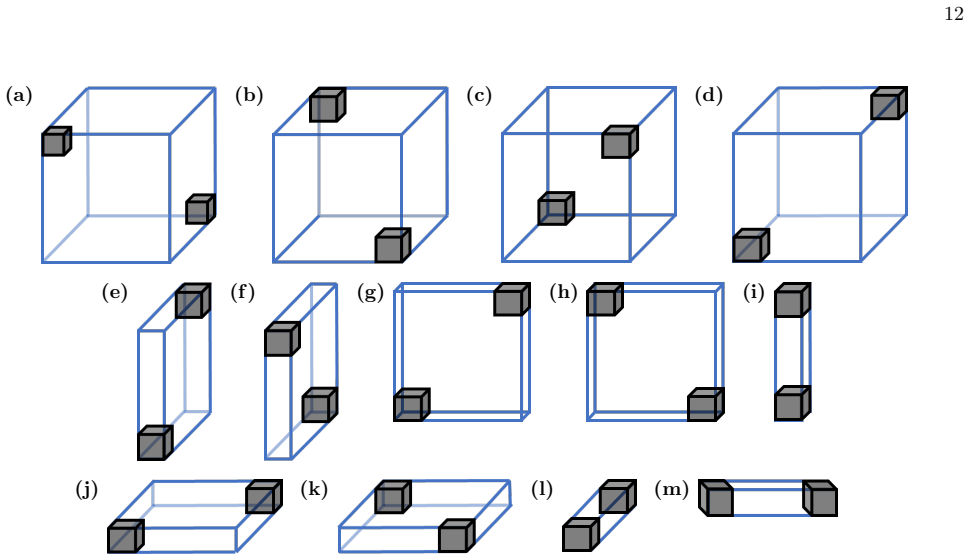
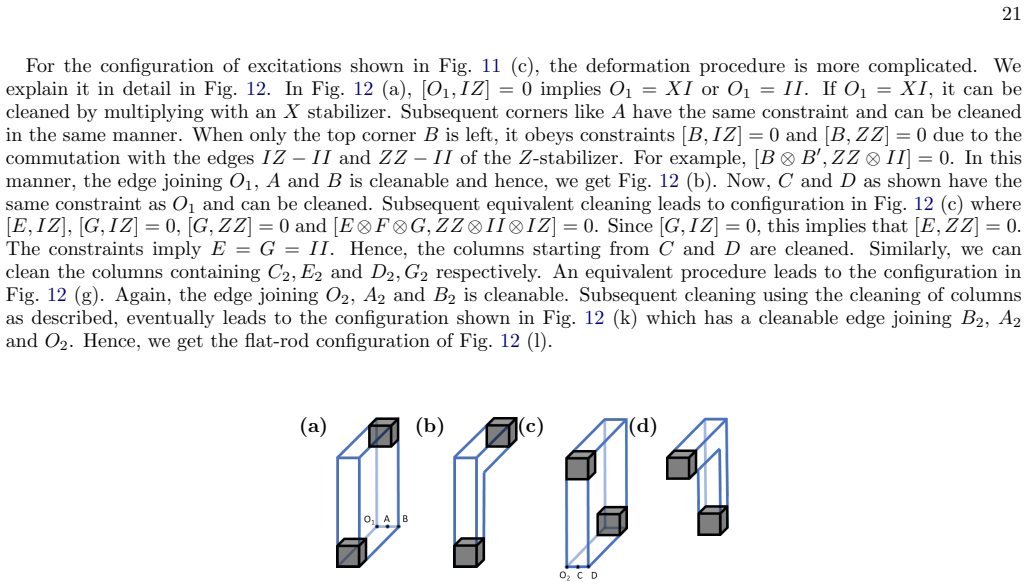
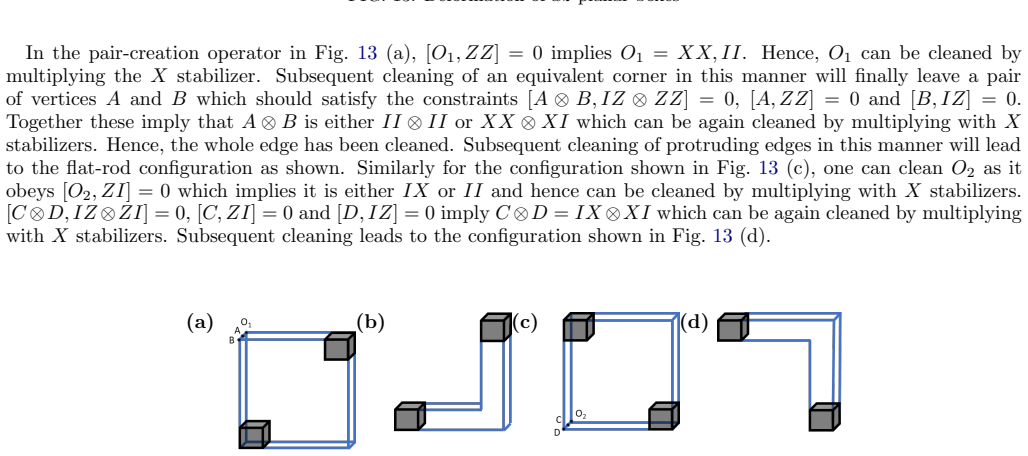
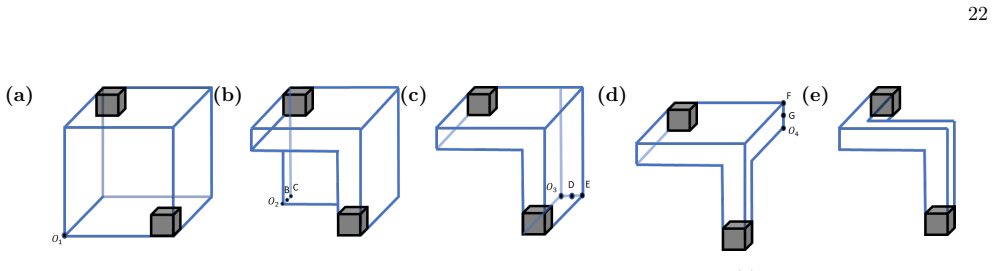
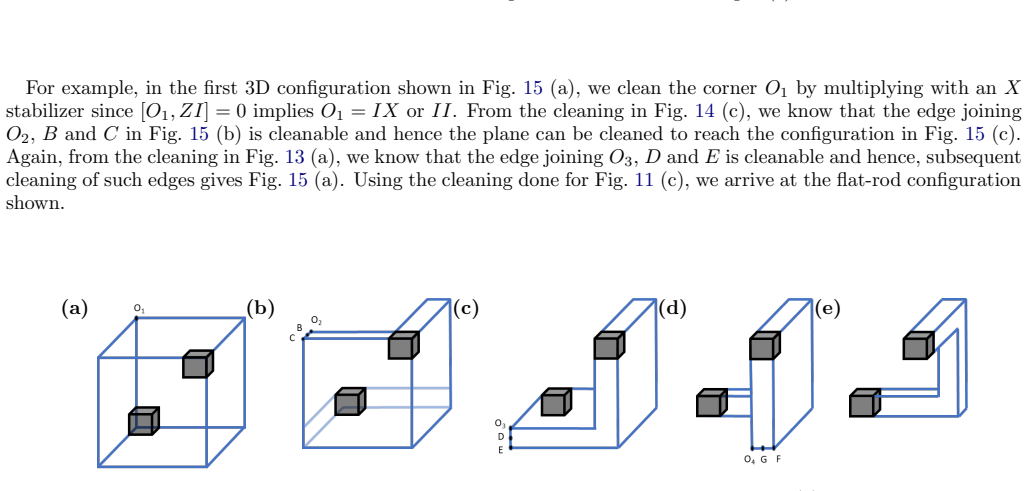
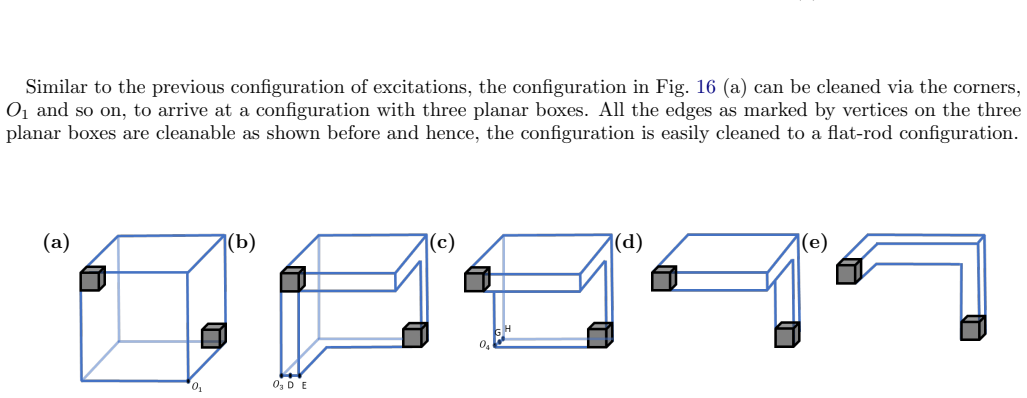
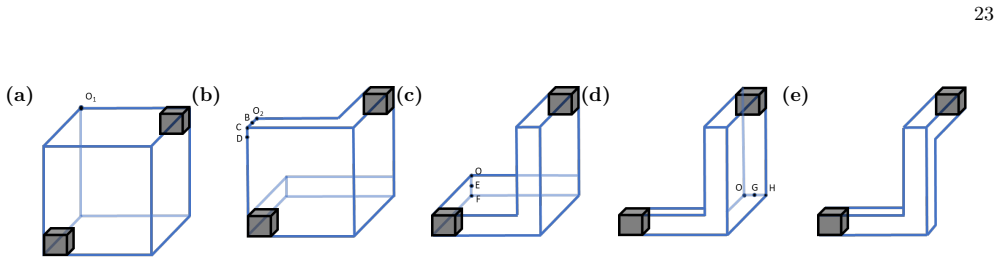
The central objects are the flat-rod commutation matrices $C_{i,j}$, defined over $\mathbb{Z}_2$ by whether a string operator $S^r_i$ on a flat-rod configuration anti-commutes with a membrane operator $S^m_j$; their rank counts independent anti-commuting string-membrane pairs. These are supplemented by the membrane-membrane commutation matrix, whose rank scaling with membrane size separates foliated from fractal type-I, and by the local-cleaning condition $\ker(C_{\mathrm{out}}(a,A)\Omega)=\operatorname{Im}(C_{\mathrm{in}}(a,A))$, which certifies when a pair-creation operator can be deformed to a flat-rod configuration. The intersection of generalized Gauss’s laws determines the minimal mobility dimension of excitations. Together these are the machinery claimed to be sufficient for the sorting.
What would settle it
Compute the deformability constraints beyond third order for the model labeled HH-II and search for string operators wider than three stabilizer generators: if a nontrivial string operator is found, the model is fractal type-I despite the paper’s inconclusive type-II-consistent data, and the finite-order flat-rod procedure is shown to be incomplete.
Extended reading notes
Core claim
The central claim is that the $\mathbb{Z}_2$-rank of the flat-rod commutation matrix, the scaling of the membrane-membrane commutation rank, and a local-cleaning test of deformability together give an if-and-only-if discrimination of the four classes. For a model whose pair-creation operators are all deformable to flat rods, equal non-zero flat-rod ranks across the 3D, 2D, and 1D configurations characterize TQFT or a stack of TQFT with type-II, while all ranks zero characterize type-II, and unequal ranks characterize type-I with rigid string operators. For non-deformable models, the membrane-membrane rank scales linearly for foliated type-I and stays constant or linear with fluctuating corrections for fractal type-I. The authors implement the sorting on a zoo of known stabilizer models, concluding that cubic codes 1–4, 7, 8, and 10 are type-II, that the remaining cubic codes are fractal type-I, and that the model labeled HH-II remains inconclusive.
Load-bearing premise
The sorting procedure assumes that any string operator deformable in three dimensions can be deformed onto one of the finite set of flat-rod shapes aligned with lattice directions, and that full deformability can be certified from finitely many local commutation constraints; the paper does not bound the required string width or the order of constraints, so a model with a rigid string only in an unconsidered shape or at a width beyond the numerics would be assigned to the wrong class.
Editorial extensions
If this is right
- If the sorting is correct, the known 3D stabilizer models split cleanly: the X-cube, checkerboard, and HH-I models are foliated type-I; the fractal spin liquid and most cubic codes are fractal type-I; cubic codes 1–4, 7, 8, and 10 are type-II; and the 3D toric code is TQFT.
- The value of the 3D flat-rod commutation rank conjecturally counts the number of copies of 3D toric code that can be disentangled from a stabilizer Hamiltonian, giving a quantitative invariant rather than just a class label.
- A model with fully deformable pair-creation operators and all flat-rod ranks zero has no string operators and is type-II, while full deformability together with equal non-zero ranks is an ‘if and only if’ condition for TQFT or a stack of TQFT plus type-II up to local unitary.
- The bulk-only nature of the diagnostics avoids dependence on boundary conditions and spurious topological entanglement entropy, so the same tools can be applied to large or coarse-grained systems without finite-size ambiguity.
- The conjectures imply that in an entanglement renormalization flow, stabilizer models with only 3D particles flow to fixed points, while each independent 2D particle yields a stack of 2D toric codes that can be extracted in the flow.
Reading between the lines
- The four-class partition is a coarse sort, not a full phase classification; the paper leaves open whether rigid strings confined to non-lattice directions or widths beyond the numerical limits would break the flat-rod completeness, so the type labels should be read as conditional on those finite checks.
- A natural test of the conjecture that $n^{3D}_{\mathrm{rods}}$ counts disentangled 3D toric code copies is to take an unknown model, stack it with a known 3D toric code, and check that the 3D flat-rod rank increases by one; the paper does not perform this additivity test.
- The membrane-membrane scaling distinction between ‘constant’ and ‘linear with fluctuations’ is qualitative; measuring the variance of the rank over system size would give a quantitative discriminator and could be applied beyond the square membranes with aspect ratio 1 considered here.
- If the sorting is phase-relevant, the diagnostics should be stable under local unitary circuits and under stacking with trivial systems; checking invariance under a known locality-preserving Clifford circuit, such as the one that maps cubic code 16 to cubic code 15, would test whether the invariants are truly invariant rather than model-dependent.
Editorial analysis
A structured set of objections, weighed in public.
Referee Report
Summary. The paper proposes a set of bulk diagnostics for translation-invariant topological stabilizer models in three dimensions: flat-rod string-membrane commutation matrices, membrane-membrane commutation matrices, a sufficient-condition cleaning lemma for deforming pair-creation operators onto flat rods, and generalized Gauss's-law mobility tests. These tools are applied to a zoo of models, including Haah's cubic codes, X-cube, checkerboard, Chamon, Sierpinski fractal spin liquid, and the Hsieh-Halasz models, leading to a proposed coarse sorting into TQFT, foliated type-I, fractal type-I, and type-II phases (Tables I-III). The authors also state conjectures relating independent 3D particles to 3D toric-code copies and 2D particles to 2D toric-code stacks.
Significance. If the universal sorting claim holds, this is an important step toward a practical classification of 3D stabilizer topological order, extending the 2D S-matrix program into the fracton regime. The paper contains real technical content: the local cleaning lemma in Appendix A is a general sufficient condition for deformability, and Appendix B gives a concrete, non-obvious deformation analysis for cubic code 8. The diagnostics are defined directly from stabilizer generators and are not fitted to the classification; they also avoid boundary-condition and entanglement-entropy artifacts. The main risk is that the central claim is stronger than what the finite checks establish, and the authors candidly acknowledge this. The paper is therefore valuable as a systematic toolbox and a conjecture-rich framework, but its headline sorting claim is conditional on unproven finite-size and finite-order sufficiency assumptions.
major comments (2)
- [§III B and Table III caption] The sorting procedure certifies type-II assignments from zero flat-rod commutation ranks together with full deformability, but in practice deformability is checked only up to third-order constraints and with flat rods three stabilizer generators wide and membranes two generators wide. The authors explicitly state that they have no upper bound on the required string-operator width. A rigid string operator wider than the checked rods, or one requiring higher-order cleaning constraints, would move a model marked type-II into fractal type-I. The HH-II '?' row is the visible manifestation of this gap, but the same gap is silent for rows marked '✓'; consequently the universal claim in §IV that the tools 'sort any translation invariant topological stabilizer model' is not yet established. This does not invalidate the diagnostics, but the scope of the claim should be qualified accordingly.
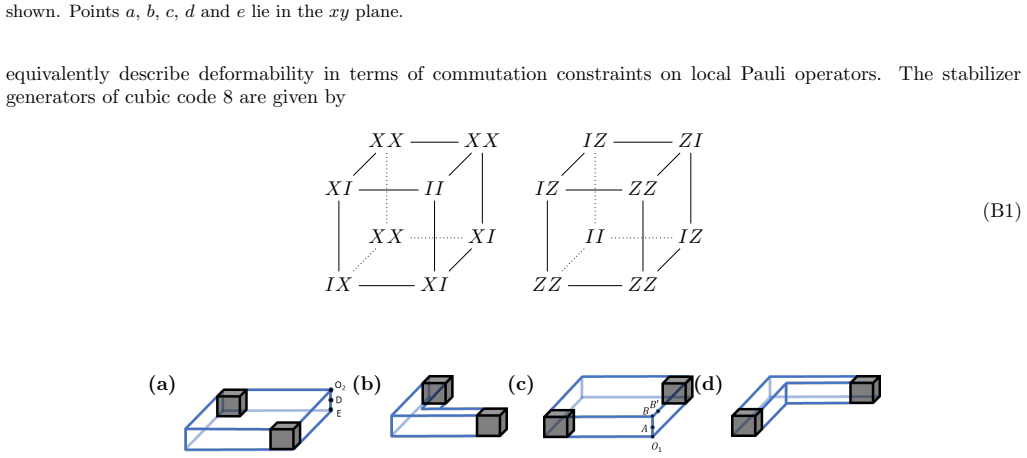
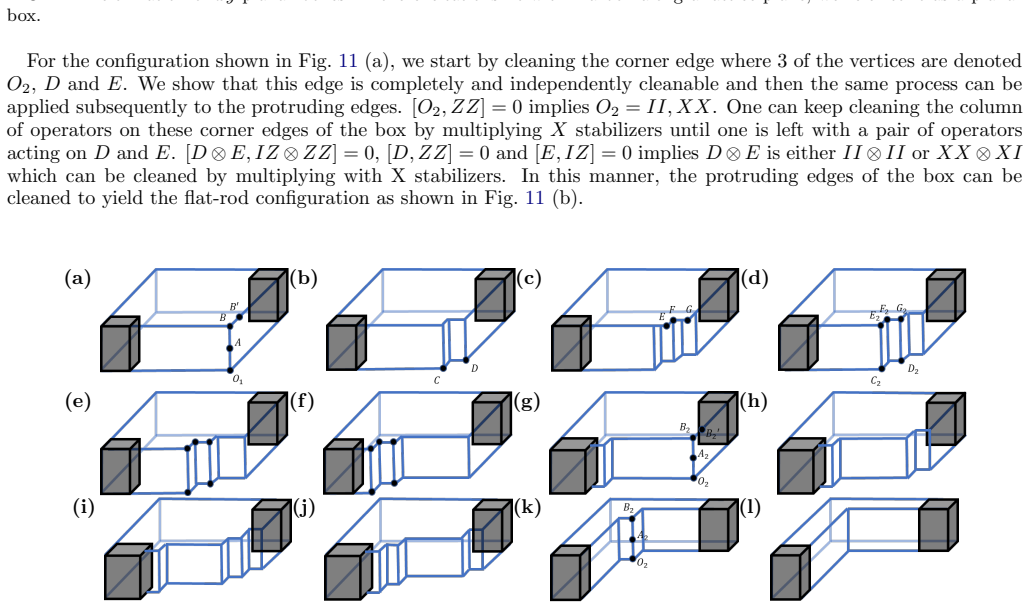
- [Table III vs Appendix D 2 a] There is a direct inconsistency in the deformability flag for cubic code 0. Table III lists CC0 as '×' (not fully deformable), consistent with the main-text statement that its only rigid string operators run along non-lattice directions, while the operator data table in Appendix D 2 a (Table XX) lists CC0 as '✓'. Since the deformability flag is one of the two inputs separating type-II from fractal type-I, this contradiction must be resolved; as printed, the two tables give opposite evidence for the same model.
minor comments (4)
- [§II B] The phrase 'We compliment the string-membrane configurations' should read 'complement'.
- [§IV] The sentence 'Over the coarse of this example centric study' contains typos: 'coarse' should be 'course', and 'example centric' is needlessly informal.
- [Appendix D 3 d] The heading 'This is a fracotn model' contains a typo ('fracton'), and the same subsection repeats 'This model has has'.
- [Table III caption] The placeholders n1 and n2 are only described as nonzero width-dependent numbers; readers would benefit from explicit values or formulas for at least one representative model, since the numerical ranks themselves are a key output of the paper.
Circularity Check
No significant circularity: diagnostics are computed from stabilizer data and benchmarked against external results; completeness gaps are acknowledged, not hidden.
full rationale
The paper's diagnostic quantities are derived directly from the stabilizer generators and commutation relations, not from the class labels they are used to assign. The flat-rod commutation matrix is defined in Eq. (9) as the Z2-rank of anti-commuting operators supported on specified flat-rod and membrane regions, and the deformability tests in Appendix A reduce to linear-algebra cleaning conditions (Eqs. A3 and A5) applied to the stabilizer data. The membrane-membrane commutation ranks are tabulated for each model from explicit numerical computation. None of these inputs are fit to the target classes, and no class assignment is fed back into the calculation. The classification results for known models agree with independent external results, such as Haah's no-strings proof for cubic codes 1-4, and the table rows are reported data rather than predictions. The conjectures, for example that n3D rods counts copies of 3D toric code or that non-deformability implies type-I, are explicitly labeled as conjectures and are not used to force the sorting. The inconclusive HH-II row, marked '?', shows that the authors do not coerce ambiguous results into a definite class. Self-citations such as Refs. [44], [59], and [69] are contextual or advertised as forthcoming and carry no load-bearing uniqueness theorem or fitted parameter. The stated limitation that there is no upper bound on the string-operator width needed to certify type-II or fractal type-I assignments is an admitted completeness gap, not circularity: it concerns whether the finite numerical checks are exhaustive, not whether the output is identical to the input by construction. Therefore the derivation chain is self-contained and no circular step is present.
Assumptions & free parameters
free parameters (3)
- Flat-rod width (w=3) and membrane width (w=2) =
3 and 2 stabilizer generators wide
- System size for commutation rank calculations =
Lx = Ly = Lz = L = 20 (or stabilizing L); aspect ratio alpha = 1
- Deformability constraint order =
up to third order
assumptions (5)
- domain assumption Models are translation invariant commuting Pauli stabilizer Hamiltonians with local generators on a cubic lattice (Eq. 1, Sec I).
- standard math 2D translation invariant topological stabilizer models are equivalent to stacks of 2D toric code under locality-preserving unitaries (Refs [4,5]).
- ad hoc to paper A finite set of flat-rod configurations (48 3D, 12 2D, 3 1D) suffices to detect all string operators; a string deformable in 3D can be supported on any 3D flat-rod configuration (Sec II A).
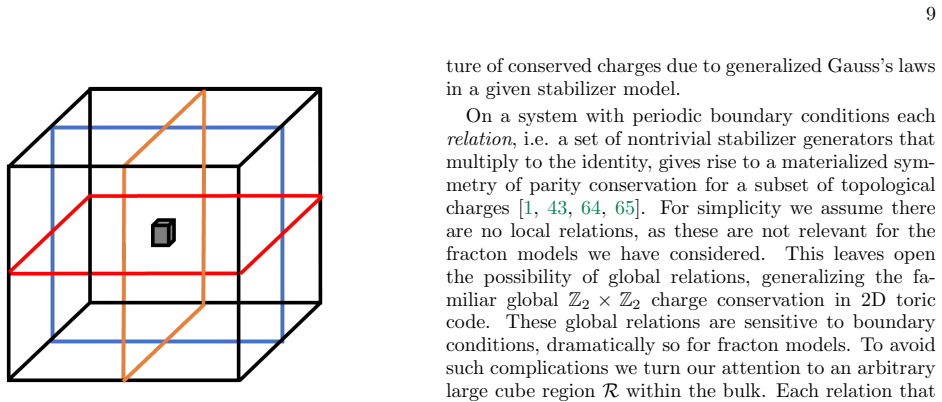
- domain assumption For generalized Gauss's laws, no local relations among stabilizer generators are relevant (Sec II C).
- ad hoc to paper Conjecture: a 3D particle implies a disentanglable 3D toric code copy, and 2D particles imply stacks of 2D toric code (Sec IV).
Cite this review
Pith. "Pith review of Sorting topological stabilizer models in three dimensions." pith.science (2026). https://pith.science/paper/6L2QTJJB
@misc{pith2026190808049,
  author       = {Pith},
  title        = {Pith review of: Sorting topological stabilizer models in three dimensions},
  year         = {2026},
  howpublished = {\url{https://pith.science/paper/6L2QTJJB}},
  note         = {Machine review of arXiv:1908.08049}
}
read the original abstract
The S-matrix invariant is known to be complete for translation invariant topological stabilizer models in two spatial dimensions, as such models are phase equivalent to some number of copies of toric code. In three dimensions, much less is understood about translation invariant topological stabilizer models due to the existence of fracton topological order. Here we introduce bulk commutation quantities inspired by the 2D S-matrix invariant that can be employed to coarsely sort 3D topological stabilizer models into qualitatively distinct types of phases: topological quantum field theories, foliated or fractal type-I models with rigid string operators, or type-II models with no string operators.
Figures
Figures from the paper (26 more)
Reference graph
Works this paper leans on
-
[1]
A. Y. Kitaev, Fault-tolerant quantum computation by anyons, Annals of Physics 303, 2, arXiv:quant- ph/9707021 (2003)
arXiv 2003
-
[2]
Moore and N
G. Moore and N. Seiberg, Polynomial equations for ra- tional conformal field theories, Phys. Lett. B 212, 451 (1988)
1988
-
[3]
Kitaev Alexei, Anyons in an exactly solved model and beyond, Annals of Physics 321, 2 (2006)
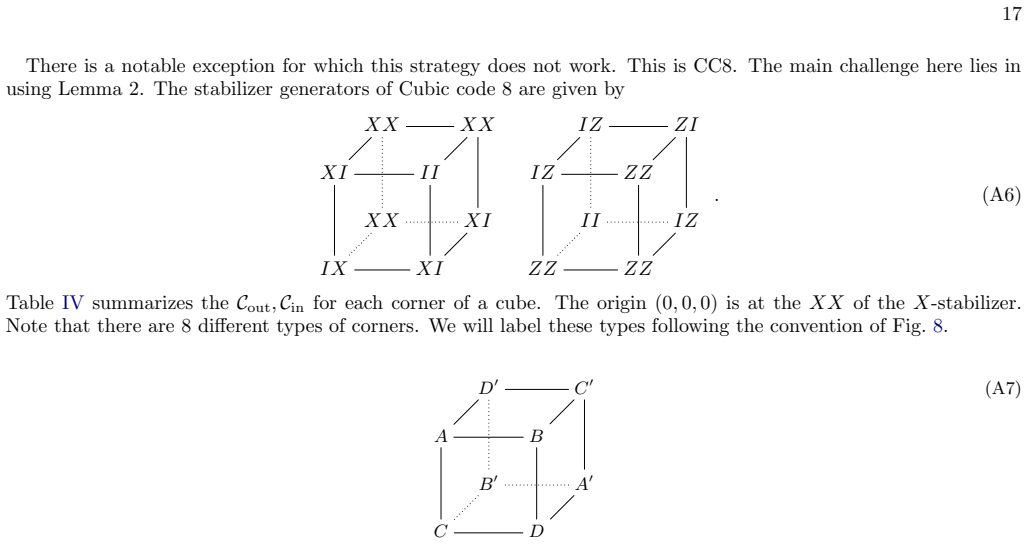
2006
-
[4]
J. Haah, Classification of translation invariant topologi- cal Pauli stabilizer codes for prime dimensional qudits on two-dimensional lattices, arXiv:1812.11193 (2018)
arXiv 2018
-
[5]
J. Haah, Algebraic Methods for Quantum Codes on Lattices, Revista Colombiana de Matem´ aticas 50, 299, arXiv:1607.01387 (2016)
arXiv 2016
-
[6]
T. Lan, L. Kong, and X. G. Wen, Classification of (3+1) D Bosonic Topological Orders: The Case When Point- like Excitations Are All Bosons, Physical Review X 8, 10.1103/PhysRevX.8.021074, arXiv:1704.04221 (2018)
arXiv 2018
-
[7]
T. Lan and X.-G. Wen, Classification of 3D Bosonic Topological Orders (II): The Case When Some Point- like Excitations Are Fermions, Phys. Rev. X 9, 021005, arXiv:1801.08530 (2019)
arXiv 2019
-
[8]
C. Zhu, T. Lan, and X.-G. Wen, Topological non- linear sigma-model, higher gauge theory, and a realiza- tion of all 3+1D topological orders for boson systems, arXiv:1808.09394 (2018). 13
work page Pith review arXiv 2018
Show all 92 references
-
[9]
Chamon, Quantum glassiness in strongly correlated clean systems: An example of topological overprotec- tion, Physical Review Letters 94, 40402, arXiv:cond- mat/0404182 (2005)
C. Chamon, Quantum glassiness in strongly correlated clean systems: An example of topological overprotec- tion, Physical Review Letters 94, 40402, arXiv:cond- mat/0404182 (2005)
2005
-
[10]
Castelnovo, C
C. Castelnovo, C. Chamon, and D. Sherrington, Quan- tum mechanical and information theoretic view on clas- sical glass transitions, Physical Review B 81, 184303, arXiv:1003.3832 (2010)
2010 arXiv
-
[11]
Bravyi, B
S. Bravyi, B. Leemhuis, and B. M. Terhal, Topological order in an exactly solvable 3D spin model, Ann. Phys. 326, 839, arXiv:1006.4871 (2010)
2010 arXiv
-
[12]
Castelnovo and C
C. Castelnovo and C. Chamon, Topological quan- tum glassiness, Philosophical Magazine 92, 304, arXiv:1108.2051 (2012)
2012 arXiv
-
[13]
Haah, Local stabilizer codes in three dimensions without string logical operators, Physical Review A - Atomic, Molecular, and Optical Physics 83, 42330, arXiv:1101.1962 (2011)
J. Haah, Local stabilizer codes in three dimensions without string logical operators, Physical Review A - Atomic, Molecular, and Optical Physics 83, 42330, arXiv:1101.1962 (2011)
2011 arXiv
-
[14]
Bravyi and J
S. Bravyi and J. Haah, Energy landscape of 3D spin hamiltonians with topological order, Physical Review Letters 107, 150504, arXiv:1105.4159 (2011)
2011 arXiv
-
[15]
I. H. Kim, 3D local qupit quantum code without string logical operator, arXiv:1202.0052 (2012)
2012 arXiv
-
[16]
Yoshida, Exotic topological order in fractal spin liq- uids, Physical Review B 88, 125122, arXiv:1302.6248 (2013)
B. Yoshida, Exotic topological order in fractal spin liq- uids, Physical Review B 88, 125122, arXiv:1302.6248 (2013)
2013 arXiv
-
[17]
Bravyi and J
S. Bravyi and J. Haah, Quantum self-correction in the 3D cubic code model, Physical Review Letters 111, 200501, arXiv:1112.3252 (2013)
2013 arXiv
-
[18]
Haah, Lattice quantum codes and exotic topologi- cal phases of matter, 10.1097/MAJ.0b013e3181d65685, arXiv:1305.6973 (2013)
J. Haah, Lattice quantum codes and exotic topologi- cal phases of matter, 10.1097/MAJ.0b013e3181d65685, arXiv:1305.6973 (2013)
2013 arXiv
-
[19]
Haah, Commuting Pauli Hamiltonians as Maps be- tween Free Modules, Communications in Mathematical Physics 324, 351, arXiv:1204.1063 (2013)
J. Haah, Commuting Pauli Hamiltonians as Maps be- tween Free Modules, Communications in Mathematical Physics 324, 351, arXiv:1204.1063 (2013)
2013 arXiv
-
[20]
Haah, Bifurcation in entanglement renormalization group flow of a gapped spin model, Physical Review B 89, 75119, arXiv:1310.4507 (2014)
J. Haah, Bifurcation in entanglement renormalization group flow of a gapped spin model, Physical Review B 89, 75119, arXiv:1310.4507 (2014)
2014 arXiv
-
[21]
I. H. Kim and J. Haah, Localization from superselection rules in translation invariant systems, Physical Review Letters 116, 027202, arXiv:1505.01480 (2016)
2016 arXiv
-
[22]
Vijay, J
S. Vijay, J. Haah, and L. Fu, A new kind of topological quantum order: A dimensional hierarchy of quasiparti- cles built from stationary excitations, Physical Review B 92, 235136, arXiv:1505.02576 (2015)
2015 arXiv
-
[23]
Vijay, J
S. Vijay, J. Haah, and L. Fu, Fracton Topological Order, Generalized Lattice Gauge Theory and Duality, Physical Review B 94, 235157, arXiv:1603.04442 (2016)
2016 arXiv
-
[24]
D. J. Williamson, Fractal symmetries: Ungauging the cubic code, Physical Review B 94, 155128, arXiv:1603.05182 (2016)
2016 arXiv
-
[25]
H. Ma, E. Lake, X. Chen, and M. Hermele, Fracton topological order via coupled layers, Physical Review B 95, 245126, arXiv:1701.00747 (2017)
2017 arXiv
-
[26]
Vijay, Isotropic Layer Construction and Phase Dia- gram for Fracton Topological Phases, arXiv:1701.00762 (2017)
S. Vijay, Isotropic Layer Construction and Phase Dia- gram for Fracton Topological Phases, arXiv:1701.00762 (2017)
2017 arXiv
-
[27]
Vijay and L
S. Vijay and L. Fu, A Generalization of Non-Abelian Anyons in Three Dimensions, arXiv:1706.07070 (2017)
2017 arXiv
-
[28]
Slagle and Y
K. Slagle and Y. B. Kim, Fracton topological order from nearest-neighbor two-spin interactions and duali- ties, Physical Review B 96, 165106, arXiv:1704.03870 (2017)
2017 arXiv
-
[29]
Slagle and Y
K. Slagle and Y. B. Kim, Quantum field theory of X-cube fracton topological order and robust degeneracy from ge- ometry, Physical Review B96, 195139, arXiv:1708.04619 (2017)
2017 arXiv
-
[30]
G. B. Hal´ asz, T. H. Hsieh, and L. Balents, Fracton Topological Phases from Strongly Coupled Spin Chains, Physical Review Letters 119, 257202, arXiv:1707.02308 (2017)
2017 arXiv
-
[31]
T. H. Hsieh and G. B. Hal´ asz, Fractons from partons, Phys. Rev. B 96, 165105, arXiv:1703.02973 (2017)
2017 arXiv
-
[32]
Devakul, Z3 topological order in the face-centered- cubic quantum plaquette model, Physical Review B 97, 155111, arXiv:1712.05377 (2018)
T. Devakul, Z3 topological order in the face-centered- cubic quantum plaquette model, Physical Review B 97, 155111, arXiv:1712.05377 (2018)
2018 arXiv
-
[33]
Devakul, S
T. Devakul, S. A. Parameswaran, and S. L. Sondhi, Cor- relation function diagnostics for type-I fracton phases, Physical Review B 97, 41110, arXiv:1709.10071 (2018)
2018 arXiv
-
[34]
Slagle and Y
K. Slagle and Y. B. Kim, X-cube model on generic lat- tices: Fracton phases and geometric order, Physical Re- view B 97, 165106, arXiv:1712.04511 (2018)
2018 arXiv
-
[35]
Bulmash and T
D. Bulmash and T. Iadecola, Braiding and gapped boundaries in fracton topological phases, Phys. Rev. B 99, 125132, arXiv:1810.00012 (2019)
2019 arXiv
-
[36]
H. He, Y. Zheng, B. A. Bernevig, and N. Reg- nault, Entanglement entropy from tensor network states for stabilizer codes, Physical Review B 97, 125102, arXiv:1710.04220 (2018)
2018 arXiv
-
[37]
H. Ma, A. T. Schmitz, S. A. Parameswaran, M. Hermele, and R. M. Nandkishore, Topological entanglement en- tropy of fracton stabilizer codes, Physical Review B 97, 125101, arXiv:1710.01744 (2018)
2018 arXiv
-
[38]
Shi and Y
B. Shi and Y. M. Lu, Deciphering the nonlocal entan- glement entropy of fracton topological orders, Physical Review B 97, 144106, arXiv:1705.09300 (2018)
2018 arXiv
-
[39]
Weinstein, E
Z. Weinstein, E. Cobanera, G. Ortiz, and Z. Nussinov, Absence of finite temperature phase transitions in the x- cube model and its zp generalization, arXiv:1812.04561 (2018)
2018 arXiv
-
[40]
Y. You, T. Devakul, F. J. Burnell, and S. L. Sondhi, Symmetric Fracton Matter: Twisted and Enriched, arXiv:1805.09800 (2018)
2018 arXiv
-
[41]
Prem, S.-J
A. Prem, S.-J. Huang, H. Song, and M. Hermele, Cage-net fracton models, Phys. Rev. X 9, 021010, arXiv:1806.04687 (2019)
2019 arXiv
-
[42]
H. Song, A. Prem, S.-J. Huang, and M. A. Martin- Delgado, Twisted fracton models in three dimensions, Phys. Rev. B 99, 155118, arXiv:1805.06899 (2019)
2019 arXiv
-
[43]
B. J. Brown and D. J. Williamson, Parallelized quan- tum error correction with fracton topological codes, , 1arXiv:1901.08061 (2019)
2019 arXiv
-
[44]
A. Dua, D. J. Williamson, J. Haah, and M. Cheng, Com- pactifying fracton stabilizer models, Phys. Rev. B 99, 10.1103/physrevb.99.245135, arXiv:1903.12246 (2019)
2019 arXiv
-
[45]
A. T. Schmitz, S.-J. Huang, and A. Prem, Entangle- ment spectra of stabilizer codes: A window into gapped quantum phases of matter, Phys. Rev. B 99, 205109, arXiv:1901.10486 (2019)
2019 arXiv
-
[46]
You, Non-Abelian defects in Fracton phase of matter, arXiv:1901.07163v1 (2019)
Y. You, Non-Abelian defects in Fracton phase of matter, arXiv:1901.07163v1 (2019)
2019 arXiv
-
[47]
Y. You, T. Devakul, S. L. Sondhi, and F. J. Burnell, Fractonic Chern-Simons and BF theories, arXiv:1904.11530 (2019)
2019 arXiv
-
[48]
Weinstein, G
Z. Weinstein, G. Ortiz, and Z. Nussinov, Uni- versality Classes of Stabilizer Code Hamiltonians, arXiv:1907.04180 (2019). 14
2019 arXiv
-
[49]
Prem and D
A. Prem and D. J. Williamson, Gauging permuta- tion symmetries as a route to non-Abelian fractons, arXiv:1905.06309 (2019)
2019 arXiv
-
[50]
Bulmash and M
D. Bulmash and M. Barkeshli, Gauging fractons: im- mobile non-Abelian quasiparticles, fractals, and position- dependent degeneracies, arXiv:1905.05771 (2019)
2019 arXiv
-
[51]
Shirley, K
W. Shirley, K. Slagle, Z. Wang, and X. Chen, Fracton Models on General Three-Dimensional Mani- folds, Physical Review X8, 10.1103/PhysRevX.8.031051, arXiv:1712.05892 (2018)
2018 arXiv
-
[52]
Shirley, K
W. Shirley, K. Slagle, and X. Chen, Foliated fracton order from gauging subsystem symmetries, SciPost Phys. 6, 41, arXiv:1806.08679 (2019)
2019 arXiv
-
[53]
Shirley, K
W. Shirley, K. Slagle, and X. Chen, Fractional excita- tions in foliated fracton phases, arXiv:1806.08625 (2018)
2018 arXiv
-
[54]
Shirley, K
W. Shirley, K. Slagle, and X. Chen, Foliated fracton or- der in the checkerboard model, arXiv:1806.08633 (2018)
2018 arXiv
-
[55]
Shirley, K
W. Shirley, K. Slagle, and X. Chen, Universal entangle- ment signatures of foliated fracton phases, SciPost Phys. 6, 1, arXiv:1803.10426 (2019)
2019 arXiv
-
[56]
Slagle, D
K. Slagle, D. Aasen, and D. Williamson, Foliated field theory and string-membrane-net condensation pic- ture of fracton order, SciPost Phys. 6, 10.21468/scipost- phys.6.4.043, arXiv:1812.01613 (2019)
2019 arXiv
-
[57]
Shirley, K
W. Shirley, K. Slagle, and X. Chen, Twisted foliated fracton phases, arXiv:1907.09048 (2019)
2019 arXiv
-
[58]
T. Wang, W. Shirley, and X. Chen, Foliated frac- ton order in the Majorana checkerboard model, arXiv:1904.01111 (2019)
2019 arXiv
-
[59]
D. J. Williamson, A. Dua, and M. Cheng, Spu- rious topological entanglement entropy from subsys- tem symmetries, Phys. Rev. Lett. 122, 10.1103/Phys- RevLett.122.140506, arXiv:1808.05221 (2019)
2019 arXiv
-
[60]
A. R. Calderbank and P. W. Shor, Good quantum error- correcting codes exist, Physical Review A - Atomic, Molecular, and Optical Physics 54, 1098, arXiv:quant- ph/9512032 (1996)
1996
-
[61]
A. Steane, Multiple-particle interference and quantum er- ror correction, Proceedings of the Royal Society A: Math- ematical, Physical and Engineering Sciences 452, 2551, arXiv:quant-ph/9601029 (1996)
1996 arXiv
-
[62]
Levin and X.-G
M. Levin and X.-G. Wen, Fermions, strings, and gauge fields in lattice spin models, Phys. Rev. B 67, 245316 (2003)
2003
- [63]
-
[64]
A. T. Schmitz, H. Ma, R. M. Nandkishore, and S. A. Parameswaran, Recoverable information and emergent conservation laws in fracton stabilizer codes, Physical Re- view B 97, 134426, arXiv:arXiv:1712.02375v1 (2018)
2018 arXiv
-
[65]
A. T. Schmitz, Gauge Structures: From Stabilizer Codes to Continuum Models, arXiv:1809.10151 (2018)
2018 arXiv
-
[66]
Haah, An Invariant of Topologically Ordered States Under Local Unitary Transformations, Communications in Mathematical Physics 342, 771, arXiv:1407.2926 (2016)
J. Haah, An Invariant of Topologically Ordered States Under Local Unitary Transformations, Communications in Mathematical Physics 342, 771, arXiv:1407.2926 (2016)
2016 arXiv
-
[67]
J. C. Bridgeman, S. T. Flammia, and D. Poulin, De- tecting topological order with ribbon operators, Physical Review B 94, 205123, arXiv:1603.02275 (2016)
2016 arXiv
-
[68]
Haah, Private communication
J. Haah, Private communication
-
[69]
A. Dua, P. Sarkar, D. J. Williamson, and M. Cheng, Bi- furcating entanglement renormalization flow of stabilizer models in three dimensions, To appear (2019)
2019
-
[70]
Fuji, Anisotropic layer construction of anisotropic fracton models, arXiv:1908.02257 (2019)
Y. Fuji, Anisotropic layer construction of anisotropic fracton models, arXiv:1908.02257 (2019)
2019 arXiv
-
[71]
Hamma, P
A. Hamma, P. Zanardi, and X.-G. Wen, String and mem- brane condensation on three-dimensional lattices, Phys. Rev. B 72, 035307 (2005)
2005
-
[72]
Walker and Z
K. Walker and Z. Wang, (3+1)-TQFTs and topological insulators, Frontiers of Physics 7, 150, arXiv:1104.2632 (2012)
2012 arXiv
-
[73]
Bombin and M
H. Bombin and M. A. Martin-Delgado, Exact topologi- cal quantum order in D = 3 and beyond: Branyons and brane-net condensates, Phys. Rev. B 75, 075103 (2007)
2007
-
[74]
I. H. Kim, Local non-CSS quantum error correcting code on a three-dimensional lattice, arXiv:1012.0859 (2010)
2010 arXiv
-
[75]
Dijkgraaf and E
R. Dijkgraaf and E. Witten, Topological gauge theories and group cohomology, Communications in Mathemati- cal Physics 129, 393 (1990)
1990
-
[76]
normal form
J. Haah, L. Fidkowski, and M. B. Hastings, Nontriv- ial Quantum Cellular Automata in Higher Dimensions, arXiv:1812.01625 (2018). Appendix A: Sufficient condition for Deformability In this appendix, we formulate a sufficient condition and a general recipe which can be employed to d...
2018 arXiv
-
[77]
Definition 1
Local cleaning We begin by formulating some intuitive notions precisely. Definition 1. Fora∈A,
-
[78]
In (a,A ) is the set of stabilizers with nontrivial support on a which are supported on A
-
[79]
inside of
Out (a,A ) is the set of stabilizers with nontrivial support on a which are supported on {a}∪ Ac. In other words, In(a,A ) is a set of stabilizers that are “inside of” A that acts nontrivially ona. Similarly, Out(a,A ) is a set of stabilizers that are “outside of” A that acts ...
-
[80]
For any model, we can apply the following greedy strategy to reduce the support of the pair-creation operator
Cleaning strategy The local cleaning lemma is extremely general. For any model, we can apply the following greedy strategy to reduce the support of the pair-creation operator. Namely,
-
[81]
For each a in the support of the pair-creation operator, check eq. A3
-
[82]
If the condition is satisfied, clean a
-
[83]
There is a freedom in choosing the order of the cleaning
Repeat. There is a freedom in choosing the order of the cleaning. However, often it is convenient to follow these steps. Without loss of generality, suppose we have a pair-creation operator contained in some box. We first clean this box so that the operator is supported on a bo...
-
[84]
A3 is satisfied
Pick a corner of the box for which eq. A3 is satisfied. Repeatedly apply the same cleaning move for every corner in the same direction
-
[85]
This results in a box with a 2D structure
-
[86]
Clean the 2D structure in a similar manner
-
[87]
stairwell
Go to the other corners and repeat the same procedure. 17 There is a notable exception for which this strategy does not work. This is CC8. The main challenge here lies in using Lemma 2. The stabilizer generators of Cubic code 8 are given by XX XX XI II XX XI IX XI IZ ZI IZ ZZ ...
-
[88]
symmetric
Type-II models In this section we collect known examples of type-II models: cubic codes 1, 2, 3, 4, 7, 8, 10, from Ref. 13, Yoshida’s type-II qubit and qutrit fractal spin liquids [16], Kim’s type-II qutrit and qudit models [15]. Cubic codes 1 to 4 were shown to be type-II cod...
-
[89]
This includes cubic codes 0, 5, 6, 9, from Ref
Fractal type-I models with lineons In this section we collect the fractal type-I models that support lineons, but do not appear to support planeons (although this is not rigorously shown). This includes cubic codes 0, 5, 6, 9, from Ref. 13, the Sierpinski [12] and the Fibonacc...
-
[90]
Fractal type-I models with planons In this section we collect fractal type-I models that support composite planons: cubic codes 11-17 from Ref. 13. All of these models include planons in a single stack of parallel planes, we indicate the orientation and braiding statistics of ...
-
[91]
Foliated type-I models In this section we collect foliated type-I models: stacks of 2D toric code in 3D, the twice foliated X-cube model [53], the standard X-cube model [23], the Checkerboard model [22], Halasz and Hsieh’s type-I model [31], Chamon’s model [9], the membrane co...
-
[92]
TQFT models In this section we summarize the TQFT stabilizer models in 3D: toric code with bosonic [71] or fermionic point particle [62] and the 3-fermion Walker-Wang model [72] which is subtly nontrivial. 42 a. 3D toric code with bosonic charge The stabilizer generators of th...
Reviewed August 14, 2026 · model on record in the stance chip above.
Discussion (0). Continue with ORCID to comment.